






Abstract
In argument mining research, educational texts such as student essays have been a popular target genre from the beginning. The annotated corpora available so far, however, focus on essays written by older (or adult) students with relatively high proficiency levels. In our work, we expand the range of texts to German essays by school students in grade 9, which display very different qualities on all levels of analysis. We show that a common approach to representing argument structure as trees is not sufficient to capture the constellations of argument components in those essays, and we propose a suitable extension of that scheme, which we applied to an initial corpus of 50 essays. Furthermore, we conducted experiments with large language models on a fine-grained version of the argument component type classification task and show that medium-sized open-source models can achieve promising classification results using only two labeled essays in a few-shot prompting approach.
Keywords
Introduction
Automatic argument mining (AM)1,2 has become a heterogeneous discipline with multiple goals and interests, which include the detection of argument components (ACs) in text or dialogue, inference of underlying argument schemes (e.g., in the sense of Walton et al. 3 ) and of enthymemes, or the assessment of the strength and quality of arguments. One central field of interest, however, has been stable over the years: the identification of argumentative sentences (or parts thereof), of their types, and of the support/attack relations holding among them. The first part is commonly referred to as AC-type classification (ACTC) and the second as argument relation identification.
In this paper, we address an educational application of AM, viz. the identification of argument structure in school essays (in our case, in the German language), as a prerequisite for the automatic or semi-automatic production of constructive feedback to students. Previous work on essays written by adult language learners has modeled this structure as a tree, 4 which is in line with our own previous work on a multilingual corpus of “microtexts,”5,6 where we used a scheme that was inspired by the ideas of Freeman. 7 Working with a new corpus of 1,061 school essays8,9; however, we found the computationally advantageous assumption of a single tree structure as not tenable, which is in part due to the huge differences in text quality as produced by the students. To illustrate the kind of text we are dealing with, Figure 1 shows a slightly shortened essay from our corpus on the topic of whether or not ebooks should replace printed books, translated to English. The component type labels will be explained in detail in the sections to come.
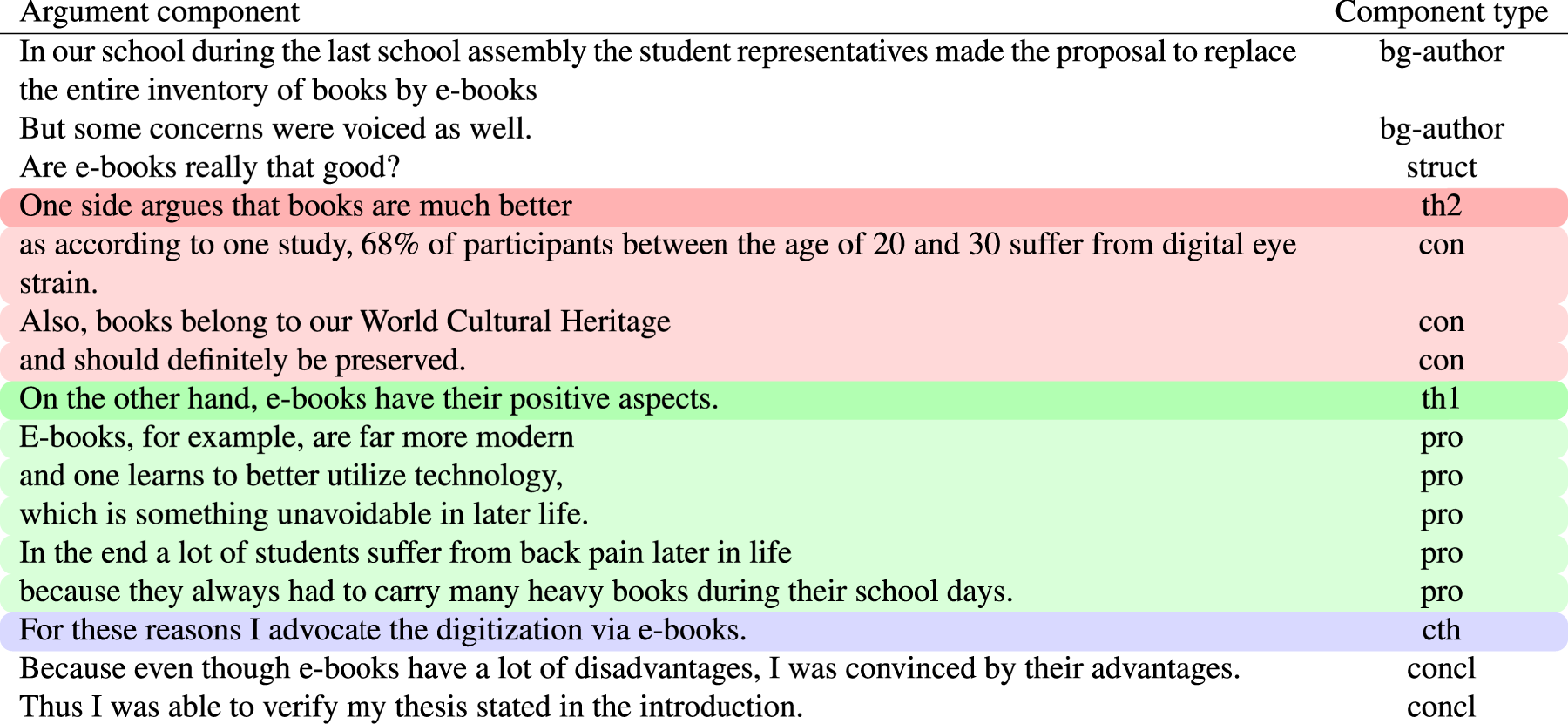
Abridged version of a sample text from our essay corpus. Translated from German. The component type labels used are introduced and discussed in the main text below.
The first contribution of this paper is therefore an analysis of “problematic” argument-related phenomena in our corpus, followed by proposing an extension of the microtext annotation scheme (and very similar schemes such as that used by Stab and Gurevych 4 ) that is able to adequately represent the argumentative moves made by the students. We use a fine-grained inventory of 10 different AC types that are specific to the genre of student essays, which, at this level of detail, has not been employed in previous work. On top of these type assignments, our scheme builds relational structures, for which we have empirically identified four different overall constellations, one of which is the classical single tree structure.
In the past 1 to 2 years, large language models (LLMs) have been applied, with different degrees of success, to several AM tasks (see our literature review below). These models currently evoke high hopes for many applications, including in the educational domain. The second contribution of our paper is therefore in presenting experiments on performing the ACTC task, with our fine-grained type set, with three different open-source LLMs. We show that while the task poses significant challenges to smaller LLMs, promising results can be achieved by medium-sized models using a few labeled essays as examples in a few-shot prompting scenario.
In summary, the paper enriches the research on educational argumentation by
introducing a gradually growing annotated corpus of German argumentative school essays; proposing an extension of a well-established, formerly tree-based annotation scheme that can represent the argumentative structure in the essays, in terms of fine-grained type labels and relations; presenting results of an inter-annotator agreement (IAA) study for the type assignment; and providing baseline results for the ACTC task using three contemporary open-source LLMs.
The paper is structured as follows: after a discussion of related work, we provide a brief outline of the role of argumentative essays in the context of school education in Germany, and describe our corpus of 1,061 texts that we obtained from students. Then, we explain the annotation scheme that we had developed in the 2010s for newspaper commentary and similar “quality” texts, which is followed by a discussion of the mismatches we found between the scheme and the argumentative writing in the essay corpus. We describe the ensuing adaptation of the annotation scheme and give results of an IAA study. Next, we present our approach to LLM-based automatic analysis of the essays and discuss the results. Finally, we draw some conclusions on the role of AM in the context of school education.
One of the most popular corpora in AM is the “Annotated Argumentative Essay” (AAE) corpus by Stab and Gurevych. 4 It consists of 402 essays, with some 7,000 sentences in total, written by adult learners of English in response to a writing prompt that specifies a debatable issue. Figure 2 illustrates the annotation scheme: there is a major claim, essentially the response to the essay prompt, which the writers place in the first paragraph and optionally repeat in the last paragraph of the essay. Paragraphs contain a small number of claims, which are supported (denoted by an arrowhead) or attacked (denoted by a line with circle head) by premises; premises can in turn support/attack other premises. All claims in the paragraph are by default connected to the major claim by a support or attack relation. In total, the corpus has around 1,500 claims and 750 major claims.
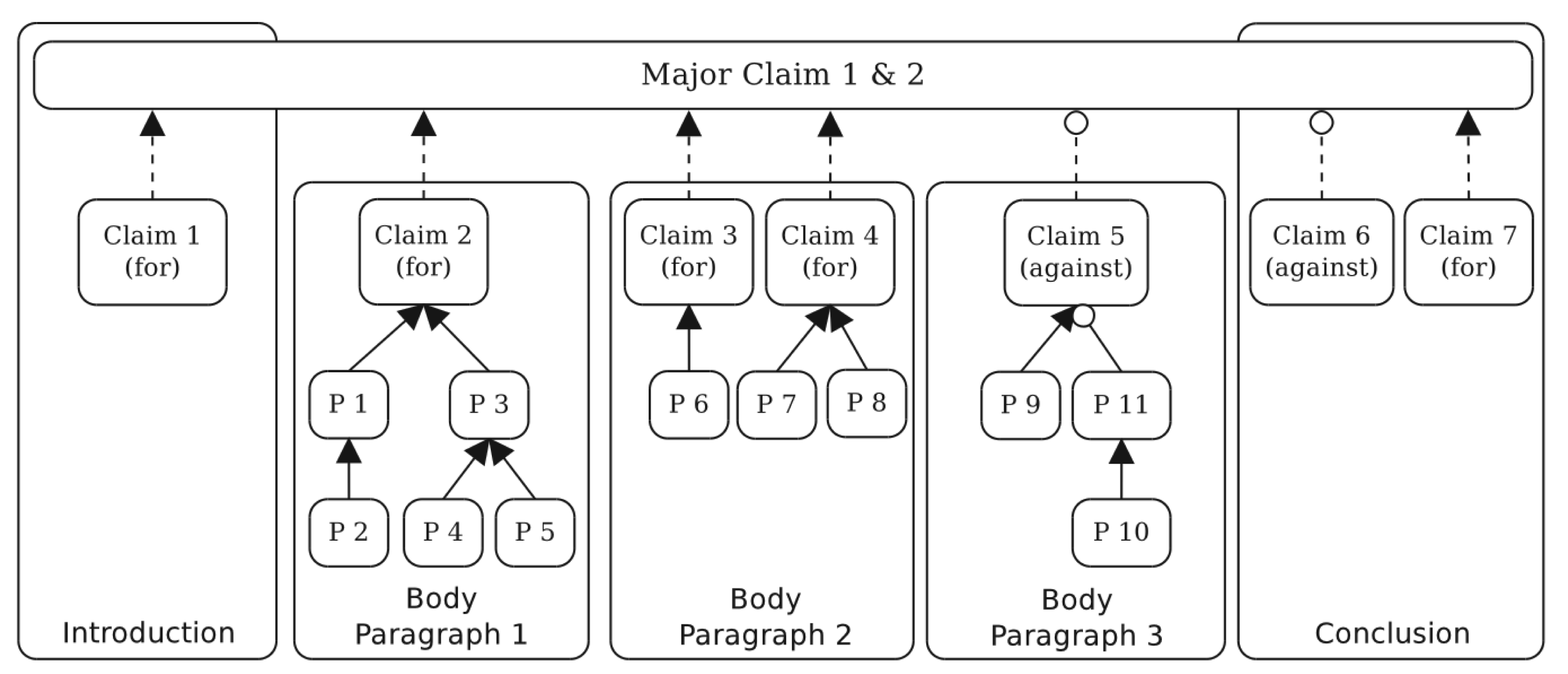
Sketch of sample essay annotation from Annotated Argumentative Essay 2 (AAE2; Stab and Gurevych
4
Over the years, some additional annotations have been done on AAE, including argument quality labels by Marro et al. 10 and fine-grained claim (policy and value fact) and evidence (testimony, statistics, etc.) types by Schaefer et al. 11 AM work has regularly used the corpus, with new state-of-the-art results being published more or less every year since 2017. (We will provide recent figures below when we report our results on our new corpus.)
Aside from the AAE, English-language essays with argument structure annotation are rare. “Feedback” is a 3,000-text subset of the PERSUADE corpus, 12 which consists of 26,000 essays written by students from grades 6 through 12. In total, 15 prompts were used to elicit the texts. The Feedback subset has been annotated for a variety of argumentative discourse unit (ADU) types, including “claim.” An example of a non-essay corpus from the educational domain is a set of 73 classroom discussion transcripts, which Lugin and Litman 13 used for experiments with claim/evidence detection.
For the German language, two corpora have recently been made available: DARIUS 14 comprises 4,500 argumentative essays written by over 1,800 German school students aged between 14 and 21. They address two essay prompts that discuss two socio-scientific topics. The corpus is annotated on four argumentation-related levels: on the level of functional content zones, each sentence is assigned to one out of the three possible zones “introduction,” “main part,” and “conclusion.” This goes back to the notion of “argumentative zoning” as established by Teufel and Moens 15 and is comparable to but far more coarse-grained than what we adopt in our designated scheme. Furthermore, comprehensive sentence-level annotations are provided for major claims and for arguments. Major claims annotations include additional information on the strategy used to justify it, while argument annotations come with a range of detailed labeling that categorizes arguments according to features such as their position (in the debate), their clarity, etc. Finally, on the token level, DARIUS is also annotated for a selected set of elements from Toulmin’s Argumentation Patterns, including “claim”, “data”, “rebuttal”, and “warrant”.
A comparable dataset is that by Stahl et al. 16 They draw on an existing corpus of essays by German secondary school students 17 and select a subsample of 1,320 essays. Aside from essay quality scores, they annotate the selected essays with argumentation mining information on different levels of granularity. At the macro level, essays are labeled with coarse-grained discourse functions, which resemble content zone annotations in DARIUS, 14 and arguments; at the micro level, they are annotated with non-/argumentative components along with support and attack relations between them, as well as with fine-grained, genre-specific discourse modes, which roughly reflect different debating strategies derived from education literature, such as “referencing statements by authorities” or “providing examples.” In comparison to our corpus, essays in the dataset by Stahl et al. 16 are significantly shorter, with an average essay length of only 66 words (This is according to our own analysis of their dataset since their paper does not specify this information.), compared to 233 words in our corpus. Moreover, a crucial difference with regard to argumentation core features is that their corpus has only a very small proportion of counter-arguments (34 spans, compared to 2.692 pro arguments), while the vast majority of our essays always consider “both sides” (see Tables 1 to 3). For these reasons, we consider our dataset to be more challenging for automatic AM purposes.
Summary of writing quality and word count at the various time points of our FDE study. 23
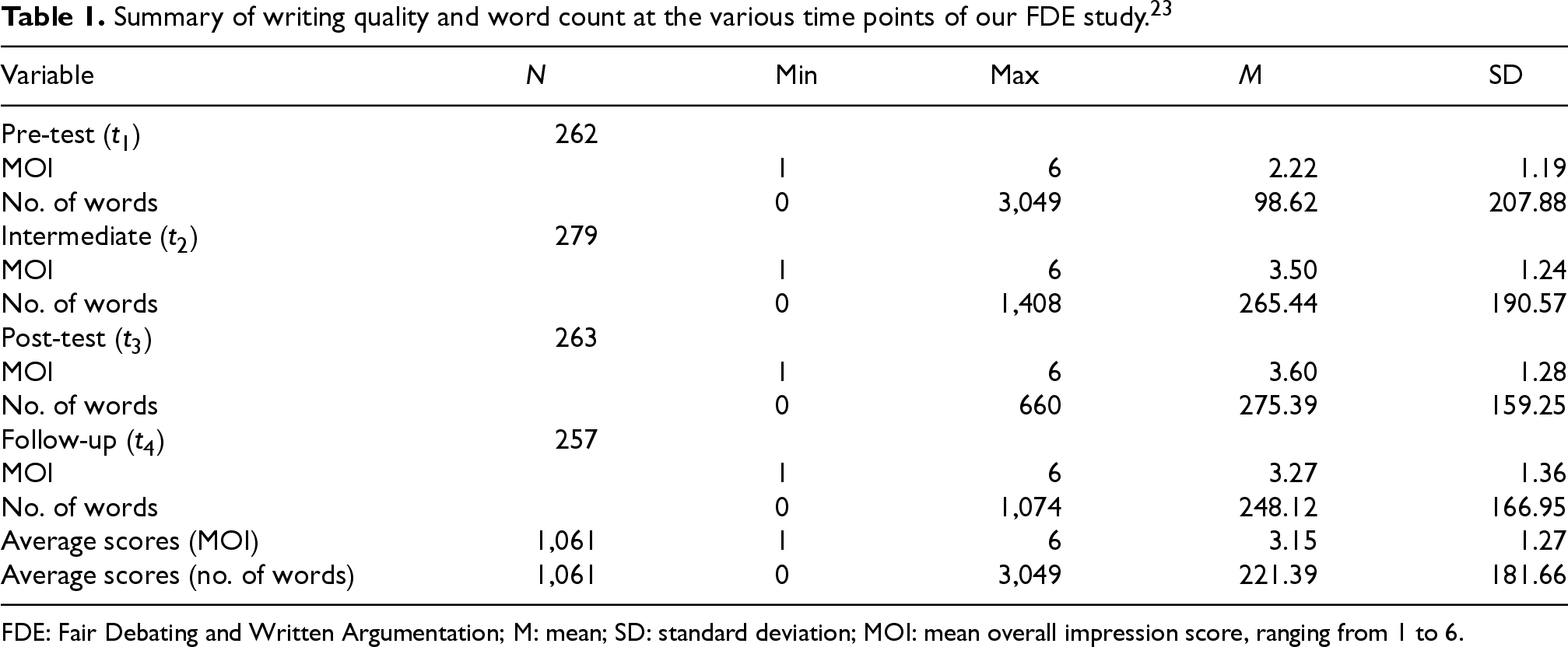
FDE: Fair Debating and Written Argumentation; M: mean; SD: standard deviation; MOI: mean overall impression score, ranging from 1 to 6.
Distribution of assigned AC types in the IAA experiment (30 texts).

AC: argument component; IAA: inter-annotator agreement; cth: central thesis; th1: thesis 1; th2: thesis 2; pro: pro premise; con: con premise; concl: conclusion; bg-world: background—general world knowledge; bg-author: background—author; struct: structure marker.
Distribution of AC types in the gold annotations (50 texts).

AC: argument component; cth: central thesis; th1: thesis 1; th2: thesis 2; pro: pro premise; con: con premise; concl: conclusion; bg-world: background—general world knowledge; bg-author: background—author; struct: structure marker.
Summary of the scheme
The basis of our work is an annotation scheme that was formulated for the AM task in a survey by Peldszus and Stede. 18 Its main inspiration is the work of Freeman, 7 which views argumentation as a dialectical exchange: a monological text can be understood as an interaction between the author (proponent) and an imagined opponent whose arguments are being taken into consideration (and then, usually, are being refuted). The diagram technique uses a set of building blocks that can be combined to yield representations of arguments unfolding in texts. Figure 3 shows the (common) cases of applying the support relation, and Figure 4 shows different kinds of attacks that the scheme accounts for. Every numbered node represents an ADU from a text, that is, a statement that functions as a claim or premise in an argument. Circle nodes indicate that the unit represents the viewpoint of the proponent, while box nodes denote the viewpoint of the opponent. The two types of arrows are the same as in the diagram in Figure 2 (support vs. attack).
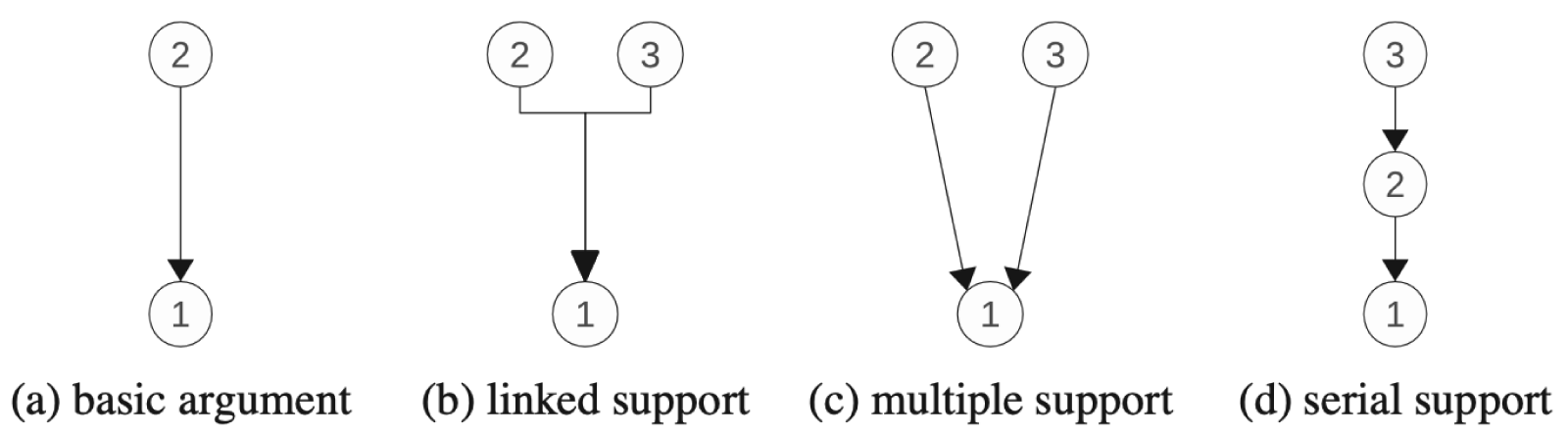
“Building blocks” of argument structure (1): cases of support. 18
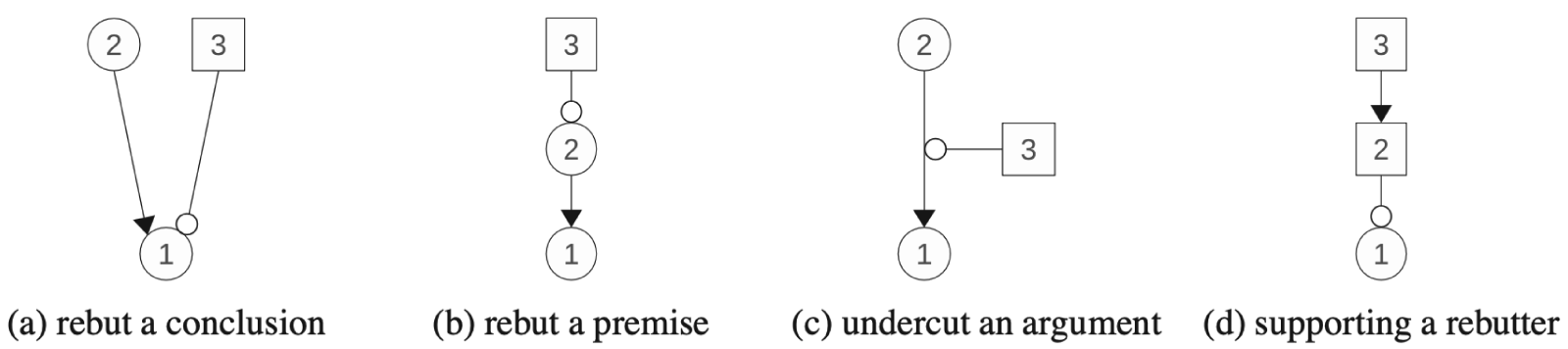
“Building blocks” of argument structure (2): cases of attack. 18
The target structure is specified formally as a tree: there is a single “central claim” for a text, and each premise is related to exactly one other unit (i.e., a divergent argument is ruled out), so that no circles can arise. The rationale was twofold: in empirical application, mentioned below, divergent argument did not seem to be required; and automatic AM can be simplified, since, for example, dependency parsing techniques can be applied (which in fact became a major trend in the field in the early 2020s; see, e.g., Ye and Teufel 19 ).
Following the publication of the scheme, it was subsequently formulated as a guideline for annotators (codebook), which is publicly available. 20 Also, an annotation tool called “GraPat” was made available (https://github.com/discourse-lab/GraPat), which allows users to conveniently build the trees interactively and stores them in an XML format. 21
When annotators apply the scheme to the analysis of a particular text, they essentially form a representation of their own understanding of the argumentative “plan” that the author realized in the text. Specifically, the scheme has been tested on “pro and contra” style newspaper editorials in the Potsdam Commentary Corpus, 22 and informally in student exercises targeting fundraising letters written by various non-governmental organizations. The larger-scale application was in the “argumentative microtext corpus,” a bilingual (German/English) collection of short texts written by students (part 1, Peldszus and Stede 5 ) and by crowdworkers (part 2, Skeppstedt et al. 6 ). In total, there are 290 texts labeled with argument structure trees. The first part of the corpus, in addition, has annotations on enthymemes and discourse structure, and there are versions in other languages (Italian, Russian, and Persian) (All information about the microtext corpus is available here: https://angcl.ling.uni-potsdam.de/resources/argmicro.html).
For illustration, Figure 5 shows a GraPat screenshot of a tree from part 2 of the corpus. (Notice that GraPat adds an artificial “label” node (c1–c4) to every edge of the tree, and it visualizes rebut/undercut arrows with a square arrowhead instead of a circle one.)
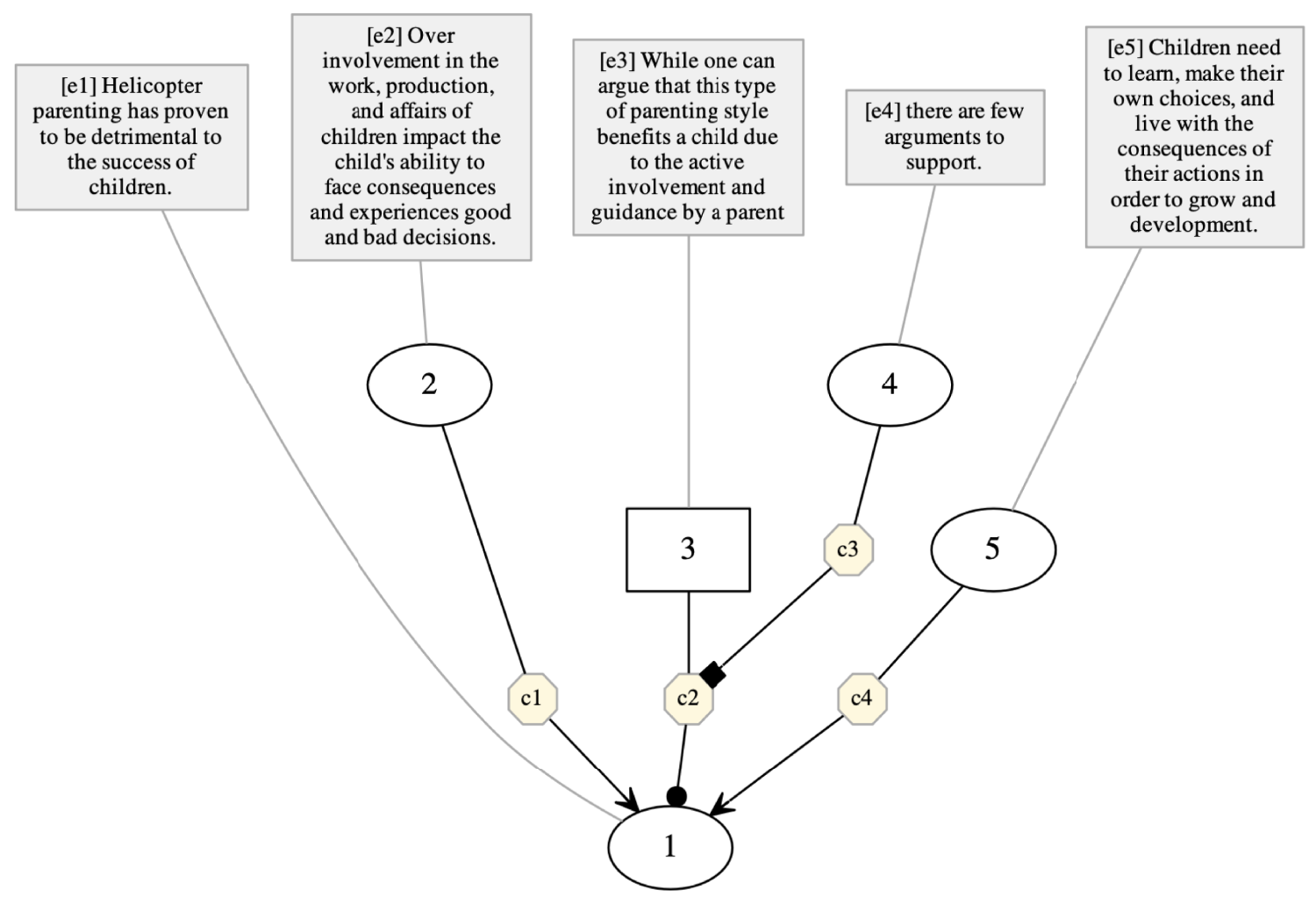
A sample argument tree from part 2 of the “microtext” corpus. 6 Nodes represent the corresponding textual argumentative discourse units (ADUs). The various elements are explained in the section “The original annotation scheme.”
Written argumentation is one of the key skills for lifelong learning that is specifically taught in grade 9 in the German secondary school curriculum. Students, at this level, are expected to write balanced essays in the form of both pro and con arguments on specific topics.9,23 These expectations also exist in the German curricula, with argumentative writing being anchored in the secondary school curricula of all federal states, so that it is compulsory for all students in all types of schools. Writing pro-and-con argumentation requires grade 9 students to justify their own positions by weighing up arguments and drawing conclusions from them. Furthermore, pro-and-con argumentation is a compulsory part of final examinations in Germany at the end of grade 10.
The importance of this text genre is addressed by our research project Fair Debating and Written Argumentation (FDE) (This study was conducted in accordance with the ethical guidelines outlined by the University of Potsdam’s ethics committee in accordance with the Declaration of Helsinki. Informed consent was obtained from all participants, and confidentiality was maintained throughout the study. Ethic Commission University of Potsdam (https://www.uni-potsdam.de/de/senat/kommissionen-des-senats/ek; accessed on 5 October 2021), Approval Code: 54/2021 (Name: “Fair Debattieren und Erörtern (No. 53/2021),” Responsibility: Prof. Dr. Winnie-Karen Giera), Approval Date: 5 October 2021.). It aims to investigate the assessment and improvement of written language skills of 9th-grade students through two lesson series—one on debating and one on pro-and-con argumentation essay writing.9,23
In our FDE study, 614 pro-and-con argumentation essays were written by grammar school students in the state of Brandenburg, and 447 by non-grammar school students. This results in a total of 1,061 texts written by the students for the entire corpus. The study was conducted between October 2021 and May 2022. Essays addressing four different topics were collected at four different time points within this period. The task required the students to write a pro-and-con argumentation essay, and stems from the official examination tasks for grade 10 students. The length of the texts varies considerably, with a mean word count of 233.10 words per text and a standard deviation of 171.53; Figure 6 shows the distribution. Regarding the topics, four writing topics are part of the corpus: Theater as a mandatory subject in school (hereafter “theater” for short); ebooks versus paper books (“ebooks”) for short); fast food versus cooking oneself (“fast food”); and working as a volunteer (“volunteer”).
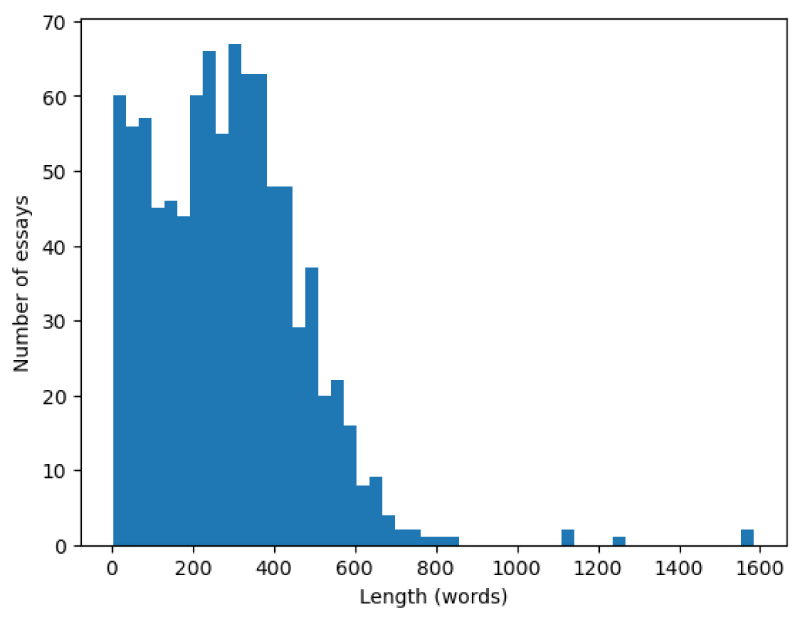
Distribution of text length in the Fair Debating and Written Argumentation (FDE) corpus. Submissions with one word or fewer are excluded.
All essays were written digitally by the participating students using the software Gorilla.Sc, 24 which stores the texts in a database and prepares them for further analysis. All our data collection was done anonymously, with no personal data being registered.
For measuring the overall and analytical text quality, all pro-and-con argumentations (
Table 1 gives an overview of the sample and selected variables, including mean overall impression (MOI) and the number of words written (“no. of words”). It demonstrates a significant improvement from the pre-test to the post-test phase. The descriptive statistics indicate constant participant numbers overall at each of the timepoints. Noticeable refinements can be observed (a) in the writing scores achieved by the participants, with an average of 2.22 on the pre-test rising to 3.60 on the post-test, and (b) in the word count, which rises from 98.62 to 275.39. Further detailed information on the study and its results can be found in Giera 26 and Giera et al.9,23
When approaching the corpus texts with the annotation scheme described above, it quickly became clear that revisions are necessary, due to the sometimes very different nature of school essays in comparison to the genres of argumentative “quality writing” that had been studied earlier. Here, we are not referring to problems with grammar and orthography—these are completely ignored in this paper. Instead, we center on the structure of the arguments presented (see Alhindi and Ghosh 27 for similar observations).
For making the revision decisions, it is important to be clear about the purpose of the scheme in our target setting. While for editorials and fundraising letters the goal was to represent a reader’s reconstruction of the “persuasive plan” of the author, we extend this slightly for the school essays: the analysis should capture (i) the different parts of the student presenting their argumentative reasoning and (ii) the connections that can be identified between those parts with regard to presenting a coherent pro/contra exposition that leads to the student’s conclusion. A “useful” diagram will be one that a teacher can use to effectively formulate feedback to the student on the argumentative quality of the essay.
With this goal in mind, we now explain the phenomena that make school essay argumentation different from more professional argumentation; then we outline our overall procedure for building the analysis; next, we summarize the key changes to the annotation scheme; finally, we discuss the results of an IAA study that we conducted.
Arguing in student essays: Phenomena
For our first phase of qualitative analysis and subsequent annotation, we considered essays of length between 200 and 800, and from these took a random sample of 50 essays. In these texts, we identified the following phenomena that render students’ argumentation different from what we studied and annotated previously. Some of them are indications of a lower text quality, while others (e.g., implicit claims) are common in other kinds of argumentative text, too; they are mentioned here only because they were almost completely absent in the corpora that we have so far applied our scheme to (see above).
Students explain their writing strategy: “I will now turn to the arguments of the other side.” Students describe their reasoning and judgment: “I think the arguments against fast food are more convincing.”
Students mention their main claim more than once (e.g., repeat it at the end of the text). Students state the same premise more than once (paraphrases).
The phenomena listed above have several consequences for the redesign of our annotation scheme:
Non-argumentative material in essays should also be classified for its purpose, so that essay quality can be assessed, and detailed feedback can be produced. When a structure is established over the argumentative material, it need not be subject to the tree constraint. The proponent/opponent distinction may sometimes be difficult to apply, because of an undecided or unclear text message. In order to produce complete structural descriptions, it may be necessary for annotators to write out (“explicitate”) a claim that is only implicit in the text.
Annotation procedure
Our new annotation guidelines divide the process into four separate steps, beginning with the ascription of an overall argumentative “constellation” to the text. The other fundamental change is the introduction of a step of assigning fine-grained AC types to the individual units.
Step 1: Determine the constellation
The annotator reads the entire text, determines the position that the author takes on the prompt question, and on this basis selects which of the four possible argumentative constellations is present in the text. This then affects the annotation of AC types, which we address further in Step 3 below. The set of argumentative constellations is as follows (see also Figure 7):
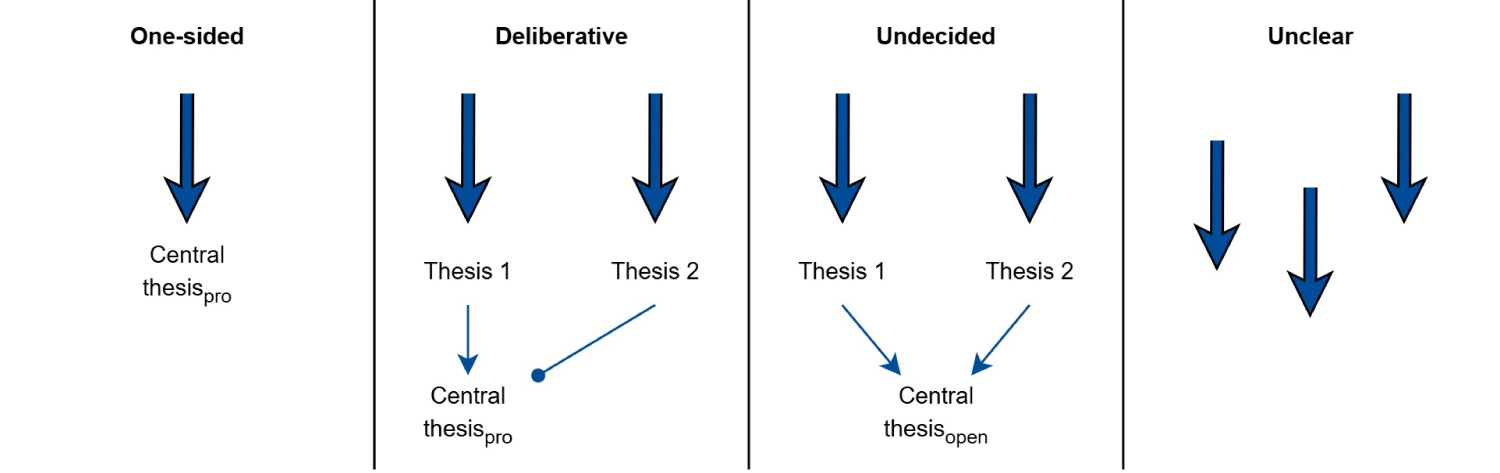
Four argumentative constellations in our corpus of school essays.
This step is conducted in accordance with our original annotation guidelines, which provide rules for splitting complex sentences into smaller argumentative units when necessary. For brevity, we exclude the details of this step from our description here.
Step 3: Assign AC types
For being able to provide helpful feedback to students (which is not a topic of the present paper, though), we need a quite detailed account of the roles of the argumentative units in the text. We present our argumentative component type inventory below. The potential second task in this step is for the annotator to make implicit theses explicit, that is, to add statements to the text that sum up previously stated arguments in the form of an explicit thesis (claim) (While implicitness is in general a difficult topic in argument analysis, for our school essays, it is usually straightforward to identify the pro and con stance of arguments and to notice the lack of an explicit statement that answers the writing prompt question.). The presence of this explicitation, too, will support a later step of feedback generation.
In terms of temporal ordering, our guideline recommends identifying the theses/claims first and to check whether the text contains a conclusion (as these assignments can influence each other). Thereafter, the pro and con premises are to be marked, and then the last step is the distinction among the background, struct, and other types.
Step 4: Assign argument relations
The types that were assigned in Step 3 already provide substantial information about the argument structure. In particular, the pro and contra positions have already been distinguished. The remaining task is to establish support relations (between units of the same position) and attack (rebut or undercut) relations (between units of different positions), such that these are linked to their supporting material. Conceptually, the main tasks are (cf. Figures 3 and 4) identifying the targets of attacks, identifying instances of linked support, and distinguishing multiple from serial support—whether a unit directly or only indirectly supports a thesis.
In terms of technical setup, we perform the segmentation step with a standard text editor, which is also used to add the argument component (AC) types and the explicitation of implicit theses (if any). To support the building of the graph structures, we adapted the GraPat tool (originally developed for the microtext corpus; see above) such that it allows for drawing the graph structures needed to represent the argumentative constellations. (For the present paper, however, relation assignment is not in our focus; as stated earlier, we here concentrate on ACTC.)
IAA study: AC types
To validate the applicability of the annotation scheme to our essay corpus, we conducted an IAA study. For now, we restrict this to the (central) step of AC type recognition, which will also be the focus of our computational experiments in the next section.
Two trained annotators labeled 30 texts that were randomly chosen from our initial set of 50. In order to focus the IAA calculation firmly on type identification, the segmentation and explicitation of implicit theses (if applicable) were beforehand agreed upon by the two annotators. The total number of segments for the study is 788, and Table 2 shows the AC-type distribution in the two annotations. We calculated the overall Cohen’s
We separately calculated the agreement of the AC-type cth that is, whether for each essay both annotators decided on the same segment as the most fundamental annotation decision. This is the case for 76% of the essays.
After the IAA calculation, the two annotators resolved the mismatches in their annotations in an adjudication step and produced a “gold standard” set, which was subsequently extended by another 20 texts (labeled by one annotator). The result is a first subcorpus of 50 essays with gold annotations, which enabled us to evaluate the automatic approach, to be described next.
AM on the essays: Component type recognition with LLMs
We now turn to our experiments on AM, that is, the task of ACTC. That is, each segment of an essay receives one of the AC-type labels described above, which creates a multiclass classification task on the segment level. At present, our data basis consists of 50 essays labeled with gold-standard segment types; see Table 3 for the distribution of types in the corpus. In addition, we report the distribution of argumentative text constellations (Table 4) as well as the distribution of the four writing topics (Table 5) among the 50 gold-standard essays. It can be noted that essays with the “deliberative” or the “undecided” constellation are far more frequent than one-sided essays since our writing exercise from the secondary school curriculum calls for “pro-and-con argumentation” that weighs up arguments for different positions (see above).
Distribution of argumentative constellations in the gold annotations (50 texts).

Distribution of argumentative constellations in the gold annotations (50 texts).
Distribution of writing topics in the gold annotations (50 texts).

Given the current interest in the performance of pre-trained LLMs for AM tasks (see our literature review below), we test the ability of several LLMs with either no or very few labeled samples for the target task. Thus, we conducted two sets of simple experiments based on prompting a selection of LLMs:
In the In the
It would be interesting to use a supervised approach as a baseline against which LLM performance can be compared. This could be, for instance, a simple support vector machine or an approach based on finetuning a transformer model such as the bidirectional encoder representations from transformers. 40 However, we consider our present set of 50 gold-labeled essays too small for supervised approaches and therefore leave this to future work.
In recent years, a growing body of literature has looked into different ways of applying LLMs to AM or its sub-tasks 30 : conduct a systematic evaluation of multiple LLMs in both AM and argument generation tasks. Among others, the AM tasks include binary claim and evidence detection as well as multiclass detection of different types of evidence. They focus on zero-shot and few-shot prompting approaches and observe that, given as few as 10 labeled examples in few-shot prompting, small-to-medium-sized LLMs (up to 20 billion parameters) can approach the performance of supervised models trained on 500 samples.
Ajjour and Wachsmuth 31 explore using different LLMs and few-shot prompting to classify argumentative stance, that is, to recognize the polarity of an argument with respect to a thesis. Notably, they particularly zoom in on strategies for selecting the best example data for few-shot prompting. They find that using data instances with the same stance as the target instance to serve as few-shot examples is consistently more effective.
As an alternative to prompting, LLMs can also be fine-tuned on labeled data 32 : they also successfully target canonical AM sub-tasks such as argument type classification and argument relation extraction on established datasets. Their approach is based on finetuning different LLMs, which is made feasible despite the models’ sizes by parameter-efficient finetuning strategies such as QLoRA. 33 A comparable approach is taken by Kawarada et al. 34 They frame AM as a task of Translation between Augmented Natural Language, 35 where the model is instructed to “translate” unannotated input texts into texts containing argument annotations. They achieve strong results by efficiently finetuning small LLMs.
The experiments detailed below describe our first step toward performing computational AM on our novel dataset. At present, we focus on using LLMs in zero-shot and few-shot settings. We leave approaches based on finetuning LLMs to future work.
Data pre-processing
Our current type inventory, detailed above, consists of 10 labels in total. This includes types which are strictly speaking not considered argumentative, such as bg-world or struct. Since they do not play a role in our present core task of recognizing argument relations (recall that we reserve feedback production for future work), their classification is currently of secondary importance in our overall scheme. We therefore map the labels bg-author, bg-world, struct, concl, and other to a single label n-a, for “non-argumentative.” This yields a resulting inventory of six AC labels. Figure 8 shows the distribution of these six labels among the 50 gold-labeled essays.
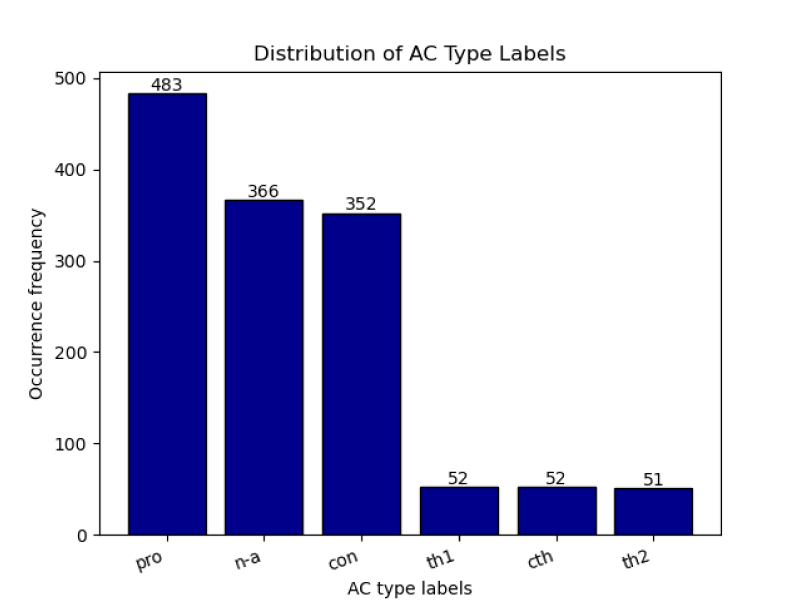
Distribution of the six argument component (AC) labels among the 50 gold-labeled essays.
Unsurprisingly, the labels denoting claims (th1, th2, and cth) are significantly fewer than those denoting arguments (pro and con), as a single claim can be supported by multiple arguments. The abundance of the label n-a can mostly be attributed to personal anecdotes and background information, which students tend to include in their essays.
For our experiments, we have chosen the following three popular LLM models of different sizes:
Instruction fine-tuned LLama 3.1 with 8 billion parameters (https://huggingface.co/meta-llama/Llama-3.1-8B-Instruct),
36
referred to as “Llama8” hereafter. Qwen 3 with 32 billion parameters (https://huggingface.co/Qwen/Qwen3-32B),
37
“Qwen32” hereafter. Instruction fine-tuned Llama 3.3 with 70 billion parameters (https://huggingface.co/meta-llama/Llama-3.3-70B-Instruct),
36
“Llama70” hereafter.
Both Llama models are instruction fine-tuned models, which means that in addition to their extensive pre-training for general language modeling, they have been further fine-tuned on human-generated prompt-response pairs for various tasks to allow the model to optimize human-like output behavior. Differences between the two models mainly relate to size (8 billion vs. 70 billion parameters). Qwen32 is trained to perform well in reasoning and instruction-following tasks, using an explicit thinking mode to support logical reasoning. In terms of model size, at 32 billion parameters, it is approximately halfway between the two Llama models.
These models are attractive since they are open-source and easy to access. In particular, they can be accessed through the Groq API platform (https://groq.com/). This obviates the need for high-capacity local hardware, which could be a limiting factor if the models were to be hosted and run locally. Moreover, all three models are multilingual and offer reliable support for German. In our experiments, all models are given exactly the same prompt texts.
Prompt engineering
As discussed above, the human annotator approaches the analysis of the essay by first determining the overall argumentative constellation. In particular, the functional meaning of various AC-type labels can be affected by whether the author of an essay argues in favor of one side of the discussion or whether she presents both sides equally without taking a stance. Hereafter, we refer to the first case as a decided constellation, which covers the argumentative constellations “one-sided” and “deliberative” as defined above; we refer to the second case as an undecided one, covering the constellations “undecided” and “unclear.” To recall, in a decided essay, the label cth is given to a segment that describes the author’s central stance on the discussion topic, while th1 and th2 are assigned to segments that describe positions which concord with or oppose the author’s stance, respectively. By contrast, in an undecided essay, cth is used for segments which explicitly express the author’s unwillingness to take a clear position, while th1 and th2 are, respectively, given to segments which express the first and second named position.
Literature has established role-playing as a prominent prompt engineering method to encourage human-like behavior from LLMs.28,29 Therefore, in the system prompt, we ask the model to assume the role of a teacher of German for 9th-grade school classes before explaining the context of the essay writing task. Following the recommended procedure for human annotators, we ask the model to first perform the binary prediction of the overall constellation of the essay (decided vs. undecided). We then present the six AC-type labels and provide a concise definition for each label, making references to either the overall constellation where needed (see above). Finally, the model is shown the segmented target essay and prompted to assign one out of the six possible labels to each segment, following a predefined output format. An example of the full-length, German-language prompt text is given in the Appendix.
In the zero-shot prompt scenario, the prompt text described above is all that we feed to the model. In the few-shot scenario, we randomly select two gold-labeled essays, one with a decided and one with an undecided constellation. Hereafter, these two essays are referred to as “demo essays.” We feed the model each demo essay paired with the desired output text to form the basis for ICL.
Evaluation method
We use regex to parse the LLM’s output text and to extract the predicted AC-type labels. In our scheme, the prediction of the overall constellation is first and foremost an intermediate step toward classification of AC-type labels rather than a goal of its own. Nonetheless, since our gold essays contain annotations for constellations, which can easily be mapped to the binary labels that the models are instructed to output (i.e., decided and undecided), we have also extracted them for evaluation.
Models have not always provided valid AC-type output for the target essay. We consider the output invalid if (a) it uses labels other than the ones from our inventory or if (b) it produces more or fewer labels than the number of segments in the essay. Invalid outputs are excluded from evaluation.
The essay-level binary constellation predictions are assessed in terms of accuracy. The segment-level AC-type labels are evaluated against our gold labels using standard metrics for multiclass classification, including accuracy and macro-averaged F1. We perform two sets of evaluation for AC-type prediction:
In the “standard” setting, all pairs of predicted and gold labels are used for the calculation of the metrics. In the “no-concl” setting, after the model output has been parsed and processed, we discard the pairs of predicted and gold labels where the original gold label is concl (prior to its mapping to n-a)
The motivation for the “no-concl” setting is as follows: according to our annotation scheme, both the conclusion and the cth may express the author’s core position. It is a convention within our annotation scheme that we label such a segment as concl rather than cth if it occurs toward the end of the essay and if it is a repetition of the cth. We therefore believe that punishing the model for confusing the labels n-a (to which concl is mapped) and cth on these segments unfairly underrates the model’s performance. Hence, the metrics in the “no-concl” setting show the evaluation of model performance without these segments.
Results and Discussion
The models’ performance in terms of our chosen classification metrics is summarized in Table 6. For AC-type prediction, we show accuracy and macro-averaged precision, recall, and F1, for each of the three models, two prompt conditions (zero-shot vs. few-shot), and two evaluation settings (“standard” and “no-concl”). For the preliminary step of essay-level constellation prediction, we report accuracy for each model-prompt pair.
Type prediction performance metrics for all models and evaluation conditions in terms of accuracy (Acc) and macro-averaged precision (Prec), recall (Rec) and F1; Invalid output gives the number of essays with invalid LLM output for AC types relative to all essays used for evaluation; Acc const gives the model accuracy at predicting the correct overall constellation as a first step. The best performances in either prompt setting are given in bold.
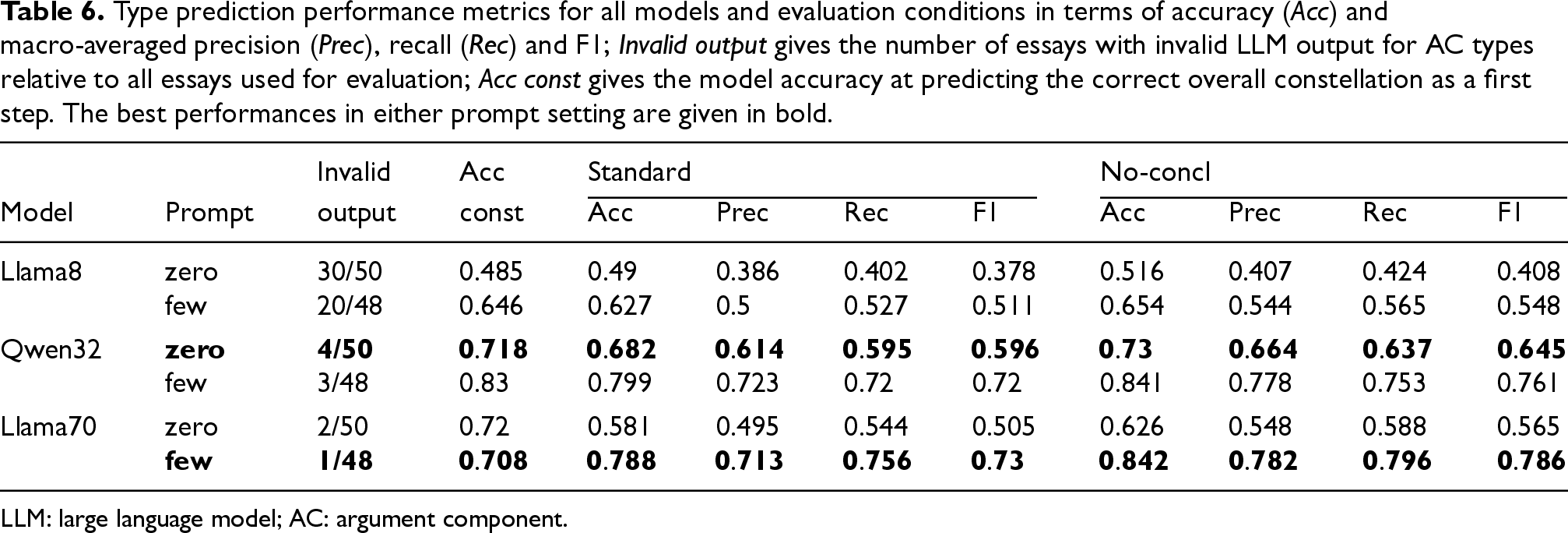
Type prediction performance metrics for all models and evaluation conditions in terms of accuracy (Acc) and macro-averaged precision (Prec), recall (Rec) and F1; Invalid output gives the number of essays with invalid LLM output for AC types relative to all essays used for evaluation; Acc const gives the model accuracy at predicting the correct overall constellation as a first step. The best performances in either prompt setting are given in bold.
LLM: large language model; AC: argument component.
Most of the model-prompt combinations have produced valid and extractable constellation predictions for all or all but one test essays, so that hardly any have had to be excluded when we calculate the prediction accuracy. The only exception is Llama8 in the zero-shot scenario, where the output for 29 out of 50 essays does not use the designated labels that the model has been instructed to use and is therefore considered invalid. Overall, although the prediction of the argumentative constellation is a binary task, the accuracy values of 0.83 at most show that it is nevertheless challenging.
With respect to our main task, AC-type classification, several observations are worth discussing: first, the smaller Llama model, Llama8, struggles heavily with the task. Not only has it produced large amounts of invalid output that need exclusion from evaluation, but the metrics based on the remaining valid output show a poor performance in terms of averaged F1. This holds for both prompt conditions. Although the few-shot scenario does result in improved performance, with invalid output for 20 out of 50 essays and an F1 score of slightly above 0.5, it is nonetheless subpar. This suggests that the complexity of the task poses a great challenge to smaller LLMs such as Llama8.
Second, all models have produced invalid output under both prompt conditions, even the overall best-performing Llama70 model in the few-shot scenario. After examining the invalid LLM output texts, we find that they are due to different reasons: for Llama8, all instances of invalid output are due to the model generating made-up labels that are not in our inventory, that is, not the labels which the model has been instructed to use. Examples include Pro_Argument_1 or Con_These. For Llama70, in contrast, all invalid output is due to the model outputting multiple sets of analysis for a single input essay and discussing them as different labeling options. Our regex-based output parser has extracted AC-type labels from all analyses, which results in significantly more extracted labels than there are segments in the input essay and therefore marks the output as invalid. To better deal with this behavior, one could either prompt the model to output only a single, final set of analysis or one could instruct the model to use specific separator tokens between the different sets of labeling so that they can be automatically recognized as such. We leave this to future work.
Finally, Qwen32 has proved to be the best model in the zero-shot prompt condition, which indicates that our task benefits from models with a focus on reasoning. Despite being half the size of Llama70, it also comes close to Llama70 in the few-shot scenario. This echoes 30 finding that model size does not necessarily determine performance success in complex tasks. It should be noted, however, that upon closer examination, we find that Qwen32 struggles particularly with the recognition of the cth, which we discuss below.
To gain more insight into model performance on individual AC types, Figure 9 shows the label-specific F1 scores for the best-performing Llama70 model in either evaluation setting.
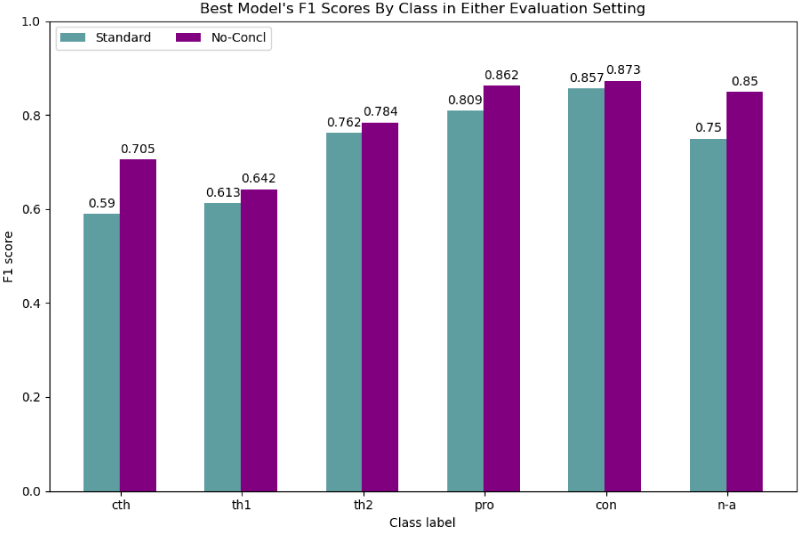
By class F1 scores of the best-performing Llama70 model in either evaluation setting.
While the model has given particularly strong results on the recognition of pro and contra arguments, its performance on the cth and th1 is comparatively low. Given that in the overall scheme of our AM approach, the cth will be the root of the analysis, this is unfortunate and requires improvement in further studies. We do observe, however, a significantly higher F1 score in the “no-concl” setting. More precisely, the model’s precision score for cth is 0.554 in the “standard” and 0.795 in the “no-concl” setting. As shown by the prediction-normalized confusion matrices (For a given class
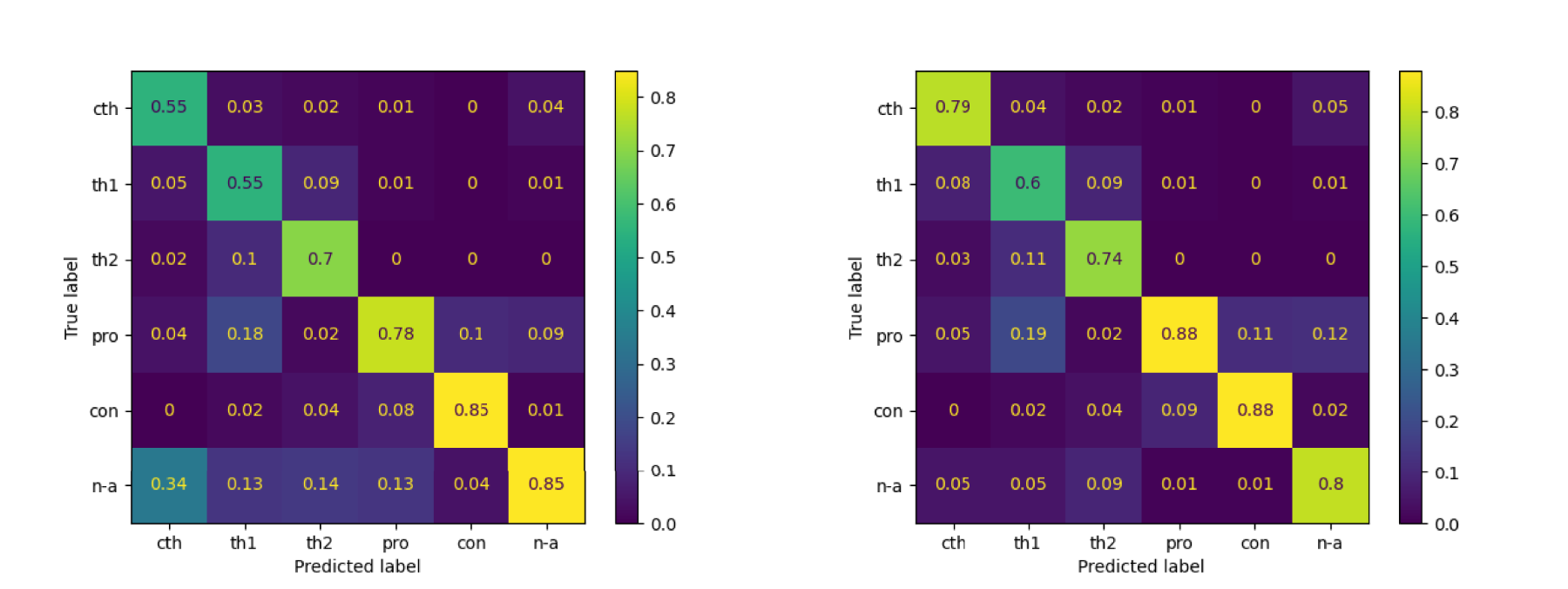
Prediction-normalized confusion matrices (values within a column add up to 1) for the best-performing Llama70 model in the “standard” (left) versus the “no-concl” (right) setting.
Finally, Figure 11 shows the performance of all models specifically on the cth class. While Qwen32 comes close to Llama70 in the few-shot scenario in terms of the macro-average F1 measure (see Table 6), its performance on cth is inferior to Llama70 by approximately 10 points. Conversely, while in the zero-shot scenario Qwen32 clearly beats both Llama models on macro-average F1, its advantage over Llama70 specifically on cth is only less than three points. This suggests that, despite its advantages, Qwen32 is less suitable for our overall AM scheme, given the importance of the correct recognition of the cth.
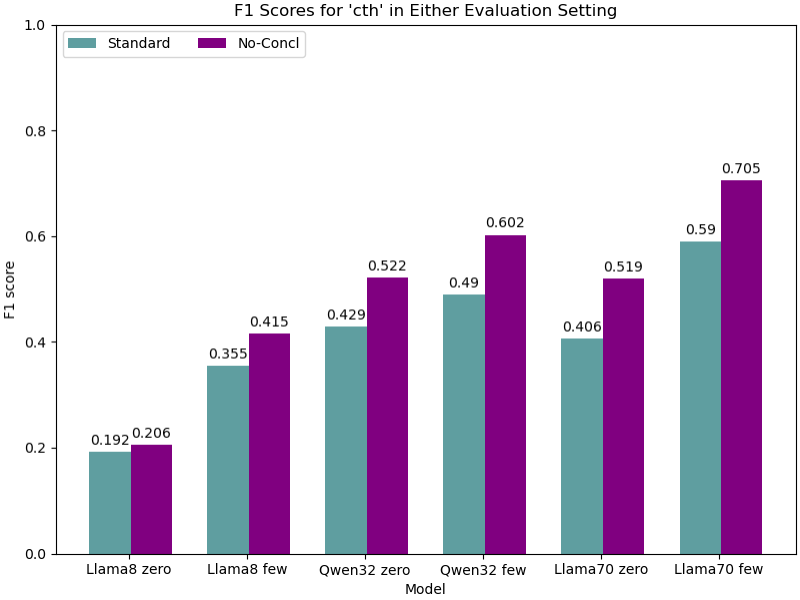
F1 scores by all models for the class cth in either evaluation setting.
Our collaboration between education scientists and computational linguists created the opportunity to exploit a large corpus of 1,061 school student essays that are argumentative in nature and display the full range of good and bad aspects of student writing. We sampled a subcorpus of 50 texts that we analyzed for phenomena of argument structure, and used these insights to redesign a tree-based annotation scheme that we had previously employed for “standard” argumentative texts of homogeneous good quality. Besides eliminating the original strict tree constraint and allowing for a small set of fundamental argumentative constellations, the main addition to the scheme is an inventory of types that characterize the functional role of the argumentative (and also the non-argumentative) units in an essay; assigning these types is the first step in the annotation procedure, followed by establishing support and attack relations between AC. While to the best of our knowledge such fine-grained typing has not been done previously on educational text, we note that similar approaches exist for other genres, notably for scientific argumentation: in building the SciDTB-ArgMin corpus, 38 annotated 60 scientific abstracts with six AC types (proposal, assertion, result, observation, means, and description), which ultimately dates back to the early work on “argumentative zoning” by Teufel and Moens. 15
We hypothesize that our new scheme is not language-specific and hence should generalize to applications in other languages and—we conjecture—to similar kinds of text that can diverge from “quality writing” in different respects. Our IAA study demonstrated that the scheme can be robustly applied to the school essays in our collection. Both the corpus and the annotation guideline (at present, only in German) are freely available online (https://github.com/discourse-lab/FairDebArgMining). Likewise, the annotation tool for building the graphs, which we have adapted to the new scheme, is available (https://github.com/discourse-lab/GraPat).
Following our corpus annotation, we conducted a series of experiments with three open-source LLMs for the type assignment step. We find that the complexity of the task posed a great challenge to the smallest LLM we used, Llama8. In contrast, medium-sized LLMs produced promising results by using two demo essays as examples in few-shot prompting; Qwen32, a model emphasizing reasoning skills, even gave a better performance in the zero-shot scenario without any labeled data. Nonetheless, while these models tend to do comparatively well on the recognition of pro and contra arguments, they struggle with the extraction of the cth, which we consider to be the root of the argumentative analysis. This clearly calls for improvement in future work. Among others, we plan to investigate finetuning smaller LLMs as well as alternative strategies for selecting demo essays for few-shot prompting.
To extend the work presented above, our next steps are:
Continue the corpus annotation with argument types, in a semi-automatic way (manual postediting of LLM output). Extend the annotation work to argument relations. Preliminary experiments indicated that this step does not involve essay-specific complications; the main challenge of separating direct from indirect support for a thesis (i.e., convergent vs. serial argument) seems to be the same as in other genres. Explore the production of feedback to students, on the basis of the argument structure annotations.
Besides these activities, we plan to take an in-depth look at the subjectivity of manual annotations. In the spirit of “perspectivism,”
39
disagreements in human annotation are regarded not as an unwelcome nuisance but as a potential asset from which systems (and ultimately also theories) can benefit by incorporating the human label variation into the machine learning processes. We believe that AM is a field where these approaches can make fruitful contributions, and we will conduct experiments with the argument graphs of our essay corpus.
Footnotes
ORCID iDs

Ethical considerations
Not applicable.
Consent to participate
Not applicable.
Consent for publication
Not applicable.
Funding
The authors disclosed receipt of the following financial support for the research, authorship, and/or publication of this article: The work reported in this paper was funded by the Deutsche Forschungsgemeinschaft (DFG, German Research Foundation)—567969163.
Declaration of conflicting interest
The authors declare no potential conflicts of interest with respect to the research, authorship, and/or publication of this article.
Data availability statement
We make our annotated corpus publicly available. Details are provided in the main text.
Appendix: Example prompt text
We show below an example of a complete, German-language prompt text fed to the LLMs in the zero-shot prompt scenario:
System prompt:
Du bist ein Deutschlehrer der 9. Klasse und analysierst argumentative Aufsätze deiner Schüler. Die Schüler schreiben den Aufsatz mit Bezug auf eine vorgegebene Streitfrage. Du Überprüfst, wie der Aufsatz argumentativ aufgebaut ist.
User prompt:
Im Folgenden liegt ein Aufsatz vor. Der Aufsatz wurde in kleineren Einheiten wie Sätzen oder Phrasen unterteilt, die im folgenden zur Vereinfachung als ’Sätze’ bezeichnet werden. Die Sätze sind nummeriert. Das Format dabei is ’Satznummer: Satz’.
Entscheide zunächst, welche argumentative Gesamtkonstellation vorliegt:
“Entschieden” bedeutet: Der Aufsatz argumentiert für eine bestimmte Position des Autors.
“Unentschieden” bedeutet: Der Aufsatz bringt gleichberechtigt Argumente für beide Seiten der Streitfrage hervor. Der Autor entscheidet sich nicht für eine Position.
Analysiere die Funktionen der einzelnen Sätze. Dabei gilt eine grundlegende Unterscheidung zwischen der Funktion der These und der des Arguments: Eine These ist eine argumentative Position, die jemand einnehmen kann. Ein Argument ist ein Grund, der eine bestimmte These stützt oder angreift.
Jeder Satz im Aufsatz soll einer der folgenden 6 Funktionen zugeordnet werden:
“Zentrale_These” bedeutet: Der Satz beschreibt in einem entschiedenen Aufsatz die Kernposition des Autors, oder er drückt in einem unentschiedenen Aufsatz explizit aus, dass der Autor sich nicht für eine Position entscheiden kann.
“These_1” bedeutet: Der Satz beschreibt in einem entschiedenen Aufsatz die Position, die mit der zentralen These Übereinstimmt, oder er beschreibt in einem unentschiedenen Aufsatz die im Text erstgenannte Position.
‘’These_2” bedeutet: Der Satz beschreibt in einem entschiedenen Aufsatz die Position gegen die der zentralen These, oder er beschreibt in einem unentschiedenen Aufsatz die im Text später genannte Position.
“Pro_Argument” bedeutet: Der Satz beschreibt ein Argument, das These 1, also die Position des Autors in einem entschiedenen Aufsatz, stützt und bestärkt.
‘’Con_Argument” bedeutet: Der Satz beschreibt ein Argument, das These 2, also die Position gegen die des Autors in einem entschiedenen Aufsatz, stützt und bestürkt.
“Nicht_Argumentativ” bedeutet: Der Satz hat keine argumentative Funktion. Stattdessen gibt er zum Beispiel Hintergrundinformationen zum Thema, Anekdoten des Autors oder dient der Gliederung und der abschließendenZusammenfassung des Aufsatzes.
Werte den Aufsatz aus und ordne jeden Satz einer der genannten 6 Funktionen zu. Das Format des Outputs soll ausschließlich wie folgt sein:
“Gesamtkonstellation
Satznummer: Funktion
Satznummer: Funktion,”
zum Beispiel
“Entschieden
1: Zentrale_These
2: Nicht_Argumentativ
3: Pro_Argument
4: These_1.”
Im Output sollen es neben der Gesamtkonstellation genauso viele Satznummer-Funktion-Paare geben wie es Sätze im Aufsatz gibt.
Schüleraufsatz
1: Was ist nun besser, Fast Food oder selbsgekochtes, gesundes Essen?
2: Immer Öfter findet eine Diskussion zwischen den beiden Seiten statt, in der Über die bessere Art von Essen debattiert, doch was ist nun besser?
3: Heutzutage konsumieren Kinder oder Teenager immer mehr Fast Food,
4: es ist schnell, günstig und lecker.
5: Dies stellt eine große Erleichterung für sie dar, wenn sie zum Beispiel nach einem stressigen Schultag schnell in ein Fast Food Restaurant gehen können und innerhalb kürzester Zeit ihr Essen vor sich stehen haben.
6: Jedoch kommen auch Argumente ans Licht die definitiv gegen eine solche Ernährung sprechen und eine gesündere Ernährung befürworten.
7: Aus diesem Anlass wird in dieser Erörterung Über die postiven Seiten beider Essensarten, aber auch Über ihre Probleme gesprochen.
8: Selbst gekochtes Essen ist viel gesünder
9: und besser als Fast Food,
10: da es eine bessere Essensqualität hat, das steht nicht zur Frage.
11: Man nimmt weniger Zusatzstoffe und Kalorien zu sich,
12: da man frische Sachen wie Gemüse verwendet.
13: Selbstkochen kann Spaß machen
14: und man findet vielleicht ein neues Hobby am Kochen,
15: doch auch Fast Food hat seine Vorteile.
16: Im Gegensatz zum selbstgekochten gesunden Essen, ist dieses günstiger und schneller,
17: fast immer schmeckt es einem
18: und nicht jeder hat noch Energie um nach einem anstrengendem Tag m Herd zustehen und zu kochen.
19: Fast Food findet man ja auch heutzutage Überall, wenn man zum Beispiel in die Stadt geht um zu shoppen oder einkaufen zu gehen.
20: Alle Seiten haben ihre Vorteile aber auch Nachteile vorallem im Thema Gesundheit, wo frisch zubereitetes Essen auf jedenfall besser fÜr den Körper ist doch man kann beide Seiten verstehen.
21: Zusammenfassend kan man sagen, dass Fast Food natürlich deutlich weniger Aufwand macht, zudem günstiger ist, aber auf eine gesunde Ernährung kann man nicht verzichten.
22: Meiner Meinung nach sollte man sich in der Mitte treffen.
23: Selbstgekochte, gesündere Sachen sind zwar besser und tragen zu einer guten Ernährung bei, aber man kann sich ab und zu einen Burger gönnen.
24: Doch Übertreiben sollte man es nicht.
25: Zum Schluss lässt sich sagen, dass jeder das essen soll, was er/sie am besten für sich selber hält, aber eine gesunde Ernährung schaded nie.