







Abstract
Developing a theoretical foundation toward establishing a futures science requires reconstructing original roots, whereby this field is conceptualized at higher generality levels. This article aims to provide a unifying framework for expressing any of the futures (from possible to plausible, plausible to undecidable) plus the mechanisms for manipulating these futures, with a view to promoting genuine futures thinking. Despite more than sixty years of studies about “the future,” the logical status of future-based conceptualizations still remains, at best, unclear. This article proposes to fill the continuity gap through designing a generative mechanism for expanding futures concepts based on formal theory. We use the well-developed Concept-Knowledge theory from Mines ParisTech, founded on set theory without the axiom of choice. The space K represents known/knowable things (present and past facts, available knowledge, what is known-to-be-known/to-be-not-known). The space C of concepts represents what is undecidable, neither provable nor unprovable at a given time. The C-K operating mechanism logically expands C concepts relatively to K, until they result in a conjunction with K—that is, become possible—possibly requiring extra development work. The article illustrates the approach on a series of field cases, whereby the path to futures robustness starts upstream at undecidable stages, as if to open up vast conceptual reservoirs of “futurabilities”—a foundational step transcending traditional futures studies. Futuring becomes a constructive and generative process, potentially leading to accepting infinities of futures formulations, where generativity is monitored as a design-oriented logic working on knowledge. Such an approach should improve the foresight practice.
On Considering the Logical Status of Futures
Developing a theoretical foundation toward establishing a futures science requires reconstructing original roots, whereby this field is conceptualized at higher generality levels. This article aims to provide a unifying framework for expressing any future (from possible to plausible, plausible to undecidable) plus the mechanisms for manipulating these futures, with a view to promoting generative futures thinking. Despite more than sixty years of studies about “the future,” the logical status of future-based conceptualizations still remains unclear. Anything such as “what might be” or “what could be” commonly receives varied formulations, catalogued as, for example, hypothetical, uncertain, speculative, or conjectural assertions. Yet, on the core founding act in considering futures, de Jouvenel long forewarned this pivotal point: “there may be a conflict between the transpresents and the foreknown futures. All this pertains to the problems of coherence of the future scene, which are easily neglected, (…) for a question about the future usually bears on some particular aspect that we hope to grasp without referring to the whole” (de Jouvenel, 1976, p.114). In present practice, foresighting is still bound to deciding in an uncertain space, whereby decision-making is meant to reduce some linear spread of realities, in other terms, prospective possibilities (recalling Dator 2017b, 197, “each of our decisions typically is based on a prediction founded on an image of the future derived from past experiences and/or future projections”).
Cracking a Deep Unknown-Uncertain Gap in Scenario Design
As such, future studies have long been imbued with a number of dominant designs—for instance, the linearity and irreversibility of time, the ordered past/present/future trilogy, or the inaccessibility of futures—which, although boasting practical wisdom and sound sense, lack fundamental solidity. At best, foresighting, instead, ought to be the capacity to either commonly plot the probabilistic merits of uncertainties or, still a rare endeavor, structure the unknown. The latter is the focus of this article, which calls for resorting to logics, not probabilities. Hence, a chronic societal reductionism from the Unknown to the Uncertain, which deprives from designing more radical conceptual views about the future. A logics-based design act includes, yet transcends, discovery or research. It expresses the fundamental hiatus between imaginary concepts and knowable items. The latter are decidable (true/false at a given moment in time), the former are not.
What is not, at present, established or known with certainty leads to uncertainty, which can originate from many sources and requires us to navigate in an environment of ambiguity, risk-taking, or a lack of knowledge (Hooge 2010), for instance, “this world is uncertain, I’ll chance it, it will probably happen, I can’t decide.” The same author (Hooge 2010, 40) appropriately cites De Finetti (1937): “We are never entitled to predict future frequencies with certainty, . . . since that would only be legitimate under some deterministic hypothesis. If we accepted such a deterministic hypothesis, no question of probability would exist.” How come, then, that scenarios are often accepted as legitimate starting points, while not necessarily bound to rigorous preparation?
Our projects require that we operate in an environment of uncertainty. “We don’t know what we don’t know” looks like common sense and formally correct. Yet, what is unknown to be known is something that forces us to acknowledge the lack of any relative theory, model of some kind, less any experience about it. Here, probabilities theory does not help because there does not exist a (subjective) probability model or density function underlying it that is known to apply a priori: no objective probability of occurrence of a given future. Yet, should not a universal theory of futures account for unexpected/unexpectable futures, too? The infinity of these should theoretically be reachable by some logical design method anyway: categorized by past nomenclature, evoked by discussing, or morphed via analogy. Given that human-experienced futures are by nature subjective and are not logically, formally designed (this presumably to be put in relation to free will), a discipline relative to futures keeps escaping scientific reasoning. And the underpinning lack of a logical status for a “future-item” incongruously uproots the building of conceptual futures from any underpinning axiom.
A compensation is the projection of, for example, scenarios. Scenarios are useful when there are many, as they offer approachable beacons that close down the span of a decision space within constraints. Scenarios slice the uncertain and open up inside views for each slice that is investigated. They stimulate projective reactions viz. what is then made perceivable. We see their main originality and usefulness in the stepping-back capacity they induce in respondents: letting their feelings and attitudes flow more freely, plus the enhanced and sharable vision of the issues depicted in context, also the learning back from the projected experience.
Yet, scenarios are rather unstructured as an expressive method. Not speaking of those that would be based on undecidable conceptual futures (crazy, unfeasible, even unimaginable): how would we possibly conduct such an exercise? We think scenarios are a twice-biased method: by the past experience and the degree of acceptance of future possibilities. These biases clearly limit the degree of conceptual expansion that could be reached, which by bypassing is the purpose of the approach proposed in this article.
Furthermore, formulating scenarios without a formal baseline tends to preempt our root thinking, and their partial significance is not as meaningful as the relationships and interdependencies between them. In addition, coupling scenarios adds second-order uncertainties. Moreover, the above factors together prevent a notion of “futures span,” we mean a space to explore as a dense conceptual continuum. In response to the relative paucity of options presented by scenario-based methods, we yearn for controlling the futures span, density, and variety by systematic, transparent, and traceable design, which factors tend to justify why a futures science is not yet existing, whereby scenarios may someday sound as rudimental as Roman numerals when decimal numbering came into being.
Various authors strove to think about the unthinkable, by creatively imagining scenarios: Haldenby (2013), for instance, scenarizes worlds (“worlding”) that connect design with the futures through experience, feeling about “what it might feel like to live in the future,” beyond scenarios and images of the future. Rosen’s (2009) anticipatory systems stimulate new futures conceptions where the modeling relations can preempt the models. Each of these attempts importantly heads toward blueprinting desirable futures, that is, futures F(Pi) based on a set of wished properties Pi, i = 1, . . . , n. The desirable expectations should be consensually shared by collective bodies, for example, the civil society, private or public organizations, or stakeholders. Here, we acknowledge the core importance of affective appreciations and sentiment brought into the sensible commons of some community. Yet, these approaches still reveal the lack of a formal and generic approach. Today and future immersive virtual technologies (augmented and virtual reality, holograms) can surely enhance the realism of constructed scenarios, and feasibly to the point of motivating and stimulating decision-making by offering vivid simulations. They are still bound by preconceived scenarios and background contexts, how appealing and irresistible they can become.
Furthermore, classical foresighting has seemingly been trapped into thinking ways based on three knowledge-based factors: (1) step scaling, for example, from micro to meso to macro, which separates out three continuums of knowledge, retaining their own distinct logics that do not mesh; (2) inferential reasoning, as deductive, inductive, abductive, and so forth, which may tend to privilege causal relations; (3) tense dualisms, for example, local-global, less or more of something, and so forth, in which opposites do not generate beyond a paucity, not a density, of scenarios, thus, failing from “investing the future.” Thus, opposites accrue to detrimental settings that contribute to prevent a futures science to emerge because the continuum hypothesis cannot be derived from scenario-based axiomatics. Most compelling among other conceptions for a Western mind is the traditional Hawaiian one where “the future emerges more or less unexpectedly from behind them” (Dator 2017a). We ought to clarify what “behind” could mean: from the nowhere, the past (for Westerners), or perhaps from an unknown territory or dimension? It would be quite appropriate for futurists to extricate this belief and translate it into a language Westerners could themselves apprehend.
Introducing the Formal Concepts-Knowledge (C-K) Framework
C-K theory is first a theory of design that was established by Hatchuel, Weil, and later, Le Masson, at Mines ParisTech through the years 1996 to 2011, where design is comprehensively intended as creative-making, spanning from science to architecture and industrial design (Le Masson et al. 2017). That it can be classified as a theory stems from its equivalence with former mathematical forcing theory (which granted the Fields medal to Paul Cohen in 1966), an equivalence that was acknowledged by Cohen and recently clarified (Le Masson et al. 2010). C-K theory makes a radical and definitive distinction between what is uncertain and what is unknown and critically differentiates from problem-solving theories (Simon and Kulkarni 1989). It has been applied in many complex industrial and administration settings with remarkable success since then (Benguigui 2010; Corsi 2013; Hatchuel et al. 2004) and to date.
C-K theory postulates a formal distinction between two spaces as a preliminary condition for design:
On one side is the Knowledge (K) space, which is populated with propositions that possess a logical status. It contains the theories, practices, crafts, traditions, tests, verifications, validations, and so on relative to some initial proposition domain. Individuals having relevant expertise or knowledge and who are able to evaluate its relative propositions are “matching experts.” K is built on truth and stability: a key indicator is robustness, that is, the capacity to resist contextual variations. Another indicator is the value for some stakeholder. Examples of knowledge chunks include the laws of physics; the known history of a country; a missing piece of economic data (what is known to be unknown is also knowledge: conscious nonknowledge is knowledge, too). K well represents the gradual evolution of science: verifiable, accumulative, occasionally prone to rewriting and restructuring. Indeed, K is relatively evolving, and, as it evolves according to the evolution of the domains of expertise, research, culture, along the passage of time, it is subject to a partial reordering of its chunks and its therein classifications.
The Concepts (C ) space contains propositions always bearing undecidable status (i.e., neither provable to be true nor false). 1 When not undecidable, a concept by definition gets thrown back to the K space. Oxymorons are typically well known and socially accepted forms of undecidable expressions: “a clear confusion,” “a global village,” “a military peace,” and so forth. It usually takes artists and creative architects to work with such original concepts, which cannot be calculated with the K representations available, and require navigating through a purely creative free space. Consider, for instance, “an intelligent 5G city,” “a smart car,” “a future now,” and so on.
Even if both C and K spaces can be conceived as having infinite content, they must come equipped with distinct representational ways because the axioms that underpin their definition do not satisfy the same definitional requirements.
In practice, K looks like a collection of categorized islands of identifiable subspaces, hence, would primarily resort to the mathematical theory of categories (Ehresmann 2013). The group of researchers who developed C-K theory attempts several ways to picture the K space with mathematics: category theory (morphisms before all), and, very recently, topos theory (high-order generic classes). Topos theory would offer a more recent suitable and powerful extension (e.g., Alexander Grothendieck) but is still under applicative implementation. We could also cite the father of morphological analysis, Fritz Zwicky, who pioneered and consistently developed general morphological analysis, which can be dubbed a possibility generator for non quantified modeling: “I have proposed to generalize and systematize the concept of morphological research and include not only the study of the shapes of geometrical, geological, biological, and generally material structures, but also to study the more abstract structural interrelations among phenomena, concepts, and ideas, whatever their character might be” (Zwicky, 1969, p. 34, cited in Ritchey, 2013). This is done via “structuring and investigating the total set of relationships contained in multi-dimensional, usually non-quantifiable, problem complexes.” Zwicky’s approach claims a weaker degree of creative design based on low generativity: the actual enumeration (e.g., permutation) of all conceivable ways by which subsystems of a larger system could be satisfied.
K can be dubbed as the space where fixations dwell, filled with our useful mental and cognitive representations that we take for granted. Beliefs are reflections partially anchored on knowledge and having an uncertain (i.e., not robust) component. Stereotypes are generalized beliefs and assumed as simplified knowledge. Fake news and rumors are projected as true knowledge, can be taken for beliefs if accepted, and eventually bear false knowledge status in the end. A secret is hidden knowledge. Historical and cognitive bias span many cases to be dealt with case by case in practice. The status of all these cases stands in a perceivable space and, to be operated, it would need to be split into a knowledge component (the decidable part) and possibly a conceptual component (an undecidable part). The interesting case of fake news expresses postulated knowledge in the face of an audience (a “directional projected blueprint”), the audience being left to decide about it (a true or false logical status), otherwise that news suspends the receiving world in an equivocal situation, unclarified and unconscious.
Our language built civilization through spatial reasoning primarily (interdependencies, analogies, form, mass, other perceivable effects), then time reasoning. And this constrained our ways to envisage futures, being bound to actual categorical representations. What about a space-time-free conceptive process generating novel representations? Because classical future-oriented approaches consider looking at the world in light of temporal modes (e.g., Sharpe’s Three Horizons, The Patterning of Hope [2013] bringing awareness to what are still K-based elements), a first step could be to break the limits of the spatial-temporal known. Any human perception, model, and conception of time defaults to and is bound to the K space (cf. the compendium of articles brought by the two special issues of Vol. 9 of the World Futures Review in 2017). Only what is known is readily accessible to the mind, which stumbles anyway into K boxes (representable as mathematical categories). We acknowledge that the four different levels of causality in Causal Layered Analysis (Inayatullah 2014) that act in the K space via transformative morphisms, are actually different ways of knowing. And a postnormal time concept essentially exacerbates the walls of the known world, projecting the notion of postnormal onto about every field (Sardar 2010). The lively K space never sleeps, unceasingly echoing the problems of our lifetime, the continual hubbub of life, a media brouhaha saturating our minds. But it took postmodern mathematics to break the wall (constructively) and tackle the unknown—a seeming vacuum full of the unmanifested potential. This article intends to offer an introduction to the art of constructively breaking the K box.
K is used both as a constraint (what is known) and a stepping guide (to express novel concepts based on reference language words). One key point is that we can only build futures representations on our fixations: the canons of our knowledge shall be the starting guides for our creations as long as we become capable to transform them—a generative process that can only be done through the C space. Generativity is the holy grail for making future futures: a property enabling going past a given K space station (the available ground model) and truly accessing the Unknown.
Wherever a knowledge base Ki is constrained by determinism and modularity, the futures design process is non generic generative. Contrastively, generic generativity escapes deterministic or modular constraints (Le Masson et al. 2015) and sources futures based on dense representations, a precondition for founding a hypothetical futures science not limited to accommodating subsets.
C-K implements generativity formalized by Forcing theory, a method invented to create new models of sets, which are “basic mathematical structures on which it is possible to reconstruct all mathematical objects” (Le Masson et al. 2010), hence, futures entities. It was showed that Forcing can be interpreted as a generic design method, hence, the correspondence between Forcing theory and C-K.
In practice, K is built on the truth, stability, and categorization triptych. Of course, there is no unique way to represent K, yet each way will enable a given path to generativity. Le Masson showed that “the formal model of forcing predicts that high-level generativity (so-called generic generativity) can only be reached if the knowledge structure meets the (so-called) ‘splitting condition’” (Le Masson et al. 2010). The way to represent K is a guide to reasoning about futures because it constraints the types of expansions that may be considered. K should be described as a collection of fixating laws.
A general method called Futures Wheel was proposed by Jerome Glenn since 1971 (Glenn 2009) for organizing the thinking about the future. A kind of structured brainstorming approach chaining K elements graphically, it starts from a central term to evaluate, then visualizes the interrelations between causes and resulting changes, being either direct or indirect consequences. It, thus, tends to postulate a probabilistic thinking. The C-K approach, instead, focuses on innovative thinking: it forces the splitting at any time of the reasoning, hence, never loops in the C space and escapes causality. As seen above, forging a C0 term in C-K is ruled by a formal desirable expression. Nevertheless, the way to organize the K space contents may favor specific expansions in the C space while not privileging others. For this reason, using Futures Wheel locally within K along a full C-K reasoning scheme seems a useful approach, although it has not been tested yet by the author.
Representing the C space intuitively resorts to set theory and is founded on Zermelo-Fraenkel set theory without the axiom of choice, which basically means that we postulate that it is not possible to pick an element (i.e., intuitively belonging to the future) in a given set. By not rejecting this fundamental axiom, we would consider that a future already exists as such (therefore, can be picked up) right in our perceivable world! We choose not to consider this possibility to force generativity. Example: in mathematics, extending the field of real numbers to complex numbers or creating novel real numbers thanks to the Cantor diagonal method are simple examples of forcing (Le Masson et al. 2015). Hatchuel et al. (2013), in addition, showed that forcing can be understood as a generic design method.
Concretely, the jump to C is done by clamping the logical status of undecidability when expressing an item concerning the future. Such an item is a concept (we long used the term “futuron” for convenience). An undecidable expression is one for which there does not exist an algorithm (a computation, a mechanical procedure, a method), which terminates in a finite number of steps, and can decide upon it (i.e., answers whether the assertion is true or false). Hence, the presence of a sort of decidability/undecidability membrane (DM, Figure 1) that keeps the two spaces well apart, not so much spatially or functionally, but, in essence, structurally. We should not view this membrane as a mere filter (it would then operate as K—>K), instead, as a disjunctive split from the K space, that is, a way to forge an expression about futures that is, by definition, undecidable (a “futuron”). This peculiar inventive process transcends the axiomatic set theory, which remains faithful to inclusive and exclusive properties. Conversely, the DM lands, back to the K space, a future scenario that owns the desired properties as a designed conjunction (Figure 1). The completed act of generating futures will be through “softening back” the DM by eventually coining final conjunctions C➔K. This allows the disjuncted futuron to be trapped back in the reality field K.
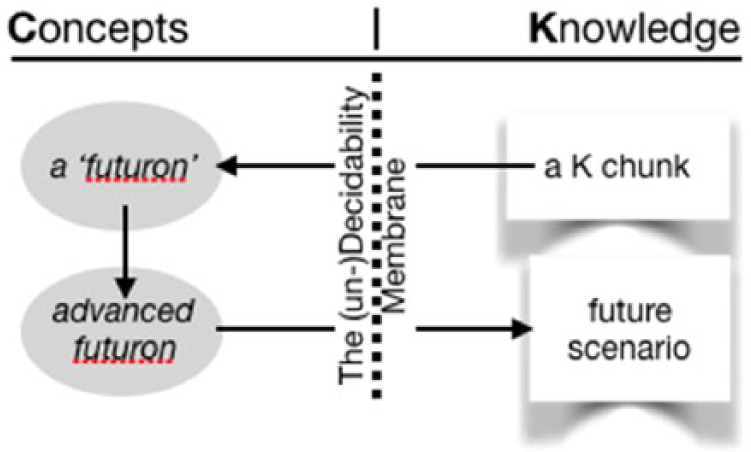
A reversible decidability membrane acts as both a disjunction and a conjunction between the C and K spaces.
We, therefore, apply C-K theory onto the arrow of time (Eddington 1930), not in causal ways by commonsensical segmentation of perceivable future/present/past lines but by dialectically and constructively mirroring these two spaces. By actuating a sort of «connect-the-dots» four-cycle engine called the design square (Figure 2), four generic operators are evidenced, which together implement the full design activity. A designer’s K➔C disjunctive operator would, for instance, read «disconnect from the Known», while an inventor’s C➔K conjunctive operator would read «connect back to a known element». The K➔K manipulations resort to what researchers, scientists, engineers, and technicians routinely perform, whereas the vast and unsought process of logical expansion (C➔C) roots the systematic logical exploration de Jouvenel was advocating long ago. A resulting C/K interplay becomes the generative machine we would expect for building rich, varied, and original representations of futures (a key indicator for navigating the C space being variety), which, in turn, creates instability in the K space, hence, its reordering. We fill the continuity gap through designing a generative mechanism for expanding futures concepts based on formal theory.
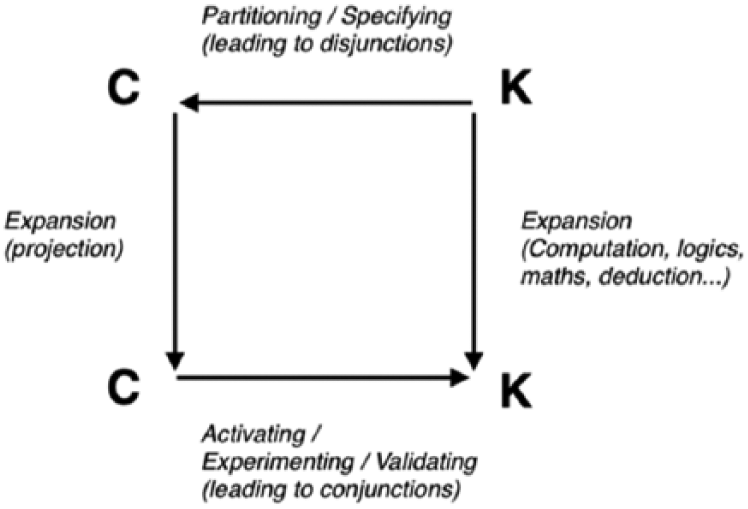
The basic design square of C-K theory.
Putting to Use the C-K Framework
The C-K agency starts from a (yet to unravel) root concept that stands detached from the perimeter of the known K knowledge (the disjunction). The C space is creatively explored through partitioning and expanding one or more progressive tree-structures where nodes (the running concepts) successively get added properties. Note an unavoidable paradox: C elements can only be expressed by using words and phrases, each belonging to the K space. We humans have no other way if we want to actuate concepts and not just be dreaming. Side to this, in the K space, the corresponding pieces of theories, information, data, prototypes, experience, tests, protocols, and so forth constituting the evolving K space stage are called on duty exactly as the whole C-K reasoning necessitates and goes: on demand and as established as true or false (both ex ante and ex post). The C-K process goes through interacting the four corners of the design square (Figure 2).
Specifically:
A conceptual C0 futures expression (e.g., “a green future,” “a future-together,” “a smart future”) is drawn as a blueprint from the given problématique at hand, which could have been in these cases: “how to decarbonize our cities,” “how to engage social solidarity in the population,” “our program is to envision a fair future for our association,” etc.). The problématique encapsulates and results from a preparation step whereby the expression of an initial problem, issue, or observation is given and is only a prelude to the whole futuring exercise. The source expression of the problem could have been “the city is congested with CO2,” “individualistic behavior predominates,” or “we are losing half our members.”
We open up systematic, quasicontinuous stretches of conceptual futures through the C➔C expansion process: a stepwise enrichment of the running concept with add-on attributes, which again satisfy the splitting of known properties in K.
The design process ends whenever one or more junction point(s) is/are found between C and K, that is, a concept gets validated in K or a concept for which specifiable R&D can be performed (with the required additional resources of our three-dimensional or 3D world). These are conjunctions softening and crossing the DM membrane back. The obtained object becomes decidable: it can now be described in K, that is, a future object becomes implementable.
In short, the creative path ending in futures robustness must start upstream at an undecidable stage, while opening up vast (conceptual) reservoirs of “futurabilities”—a foundational step transcending traditional futures studies. Three fundamental positive changes are hereby brought forward:
Futuring becomes a generative process, potentially leading to accepting infinities of futures formulations, thus, cutting off definitively obsolete ideas about “a future.” Generativity is monitored as a design-oriented logic working on knowledge structures, and its degree can be controlled by means of the expansive power released.
“Static” futures items are substituted by the capacity to design futures constructively, to conceive propositions about futures, ultimately, futures embodiments. For instance, ethics, feasibility, and other considerations can eliminate cognitive dissonances and biases found in progressing concepts, thus, generating value.
Progressed conceptual paths traces are evidenced, a documentation justifiably engaging impending stakeholders.
Illustrating the Process
We consider futures cases F expressed as satisfying a given set of n desired properties Pi:
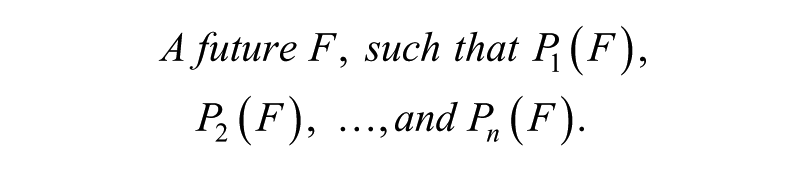
Until this is not the case, a prework is necessary to obtain such form. In field practice, this is called the design phase and is left out-of-scope of this article. In Corsi (2015), we exemplified a series of futures designs stemming from conceptual expressions drawn (the disjunctions) from known science fiction novelists and showed how at least one feasible embodiment (the conjunction) could be achieved. Here are a few examples, where the developments provided are only extracts. Actually, a C-K workshop provides such an extended wealth of results that only vast planar surfaces can accommodate (the room’s walls are literally filled with paperboard sheets).
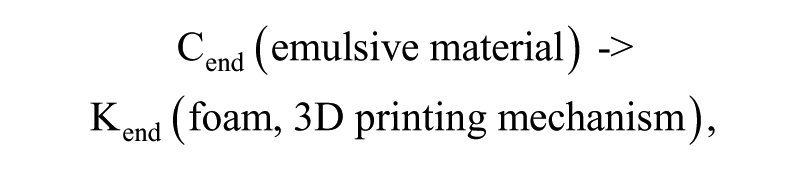
In “A house that builds itself from an auto-polymerizing fluid” from The Seed of Earth by Robert Silverberg (1962), the author’s concept is the “bubble houses,” houses building themselves from an auto-polymerizing fluid, where three liters are enough to build thousands. The C-K diagram resulting from operating the design square is shown in Figure 3. The large number of disjunctions and also conjunctions between the two spaces C and K are not shown here for clarity. To expand the root concept, it was voluntarily freed from too peculiar technical conditions that would prescribe a closing solution too soon, and was rephrased as “a house that builds itself.” In this example (cf. Figure 3), the root disjunction C0 is the operation (not represented in the picture):

Conversely, the conjunction shown goes as,
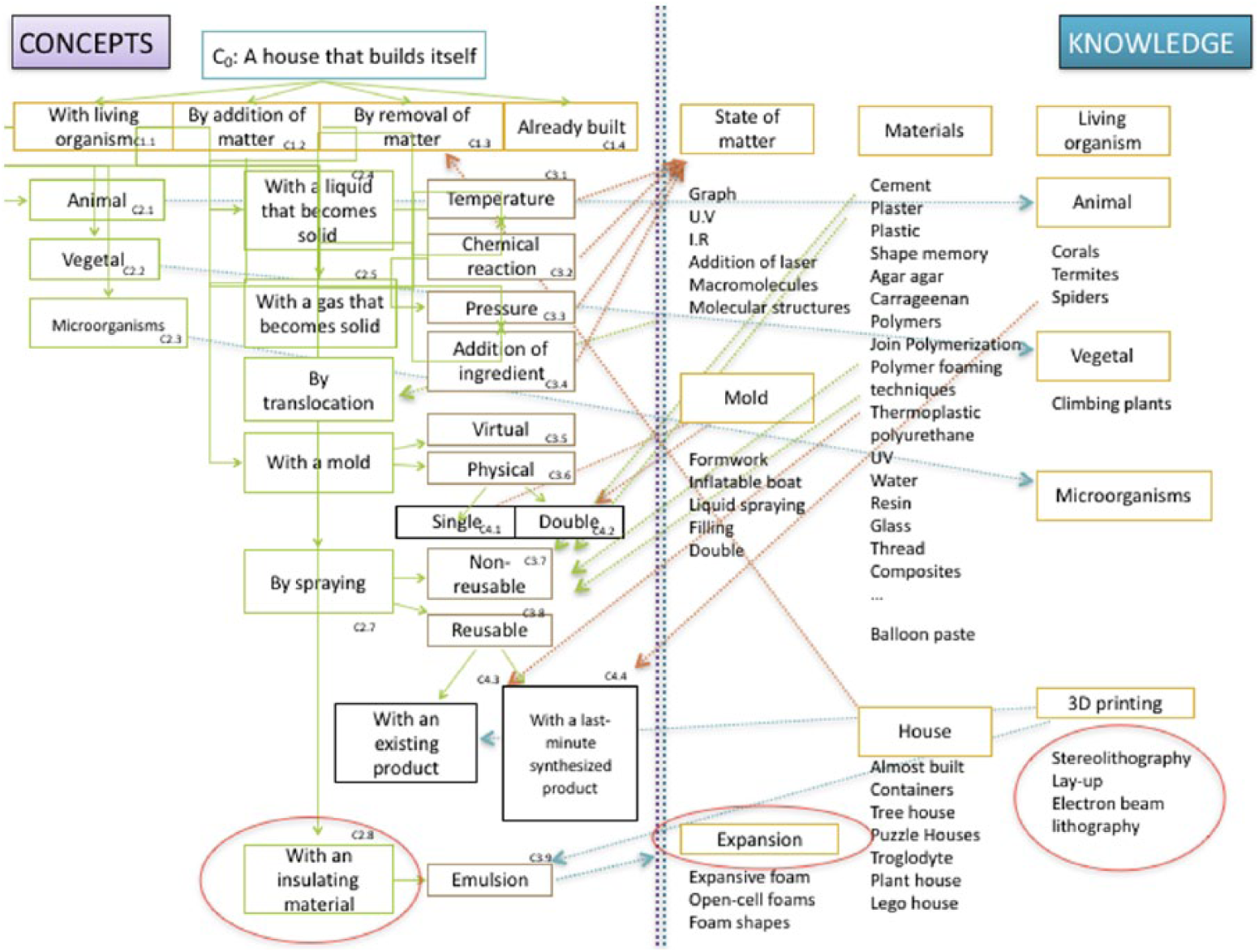
A C-K diagram expanding a “house that builds itself” concept.
whereby Kend is found to be feasible with currently available state-of-the-art. This ends up the whole futures design process. From the conjunctions found (circled in Figure 3), the participants coined a futuristic concept: a house made of foam and polymerized by a laser.
From a set of seven novels including Ray Bradbury’s Fahrenheit 451 (1953), La dixième planète by Charles-Henri Badet (1954), and Fred Hoyle and Geoffrey Hoyle’s The Molecule Men (1973), initial expressions were first conceived: “a world where everything is controlled (time, genetic, etc.),” “The molecule man can transform himself in everything which is alive (animal, human, plant . . .),” “Tribe of warrior women (organization),” and “Previous lives,” suggesting the “Time control” abstraction, eventually leading to formulating the blueprint concept “a man who can travel through time,” and resulting into the following C-K diagram (Figure 4) showing one resulting conjunction as “controlling the effect of time on the human organism” and mobilizing R&D via food nutriments and pointing at crawling nanorobots and nano cars using body sugar as energy.
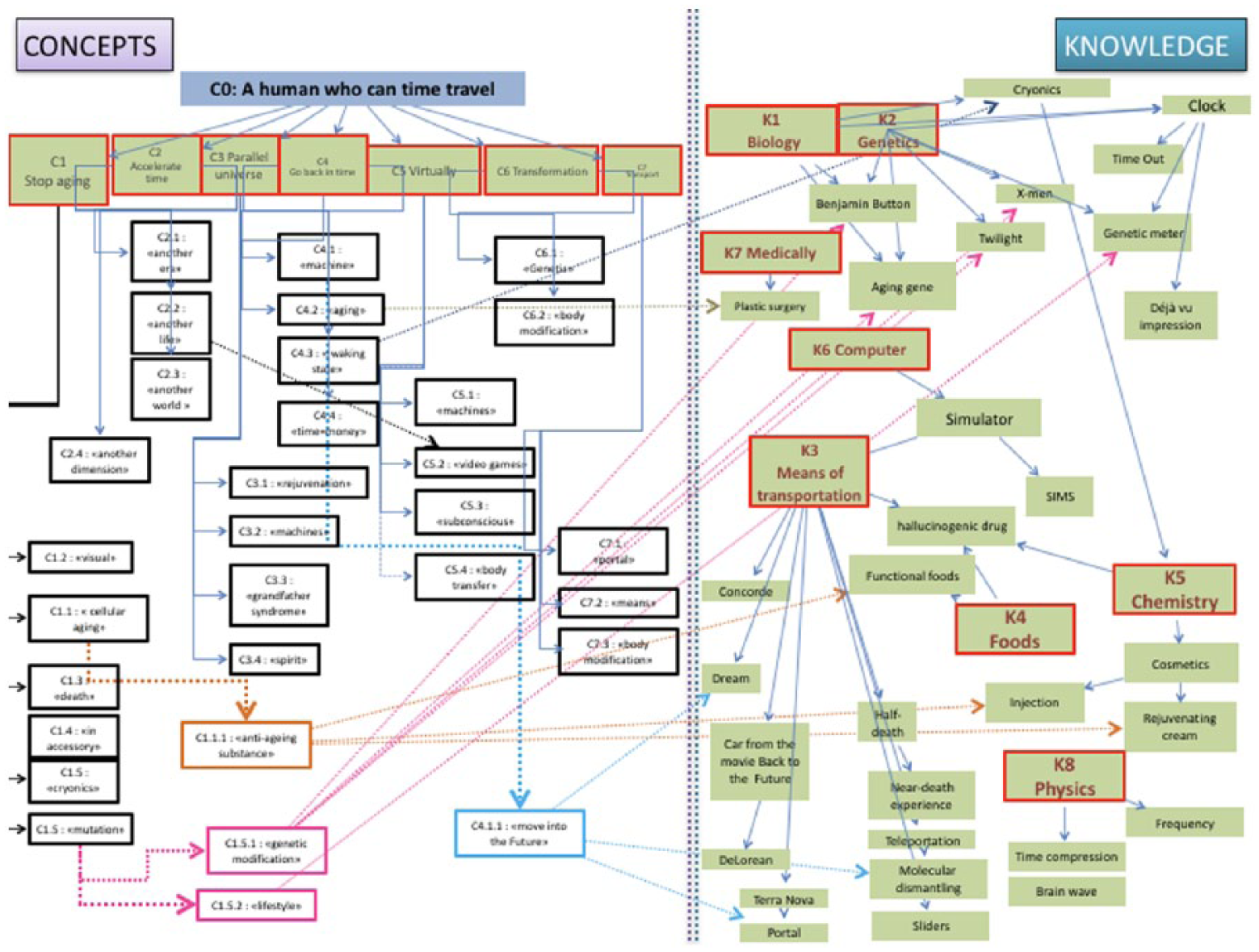
A C-K diagram expanding a “human who can time travel” concept.
The author has conducted more than thirty workshops in academia and industry for designing future ways to address a current known problem, an issue resisting classical problem-solving methods, or forging alternative ways that depart from fixated means and methods. One published case was the study of the evolution of coworking spaces from their initial version as “a working space for common use that can be used as an à-la-carte office by any knowledge worker or maker,” to second generation “a work-dedicated real estate a priori available anytime for visitors,” then “a facility binding space and time conjointly which enhances people’s and all available resources’ synergetically.” In this latter case, the C-K approach resulted in a vast compendium of embodiments, such as the depiction of a store-which-is-not-a-store (see photo by the author in Figure 5). Actually, in Corsi (2015, 97), we decoded the first Apple Store built as more than a store (Figure 5):
a central grove surrounded by grown up trees inviting to share, work and cooperate, mixing creative people from different generations; specialized areas proposing events, chats, even rest; longitudinal alleys connecting them all as a fluid link; the cathedral-like room uniting the interior and the exterior through giant wavy glass structures in one living-experience continuum; and the store inviting the street and reciprocally, each absorbing the other into everyday life and culture.
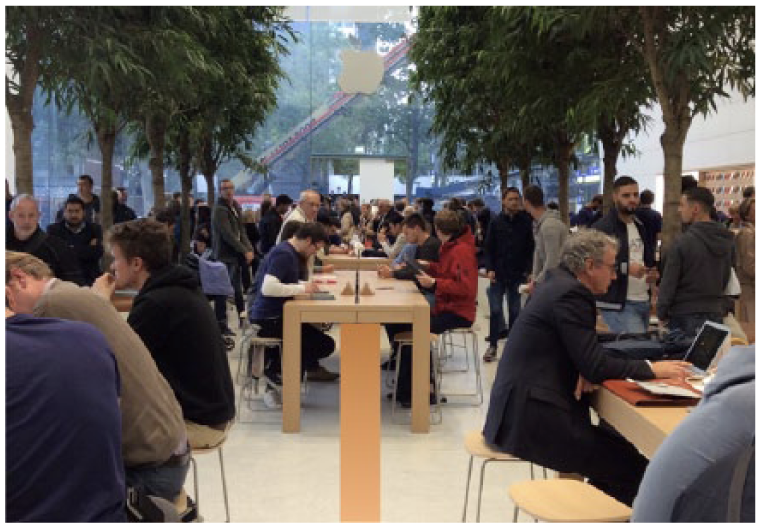
A collaborative model that is more than a store.
In other cases (cf. the two following diagrams in Figures 6 and 7), the problématique of C0 “urban traffic infrastructure” led to the undecidable blueprint concept of C0 “a city-bound transportation without wheels” by considering the following knowledge subdomain set:
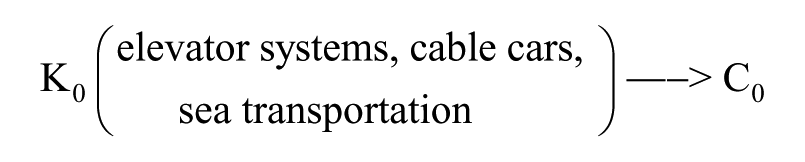
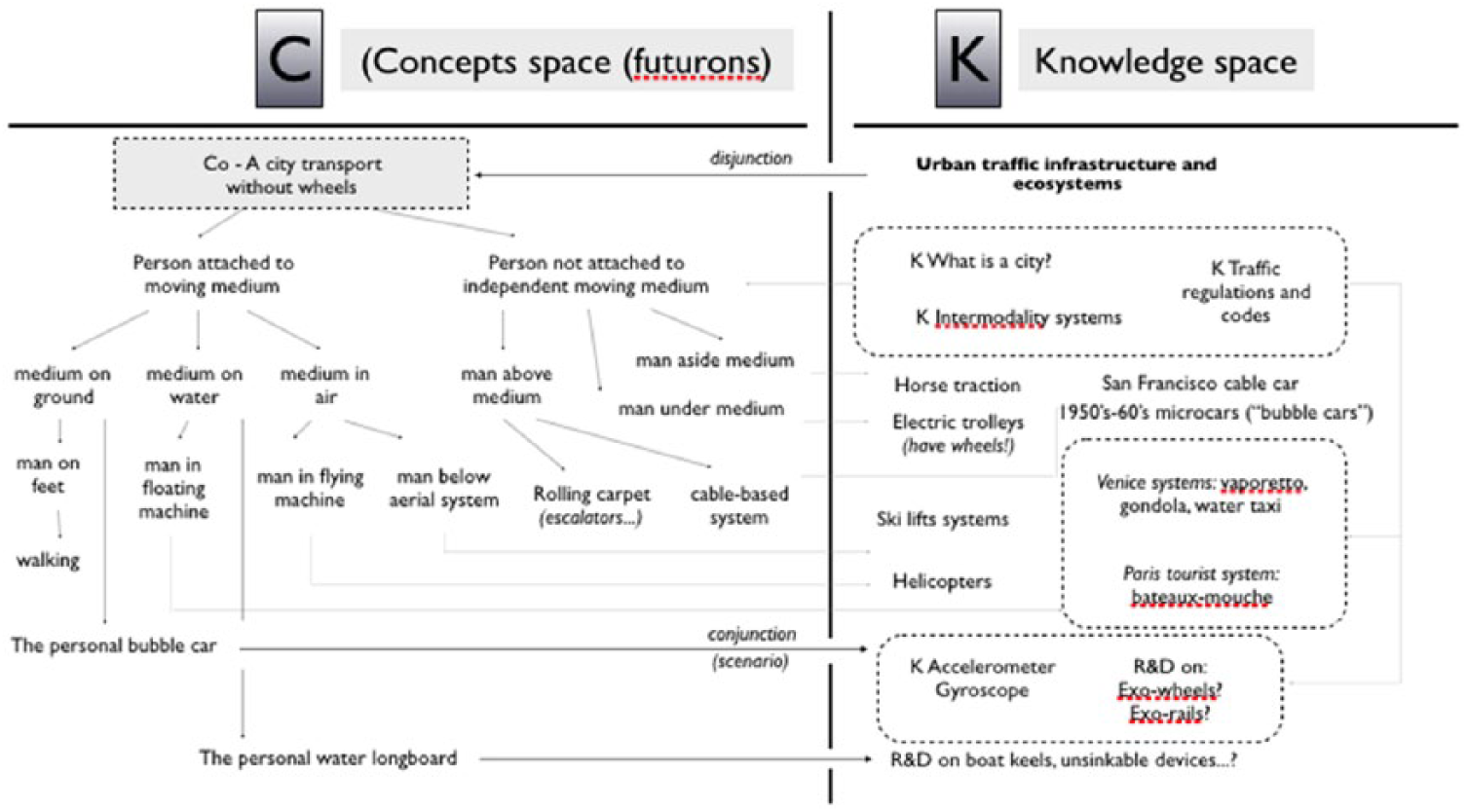
Cracking down the fixation on wheels in cities.
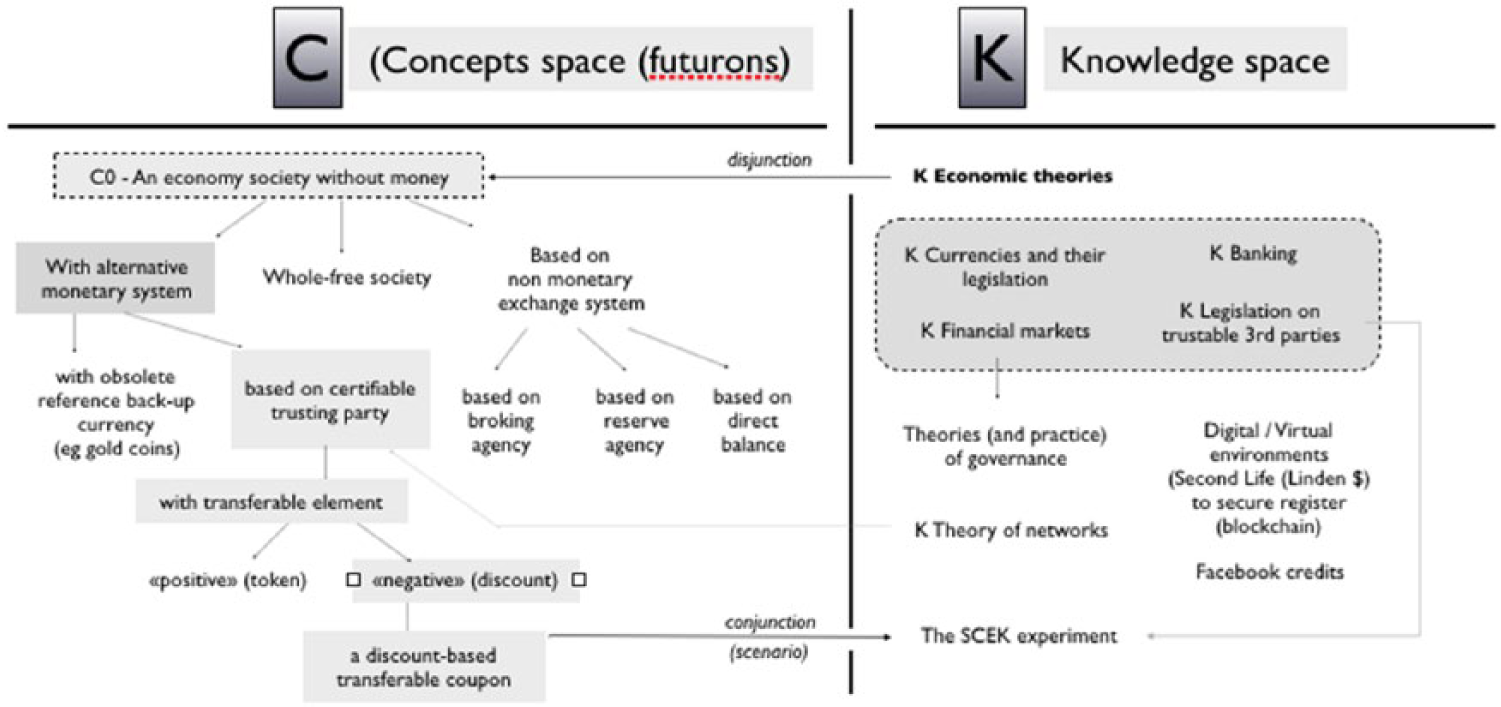
Breaking away from a dominant design of economy: the centrality of money.
This disjunctive root operation directly breaks the “fixation on wheels” that created cities’ congestion. Note this workshop was performed before automated drones, self-driving autonomous vehicles, and other Hyperloop projects came of age. The chief reason we show this example is for the generic method mechanism: back in 2018, we would populate the K base with a collection of innovative projects that have now come of age: the power of the method could be extended toward electromagnetic sustentation, antigravitation systems, and so forth, even quantum entanglement!
Likewise, “a moneyless economy” C0 expressed the generic focus idea to depart from mere accumulation of money at fixed locations, thus, circumventing a number of dominant designs of traditional economy. The generic power of this undecidable C0 is such that it could even lead to creating a legal alternative to a currency by means of discount coupons (backed by a national currency anyway). In Corsi (2015), we wrote, in a similar vein to Haldenby stirring around scenarized experiences, to reflect how new technologies emerge through human-centered design techniques (Haldenby 2013). Our experiments bring forward designed agendas enhancing possible society’s values and goals, timely projecting previously undecidable future elements into actionable projects roadmaps. They provide value to ideas, for example, a house-building concept may bear contextual value in emergencies by providing shelters for people having lost homes.
As we conceive new futures from the above design-based constructive approach, a futures management (Le Masson et al. 2010) discipline needs to be nonetheless promoted, to include services provisions and accompaniment. The strategy motivating such manipulation of futures can hopefully be made transparent when exercising it, and with it, proper ethics and governance.
How Close to Some Science Status Do We Get?
Using the C-K formalism is a step toward reorganizing futures research into a science. Qualitatively first: processing two separate C-K workshops on the exact same problématique (as per K—>C disjunctions), with same logistical determinants (in particular, identical participants profiles, expertise, and cultures), and the same background knowledge will theoretically lead to, not obtaining the exact same results, but develop similar sets of high-level conceptual expansions. This is important to note, as the semantic referential of the two groups and the expansive ability (the specific C—>C capacity) are supposedly identical in both cases. The originality criterion is, therefore, theoretically preserved by shifting groups. In practice, subjectivity predominates any human-based workshop, and we tend to compensate the results drifts quantitatively via more coverage, balancing groups, or swapping some of their members.
Quantitatively then, it is obvious the number and variety of results depend on the amount of resources thrown into the exercise: time, effort, availability of external knowledge sources (such as thesauri, corpuses, domains of expertise, i.e., K—>K operations). We can only assume that, with infinite access to infinite resources, the two groups will eventually detect equivalent C—>K conjunctions. Moreover, the author has observed that leading two distinct groups of participants at two different epochs on the same problématique led to rediscover and opportunistically extend the findings of the earlier runs, which offers a way for ever capitalizing on previous results while happily evolving the K base in actual contexts.
Boundaries and Limits of the Approach
Clearly, C-K theory helps thinking differently, laterally, and via the opening of radical new futures. Yet, the application and processing of the theory shall first need to free us (individually and also collectively in workshops) from status quo conditions, namely, cognitive fixations and mental bias (although we stressed that a K space ought to be used as the only available defixating springboard).
Thus, the theory cannot help the up-front choosing or formulating of appropriate root concepts at the first stage: only the practitioner needs to prove enough maturity at an early stage by scoping in and out the consistent and coherent problématique, which essentially represents and also covers the original statement issued. The art of shifting the expression of a complex-problem-to-solve into an addressable problématique usually requires a number of exchanges with the problem owner—should it exist, however (the above said Design phase). Yet, this can be a qualifying test for futuring professionals in the field.
Accessorily, C-K theory presupposes some implicit partitioning criteria or method in C, as far as these can easily be hoped to be made explicit. Heuristics are welcome but often denote specific viewpoints about the problématique: designing futures in generic ways is not a natural skill, nor is not taught yet, it seems. In the end, it leaves unclear the proper valuing of the conjunctive expressions found, while the merit, desirability, or usefulness of such result may more reasonably fall onto the hands of seasoned stakeholders (field experts, validation agencies, marketers . . .).
Furthermore, despite the manipulation of knowledge it implies (classifications, reorderings), C-K theory does not make direct reference to Knowledge management discipline.
Second, the implementation of C-K theory is only as extensive and equal to the task of addressing the problématique as the field implementers are dedicated to perform with logical discipline. And field workshops populated with arrays of stakeholders remain the norm as necessary ecosystemic ingredients, plus, experienced futuring coaches not only control the workshops’ implementation and unfolding, but also animate them and accompany the corresponding ecosystem(s) of players harmoniously, coherently, and sustainably toward innovative solutions.
While one of the theory strengths is to enable co-creation and collective design—and this applies so well to futures contexts—the proper decompositions of complex problems into parallel and possibly remote groups of designers is, at the moment, unspecified. This would, indeed, be useful for tackling, for example, the most complex issues of society today (say, environmental, societal, and financial/economical) in converging ways, while few methods, if any, appear to be suitable enough for such daunting tasks.
Finally, the field value resulting from implementation should still be assessed (forcibly in K!) as to justify the findings and support for planning, roadmapping, policy-making, or else decision-making. Hence, a tailing phase that articulates the conjunctive (and perhaps surprising) findings with the necessities and determinants of the target organization or environment remains necessary. Perhaps the greatest barrier to any paradigmatic shift resulting from a C-K approach is, in some high-end cases, the reality of paradigm paralysis. In other words, the inability or refusal to see beyond the current models of thinking. Our international consultancy in building future innovation capacity for clients has long been facing the situation, and we found that a degree of maturity in the target mindset helps starting off with enough a priori confidence. Often, target organizations have tried out several methods and approaches before resorting to a C-K implementation. Of those that did, none backtracked, far from this. They discovered new avenues, capitalized upon them, and their new discovered challenges were twofold: disseminating the benefits beyond the results and setting a genuine changing game across the organization.
Considering Further Research toward an Epistemology of Futures
The approach introduced in this article applies to the elaboration of exploratory scenarios. The chief contrast with normative scenarios is the capacity to explore an unknown and not be bound to problem-bound goals. As for exploratory scenarios, this article places a call for systematizing the exploration of the very definition of scenarios. The approach presented can be used as a front-end step for the preparation of scenarios grounded on the four C-K theory criteria of originality and variety of the concepts elaborated, and the robustness and value of proposed scenarios. Hence, we propose a third type of scenarios beyond normative or exploratory, which we name design-based.
We played a selection of science fiction extracts mechanisms to forge accessible futures and are tempted to say that science fiction writings are a gold mine for futurists once these can be equipped with a suitable methodology that aptly crosses the decidability membrane. Movies, too, based on writings or not, can illustrate undecidable concepts and serve the same purpose.
There are many other suitable stories that might have been used in the C-K diagrams. For instance, “The Veldt” on future homes (creating a foreign environment in a room through augmented reality), although Bradbury did not use that term, or “The Sound of Thunder” about time travel, and so forth.
In the Hawaiian metaphor recalled in the introduction, the future emerges . . . “behind.” What does “behind” mean for a Westerner? Is it actuating the “dark” C space that illuminates the seeker? By replacing scenarized futures with a process founded on C-K theory, the professional activity commonly named futurism can be founded on solid conceptual grounds, themselves backed by theory. By accepting the dialectical C-K interplay, we transcend the boundaries of the Known, hence, do create fresh futures, while favoring both its collapsing and a due accompanying regeneration.
We endeavor considering the futures studies field to “be very different from what it has been and is now” (Dator 2017a), where field futurists are venturing far beyond decision-making and being problem solvers, becoming designers of futures—the morrow architects opening up entire realms of collective becoming. And the C-K formalism has been shown as a model for designing generative futures.
We end up formulating three research hypotheses regarding the design of generic futures:
Setting the conditions for generating futures. For instance, generic futures generativity implies (1) combining available K elements, (2) reordering this base, and (3) designing a new entity that cannot be found in the knowledge base. The specific conditions for these three steps are part of the practice.
The density of future elements obtained shall be contrasted to the paucity of, for example, scenarios or images of the future that are customarily used in practice. Density is a necessary property for it embeds and results from the generative process. C-K workshops end up with multiples of ten (sometimes much more, depending on resources and the effort put in) of resulting projects-concepts (the resulting appropriate scenarios if we wish). The rapport of their number to the complexity, importance, or urgency of the problématique at hand may constitute a guiding indicator for pouring adequate resources into them.
The study of outstanding visionaries (e.g., Alvin Toffler or Steve Jobs, to name only them), science fiction authors (e.g., Jules Verne), and exceptional innovators (e.g., Leonardo da Vinci or Elon Musk) as generative exemplars may reveal patterns of futuring—not quite through what they have actually accomplished, but along the deeper process they (might) have followed or conceived themselves, which is the method.
We studied and correlated some of the ways of geniuses, their knowledge base, and the evolution of same (i.e., in Corsi 2015, science fiction and future studies; in Corsi and Morin 2016, Jobs and da Vinci) in light of C-K theory and found compelling arguments in favor of our number 2 design imperative above: the need for density, yet more research is needed to assemble the findings. The use of C-K consistently leads to new, regenerating futures grammars—is it not precisely what we need for endeavoring to walk toward a “futures science”?
Footnotes
Declaration of Conflicting Interests
The author(s) declared no potential conflicts of interest with respect to the research, authorship, and/or publication of this article.
Funding
The author(s) received no financial support for the research, authorship, and/or publication of this article.