







Abstract
Human population growth and dwindling fragmented natural habitats for elephants in Asia are leading to increasing conflict between humans and wild elephants. Sohail Inayatullah’s Causal layered analysis (CLA) is applied to understand the human–elephant conflict (HEC) situation. Gregory Bateson’s “ecology of mind” (EoM; epistemology, recurrence, abduction, and metaphor) is also employed to focus on possible implications of metaphor, epistemology, and social–psychological misalignments. The article aims to inform multidisciplinary practitioners on the relevance of applying both CLA and EoM to social–ecological issues in the twenty-first century. CLA and EoM are compatible and complementary multilayered approaches which, as metaphorical approaches, share mixed entailments. Bateson’s “double bind” theory is applied within CLA to explore the implications of possible Asian elephant extinction within the Anthropocene in respect to Indian (Hindu and Buddhist) cosmologies.
Introduction
This article applies causal layered analysis (CLA; Inayatullah 2004, 2008; Inayatullah and Milojević 2015) to understand the social and ecological implications of possible Asian elephant extinction during the Anthropocene. 1 Gregory Bateson’s ([1972] 2000, [1979] 2002) principles of “ecology of mind” (EoM) 2 are considered within CLA to help establish a futures studies platform to evaluate social–ecological misalignments within human–elephant conflict (HEC). CLA and EoM are not compared in a competitive framework seeking dominance. Rather, value is given to applying both within a foresight toolkit to deepen multilayered analysis of Asian elephant futures and develop a suitable design approach. 3
Initial steps toward developing an approach to Asian elephant futures research (EFR) commence with comparative metaphorical analysis of how elephants have been constructed historically within civilizations. CLA review of possible Asian elephant extinction by 2080 involves analyzing the social system factors involved in elephant policy and management, assessing impacts on worldview-related issues, and exploring underlying elephant-related myths, metaphors, and possible transformations. EFR is a combined CLA-EoM approach which can be generalized to other elephant species. 4 The Asian elephant is classified as endangered (Choudhury et al. 2008; International Union for Conservation of Nature [IUCN] 2017). CLA exploration, via myth and root metaphor analysis, is especially suited to HEC in Asia where natural elephant habitats are increasingly pressured by growing human populations dominated by traditional Hindu/Buddhist cosmology, religion, and culture. 5
The article provides an overview of Asian elephant extinction risk in the twenty-first century followed by an outline of both CLA and EoM as they relate to EFR. The article then indicates where EoM principles may support deeper CLA focus on possible double bind conditions involving dissonance between myth/cosmology, sacred symbols, and the realities on the ground—for example, HEC and captive elephants in temples, tourist parks, conservation reserves, and zoos. 6 The “Elephant” provides a root metaphor for this exercise in respect to twenty-first-century CLA futures studies and possible “blindsiding” risk (Fukuyama 2007; Harris 2002) within an emerging Asian Anthropocene context (Inayatullah and Na 2018). A variety of elephant-orientated myths/metaphors are considered as inputs for CLA relevance in establishing an effective EFR approach—for example, elephant and six blind men, elephant in the room, and white elephant. In this process, CLA and EoM are synthesized as metaphorical “entailments” (Lakoff and Johnson 1980) across elephant-related fable, myth, metaphor, and symbol. EFR then emerges as a critical futures studies model supporting interdisciplinary research and coordination—a frontline need identified by Jadhav and Barua (2012) and Buchholtz et al. (2019).
CLA has limitations and can be applied effectively in conjunction with other deepening processes (Inayatullah 2002a). EFR invokes a “bird’s nest” metaphor used to describe integrity and strength within both national integrity systems and cross-disciplinary praxis (Sampford et al. 2005). Kelly (2008, xxi) combines CLA and sense making (in the vein of Dervin et al. 2002) as complementary methodologies: “CLA and Sense–Making were appropriate because their complementarities include a critical metatheory which guides their methods.” In this sense, CLA belongs to (and creates space for) open, plural, and cybernetically recursive processes within a mature futures studies “globally distributed metadiscipline” domain—that is, a futures studies approach that integrates various sources of “materials, data, ideas, tools” to support “disciplined enquiry into creating human futures” (Slaughter 2004, 36–37). EFR extends this principle to nonhuman futures via Asian elephants. CLA poststructuralism and EoM cybernetics have common historical roots. Lafontaine (2007) outlines the post–Second World War influence of cybernetics on the development of French thought and the evolvement of “French theory” (Cusset 2003) within American technological innovation and postmodernism: Not only is La Condition postmoderne [Lyotard 1979] brimming with references to cybernetics, Bateson and the Palo Alto theorists, but the whole differential logic of postmodern knowledge rests on the informational model. (Lafontaine 2007, 40)
Background Steps toward Elephant Futures in a Rising Asia
Setting the HEC Scene
Rapid economic development in Asia and specifically human population pressures and conflict-related migrations are leading to fragmented unviable natural habitats for wild Asian elephants (World Wildlife Fund 2018). The United Nations Department of Economic and Social Affairs (UNDESA 2019) estimates that global human population will increase by 2 billion people over the next thirty years to a total of 9.7 billion by 2050. By 2100, the world’s population could peak around 11 billion with India ranking highest in UNDESA’s list of nine countries with the largest population growth forecasts. India’s human population is expected to surpass China by 2027 and reach around 1.4 billion by 2100. 7
Initial EFR focus is placed on India where between 60 and 80 percent of the remaining Asian elephant populations reside (mainly in Kerala and Assam)—a situation involving around 20 percent of the world’s human population coexisting with wild elephant habitat resulting in “considerable conflict between people and elephants, and with institutions wanting to conserve elephants” (Jadhav and Barua 2012, 2). This situation leads to increased HEC in borderland regions (Shaffer et al. 2019). In India, on average, elephants kill in excess of four hundred people per annum and around one hundred elephants per annum are human retributive action (Rangarajan et al. 2010)—an outcome resulting in more than five hundred thousand families affected by HEC (Desai and Riddle 2015, 3). Agricultural crop loss to elephants in India has been estimated between 0.8 and 1 million ha annually and between ten thousand and fifteen thousand houses per annum destroyed (Bist 2006, 30). Some Indian states are affected substantially more than others, and, on average, farming families may lose “approximately 11% of their annual grain production (0.82 tonnes per family) to elephants” (Madhusudan 2003, 466).
The individual and social consequences of HEC on human well-being in India are significant—mainly due to interrupted sleep, stress, and drug/alcohol consumption by subsistence farmers protecting their agricultural crops from wild elephant raids. Poorly documented casework, due mainly to “disciplinary constraints and absence of a dialogue between human geography, conservation science and public health,” leads to poor wild elephant policy and management (Jadhav and Barua 2012, 9). The following quotation describes the EFR situation under focus: Human geography has made significant advances in blurring the divide between nature and culture. It formulates a more inclusive political ecology that takes into account the influence of nonhuman animals and materials in social and political outcomes (Braun and Whatmore 2010; Latour 2004b; Whatmore 2002). The field of psychiatric geography, which focuses on the spatial distributions and environmental correlations of mental ill-health, has theorized the entangled relations of mental health, society, space and environment (Curtis 2010; Kearns and Moon 2002; Philo 2005). Similarly, clinically-applied anthropology and cultural psychiatry have sought to establish links between culture and psychiatric diagnosis. They seek to demonstrate the cultural construction of suffering (Jadhav 2001; Jain and Jadhav 2008). (Jadhav and Barua 2012, 9)
Facilitating interdisciplinary communication between “human geography, wildlife conservation and public health” aimed at developing a “more holistic understanding of issues at the forefront of human wellbeing in the 21st century” aligns with a CLA-EoM paradigm (Jadhav and Barua 2012, 9). 8
Asian Elephants at Risk
Asian elephants (Elephas maximus) are classified as endangered on the IUCN’s (2017) Red List of threatened species. Global Asian elephant population is estimated at around forty thousand with some fifteen thousand living in captivity (Choudhury et al. 2008). The major trends across Asia contributing to this situation include human population growth, economic development, illegal poaching, agricultural encroachment, diminishing and increasingly fragmented natural habitat, industrial-scale palm oil plantations, 9 climate change with increasing temperatures and droughts (especially in India), corrupt government, 10 and increasing wealth driving demand for elephant ivory and skins for “natural” medicines.
Ancient Evolutionary History
Elephants belong to the family Elephantidae, the sole remaining family within the order Proboscidea, and fall within the clade Afrotheria which includes five other related placental orders: Sirenia (dugongs and manatees), Hyracoidea (hyracoids), Macroscelidea (elephant-shrews), Tubulidentata (aardvarks), and Tenrecoidea (tenrecs and golden moles) all of which have evolved since the Cretaceous (Tabuce et al. 2008). Three existing species of elephants are recognized: African bush elephants (Loxodonta africana), African forest elephants (Loxodonta cyclotis) of Sub-Saharan Africa, and Asian elephants (Elephas maximus) of South and Southeast Asia. Two related species, Palaeoloxodon antiquus (straight-tusked elephant) and Mammuthus primigenius (woolly mammoth), became extinct at around 50,000 years BP and 4,000 years BP, respectively. Extant human and elephant species have survived five natural mass extinctions (Barnosky et al. 2011; Ceballos et al. 2015; Ceballos et al. 2017; McRae et al. 2017). A sixth mass extinction now appears underway, this time largely driven by human development and evolution. The Anthropocene, a proposed new epoch emerging from the Holocene, represents significant human impact on the planet’s geology and ecosystems (Steffen et al. 2011; Zalasiewicz et al. 2010).
Recent Historical Trends
African and Asian elephant populations have reduced from an estimated 1.3 million in 1970 to below five hundred thousand today mainly due to poaching and habitat loss (Cohn 2006). Estimated Asian elephant populations at commencement of the twentieth century exceeded hundred thousand and have reduced to at least 50 percent within three generations (Choudhury et al. 2008; Sukumar 2006, 2008). The average life span of captive elephants is approximately 50 percent of wild elephants—around thirty years compared with sixty years. Captive elephants do not generally breed and captive populations are usually replenished from wild stock. Reduced life span of captive elephants is attributed to stress and diseases (e.g., tuberculosis), which can also infect wild stock (Miller et al. 2019; Murphree et al. 2011). A twenty-four-month gestation and four-year weaning period result in slow elephant population recovery rates. Natural habitat has dwindled to 10 to 15 percent of its historic range with future scenarios indicating a further 42 percent loss of natural elephant habitat in India and Nepal due to climate change (Kanagaraj et al. 2019). Historical evidence suggests Elephas maximus originally roamed as far west as the Egyptian delta and Syria, throughout the Persian Gulf, India, and north into northern China (Elvin 2004; Riddle et al. 2011). Borneo supports the most easterly populations of extant wild Asian elephants (Alfred et al. 2011). 11
Elephants once existed across China but now only a small residual population of approximately 200 reside in southern provinces. Elvin (2004) applied the retreat of China’s elephants as metaphor for an environmental history of China. The eastward retreat of the Asian elephant from the Mediterranean has passed through Pakistan where it is now considered regionally extinct (Choudhury et al. 2008). The main extant populations today are located across thirteen countries with concentrations in India, Sri Lanka, and within small localized regions around Thailand and Myanmar (Choudhury et al. 2008).
Future Trends and Futures Studies
Trends in human population growth and Asian economic development suggest a poor prognosis for the Asian elephant species during the remaining twenty-first century. Social, technological, economic, environmental, and political (STEEP) factors are conspiring against the survival of the species—along with many other endangered species across Asia such as the tiger, rhinoceros, and orangutan. Empirical research resources and conservation strategies focus complex issues within disciplines. As noted earlier, unfortunately, much like the fragmenting wild habitats, joined-up policy and interdisciplinary research is poorly developed (Buchholtz et al. 2019; Jadhav and Barua 2012): In studies looking at human-elephant interactions within SES [social-ecological systems], studies have focused separately on the behaviors of people or elephants . . . This leaves many questions unanswered about the nature of human-elephant relations and provides a compelling gap in knowledge for interdisciplinary research and synthesis. (Buchholtz et al. 2019, 2)
As a key species, with highly symbolic significance in traditional Asian culture and lore, the Asian elephant represents an opportunity for futures studies research. Western “used futures” and eastern “disowned futures” (Inayatullah 2008, 5)—including those aspects of self and future scenarios suppressed by dominant controlling ego (Inayatullah 2007a; Stone and Stone 1989)—are supporting disconnection between human development and ecological sustainability in the Asian region. 12 Nonlinear rates of growth/collapse can quickly combine to create systemic instability and unsustainable outcomes, and to mix metaphors, the Asian elephant is becoming a huge “canary in the coalmine” staring humanity in the face. The Asian elephant’s precarious future is a regional-scale twenty-first century “elephant in the room” helping focus sustainable futures studies on the need for coordinated cross-disciplinary research and resources allied with preferred elephant futures scenarios.
With the introduction completed, we can now proceed with CLA and EoM overviews—including a synthesis outline for EFR design focused on myth and metaphor. The CLA overview is short and condensed providing general outline and genealogy. 13 Bateson’s EoM is less developed within futures studies and therefore justifies more extensive examination for CLA synthesis in support of EFR design.
Inayatullah’s CLA within Critical Futures
CLA (Inayatullah 2004) resides within a six-pillars futures studies approach developed by Sohail Inayatullah (2008): “Futures studies is the systematic study of possible, probable and preferable futures including the worldviews and myths that underlie each future” (Inayatullah 2013, 37). CLA is an open, pluralistic futures studies research theory and method that “seeks to integrate empiricist, interpretive, critical, and action learning modes of research” to establish “transformative spaces for the analysis and the creation of alternative futures” (Inayatullah 2017, 3).
14
CLA is “both a method and a process theory”—“[a]s an analytic method CLA functions taxonomically, as process–theory it functions rhizomically” (Bussey 2014a, 49).
15
CLA does not specify the methods for working vertically through, and horizontally across, layers. CLA assumes how a problem is framed influences the policy solutions and those responsible for promoting the desirable transformations (Inayatullah 2007b, 14): Instead of future facts (trends or emerging issues), what is needed are new, culturally self-aware interpretations of the future. (Inayatullah 1990, 122)
CLA is a four-layered critical futures analysis of the social, economic, and political causes behind worldly events. It involves deeper investigations into the underlying systemic activities (social systems), associated worldviews, and supportive myths, metaphors, and narratives (Inayatullah 2004). The four CLA layers represent “data, systems, worldviews and myths,” respectively (Inayatullah 2010, 99). Data, systems, and worldviews, the “cognitive lenses we use to understand and shape the world,” are deconstructed to reveal the “deep unconscious story” buried within associated operative myths and metaphors (Inayatullah 2008, 12). Integrated critical analysis of a situation (litany/data) across other CLA layers helps identify opportunities for strategic change, new language, and metaphor transformations: CLA “identifies the competing narratives, identifies new narratives, and seeks solutions from outside the existing framework” (Holdaway 2016, 22).
CLA Layer 4 is the most influential and pivotal mechanism informing all other layers of new meaning and transformational change potential (Inayatullah 2003; MacGill 2015). Once desirable metaphor change is identified, then corresponding changes can be reflected throughout other CLA layers—that is, worldview, social systems, and eventually litany via action learning with revised key performance indicators (KPIs) supporting operationalization. This process increases the probability of success by reducing opportunities for inertia and resistance originating in misalignments between layers. The most common representation of CLA uses an iceberg analogy with the top layer above the waterline indicating litany while the lower regions represent descent into deeper underlying systemic, worldview, myth, and root metaphor layers. CLA can be approached systemically, or rhizomically as an unstructured organic network (Bussey 2014a), depending on context and personal choice of framing metaphor. 16
Critical Futures Context
Critical futures perspectives were originally introduced into futures studies as an “epistemology of foresight” by Richard Slaughter (1982, 1998, 1999b) based on the critical theory of Jurgen Habermas—a “second-generation member of the Frankfurt school of critical theory, [who] was a student of Max Horkheimer and Theodor Adorno” (Ramos 2003a, 16). Slaughter’s (1999b) conception of critical futures drew from Habermas’ theory of cognitive interests wherein broader knowledge arises from three types of cognitive interest (technical, practical, and emancipatory) considered necessary for human well-being. Critical involves questioning philosophic meanings and investigating worldviews to facilitate: (1) “culturally situated ways of knowing”; (2) “problematising existing social arrangements and assumptions regarding the future”; (3) “breaking the mould of historically reified ways of being, to open up alternative futures otherwise obscured”; and (4) “emancipatory social innovations and creativity for cultural renewal” (Ramos 2003a, 18).
Richard Slaughter met Sohail Inayatullah in 1986 while traveling to Australia via Hawaii. He found close affinities between his critical futures work and Inayatullah’s developing “typology for futures studies using three epistemological categories, predictive, interpretive, and critical, based on the work of Michael Foucault” (Ramos 2003a, 16). The CLA’s genealogy within critical futures studies research, including relationships with Integral Futures (IF), is outlined in Inayatullah (2004, 2010), Ramos (2003b, 33–53), and Morgan (2011). A fundamental debate occurred within futures studies between 2008 and 2010 related to the use of IF. These debates centered around perceptions of undue fragmentation and overabundance of variety within the futures studies’ domain: “As a matter of fact, one reason for the emergence of IF is to address the problem of fragmentation in FS [Futures Studies]” (Morgan 2011, 124). Ken Wilber (1995) applies “holon” (Koestler 1967) in a search for more depth within his Kosmos (Goff 2013, 67) as “the pattern that connects” and is generally dismissive of Bateson as a theorist referring to his writing as “one dimensional” (Wilber 2000b, 328). 17 In contrast, Bateson takes recursion as a mental device and metaphor rather than an ontological reality (Harries-Jones 1995).
Poststructural foundations of CLA focus on problematizing existing structures and generating alternative perspectives (Inayatullah 1998). Drawing on Foucault (1972), emancipatory attention is given to power, exclusion, and the dynamics of oppression within a situation. Combined with the instrumental and practical through a contextual “six pillars” framework (Inayatullah 2008), CLA facilitates critical futures studies research at deeper levels. This accommodates and aligns with G. Bateson’s ([1972] 2000) EOM theories using metaphor, abduction, and stereoscopic vision analogy in his double description.
18
Bateson’s focus on relationships, patterns of connecting, and the spaces between contrasts with Wilber’s focus on things and everything—for example, “Integral Theory of Everything” (Wilber 2001). Whether variety is framed negatively as fragmentation, loss of quality, and dissolution or positively as openness, epistemological diversity, and ecology largely depends on several factors: temperament, intent, sentiment, and the quality of the metaphors applied with respect to communicating and representing requisite variety (Ashby 1958). Bateson’s approach clearly favors open, pluralistic, incomplete models that allow space for “ecological” coupling: The most profound insight for me came towards the end of the film. Ms. Bateson [daughter] relates here how her father [Gregory Bateson] taught her that to be really complete, incompletion must be included in the system. (van Boeckel 2011, 4)
CLA 2.0
“CLA 2.0” reader (Inayatullah and Milojević 2015) contains theoretical and methodological discussions with twenty-nine varied case studies from a total of forty-two authors and covering “topics such as the environment, conflict and security, national aspirations, finance, education, health and well-being, the workforce, community, film and art” (Inayatullah and Milojević 2015, 2). Here, Inayatullah notes double binds exist and are relevant in CLA, although examples do not reference Bateson’s multilevel learning approach: By identifying the issues (the internal research question) and the double binds that restrict their solutions, individuals create alternative maps of their consciousness and then move toward a new metaphor, a new life narrative, and consequently an alternative future. (Inayatullah and Milojević 2015, 14)
19
CLA can accommodate a spectrum of discourses across empirical-symbolic and dominant-marginalized dimensions (Milojević 2015, 536): “CLA is a tri-dimensional method, exposing the inner and the deeper aspects commonly hidden from view” (Milojević 2015, 555). “Tri-dimensionality” aligns with Bateson’s approach and strengthens CLA’s conceptual linkages with a genealogy privileging “beyond-binary” science paradigms traceable back through Peirce (1955) and John Locke, to Aristotle. 20
Bateson’s Recursive Epistemology and Theory of Mind/Mind (EoM)
G. Bateson ([1972] 2000; [1979] 2002) begins with the nonmechanical metaphor “steps to an ecology of mind” and continues his theoretical journey further refining an ecological and recursive epistemology focused on the “necessary unity” of mind and nature. His “recursive vision” (Harries-Jones 1995) culminates posthumously in pointing toward an “epistemology of the sacred” (G. Bateson and Bateson 1987). Bateson’s ecologically orientated epistemology incorporates ecological epistemology, recurrence, abduction and metaphor. 21 His patterns that connect, double description, and learning levels rely on logical types (Whitehead and Russell 1910) while his double bind hypothesis (G. Bateson et al. 1956) stems from insights obtained during his work with psychiatric patients and family therapy. Bateson’s double bind theorizes on discordant dynamics between logical levels of communication, feedback, and meaning are still considered relevant today (Gibney 2006).
Ecological Epistemology
Bateson’s use of “ecology” aligns with both ecological awareness and naturalist values (as in the way nature works). It is also a metaphor for epistemological requisite variety (Ashby 1958) within the mind as new knowledge and learning emerge through recursive feedback loops. Two “faces” exist in ecology: one concerned with energy and materials, which he refers to as “bioenergetics,” and the other with information, “pathways and probability” which he labels “entropic ecology” (G. Bateson [1972] 2000, 466–67). Bateson viewed mind and consciousness as immanent within Nature, rather than outside and transcendent. His mind extends as a recursive pattern connecting with a larger “Mind” within greater Nature on the scale of evolution (G. Bateson [1979] 2002, 85–86).
22
Mind-mind scales recursively, within his cybernetic epistemology, between the upper unit level of evolution and lower level biological subsystems of minds coexisting within the natural environment. His entropic ecology involves both messages and pathways which echo rhizomic nets, and a recursive nested hierarchy of mind to the scale of evolution
23
: The cybernetic epistemology which I have offered you would suggest a new approach. The individual mind is immanent but not only in the body. It is immanent also in pathways and messages outside the body; and there is a larger Mind of which the individual mind is only a subsystem. This larger Mind is comparable to God and is perhaps what some people mean by “God,” but is still immanent in the total interconnected social system and planetary ecology. (G. Bateson [1972] 2000, 467)
Bateson considered Cartesian dualism within modern philosophical and scientific thought as limiting and often a source of fundamental error and hubris. In his view, enfolded hierarchical levels of qualitative recursion, based on logical-type categories, better described the necessary patterns of distinctions that made an effective difference within ecologically orientated epistemologies. In G. Bateson’s ([1972] 2000, 462) view, Cartesian body–mind distinctions contained epistemological errors that support ways of thinking and language which subsequently inhibit both development of deeper understanding and comprehension of a living dynamic reality within the realm of creatura—a term borrowed from Carl Jung to describe the living world in which both information processes and matter-energy processes are relevant. 24 Bateson applies epistemology in (at least) five contexts: epistemology as theory of knowledge, paradigm, biological cosmology, science (“specifically, a branch of natural history”), and character structure (Dell 1985, 2–4). As a result, Bateson’s broad encompassing undifferentiated ecosystemic view of the world resembles postmodern problematic and appears to elevate cybernetics and systems theory to the status of an epistemology: “Moreover, he seemed to claim that the epistemology of the systemic outlook is the correct epistemology of the world. In his view, failure to recognize that we live within a cybernetic epistemology almost always results in epistemological error” (Dell 1985, 14). 25 This cybernetic perspective can be placed as a worldview in CLA Layer 3.
Recurrence, Feedback Loops, and Abduction
Recursion describes dynamic enfolding processes rather than hard dualistic Cartesian distinctions. Bateson applied recursiveness to address the limits he saw in linear thinking, Cartesian classification, and the various languages which had evolved to represent binary thinking styles (Smith 2016, 3). Information, in this sense, was synonymous with Ashby’s (1958) Law of requisite variety and Claude Shannon’s Information Theory (Shannon and Weaver 1964): “Claude Shannon held that the correlation of information to the rate of change in energetic systems referred to the capacity of a communicative channel to overcome disorder or noise” (Harries-Jones 2008, 156). Shannon’s information theory views EoM- and CLA-type approaches as communication frameworks and feedback channels aimed at overcoming variety/chaos (entropy). 26 Although variety implied “difference,” Bateson saw the essential “difference that makes a difference” occurring as patterns of distinctions manifesting as recursive nested information feedback loops rather than Cartesian boundary separations—for example, with an interface boundary analogue similar in nature to the freshwater/saltwater divide based on differing densities. 27 Bateson’s reflexive recursive loops reenter their own information domains and create derivative second-order effects—that is, feedback information occurring across logical levels. This vertical coupling between information and its associated meta-information is denoted as “double description”—a process that supports rhizomic processes (Deleuze and Guattari 1987, 2005) within CLA as outlined by Bussey (2014a).
Bateson incorporated abduction from C. S. Peirce ([1940] 1955) to identify useful similarities between patterns and uncover higher order rules. Peirce considered abduction a foundational form of inference “on which all other forms ultimately rest . . . because it is the inferential logic of categorization; of identifying similar” (G. Bateson [1979] 2002, 79). Bateson saw abduction as a process for generating useful double descriptions and producing informational outcomes of a higher logical typing than the original phenomena being compared—thereby functionally linking with horizontal/vertical mapping and analysis processes in CLA: Bateson claimed that the product of double description belongs to a higher logical type than the phenomena that were abductively compared. The similarities reached by abduction are here seen as cases on which to build an inductive inference that brings us to a higher logical type. (Hoffmeyer 2008, 5)
While abductions can facilitate double descriptions, they may not necessarily generate useful effects. Bateson saw their usefulness in the “capacity to provide metaphoric depth” (Hoffmeyer 2008) and was only concerned with those aspects of abduction relevant to “changes in basic epistemology, character, self, and so on” (G. Bateson [1979] 2002, 143). In this respect, useful abduction involved the “categorization of the natural relations and the social organization based on similar rules” and “using an abduction to bring attention to a potentially instructive induction” (Hui et al. 2008, 85). Bateson does not differentiate strongly between the ideas of logical types and logical levels and uses both terms interchangeably in respect to his learning model: 5. Multiple levels of learning and the Logical Typing of signals. These are two inseparable sets of phenomena—inseparable because the ability to handle the multiple types of signals is itself a learned skill and therefore a function of the multiple levels of learning. (G. Bateson [1972] 2000, 204, emphasis in original)
G. Bateson’s ([1979] 2002, 122–23) approach to logical levels (learning) and logical types (information) is based on the communication and coding of messages in which there are two types of signals: (1) the initial signals emitted and (2) another class of “meta-message” information that contextualize the original coding of the message, information, or indication—for example, signaling play, rather than aggression.
Patterns that Connect, Double Comparison, and Binocular Vision
“Patterns that connect” describes layered processes of information, organization, and analysis, which seeks causal associations and meanings: My central thesis can now be approached in words: The pattern which connects is a meta-pattern. It is a pattern of patterns. It is that meta-pattern which defines the vast generalization that, indeed, it is patterns which connect. (G. Bateson [1979] 2002, 11)
Bateson explains his interconnecting pattern as a ladder comprising three orders of interrelated phenomena on the nested scales of individual, society, and ecology. Double comparison in the mind is based on similar principles to binocular vision in the brain based on double signals from the two eyes (G. Bateson [1979] 2002, 87; Hui et al. 2008): The regularities in the differences provide an extra dimension or an extra frequency beyond what was provided as input; a bonus. This, then, becomes a metaphor for what should result from useful double descriptions, and serves as a template for distinguishing double description from mere comparison. (Hui et al. 2008, 81)
Automatic precognitive comparisons within the brain, of the slight differences between retinal images, infer visual depth and involve “buffering” processes (Egner et al. 2010). G. Bateson ([1979] 2002, 70) interprets the emergence of depth and distance as analogous with the generation of new dimensionality and meaning within multilevel analysis: “In principle, extra ‘depth’ in some metaphoric sense is to be expected whenever the information for the two descriptions is differently collected or differently coded.” 28 These “regularities in the differences” and buffering effects providing “extra dimensions” can be extended to phenomena interpreted differently in left- and right-brain hemispheres. The corpus callosum allows inhibiting of either left- or right-brain functions and therefore conscious perceptions: depending on context/need/bias, a “temporal hierarchy of attention” emerges in which “global attention” occurs first in the right brain before “local attention” in the left (McGilchrist 2009, 43). 29 Similarly, the left brain’s dominance of language indicates the important role of language in Cartesian dualism bias.
Double Bind Theory
Double bind theory emerged from family therapy and psychiatry to “account for the etiology of schizophrenia” (G. Bateson et al. 1956). Double bind concepts were later extended into organizational contexts to reflect “intractible dilemmas” (sic) where “one is caught in a no-win game and the rules of the game are undiscussable” (Argyris and Schön 1978, 118–19).
30
However, important distinctions exist: Double bind, in Bateson’s view, was never a matter of simple intellectual confusion or of being caught in a dilemma of “I am damned if I do and I am damned if I don’t.” Double bind was a situation in which simple dilemmas were compounded by falsified contexts, supported by patterns of interpersonal communication which ensured continuation of the denial that a falsified context existed. (Harries-Jones 1995, 135)
Apparent conflict in feedback signals between learning levels (see Table 1) can produce classic double bind conditions associated with schizophrenia in extreme circumstances (G. Bateson et al. 1956). Double binds can develop when communication signals and their associated meta-signals are misaligned within contexts perceived as inescapable.
31
Bateson’s double bind theory and “deutero-learning” concepts have influenced various fields of social and behavioral science. However, differences in meaning have emerged over time, and across disciplines, with focus trending away from relationship and toward entities—thereby resulting in “reconceptualizations and redefinitions that tended to treat these concepts as properties of individual mental states instead of dyadic interactions” (Visser 2003, 269).
32
Bateson’s descriptions of double bind also help with de-mystification
33
: Third, the clarity of Bateson’s description offered an example of what the anti-psychiatrists called “demystification.” . . . a clear spelling out of the pathologizing process, [and] was required as a first step. The double bind hypothesis is such a de-mystification, par excellence. . . . The double bind theory adds the communicational and interactional evidence and perspective that allows a more clear and valid understanding of the emotional process. (Gibney 2006, 55)
Bateson’s Learning Levels and Associated Implied CLA Layers.
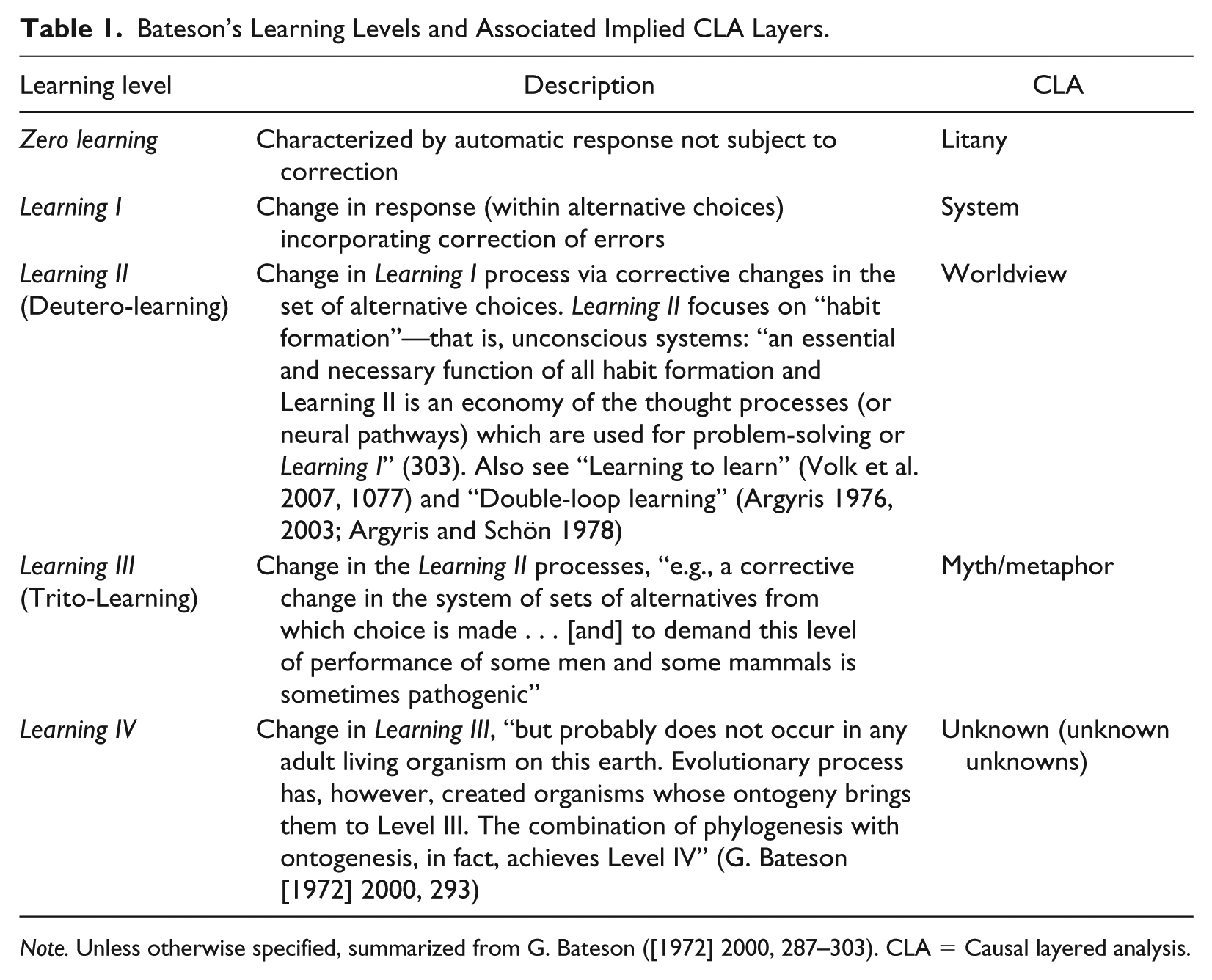
Note. Unless otherwise specified, summarized from G. Bateson ([1972] 2000, 287–303). CLA = Causal layered analysis.
Bateson’s double bind theory “introduces the concept of ‘power’, albeit covertly, into the psychotherapeutic realm” within the domains of psychotherapy and family therapy: “Bateson’s pithy and gritty descriptions and concepts make it the very seeable shadow in most distressing human interactions” (Gibney 2006, 55). Table 1 summarizes EoM learning levels in association with CLA.
There is close alignment between CLA layers and Bateson’s learning model levels: The aim of CLA is to move participants away from “zero loop” learning wherein they feel overwhelmed and even away from “single loop” learning where the focus is on “take aways.” The goal of CLA is to move towards reflective “double loop” learning, which is outside of paradigm learning and is a means of entering the unknown. Beyond this there is “narrative learning,” which is about finding archetypal stories and creating preferred narratives. CLA pushes participants to get in touch with the unknown but does not necessarily force them to leave their comfort zone. (Milojević 2015, 548–49)
Double-loop learning (Argyris and Schön 1978) is effectively a relabeling of Bateson’s Deutero-learning within organizational theory and applies the basic principles to organizational levels: Not surprisingly, we have been most influenced by those researchers who have also tried to synthesize a variety of perspectives on organizations for purposes related to double-loop and deutero-learning. Among these are Vickers and Bateson, both of whom have attempted (although in ways very different from one another) to combine cultural, cognitive, social-psychological, and systems approaches with the notion of organization-as-agent. (Argyris and Schön 1978, 331)
34
G. Bateson ([1972] 2000, 293) notes Learning III can induce pathogenic reaction when any “corrective change in the system of sets of alternatives” threatens substantial change in paradigm, worldview, and degrees of perceived novelty. 35 Bateson’s deutero-learning is focused on the individual’s learned adaptation to their environment—a learning process that can be pathological and not necessarily leading to improvement in a toxic environment. Inayatullah (2008, 6) notes discord can occur within the observer between worldviews, internal maps, and inner alignments. 36 Argyris and Schön (1978, 167) note that double-loop learning, at both individual and organizational systemic levels (i.e., individuals moving beyond their routine models and “theories-in-use” and organizations shifting beyond their normative learning systems and cultures), involves dealing with the ignorance of this lack of capacity and learning how to “discover how to discover, invent ways to discover, produce the inventions that lead to discovery, and generalize the learning created as a result of going through these processes.”
Metaphor, Entailment, and Ecology
Metaphors have been integral in historical structure and growth of human thought and language (Nerlich and Clarke 2001). Surfacing tacit or implicit metaphors involves gaining conceptual distance and uncovering underlying assumptions, which can then be consciously retained, discarded, or transformed as the metaphors are reassessed (Steuter and Wills 2008, 204). Multilayered approaches can be synthesized through compatible shared mixed metaphorical entailments, and two metaphors can be mixed if their purposes are different aspects of the same phenomena under consideration (Lakoff and Johnson 1980). Therefore, seeking foresight supports coherence in metaphorical structuring when complex coherences exist in CLA-EoM alignment—for example, mixed journey and container metaphors can represent compatible aspects of goal/progress and content, respectively: When two metaphors successfully satisfy two purposes, then overlaps in the purposes will correspond to overlaps in the metaphors. Such overlaps, we claim, can be characterized in terms of shared metaphorical entailments and the cross-metaphorical correspondences established by them. (Lakoff and Johnson 1980, 97)
Metaphor therefore plays a fundamental role in synthesizing CLA and EoM processes. Within CLA, pivotal change processes are based on metaphor transformations. Within EoM, ecology, bind, recursion, and loops are used to transform human thought and language toward a non-machine-orientated recursive vision (Harries-Jones 1995). Sufficient metaphorical entailment exists around journey and containment to support combining CLA-EoM in pursuit of EFR objectives. Fragmented mental models produce disjointed policy and research resulting in fragmented biological habitats—that is, involving patterns of apparent associations to which abduction can be applied. For example, western civilization’s “obsession with present-mindedness” (Innis 1951, 87) diminishes focus on the past or the future resulting in fragmented time which privileges engineers and accountants: with modern communications media privileging space, power, and discontinuity above time, continuity, and tacit knowledge (Innis 1951, 140). Therefore, metaphors of nature such as “Nature as a stock” (Norgaard 2010) do not align well with ecological metaphors that promote interrelated networks and rhizome-like processes. Metaphor also transcends rationality and connects aesthetics, beauty, and the sacred: Bateson has many times denied that either aesthetics or the sacred can be brought entirely within rational discourse, asserting that they belong, at least in part, to the realm of metaphor and analogy, of feeling and emotion. (Charlton 2008, 127)
Having introduced Asian elephant futures risk in the Anthropocene, and outlined how both CLA and EoM may be usefully related toward common foresight purpose, the next section sets out six conceptual steps indicating how CLA-EoM can be related to HEC.
Discussion—An EFR Case Study Design
Social media and academic literature draw attention to the plight of Asian elephants (litany layer). HEC focuses on social system conflict and deficits (Jadhav and Barua 2012; Liu et al. 2017). Deeper links to a spectrum of worldviews, social strata, and caste are less discussed—for example, involving, western educated urban elites compared with poor rural subsistence farmers. Beneath worldviews and political/nationalistic discourse resides a core of binding tradition, culture, and religious identity deeply rooted in ancient creation myths, which include the elephant—for example, Ganesh and Airavarta within Hindu cosmology’s Samudra Manthana (Churning of the Milk Ocean). A CLA of this complex situation could involve abductive analysis focused on the apparent discordance between root metaphor/myth and social/systems practice—for example, Fischer (2001), hypothetical (common) cause abduction (Schurz 2008), Patokorpi (2006), Patokorpi and Ahvenainen (2009), projectural abduction (Tuzet 2006), 37 or manipulative abduction (Magnani 2001).
The following six steps begin with an initial justifying abduction invoking sustainable development. The concluding step indicates one possible pathway to operationalize desirable change across CLA layers via clinical resources.
Step 1: Setting Out the Situation
Table 2 sets out a supportive abductive inference using Peirce’s classic abduction statement format (Burch 2018; Minnameier 2017; Peirce [1940] 1955) that justifies further CLA inquiry. Abduction, as part of a full three-part scientific approach (Peirce [1940] 1955), is applied to establish inference connections between EFR and sustainable futures in Asia—that is, in contrast to scenarios privileging economic development without strong consideration for habitat and wildlife impacts on culture.
Abduction of Asian Elephant Futures and Sustainable Development.
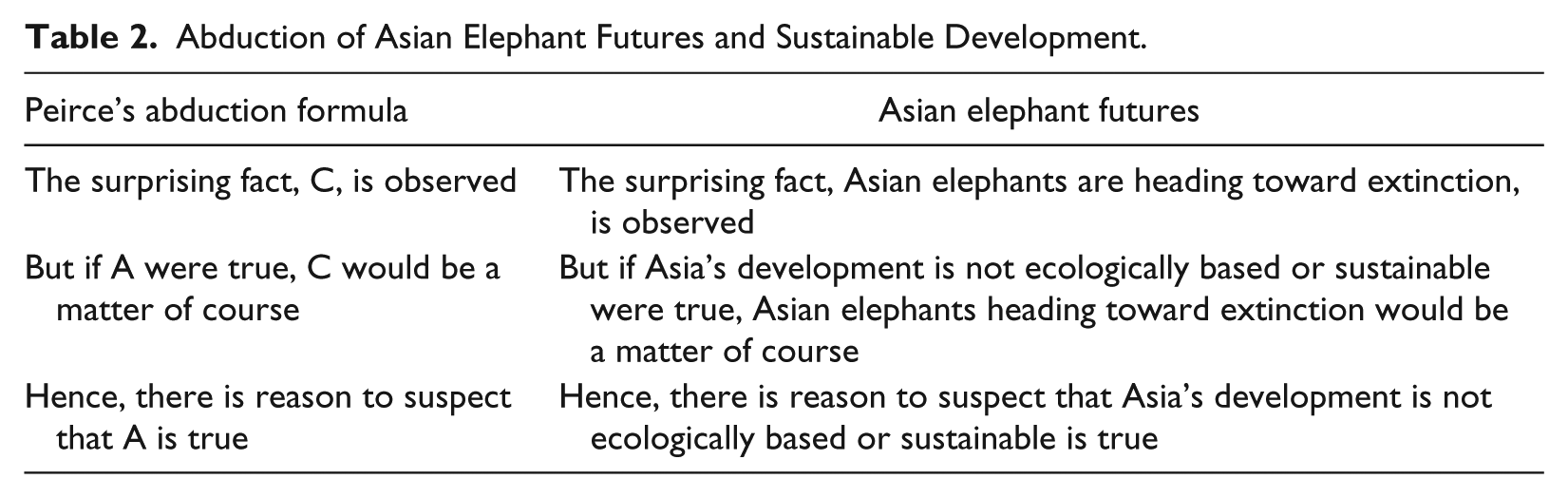
This step frames sustainability discourse in Asia in terms of elephant futures and habitat loss. Elephant extinction and sustainability inference is not a tautology if China is now considered somewhat sustainable without elephants. It is the process of losing elephants while claiming to be sustainable that is considered problematic. Two EFR Asian region scenarios can be considered: (1) a “Chinese future” scenario without Asian elephants or (2) an “Indian future” scenario with viable populations of Asian elephants living in their natural habitats. Other than within Buddhism, Asian elephants appear to play no role within modernizing communist China—apart from ivory/skin imports for artisan and “natural medicine” industries: they are largely “nature as stock.” Therefore, Asian elephants are a “weak signal” and key (species) indicator related to broader “China-India” scenarios (e.g., within a six-pillars process). If a “China” scenario evolves across Asia, then what will be the effect on Indian and Hindu/Buddhist culture? 38 Further abductions could develop this question. The elephant is the indicator.
Table 3 lists relevant literature, approaches, methods, and themes as CLA inputs.
CLA Relationships between Literature, Approach, and Themes.
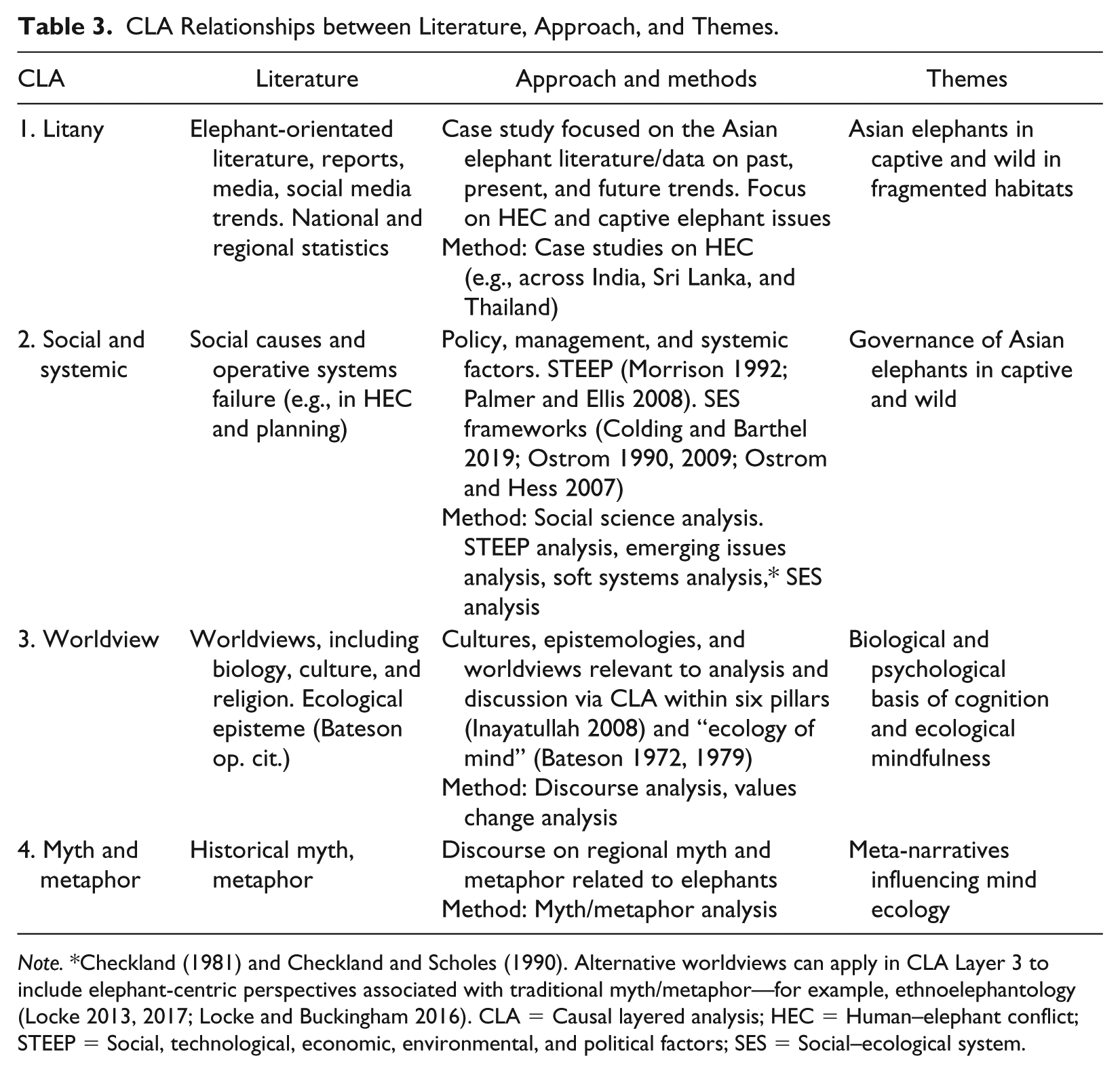
Note. *Checkland (1981) and Checkland and Scholes (1990). Alternative worldviews can apply in CLA Layer 3 to include elephant-centric perspectives associated with traditional myth/metaphor—for example, ethnoelephantology (Locke 2013, 2017; Locke and Buckingham 2016). CLA = Causal layered analysis; HEC = Human–elephant conflict; STEEP = Social, technological, economic, environmental, and political factors; SES = Social–ecological system.
Step 2: Aligning CLA and EoM Principles
Table 4 associates CLA layers and EoM learning levels for deeper combined analysis and focuses on areas/contexts exhibiting higher risk of double bind pathologies in HEC. This bird’s nest approach encourages multilayered information analysis and double description relevant to cross-disciplinary elephant research, policy, and management, as noted by Jadhav and Barua (2012).
CLA and Bateson Approaches Aligned.
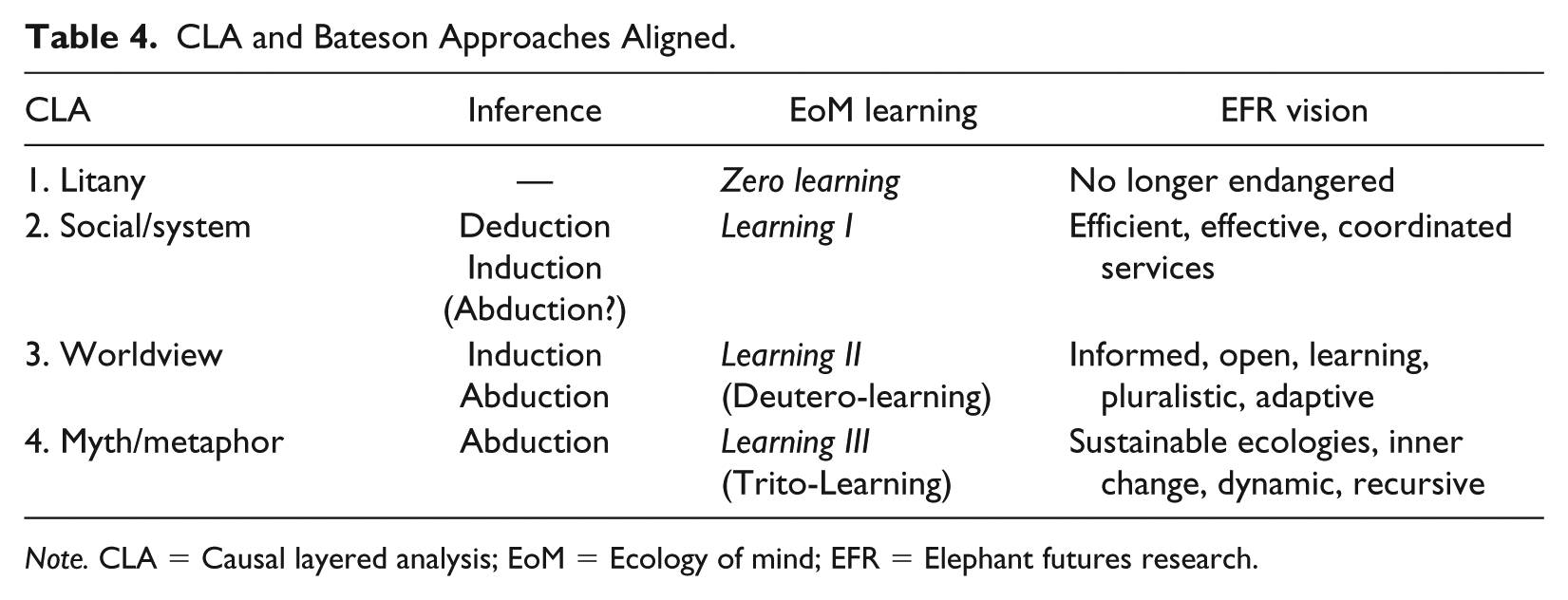
Note. CLA = Causal layered analysis; EoM = Ecology of mind; EFR = Elephant futures research.
In this interpretation, Level 1 (litany) implies no learning and simplistic narratives developed to meet day-to-day agenda—for example, media reflecting action–reaction situations. CLA Level 2 abduction may apply if science and engineering are undertaken as full three-part processes. However, in real-world applications, the implied abductive steps are often externalized or submerged.
Step 3: Begin with Myth/Metaphor in Mind 39
Table 5 sets out a nonexhaustive list of elephant-related myth/metaphor/fable for deconstruction and discourse analysis supporting CLA Layer 4 process for possible metaphor transformation.
Common Examples of Elephant-Related Myth/Metaphor/Narratives.
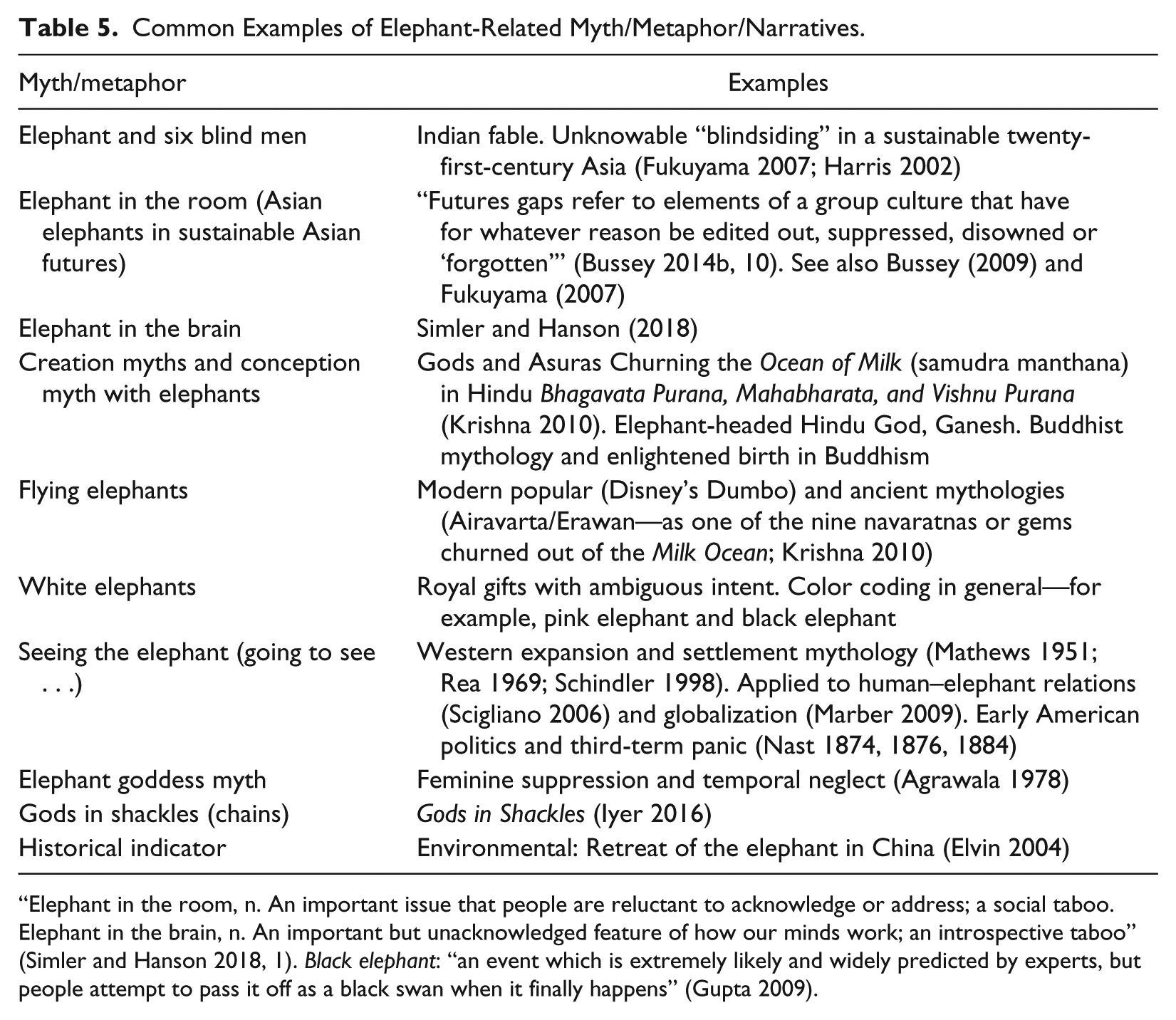
“Elephant in the room, n. An important issue that people are reluctant to acknowledge or address; a social taboo. Elephant in the brain, n. An important but unacknowledged feature of how our minds work; an introspective taboo” (Simler and Hanson 2018, 1). Black elephant: “an event which is extremely likely and widely predicted by experts, but people attempt to pass it off as a black swan when it finally happens” (Gupta 2009).
Deconstruction (Derrida 1997) of positive elephant orientations in eastern religions and ambivalent/negative orientations in western civilization, reflecting Zoroastrian demonology (Daryaee and Malekzadeh 2017), can be employed to reveal the internal logic of ideas and meaning. Table 6 summarizes these into subcategories 4.1, 4.2, and 4.3 to distinguish between eastern, western, and neutral metaphors, respectively. 40
The Elephant Futures Research Problem Framed by the CLA.
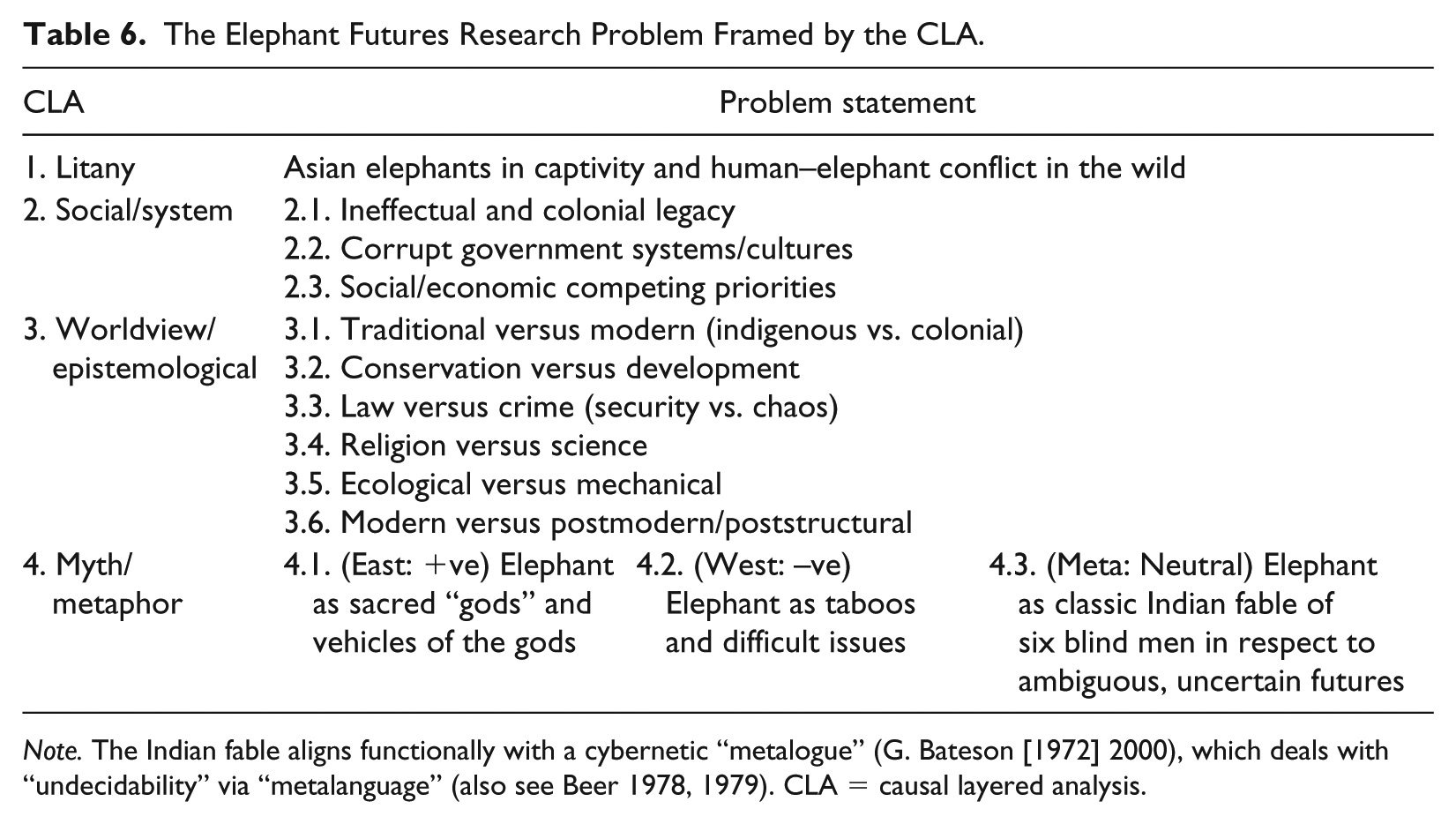
Note. The Indian fable aligns functionally with a cybernetic “metalogue” (G. Bateson [1972] 2000), which deals with “undecidability” via “metalanguage” (also see Beer 1978, 1979). CLA = causal layered analysis.
Step 4: Setting Out a CLA Problem Statement
Table 6 sets out a high-level CLA problem statement drawing on literature, litany, and information sources (Table 5). These can be assessed for patterns that connect with CLA Layer 4 relevance, policy solutions, and transformation strategies/scenarios. Suitable approaches can be employed for horizontal “rhizome-like” analysis across implied dualisms—for example, analyzing how colonial legacy (2.1) is reflected in government systems (2.2). Vertical analysis can seek useful double descriptions and connecting patterns—for example, apparent dichotomies between western scientific rationalism and pragmatism operating within ruling elites and Hindu religious contexts (3.4). This horizontal–vertical analysis leads toward understanding and meaning of myth/metaphor relevance as an eastern (4.1) and western (4.2) dynamic in respect to elephant-related issues. Synthesis of symbolic dualism involves stepping back and power-equalizing reframing within neutral meta-unknown (4.3) relationships. Making double description conscious and subsequently reconciled exposes cognitive dissonance and provides impetus for pursuing necessary change in worldview, social systems, and daily litany.
41
Bateson’s process of cybernetic recursive elevation to a higher logical level (which he also refers to as “metalogue”) is reflected in Rudyard Kipling’s (1889) “East is East, and West is West, and never the twain shall meet.” The four lines (below) embody the paradox and transition implied in CLA Layer 4 as recursive shifts in logical levels. Dualism in the first two lines, which permeates all CLA layers in this example, is reconciled in the last two lines by invoking strength as leading to more universal, power-equal, nondual perspectives (i.e., 4.3): Oh, East is East, and West is West, and never the twain shall meet, Till Earth and Sky stand presently at God’s great Judgment seat; But there is neither East nor West, Border, nor Breed, nor Birth, When two strong men stand face to face, though they come from the ends of the earth!
42
Further CLA assessment and demystification can include cross-analysis into classes—for example, applying P. R. Sarkar’s social reality model consisting of four classes and states in history: worker/shudra, warrior/ksattriya, intellectual/vipra, and accumulators of capital/vaeshyan (Galtung and Inayatullah 1997; Inayatullah 1999; Sheraz and Farooqi 2014).
Step 5: Deeper Clinical Engagement with Cross-Disciplinary Resources
This step explores the deeper implications and dynamics of possible Asian elephant extinction scenarios in respect to both Hindu/Buddhist and western cosmologies. While CLA sets up the conceptual space and exposes the general double bind contexts, EoM helps explore the deeper principles at individual, social, and national levels to identify any double bind hypothesis “crazy-making” features (Gibney 2006), for example, that indicate 43
lower capacity to discriminate between orders of message;
evidence of unsolvable communication issues, mystification, and prohibition from seeing;
evidence of power shadow in distressing human interactions;
lack of opportunity to propose interventions that dismantle pathology;
limited or lacking escape opportunities.
Therefore, a CLA of HEC helps shine light on the relevant areas of potential cross-disciplinary interest—for example, as suggested necessary by Jadhav and Barua (2012). The “future” (of the elephant) is a common interdisciplinary root metaphor. This step therefore facilitates application of clinical and interdisciplinary resources (six blind men) needed for deeper exploration into complex interrelated issues surrounding subsistence farmers and drug/alcohol use, lethargy and inertia in postcolonial administrative systems, epistemological dissonance between traditional and modern worldviews, and political dominance (power) related to western education and myth versus traditional thinking and ecological-orientated sentiments summarized in Table 6. Inayatullah (2015, 15) applies three questions to initiate transformative narratives: Is there a core metaphor that describes this situation? What might be a new story, a new metaphor that can reduce or transform the double-bind? How can this new metaphor be supported by behavior and practice?
Step 6: Back to Kansas
The final step involves identifying “relevant metaphors based on the policy community’s own cultural and historical experience and then [using] these metaphors to construct an authentic vision of desirable and dystopic futures” (Inayatullah 2007b, 13). While it is difficult to reconcile fundamental “good-evil” metaphorical dichotomies, it is less difficult to get general agreement that we are all blind in some respect to the higher aspects of complex problems. Operationalizing this reconciling vision within HEC may involve professional cross-disciplinary social-work resources adding depth and skills—for example, on issues and metaphors related to stress and drug/alcohol abuse and mitigation. Applying desirable changes involves cascading “causal” processes (Ramos 2015) reflecting the horizontal and vertical causal nets initially identified with myth- or metaphor-level factors. CLA “space” created for EoM reflection and desirable change can be both deployed within the broader “six-pillars” futures framework (Inayatullah 2008) and involve family therapy and social work informed by Bateson’s work.
Conclusion
This article sets out how EoM principles can work within CLA when applied to Asian elephant futures. Tentative steps are taken toward a future studies research design aimed at exploring social–ecological issues in contexts where cosmologies and ecologies play important roles in culture and identity.
Bateson’s relevance for critical futures research lies in the opportunity to explore CLA as a recursive learning model facilitating emergence of ecological mindfulness. CLA has wide appeal within futures studies and accommodates EoM principles within open futures, epistemological pluralism, and praxis. Bateson observes that quality disappears when patterns that connect dissipate. Conversely, quality appears when associative patterns are conserved. Combining EoM with CLA raises requisite variety and capacity to address systemic complexity and perceptions of fragmenting chaos. Both CLA and EoM disrupt automatic cognitive “buffering” with a bias for privileging fresh real-world information over retained images and semiconscious cognitive processes reinforced by external culture. Synthesis leads to an ecology of technical, practical, and emancipatory factors being reinforced across nested scales of individual, society, and ecology. CLA is a modern twenty-first-century example of taking further steps to an EoM (in Bateson’s terminology) supporting necessary unity of mind and nature and accommodating recursive vision and epistemologies of the sacred.
Bateson applies recursion to help define “limits” to the growth of twentieth-century Occidental hubris he considered was leading to irrevocable climate change and widespread ecological breakdown. Little has changed over the last forty years. If Al Gore had succeeded in the contentious election which preceded a litany of subsequent tragedies from “9/11” through to invasions of Afghanistan and Iraq, then the tone for the emerging twenty-first century may have been radically different and more ecologically orientated. 44 Bateson’s thinking is not widely disseminated within futures studies and merits closer scrutiny. Those who see a potential treasure trove within Bateson’s EoM and seek greater applicability to real-world issues may like to keep CLA in mind as a step toward more effective ecologies of mind within the Anthropocene. Conversely, those seeing wider CLA applicability and deeper understanding through coupled multilayered analysis may find value in exploring EoM.
Finally, the article explored CLA-EoM potential for social–ecological policy and planning inclusive of the “shadow-side” of an increasingly prosperous Asian region—for example, see “Asia 2038” vision (Inayatullah and Na 2018). It is clear the black elephant in the room (Gupta 2009; Sardar and Sweeney 2016) in all Sustainable Asia scenarios is, paradoxically, now very much the actual gray Asian elephant in Asia. And the cosmic white elephant in the regional room may well be preparing for another cosmic churn. Such ironic Asian futures’ alignments between real-world biology and cross-civilizational elephant metaphors elicit the deeper aesthetic relevance of Gregory Bateson’s twentieth-century eco-epistemic insights and the potential of twenty-first-century CLA. Any sustainable futures deconstructing across a rising Asia need only ask one “so what?” elephant in the room question: Quo vadis, Elephas maximus?
Footnotes
Declaration of Conflicting Interests
The author(s) declared no potential conflicts of interest with respect to the research, authorship, and publication of this article.
Funding
The author(s) received no financial support for the research, authorship, and publication of this article.
