







Abstract
Backcasting is a Futures method that starts with a preferred future and works back to the present, identifying actions over time needed to achieve the preferred future. But there are few specifics in the Backcasting literature on how to develop the pathway that connects a preferred future to the present. This article describes a participatory process for Backcasting that uses a structure similar to the Futures Wheel to develop the pathway from the preferred future back to the present. A case study of U.S. Forest Service organizational planning is used to illustrate the method.
Introduction
Forecasting extrapolates from the present into the future. Backcasting is a Futures method that goes the opposite direction, starting from a preferred future—a vision of what we aspire to and want to achieve—and working back to the present. The critical importance of a positive vision of the future was firmly established in the futures studies classic, The Image of the Future (Polak 1973). In the context of environmental futures, Costanza and Kubiszewski (2014, 3) stated: “The most critical task facing humanity today is the creation of a shared vision of a sustainable and desirable society.”
Backcasting asks “How can we achieve our preferred future?” and identifies actions over time needed to succeed. The origins of Backcasting can be traced to the work of energy policy analyst Amory Lovins (1976, 1977), who proposed what he called “backwards-looking analysis” as an alternative to traditional energy forecasting based on trend extrapolation. Robinson (1982) subsequently coined the term Backcasting. Since its beginnings in energy policy, the use of this technique has spread to many fields and the research literature on Backcasting is now vast: a Google Scholar search of “backcasting” produced more than 21,000 research papers. A shift to participatory approaches began in the early 1990s in the Netherlands (Quist and Vergragt 2006) and participatory Backcasting is now widely practiced.
The essence of Backcasting is developing a pathway that connects a preferred future to the present and identifying milestones along the pathway that can be used by planners and policy makers to track progress (UK Government Office for Science 2017). But there are few specifics in the Backcasting literature on how to develop the pathway (Hines, Schutte, et al. 2019). In the literature, the Backcasting process is often a black box. This article is an effort to open that black box by specifying a participatory process for developing a pathway and milestones in Backcasting. It describes a Backcasting method that uses a structure and process similar in some respects to the Futures Wheel (Bengston 2016). The “Backcasting Wheel” described here is an approach to Backcasting that provides a practical and participatory process for developing a viable pathway from a preferred future back to the present.
The Backcasting Wheel
A Backcasting Wheel exercise starts with a clear statement of a preferred future that has been created in advance through a visioning process (e.g., Bezold 2009b; Bishop and Hines 2012b). A vision should be based on a group or organization’s shared values and purpose, and should represent a compelling expression of the future the group aspires to achieve (Bezold 2009a). Desirable characteristics of shared visions include group buy-in, shared understanding, strategic orientation, specific imagery, and clarity (Lippitt 1998).
Alternatively, the starting point for a Backcasting Wheel exercise could simply be an important goal identified through strategic planning or other planning process, rather than a complete vision or preferred future. This narrower approach to the starting point of a Backcasting Wheel is nevertheless useful in practical planning contexts. Thus, the “preferred future” at the center of a Backcasting Wheel exercise could be a broad, long-term vision for an organization or community, or it could be a more focused, shorter term strategic goal for an organization or for a unit within an organization.
The process and structure of the Backcasting Wheel is similar to the Futures Wheel or Implications Wheel® (Barker and Kenny 2011; Bengston 2016). In a standard Futures Wheel exercise, a significant change that is of interest (e.g., an emerging issue or trend, a game-changing event, a new policy, a technological innovation) is placed in the center of the wheel and participants follow a structured brainstorming process to identify possible direct and indirect consequences of that change branching out from the center in concentric rings of secondary and tertiary impacts. In the Backcasting Wheel process, the organization’s preferred future or goal is placed in the center and the objective is to identify the management and policy actions needed to achieve the preferred future. With regard to time, the Futures Wheel moves forward in time as you move out from the center. In contrast, the Backcasting Wheel moves back in time—back to the present—as you move out from the center.
Participants in a Backcasting Wheel exercise should ideally include both “insiders” (e.g., planners, managers, policy makers, and others from within the organization) and a number of diverse “outsiders” (participants from outside the organization or field who bring different perspectives, backgrounds, and information). Organizational insiders may be too focused on the organization’s internal environment and not paying attention to negative developments in the contextual environment that could derail planning, or positive developments that could enhance planning to achieve the preferred future. Outsiders may be more likely to be aware of emerging external developments, possibilities, opportunities, and obstacles. An alternative to including outside participants is to inform the exercise with the results of a horizon scan (Hines, Bengston, and Dockry 2019) to provide participants with awareness of emerging developments and signals of change from outside of their field, and to broaden thinking about the future. The goal of either approach is to help participants break out of narrow, business-as-usual thinking by bringing diverse perspectives into the exercise.
The number of participants is not fixed but should be roughly consistent with other brainstorming processes. For example, in the original approach to brainstorming developed by Alex Osborn and first published in 1953, groups of about five to twelve people were recommended (Besant 2016). Similarly, focus groups “. . . can range from as few as four to as many as twelve” (Krueger and Casey 2000, 10). Upper and lower limits on group size are intended to create a group environment that is small enough to allow all participants to share their views, but large enough to include a diversity of perspectives. If there are more than twelve participants in a Backcasting Wheel exercise, several smaller groups can be formed and multiple Backcasting Wheels with the same center can be completed for comparison and discussion.
Given a clear vision or goal identified through a planning process and a diverse set of participants, the main steps of the Backcasting Wheel process are as follows:
1. Identify key dimensions of success: The group process begins with the facilitator briefing participants on the issue at the center (i.e., the predetermined preferred future or goal). A concise statement of the preferred future or goal is placed in the center of the wheel (Figure 1). The facilitator then asks, “What are the most important dimensions of success for our preferred future/goal? How would we know if we have fulfilled the preferred future/goal?” Each participant offers ideas in turn, which are added to the wheel diagram. These ideas about the key dimensions of success form the inner ring of the wheel, branching out from the center. Once an initial set of key dimensions of success is identified, the facilitator leads a discussion to ensure that the set is complete, that the individual key dimensions are all necessary for success, and that each dimension is clear and specific. Four dimensions are shown in Figure 1, but the number is variable depending on the breadth and complexity of the center.
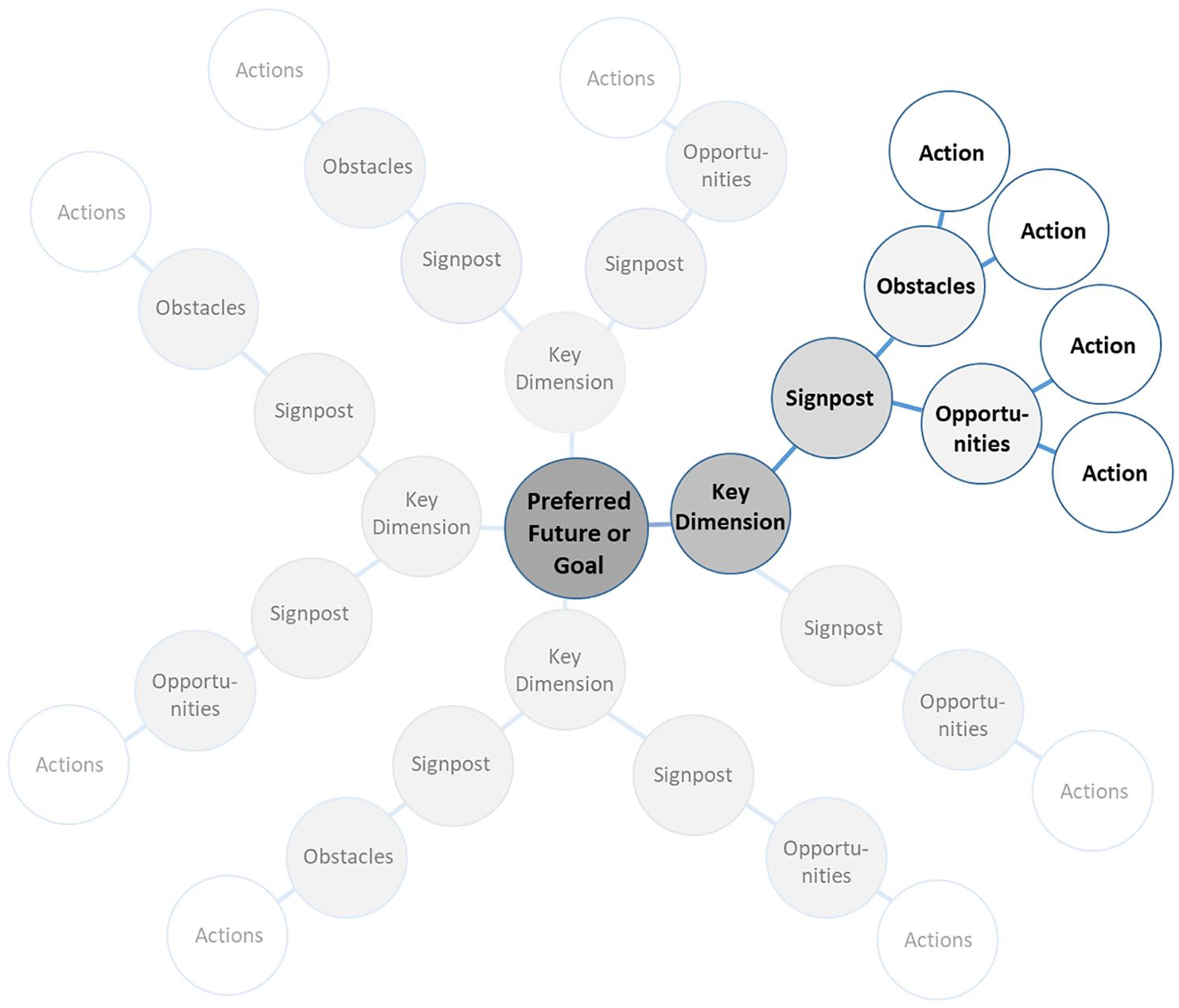
Structure of the Backcasting Wheel.
An alternative to having the brainstorming group identify key dimensions of success is to have an executive or planning team identify the key dimensions in advance of the participatory group process. A core team can take the time needed to thoroughly consider possible key dimensions and ensure that a complete set is developed for the participatory group process. Identification of key issues in advance also allows more time for the other steps in the Backcasting process. Involvement of an executive team in identifying key dimensions of success contributes to leadership buy-in, which can be vital to a process of this nature.
Whether the key dimensions of success are identified by the brainstorming group participants or in advance by a core team, formal idea generation methods can be used to add rigor and improve the quality of the key dimensions (Shah et al. 2000). For example, the “6-3-5 method” allows participants to work alone at first to generate many divergent ideas and then interact with the ideas of other participants to converge on a smaller set of key ideas (Markman 2017). The name 6-3-5 derives from having six participants around a table. Each person writes down three ideas on their own and then passes their ideas to the person on their right. That person builds on the ideas that are now before them and then passes the modified ideas to the right. The passing of ideas is done five times so that everyone has had the opportunity to build on each of the ideas. Then the entire group reviews and evaluates all of the ideas to come up with a final set.
2. Identify signposts: In the second round of the group process, one or more “signposts” are identified for each key dimension of success (Figure 1). In this context, a signpost is defined as a potential future event that signals the achievement of a key dimension of success for the preferred future. If there are enough participants for multiple brainstorming groups, each group could be assigned one key dimension to work through. Signposts needed to achieve a particular key dimension are identified by brainstorming the question: “What’s needed to achieve this dimension? How would we know if we’ve achieved it?”
Identification of signposts is a standard element in constructing the pathway back from the preferred future in Backcasting (Hines, Schutte, et al., 2019). At this point in the process, signposts are not linked to a particular point in time to construct the pathway—that comes in step 5, the scoring round. Figure 1 shows just two signposts for each key dimension of success, but the number could range from one to several.
3. Identify opportunities and obstacles: In the third round, opportunities to help achieve success and obstacles that could limit success for each signpost are identified by asking, “What could be done to increase the likelihood of achieving this signpost? (Opportunities)” and “What could prevent the achievement of this signpost? (Obstacles).” Participants may need to be encouraged to contribute opportunities, given negativity bias (Soroka et al. 2019) and the tendency to more readily identify problems (obstacles) rather than potential positive opportunities. Furthermore, participants should be encouraged to think broadly about potential opportunities and obstacles. Many external forces such as new technology, social changes, economic factors, and more may influence opportunities and obstacles for the issues addressed in any given Backcasting process.
4. Identify concrete management actions: In the fourth round, the group brainstorm actions needed to overcome or avoid obstacles, and actions needed to take advantage of opportunities, for each of the obstacles and opportunities that have been identified in the preceding round. The facilitator asks, “What concrete steps do we need to take to achieve this component? What steps do we need to take to overcome obstacles that could prevent us from achieving this component?” Actions need to be specific. For example, instead of “Increase training opportunities,” a specific and detailed management action is needed, such as “Institute quarterly training on creative thinking techniques for all employees.” Similarly, steps to capitalize on opportunities also need to be specific and actionable. The aim of this step is to have concrete ideas of action items to achieve the desired future.
5. Scoring round: The actions identified in the preceding round are scored by participants for importance (5 = critical, 1 = noncritical) and timing (5 = must do immediately, 1 = not urgent). Scoring is individual and then aggregated. Scoring also includes special scores for extraordinarily important opportunities or obstacles, similar to the triumph (+50) and catastrophe (–50) scores used in the Implications Wheel®.
The signposts (step 2) can also be scored for specific, chronological timing (e.g., 5 years in the future, 10 years in the future) by first being arrayed along the pathway from the present to the preferred future and then conducting a brainstorming session with participants to assign specific times to each signpost. This chronological scoring may take place in multiple rounds. For example, the small groups may do the initial scoring, with refinement of the timing taking place in a full-group report out or by the core planning team.
6. Analysis: The Backcasting Wheel method may produce a significant amount of detailed information. As shown in Figure 1, as you move out from the center, the amount of information grows geometrically. These data need to be synthesized and analyzed for decision makers and planners, for example, identifying areas of agreement and divergence, or specifying the necessary order in which sub-issues must be addressed before an opportunity or obstacle can be acted upon. The analysis stage may be iterative (e.g., a focus on the most important steps first, with the core team or others returning to the results when the highest priority steps have been implemented). Analysis may also need to be in the hands of experts, if planning steps need to meet regulatory or other requirements.
Visualization techniques may be useful in analysis: flowcharts, tree diagrams, color coding, and other techniques may all help assess the potential actions. In complex situations—for example, a preferred future with many key dimensions—more in-depth analytic techniques may be needed, such as those used in analysis of qualitative data (e.g., Corbin and Strauss 2014). Whatever analytic approach is used, the goal is to develop action plans to implement changes in the present, and to set up midterm changes, to achieve the desired future state.
Case Study: US Department of Agriculture Forest Service Region 9 Planning
We conducted a small-scale Backcasting Wheel exercise with two administrative Units of the USDA Forest Service that were reorganizing to share leadership and a headquarters. One Unit was from the State and Private Forestry branch of the Forest Service, and the other was from the National Forest System branch. Sharing leadership and a headquarters for these Units was a major change and meant significant upheaval for many employees. The receiving Unit was focused on a successful outcome and, based on earlier exposure to the Implications Wheel®, wanted to use a similar approach to help plan for a smooth transition. Leaders of the two administrative Units reached out to members of the Strategic Foresight Group for assistance, and we suggested the Backcasting Wheel.
We worked with a core planning team from the two Units to define and refine the desired outcome, that is, the “center” of the wheel. The following goal was selected as the center: “[The Units] are working together and with partners in a way that other Forest Service Regions will want to emulate.” The two Units had already identified four key areas or domains where they aspired to achieve excellence:
Collaboration focused on creating a collaborative environment, one that allows working together as appropriate without protecting turf.
Mission delivery focused on different aspects of getting work done and meeting external partner’s needs. This included fast and efficient program delivery to partners; improved customer service to states, to national forests, and to other partners; and developing a working environment in which innovation is rewarded.
Employee understanding focused on a variety of different components of State and Private Forestry and National Forest System employees developing a shared understanding of the work and priorities in both Units, including the need for open and continuous communication, information sharing for all employees across the organizations, strong agreement on priorities and focus, continuity of programs during transition, recognizing where working separately to deliver programs is appropriate, and developing clear understanding of the relationship between how resources are aligned and outcomes.
Employee attitude focused on the mind-set State and Private Forestry and National Forest System employees bring to the joined headquarters location, including acceptance of the process, ensuring a smooth operational transition, creating a positive work environment, and creating a supportive office that is welcoming and where employees are curious about each other’s programs and roles and want to learn how to best work together.
These four domains were used as the key dimensions of success to frame the discussion. We printed poster-sized sheets with the center statement for use in the breakout sessions (Figure 1).
At an in-person meeting of the two administrative Units, we divided participants into four groups with each taking on one of the four key dimensions of success. To obtain a wide range of input, each group comprised a mix of staff from both Units, as well as both programmatic and administrative staff.
Ground rules were given for brainstorming, such as outside-the-box thinking is encouraged, do not split hairs, be specific and concrete, and respect all input and comments. To keep participants focused on the conversation, we limited email access during the sessions, and scheduled longer breaks to allow email checks during the day. Once in their breakout groups, participants were provided with instructions for the first step: identify signposts (as the key dimensions of success had already been determined). The instructions were as follows: Identify signposts that indicate you’re on the way. Signposts are a “recognizable potential future event that signals a significant change.”
We were ready with additional prompts if a group finished quickly, including the following:
Try for two more signposts
Think about what negatives might be, and then flip to the positive as a signpost
Think outside your organizational role or program
What about outside forces: Social, Technological, Economic, Environmental, and Political?
What about signposts other than social dynamics?
Do you have crazy ideas or other outside-the-box thinking?
The second phase of the discussion focused on identifying obstacles and opportunities to achieving the signposts identified in the first step. Prompts for this second phase were like those in the first (e.g., try for two more) but included two additional prompts for deeper thinking: (1) “Do you have a rough balance of obstacles and opportunities?” and (2) “What would colleagues in the other groups be adding here?”
The third breakout discussion session focused on finding concrete actions to achieve the opportunities and to mitigate obstacles the group identified. The same types of prompts were introduced as needed to encourage additional thinking.
We provided examples of signposts, obstacles and opportunities, and concrete actions:
Signposts are recognizable potential future events that signal a significant change: for example, a signpost that your children are transitioning into adulthood is when they get their driver’s license.
Obstacles and opportunities: An obstacle to a child’s using their new license could be increased insurance costs. An opportunity is presented when new drivers are able to get themselves to practice sessions and the like, freeing up parents’ time for other things.
Concrete actions involve taking advantage of an opportunity or reducing the likelihood of or preventing an obstacle. For example, your child gets a part-time job to pay for increased insurance costs.
Two facilitators floated between the groups to answer questions, offer guidance as needed, and suggest needed refinements of ideas generated (e.g., suggesting that the group makes an idea more concrete). Over lunch, the process leaders looked at the results across all four groups to assess progress, look for problems that may need to be addressed (e.g., whether there were conflicting recommendations), and assess the extent to which similar ideas were emerging across the key domains. This informed their guidance of the afternoon sessions.
The final breakout session focused on scoring the obstacles, opportunities, and action items. Each group was instructed to score for importance and timing, and for triumphs and catastrophes. Participants were to start with the action items, which were furthest out on the diagrams, and work their way in. They were provided examples of catastrophes (e.g., a doubling of conflict resolution management process requests) and triumphs (e.g., no complaints from any State Forester, or number of acres treated with forest management practices rises sharply). In addition, the groups were told:
Develop a group consensus score (with dissenting scores possible)
Don’t split hairs—can you live with a score?
Can’t decide in a couple minutes? Note why and move on
Start with importance, then timing, then triumph and catastrophe—look across all the levels
After the small group work, the four breakout groups came together to report out and decide future steps. The full team looked at surprises, commonalities, triumphs, and catastrophes. They discussed the action items rated as needing immediate attention to assess them, decide on next steps, and assigned a person to lead each task.
In the weeks following the exercise, we received positive feedback on the process from the participants who found it helpful and insightful. The Backcasting Wheel process appeared to be a promising way to help participants achieve their stated goals related to the merger of the two administrative Units. But we will never know whether the outcome of the exercise was in fact effective because staff and leadership turnover affected continuity of these planning efforts.
Concluding Thoughts
The Backcasting Wheel provides a participatory process for working back from a preferred future to the present. It could be used in a variety of strategic and long-term planning contexts. The example provided above was a very specific, tactical issue. But just as Backcasting has been used for a wide range of strategic issues and preferred futures, the Backcasting Wheel is intended to be used in these broader and longer term contexts as well.
Reflecting on lessons learned from applying the method in our case study, it was clear that the participatory and interactive nature of the Backcasting Wheel was an important strength. Complex problems can be solved more effectively with a diverse team than by the best individual experts (Page 2007). We also encountered certain limits to participatory methods. While a diversity of viewpoints and backgrounds are important to an effective use of either the Futures Wheel or a Backcasting Wheel, not all of the participants in the case study reported here were able to think as broadly as needed to fully participate. People in jobs that require skill in processing routine procedures appeared least able to contribute effectively in the Backcasting Wheel exercise. Related to this point, the process may have benefited from more advanced preparation for participants, or perhaps the addition of a Futures thinking warm-up exercise to jump start creativity and brainstorming. In addition, ensuring leadership continuity (to the extent possible) would increase likelihood of meaningful outcomes from a Backcasting Wheel exercise.
The Backcasting Wheel is a technique that can generate insight into achieving a desired future state or goal for a community or an organization. It could also be used by individuals for life planning exercises (e.g., career planning). The technique helps participants think through an issue in a stepwise manner and plan to take advantage of opportunities and avoid or overcome obstacles, thereby effectively preparing for the future they wish to have.
Footnotes
Declaration of Conflicting Interests
The author(s) declared no potential conflicts of interest with respect to the research, authorship, and/or publication of this article.
Funding
The author(s) received no financial support for the research, authorship, and/or publication of this article.
