







Abstract
Food systems express many systemic inequities and injustices that leave actors with varying capabilities to participate and benefit from food production activities. Many resilience studies therefore focus on promoting transformations towards more equitable and sustainable food systems. This study applied two complementary Future Study methods, namely Causal Layered Analysis and the Three Horizons approach, to case studies of small-scale, emerging, and large-scale farmers in South Africa. The study considered (a) how these actors frame persistent challenges they face in farming and (b) which pathways they feel can facilitate the desired futures they have identified. Separate workshops were hosted for the different actor groups, after which the workshop materials were transcribed, coded and analysed using qualitative content analysis. We found that small-scale farmers faced the highest number of unique constraints in their farming operations. A significant difference between these farmers and large-scale farmers is access to finance and farming equipment. Key issues for large-scale farmers are to overcome governance bottlenecks, such as port inefficiencies and bureaucratic processes, to secure and expand their presence in markets and the barriers to additional natural resources. Emerging and small-scale farmers also identified a lack of access to and decision-making power over the resources needed for production. Additional barriers for these farmers included a lack of recognition as farmers who were previously disadvantaged but equally capable of contributing to food production, resulting in their perceived exclusion from industry organisations and governance processes. To achieve their desired futures, all groups mentioned the improved functioning of public infrastructure, governance processes, better communication and knowledge sharing within the farming community as necessary changes. By examining the current, future, and transitioning options from different farmer group perspectives, this study provides a novel and relational view of the land reform project in South Africa that presents pathways towards a future that is co-produced and holds shared benefit to farmer groups.
Keywords
Introduction
The global food system drives environmental changes that characterise the Anthropocene and contribute to many systemic inequities (Steffen et al. 2015; Whitfield et al. 2021). Inequities manifest in disproportionate effects on marginalised groups due to the prioritisation of objectives related to individual food security and national economic objectives (Fanzo et al. 2021; Jones and Ejeta 2016; Levy and Patz 2015; Phalkey et al. 2015; Vermeulen et al. 2012). The pursuit of these objectives have led to many being excluded from food system activities and benefits, further increasing poverty and reducing access to education and resources (Fan and Swinnen 2020; Heldring and Robinson 2012; Mwanamwenge and Harris 2017). Therefore, food system transformations are required to achieve sustainable and equitable outcomes for those involved in these activities (Godfray et al. 2012; Mann et al. 2009; Ruben et al. 2021; Schoneveld 2022). Research into food system transformations has moved to incorporate greater considerations of equity and justice (Ruben et al. 2021; Whitfield et al. 2021). Different equity dimensions are rooted in environmental justice theories, thereby linking the two terms. Equity is commonly expressed through distributional, procedural and recognitional dimensions, which are situated within a specific social-ecological context where historical inequities shape current equity landscapes (Leach et al. 2018).
Food systems are social-ecological systems (SES) because they represent interconnections between ecological and social systems in ways that are difficult to separate (Schröter et al. 2021). The ability of an SES to transform is generally conceptualised as a capacity of social-ecological resilience (Béné et al. 2014; Reyers et al. 2018; Walker and Salt 2012), which is defined as the capacity of a social-ecological system to sustain human well-being in the face of change, particularly unexpected change (Folke et al. 2016). Transformations consist of a marked shift in multiple aspects of the system (i.e. views, practices, structures and functions) from those subjectively undesirable to particular individuals or groups towards those with more desirable features (Folke et al. 2010). However, such transformations are messy undertakings and often result in unpredictable effects when they do happen (Moore et al. 2018).
To better anticipate change and build the capacity of systems to navigate current and future disruptions requires forward-looking approaches (Leach et al. 2010: 77). Future Studies provide a way of systematically thinking about the multiple possible futures that are continually shaped by the complex interactions in SESs and can therefore be used to inform management of these systems (Hichert et al. 2021). In food systems research, Future Studies have provided a means of producing and exploring the usefulness of scenarios in agrifood networks of Ecuador (Hernandez et al. 2023), anticipating and responding to future challenges in Finland (Rikkonen et al. 2024) and to challenge intrenched power dynamics keeping systems locked in to undesirable states in Guatemala (Rutting et al., 2024). Others have also integrated futuring techniques into existing frameworks, such as various ecosystem assessment frameworks, to complement modelling approaches that are used for governance at local, regional and international levels (Berg et al. 2016).
While Future Studies actively seek participants to “open their minds” and include the perspective of others in their thinking (Poli 2010), tension may emerge based on the underlying values and worldviews that feature in different actors’ visions of the future (Martin et al. 2022). The different relationships that people have with their immediate environment, including its social and ecological components, may dictate the future that they aspire to (Ives and Kendal 2014). When different values underpin how actors view these relationships, for example, in the importance they attribute to human-human or human-nature relationships or to limited services and resources, the potential for conflict may emerge (Pascual et al. 2017). Also to be considered is how the actions of certain actors that seek to improve their sustainability or economic outcomes may negatively affect the prospects of others in their shared system (Thomalla et al. 2018). Despite the usefulness of Future Studies, there remains a gap in understanding how this tool can be used to support food system transformations in contexts where actor groups are subjected to unequal participation in livelihood and economic activities. Achieving equitable outcomes in food systems with diverse actor groups have been shown to be particularly challenging due to disparate power relations that exist between actors in such systems and may lead to the entrenchment of existing inequities (Blythe et al. 2018; Corson and MacDonald 2012; Fairfield and Charman 2019).
This study explores large-scale versus small-scale and emerging farmers’ desired futures across two South African catchments. South Africa is one of the most unequal countries in the world, and the issue of sustainable and just transitions to address the legacies of the past is a government and societal priority. Using workshops, we combined different futuring methods, specifically Causal Layered Analysis and the Three Horizons Framework, which help actors systematically think about the deep-rooted values and beliefs underpinning a system’s present structures and actions that can help achieve more desirable futures. The output from the workshops was used to identify and compare the desired futures of the different actor groups for each catchment, the constraints they face in achieving these, and potential intervention pathways through which they can be achieved. In doing so, the study contributes reflections around the use of futuring approaches to evaluate equity in shared systems where power disparities occur and develop options for how these outcomes can be improved.
Case Studies
We used two exploratory case studies to understand desired futures in South Africa’s agricultural food production systems from an equity perspective: the Breede River Catchment (hereafter referred to as the ‘Breede’) in the Western Cape Province and the Letaba River Catchment (hereafter referred to as the ‘Letaba ’) in the Limpopo Province (Figure 1). The two case studies were located in the Breede River Catchment, with the town of Wolseley serving as the venue for workshops, while Letsitele was the venue for workshops from the Letaba River Catchment.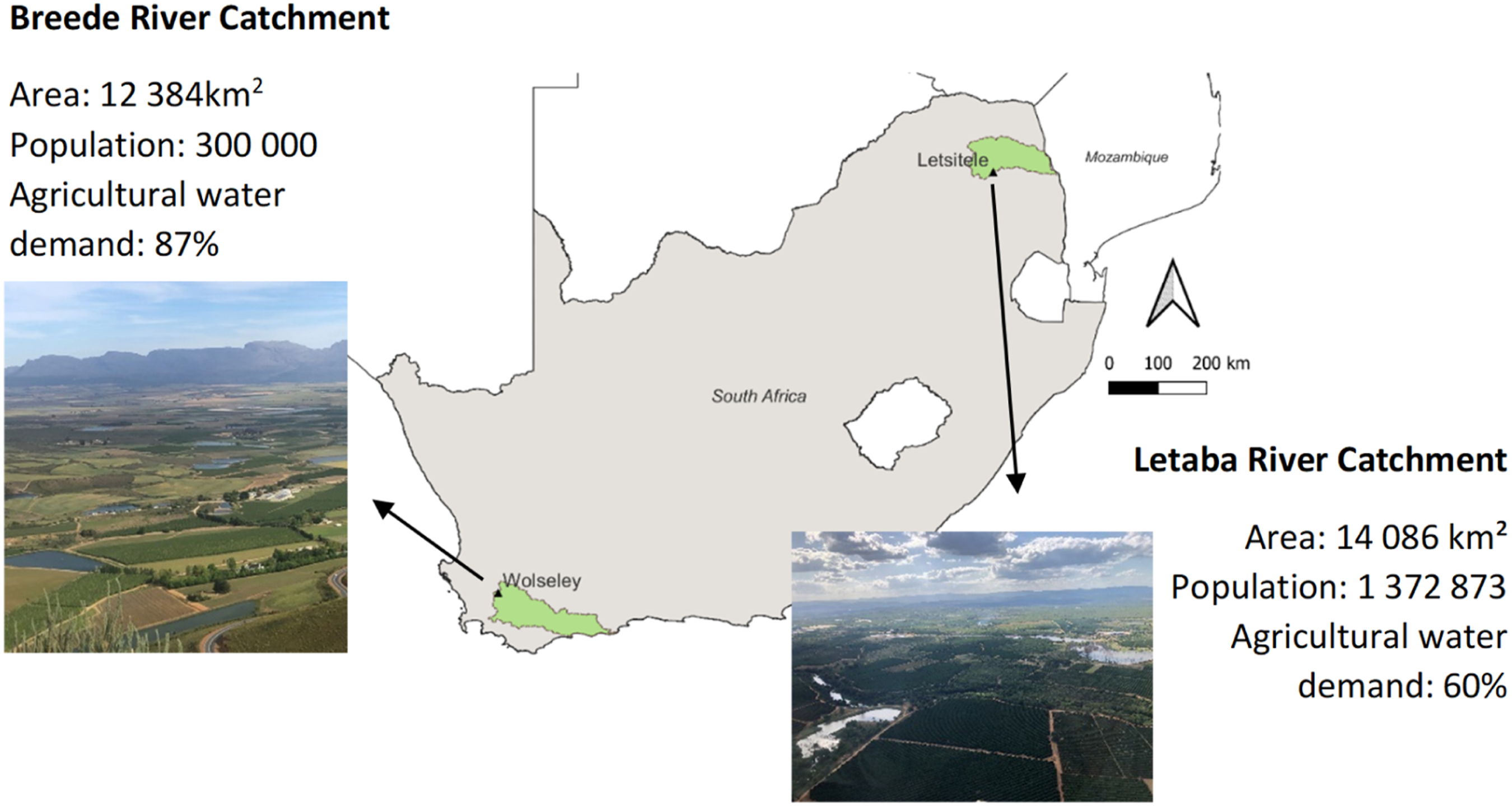
The South African Agriculture Context
Agricultural production systems in South Africa display many inequities, manifested in the ‘dualism’ of the sector (Greyling et al. 2015; Sihlobo and Kirsten 2021). This dualism refers to the disparity in production and land availability between large-scale farmers, who are mostly White and small-scale and subsistence farmers, who are mostly Black. Although there are relatively few large-scale farmers, they produce most of the commodities for the national and export consumer markets. Many farmers are classified as small-scale farmers and produce food on a smaller scale for home consumption and additional income generation from the surplus. Differences between these groups include access to finance and technology, which directly influences farm inputs and productivity and leads to further implications for the viability of operations (Malinga et al. 2018; Zantsi et al. 2021). The dualism is rooted in historical policies, such as the 1913 Land Act, which excluded Black people from owning land (Sihlobo and Qobo 2021). These inequities persist despite the priority of the 1994-democratically elected government to address them (Binswanger-Mkhize 2014).
We distinguish between small-scale farmers, emerging farmers, and large-scale farmers. Large-scale farmers are commercial producers who mainly target high-value markets, such as export markets or local high-value supermarkets, whereas small-scale farmers sell fruit locally, mostly at municipal fresh produce markets or directly to informal traders who sell their produce from roadside stalls. Emerging farmers can do both, for example, by utilising the market channels of partnering large-scale farmers to sell their produce on the export market, or locally via traders or the municipal fresh produce markets. Small-scale and emerging farmers are often collectively referred to as smallholder farmers (Zantsi et al. 2019). However, lumping them together obscures their different attributes and requirements which are needed to design and support effective interventions (Carelsen et al. 2021).
The size of small-scale farms in our study ranged from 1 to 30 ha, while none of the large-scale farms had cultivated areas of less than 50 ha. For emerging farmers, the farmed area ranges between these sizes, while the potential and desire for the expansion of cultivated land exists. Emerging farmers are, therefore, considered to be closer to large-scale farmers in terms of the inputs and outputs they aspire to achieve (Muzekenyi et al. 2022), whereas small-scale farmers mostly depend on household labour for agricultural production and have comparatively small production volumes.
Methods
Summary of the Workshop and Participant Details for Each Workshop.
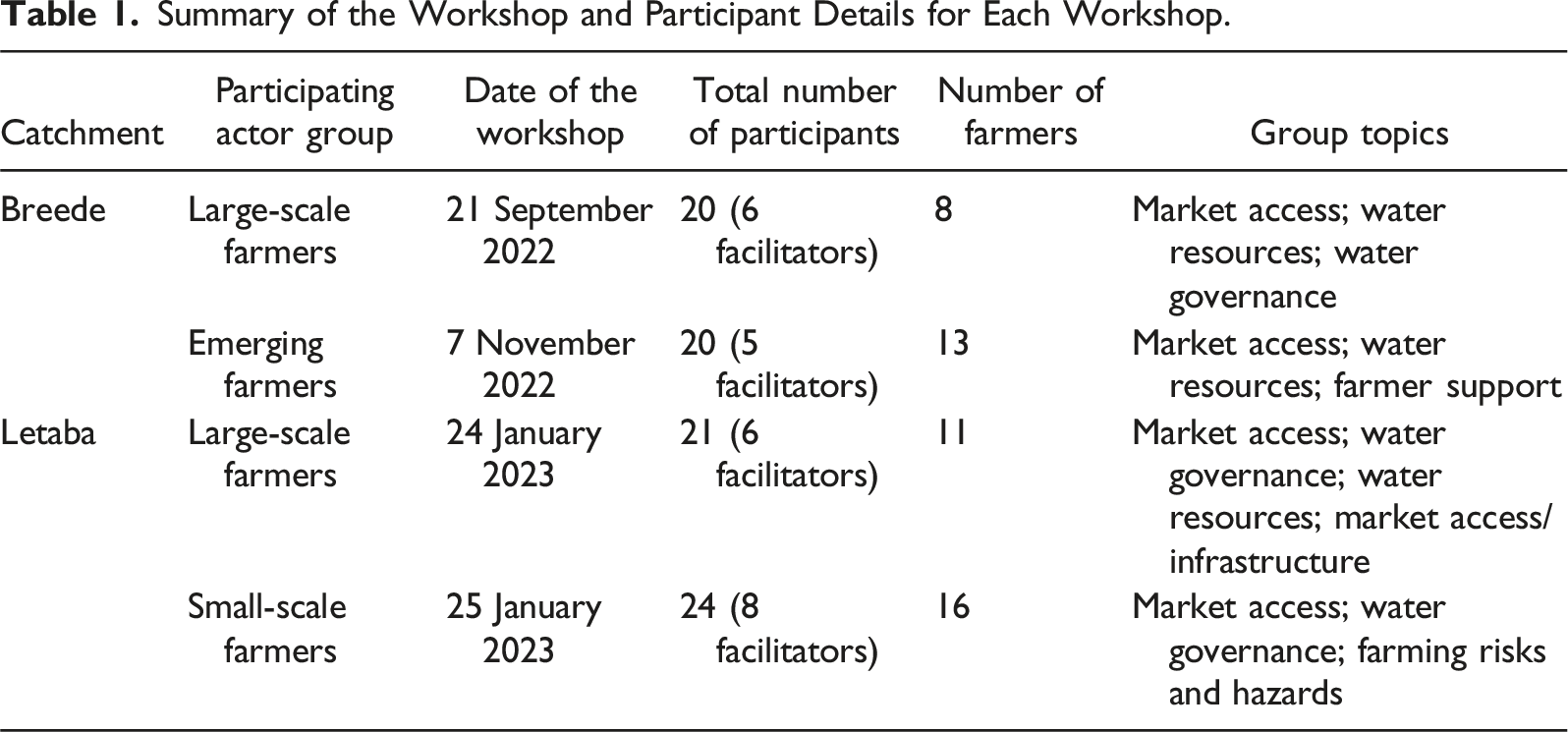
The workshops were run as part of a larger project funded by the Economic and Social Research Council with ethical approval obtained from Stellenbosch University (23133) (Bellwood-Howard et al. 2025). The project was initially centred on issues of inequity regarding water governance, but we expanded our scope to include topics of market access, farmer support programmes, infrastructure and farming-related hazards following initial phase interviews (Bellwood-Howard et al. 2025) (Table 1).
Participant Selection
Different approaches to participant selection were applied to each farmer group. In the Breede, large-scale farmers that were already part of the researchers’ networks were invited, while workshops were also advertised through an industry newsletter. Emerging farmers were invited to participate through the Agricultural Advisors from the Western Cape Department of Agriculture. Small-scale farmers are relatively few in this study area (Ncube 2018) and were therefore not included in the participant group. In the Letaba, large-scale farmers were invited by researchers, while small-scale farmers were recruited through the chairperson of their agricultural cooperative.
A limited number of representatives from other relevant authorities were present across all workshops to provide management-level perspectives alongside those of the predominantly farmer-oriented groups. These included Agricultural Advisors and officials from the provincial Departments of Agriculture and representatives from the Catchment Management Agencies and the Department of Water and Sanitation.
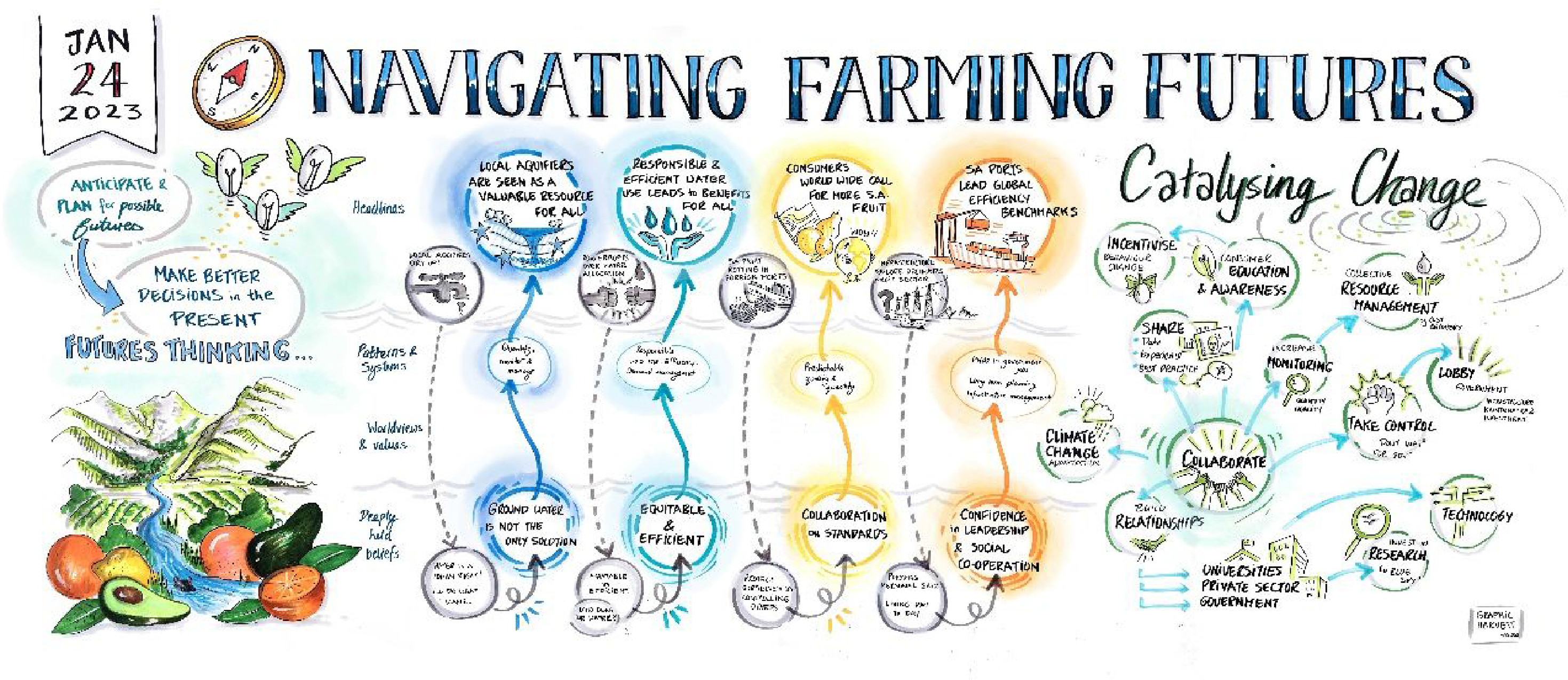
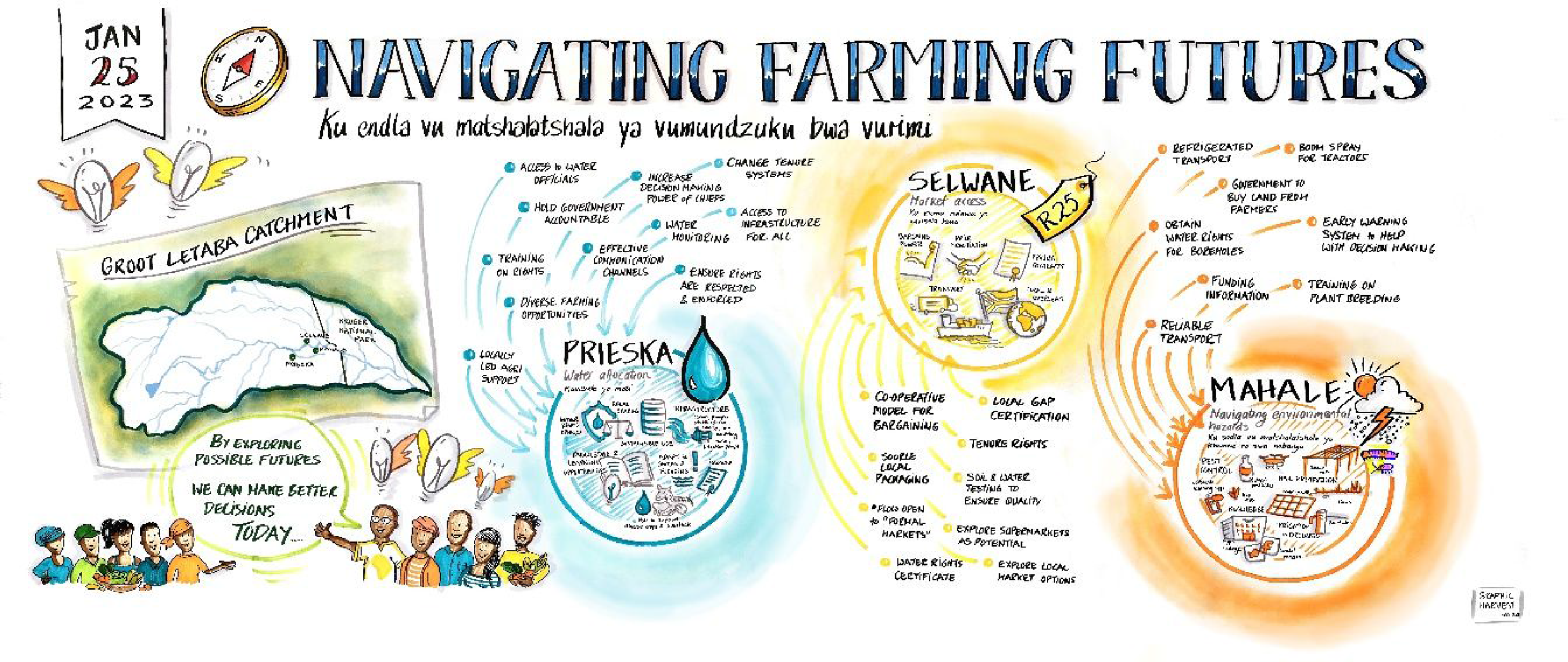
Also present at each workshop were 5–8 facilitators who included project team members with experience in hosting participatory futuring workshop processes. Team members were able to facilitate discussions in the home languages of participants, namely English, isiXhosa and Afrikaans in the Breede and English and Xitsonga in the Letaba. A graphic harvester was also contracted to capture output from the workshops and create a visual synthesis of information that was shared with participants during the workshop.
Workshop Process
We combine Causal Layered Analysis (CLA) (Inayatullah 2008) and Three-Horizons (3H) to complement participant perspectives of causes leading to catchment-specific issues with the actions that are necessary to transform them (Figure 2). The CLA offers a poststructuralist view of system dynamics by allowing participants to deconstruct the system qualities underpinning current outcomes and their connections across system depths (Inayatullah 1998). The 3H approach builds on the context that an understanding of these connections offers by emphasizing the actions and attributes that are necessary to achieve desired futures (Sharpe et al. 2016). We further prompted participants to consider social, technological, environmental, economic, political, and value-based elements (STEEP-V) during the 3H exercise to guide practical action. Combined, the two methods therefore allow participants to explore the underlying causes that lead to the emergence of observed issues, the visualisation of alternatives, and the identification of potential pathways towards realising them. Flow chart indicating the integration of two futuring approaches, the Causal Layered Analysis and three-horizons approach between distinct farmer groups.
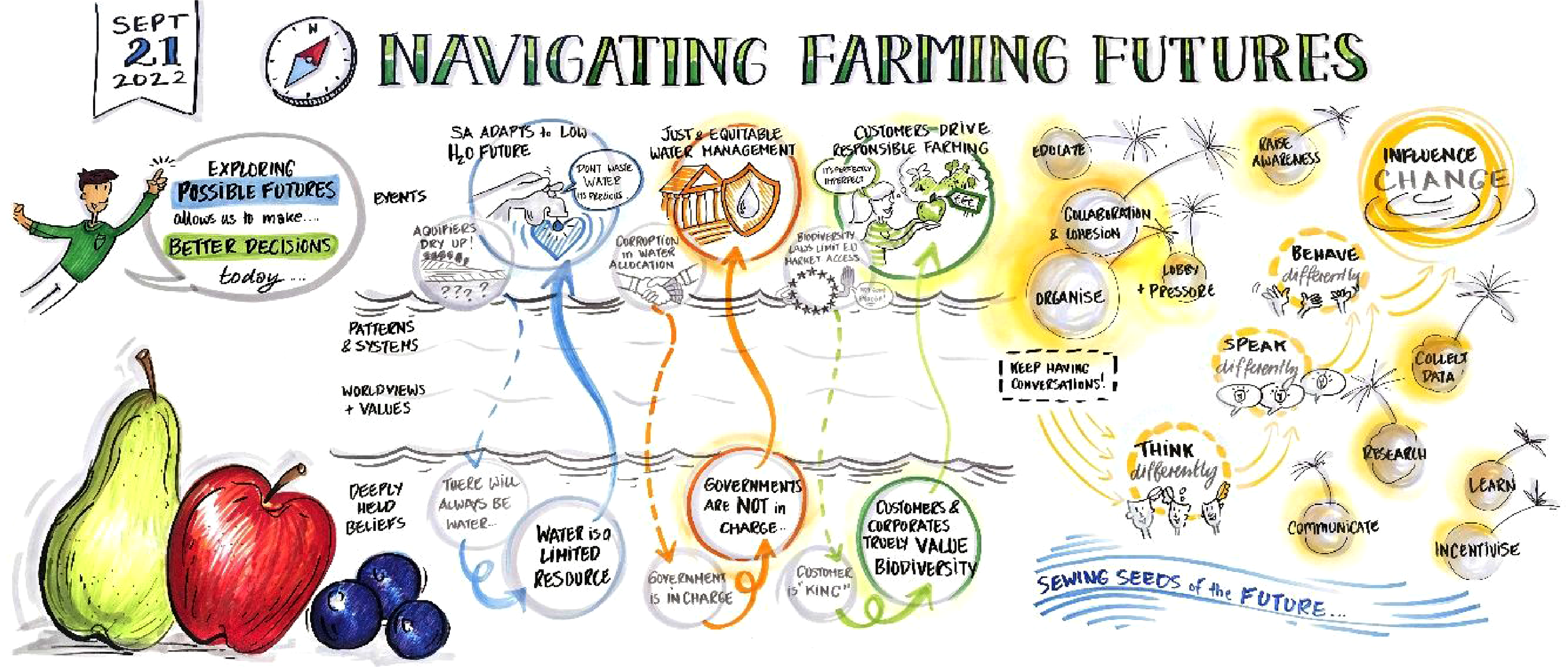
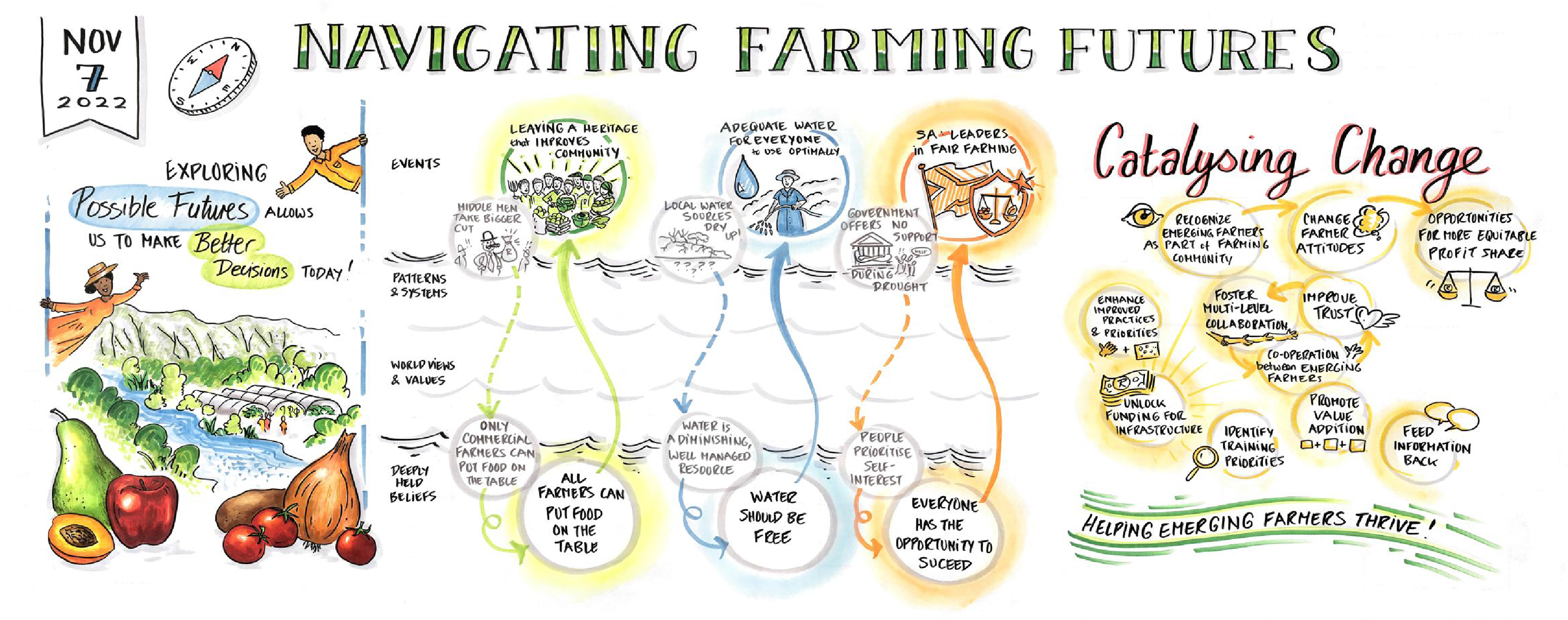
With the exception of the small-scale farmer group in the Letaba catchment (who encountered time and travel constraints), all other groups first conducted the CLA (Figure 3) in which they were given a “headline” topic and asked to explore the patterns and systems, worldviews and values, and deeply held myths that underpin the topic. After reaching the myths and metaphors layer, participants were asked to reformulate the deeply held beliefs that underpin the current structure of the iceberg and reconstruct each layer to articulate a positive scenario. Once the positive scenario has been articulated, the groups were asked to flesh these out using the Three Horizons framework (Figure 4). In lieu of the CLA, the small-scale farmer group in the Letaba were presented with the topics indicated in Table 1 as prompts to start their Three-Horizons exercise. The Causal Layered Analysis approach presented through four layers of the iceberg model (adapted from Haigh 2016). Participants are first presented with headline topics that are sequentially deconstructed by participants by populating each layer with post-it notes that underpin or explain the observed headline. After reaching the myths and metaphors layer, participants are asked to reformulate the deeply held beliefs that give rise to the current structure of the iceberg, and then reconstruct each layer to articulate a positive scenario. Figure showing the operationalisation of the three horizon framework, where the Y-axis represents dominance of elements reported by participants or strategic fit of potential actions to achieve greater dominance of desirable future elements. The X-axis represents time.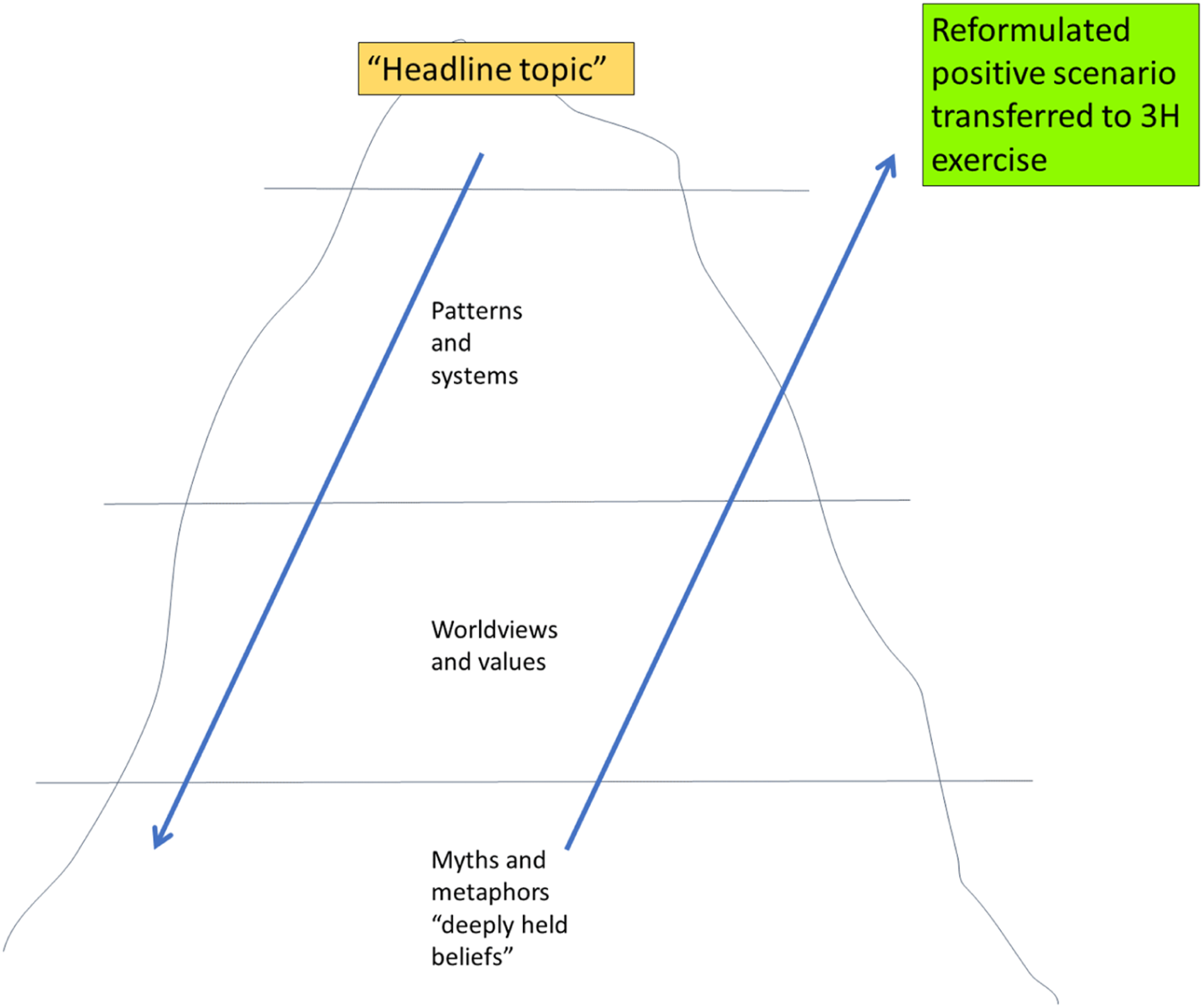
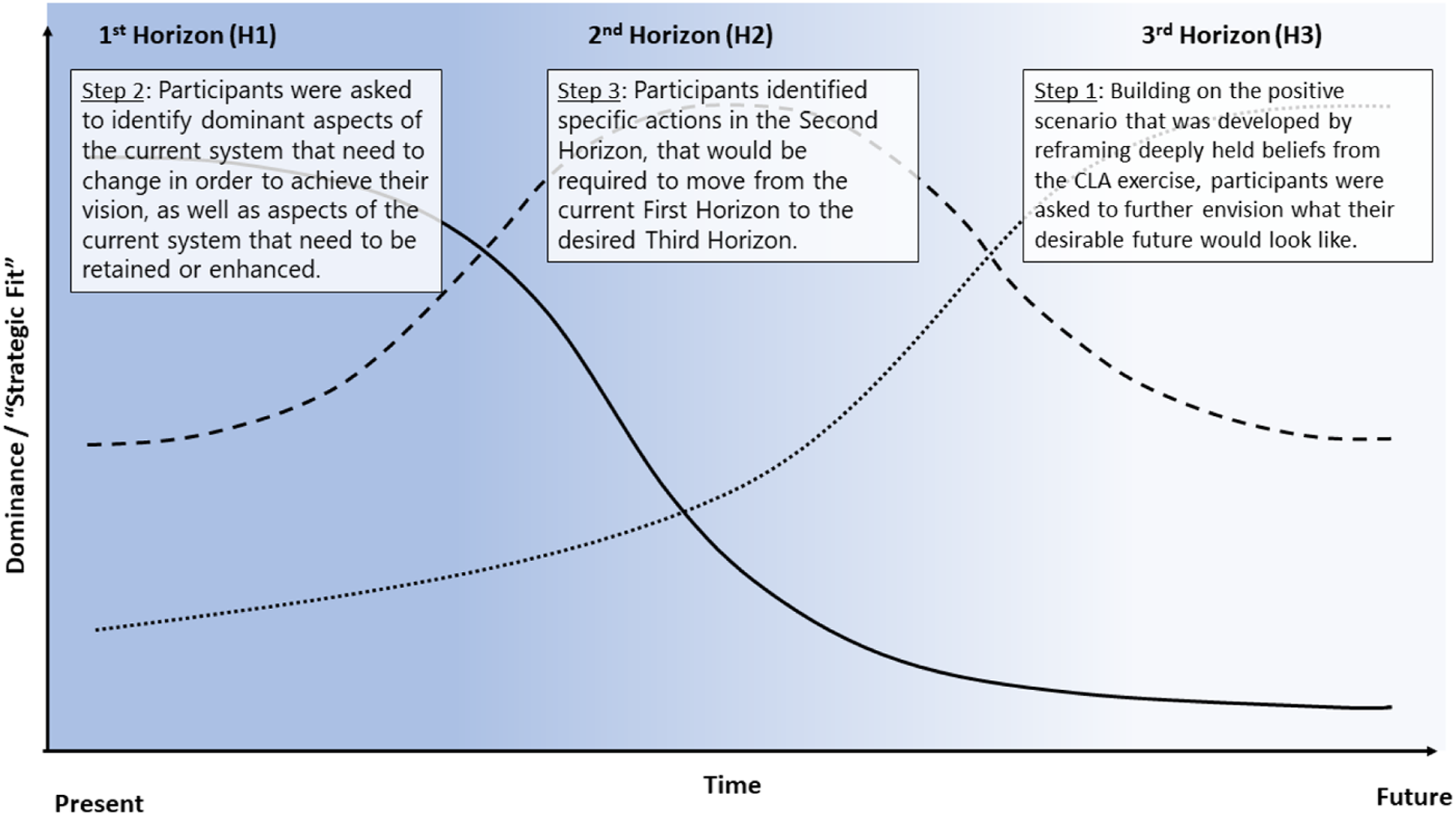
In the 3H exercise, all groups were asked to build on their specific topic and imagine what a desired future might look like (H3). Following this, they were required to define elements of the current system state (H1), and then to identify specific actions that would enable a transition from H1 to H3. In each horizon participants were asked to think about system characteristics using STEEP-V. A graphic harvester captured the outputs from both these exercises, which were synthesised into a single visual representation. Participants were encouraged to provide additional input to ensure that the harvester adequately captured their ideas.
Qualitative Content Analysis
Following the workshops, the CLA and 3H output produced by each group were transcribed and digitally coded using the STEEP-V framework and Atlas.ti. We followed the IPBES definition (Díaz et al., 2015) for values, which interprets values “as principles or core beliefs underpinning rules and moral judgments”. Codes are not mutually exclusive because the Horizons of the 3H framework are often comprised of overlapping elements. For example, STEEP-V elements coded as values may also be interpreted as social elements if a change in values is associated with changes in social behaviour.
A second round of coding comprised categorising relevant post-it notes produced during the workshop process, including those previously coded for STEEP-V, according to the three dimensions of equity: distributional, procedural, and recognitional (Leach et al. 2018).
Codes were then analysed using qualitative content analysis (Wicks 2017). This was chosen for its ability to combine the manifest elements in content with underlying or latent elements that emerged throughout the workshop process (Schreier et al. 2019). We also measured the frequency of reported STEEP-V variables as an indicator of their relative importance to participants while accounting for more nuanced interpretations of equity among the participating groups.
The similarity in discussion topics in all workshops allowed us to compare outputs across the workshops. However, actors did not always provide input directly related to the workshop topics presented to them. Instead, they used the futuring process as a forum to express themselves on various issues, and therefore we aggregated the analysis and compared the participants’ input between each workshop rather than that of the separate groups within each workshop.
Results
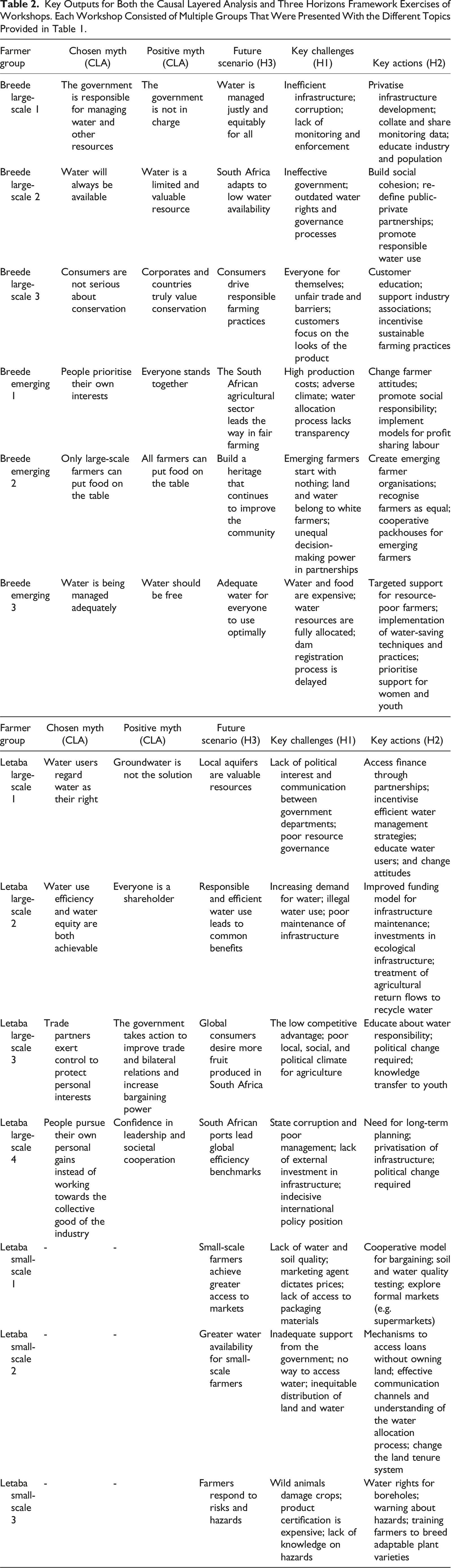
Key Outputs for Both the Causal Layered Analysis and Three Horizons Framework Exercises of Workshops. Each Workshop Consisted of Multiple Groups That Were Presented With the Different Topics Provided in Table 1.
Differences and Inequities Between Actor Groups
Large-scale farmers from both catchments identified political issues as the main current constraints to their operations (Figure 5: H1; Figures 6 and 8 of graphic harvests). Emerging farmers from the Breede focussed primarily on economic elements in H1 (Figures 5 and 7), while small-scale farmers from the Letaba emphasised environmental and political elements in H1 (Figures 5 and 8). Regarding future visions, both sets of large-scale farmers emphasised environmental elements as aspects of their desired futures, while emerging farmers highlighted economic and social elements, and small-scale farmers highlighted technical elements (Figure 5:H3; Figures 6–9 of graphic harvests). Regarding interventions (H2), large-scale farmers from both catchments highlighted social and political elements as ways to achieve their desired futures. Emerging farmers highlighted social, economic, and, to a lesser extent, political elements, whereas small-scale farmers focussed on economic and political elements. Radar diagrams of social, technological, environmental, economic, political, and values (STEEP-V) elements coded for each workshop. The rows show the Horizon from the three horizons framework to which the coded elements apply, while the columns indicate the farmer group that participated in each workshop. The STEEP-V elements highlight the domains of challenges, actions, and desirable futures for each farmer group. Output of the graphic harvest from the Breede River Catchment’s large-scale farmer workshop. The centre-left part of the figure shows the output of the Causal Layered Analysis which identified the key beliefs that underpin challenges faced by the catchment, while the right shows actionable options derived from the Three-Horizons exercise to drive change towards desired futures. Output of the graphic harvest from the Breede River Catchment’s emerging farmer workshop. The centre-left part of the figure shows the output of the Causal Layered Analysis which identifies the key beliefs that underpin challenges faced by the catchment, while the right shows actionable options derived from the Three-Horizons exercise to drive change towards desired futures. Output of the graphic harvest from the Letaba Catchment’s large-scale farmer workshop. The centre-left part of the figure shows the output of the Causal Layered Analysis which identifies the key beliefs that underpin challenges faced by the catchment, while the right shows actionable options derived from the Three-Horizons exercise to drive change towards desired futures. Output of the graphic harvest from the Letaba Catchment’s small-scale farmer workshop. The Xitsonga and English versions of the title are shown. Since only the Three-Horizons exercise was performed with these farmers, it shows the actions which actor groups can take to drive change towards desired futures.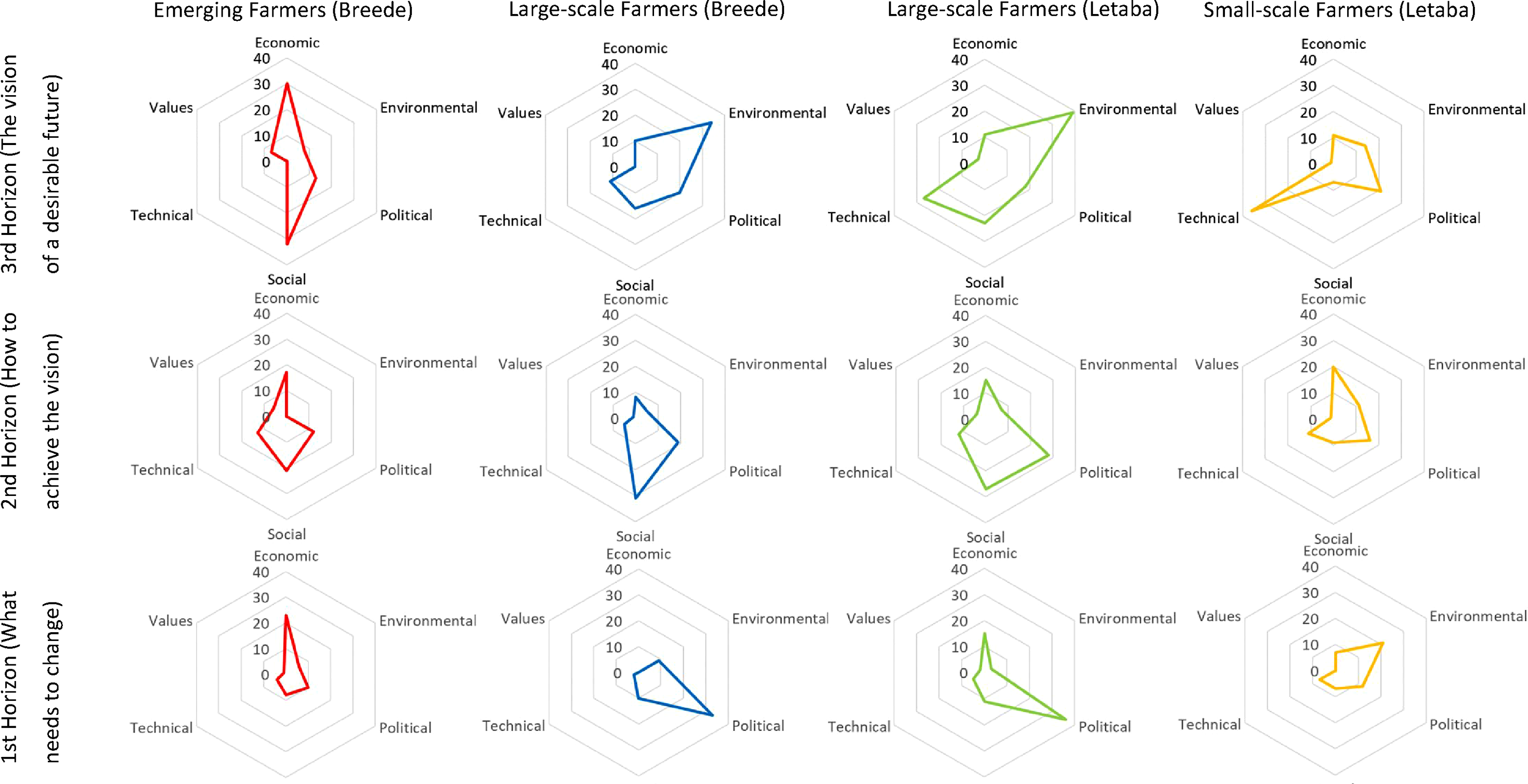
Types of Inequity Mentioned by Actor Groups During Their Causal Layered Analysis and Three-Horizons Approach Exercises.
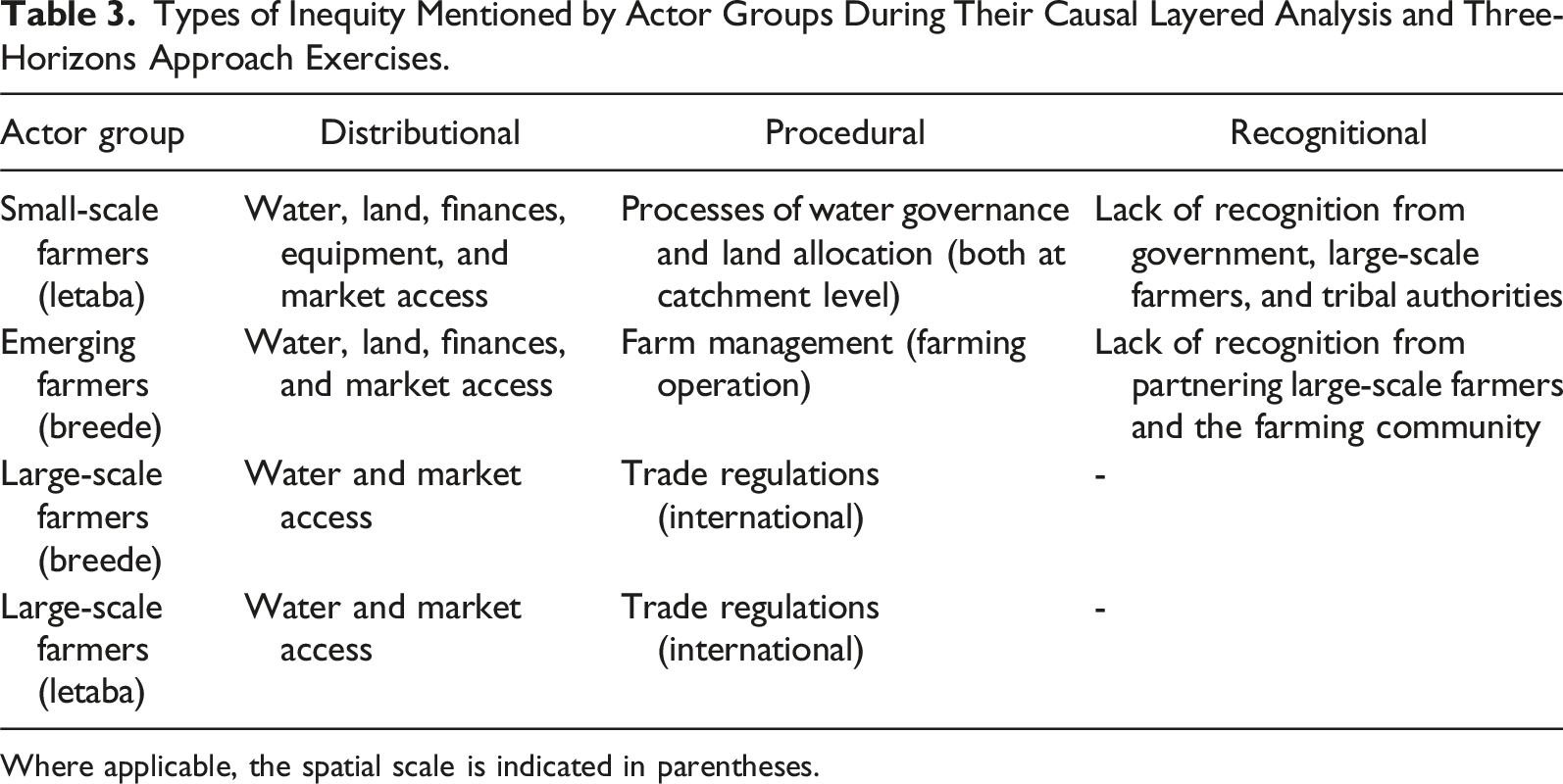
Where applicable, the spatial scale is indicated in parentheses.
An apparent discrepancy was also detected in the different markets to which actor groups had access (Table 2). Large-scale farmers prioritise high-value export markets and orient their operations to supply these markets. Emerging and small-scale farmers, on the other hand, mostly supply their produce to municipal fresh produce markets. Reasons provided for their lack of access to international and retail markets included insufficient funds to pursue the required certification for these markets and lack of access to the packaging and storage facilities in the value chains that allow farmers to supply these markets. However, an exception was seen in cases where emerging farmers partnered with large-scale farmers and used their existing value chains to gain access to international markets.
Procedurally, large-scale farmers from the Breede and the Letaba stated that access to international markets should be fairly regulated. This was mentioned in relation to what they consider “European protectionism” for European producers when restrictions are imposed on imported fruit without warning, as was the case in 2022 when European authorities demanded enhanced cold treatment for citrus (Table 2). In this respect, we also found differences between the visions of emerging and small-scale farmers compared to those of large-scale farmers. Where large-scale farmers aspired to open up trade to global markets, for example, by instituting one global standard that all producers adhere to, emerging and small-scale farmers seek regulation of local markets that prevent excessive imports, thereby promoting local produce consumption. Similarly, while large-scale farmers prioritise higher-value international markets or are already supplying to local retail supermarkets, emerging and small-scale farmers seek government support to gain access to retailers.
Emerging farmers and large-scale farmers from the Breede also highlighted water governance challenges, noting that water user associations should fairly manage processes around water and that water should be charged fairly (Table 3). Small-scale farmers from the Letaba wanted to be included in water governance processes, as they currently lack information regarding allocation of the resource. They further desired better enforcement of water regulations because upstream farmers threatened to close valves that are meant to release water to small-scale farmers further down the catchment.
Small-scale farmers also mentioned unfair land rental agreements with their chiefs, who were more likely to rent land to large-scale farmers than farmers from their community. Emerging farmers from the Breede who partnered with large-scale farmers wanted to be included in decision-making processes surrounding the management of the farm, which some mentioned favoured large-scale farming partners. Emerging farmers in both catchments also pointed to power imbalances with market agents, who dictated the price of fruit; therefore, small-scale farmers wanted to move from “price takers to price negotiators”.
Tied to procedural inclusion in formal and tribal governance processes was the desire of both small-scale farmers and emerging farmer groups to be recognised as equal farmers and co-inhabitants of the catchment (Table 3). Emerging farmers from the Breede desired that the large-scale farmers with whom they partnered regard them as equal farmers and not “previous employees”, as reported by some (Table 2). Small-scale farmers also expressed the need for recognition by government and tribal leaders who currently recognise large-scale farmers and therefore, include them in governance processes, but not small-scale farmers. Similarly, both small-scale and emerging farmer groups expressed that they are omitted from participating in organised agricultural organisations.
Common Intervention Pathways towards Desirable Futures
Key Interventions for Transforming the South African Farming System Towards Desired Futures, Grouped Into Five Overarching Themes and Drawn From the Causal Layered Analysis and Three-Horizons Approach Workshop Outputs.
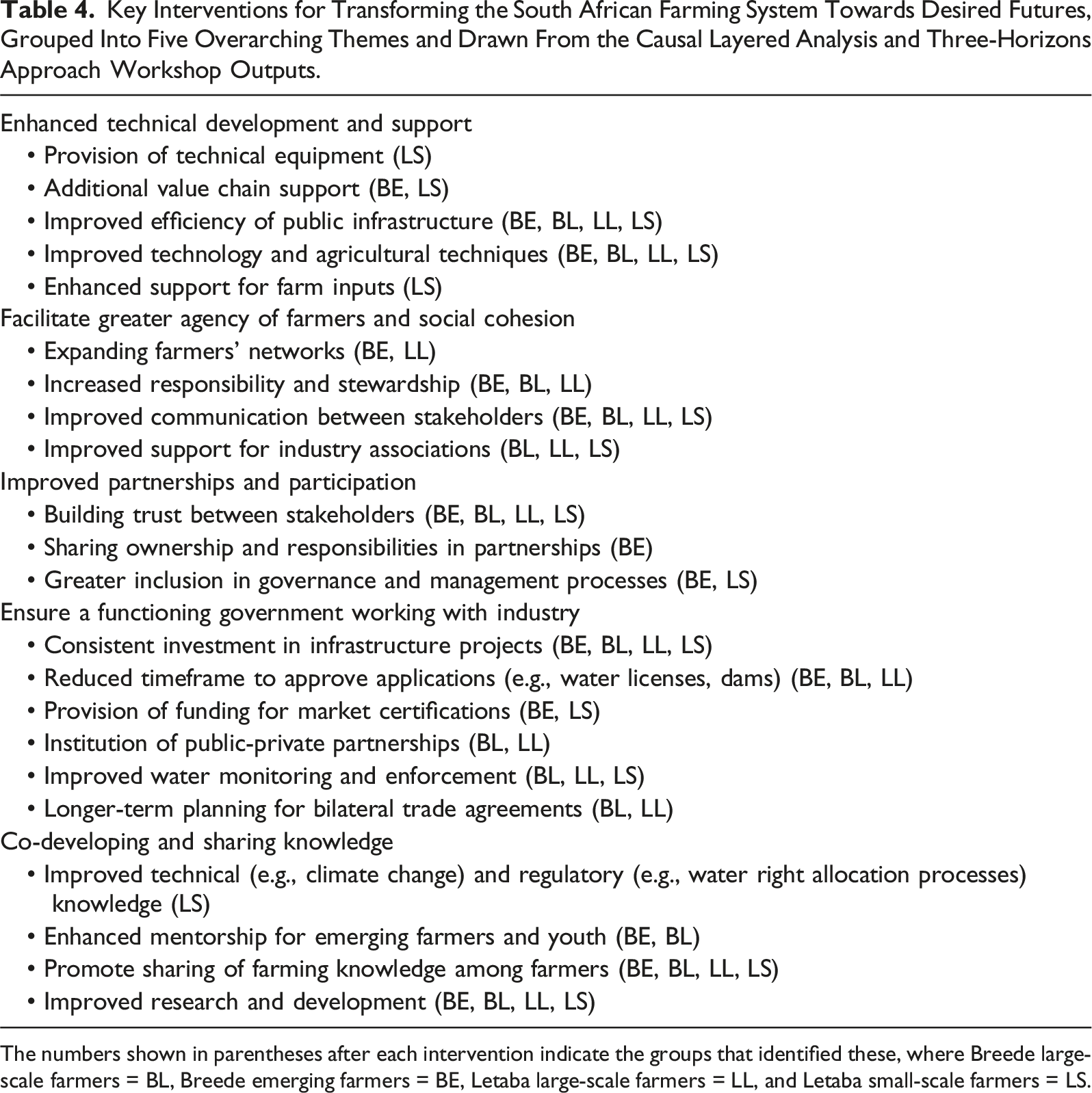
The numbers shown in parentheses after each intervention indicate the groups that identified these, where Breede large-scale farmers = BL, Breede emerging farmers = BE, Letaba large-scale farmers = LL, and Letaba small-scale farmers = LS.
Although these pathways are not mutually exclusive, they represent focal areas for suggested interventions that were shared by different actor groups within and across catchments. We observe convergence around certain interventions, for example where all groups mentioned improved communication between stakeholders. For large-scale farmers in the Letaba, improved communication was suggested to achieve responsible and efficient water use, small-scale farmers in the Letaba mentioned improved communication between relevant stakeholders as an intervention required to improve transparency and understanding in the water allocation process.
Analysis and Interpretation
Constraints Faced by Different Actor Groups
While all groups in this study shared a vision to expand their ability to produce, package, and distribute their products, they differed in the constraints for achieving these aspirations. Small-scale farmers in the Letaba focused mostly on technical aspects but also highlighted environmental challenges related to land, funding, water and water use licences, implying that these aspects constrain their ability to improve their farming output and economic returns, and is echoed by other authors who work on topic of smallholder development (Aliber and Hall 2012; Von Loeper et al. 2016).
Emerging and large-scale farmer groups do not face the same constraints as small-scale farmers, although the constraints of small-scale farmers tend to include those of the other groups. In terms of technical elements, a spectrum is observable whereby small-scale farmers are restricted by a lack of technical equipment, while emerging and small-scale farmers are restricted by access to value chain facilities like packhouses, and all groups are constrained by public infrastructure shortcomings. Both small-scale farmers as well as emerging farmers reported that the price of audits prevented them from certifying their products, thereby contributing to their exclusion from higher-value retail supermarkets, a finding that has previously been reported for African farmers more generally (Dolan and Humphrey 2000; Heijden and Vink 2013). While financing options may exist for some, it has been noted that small-scale in Letaba and emerging farmers in the Breede consider borrowing money as expensive, causing them to shy away from credit (Fanadzo et al. 2021). In comparison, the two large-scale farmer groups mentioned very few economic elements, suggesting that they have sufficient modes of accessing finance with favourable terms. Indeed, the South African large-scale agricultural sector has access to well-developed financial institutions compared with other farmer groups (Aliber 2020; Delgado 1999; Western Cape Department of Agriculture 2016). The technical resource constraints that large-scale farmers from the Letaba mention refer to working infrastructure such as irrigation dams and canals, port facilities, transport networks, and the electricity grid. Since these are predominantly public infrastructures, farmers have very little input or control over their utility, explaining the emphasis that large-scale farmers from both catchments place on changes to governance systems to achieve their desired futures. As a way of exerting political influence, these farmers rely on industry organisations to collectively negotiate with the government on their behalf. This tactic has achieved relative success, an example of which can be seen in the bilateral trade agreements that saw South African apples and pears being exported to China and Vietnam (Viviers et al. 2014).
Emerging and small-scale farmers reported constraints to natural resource access, mentioning mostly that water and land were in the hands of large-scale White farmers. National level data confirm that the large-scale sector is still dominated by White farmers (Kirsten and Sihlobo 2022; Sihlobo and Kirsten 2021). While all groups in this study are actively engaging in production activities, the scale of operations differs greatly (Greyling et al. 2015). The output per hectare of small-scale crop farmers lags far behind that of large-scale farmers (Zantsi et al. 2021). Using the example of maize, Zantsi et al. (2021) found that 95 percent of small-scale farmers achieved yields which equated to 40 percent of the yield per hectare of large-scale farmers. The difference between these farming groups infer that there is greater opportunity for growth in production among the small-scale farmer groups. Addressing the constraints of small-scale and emerging farmers and supplying them with appropriate support may therefore represent interventions for achieving the many equity and social-economic benefits that increase productivity brings (Christiaensen and Martin 2018). In addition to contributing to equity in the food sector, increased productivity of small-scale farmers has been declared an important policy objective due to the potential employment opportunities and food security that improved production may provide to the rural economy (Aliber and Hall 2012; Thamaga-Chitja and Morojele 2017).
Social Inclusion in the Farming Community
The focus on social elements across all actor groups is noteworthy. While many farmer groups advocate for social action in addressing the challenges they face, for example by being responsible in the way natural resources are managed, there are also important differences. In the Breede, Black emerging farmers are engaged in partnership agreements with mainly White large-scale farmers, which alongside the designated government department and local municipality provide them with support, for example, by creating a new business entity in which the two farmers are both shareholders (Staal 2019). In the context of South Africa, where colonial legacies and Apartheid policies led to the accumulation of land and sector participation predominantly among White farmers, land reform initiatives such as these have been identified as important mechanisms to redress past injustices and contribute towards a more equitable society (Sihlobo and Kirsten 2021). However, our results show that emerging farmers seek recognition from their large-scale partners as equal farmers. Additionally, they also point to procedural inequity by which the emerging farmer is excluded from decision-making roles within the partnership or from being given reasons as to why certain decisions are being made by the large-scale partner. Their exclusion from these processes and the motives that drive this exclusion erodes trust, as emerging farmers feel that decisions are made exclusively for the benefit of the large-scale partner (Chiluwe et al. 2022). From the large-scale partner’s perspective, their participation in such partnerships carries increased risk, since they often invest their own financial capital into the new entity, while it also demands time for mentoring the emerging farmer. In this regard, Staal (2019) and Vink and Kirsten (2019) report that suitably incentivising large-scale farmers to participate in such partnerships, for example through assurances of land security or additional water allocation, may lead to improved commitment from large-scale farmers to such partnerships.
Farming is not purely an economic activity, but also one of social importance that ties into the farmers’ sense of place, identity, and community (Delind and Bingen 2007; Marshall et al. 2007). This reinforces the need for inclusivity that promotes social cohesion. Interestingly, the literature on land reform in South Africa seldom regards aspects of social cohesion as enabling factors for emerging or small-scale farmer success. Schirmer (2015) point to the transformational power of social interactions to achieve higher farm productivity, but stop short of describing how these can be used to build community between culturally heterogeneous farmer groups. The benefits of social cohesion also extend to other drivers required to achieve the desired futures mentioned by actor groups, such as technical and financial assistance from fellow farmers. Therefore, social cohesion comprises an important component of farm resilience (Malherbe et al. 2024). Social inclusion that stems from recognising others as part of the farming community may therefore be a previously neglected component of land reform initiatives (Binswanger-Mkhize 2014). The current lack of participation of small-scale and emerging farmers in farmer organisations (Kirsten et al. 2022; Sihlobo and Kirsten 2021) reflects the extent to which exclusion occurs.
As a way of addressing this, emerging farmers suggest the formation of emerging farmer network groups with mentorship and support from large-scale farmers who have similar backgrounds to themselves. In doing so, these initiatives may help with the institution of a new and inclusive farming community, which has been shown to benefit constituent farmers elsewhere in Africa (Wouterse and Faye 2020).
Politics and Governance as Common Ground
Governance failure to provide a range of services and enabling conditions is viewed as the most common impediment and risk across the four actor groups. Shortcomings of the state have been reported by numerous reviews of South African agriculture, and although these stem from a complex socio-political history, the common view is that government policy implementation is a major constraint to the sustained growth and transformation of the agricultural sector (Greyling et al. 2015; Makhado 2012; Sihlobo and Kirsten 2021; Viviers et al. 2014).
Although all groups desire political change, there are clear differences in how these groups see the role of the state in achieving their desired futures. While emerging and small-scale farmers seek greater cooperation and support between themselves and government departments, large-scale farmers tend to see the role of the state reduced in favour of increasing their own influence through public-private partnerships. Risks from a small-scale or emerging farmer’s point of view are that these farmers may become overly dependent on the state, when the goal should be for intervention strategies to enable them to become self-sufficient (Vink and Kirsten 2019). At the same time, there is evidence that certain government departments are currently devolving the responsibility of their traditional functions to the private sector, as can be seen in recent legislation permitting private power generation that has seen tremendous uptake by the private sector (Ahlfeldt et al., 2025). While such initiatives may increase the viability of large-scale farmers as a whole, they present risks to groups who are previously disadvantaged and therefore require government support to gain a foothold in well-developed industries with high capital costs, like large-scale agriculture.
Scholars of South African agriculture point to the need for a functional but independent state that is capable of facilitating the potential for growth of the sector as well as its transformation towards inclusive representation of South Africans (Kirsten et al. 2022; Vink and Kirsten 2019). Importantly, improving the effectiveness of sectoral transformation efforts requires targeted support, whether it be to new entrants or small-scale farmers who wish to scale up their operations, and for this support to be applied to as many beneficiaries as possible (Aliber 2019; Aliber and Hall 2012; Maake and Antwi 2022; Vink and Kirsten 2019). To overcome the slow progress of efforts, we see the potential for land reform programmes to include futures thinking and social-ecological systems transformation methodology, such as the creation of transformative spaces for deliberation, negotiating and conflict resolution (Pereira et al. 2020; Weh et al., 2023). Combining co-constructed visions of hope with processes that allow for contested notions to be negotiated, would provide a fresh addition to existing structures that govern multi-actor landscapes.
Discussion
This study combines two futuring approaches to (i) understand differences in the desired futures of different actors in systems where major power disparities occur, and (ii) identify potential interventions to support transformations to more just and sustainable futures.
Common Intervention Pathways
We identified five common intervention pathways suggested by actor groups as ways to achieve desired futures. Common pathways for intervening in systems are important because they improve the prospect for collective action due to being grounded in participatory, transparent and inclusive processes (Bodin 2017; Lembi et al. 2024). In producing such pathways and the actions they comprise of, Future Studies contribute to the governance of complex social-ecological systems where multiple actor groups are engaged and dependent on ecosystems for their distinct livelihoods (Weh et al. 2023). By virtue of different actor groups identifying similar interventions in independent workshops, it also indicates that their interest regarding governance issues is substantially aligned, which can support their willingness to collaborate around these issues. Their involvement in collaborative efforts may additionally benefit system outcomes by opening the door to broach contested topics not immediately tied to their initial interest (Breuer and Lüdeke-Freund 2019; Mohajan 2018). In doing so, we demonstrate how futuring tools can contribute to influencing equity and sustainability outcomes of shared spaces by making actors aware of their relationality with other actors and the natural environment, and subsequently the development of actions to manage the interactions that influence outcomes for the system and its inhabitants.
The research contributes to the pursuit of equitable food system futures by allowing individual actor groups to firstly gain an understanding and appreciation for the challenges of other actor groups they share a system with, and then to identify common benefits future visions may hold. The ability to help actors broaden their views of the systems they inhabit represents a key strength of Futures Studies methods (Cork et al. 2023). Using methods that produces imaginaries and using a graphic harvester to capture the process provides means of engaging participants in an informative and responsible way (van Lente and Peters 2022). In doing so, the process itself builds motivation for actor groups to act in ways that helps them realise the desired futures that they were part of co-creating.
To achieve transformative outcomes, however will require a congruent set of interventions to be deployed when pursing desirable futures due to how interventions interact (Manlosa et al. 2019). Davelaar (2021) refers to these as nested hierarchies and uses the concept of an onion to illustrate the interaction between the distinct levels of ‘system behaviour’, ’structure’, ‘goals’, ‘paradigms’ and ‘worldviews’. In our study we can distinguish between common interventions that target systems at the ‘goals’ level, although the ‘structural’ outcomes nested within these goals may vary. For example, interventions related to increased responsibility and stewardship at the ‘goal’ level may be shared between the actor groups, whereas the ‘structural’ level objectives that arise from responsibility and stewardship may differ between groups. Common interventions such as these can therefore be considered as leverage points to focus on because they can be used to achieve multiple actor-related objectives in the system and therefore represent easy wins (Meadows 1999). It is also important to consider that not all interventions may be achievable or desirable at specific points since the system needs to be receptive for them to be effective (Pereira et al. 2018). However, with certain interventions facilitating multiple desirable outcomes, common interventions can create positive outcomes when conditions allow it as well as contribute towards the necessary structures that enable changes to occur more readily when the necessary conditions emerge (Abson et al. 2017; Leventon et al. 2021).
Application of Futuring Methods in Multi-Actor Systems
A key strength of our chosen approach was the ability to separately identify the constraints and pathways towards the aspirant futures of different farmer groups. This differs from other studies that combined actor groups in applying futuring methods (e.g., Schaal et al. 2023; Sellberg et al. 2020). Our approach allows group-specific issues and opportunities to be identified in greater detail and to be subsequently compared. For example, our analysis showed that certain groups face constraints on a greater bundle of resources than others in achieving their desired futures. Disaggregating actor groups in the manner we did might allow group-specific needs and aspirations to emerge more clearly than would be the case if actor groups were combined in one workshop. This makes it possible to identify constraints separately and therefore the actor-specific intervention points for those who need it most. It also demonstrates how different forms of equity are implicit in the conditions for actors to achieve their desirable futures.
While this approach allowed us to explore differences between actor groups, it limited the extent to which shared visions and pathways were developed. By being relatively homogenous in their composition, the actor group represented by each workshop have been limited in their consideration of others in their desired future, or the potential combination of roles different actors may play in getting there. In this respect, our approach subverts one of the objectives of the Three Horizons Framework, namely that both the desired futures and the pathways towards them are co-developed among participants of a shared system (e.g., Schaal et al. 2023). Combining actor groups may have improved awareness of other actors’ perspectives and the quality of collaborative efforts that emerged from the Second Horizon. However, existing power imbalances is clearly prevalent between these actor groups, and paired with a lack of trust it is likely that different responses would have been attained had groups been combined. This was perhaps most evident when considering the direct reference groups made to others in the catchment. For example, we expect that with large-scale farmers present, emerging farmers in the Breede would not have identified a lack of recognition from their large-scale partners as an aspect that needs to change.
Therefore, we consider our approach as an effective first step towards consolidating desirable futures through shared participatory processes between the different groups of farmers that constitute the catchments we worked in. Moving forward, we suggest that the commonalities surfaced in this work be used as a basis for the co-production of catchment futures and simultaneously broach the equity issues that emerged. We also suggest that futuring and participatory processes that seek to engage these and other mixed groups of participants with disparities in power and various dimensions of equity include deliberative mechanism that is capable of (a) surfacing these equity issues and (b) potentially providing a space for negotiation, deliberation, and collaborative creation of specific pathways towards transformation (Pereira et al. 2020; Weh 2025).
In providing a platform to surface the intentions of different actor groups, and also serving as a process to co-develop pathways towards shared system objectives, we demonstrate how futuring tools can be used to build anticipative capacity for system resilience (Jones 2019; Quandt and Paderes, 2023). Elsewhere, Malherbe et al. (2024) argue that anticipation provides a mechanism for resilience processes to explicitly consider normative aspects of system change, specifically through surfacing of value judgements tied to different system states before deciding on management actions used to navigate systems towards such states. There is however a need for more clear integration (and iteration) between processes that build anticipative capacity with those that implement actions, and we suggest this as a direction for future research.
Conclusion
This study presents the findings from a futuring approach used to surface perspectives of present challenges, desired futures, and possible intervention pathways for achieving these futures across different actor groups in two catchments in South Africa. We show important points of divergence and convergence in the constraints and pathways that different actor groups propose to achieve their futures. Our chosen approach to futuring allows us to co-develop futures and pathways amongst a heterogeneous set of participants, contributing to building anticipatory capacity towards social-ecological transformations. This is done by hosting separate workshops for distinct actor groups, which makes it possible to identify commonalities between the futures and pathways towards achieving them. In doing so, we argue that our process allows common ground to be created between these distinct and sometimes opposing actor groups, which serves as a basis for future processes that could contribute to the desired and needed transformation of the food system.
Footnotes
Declaration of Conflicting Interests
The authors declared no potential conflicts of interest with respect to the research, authorship, and/or publication of this article.
Funding
This work was supported by the UKRI GCRF Equitable Resilience grant ES/T003006. RB and WM were also supported by the DST/NRF South African Chair (SARChl) in Social-Ecological Systems and Resilience (grant 98766).
