







Abstract
Given the combined context of the present climate emergency and hegemonic neoliberal world order, some contemporary artists have begun to grapple with and critique this status quo through their work. In the context of Southeast Asia, these experiences manifest by way of extreme weather such as unpredictable monsoon seasons, flash floods, extreme heat, and are combined with continued resource extraction and accelerated infrastructural development. To reflect these lived realities, moving image has emerged as a salient tool in engaging with ecocriticism. This paper is interested how artists from Southeast Asia are using moving image to communicate local worldviews and indigenous cosmologies. Time in film often follows a linear trajectory, with minutes steadily moving along a progress bar at the bottom of one’s media player or screen. It is an inherently chronological medium, but also one that is defined by a sequence of images in motion. Whilst artists are cognisant of moving image’s inherent qualities, they also seek to subvert or reshape the medium to make space for multiple perspectives or inconclusive narratives. The paper is also interested in how moving image works might also experiment with visibility and visuality across a variety of scales. Whilst images might often present indexically on screen, artists have wielded strategies such as multiple roles, found or archival footage, collage, poetry, sound, and communal authorship to deal with more-than-human subject matter such as the spiritual (deities, spectres, and other dimensional entities) and the directional (currents, wind, etc). To illustrate its points, this paper will consider works such as Monisme by Riar Rizaldi (2023), Kindred by Lêna Bùi (2021) and Tirta Maya by Zachary Chan and Rosemainy Buang (2024) to provide a glimpse into how these shapeshifting moving image works might nudge viewers towards considering a different conception of time, space, and relationship to the more-than-human.
Keywords
“We can’t breathe. We humans, the voice and breath of the planet as its most conscious living organism, we can’t breathe. We need to breathe. In and out. Deeply. Take the long view for our planet and all earth’s organisms. Panicking now would be a disaster. To return to a breathable rhythm, we need to decolonize time.” (Power 2023, 126)
Introduction
In their introduction to an edited dossier on ecocritical cinema in Southeast Asia, Graiwoot Chulphongsathorn and Philippa Lovatt argue that attending to environmental concerns in the region’s film and artists’ moving image practices necessitates an engagement with its specific histories and environmental politics (2021, 539). In Southeast Asia, the climate emergency materialises through extreme and uneven weather patterns—unpredictable monsoon seasons, flash floods, prolonged heat—unfolding alongside ongoing extractive economies and accelerated infrastructural development. Against this backdrop, recent ecocritical moving image works have not only grappled with environmental degradation as a representational problem, but have also begun to ask how alternative ways of inhabiting time, space, and multispecies relations might be sensed, rehearsed, or imagined.
Building on these concerns, this essay shifts from identifying an emergent “aesthetic of the Anthropocene” in Southeast Asian moving image practices toward examining how such works actively model environmental futures grounded in more-than-human mutuality (Chulphongsathorn and Lovatt 2021, 539). Rather than positioning cinema as a medium that merely visualises ecological crisis, the works discussed here propose film as a speculative and affective site through which alternative ontologies—relational, non-linear, and attuned to environmental entanglements—can be experienced.
This essay focuses on three recent works by contemporary artists from Southeast Asia: Monisme by Riar Rizaldi (2023), Kindred by Lêna Bùi (2021), and Tirta Maya by Rosemainy Buang and Zachary Chan (2024). All three films are rooted in distinct local contexts, so this essay does not claim to present a comprehensive survey of regional ecocritical practices. Instead, it hopes to provide a framework for how we might foreground alternative temporal experiences in our consideration of human-nature relations using these three films and their different registers as case studies.
Attending to how these works are sited and experienced, and to how they conceptualise time, this essay argues that the three films call us to move beyond linear, human-centred chronologies. Through a variety of technical and visual strategies, the works do not simply depict environmental systems. These films render them palpable—inviting viewers to sense time as sensorial, communal, and fundamentally existential.
Sensing Time Otherwise
Forces of Nature: Stratified Time
“Monism, as a concept in philosophy and theology, indicates that all reality is singular, originating and ending from the same unity. That everything we know and experience is just one entity. In the context of temporality, this singularity cannot be represented through a linear progression.” (Riar Rizaldi, Email conversation with author, June 10, 2024)
Monisme is a feature-length film by Indonesian artist, Riar Rizaldi that is centered around Mount Merapi, an active volcano in Yogyakarta. The film is well circulated—it made its premiere at FIDMarseille and has been shown at many prestigious film festivals since, including São Paulo International Film Festival, Singapore International Film Festival, and Doc Fortnight 2024: MoMA’s Festival of International Nonfiction Film and Media. Whilst moving image works by contemporary artists often circulate within the contexts of museums, cultural institutions, and independent galleries, it is notable that Monisme has taken a different route. Viewers would likely have watched Monisme in a cinema, the same way they would encounter a movie. Rizaldi sees cinema as “a sufficiently ‘didactic’ space”, one that is rather “demanding in terms of audience engagement, and [that creates] an immersive, sensorial, and focused situation.” (Riar Rizaldi, Email conversation with author, June 10, 2024) Whilst they might have been free to move in and out of the film’s space if it were to be shown in a gallery, the setting of the theatre commands the viewer’s undivided attention (Figure 1). Riar Rizaldi, Monisme (still), 2023, film, 115 mins. Image courtesy of the artist.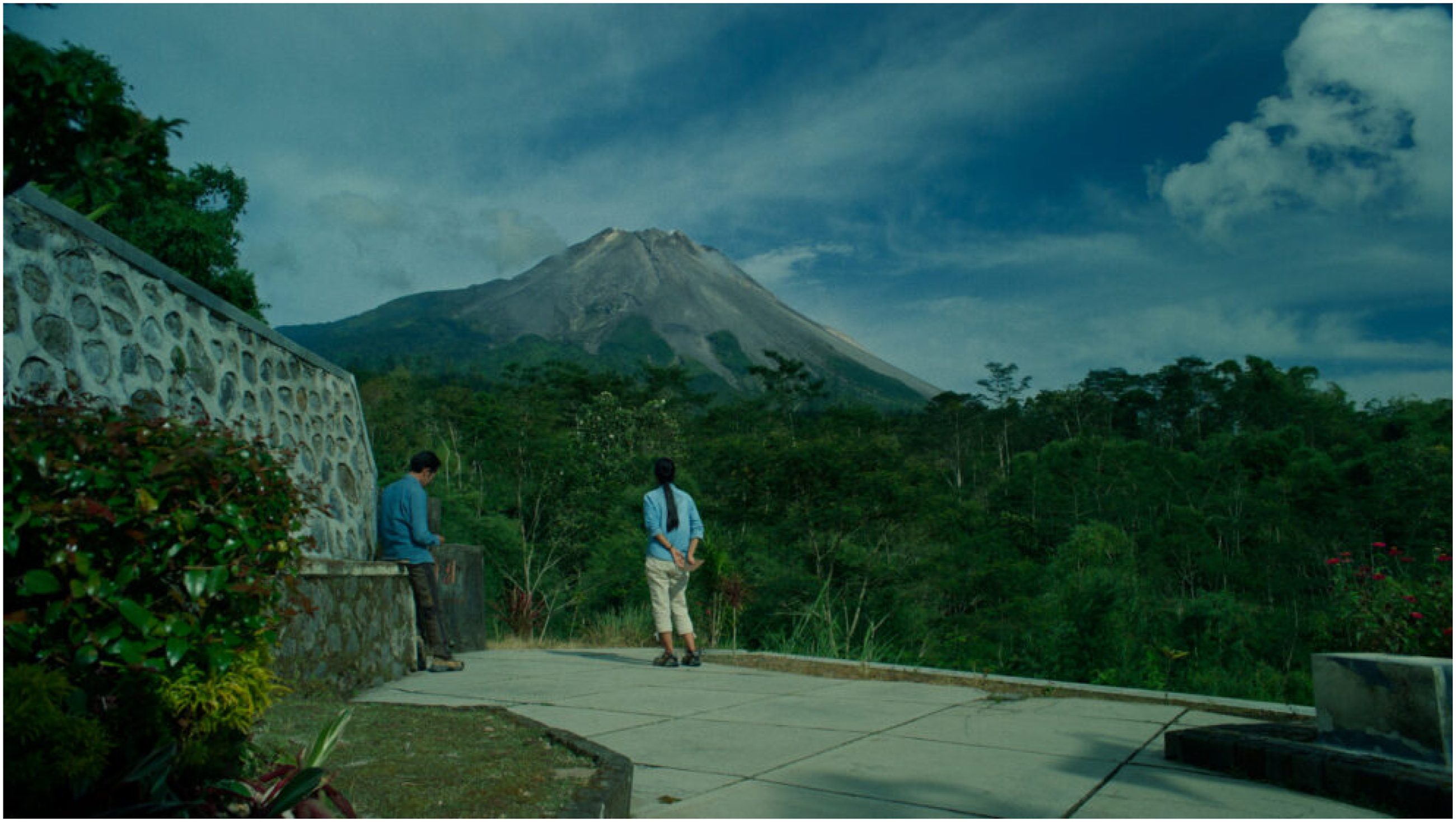
Whilst the volcano itself isn’t always shown in the film, it looms large over the entire film. The volcano and its environs are simultaneously the site of, a character within, and co-creator of the work. The film is also an eclectic blend of documentary and fiction, and it finds a comfortable space between two typologies that are often seen as polar opposites of one another. This mirrors a clear theme that emerges within Monisme: the contrast between scientific time and more-than-human time. This binary is exemplified by a conversation between the two volcanologists: “In the eyes of science, humans are the only living creatures who expect to predict the future,” one volcanologist muses. “Unlike other animals, who perceive the present time as their only construct.”
1
Monisme’s thesis around time is encapsulated within the above statement: time is unruly—it resists human control. Understanding that the desire to restrain time is an absurd and futile one, Rizaldi does not attempt to present viewers with a chronological account of events. The film unfolds along four chapters. The film opens with several seemingly unconnected vignettes: men from a paramilitary group mock and ultimately kill someone deep in the forest. Later, two volcanologists share philosophical musings around apocalyptic events. Various photographs and documents that portray Mount Merapi from different perspectives are also presented. As viewers are transported from one story to another, there are no clear indications given as to which episode happened first. This lack of temporal specificity was important to Rizaldi, who hoped that Monisme would embody “the idea of monism not just through the concept but also through its medium.” (Riar Rizaldi, Email conversation with author, June 10, 2024) Indeed, assembling a definitive sequence of events does not seem relevant or necessary to film or our understanding of it.
Yet this is not to say that time in Monisme is a messy, mutinous affair. It might seem that the four chapters are unconnected, but Rizaldi has peppered nuances throughout that hint towards overlaps between the various characters. The same actors, for example, reprise different roles across the chapters. The actor, Rendra Bagus Pamungkas, plays the volcanologist we encounter in the second chapter, the sand miner in the third, and the shaman in the fourth.
These methods recall the practice of Vietnamese artist and scholar Trinh T. Minh-ha. Trinh’s works were marked by the idea of speaking nearby, as compared to speaking about. Instead of relying on descriptive or distant language, to speak nearby was to meander, to explore different registers of visuality, and to lean into the poetic. This allowed her to “come very close to a subject without, however, seizing or claiming it” (Chen 1992, 87). Monisme does not claim to present Mount Merapi from a neutral or objective point of view. Instead of showing the contradictions and idiosyncrasies of living under the shadow of the volcano, the film embodies this by idiosyncratically contradicting itself. This is most evident in Monisme’s closing scenes. In the final chapter, Pamungkas takes on the role of a shaman. Throughout this chapter, documentative interviews with Puthut Juritno, the spiritual head of the group Jathilan Kudho Taruno Wonolelo, have also been included. What begins as a scene of Pak Juritno conducting a ritual within the forests soon intensifies. The scene reaches a fever pitch as more performers fall into a trance, with the camera finally spinning around to what is happening behind the scenes to show that the rituals have also stirred a crew member. Compared to the even-keeled cinematography that characterised most of the film, the camerawork here is shaky and almost frenzied, mirroring the visceral nature of the ritual it is capturing.
Returning to the binary it posed earlier between scientific and spiritual time, Monisme concludes by taking neither position. Instead, it asserts that time is Merapi and Merapi is time. By collapsing the arbitrary boundaries between what lies in front and behind the camera, Monisme makes it clear that negotiating a position between these binaries is irrelevant. Mount Merapi is not just a natural landmark, but a cosmological force that supersedes all.
Rites of Reincarnation: Genealogical Time
“The piece played with the idea of reincarnation but in a broader sense, with souls breaking and regrouping in a variety of configuration with each lifetime, so that in each thing is a soul comprised of many—a we—instead of a singular entity moving from one life to the next as is traditionally imagined.” (Lêna Bùi, Email conversation with author, March 8, 2023).
Kindred was made against the backdrop of the Covid-19 pandemic. Lêna Bùi was meant to embark on an artist residency with NTU Centre for Contemporary Art Singapore in 2020, but the pandemic disrupted those plans for the artist to be in Singapore physically. Kindred was made at the end of Bùi’s residency, and it very much reflects the context within which it was produced. Kindred was made amidst travel restrictions and whilst sheltering at home. To create a work that traversed different geographies despite the immotile reality at the time, Bùi drew upon materials within her own archive and travelled to institutional archives around the world by way of their digital repositories. In addition, the film’s elegiac prose-poem was written in collaboration with Elizabeth Ang, a research liaison based in Singapore who was paired up with Bùi to support the artist in developing her project. When asked about the process of making Kindred, Bùi acknowledged the difficulties involved. Yet she is quick to recognize the plucky inventiveness that bubbled up in response. “I like limitations,” Bùi writes in an email to me, “it often generates a lot of creativity.” (Lêna Bùi, Email conversation with author, June 6, 2024) Since it was made, the work has been shown within the context of film screening programmes and institutional biennales. Whilst the artist didn’t have a set vision for how the work was to be presented at the time it was made, Bùi will be experimenting with projecting the film onto a screen of silk cloth for an upcoming solo exhibition (Lêna Bùi, Email conversation with author, June 6, 2024). This stands in marked contrast to its straightforward presentation at the 2022 Jeju Biennale as a wall projection, and these variations demonstrate the work’s shapeshifting configurations (Figure 2). Lêna Bùi, Kindred (still), 2021, single channel video projection with sound, 7:37 minutes. Image courtesy of artist.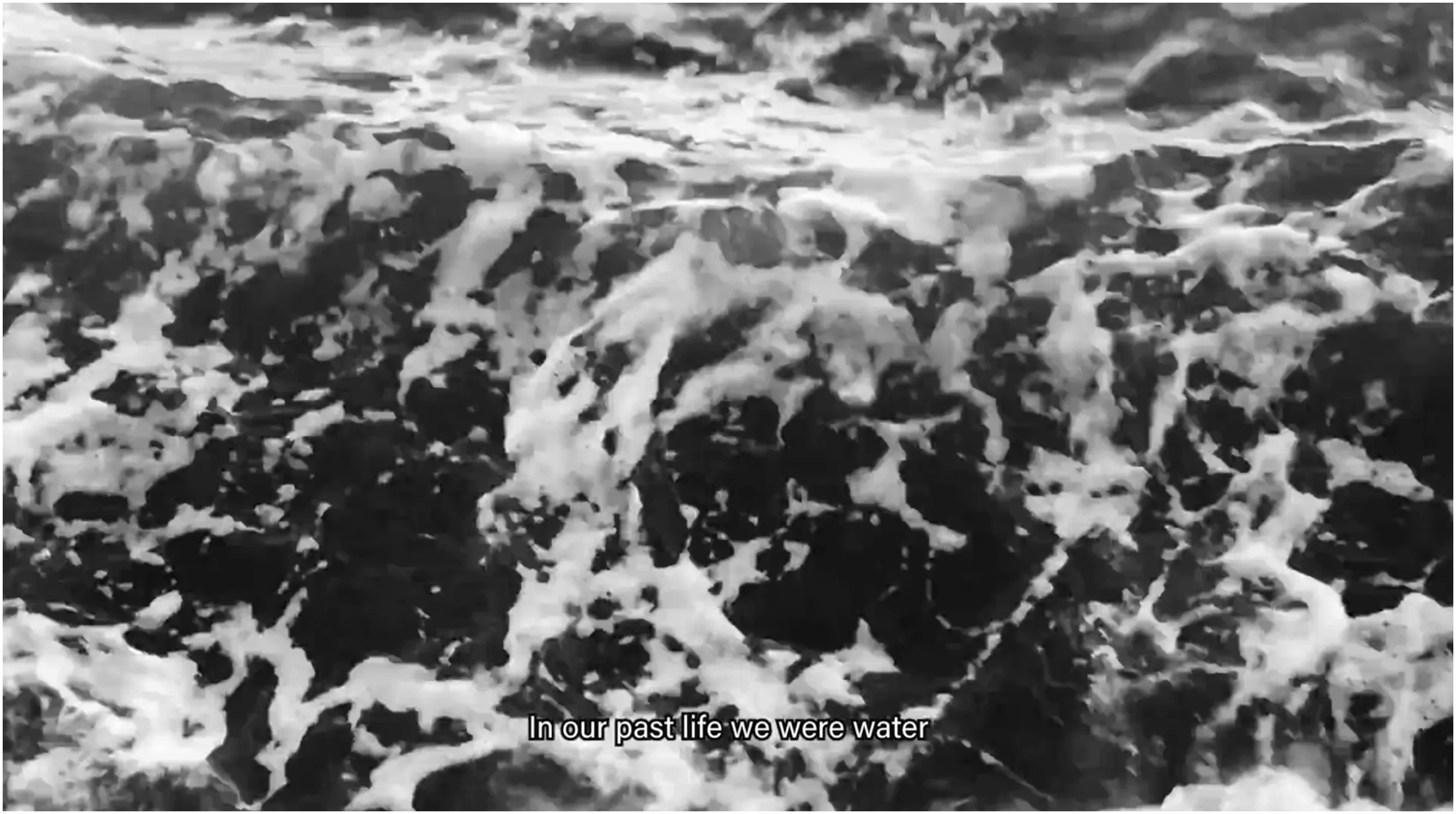
In a film about reincarnation, water marks the beginning and the end of Kindred. As scenes of rippling waves occupy our screens, it becomes clear that this cyclicality mirrors the film’s central theme. From tiger, to human, grass, and gecko—we follow the polyvocal narrator(s) through their past and current lives. The prose-poem is narrated in seven languages: Cham, Tamil, Javanese, Khmer, Vietnamese, Cantonese, and English. As her research delved into the stories and histories of Southeast Asia, Bùi wanted the prose-poem to feature languages that are commonly spoken in the region.
Yet despite the circularity that reincarnation offers, Bùi observed that the process still “follows a very linear route towards nirvana” (Lêna Bùi, Email conversation with author, March 8, 2023). To reflect this, most of Kindred has been washed over by shades of gray. This monochromatic treatment has been applied to scenes that relate to the narrators’ past lives. As we move towards the end of the film and into the contemporary moment, more colours begin to enter the frame, a clear visual indication of the steady progression of the film and its story.
Here, the dual nature of time as cyclical or linear is presented as two distinct experiences that have brushed up against one another. Instead of trying to mesh them together into a definitive perspective that consolidates both temporalities, Kindred generously makes space for plurality. This is clearly modelled by Bùi’s use of found and new footage as archival photographs and clips sit alongside newer recordings. Of the latter, some were filmed by Bùi herself, and others were filmed by her research liaison, Ang, who was more than 600 miles away from Bùi at the time. Instead of enveloping everything into a single ambiguous whole, Bùi makes it very clear that these are of different times and places. As the film’s post-credits roll, a clear list of the archives Bùi accessed has been included. Placing them together within the same film and in relation to the prose-poem serves to, instead, allow these different moments to get acquainted with one another at their own pace and for new connections to form in the process.
In his book Beyond Settler Time, Mark Rifkin notes that turning our focus away from thinking of time as a singular arrow in motion towards multiple routes crossing paths could “[shift the discussion of temporality from an insistence on the sharedness of now (as well as implicitly of then and will be) toward a consideration of what constitutes a temporal formation and how such formations might engage with and alter each other without becoming—or being plotted on—a singular timeline” (2017: 17–18). This is what Rifkin refers to as “being-in-time” (2017: 16–17). This also recalls historian Wayan Jarrah Sastrawan’s writings on how experiential temporality can be theorized in the context of Southeast Asia. Sastrawan proposes a “narrative-centered theory” that proposes that time in this part of the world should be framed through the forking paths of genealogy instead (2020, 211). As such, perhaps the multiple routes in Kindred might be better understood as lineages, especially as the film moves into its final sequences in colour. At the end, the narrator says in Cantonese, “In a matter of time, we become another form and element. Another impression of this world. Reaching further into the spaces between then and now.” 2 Whilst both temporal worldviews inform the film, Kindred points us towards the limitless possibilities that exist within liminal spaces.
Kindred pushes back on the existence of a single, hegemonic timescale by establishing multiplicities within a film about rebirth. Having said that, it also goes beyond the assertion that there are multiple temporalities. By placing an emphasis on associations and openings, time becomes a verb, not a noun. In short, time in Kindred is a myriad of active processes where momentum, motion and direction is manifold.
Assembling an Ensemble: Rhythmic Time
In stark contrast to Kindred’s largely monochromatic aesthetic, Tirta Maya is a smorgasbord of technicolour. Made by Rosemainy Buang and Zachary Chan, the work collages together vibrant graphics, illustrations, maps, and found footage. Interestingly, the work was conceived as a music video. Typically made to provide a visual narrative or impression of a song, the pictorial and the aural feed back into one another in conceptualising and making a music video – both are of equal footing and importance. In an article that charts the advent of music videos, Pat Aufderheide noted that “music videos have also set themselves free from the television set, inserting themselves into movie theaters, popping up in shopping malls and department store windows, becoming actors in both live performances and the club scene” (Aufderheide 1986, 57). As a music video, Tirta Maya met viewers where they were at. The film was uploaded, like many music videos today are, on a video streaming platform, Vimeo. Instead of presenting it within a theatre or a gallery space, the intention was for viewers to encounter Tirta Maya by way of personal electronic devices such as laptops or phones.
3
The artists found the format “more laid back” and cited that it propelled them towards “[breaking] away from the pressures of following certain conventions in contemporary art today” (Rosemainy Buang and Zachary Chan, Whatsapp conversation with author, June 25, 2024). This freeing sentiment is mirrored in the viewer’s experience with the work. – one can view Tirta Maya whenever they’d like, from wherever they are, and at whatever pace they’d like. At the same time, Buang and Chan also staged Tirta Maya as a performance in November 2024. As the work was first launched online, this live event adds yet another temporal layer to an experience with the work—one that insists on existing beyond the four corners of the screen (Figure 3). Rosemainy Buang and Zachary Chan, Tirta Maya (still), 2024, 6:09 minutes, video. Image courtesy of the artists.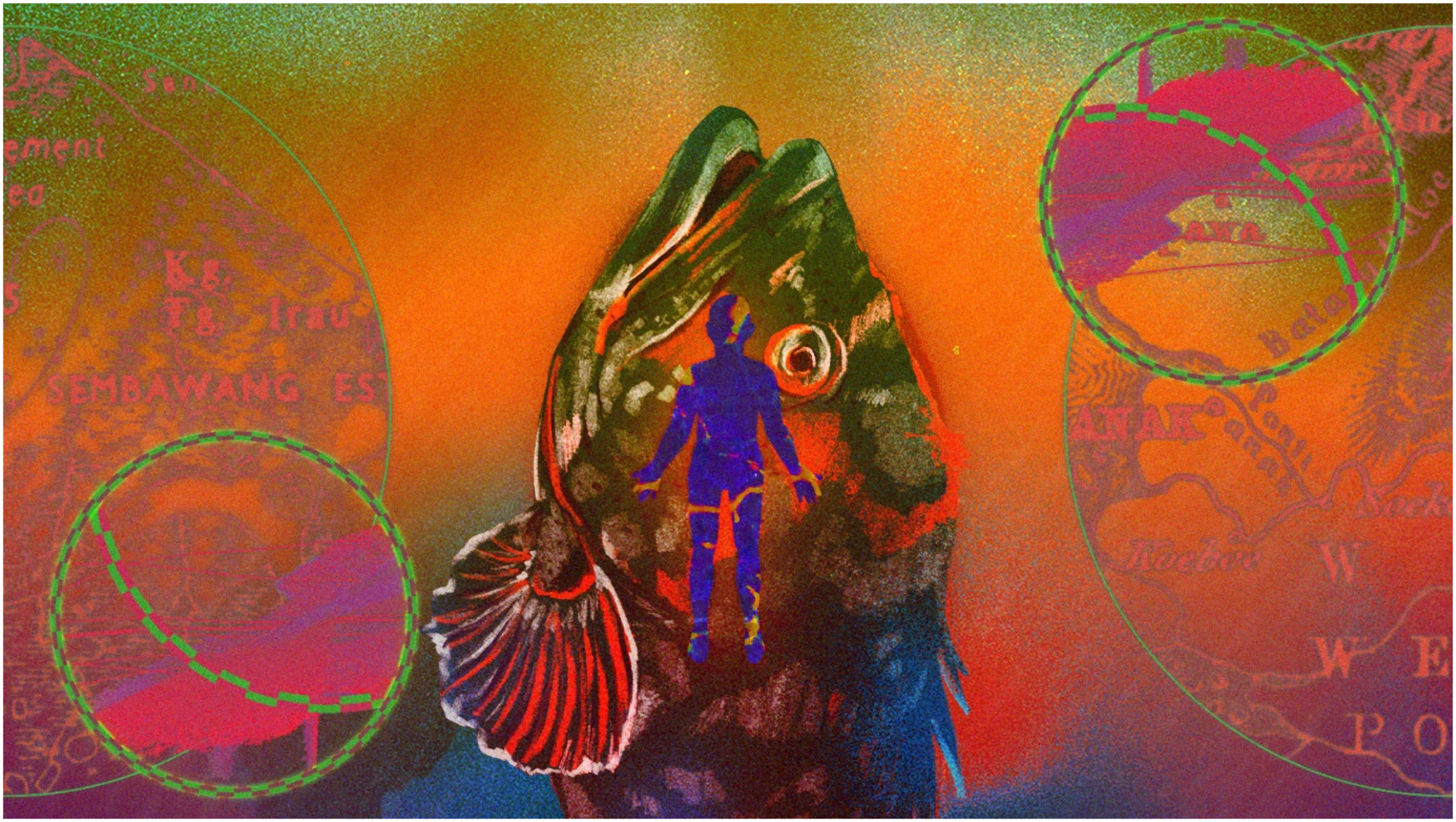
Tirta Maya brings listening viewers through three scalar chapters: the cosmic ocean, the womb and the underworld. At the heart of the work is a haunting langgam-dangdut soundtrack, which includes elements of Javanese gamelan, Javanese langgam style and dangdut groove. Distinct moments of call and response have been incorporated into the original composition, and its lyrical verses explore creation mythologies, otherworldly beings and personal stories that have been passed through the generations. By approximating an archipelagic landscape with Tirta Maya, the sea here becomes a connecting substrate for travel from one chapter to another.
Monisme and Kindred both took an anachronistic approach to time, and time here is similarly rhizomic. In Tirta Maya, this sentiment emerges particularly through its dense and polysemous nature. As mentioned previously, the work comprises of three scalar chapters, and each chapter unfolds at a different pace. These chapters are undergirded by a lyrical composition, which itself is layered beneath the visual, which is in turn then layered beneath a prose-poem. These elements are not always presented concurrently, and it might be more accurate to think of them as an interlocked trio that take turns to ebb and flow, wax and wane. Whilst certain elements, such as the lyrical composition, are more constant fixtures; others, such as the prose-poem, assume a more intuitive, syncopated tempo. Another motif that binds the three chapters together are sequences that feature multiple interlocking gates opening or closing. The gates are stylised in different colours and patterns, and do not appear at regular or predictable intervals (e.g. at the beginning or close of each chapter). Instead, each occurrence gives listening viewers the sense that they are moving deeper still into Tirta Maya’s cavernous world. In sum, each element has been employed at different junctures and to varying degrees and intensities. If the elements could be approximated as notations, a stratified landscape would emerge for one to walk through.
In that sense, perhaps the experience of time in Tirta Maya parallels how time flows in the context of gamelan music, a concept that is best encapsulated by the term, irama. In an introduction to Javanese gamelan, gamelan musician and scholar Sumarsam describes irama as such: “In the narrower sense, iråmå is tempo, i.e., the rate of temporal flow: seseg (fast), sedheng (moderate) and tamban (slow). In a wider sense, iråmå represents the process of expansion or contraction of formal structure which is accompanied by the change in density levels of the elaborating instruments” (Sumarsam 2023, 95). In practical terms, this means that different durations, styles, moods and intensities may be expressed by the various instruments in a gamelan ensemble when playing a piece of music. Here, the notion that time can be an endlessly permutative and textural experience emerges.
Instead of pitting time that has been filled up either by sound, visuals, or text, against time that remains seemingly empty or vacant, time here is variegated as the steady cadence of musical time is distinct to the fluctuations of textual time, or the gradations of visual time. By presenting time as a series of textures to be felt and by reifying different modes of perception through its format, Tirta Maya asserts that time can be a shifting, subjective, sensorial experience as well.
Conclusion
“The rhetoric of anachronism is consistently employed by proponents of homogeneous time whenever a stubborn heterogeneity is encountered. One comes to expect that wherever anachronism is shouted, conflicting, coexisting times are being hastily denounced.” (Lim 2009, 84)
Film is an inherently chrono-centric medium, comprised of a sequence of images that have been ordered intentionally by an artist or director. Consolidated to run for a certain duration, these individual frames are then presented to viewers at a constant pace, providing a sensation of progression. Whilst time seems to pass linearly from the present moment and the soon-to-be future when one watches a film, the works discussed in this essay demonstrate that when directed, films may also inhabit, establish and connect different times at once. Through these artists’ sleight of hand, the medium endears itself to the acknowledgement of what Tsing refers to as “eclectic knowledges and overlapping pleasures” (2023, 113). For contemporary artists in Southeast Asia who are interested in showcasing contradictions, confluences and collaborations, and often all at once, the ability for film to embody alternatives to linear clock time has made it a compelling material form. By resisting a single, hegemonic understanding of time, these ecocritical works can take on a life of their own. They move beyond functioning as a documentarian look at the world around us and begin to model possible futures founded upon diverse epistemologies.
At the same time, film is able to speak without speaking or name without naming. This is not to say that film speaks indirectly. By this, I refer to how a composition of image, dialogue, sound, character, lighting, location and viewing context may give rise to multiple interpretations and sensations at once. Whilst not without exclusions, this stands in marked contrast to the place of language. In his seminal text disavowing heterogenous time, Henri Bergson observed that the signified can sometimes be overwhelmed by its own signifiers – a process of definition that occludes the very mutability that is at the core of sensing, writing that “we confuse the feeling itself, which is in a perpetual state of becoming, with its permanent external object, and especially with the word with expresses this object” Bergson (2022, 89). Later, Bergson notes that “not only does language make us believe in the unchangeableness of our sensations, but it will sometimes deceive us as to the nature of the sensation felt” (2022, 89). In elucidating our felt experiences, Bergson felt that language solidifies otherwise elusive encounters—and possibly inaccurately. To that end, film is an unbounded yet full-bodied experience. The prominent film scholar May Adadol Ingawanij studies the context of Southeast Asia closely and considers how films envelop viewers into their installation through immersive elements. Calling this animistic cinema, Ingawanij proposes that “the spectator becomes a re-wilded figure and an idea yet to be formulated” (2021, 81). The three works discussed within this essay are not fixatives. Instead, they share a firm insistence on maintaining an open-endedness, folding us as viewers into new realms and questions, and bringing us along for the ride.
The ongoing and all-encompassing ecological crisis calls for us to rise to the moment. The artists of these three films ask us to consider the fundamental question of what it means to be in the face of widespread environmental collapse. Rather than offering idealistic escape, these works activate what Cantó-Milà and Seebach, after Castoriadis, describe as a radical imaginary: an opening toward futures that cannot yet be fully named, but whose conditions are nonetheless rehearsed in the present (2024, 307). Through their reworking of time as stratified, geneology, and ensemble, these films expand aesthetic imaginaries of ecological futures beyond trite narratives of progress or advancement. Unsurprisingly, the way forward requires us to look outside of ourselves. In the three films discussed, it is suggested that time – this epoch – is not a passive encounter or something that merely happens to us. It does not simply exist outside of and separate from ourselves. In fact, the various more-than-human actors in these films model profoundly embodied timescales – timescales that are cyclical, circadian and cosmic. As these times collide, find confluence with, and contaminate each other, “the plurality of scales, and their overlaps and entanglements” present us with the exact antonym of “the discrete, measurable time period” (Wiggin et al., 2020, xiii). These alternative timescales point us towards other conceptions of time outside linearity, something that Keri Facer proposes has the power to “[structure] the perception of possibility” (2023, 62). This optimistic language is important because it calls us to consider that not only are other ways of being in the world, aligning ourselves to them is not quite as preposterous as the powers that be would like us to think. These timescales of possibility destabilise the hegemonic narrative of humanity as the only force worth reckoning with on Earth In doing so, they manifest the “pursuit of the unrealized potential of complex assemblages of subjects, at a time when the future seems rather to shrink dramatically” that philosopher Rosi Braidotti writes about (2017, at 52:30─52:40).
By seeing and, most significantly, feeling with others, we may arrive at a collective rhythm of breath – acknowledging in our bodies the thrill of existing outside clock time and within differently shaped chronologies. Attending to these cinematic experiments in time therefore allows us to understand moving image practices not simply as reflections on environmental crisis, but as active sites for cultivating relational environmental futures that remain open, plural, and contingent.
Indeed, another world is feasible, and it might begin with us skipping to its syncopated beat.
Footnotes

Funding
The authors received no financial support for the research, authorship, and/or publication of this article.
Declaration of Conflicting Interests
The authors declared no potential conflicts of interest with respect to the research, authorship, and/or publication of this article.