






Abstract
In response to intensifying social-ecological challenges, sustainability science has increasingly turned to imagination and futuring practices to guide collective action toward desirable futures. While conventional methods such as scenario planning and quantitative modeling have advanced scientific foresight, they often fall short in engaging affective, cultural, and participatory dimensions critical for transformative change. This paper investigates how emerging media art - projects leveraging interactive and immersive technologies (XR), sensor-based systems, and generative storytelling and AI - conceptualizes engagement with environmental futures. Drawing on a performative approach to futuring, we analyze 78 emerging media art projects t. Our analysis examines how these projects position themselves discursively and what affordances they might offer for addressing recognized limitations in conventional futuring practice. Findings reveal six recurring affordances: embodied perspective-shifting, making invisible processes perceptible, situated augmentation of place, centering non-Western and Indigenous epistemologies, creating boundary objects for deliberation, and networked storytelling. These affordances demonstrate how artistic techniquesmobilize narrative immersion, embodied experience, and participatory design to render social-ecological imaginings tangible. Further, we discuss structural limitations in the field. Rather than offering emerging media art as a panacea, we argue for its considered integration into pluralistic futuring ecologies that combine analytic rigor, artistic imagination, and inclusive practice. This work contributes to emerging dialogues on the intersection of creative practice and environmental foresight proposing pathways for more affective, situated, and democratic futuring in sustainability science. Future empirical research is needed to assess whether these intended affordances translate into actual transformative impacts on participants’ understanding and action.
Introduction
The escalating climate and ecological crises of the twenty-first century have intensified the need for innovative and effective methods to envision and pursue just and sustainable futures (Bai et al. 2016; Folke et al. 2021; Groves 2017). In response, imagination has become a focal point of research into the capacities required for transformative societal change (Galafassi et al. 2018; Moore and Milkoreit 2020). Within sustainability science, “futuring”, the systematic exploration of possible, probable, and preferable (and sometimes preposterous) future scenarios, has emerged as a critical practice, shaping policy, guiding interventions, and informing societal responses to environmental change (Cork et al. 2023; Kim et al. 2023; Preiser et al. 2024). Mainstream approaches to environmental futures have primarily relied on expert-driven methods, including modeling, forecasting, and scenario development, resulting in valuable frameworks such as the IPCC’s Shared Socioeconomic Pathways (O’Neill et al. 2017) and the IPBES Nature Futures Framework (L. M. Pereira et al. 2020).
Recent reviews have identified that contemporary futuring methodologies fall short in their transformative and transgressive potential (Cork et al. 2023; Juri et al. 2025; Ketonen-Oksi and Vigren 2024). While they have advanced the capacity to model environmental change and articulate scientifically credible scenarios, these frameworks often remain constrained by epistemological narrowness and expert dominance (Rutting et al. 2022). Reliance on quantitative, technocratic, and expert-led methods tends to marginalize experiential, affective, and local knowledge systems, thereby reproducing existing cultural and institutional logics rather than enabling new imaginaries (Hajer and Pelzer 2018; Marzec 2018; Preiser et al. 2024; Rickards et al. 2014). Such approaches rarely make space for sensory, embodied, or emotional engagement, privileging cognitive and analytical dimensions at the expense of participatory, relational, and aesthetic ways of knowing that could open up genuinely alternative futures.
Moreover, participation within these frameworks is frequently shallow, limited to stakeholder representation rather than true co-creation, and tends to exclude both the most powerful and the most marginalized actors (Lazurko et al. 2023; Oteros-Rozas et al. 2015; Pereira et al. 2020). As a result, many methodologies fail to address power asymmetries, justice concerns, and the more-than-human entanglements of ecological futures (Houston and Marshmallow Laser Feast 2021; Juri et al. 2025). These shortcomings underscore the need for complementary modes of futuring, capable of mobilizing imagination, emotion, and embodied experience as catalysts for change (Galafassi et al. 2018; Marzec 2018; Oomen et al. 2022; van Lente and Peters 2022).
In this context, arts-based approaches have emerged as a current within futuring methodologies (Heras et al. 2016; Ketonen-Oksi and Vigren 2024). There is a longstanding debate about whether futures studies constitutes a science or an art (Niiniluoto 2001; Poli 2024). Indeed, futures are inherently aesthetic as they must be imagined, felt, and made compelling to motivate action (Oomen et al. 2022; van Lente and Peters 2022). In this article we examine the potential contribution of emerging media art to environmental futuring practices. In a ground-breaking and influential analysis of the field, Sinclair’s “Making a New Reality” (Sinclair and Clark 2020) highlights how emerging media art immersive, interactive, and multisensory modalities, have the potential to unsettle dominant temporalities, evoke affective responses, and render complex socio-ecological relationships experientially tangible. We define emerging media art here as art that leverages interactive technologies, digital platforms, virtual and augmented reality, generative technologies, multimedia storytelling and more.
We focus primarily on artist-led processes rather than adjacent science-led processes (e.g., Lübker et al. 2023), or studies of emerging media impact (e.g., Blythe et al. 2021). The reason is that independent artists are vigorously pushing the boundaries of how stories are created and told and are working with the distinctive affordances of emerging media technologies. This form of artistic expression inherently foregrounds aesthetic experimentation, participatory and speculative engagements with possible futures, and possibly creates dynamic spaces for collective imagination (Anderson 2016; Anderson and Jones 2015; Bendor 2018; Candy and Dunagan 2017).
Despite its potential, emerging media art is also a site of controversy. Critical scholars question whether virtual reality artists’ claims to empathy are achievable or merely reproduce what (Nakamura 2020) calls “virtuous virtual reality”, that is, technologies that allow users to feel good about feeling bad without generating actual change (Pykett et al. 2025), warn that immersive speculative environments in museums risk becoming spectacular entertainment (“futainment”) rather than critical engagement. Further, despite early aspirations that digital technologies would democratize cultural production and transform systems of knowledge sharing, the current landscape reveals persistent asymmetries. Creative and technological power is increasingly concentrated within a handful of large tech corporations, raising concerns about who controls the tools of imagination and whose futures are rendered visible. As Sinclair and Clark (2020) notes, the infrastructure behind immersive media (from VR headsets to machine learning systems) is never neutral. It encodes the assumptions, values, and biases of its designers. These often reflect and reinforce dominant Western, technocentric worldviews, risking the reproduction (and even amplification) of existing inequalities across race, gender, class, and geography.
Academic examination of emerging media contributions to futuring practices remains limited and there is a critical gap in understanding how emerging media art aligns with, diverges from, or expands upon established futuring methodologies, and how may these artistic engagements be mobilized within sustainability practices. This article addresses this gap by analyzing a set of emerging media art projects. We seek to examine the specific affordances of emerging media and how they can inform a new frontier of futuring practices within sustainability science and practice.
We ask: How do emerging media art projects position themselves in relation to environmental futures? What techniques do they employ that differ from or complement conventional scenario methods? And what affordances - and limitations - do these approaches offer for expanding environmental futuring practice? Rather than evaluating whether these projects achieve their intended impacts on participants, we analyze how they conceptualize their role as techniques of futuring. In addressing these questions, we contribute to emerging convergences between futures studies, artistic research, and sustainability science.
This paper proceeds as follows. Our first step is to position emerging media art as techniques of futuring (Oomen et al. 2022). We then describe our methodology for constructing and analyzing a database of 78 emerging media art projects addressing environmental themes. We then present our findings and examine both the novel possibilities these approaches offer and the tensions they embody. We conclude by reflecting on how emerging media art might contribute to more pluralistic and inclusive approaches to imagining sustainable futures.
Emerging Media as Techniques of Environmental Futuring
Futures as Art-Science Practice
Emerging media such as immersive technologies, extended reality (XR), generative AI, sensors-driven and networked narratives, operate across a wide spectrum of futuring practices (Figure 1). At one end are scientist-led, expert-oriented processes such as digital twin initiatives (Hazeleger et al. 2024), modeling exercises (O’Neill et al. 2017), and scenario-planning frameworks that primarily serve policy communities and decision-makers (Juri et al. 2025; Oteros-Rozas et al. 2015). At the other end are artist-led, culturally oriented practices, where professional artists develop installations, performances, and speculative artworks for galleries, festivals, and public spaces. Between these poles lie hybrid and collaborative modes from science communication projects that translate complex data into accessible narratives, to co-creative processes in which artists generate “boundary objects” that help diverse participants engage with foresight and systems thinking (Ketonen-Oksi and Vigren 2024; Rutting et al. 2022). Emerging media in environmental futuring features across a spectrum from analytical/scientific approaches (left) to aesthetic/experiential approaches (right), and from expert/technical audiences (top) to general publics (bottom). Four archetypal practices occupy this space: scenario planning and foresight analysis (scientific/expert), boundary objects for deliberation (hybrid/expert), science communication and exhibitions (scientific/public), and cultural experiences (aesthetic/public). This paper examines primarily the lower-right quadrant - professional emerging media art engaging broader publics with environmental futures.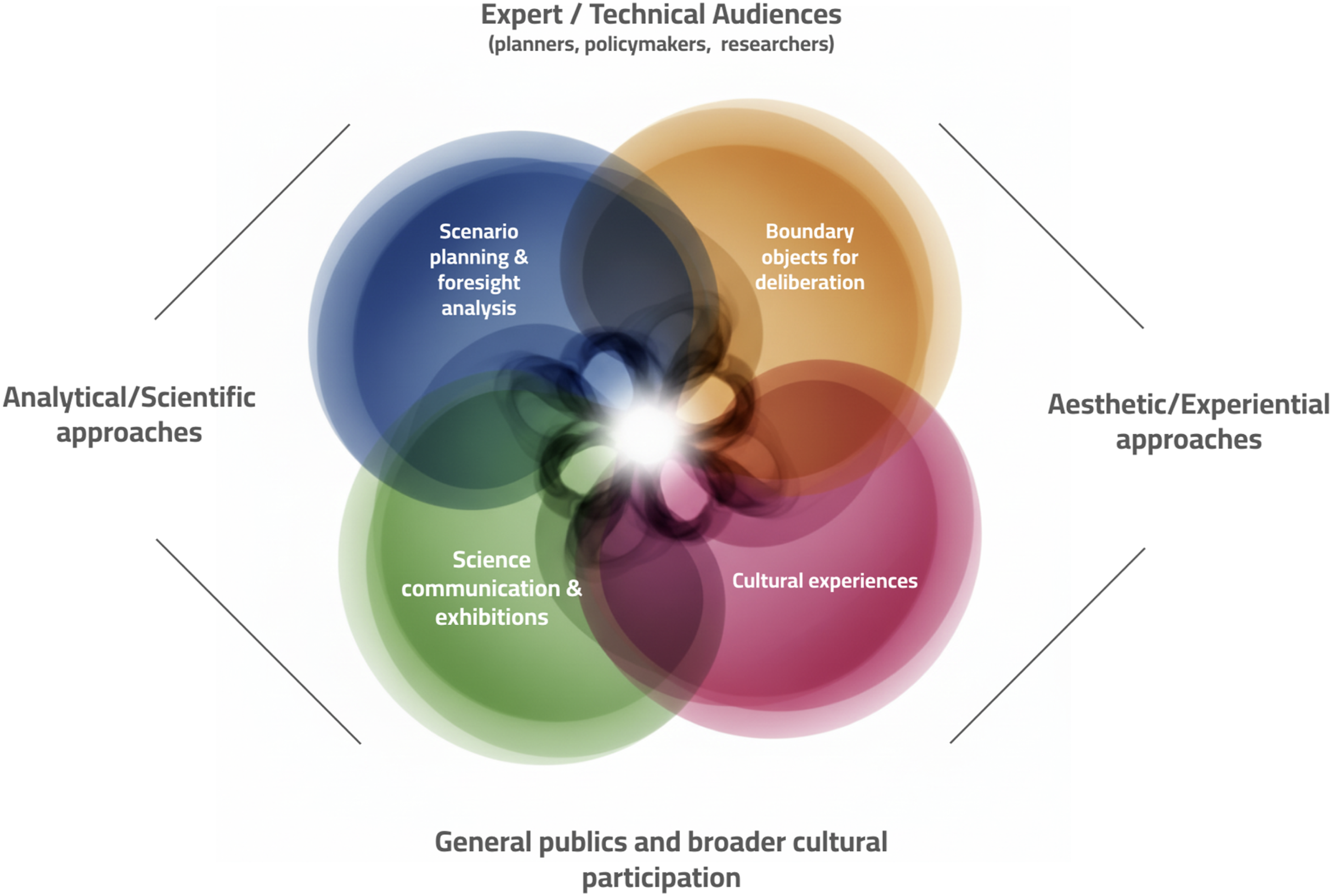
Artists and scientists thus collaborate across this continuum (Figure 1) - from analytical modeling and quantitative forecasting to speculative, experiential, and participatory interventions. Each approach offers distinct affordances for engaging with uncertainty, complexity, and possibility (Bussey 2017; Vervoort et al. 2015). Scholars increasingly argue that futures are not only analytical constructs but fundamentally aesthetic experiences that engage imagination, emotion, and embodiment (Galafassi et al. 2018; Niiniluoto 2001; van Lente and Peters 2022). This recognition opens space for research-creation methodologies that treat artistic practice not as communication of scientific findings but as a distinct mode of inquiry into environmental futures (Manning 2016). Even the most technical scenarios rely on narrative structure, visual representation, and affective resonance to gain social traction (Oomen et al. 2022). Thus, artistic practices often function as alternative epistemologies, where speculative imagination and sensory design open up new ways of knowing ecological futures.
These diverse approaches collectively build futuring as a social anticipatory capacity (Boyd et al. 2015). Together they expand who imagines futures, through what means, and with what social effects. This paper examines emerging media art’s contribution to this broader ecology.
Why Emerging Media Art Matters for Futuring
This paper focuses primarily on the work of professional emerging media art that engages public and cultural audiences with environmental futures. With this we seek to elucidate what artistic practice contributes to the broader ecology of anticipatory methods.
Emerging media art occupies a distinctive position in environmental futures practice for several reasons. First, artists function as early adopters and experimenters with technologies that have not yet been codified into standard research or policy tools. When virtual reality was still primarily a gaming technology, artists were already exploring its potential for perspective-shifting and embodied environmental storytelling (Simeone et al. 2022). As generative AI emerged, artists began experimenting with it as a collaborator in speculating about more-than-human futures (Roudavski and Brock 2025). Art spaces thus serve as prototyping grounds, that is, sites where the affordances of emerging technologies for futures engagement are tested, refined, and demonstrated before they become formalized in other contexts.
Second, the public-facing nature of artistic production promises art to democratize participation in futures discourse. Whereas scenario workshops or simulation tools are typically confined to expert groups, art installations appear in museums, biennales, and public spaces where diverse publics encounter them in affective, embodied ways. This visibility also shapes how futures are enacted. Artists must consider accessibility, emotional resonance, and cultural legibility in ways that research prototypes need not. The constraints and possibilities of public exhibition therefore generate innovations in how futures can be made tangible, compelling, and participatory.
Third, artists bring disciplinary expertise in dramaturgy, narrative, aesthetics, and sensory design. These skills tend to be less emphasized in scientific futuring but essential for creating experiences that move audiences (Oomen et al. 2022). Baikulova and Suderevskaia (2019) note that artists working with VR and AR in futures contexts attend carefully to spatial design, soundscapes, pacing, and emotional arcs in ways that enhance both learning and affective engagement. This expertise in staging experiences complements the analytical rigor of scientific scenarios, offering different pathways into understanding complex environmental relationships.
Fourth, artistic practice operates under different constraints regarding “accuracy” or “validity” than scientific futuring. Artists can explore provocative, uncomfortable, or seemingly implausible futures without the burden of defending them as probable outcomes. This freedom creates space for what Candy and Dunagan (2017) call “experiential scenarios” - futures encountered not as intellectual propositions but as visceral, sometimes disorienting, lived experiences. Such encounters can surface assumptions, challenge normalized trajectories, and expand the imaginative repertoire in ways that complement more constrained expert processes.
Finally, examining emerging media art provides insight into how technologies might be mobilized in other futuring contexts. The interactive techniques, participatory structures, and affective strategies that artists pioneer often migrate into science communication, education, and participatory research. Understanding what artists discover about these technologies’ possibilities and limitations therefore informs the broader evolution of futuring practice.
Futures as Performative Practice
Within futures studies, a performative turn has recognized that futures are not simply predicted or represented but actively enacted through social and material practices (Hajer and Versteeg 2019; Oomen et al. 2022). From this perspective, the future is continuously brought into being through practices - the scenarios we write, the workshops we convene, the models we build, the stories we tell, and the experiences we stage. Such practices shape how futures are imagined, who participates in imagining them, and which visions gain social traction.
Oomen et al. (2022) describe such anticipatory activities as “techniques of futuring”, that is, performative practices through which imagined futures gain social and ecological consequence. They highlight that futures take shape through the interplay of relations, materials, discourses, and dramaturgies that mediate how people collectively sense and act upon possibility.
This performative understanding is particularly salient for analyzing emerging media art. Immersive installations, interactive narratives, and participatory simulations create experiential encounters where participants actively perform aspects of imagined futures. For these artists the question is not how to represent a future accurately but rather what do these performances make possible? How do they configure relationships between humans and more-than-human worlds? What sensibilities, orientations, or capacities do they cultivate?
Recognizing futuring as performative also clarifies why the artistic end of the spectrum matters. Artistic interventions seek to craft experiences through which futures can be sensed, contested, and collectively negotiated.
This paper examines emerging media art as techniques of futuring, analyzing 78 project descriptions to map techniques, formats, and strategies through which artists engage publics with environmental futures. Building on this analysis, we identify the distinctive affordances and limitations that emerging media offer for cultivating transformative, participatory, and imaginative engagements with environmental change.
Methodology
Emerging Media Database and Analysis
Our methodological approach operates across two analytical layers: (1) descriptive analysis of how emerging media art projects frame and position themselves through textual evidence (artist statements, curatorial texts, project descriptions); and (2) an interpretive analysis of what affordances these techniques might offer for environmental futuring practice. Our aim is not to evaluate realized impacts or audience experiences but to identify articulated potentials. We are interested in how artists and curators signal or gesture towards the possible roles of emerging media in engaging with environmental futures. This approach differs from both discourse analysis, which focuses primarily on textual meaning, and from impact evaluation, which would measure outcomes or participant effects. Instead, we inductively assess how emerging media art might contribute to addressing gaps in current futuring approaches within sustainability science.
We built a database of emerging media art projects drawing from four principal sources: (1) curated selections at major media arts festivals (e.g., Venice Biennale Immersive, Sundance New Frontier), (2) Three institutional repositories (e.g., MIT Docubase), (3) artist websites (e.g., from the Global Climate Storyteller Network), (4) snowball sampling of specialized databases of interactive environmental projects and experts consultation (further details on Annex 1). This strategy ensured coverage of high-profile projects and diverse formats. Selection criteria emphasized projects using immersive or interactive techniques and thematically linked to environmental futures. The nature of their engagement with futures varied from fully realized speculative worlds to more subtle evocations of alternative possibilities. We thus assembled a diverse international sample of 78 projects, although influenced by the visibility of well-known festivals and platforms.
For each project, we collected descriptive information including the project title, creators, year of creation, producers, a summary description of the project, the stated country, and key exhibition venues or events were shown. To ensure consistency in data extraction, we employed a semi-automated process using Claude 3.7 Sonnet AI, which was prompted to identify and label metadata (titles, creators, dates, venues) from artist statements and catalog entries. The AI-assisted process supported data structuring only, while all interpretive reading and coding were conducted manually. Accuracy was ensured of the data structuring was ensured through independent human validation of a random sample of 30 entries by the lead author.
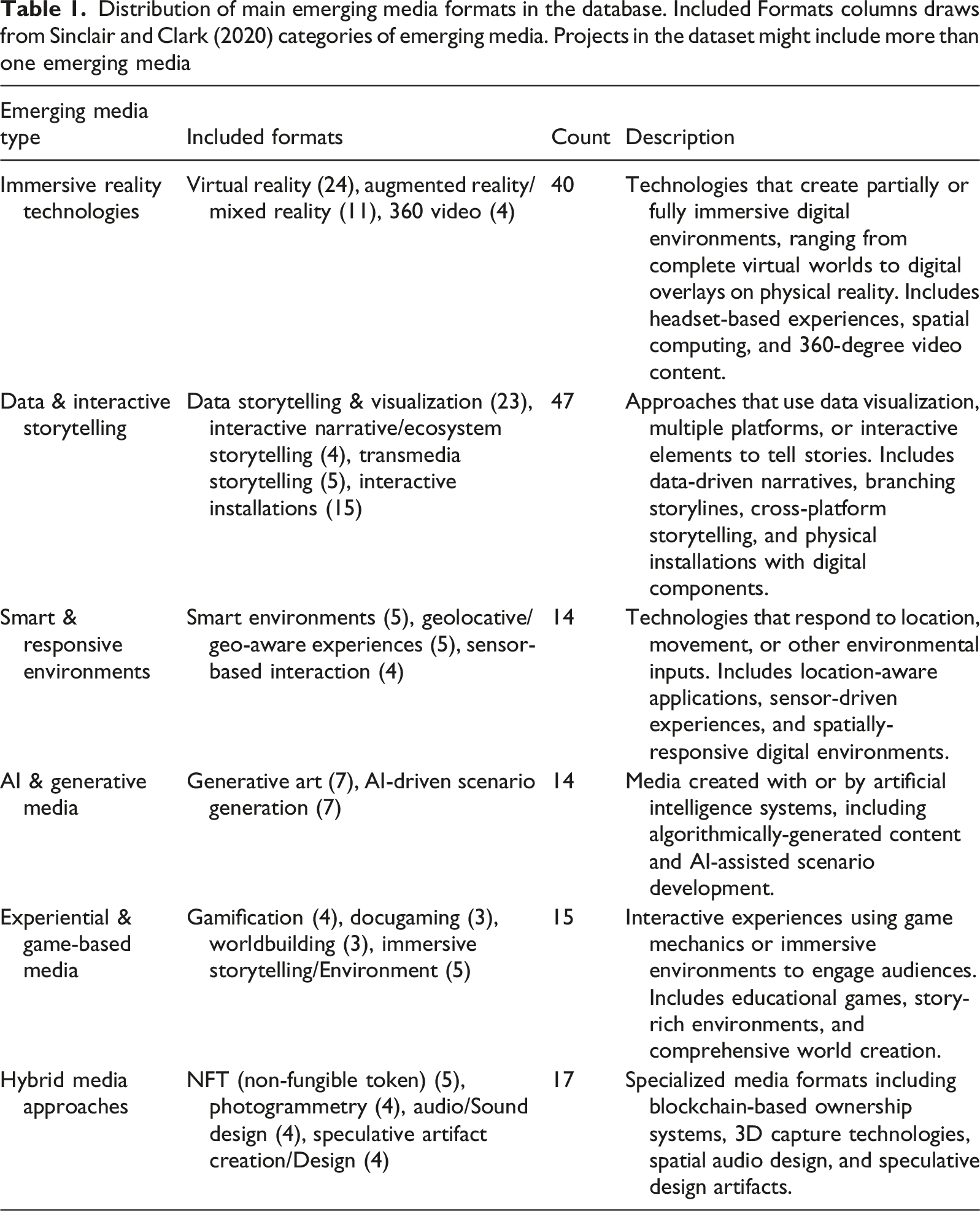
Distribution of main emerging media formats in the database. Included Formats columns draws from Sinclair and Clark (2020) categories of emerging media. Projects in the dataset might include more than one emerging media
Positionality
Our methodological choices are informed by our positioning between sustainability science and emerging media practice. All authors have experience in transdisciplinary sustainability research, transformations scholarship, and futures scenario methodologies (Diego 2018; Moore and Milkoreit, 2020; Norström et al. 2020). The lead author additionally works as a practitioner developing immersive experiences, including the mixed-reality installation Breathe (Galafassi 2023), providing experiential insight into how emerging media operate as a creative field. Rather than analyzing emerging media art from a purely external scientific standpoint, we occupy an intermediary position that enables reflexive understanding of both the limitations of conventional futuring methods and the affordances of immersive and generative media.
This positionality allows us to interpret projects through a dual lens. We analyze how they position themselves discursively (what they claim to do through available texts) while assessing what they might afford for addressing recognized gaps in environmental futuring. Following established approaches in transdisciplinary research (Lang et al. 2012), we employ theoretical interpretation grounded in field expertise to assess potential rather than empirical contributions. Future empirical studies for example through audience observation, creator interviews, and impact assessment would be necessary to validate whether these potentials are realized in practice.
Qualitative Analysis and Limitations
Our qualitative analysis was iterative and inductive, aimed at identifying patterns in how emerging media art projects engage with ideas of environmental futures. Using a combination of deductive and inductive thematic analysis (Braun and Clarke 2006) we coded textual materials for recurrent motifs, techniques, and conceptual framings related to futures engagement. We first familiarized ourselves with project descriptions, then coded across the dataset, assigning codes inductively. Through repeated reading and comparison, we identified emergent clusters of techniques that appeared across multiple projects - later refined into the six futuring affordances.
Beyond this descriptive coding of how projects position themselves, we interpreted the potential affordances of identified techniques by drawing on environmental futuring literature that documented limitations of conventional approaches (e.g., limited affective engagement, expert-driven processes, abstract representations). This interpretive layer distinguishes between what projects claim about themselves and what we assess they might offer as complementary futuring approaches based on our theoretical framework and field expertise.
While the dataset covers a wide international range, it remains weighted toward projects visible through Euro-American festivals and archives. This reflects the institutional geographies of emerging media art, and the underrepresentation of Global South initiatives (Pereira et al. 2020, Whyte 2017). We sought to mitigate this by incorporating expert recommendations through snowball sampling with field experts who added their recommendations of projects. Nevertheless, we acknowledge that the sample is far from exhaustive and inherently reflects the curatorial biases of our sources and selection process.
Finally, because our analysis relies on secondary textual sources (artist statements, curatorial texts, reviews), it focuses on how projects frame their intended performativity rather than measuring actual experiential or behavioral outcomes. We therefore make no claims about efficacy or audience impact. Such evaluation would require ethnographic, reception-based, or participatory research beyond the scope of this paper. Future work engaging directly with artworks and audiences would be essential to substantiate the performative impacts and experiential transformations these projects may produce.
In this study, we use the term “affordance” in an interpretive rather than functional sense. As the perceived or claimed capacity of a medium or artistic approach to support specific forms of futuring. Distinct from how the term is used in ecological psychology (Scarantino 2003) here we are interested in how artistic techniques enable or invite particular imaginative, affective, or participatory engagements with environmental futures. Our coding thus identifies aesthetic, epistemic and technological strategies through which projects articulate or imply these possibilities.
The following section presents the outcomes of this interpretive analysis. Drawing on the coded dataset, we identify a set of recurring futuring affordances through which emerging media art engages with environmental futures. These affordances capture distinct yet overlapping ways artists mobilize immersive, interactive, and generative technologies to render environmental change experiential, participatory, and speculative. Each category is discussed in turn, with examples from the database illustrating how particular artistic strategies enact these affordances.
Results and Discussion
Overview of Emerging Media Art Projects
The 78 emerging media artworks in the database span a wide technological and aesthetic spectrum oriented toward environmental futures (Table 1). Virtual-reality (VR) experiences constitute roughly one-third of the sample, making VR the single most common format. Interactive installations, often combining sensors, projections, and spatial sound in museums or public venues, represent nearly one-fifth, while Augmented-reality (AR) applications account for 11 of 78 projects. The remainder includes data-driven visualizations, web-based works, audio walks, and hybrid projects blending multiple media such as photogrammetry, blockchain interfaces, or generative AI. Participation modalities vary likewise. About two-thirds invite active engagement through movement, choice, or bodily feedback; 17 projects are primarily observational; and only a small subset are co-creative, involving audiences or stakeholders in content generation. Intended publics range from general audiences in festivals and exhibitions to scientists, educators, and policy actors engaged in deliberative or educational settings. Thematically, climate change and energy transitions dominate, but biodiversity, ocean health, pollution, and cultural imaginaries of resilience also recur. Several works center Indigenous or non-Western epistemologies, while a few explore technological frontiers such as AI or blockchain. Taken together, the dataset portrays a heterogeneous field in which artists mobilize new media to render environmental transformation perceptible, participatory, and culturally meaningful.
Across the dataset, projects dramatize environmental futures through distinct performative strategies, i.e. choices about how to stage temporality, orient affect, and position participants within unfolding scenarios. Drawing on Oomen et al.’s (2022) concept of techniques of futuring as performative practices, we identify five recurrent dramaturgical orientations. Approximately one-third of the works stage cautionary scenarios, depicting climate impacts, sea-level rise, melting ice, or adaptation challenges to mobilize urgency and motivate precautionary action. A comparable share perform aspirational futures, envisioning restorative or regenerative possibilities grounded in interdependence, multispecies coexistence, and ecological repair, framing the future as a site of renewal. Around one-fifth employ critical provocations, using collapse, pollution, or techno-extractive excess to interrogate present trajectories and unsettle comfortable assumptions. A smaller but distinctive subset explore more-than-human cosmologies, distributing agency across species, materials, or intelligent systems to decenter anthropocentric temporalities. Finally, several projects stage ancestral continuities, weaving cyclical temporalities and Indigenous cosmologies to assert long-duration perspectives that challenge linear Western futures. These dramaturgical choices reveal how artists mobilize affect, narrative structure, and relational positioning to transform futures from abstract projections into ethically and sensorially charged encounters.
The following sections discuss six affordances that emerged inductively from our analysis. The first three - embodied perspective-shifting, making invisible processes perceptible, and situated augmentation of place - are primarily ‘experiential’, transforming how futures are sensed. The latter three - centering non-Western and Indigenous epistemologies, creating boundary objects for deliberation, and networked storytelling - are more ‘epistemic and institutional’, transforming who imagines and how knowledge circulates within futuring practices.
Embodied Perspective-Shifting Through Immersive Experience
In 45 projects, immersion, bodily movement, gesture, and multisensory engagement replace detached observation. Participants of the project In the Eyes of the Animal (Marshmallow Laser Feast) are invited to inhabit the representation of the perceptual worlds of mosquito, dragonfly, frog, and owl through LIDAR-scanned forests and haptic feedback. The project seeks to enact ecological perception as a way to “rehearse” multispecies awareness. The creators describe their aim as inviting participants “to step away from our human-centric viewpoint, … offering not information but temporary inhabitation of alternate sensoria”.
A similar logic underpins Refuge for Resurgence (Superflux), a participatory installation combining video, sculpture, and scenography that invites visitors to a future banquet where humans and animals dine together amid post-Anthropocene ruins. Visitors sit among non-human guests, their physical presence completing the imagined assembly of species. The act of sharing a table becomes a micro-performance of ecological kinship, transforming interspecies relationality from concept to embodied ritual.
These strategies counter a position of humans as external observers of systems change rather than embedded participants (Rickards et al. 2014). By folding bodily movement and affect into the representational frame, immersive works aim to make ecological interdependence something one enacts rather than merely understands. The body becomes an interface through which alternative ecological relations are rehearsed. This embodied approach has been identified as essential for environmental learning, making abstract knowledge a somatic experience which can shift not only what people know but how they sense their place within ecological systems (Bentz et al. 2021; van Boeckel 2015). Although this is an important potential affordance, whether the transformation they promise endures beyond the installation remains an open question.
Making Invisible Processes Perceptible
A persistent challenge in futures-oriented environmental research lies in the epistemic and affective invisibility of ecological transformation. As (Groves 2017) argues, environmental change unfolds through temporalities and causal chains producing futures that are sensed only abstractly and thereby ‘emptied’ of experiential immediacy. Similarly, Hajer and Versteeg (2019) describe how the deep temporal horizons and systemic feedbacks of climate change render it “structurally invisible” within everyday life, sustaining imaginaries that remain tethered to short-term horizons and technocratic management rather than transformative anticipation. The consequence is that this disjunction between ecological temporality and human experience constrains the imaginative and ethical capacities required for futuring.
Twenty projects in the database exemplify a second recurrent strategy involving translating atmospheric, molecular, or planetary processes into sensory experience. Breathe (Galafassi 2023) uses biosensors that capture participants’ respiration in real time, the mixed-reality (AR) environment visualizes each inhalation as a stream of luminous particles drawn from the surrounding air and each exhalation as dispersal back into the shared atmosphere (Figure 2). The work materializes the continuous exchange between body and environment, erasing boundaries between self and air and rendering interdependence visible. The work’s premise is that imagining sustainable futures begins with sensing the entanglements with nature. It seeks to materialize interdependence, transforming an abstract ecological concept into a present-tense bodily experience. Participants in the multi-sensory mixed-reality installation “Breathe” wear mixed-reality headsets where their own breath is visualized as part of the ecosystem. Credit Diego Galafassi.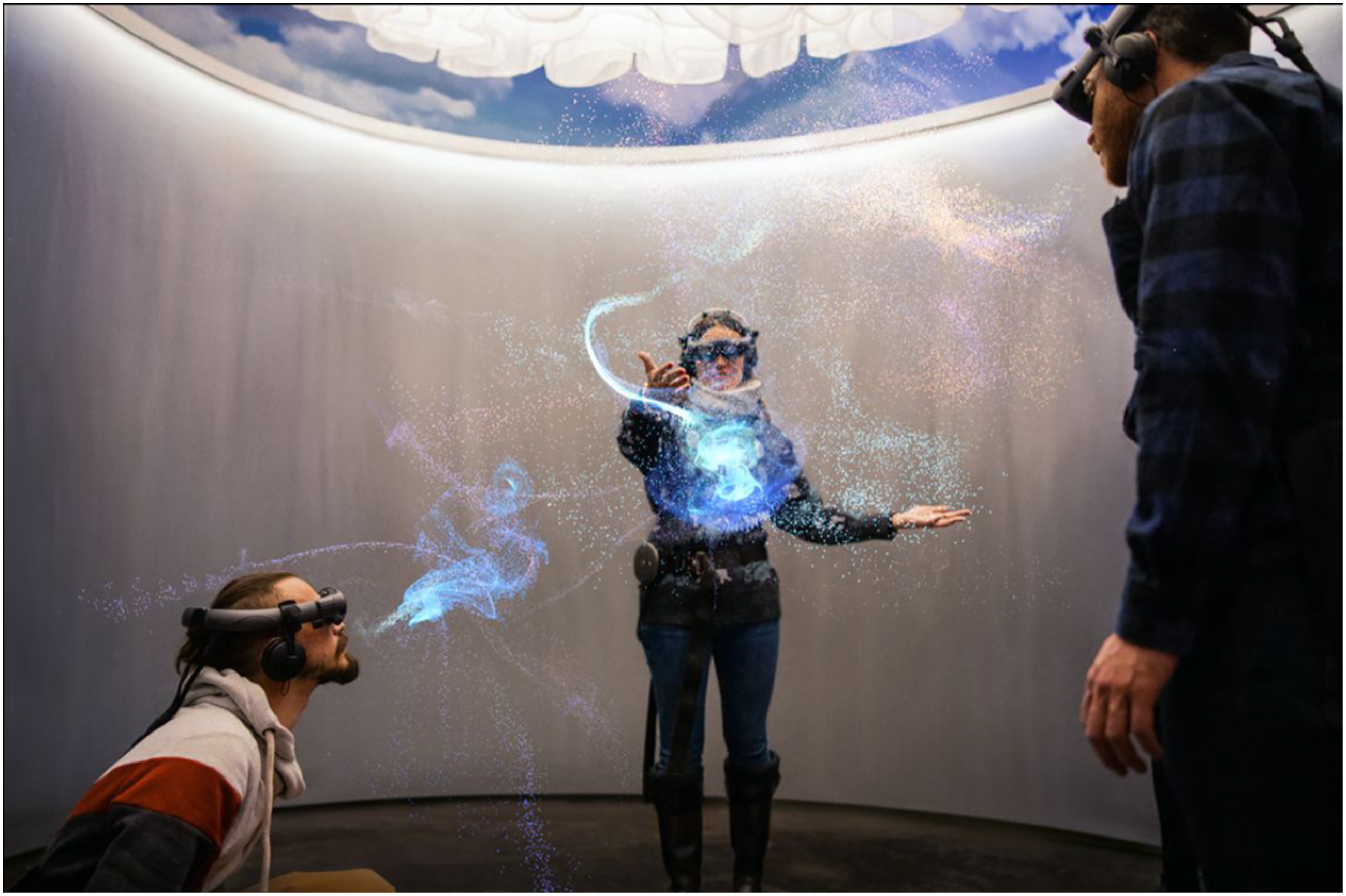
Related projects apply the same principle at different scales. Berl-Berl (Steensen) uses generative sound and 3D imagery derived from ecological data to reconstruct Berlin’s vanished wetlands, allowing participants to move through visualized metabolic processes of a living landscape. Breathing with the Forest synchronizes human respiration with real-time tree data streams, creating a shared rhythm between body and ecosystem.
Collectively, the 20 works (in the database) seek to cultivate what Tsing (2015, 22) suggests as “arts of noticing” - practices of attention that render perceptible the multispecies entanglements and ecological relationships ordinarily hidden from everyday perception. By re-situating knowledge of environmental change from intellect to perception, they seek to open an affective entry point that may complement scientific visualization. Their shared proposition is that when imperceptible processes become bodily experiences, futures cease to be remote abstractions and become conditions one is already living within.
Situated Augmentation of Place
A third experiential affordance concerns how emerging media situate futures directly within the geographies of everyday life. Using AR, mobile interfaces, or geolocated sound, artists overlay speculative or data-driven futures onto actual streets, parks, and neighborhoods, collapsing the distance between abstract projection and lived space. Projects such as After Ice (Justin Guariglia) use smartphone AR to superimpose NASA sea-level data on a user’s immediate surroundings, transforming familiar streets into flooded futures. Standing on a familiar street corner, participants see water levels climb around them in real time as they adjust timeline sliders - their neighborhood becomes a flooded future. The work transforms abstract climate data (meters of sea-level rise by 2,100) into a situated encounter. CURRENT (Annie Saunders) offers an audio-based walk through Lower Manhattan where narrative fragments (stories of past hurricanes, future adaptation strategies, or speculative climate fiction) unfold with the listener’s movement. The Deep Listener (Jakob Kudsk Steensen) brings augmented ecological encounters into public parks that passers-by may encounter unintentionally, hearing amplified insect communication or soil microbial activity beneath their feet. In each case, the future is “where you are standing now”.
This affordance extends futuring beyond institutional settings into public space, turning ordinary movement through a city into an act of imagination. They may situate futures within geographies of everyday practice (Cork et al. 2023; Groves 2017). It also exposes a current limitation. Most of the fourteen location-based projects concentrate in dense urban or coastal areas, with very few engaging rural, industrial, or non-Western sites. This spatial bias mirrors the cultural infrastructures of media-art production (festivals and urban galleries) and signals a missed opportunity to explore other situated futures. Expanding the geography of location-based practice would therefore diversify not only who encounters futures but what kinds of places become imaginable within them.
Centering Non-Western and Indigenous Epistemologies
Indigenous scholars have long critiqued how mainstream scenario processes position Western scientific rationality as the sole legitimate basis for imagining futures, marginalizing relational ontologies, cyclical temporalities, and reciprocity-based knowledge systems that center long-term ecological stewardship (Cheok et al. 2025; Stein et al. 2020). This epistemic narrowing limits not only who participates in futuring but what kinds of futures become imaginable.
Nearly one-third of the cases engage non-Western or Indigenous frameworks. Biidaaban: First Light (Lisa Jackson) exemplifies this approach by situating participants in a future Tkaronto (Toronto) where nature has reclaimed the city and Indigenous languages guide navigation (Figure 3). The VR experience unfolds through Wendat, Kanien’kehá:ka, and Anishinaabemowin rather than English, making language choice itself an act of epistemic assertion. Progression through the world follows the Seven Fires prophecy (a cyclical Indigenous temporal framework) rather than linear narrative structure. Interaction requires relational attentiveness: participants must listen, observe patterns, and respond to the rhythms of the environment rather than extract or master it. Through these design choices, the work enacts what it means to navigate futures through Indigenous cosmologies of reciprocity and presence. Biidaaban: First Light (Jackson 2018).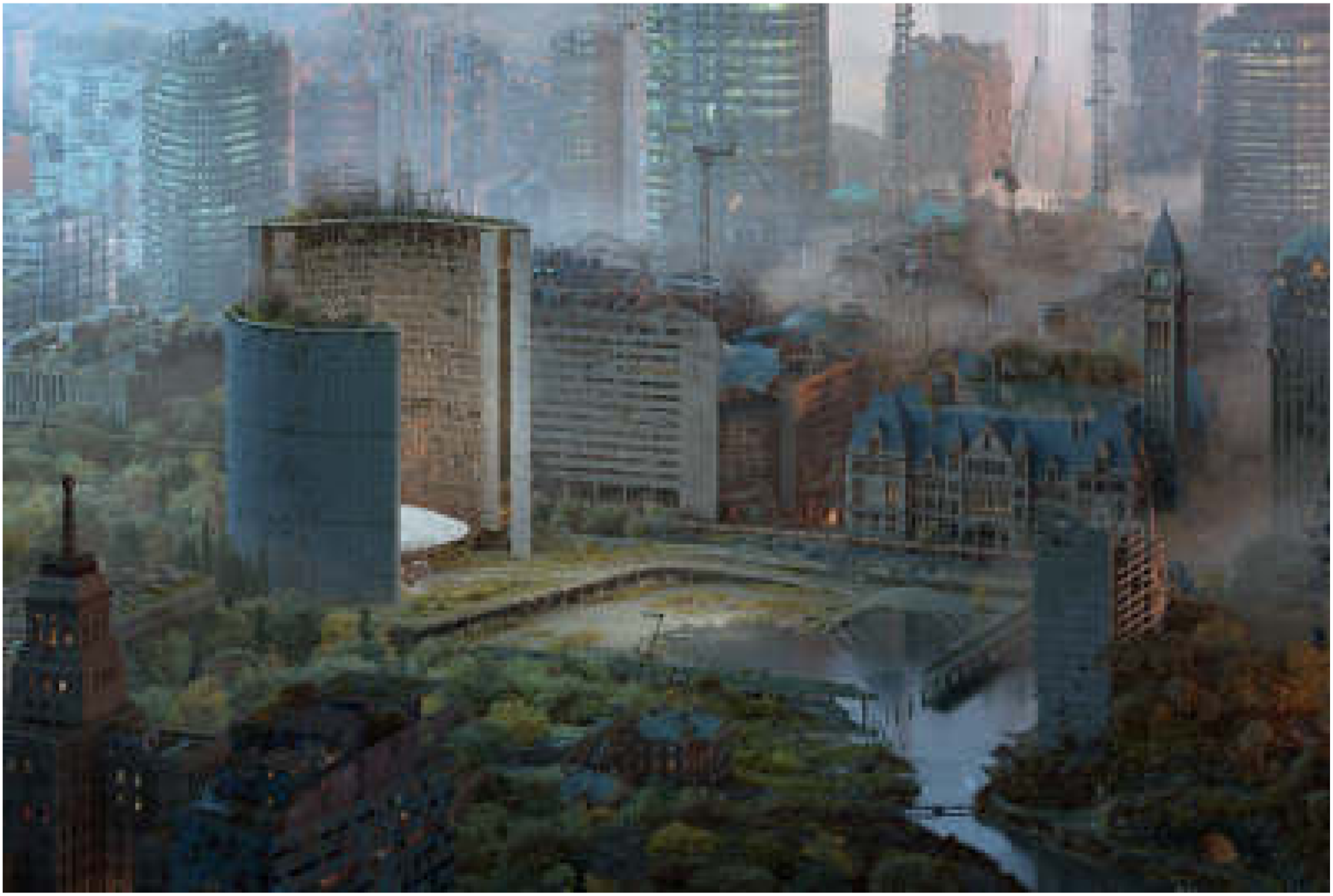
Immersive and interactive technologies offer particular affordances for enacting non-linear temporalities and relational ontologies that text-based scenarios struggle to convey. Unlike written scenarios that default to linear narrative structure, VR environments can layer multiple temporal scales simultaneously - deep time, seasonal cycles, and prophetic futures coexisting within a single experiential frame.
Other examples extend this principle through critique or syncretism. Unceded Territories (Lawrence Paul Yuxweluptun) confronts settler-colonial exploitation through immersive satire, while FISHER CHILD interlaces ancestral coastal knowledge with climate science. Collectively they reveal an epistemic affordance distinct from sensory immersion. They seek to reconfigure who has authority to speak about the future and what temporalities are imaginable.
However, the representation of Indigenous futures through emerging media carries fraught histories. Critical scholars document how immersive technologies have been used for extractive “virtual tourism” that commodifies Indigenous perspectives without redistributing power or resources (Lewis et al. 2025; Nakamura 2020). Genuine decolonization requires Indigenous creative control and ownership, not just inclusion of Indigenous content within Western-authored frameworks (Lewis et al. 2025).
Networked and Participatory Storytelling
Conventional environmental futuring processes overwhelmingly concentrate authorship within expert and institutional actors, who develop scenarios that are then disseminated to wider publics rather than co-created with them (Neuhoff et al. 2023). This concentration is not accidental but built into prevailing scenario methodologies, which privilege technical expertise, quantitative modeling, and policy-oriented forecasting. As Lazurko et al. (2023) argue, these methods lack reflexivity about the boundary judgments and epistemic choices that shape what futures can be imagined in the first place. The decisions about which actors, values, temporalities, and worldviews are rarely made transparent or contestable. As a result, participation is often procedural rather than substantive. Even in participatory formats, publics are invited to respond to predefined frames rather than author alternative futures on their own terms (Lazurko et al. 2023). This limits both epistemic diversity and democratic legitimacy, excluding experiential, place-based, and marginalized knowledge systems that are crucial for envisioning environmental futures capable of transformative change.
A smaller cluster (5) mobilizes networked media to build distributed narrative worlds that accumulate through many contributions. Sandy Storyline, initiated after Hurricane Sandy, invited residents to upload testimonies, photographs, and videos, creating a collective chronicle of loss and adaptation. The Vault of Life employs web-based interaction and generative design to let participants contribute data and stories about threatened species, building an evolving digital ecosystem. Dear Climate (Una Chaudhuri & Marina Zurkow) operates as an ongoing participatory platform where people write letters to climate futures, which are then woven into evolving narrative performances.
These projects treat storytelling as infrastructure rather than artifact. Their affordance lies in sustaining publics over time as the work continues as long as contributions accrue. Networked storytelling expands futuring from singular vision to collective authorship, distributing agency across many tellers and thereby transforming imagination itself into a participatory commons.
Creating Boundary Objects for Deliberation
Environmental futuring often struggles to bridge divides between scientific analysis, policy deliberation, and public engagement (Rutting et al. 2022). But also it rarely confronts the performative nature of scenarios as interventions that actively shape social and political realities (Oomen et al. 2022).
A small portion of projects (3) explicitly functions at the intersection of art, science, and governance, serving as material mediators within multi-stakeholder processes. 2050-An Energetic Odyssey (Hajer and Pelzer 2018) exemplifies this role. Developed collaboratively among designers, scientists, and policy actors, the eight-by-five-metre dome installation visualized a North Sea energy transition powered by 25,000 wind turbines. The immersive spectacle became a shared reference during policy discussions, allowing divergent actors to deliberate around a common image of possibility. Rather than communicating finished science, the work hosted negotiation.
Projects such as Carbon Ruins (Stripple et al. 2021) a fictional museum of the fossil era co-created through workshops, operate similarly though with less documented policy uptake. The rarity of such cases reflects both our sampling strategy - which prioritized cultural institutions - and a genuine structural pattern within the field itself. Even after targeted snowball sampling to identify policy-embedded projects, deliberative applications remained scarce. This suggests that most emerging media artworks are produced for public engagement circuits. The infrastructures, funding mechanisms, and professional networks that support artistic production differ substantially from those that enable policy deliberation, creating a potentially a separation between cultural and institutional futuring. Yet when artists and scientists deliberately collaborate to embed works within governance contexts, as in 2050-An Energetic Odyssey, the boundary-object function demonstrates how artistic imagination can complement analytical modeling by providing emotionally resonant, collectively owned visions of transformation.
What is missing is attention to how futures become socially real through shared images, embodied encounters, and material artifacts that can be held, debated, and negotiated across different social worlds. Boundary objects offer a means of operationalizing this performativity.
Frontiers and Possibilities
The six affordances described above are not a full list nor a fixed one as the field is evolving rapidly and remains fluid, recombining technologies and aesthetic strategies. For example, Planet City (Liam Young) uses world-building, generative AI and speculative propositions to probe what futuring itself might become (Figure 4). It envisions a single, continuous metropolis housing all ten billion people so the rest of Earth can rewild - a scenario at once utopian and claustrophobic. Through strong cinematic design the work invites audiences to feel the scale and constraint of radical sustainability. Similar to projects like Radical Ocean Futures (Merrie et al. 2018), Planet City does not advocate feasibility, it performs an emotional stress-test of our attachments to growth, freedom, and collectivity, demonstrating how speculative world-building may reorient ethical and affective horizons of environmental governance (Young 2021). Frame from Planet City by Liam Young. Credit. Liam Young.
Similarly, The Ecological Intelligence Agency (Superflux) reimagines artificial intelligence as an advocate for more-than-human entities. Here, AI agents speak on behalf of rivers and ecosystems, suggesting that the tools shaping future policy could represent non-human stakeholders as much as human ones. Both projects extend emerging-media futuring toward institutional imagination, expanding who or what participates in envisioning the future, and on what terms.
Other notable examples are, Our Family Garden (Smirna Kulenovic) which enacts reparative justice by linking ecological restoration with intergenerational healing from historical trauma, and Seed Protocol - DLITE (Amelia Winger-Bearskin) prototypes distributed governance infrastructures designed to sustain cultural continuity and enact accountability across human and more-than-human communities. These projects highlight the field’s open-endedness. They demonstrate how emerging media artists continually test how speculative and aesthetic practices can unsettle the boundaries of what is politically, ethically, and ecologically thinkable.
Towards Ecology of Futuring Practices
The six patterns identified below - embodied perspective-shifting, making invisible processes perceptible, situated augmentation of place, centering non-Western epistemologies, creating boundary objects for deliberation, and networked storytelling - represent affordances that have been theorized within environmental education, futures studies, and participatory research for decades. What this analysis contributes is not the discovery of these aspirations, but the empirical demonstration that emerging media art is actively operationalizing them through specific material-technological affordances. Each affordance represents an intersection between an established theoretical concern and an emerging technical capability. For example, VR may enable embodied perceptual shifts; biosensing and data visualization may materialize imperceptible ecological processes; augmented reality may reconfigure place-based futures in situ; interactive nonlinear systems may enable stories driven on Indigenous temporalities; networked platforms distribute authorship across publics; large-scale installations function as boundary objects that anchor deliberation.
What makes this analysis novel is twofold. First, it empirically documents how these affordances recur across dozens of projects, not as isolated artistic experiments but as a coherent repertoire emerging across the field. Second, it demonstrates that when coordinated within artistic practice, these media technologies do not simply communicate environmental futures—they perform them into being, reconfiguring how futures are sensed, narrated, contested, and collectively authored.
Up to this point, our discussion has highlighted the potential of emerging media art to expand how societies imagine environmental futures. Yet, the same qualities that make these media compelling, that is, their immersiveness, affective immediacy, and aesthetic force, can also obscure, simplify, or commodify complex social-ecological realities (Benjamin 2019). To think productively about complementarities between artistic and scientific futuring, we must situate emerging media within critical, reflexive, and inclusive frameworks. Three points of caution provide a starting orientation.
First, claims that immersive media “generate empathy” are empirically mixed (Blythe et al. 2021; Sora-Domenjó 2022), and can slip into consumable otherness without solidaristic consequence (Benjamin 2019; Nakamura 2020). Similar patterns emerged in technology’s promises to ‘bridge’ racial divides - VR experiences claiming to generate empathy for racialized communities often reproduced voyeuristic consumption rather than solidarity (Nakamura 2020). The parallel cautions against assuming that visceral environmental experiences automatically generate ethical commitment. Without facilitation toward concrete action, they may offer moral comfort without transformation. The point, then, is not empathy as an outcome but what the medium affords when embedded with facilitation, pedagogy, and pathways to action. Likewise, spectacular installations risk “futainment” (Pykett et al. 2025) if aesthetic intensity substitutes for responsibility; if, however, we accept that futures are always aesthetic experiences (van Lente and Peters 2022), then the politics of who produces those aesthetics, for whom, and with what accountabilities becomes central.
Second, it is also important to consider material and institutional limitations. Immersive infrastructures are corporate-concentrated (Sinclair and Clark 2020), tilting production toward well-resourced Global North venues and aesthetics (Stein et al. 2020). They also carry non-trivial footprints - compute energy, water, rare-earth extraction, e-waste (Chen 2025). Generative AI further complicates this picture, by rapidly producing plausible “green” imaginaries, it can perform futures into discourse without ecological grounding (Oomen et al. 2022), steering expectations and investments by circulatory power rather than substantive feasibility or justice (Lemos 2025). These tensions require more reflexive design, co-governed ethics around data and imagery, and distribution of authorship toward communities most affected.
Finally, accessibility barriers also deserve attention. Most immersive experiences require specific physical abilities (standing, moving, seeing, hearing) and technological literacies that exclude many potential participants. While some projects provide alternative modes of engagement (e.g., projected views for non-VR participants in We Live in an Ocean of Air) systematic accommodation remains rare.
Our analysis therefore positions emerging media art not as panacea or provocation at the margins, but as complementary practice within broader futuring ecologies. They are valuable precisely where conventional approaches struggle: affective engagement, embodied sense-making, public accessibility, epistemic plurality, and cross-sector mediation (Moore and Milkoreit 2020; Rickards et al. 2014; Rutting et al. 2022). The six affordances we discussed are not exhaustive and should be understood as performative capacities that can be orchestrated with modeling, scenarios, and participatory planning, not as replacements.
Rather than positioning artistic practice as an extension of science, we can think of futuring as an ecology of methods that co-evolve and cross-pollinate. At times, artists catalyse new imaginaries that science later renders tractable; at others, scientific modeling provides the scaffolding that art translates into embodied or affective experience. The value lies in these oscillations - when modeling, storytelling, and staging circulate between domains to test not only what is possible but what is desirable, just, and sensed. Indigenous and community-authored works shift this ecology further, redefining who holds the authority to imagine and under what temporalities futures are conceived. With this orientation, projects like Planet City can become world-scale thought experiments that prime deliberation. Deliberative artworks like 2050 - An Energetic Odyssey or indigenous-led Biidaaban: First Light demonstrate how images, rituals, and public encounters can become mediating devices within collective decision-making. In this light, futuring is less a division of labor than a choreography of approaches that together make futures perceptible, arguable, and actionable.
Conclusion
This study has examined how emerging media art contributes to environmental futuring through qualitative analysis of seventy-eight projects. From this database, six recurring affordances were identified. We discussed how emerging media art might complement conventional futuring practices by mobilizing capacities that conventional approaches often neglect such as affect, embodiment, relationality, and aesthetic meaning. Experiences such as Breathe or After Ice make planetary processes tangible in the space of the body and the street, while Biidaaban: First Light and 2050 - An Energetic Odyssey illustrate how immersive or deliberative staging can convene publics and stakeholders around shared imaginaries.
At the same time, critical engagement is essential. Claims that immersive media automatically generate empathy or transformation remain empirically weak and risk turning aesthetic experience into “futainment” (Pykett et al. 2025). The infrastructures of production are concentrated in corporate and Global North contexts (Sinclair and Clark 2020), reinforcing inequities in whose imaginaries become visible. The environmental costs of computation and hardware manufacture complicate the sustainability of the very futures these works advocate (Gaffney et al. 2025). Generative AI further amplifies performative power by producing persuasive yet potentially misleading visual futures (Reina-Rozo 2023). Addressing these tensions requires reflexivity such as transparency about material footprints, redistribution of authorship, and attention to the cultural and ecological politics of representation.
Reframed through a performative lens, the value of emerging media futuring lies in ‘staging encounters’ (Bussey and Jaworski 2024) through which societies rehearse possible relations to environmental change. Immersive and speculative works function as laboratories of feeling and sense-making where desirability, fear, and collective responsibility can be tested (Galafassi et al. 2018). In this way, emerging media can operate alongside models and scenarios, probing boundaries of meaning. Ultimately, environmental futures are not only projected or planned, they are performed. The artworks examined here materialize that insight by engaging bodies, places, technologies, and stories. They enact futures in the present and expand the field of what can be collectively imagined, desired, and enacted in times of ecological urgency.
The challenge ahead is to build pluralistic futuring ecologies capable of orchestrating these complementary modes. This entails cultivating infrastructures where scientists, artists, Indigenous knowledge-holders, and communities collaborate on equal terms; ensuring that artistic work is embedded within educational, policy, and civic processes; and providing sustained institutional support that values artistic inquiry as a legitimate form of futures research. Based on our analysis, we contend that merging media art, when situated within such ecologies, can deepen the imaginative and ethical dimensions of transformation.
Looking ahead, these insights suggest practical openings for cross-sector collaboration at the intersection of futures studies, artistic practice, computational practices and sustainability research, where emergingmedia futuring could be mobilized not only in artistic and educational contexts but also within participatory governance, climate communication, and community resilience planning, creating shared imaginative processes across science, policy, and civic life.
Supplemental Material
Supplemental Material - Emerging Media Arts and Environmental Futures
Supplemental Material for Emerging Media Arts and Environmental Futures by Diego Galafassi in World Futures Review
Footnotes

Funding
This research received funding from Swedish Formas under the project “Techniques of Futuring” (Grant 2023-01243).
Declaration of Conflicting Interests
The author declared no potential conflicts of interest with respect to the research, authorship, and/or publication of this article.
Supplemental Material
Supplemental material for this article is available online.
Author Biographies
References
Supplementary Material
Please find the following supplemental material available below.
For Open Access articles published under a Creative Commons License, all supplemental material carries the same license as the article it is associated with.
For non-Open Access articles published, all supplemental material carries a non-exclusive license, and permission requests for re-use of supplemental material or any part of supplemental material shall be sent directly to the copyright owner as specified in the copyright notice associated with the article.
