






Abstract
Introduction:
The lack of standardized biobanking facilities remains a critical barrier to translational research in developing countries, often exacerbating the gap between basic science and clinical application.
Objective:
This study assesses the urgency and specific requirements for a biobank facility at the Faculty of Medicine, Universitas Andalas, Indonesia, a representative resource-limited academic setting.
Methods:
We conducted a cross-sectional survey of 60 biomedical researchers to evaluate their current specimen management practices and perceived needs. To ensure rigorous evaluation, 11 core Likert-scale items were categorized into three distinct operational domains physical infrastructure, data and ethics, and collaborative and operational needs.
Results:
A subgroup analysis using the Kruskal–Wallis H test revealed a consistent consensus across undergraduate, master’s, and doctoral researchers regarding infrastructural demands in all domains (p > 0.05), indicating a systemic institutional deficit. Results indicate a high demand for a biobank, with DNA/RNA and fresh tissue identified as the highest priority. Notably, we observed a profound perception-reality gap. While 81.7% of respondents rated current storage methods as adequate or very adequate, 90% acknowledged that these very methods hinder their research efficiency, and 46.7% reported significant difficulties in biospecimen collection.
Conclusion:
This paradox suggests that researchers in low-resource settings may culturally normalize inefficiency due to the chronic absence of a standardized biobank. Establishing a centralized and standardized biobank is an urgent institutional priority to address this gap and accelerate translational biomedical research and innovation outputs in regional academic centers.
Introduction
Translational research is pivotal for bridging the gap between basic biomedical science and clinical application.1,2 However, a significant bottleneck in this process is the lack of high-quality biospecimen availability, specifically in developing countries. 3 While biobanks have become integral to research infrastructure globally, their establishment in developing countries like Indonesia remains limited.4,5 This deficit creates a challenging environment where researchers often rely on suboptimal storage methods, potentially compromising sample integrity and research reproducibility.6,7
The Faculty of Medicine at Universitas Andalas serves as a primary biomedical research institution in West Sumatra. Despite the growing volume of biomedical research, there is currently no centralized biobanking facility. This absence necessitates a comprehensive assessment to determine not only the infrastructural needs but also the behavioral readiness of biomedical researchers. Understanding these factors is crucial to avoid the underutilized facilities due to misalignment with user needs.8,9
While large-scale biobanking initiatives have been established in Indonesia, such as the national biobank network and facilities at Universitas Gadjah Mada, institutional-level adoption in regional academic centers remains challenging.8,10 In such settings, researchers often face a perception-reality gap, where basic makeshift storage is perceived as adequate due to the absence of international-standard alternatives.
In many low-and middle-income countries, the establishment of standardized biobanking facilities is frequently impeded by chronic financial and logistical constraints.5,11 Over time, these prolonged infrastructural deficits can induce a behavioral adaptation among scientists.
Lacking routine exposure to international-standard biobanking workflows, researchers often inadvertently lower their baseline expectations. 12 This creates a profound perception-reality gap, wherein suboptimal, makeshift storage solutions are culturally normalized and perceived as adequate. Consequently, researchers may express high satisfaction with their current infrastructural environment, even when these very methods systematically hinder their research efficiency and compromise sample integrity.
This study aims to assess the specific biobanking requirements of biomedical researchers at the Faculty of Medicine, Universitas Andalas (FK Unand).
Methods
We conducted a cross-sectional study involving active biomedical researchers at the Faculty of Medicine, Universitas Andalas, Indonesia. The study population consisted of undergraduate, master’s, and doctoral students, as well as alumni who had authored at least one research article utilizing biological samples.
The research instrument (Supplementary Data) was adapted from the frameworks outlined in the ISBER Best Practices and IARC guidelines.13,14 To address the functional complexities of biobank establishment in a resource-limited setting, 11 core Likert-scale items were grouped into three different domains: (1) physical infrastructure needs (questions 7, 10, 12, 20, and 21), representing hardware requirements and temperature monitoring systems; (2) data and ethical needs (questions 14, 15, 17, and 22), reflecting the requirements for biospecimen traceability and patient anonymization; (3) collaborative and operational needs (questions 16 and 24), assessing institutional readiness for interdisciplinary collaboration and financial cost-sharing.
A stratified purposive sampling approach (n = 20 per strata) was intentionally employed to ensure equal representation across research experience levels, despite undergraduates numerically dominating the institution. The internal consistency of the grouped items was evaluated, and the differences in requirements across academic strata were analyzed using the Kruskal–Wallis H test, with a significance threshold of p < 0.05.
Results
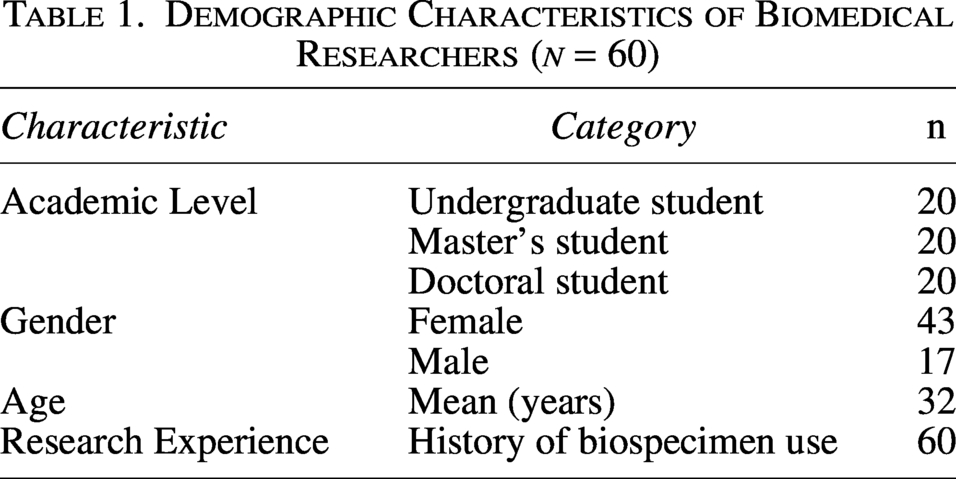
A total of 60 biomedical researchers completed the survey, comprising an equal distribution of undergraduate, master’s, and doctoral candidates. The cohort was predominantly female (72%) with a mean age of 32 years (Table 1).
Demographic Characteristics of Biomedical Researchers (n = 60)
The survey identified sample acquisition as the primary bottleneck in the research workflow. Specifically, 46.7% of respondents reported difficulty in obtaining biospecimens as their most significant obstacle (Table 2). This logistical burden forces researchers to divert significant resources toward collection rather than analysis. Reflecting these deficits, the highest demand was for molecular and hemic sample preservation, with 35% of researchers prioritizing DNA/RNA repositories, followed by plasma and fresh blood (Table 2).
Technical Requirements, Biospecimen Preferences, and Research Barriers
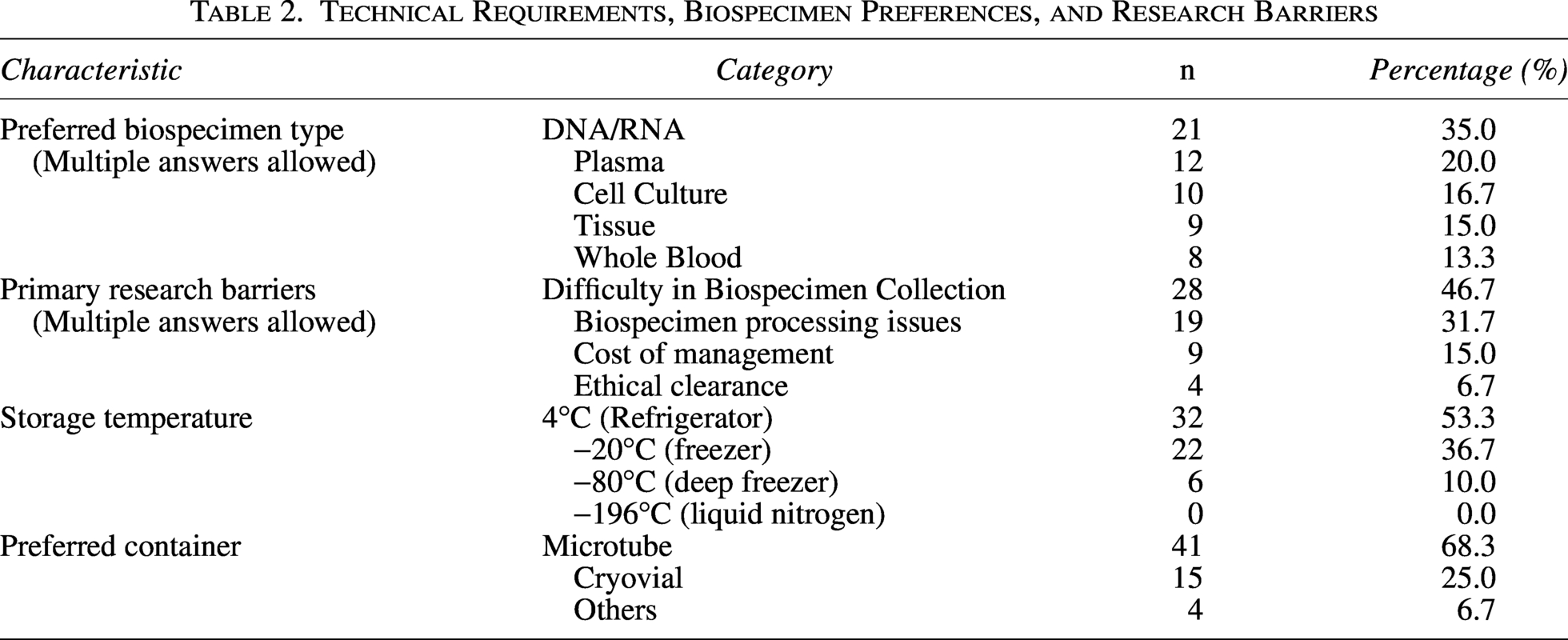
However, a striking paradox emerged regarding infrastructure perception. While 81.7% of respondents rated their current storage capacities as adequate or very adequate, this subjective satisfaction sharply contradicted the operational reality, where nearly half of the cohort (46.7%) cited sample acquisition as a major obstacle. This discrepancy points to a perception-reality gap, suggesting that researchers may have normalized the inefficiencies of decentralized storage systems despite the clear hindrance to their workflow.
To address the heterogeneity of the questionnaire and evaluate the consistency of infrastructural demands, we categorized the 11 core Likert-scale items into three distinct domains: physical infrastructure needs, data and ethical needs, and collaborative and operational needs (Table 3). A Kruskal–Wallis test revealed no statistically significant differences across undergraduate, master’s, and doctoral researchers in any of the domains (all p > 0.05). Notably, physical infrastructure scored the highest uniformly (range 3.66–3.71 out of 4.0), indicating an institutional consensus. The lack of variance across educational strata emphasizes that infrastructural deficits are systemic challenges equally experienced by all biomedical researchers across the institution, rather than isolated to any specific academic level.
Comparison of Biobanking Infrastructure and Operational Needs Across Academic Strata (n = 60)

p-Values derived from Kruskal–Wallis H test, indicating there is no significant difference across educational levels.
Values are presented as mean ± standard deviation.
Discussion
Our findings reveal a critical disconnection between infrastructure perception and operational reality among biomedical researchers. The reported 81.7% satisfaction rate with current storage, despite 90% of respondents acknowledging that these methods hinder research, characterizes a profound perception-reality gap. This paradox highlights that subjective satisfaction stands in sharp contrast to practical challenges reported, where nearly half of the cohort identified sample acquisition as their primary bottleneck.
In a resource-limited setting, researchers appear to normalize the use of decentralized and suboptimal storage as standard practice. This suggests that researchers may decouple the “storage adequacy” from “research efficiency,” likely due to a lack of exposure to professional biobanking workflows.
Consequently, they perceive these methods as sufficient for day-to-day operations, failing to recognize that this reliance on makeshift infrastructure creates a hidden ceiling on sample integrity and long-term research reproducibility. Furthermore, the lack of significant variance in needs across education levels (p > 0.05) reinforces the urgency for a centralized facility that serves the entire academic community.
The establishment of a centralized biobank serves as the critical intervention to break this cycle of inefficiency. 5 By transitioning from ad-hoc, personal storage methods to a professionalized repository, the institution can implement rigorous quality control and standardized preservation protocols, specifically for high-demand specimens such as DNA/RNA and fresh tissue.8,15
Aligning the repository’s initial inventory strategy with these specific scientific needs is a fundamental step for future-proofing the facility. 16 Beyond quality assurance, this centralized model offers a sustainable economic solution for resource-limited settings. It enables a cost-sharing mechanism that alleviates the financial and logistical burden of maintaining individual cooling units, thereby optimizing institutional resources while ensuring that researchers have reliable access to standardized biospecimens regardless of their individual project funding.5,9,16
We acknowledge the limitations of this study, primarily the modest sample size (n = 60) and its restriction to a single academic institution. However, as a premier medical education and research center in Sumatra, the conditions at FK Unand serve as a representative microcosm of the challenges faced by similar institutions in developing economies. The observed patterns of infrastructure deficit and perception-reality gap are likely symptomatic of broader systemic issues hindering biomedical research advancement across other regional centers in Indonesia and the broader ASEAN region.3,16
Therefore, while the data are local, the implications for infrastructure planning and research policy are relevant for other low-resource settings striving to bridge the translational gap. Future research should employ validated psychological instruments to further explore the cognitive drivers behind the identified perception-reality gap. Furthermore, the 81.7% storage adequacy finding derives from a positively framed question, which may introduce the acquiescence bias. In line with these considerations, future studies should utilize neutrally phrased items to mitigate this effect.
Conclusions
In conclusion, the current absence of a professional biobank acts as a latent barrier to translational research progress at Universitas Andalas. Our study highlights that the solution extends beyond mere physical infrastructure. It requires a fundamental cultural shift. The prevalence of a perception-reality gap among researchers indicates that the construction of a biobank must be accompanied by comprehensive educational programs. These initiatives are essential to transition the institutional mindset from accepting “adequate” makeshift storage to demanding global standards of biospecimen quality.
Therefore, the establishment of a centralized biobank represents a critical strategic investment for West Sumatra. By securing the integrity of biological specimens, the institution will not only resolve current logistical bottlenecks but also lay the foundation for sustainable innovation. This facility is a prerequisite for elevating local research capacity, ensuring that biomedical studies originating from this region are robust, reproducible, and capable of contributing to the global scientific community.
Authors’ Contributions
R.R.: Conceptualization, methodology, supervision, writing original draft. A.F.: Conceptualization, data curation, formal analysis, investigation, writing original draft, writing review and editing. A.A.: Supervision, project administration, and interpretation of the data. H.A.: Validation, supervision, reviewing the article, and final approval of the article. E.E.: Validation, supervision, reviewing the article, and final approval of the article. D.P.: Resources, supervision, reviewing the article, and final approval of the article. Rizki Rahmadian and Adam Fitrah equally contributed to this work and share first authorship. All authors have read and approved the final version of the article.
Supplemental Material
sj-pdf-1-bpb-10.1177_19475535261455855 — Supplemental material for Perception-Reality Gap in Biobank Adoption: A Needs Assessment in a Resource-Limited Academic Center
Supplemental material, sj-pdf-1-bpb-10.1177_19475535261455855 for Perception-Reality Gap in Biobank Adoption: A Needs Assessment in a Resource-Limited Academic Center by Rizki Rahmadian, Adam Fitrah, Adrial Adrial, Hirowati Ali, Endrinaldi Endrinaldi, and Dian Pertiwi
Footnotes
Data Availability Statement
The original datasets generated and analyzed during this study are not publicly available due to privacy and ethical restrictions regarding institutional infrastructure assessments, but are available from the corresponding authors upon reasonable request.
Compliance with Ethical Standards
This study was approved by “The Faculty of Medicine Universitas Andalas Research Ethical Commission”, as project number 499/UN.16.2/KEP-FK/2025. In line with ethical standards for human research, all respondents provided informed consent before participating in this study.
Acknowledgments
The authors wish to thank Ms. Jajah Fachiroh (Universitas Gadjah Mada) for her expert advice on the development of the survey instrument. They also express their sincere appreciation to all biomedical researchers at the Faculty of Medicine, Universitas Andalas, who participated in this study for their time and valuable input.
Author Disclosure Statement
No competing financial interests exist.
Funding Information
This research received no external funding.
References
Supplementary Material
Please find the following supplemental material available below.
For Open Access articles published under a Creative Commons License, all supplemental material carries the same license as the article it is associated with.
For non-Open Access articles published, all supplemental material carries a non-exclusive license, and permission requests for re-use of supplemental material or any part of supplemental material shall be sent directly to the copyright owner as specified in the copyright notice associated with the article.
