






Abstract
Biobanks play a critical role in advancing biomedical research, yet they face persistent challenges related to sample findability, provenance verification, and cross-institutional collaboration. Existing systems lack standardization, suffer from data silos, and often fail to meaningfully engage donors, resulting in underutilized samples and inefficiencies. Blockchain technology, with its features of immutability, transparency, and decentralized trust, is well suited to help address these challenges. This paper explores the potential of blockchain-based decentralized biobanking, introducing key technological concepts such as distributed ledgers, smart contracts, and privacy-preserving cryptographic protocols. By enabling clear provenance trails, partially automated governance, and ethical compliance mechanisms, blockchain protocols can meaningfully address biobanking’s core issues of trust, coordination, and operational complexity. We examine practical applications in improving sample visibility and governance and ensuring donor-centric ethical practices. While implementation challenges such as privacy regulations, scalability, and organizational adaptation remain, the paper argues that blockchain technology provides a robust technical framework for enhancing biobank functionality and fostering collaboration. As the field evolves, blockchain-enabled biobanking networks hold significant potential to accelerate biomedical research.
Introduction
The potential for biobanks to facilitate biomedical research is fundamentally constrained by the availability of high-quality specimens. This availability depends not only on physical access to samples but also on researchers’ ability to identify relevant samples in the first place, verify sample quality and appropriateness to the research question, 1 and understand provenance, 2 while also confirming appropriate consent status to meet ethical and regulatory requirements. 3 Modern biobanks are of a size, and data requirements are of a complexity, that render high-quality indexing and management of biosamples a significant logistical challenge. Today, leading institutions like Austria’s Biobank Graz maintain collections of more than 20 million samples. 4 As a result, research has documented significant challenges in sample findability, usage tracking, and cross-institutional collaboration. In a survey of US biobanks, for example, 69% of biobank managers reported being concerned about the underuse of samples. 5 The often remarkably low utilization rate stems partly from researchers’ inability to discover relevant samples across institutional boundaries and partly from the complex regulatory, ethical, and administrative requirements that govern sample transfers between institutions. 6
The logistical challenges faced by biobanks are not unique to the biomedical sector. Industries such as international shipping and supply chain management confront similar issues of tracking physical assets, maintaining provenance records, and coordinating multiple stakeholders across jurisdictions. These industries have increasingly turned to blockchain technology to address such challenges. 7 Originally developed for financial transactions, 8 blockchain technology comprises a set of innovations drawing on computer science, cryptography, and economic theory that collectively enable a system of secure and transparent data sharing between individuals unknown to each other.
In what follows, we provide a high-level overview of blockchain technology and explain its particular relevance to the biobanking sector. We begin by exploring the challenges facing contemporary biobanking before describing the technology in sufficient detail to enable an understanding of its key components, affordances, and use cases in the biobanking context. We then briefly introduce and review some of the existing efforts at integrating blockchain technologies with biobanking systems—an emerging field known as “decentralized biobanking.” We discuss the promise and limitations of decentralized biobanking to address logistical and other challenges in biobanking before turning to possible future use cases that have the potential to radically reshape the biobanks of tomorrow.
Biobanking Industry
The role of biobanks in biomedical research has grown immensely over the last several decades, particularly as the use of biosamples in pathology and population genomics research has become a routine part of clinical care. 9 The concept of storing and cataloging diseased and healthy samples of donated biological material (e.g., biopsies or plasma) for research use has had a tremendous impact on all areas of the life sciences. 10 Biobanks are regularly found in hospitals, academic institutions, and biopharma companies, and a number of international and regional organizations have emerged to enhance collaboration between researchers and institutions and streamline translational research. 11
Despite the growing prevalence and use of biobanks, there are substantial hurdles preventing their full utilization. Biobanking has become an ever more distributed practice with workflows that span numerous stakeholders (e.g., patients, physicians, pathologists, technology transfer officers, IRBs); a lack of incentives means that samples are frequently hoarded rather than shared, and business sustainability and cost recovery operations remain limited. 12 Because of the fragmented nature of the current biobanking ecosystem, sample provenance is frequently lost, especially when research assets are transferred between institutions. All of these factors culminate in the industry-wide problem of standardization. In cancer research, for instance, “one of the most widely recognized and significant roadblocks to progress […] is the lack of standardized, high-quality biospecimens.” 13
The last decade of biobanking has seen great efforts in digitizing data and inventory records. An increasing number of biobanks are implementing Laboratory Information Management Systems (LIMS) for indexing and inventory management as well as data capture software, and well-funded institutions are beginning to install laboratory automation technologies. A number of private companies and public initiatives have aimed to solve the problem of sample indexing and searchability, although none seem to have fully solved the issue. LIMS systems are indeed effective in tracking samples, but only within institutions. Given that there are dozens of prominent LIMS vendors in the market, each of whose products may involve significant expenses and none of which is designed for interoperability, harmonization, and standardization across these disparate technology stacks is very difficult in practice. 14
One of the biggest challenges associated with the scale and complexity of modern biobanking operations concerns informed consent for the use of biospecimens and other related ethical issues. 15 Every institution that collects and stores biosamples for research has different approaches to approving and implementing consenting protocols: some use e-consent; some use single-study informed consent; some use so-called “broad” or blanket consent, and so on. The experience for the research participant is often the same: someone asks for permission to use their samples and data in research, they sign a piece of paper and/or provide a digital signature, hand over their sample, and the two part ways and never see each other again.
Downstream researchers are obligated to ensure that samples were consented to correctly, but the current standard of correctness often amounts to little more than a tick-box exercise as opposed to a way to genuinely inform and engage a patient in research.
Biobanking today consists of a loose network of stakeholders, data, and actors. A primary aim of the industry is to achieve some form of harmonized centralization: a system with aligned incentives, streamlined sample/data search, unified or interoperable licensing and exchange, and verifiable trustworthiness that respects and values research participants’ donations to science. Trustworthiness, in turn, has several facets. How does the biobanking community build trust with donors and participants? How can biobanks trust the integrity of the samples and associated data acquired? How do donors and researchers trust that they will receive the recognition they deserve when contributing to a sample characterization or subsequent publication? The biobanking industry today spends an immense amount of time, energy, and resources in attempting to build this trust, but it remains incomplete and fragile.
These challenges—of coordination, standardization, and trust—are not unique to biobanking. As mentioned, we can learn from other industries managing complex networks of physical assets and stakeholders that have innovated purpose-made technological solutions to address similar issues. Of particular interest is blockchain technology, which has demonstrated success in supply chain management and healthcare contexts where transparent record-keeping and multi-stakeholder coordination are essential.16,17
What Is a Blockchain?
Blockchain technology comprises a set of innovations that enable a new type of data structure (i.e., a way of storing, transmitting, and accessing data). This data structure has several distinct features that are particularly relevant to biobanking: immutability, transparency, near-real-time updates, and the ability to integrate executable code in the form of so-called “smart contracts.” First introduced in 2008 by the pseudonymous Satoshi Nakamoto 8 to undergird the cryptocurrency Bitcoin, blockchain combines public key cryptography, cryptographic “hash functions,” and economic incentive mechanisms to create tamper-resistant, distributed ledgers that can operate without central authorities or guarantors. This section provides a high-level overview of the key technical foundations of blockchain technology.
The concept of a blockchain
The technology’s name derives from its fundamental structure: Data are aggregated and organized into “blocks,” which are cryptographically ‘chained’ together in chronological sequence. Each block typically contains all transactions or data entries from a specific time period—in Bitcoin’s original implementation, ∼10 minutes. This temporal grouping of data enables efficient processing and verification of multiple entries simultaneously. Beyond the primary transaction data, each block contains two important mathematical elements: a timestamp indicating its creation time 18 and a cryptographic “hash” value derived from the contents of the previous block. A hash in this context is a string of characters produced by a special function, as we will now describe.
The cryptographic hash function produces fixed-length digital fingerprints of data (in this case, the previous block of data) with several important properties. First, they are deterministic, meaning the same input always produces the same output. Second, they are one-way functions: while one can easily compute a hash from input data, reverse-engineering the original input from a hash value is computationally infeasible. Third, even minimal changes to input data produce completely different hash values. This property ensures that any modification to the existing chain of data becomes immediately apparent, as it would break the chain of hash values linking successive blocks in an obvious way.
Distribution and network architecture
Unlike traditional databases managed by central authorities, blockchains distribute their ledgers (i.e., transaction records) across computers participating in the network, which are known as nodes. Each node maintains a complete copy of the network’s’ transaction history, resulting in the “distributed” architecture of blockchains. The integrity of this copy is guaranteed by consensus—that is, all, or a majority, of nodes must reach agreement about the validity of new data before it can be added to the blockchain. Consensus is achieved in practice via something known as a “consensus mechanism,” of which there are several distinct types, each with their own advantages and drawbacks. These are described in greater detail in the next section.
The challenge of reaching consensus between nodes becomes particularly acute when considering that nodes may be operated by unknown and/or potentially malicious actors. Traditional database systems solve this problem through access controls and trusted administrators. Blockchain networks, in contrast, achieve consensus through cryptographic protocols and economic incentives structured through specific consensus mechanisms.
Consensus mechanisms
The original consensus mechanism, introduced with Bitcoin, is known as Proof of Work (PoW). In a PoW system, nodes compete to solve complex mathematical puzzles that require significant computational resources and scale in difficulty with the number of computers in the network. The first node to solve the puzzle by submitting a correct solution gains the right to propose the contents of the next block of transactions and receives cryptocurrency tokens as a reward. This process, known as “mining,” creates economic incentives for honest behavior: while successful validation brings rewards in the form of cryptocurrency, the high computational costs make fraudulent behavior prohibitively expensive. To alter historical data, an attacker would need to control more than half of the network’s total computational power and redo all subsequent mathematical puzzles—a task that becomes increasingly infeasible and expensive as the blockchain grows. It is thus not so much mathematically impossible as simply too expensive to be worth attempting.
However, PoW’s substantial energy requirements have prompted the development of alternative consensus mechanisms. The most prominent alternative is Proof of Stake (PoS), where validators must place cryptocurrency assets at risk (“stake”) as a guarantee of honest behavior. In PoS systems, the probability of being selected to validate the next block is proportional to the amount of cryptocurrency staked. Validators can lose their staked assets if they attempt to record fraudulent information, creating powerful economic incentives for integrity without the environmental impact of PoW. Modern blockchains are powered by any of more than a hundred distinct variations of such consensus mechanisms. 19
Smart contracts and automation
A crucial development in blockchain technology has been the introduction of smart contracts—self-executing programs stored on the blockchain that automatically enforce predefined rules as reflected in their code base. Originally described by Nick Szabo, 20 smart contracts enable complex automated interactions between parties without requiring trusted intermediaries. While the ability to include executable programs into the original Bitcoin blockchain was limited, modern platforms like Ethereum 21 provide sophisticated, Turing-complete virtual machines capable of executing arbitrary computational tasks. (“Turing-complete” means that a system can, in principle, run any computation that a general-purpose computer can run, given enough time and memory. “Turing” refers to Alan Turing, the British mathematician and computer scientist who formalized the concept).
Smart contracts typically comprise three elements: (1) a specification of predetermined conditions that trigger execution; (2) the code that performs specific actions when triggered, that is, the logic of the program; and (3) the state changes that result from the execution, meaning a description of the desired outcome following execution of the smart contract. These programs “run on top of” a blockchain, such that they can access existing data stored on the blockchain, modify the contents of future blocks, and interact with other smart contracts as well as data sources and programs external to the blockchain. This programmability enables applications far beyond simple value transfer, from automated compliance systems to complex multiparty agreements.
Modern blockchain ecosystems
The blockchain landscape has evolved significantly since Bitcoin’s introduction in 2008. There are dozens of blockchains, each with its own specification of key functional parameters like block size, duration, and consensus mechanisms. 22
Interoperability has emerged as a crucial focus, with various protocols enabling secure data and asset transfer between different blockchain networks. Blockchain “bridges” allow assets to move between blockchains while maintaining their properties and provenance records. 23 So-called “Layer-2” scaling solutions (see Table 1) enable high transaction throughput without compromising the security guarantees of underlying blockchain networks. 24 This is of particular relevance to biobanking given the number of specimens stored.
Key Terms and Definitions of Blockchain Technologies
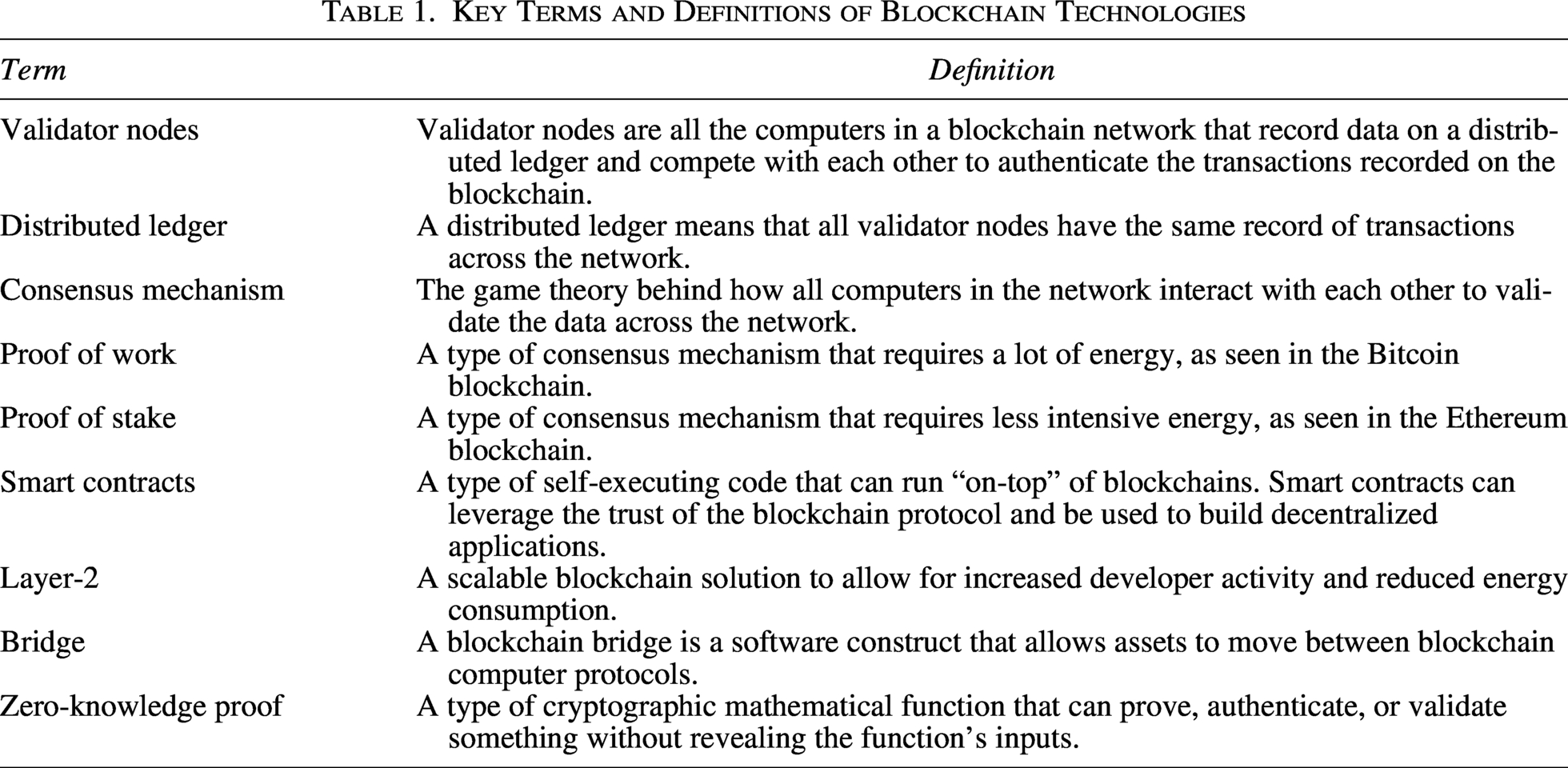
Privacy-preserving technologies have also advanced significantly. Zero-knowledge proofs enable verification of claims without revealing underlying data, while secure multiparty computation allows multiple parties to compute functions over their collective data without sharing the data itself. 25 These advances are relevant for healthcare applications where data privacy is of great importance.
The evolution of blockchain technology has thus produced a sophisticated toolkit for addressing complex organizational and technical challenges. Its combination of secure record-keeping, automated compliance through smart contracts, and privacy-preserving data sharing capabilities makes it well suited to address biobanking’s challenges of sample tracking, provenance verification, and stakeholder coordination. The next section examines specific applications of these capabilities in the biobanking context.
Decentralized Biobanking
The technical features, capabilities, and affordances of blockchain technology described in the previous section are relevant to biobanking’s persistent challenges of trust, coordination, and standardization. Because blockchain automates the centralized guarantor or authority function, the application of blockchain-based solutions to a sector or field is often described as decentralization. Financial exchange systems running on blockchains, for instance, are known collectively as decentralized finance (DeFi 26 ); blockchain-based automated voting and governance systems are described as decentralized governance (DeGov 27 ); and blockchain-based solutions for research are known as decentralized science (DeSci 28 ). By extension, “decentralized biobanking” refers to the application of blockchain protocols and their associated tools to create systems of trust and transparency in biobanking operations without relying on traditional intermediaries.29–34 Rather than depending on human actors and institutional relationships to validate sample provenance and coordinate transfers, decentralized biobanking uses blockchain’s cryptographic guarantees and smart contract capabilities to automate these trust- or authority-based functions.
To understand the practical implications of this approach, consider two biobanks with typical but distinct technical infrastructures, as shown in Figure 1. The first institution (Biobank A) maintains LIMS software to capture data and a platform to integrate with electronic health records (EMR). This biobank identifies samples through a local barcoding system, with identification numbers stored across all three platforms. Their LIMS enables tracking of sample processing, aliquots (i.e., a subportion of a larger sample), and derivatives throughout the institution. The second institution (Biobank B) operates with a different LIMS system, lacks EMR integration, and relies on a proprietary database, using its own distinct sample barcoding format.
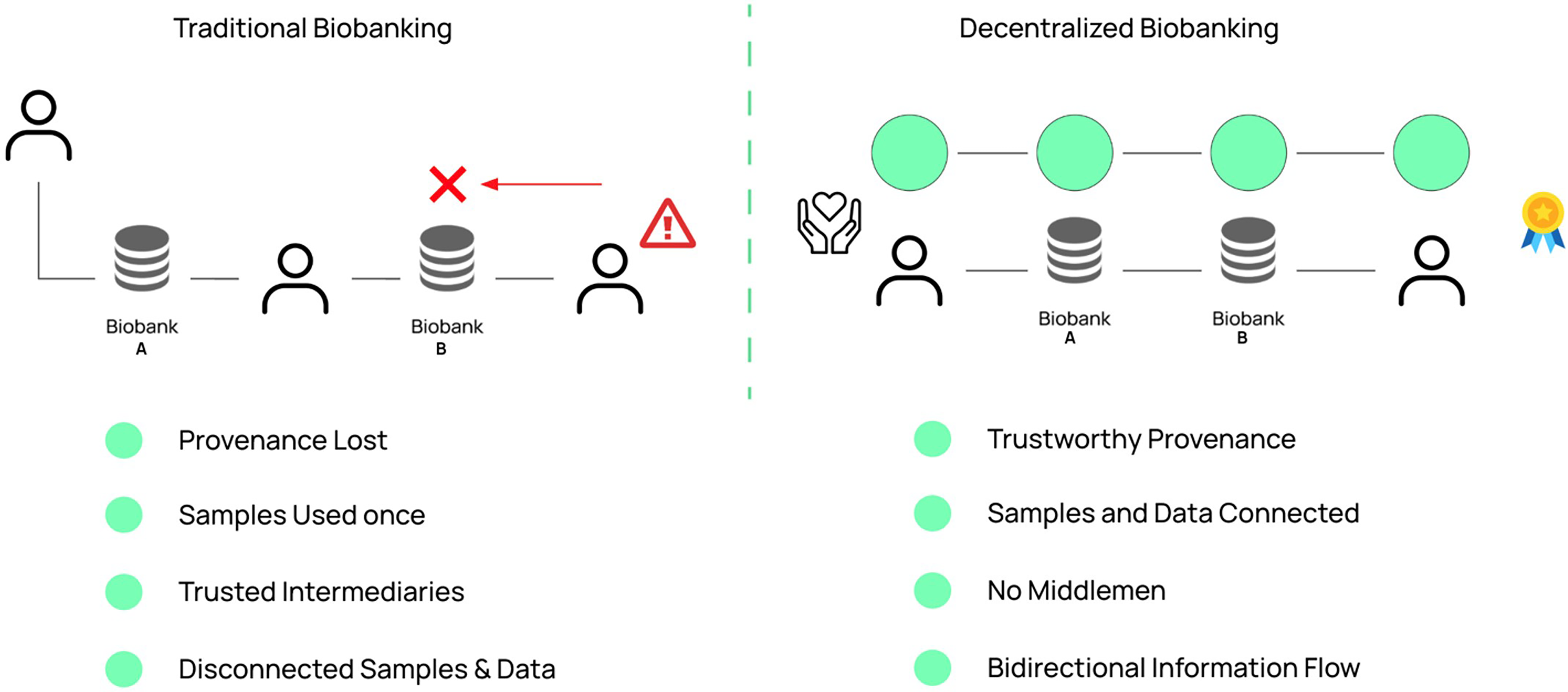
In traditional biobanking, two different biobanks with different databases and tech stacks will not have interoperable inventory systems. Sample provenance is lost when specimens move between biobank A and biobank B, and humans must be trusted as middlemen to communicate information between institutions. In decentralized biobanking, blockchain protocols are connected to all biobanks, and the rules of data visibility and sharing are customized and governed by smart contracts. Because the blockchain is a tamper-proof database, users in a decentralized biobanking network can trust the information they see “on chain.” Leveraging this decentralized trust, many applications can be built on the blockchain to streamline biobank functions without the need for human-based intermediaries or communication (e.g., sample search, MTA’s, return of results).
Under current practices, transferring samples between these institutions involves numerous stakeholders, each executing several manual steps. When Biobank A requires a sample from Biobank B, the process typically begins with telephone or email inquiries about sample availability. After confirming the sample’s presence in their −80°C freezer, the institutions must negotiate material transfer agreements (MTAs)—a process that often spans months and involves multiple departments including principal investigators, biobank managers, and technology transfer offices. Upon physical receipt, the sample must be re-barcoded according to local standards, often severing the connection to its original data context. While both institutions might record shipping information, requesting additional data about the sample later requires extensive administrative effort.
Decentralized biobanking reimagines this workflow through blockchain integration. In this model, each institution’s existing technical infrastructure—including LIMS, data capture systems, and EMR databases—connects to a shared blockchain protocol through standardized application-programming interfaces (APIs). The blockchain serves as a parallel record-keeping system, with samples represented as nonfungible (i.e., unique) tokens (NFTs) or other types of “on-chain” data, that maintain consistent identity across institutions regardless of local barcoding schemes (Fig. 1).29,33–35
This architecture enables several key improvements to the traditional workflow. First, sample visibility becomes immediate and straightforward: Biobank B can discover the existence and availability of samples that Biobank A has registered with the blockchain without requiring direct communication. In other words, the blockchain-based inventory management system has the potential to greatly improve the indexing, searchability, and description of samples. Second, MTAs can be encoded as smart contracts, automating much of the licensing and compliance verification process. Third, and perhaps most significantly, the blockchain maintains an immutable provenance trail that persists even as samples are re-barcoded and moved between institutions.
This approach has a number of implications. The blockchain protocol effectively provides credible neutrality—a form of protocol-level cryptographic trustworthiness through transparency and verifiability that operates independently of institutional relationships or local technical implementations. When both biobanks integrate with the same blockchain protocol, they inherit these trust guarantees regardless of their distinct internal systems and processes.
The scalability of this approach manifests in both vertical and horizontal dimensions. Vertically, once two biobanks establish a blockchain-mediated connection, any new insights, aliquots, derivatives, or data generated at either institution become immediately discoverable and accessible to the other. Requests for additional information, return of research results, and reporting of incidental findings can be streamlined or automated through smart contracts, eliminating the need for manual intermediation in routine transactions, both speeding up the pace and reducing the financial cost involved.
Horizontally, these benefits compound as more institutions join the network. The creation of a permanent, reliable provenance trail becomes particularly valuable when tracking samples across complex journeys involving multiple institutions—hospitals, laboratories, biobanks, and research facilities. 2 This capability addresses the common challenge of losing track of sample origins, consent status, and derivative creations as materials move between institutions.
Decentralized Biobanking Applications
The technical capabilities of blockchain technology enable several transformative applications that address persistent challenges in biobanking operations, as shown in Figure 2. This section examines five key areas where blockchain implementations can enhance biobank functionality: sample visibility and data accessibility, data quality assurance and standardization, inter-institutional sample and data provenance, governance and licensing frameworks, and ethical compliance mechanisms.
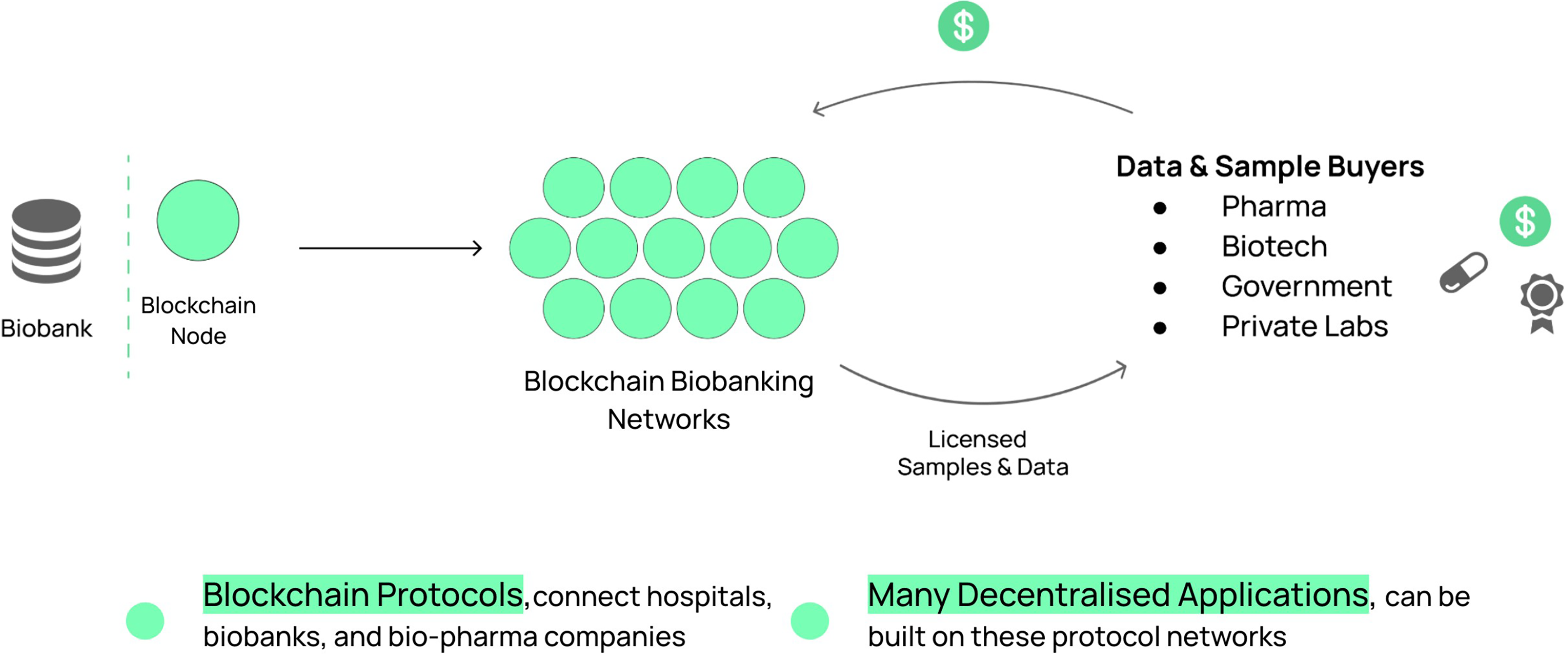
Blockchain protocols are extremely customizable and composable; blockchains can be used to store data, track records, encrypt identities, transfer money, and much more. Blockchains can power a great variety of new and novel applications, without the need for human-based communication. Smart contracts can be customized to build bespoke apps for public/private, regional, or consortia-based biobanking networks. These decentralized applications built on blockchain networks can align incentives between all types of clinical research stakeholders.
Sample visibility and data silos
A fundamental challenge in contemporary biobanking stems from isolated data repositories and management systems. Biobanks typically operate with diverse technical infrastructures, including various inventory management systems and data capture platforms, tailored to specific institutional needs or sample types. These systems may include commercial LIMS implementations, academic database solutions, and local storage systems. The complex workflow of biobanking often results in individual investigators maintaining physical samples and research data locally rather than in centralized repositories. This fragmentation of data and sample storage creates significant barriers to sample discovery and utilization.
While the past decade has seen substantial efforts to make samples and data Findable, Accessible, Interoperable, and Reusable (FAIR 36 ), no comprehensive solution has yet been implemented. Blockchain protocols offer a novel approach to this challenge by maintaining consistent provenance records across institutional boundaries. As specimens move through the biobanking ecosystem—from hospitals through pathology laboratories to biobanks and external researchers—the blockchain maintains an unbroken provenance trail of the sample and its derivatives. This capability persists even when underlying data resides in different systems, as the blockchain serves as a unified reference layer connecting different data sources.
Data quality assurance and standardization
Ensuring high data quality and standardization is a persistent challenge in biobanking, particularly as samples and associated metadata move across institutions and platforms. 14 Blockchain technology can enhance data quality assurance by providing immutable audit trails for every data entry, update, and access event. Smart contracts can also be programmed to enforce standardized metadata requirements, flag incomplete records, and automate data validation steps prior to sample transfer or sharing.2,3 The immutable data stored on blockchains also provides the basis for automated record-keeping for various compliance requirements, for example, 21 CFR part 11 compliance. 37
Provenance across mixed platforms
Samples will sometimes move from a node that is on-chain (Biobank A) to one that is not yet connected (Biobank C). A can still register the shipment on the ledger, attach the on-chain ID to the vial (e.g., as a QR code or hash), and include a digitally signed transfer form listing consent and handling data. Anyone can later match that physical ID to the last on-chain event and verify the specimen’s history up to the point it left Biobank A. From there, Biobank C maintains its usual LIMS or paper record. If Biobank C later adopts blockchain-integrated software, it can push a time-stamped hash of its local record back to the ledger, linking the two histories without replacing existing systems.
Governance, access policies, IP licensing
Current processes for making specimens available to external collaborators require navigation of multiple governance structures, access policies, and MTAs. These procedures typically involve numerous stakeholders, including principal investigators, biobank managers, and technology transfer officers. The coordination requirements among these actors frequently result in months-long delays in sample transfer approvals.
Blockchain protocols have the potential to address these challenges through automated governance mechanisms implemented via smart contracts. Smart contracts can encode institutional policies, access requirements, and licensing terms, automatically verifying compliance and managing approvals. The technology’s immutable record-keeping ensures all stakeholders maintain a consistent view of agreements and permissions, while automated execution of predefined conditions streamlines the transfer process. Moreover, blockchain-based applications can implement dynamic access control systems, where permissions adapt automatically based on changing circumstances or requirements.
Ethical, legal, and social implications
Contemporary biobanking practices often struggle to maintain meaningful engagement with specimen donors while ensuring consistent application of consent and access policies. These challenges raise significant ethical concerns regarding transparency, equity, and autonomy in the sense of respecting a donor’s intentions, and appropriate use of sensitive materials. Blockchain technology enables new ways of managing consent by securely recording the specific conditions under which individuals agree to their data or samples being used and by automatically enforcing corresponding limits on who may access those materials, for what purposes, and for how long. 3
Specimen donors have long played a passive role in biobank governance, often limited to a one-time consent procedure with little visibility into downstream usage (so-called “broad” or “blanket” consent 38 ). Due to their ability to integrate smart contracts that trigger only when appropriate consent metadata is present, blockchain technologies have been proposed as a technological basis for advanced consent models such as dynamic 39 and demonstrated consent. 29
Central to these alternative models is a secure digital interface in which participants can modify their consent preferences and be provided with information about the studies in which their samples are used, respectively. These models attempt to recast donor involvement as an ongoing relationship or process, as opposed to a single, transactional event. They also aim squarely at responding to the need for public trust in research and technology. As with any technology likely to affect individuals’ health and well-being, meaningful engagement of all stakeholders—including specimen donors, clinicians, and data stewards—from early design onwards is essential to align the system with real-world workflows, uphold ethical and compliance standards, and sustain trust. 39
Smart contracts can encode ethical and consent requirements directly into biobanking operations, ensuring that biological samples are used only in ways consistent with donors’ stated permissions. Privacy-preserving protocols, such as zero-knowledge proofs (which allow a party to demonstrate compliance with agreed-upon rules without revealing the underlying sensitive data), can be used to verify that these requirements are being met. In addition, decentralized governance mechanisms can give donors and other stakeholders a clearer and more direct say in how biobanks are managed—for example, by allowing them to participate in setting policies, approving certain uses, or reviewing how samples are accessed—which may increase transparency and trust in the research enterprise (Fig. 2).
The implementation of these applications requires careful consideration of existing institutional processes and regulatory frameworks. However, the potential benefits—including increased sample use, streamlined operations, and strengthened ethical compliance—suggest significant value in exploring blockchain-based solutions to biobanking challenges. The following section examines specific implementation considerations and potential limitations of these approaches.
Examples in Decentralized Biobanking
Blockchain technology for decentralized biobanking is still in an early phase of maturation. However, several working projects already show how blockchain can fingerprint specimens, automate permissions, and maintain tamper-evident provenance.
Genomes.io uses a private blockchain to anchor an immutable hash of each donor’s encrypted whole genome sequence and issues “data-access tokens” that donors can use to revoke their data at any time, illustrating fine-grained, revocable consent in practice. 40 Similarly, platforms like Genobank.io have demonstrated how DNA data can be encrypted and stored in a blockchain-connected database and governed by “token-gated” permissions. 41 The De-Bi NFT pilot at the University of Pittsburgh created non-fungible tokens to represent tissue samples, where on-chain metadata captured collection details and consent information. Encrypting and de-identifying patient identity and physical specimen information via non-fungible tokens demonstrated how donors were able to trace and learn about the use of their samples without revealing their identity. 33
Beyond these companies and projects that focus on specific applications of blockchain technology in healthcare and biobanking, platforms like Circular Protocol and the Sei Foundation have built general-purpose blockchains for the healthcare sector. These blockchains are specifically designed to embed healthcare regulatory standards and regional compliance so that developers can more easily build tailored healthcare decentralized applications. While not exclusively focused on biobanking, these blockchains provide a robust base layer upon which health care-specific applications can be developed and standardized.
Discussion
Risks, challenges, and open questions
Decentralized biobanking represents a significant shift in how biospecimens and associated data can be managed, discovered, tracked, and used. The potential benefits, surveyed above, are clear. However, there are several issues related to practical implementation challenges, governance and environmental concerns, implications for stakeholder relationships, and broader impacts on the biomedical research enterprises, which require careful consideration before these benefits can be fully realized.
Perhaps the greatest practical challenge is that the transition to blockchain-based decentralized biobanking systems requires substantial technical and organizational adaptation, which also results in transition-related costs. Although these systems can be designed so that the blockchain runs entirely in the background and is invisible to users, building and integrating them still requires significant technical expertise and a willingness to adopt new ways of working. While this set of issues should not be underestimated, it is also a core organizational challenge common to the integration of all new technologies.
Decentralized biobanking also requires addressing issues related to privacy. In general purpose, public blockchains, all data is transparently shared between a network of computers, as described above; without modification, this would mean that not only all nodes in a biobanking network but also any other actor with access to this public blockchain would be able to see and copy all information associated with all samples. This would conflict with legitimate expectations of data privacy as well as with various regulations such as the EU’s General Data Protection Regulation (GDPR). 37 While various technical solutions exist, including zero-knowledge proofs and sophisticated encryption schemes, their implementation must be carefully designed to ensure compliance with regulations such as GDPR while maintaining the benefits of blockchain’s transparency. The architecture of decentralized biobanking systems must therefore incorporate privacy-by-design principles that protect sensitive information while preserving the verifiability of critical metadata.
Governance structures present another crucial consideration. The decentralized nature of blockchain systems raises important questions about protocol management, dispute resolution, and system evolution. Traditional biobanking governance models, centered on institutional authority and bilateral agreements, must evolve to accommodate multi-stakeholder decision-making in decentralized networks. This might involve the creation of representative governance bodies including biobanks, patient advocates, ethics committees, and funding organizations to oversee protocol development and establish standards for smart contract implementations. The extant field of decentralized governance has explored these issues in depth, as has the academic literature surrounding the concept of decentralized autonomous organizations.42–44 Decentralized biobanking can draw on this groundwork to create bespoke solutions adapted for the particular context of sample management, tracking, and exchange.
Technical scalability and environmental impact also require careful consideration. While modern consensus mechanisms have gone a large way toward addressing the energy consumption concerns associated with early blockchain implementations, the computational demands of managing large-scale biobank networks cannot be neglected. 45
Despite its transformative potential, blockchain adoption within the biobanking community has remained modest. Several factors contribute to this hesitation. First, implementation typically requires highly specialized expertise at the intersection of cryptography, systems integration, and biomedical compliance—skills not commonly present within biobank operational teams. Second, regulatory ambiguity, especially regarding GDPR, HIPAA, and consent verification, has made institutions cautious about investing in novel technologies. 46 Third, many biobanks face institutional inertia; legacy LIMS and paper-based consent systems represent sunk costs and entrenched workflows.
While blockchain offers powerful tools for provenance and coordination, scalability and cost remain practical concerns. Large biobanks may generate thousands of transactions daily, raising questions about transaction fees, network congestion, and long-term sustainability. 24 Emerging solutions such as Layer-2 protocols, transaction batching, and hybrid on-chain/off-chain architectures can mitigate these challenges by reducing costs and improving transaction throughput. 24 Careful system design and ongoing evaluation are necessary to ensure that blockchain implementations remain economically viable and environmentally responsible as networks grow. 45
Addressing these constraints will require a multifaceted strategy. Pilot programs that demonstrate operational gains can build institutional confidence, while regulatory sandboxes can provide safe environments for experimentation and iterative development. The creation of open standards for metadata, token structures, and consent ontologies will ease integration burdens and support interoperability. Finally, targeted capacity-building initiatives can upskill biobank staff and reduce dependence on third-party developers. As these enabling conditions mature, blockchain’s role in biobanking is likely to expand rapidly.
With the recent release of Google’s Willow chip (a major advance in quantum computing capacity) long-standing theoretical concerns related to the potential impact of quantum computing on blockchain security represent a longer-term consideration. 47 These advances in quantum computing capabilities suggest the eventual need for quantum-resistant cryptographic protocols. 48 Again, this is a significant, industry-wide concern which should not be underestimated.
Perhaps most significantly, the success of blockchain implementation in biobanking depends on cultural and organizational change within institutions. The transition from traditional, institution-centric operations to decentralized networks requires significant shifts in operational processes and stakeholder relationships. The technology’s potential benefits in reducing administrative overhead and enhancing specimen use must be weighed against the investments required for implementation and the challenges of organizational adaptation.
Looking forward, blockchain technology enables new possibilities for biobank operation and collaboration. The creation of trusted connections between independent systems suggests opportunities for more distributed, resilient biobanking networks that could better serve rare disease research, population-scale genomic studies, and other initiatives requiring broad collaboration. Integration with emerging technologies, particularly artificial intelligence, could further enhance the value of blockchain-enabled biobanking networks, including by facilitating sophisticated sample matching and advanced search functions.
To realize the full potential of blockchain in biobanking, strategic coordination across infrastructure, policy, and governance will be necessary. The development of reference implementations, modular, open-source frameworks that biobanks can adapt to their contexts, would reduce the need for bespoke development and lower barriers to entry. In parallel, regulatory sandboxes modeled on fintech innovation zones could provide controlled environments for testing blockchain use cases under modified compliance regimes.
Funding remains a critical enabler. Biobanking infrastructure should be recognized as a public good, akin to libraries or national archives, and supported by durable public investment. Cross-institutional consortia could further develop best practices and standard operating procedures for decentralized governance. Additionally, the creation of quantitative evaluation frameworks, tracking metrics such as sample utilization, consent compliance, and cross-institutional access rates would clarify the return on investment for stakeholders. These initiatives, if pursued in tandem, would establish a robust foundation for decentralized biobanking to emerge as a core pillar of the biomedical research ecosystem.
Conclusion
Blockchain technology offers a promising approach to addressing persistent challenges in biobanking operations. By enabling trusted, transparent networks for specimen tracking and data sharing, blockchain protocols provide a foundation for enhancing collaboration and specimen use across institutions. While significant implementation challenges exist, particularly around privacy, governance, and organizational adaptation, these appear manageable through careful system design and phased implementation approaches. The technology’s potential to transform biobank operations, accelerate research, and enhance participant engagement suggests that continued investment in blockchain infrastructure development is warranted. As the technology matures and implementation experience grows, blockchain-based systems are likely to play an increasingly important role in shaping the future of biobanking and, by extension, biomedical research.
Authors’ Contributions
C.B. and S.P.M. contributed an overview and analysis of blockchain technology, B.E. and J.S. contributed material on ethical concerns, and P.T. contributed to discussion and analysis on biobanking. All coauthors have reviewed and approved the article before submission.
Footnotes
Acknowledgments
In the preparation of this article, the authors used Claude 3.5 Sonnet, an LLM by Anthropic, to structure and edit their own written text. Any use of generative AI in this article adheres to ethical guidelines for use and acknowledgment of generative AI in academic research. 49 , 50 Each author has made a substantial contribution to the work, which has been thoroughly vetted for accuracy, and assumes responsibility for the integrity of their contributions.
Author Disclosure Statement
C.B. is founder and CEO of AminoChain Inc., a company that develops blockchain infrastructure for biobanking. S.P.M. and J.S. are advisors of AminoChain Inc.
Funding Information
S.P.M.’s work was funded by the Novo Nordisk Foundation grant for a scientifically independent International Collaborative Bioscience Innovation & Law Program (Inter-CeBIL Program, grant no. NNF23SA0087056).