







Abstract
The purpose of this study was to investigate middle school and high school string students’ (N = 241) preferences for various alternative string styles. String styles selected for the study were those represented in published, age-appropriate method books available for heterogeneous string study and included American Folk, Bluegrass, Celtic, Jazz, and Mariachi genres. Participants listened to 10 musical examples, two from each style, and gave a preference rating for each example using a seven-point response continuum. Results indicated that the Celtic genre was the most preferred, followed by Jazz, American Folk, Mariachi, and Bluegrass genres. Celtic and Jazz examples received significantly higher ratings than American Folk, Mariachi, and Bluegrass examples. Results also indicated significant differences between the preference ratings of participants who indicated they were familiar with at least one of the examples from each style and preference ratings of participants who were unfamiliar with either of the examples. No significant differences were found in preference ratings based on participants’ grade level, primary instrument, or gender.
Including alternative string styles in the school music curriculum serves to broaden the scope of the music program and to potentially energize student interest especially the interest of those students whose string performance background is not in traditional orchestra ensembles. By incorporating alternative string styles in the curriculum, string educators can create opportunities to teach diverse performance skills important in all string playing. Additionally, teaching subject matter such as improvisation, composition, arranging, and stylistic sensitivity may be easier and more accessible to students through the use of alternative string styles. Teachers often choose performance pieces for their ensembles and create extracurricular groups based upon their students’ musical preferences. Introducing alternative string styles in the music curriculum provides opportunities to expand students’ preferences for world music and other nontraditional music genres.
In recent years, the topic of alternative string styles has become more prominent in the conference programs of professional teaching organizations. The 2011 national conference of the American String Teachers Association (ASTA) included 23 alternative string style educational sessions. These sessions dealt with various aspects of teaching and incorporating alternative string styles in the school music curriculum. ASTA also created an Eclectic Strings Festival and helped pilot an after-school Mariachi program at a Florida elementary school in the hopes of increasing students’ access to string instruction in the public schools. This rise in professional attention to alternative string styles has coincided with an increase in the availability of classroom materials for teaching such string styles. For many teachers though, providing adequate instruction on all alternative styles may be impractical. Instead, teachers may prefer to select certain styles to teach in the music classroom and one or more styles to use in special after-school ensembles. In such cases, students’ string style preferences may guide teachers’ decision to select which styles will be included in their curricula.
In the early 1980s, Albert LeBlanc (1982) published an often-cited theoretical model of musical preference that lists and categorizes related variables. Researchers interested in the development of musical preference have investigated many of the variables cited by LeBlanc. In regard to tempo, they have found that students tend to prefer music with fast tempos rather than slower tempos, regardless of the music style or genre (LeBlanc, 1981; LeBlanc & Cote, 1983; LeBlanc, Colman, McCrary, Sherrill, & Malin, 1988). Montgomery (1996) investigated tempo preferences of students in grades K-8 and found that students in grades 3-8 also preferred music with a fast tempo; however, students in grades 1-2 did not show tempo preferences. This finding suggests that tempo may not affect children's preferences until about the third grade. Another finding of tempo studies was that participants in grades 6-8 gave the overall lowest preference ratings for music of any tempo; ratings were higher for younger and older participants (Gregory, 1994; LeBlanc et al., 1988; LeBlanc, Sims, Siivola, & Obert, 1996; Montgomery, 1996).
Social influences, familiarity, and complexity have been found to be important factors in determining musical preferences. One frequently studied variable is the effect of adult and peer approval on students’ musical preferences. Several investigations have shown approval to affect music preference ratings regardless of who is giving approval to whom (Alpert, 1982; Asch, 1951; Furman & Duke, 1988; Greer, Dorow, Wachhaus, & White, 1973; Murray, 1975). Repetition is another factor shown to affect preference ratings. Getz (1966) found that familiarity through repetition correlated highly with the preference ratings of fifth graders. Johnston (2009) found evidence suggesting the possible transfer of preferences within stylistic genres through the use of repetition: Music examples were repeated eight times to an undergraduate music appreciation class throughout a semester, but during the ninth repetition, different songs were used that represented the same stylistic genres as the original set of songs. Preference ratings for the final set of songs were significantly higher than the first ratings given to the original set of songs, suggesting a transfer of preference.
Cultural background can play an important role in students’ preferences for a selected style or type of music. Generally the text and music of a song are interwoven, but both can independently portray cultural information that may affect a listener's perceptions of and preferences for a song. Abril and Flowers (2007) used three versions of the same song (instrumental, English text, and Spanish text) to examine preferences of monolingual and bilingual Spanish-speaking sixth grade students. Monolingual students preferred and identified with the instrumental version of the song, while bilingual students preferred and identified with the Spanish text version.
Hargreaves (1984) examined both repetition and complexity as factors related to preference and found that repetition and complexity supported an inverted-U model of music preferences. The inverted-U model is a theory that states music preferences will be highest for moderately complex music, also known as optimal-complexity, and lower for very simple and very complex music (Radocy & Boyle, 2003). Hargreaves found that as the complexity of music increased, so did the number of repetitions needed to affect preference; and conversely, the simpler the music, the fewer repetitions were needed to affect preference.
Several researchers have investigated the influences of teacher and student music preferences on music education environments. Droe's (2006) review of literature noted that music educators influence the development of students’ music preferences. Anthony (1974) surveyed 10,000 students who had quit band before they graduated and found that subjects’ second most cited reason for liking band was the music performed in class. Forbes (2001) examined the repertoire selection practices of 104 choir teachers who had been placed into two groups—one of directors identified as outstanding and one of all other directors. The findings suggested that outstanding directors programmed more classical music than the other directors. Another finding was that directors in both groups were critical of using popular music as a central focus of programming; however, they acknowledged the use of popular music to some extent.
Preferences for various musical styles and genres often vary according to age and experience. LeBlanc (1981) investigated fifth graders’ preferences for music styles representing rock/pop, country, band, newer jazz, older jazz, and art music. The styles were found to be most preferred to least preferred in the order listed above. In addition, instrumental music was more preferred than vocal music. Ginocchio (2006) studied fifth graders’ and undergraduate non-music majors’ preferences for traditional jazz, Romantic classical music, and seven styles of pop music. Both groups ranked pop music styles among their most preferred styles, and ranked country, traditional jazz, and Romantic classical music as the least preferred styles. Within the traditional jazz and Romantic classical styles, fifth grade students least preferred vocal classical followed by jazz vocal, orchestral classical, classical piano, and instrumental jazz. College students showed similar preferences but listed instrumental jazz as the third least preferred. Overall music preference scores were significantly higher for participants who had musical training. Schäfer and Sedlmeier (2009) investigated the top 25 best-known styles among 507 German citizens who were 11-50 years of age and found that classical music was ranked in the top three most preferred styles.
A few researchers have investigated preferences for music that specifically contained prominent string timbres. Gregory (1994) studied music preferences of sixth grade, high school, and college musicians who listened to recordings representing four different styles of music arranged for keyboard, band, choir, and orchestra. Both high school and college participants had the highest preferences for orchestral arrangements. In contrast, Webster and Hamilton (1981) studied the preferences of students in grades 4-6 for music with a prominent violin timbre and found that students gave higher ratings for music that did not contain a prominent violin timbre.
A number of researchers have incorporated classical string music when examining participants’ stylistic preferences; however, little to no attention has been given to participants’ preferences for alternative string music styles. The purpose of this study was to examine middle school and high school string students’ preferences for various alternative string styles. The following research questions were asked: 1) What are middle school and high school string students’ preferences for American Folk, Bluegrass, Celtic, Jazz, and Mariachi music styles? 2) Are there differences in preference ratings according to grade level? 3) Are there differences in preference ratings according to participants’ primary instrument? 4) Are there differences in preference ratings according to gender? 5) Are there differences in preference ratings for students who are familiar with the example representing a style and students who are unfamiliar with the example?
Method
Participants
Two hundred and forty-one (N = 241) middle school and high school string players participated in this study. All participants were enrolled in public school orchestra programs primarily from the southeastern region of the United States. Participants were divided into three levels: middle school (grades 6-8), underclassmen (grades 9-10), and upperclassmen (grades 11-12). The grade level, primary instrument, and gender of participating students included: middle school (n = 58), underclassmen (n = 115), upperclassmen (n = 68); violin (n = 126), viola (n = 43), cello (n = 49), double bass (n = 23); and female (n = 149), male (n = 92).
Materials
Songs representing five alternative string styles were selected for inclusion in this study: American Folk, Bluegrass, Celtic, Jazz, and Mariachi. American Folk music is a broad term referring to fiddle music that was developed in the United States. The American Folk genre is comprised of various fiddling styles including Old-Timey, New England Fiddling, Appalachian Folk, and various others. Bluegrass is a subset of American Folk that was heavily influenced by African-American culture and incorporates elements of blues and jazz. Musical examples of Bluegrass were selected for their emphasis on steady back-up rhythms and lack of counter-melodies. The selected Bluegrass examples also contained a dominant banjo sound in the accompaniment harmony whereas American Folk examples had a more prominent guitar sound. Three music professors from a large university in the southeastern United States were used to establish the stylistic validity of the selected musical examples. The professors were provided a short description of each of the five styles, and upon listening to a random order of the musical examples, were instructed to identify the style of each piece. The index of agreement was 100 percent.
The musical examples were selected from alternative string style method books published during the past 15 years. One criterion for choosing listening examples was selecting music of similar complexity levels. Alternative styles often place a strong emphasis on memorization and improvisation, and accordingly, the written-out melodies are generally short in length and repetitive in form; however, key signatures and technical issues such as shifts are not always written to favor all of the string instruments. Musical examples were selected on their accessibility for both middle school and high school string students on all instruments. In general, students with only a few years of public school instruction should be able to perform the melodies.
Another criterion was the recording quality and instrumentation of the method book accompaniment CDs. Recordings differed in the amount of emphasis that was placed on accompaniment instrumentation, the number of performers used in the accompaniment parts, and the string instruments performing the melody. Musical examples were selected that placed similar amounts of emphasis on the accompaniment instrumentation and used similar amounts of accompaniment performers. The selected examples contained instruments germane to each particular style performing the harmony, and violin(s) performing the melody. For example, jazz excerpts contained a traditional jazz rhythm section (drums, bass, and piano) performing the accompaniment harmony while Bluegrass excerpts contained a banjo, guitar, and bass rhythm section; however, all musical examples employed violin(s) performing the melody. No vocal excerpts were used, and in order to control for tempo effects on preferences, all excerpts were “fast” (120-240 bpm). Tempo estimates were based on the macro-beats.
Design & Procedure
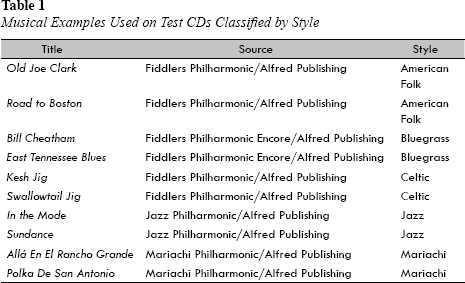
Two musical excerpts from the five different genres were selected to create a total of 10 listening examples (see Table 1 for a listing of specific excerpts). Excerpts ranged in duration from 22 to 35 seconds (M = 29.3s) and contained at least one musical phrase. Excerpts were randomly ordered on two stimulus CDs to balance for possible order effects. Participants were randomly assigned to one of the two stimulus CDs. Before listening to the musical examples, participants were instructed to answer demographic questions located at the top of a response sheet. The rest of the response sheet contained 10 seven-point response continua anchored by descriptors: “1 - strongly dislike,” “2 - dislike,” “3 - somewhat dislike,” “4 - neutral,” “5 - somewhat like,” “6 - like,” and “7 - strongly like.” After each listening example, ten seconds of silence was provided to allow participants an opportunity to mark their preference rating for the musical example, and also to mark whether they were familiar or unfamiliar with the excerpt.
Musical Examples Used on Test CDs Classified by Style
Results
Raw data consisted of middle school and high school string students’ music preference ratings for selected alternative string styles: American Folk, Bluegrass, Celtic, Jazz, and Mariachi. Means, standard deviations, and significant differences for all tested data factors are found in Tables 2 and 3. Forty-four participants were randomly chosen to hear the musical examples twice to test for reliability. Students who received the test-retest model were administered the preference survey approximately two weeks apart and heard the same listening order both times. Test-retest data analyzed using a Spearman's rank correlation coefficient resulted in a correlation of r = .86, indicating acceptable test-retest reliability.
Mean Preference Ratings for Style
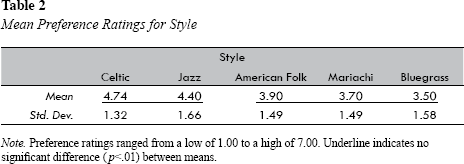
Note. Preference ratings ranged from a low of 1.00 to a high of 7.00. Underline indicates no significant difference (p<.01) between means.
Mean Preference Ratings for Grade Level, Primary Instrument, Gender, and Familiarity
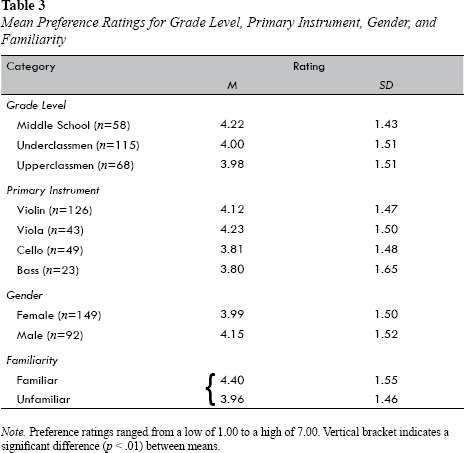
Note. Preference ratings ranged from a low of 1.00 to a high of 7.00. Vertical bracket indicates a significant difference (p < .01) between means.
A four-way ANOVA with one within-subjects (the five styles) and three between-subjects variables (grade levels, primary instrument, and gender) was used. Analysis indicated a violation of sphericity, therefore the Greenhouse-Geiser adjustment for a within-subjects ANOVA was used. An alpha level of .01 was used for all statistical analyses. Results showed a significant difference between the five musical styles, F (3.37, 730.6) = 18.97, p < .001, partial η2 = .08. The Bonferroni test for multiple comparisons showed that Celtic and Jazz styles were significantly different from American Folk, Mariachi, and Bluegrass styles (p < .001). No significant differences were found between Celtic music (M = 4.74) and Jazz music (M = 4.40), or between American Folk music (M = 3.90), Mariachi music (M = 3.70), and Bluegrass music (M = 3.50) (see Table 2). No significant differences were found in relation to participant grade level, primary instrument, gender, or interactions of these factors.
An independent t-Test was used to analyze differences between the preference ratings of participants who indicated they were familiar with at least one of the musical examples from a particular style and the preference ratings of those who were unfamiliar with either musical example of a particular style. Results revealed a significant difference, t (2408) = 4.74, p < .001, d = .30. The mean preference rating for styles that had at least one music example marked as familiar was M = 4.40, while the mean rating for styles that were unfamiliar was M = 3.96. It appears however that familiarity had little effect on overall preference ranking since participants who were familiar and unfamiliar with the examples indicated the same order of style preference: Celtic, Jazz, American Folk, Mariachi, and Bluegrass.
Discussion
The purpose of this study was to investigate middle school and high school string students’ preferences for various alternative string styles. The highest overall preference ratings were given to Celtic music and Jazz, followed by American Folk, Mariachi, and Bluegrass. Anthony (1974) found that students cited the music they played as one of the primary reasons for liking their performance ensemble experiences. Enjoyment is a crucial component of music education classrooms and potentially influences students’ attitudes toward the music they perform and toward the music classes themselves (Droe, 2006). Programming students’ preferred music may also influence their involvement and continuation in music, as well as their willingness to practice—and consequently their performance abilities.
A number of studies have revealed a relationship between participants’ preference ratings and their familiarity with the music being rated (Getz, 1966; Hargreaves, 1984; Johnston, 2009). Findings of the present study were consistent with previous research that indicated higher participant preference ratings for familiar music than unfamiliar music. Interestingly, students in the present study who were familiar with at least one of the musical examples from a particular style and students unfamiliar with the examples of the style shared the same overall preference order from most preferred to least preferred. This finding may indicate that student preferences were due to inherent characteristics of the musical styles as well as familiarity. Students may have been familiar with a style from having performed similar pieces, or prevalence of the styles in popular media.
Cultural attitudes may have also played a role in students’ preferences for some musical styles. Mariachi music was the second least preferred style of music, but results may have differed if the sampled population included more Hispanic students or were from an area of the country where Mariachi music is heard more often.
It may not be surprising to some string teachers that Celtic music was the most preferred style. Celtic music is included in many general method books and was likely more familiar to students. A study on the relationship between style representation in method books and student preference may be warranted.
Another possible reason for participant preference ratings in the present study may have been meter, as all musical examples were in duple meter except for the Celtic examples, which were in 6/8 meter, arguably an inherent musical characteristic of the style. Students’ stylistic preference ratings may have been influenced by their preference for playing in one meter rather than another. Future researchers may want to continue investigating the reasons students are drawn to some styles of music more than others, and why certain pieces seem to be popular among students regardless of their cultural and socioeconomic backgrounds.
Middle school students in the present study rated all styles higher than the high school students rated them. This finding seems to contradict previous research in which middle school students gave the lowest preference ratings (Gregory, 1994; LeBlanc et al, 1988). Preference ratings in the present study may be partially explained by participants’ perceptions regarding the musical complexity of the selected styles (Hargreaves, 1984). The musical examples were drawn from various string method books and contained melodies that were accessible to students with only a few years of string study. Consequently, older students may have given lower preference ratings because the music examples were perceived as easy; however, in practice, the complexity of the selected music styles is not in playing the melody, but in learning how to properly perform the styles—which frequently involves embellishing the melodies and improvising new ones. Students may have different perceptions of complexity when they are introduced to these performance practices, and consequently, different preferences for the styles.
Preference ratings in this study may have also been affected by the instrumentation of the musical examples. Demorest and Schultz (2004) found that when fifth-grade students heard both authentic and arranged versions of world music recordings, they preferred the authentic versions. The musical examples in this study were arranged to be accessible for string classrooms and were not necessarily authentic versions.
Participants’ primary instruments also seemed to play a role in overall preference ratings. Upper string players tended to give higher overall preference ratings than lower string players. Since the listening examples used in this study all contained violin(s) performing the melody, it is perhaps not surprising that upper string players had overall higher preference ratings. Future researchers may want to consider including other instruments performing the melody, or a variety of instruments performing the melody.
Several observations seen in the statistical analysis seem relevant. First, there was a relatively small effect size of the significant difference for styles (partial η2 = .08), suggesting that results may vary under different circumstances. While this study suggests a certain order of preference ratings among the sampled population, it may be different for other populations. Second, several interactions between variables, although not significant, appear of interest. Two of these interactions were grade level by instrument and gender by instrument, both of which had relatively large effect sizes. Grade level by instrument had an effect size almost the size of the main effect for styles (partial η2 = .07). This may have been due to an overall declining preference rating for older students, but relatively higher and more consistent preference ratings given by upper string players. As mentioned earlier, upper string players may have been more influenced by the violin timbre to give higher preference ratings than the lower string players. Future researchers may want to explore the possible interaction of grade level by instrument on preference ratings. Additionally, researchers may want to explore the possible interaction of gender by instrument on preference ratings. In this study, male double bass players consistently gave higher preference ratings for each style than female double bass players. Researchers may find other possible gender differences of preference ratings within and between instruments with further inquiry.
Music educators are responsible for exposing students to a wide variety of styles in order to expand their knowledge and understanding of musical meaning. Teachers should consider the implications of programming music solely on the basis of student preferences. Teachers may want to program music with which students are unfamiliar to expand their awareness and understanding of other styles. By understanding the factors that contribute to student preference ratings, teachers may attempt to increase student interest in a particular style of music. For instance, researchers have shown that students typically prefer fast tempos. If a teacher wants to introduce a style of music that may be of little interest to students, choosing a piece with a fast tempo may initially help to improve students’ perceptions of and preferences for the musical style.
The results of this study may assist string teachers in choosing which alternative string styles to include in their curricula. By selecting styles students prefer, such as Celtic or Jazz, teachers may increase student participation in after-school ensembles. On the other hand, if teachers want to introduce a style of music that students are not familiar with and do not seem to like, they may want to include the style among the music programmed for their regular ensembles until students are familiar with the music and can make an informed decision regarding preference. Future researchers may want to investigate the relationship between programming music that students prefer and students’ practice habits and performance improvement.
By carefully considering known variables that affect music preferences, such as tempo, teachers may be able to increase students’ preferences for and understanding of Bluegrass music or other relatively lower preference styles. Teachers may also wish to program preferred styles to increase student interest or to motivate students to practice more, while not limiting their repertoire to preferred styles. Doing so is not unlike what an English teacher might do; include some popular literature to increase students’ interest in reading, but also include standard readings that will expand familiarity with and understanding of a broader range of literature.
Selecting repertoire for students is one of music teachers’ most important responsibilities. Researchers can provide help in the selection process by continuing to explore variables that affect musical preference, and how these variables can assist to increase student interest, garner visibility of the music program, and create deeper cultural understanding among students. By acknowledging students’ musical preferences, teachers can create a positive learning environment while broadening appreciation of all music.