







Abstract
There is limited information on students with disabilities in the string classroom. The aim of this integrative review was to synthesize the existing knowledge and trends regarding educational practices for students with disabilities in the string or orchestra classroom. A total of 20 articles met inclusion criteria. The majority of available information consisted of expert opinion, with no true experimental designs found on string/orchestral education for students with disabilities. The analysis revealed that having a disability does not prevent a child from achieving on a string instrument, although barriers and challenges to participation do exist. Furthermore, the review showed that investigations specifically targeting string educators or teaching strategies in the string classroom are limited at best. More research is needed to better understand how students with disabilities can be effectively included in the string classroom.
The Individuals with Disabilities Education Act (IDEA), which was enacted in 1975, mandates children ages 3-21 with disabilities receive a free and appropriate public education (NICHY, 2012). Since its inception, the number of students with disabilities served in United States public schools has increased from 8.3% in 1976-77 to 13.8% in 2004-05, with a slight drop to 13.1% in 2009-10 (U. S. Department of Education, 2012). Due to this inclusive legislation many students now attend “non-traditional academic classes such as music, art and physical education with their non-disabled peers, as an integration experience” (Simeonsson, Carlson, Huntington, McMillen, & Brent, 2001, p. 50). Unfortunately there are often barriers to involvement in these non-traditional academic areas (Simeonsson et al., 2001). At the same time, teachers have the responsibility to ensure a proper music education for all students (Mazur, 2004).
The desire to provide music education for all was an important concept in early 20th century music education. Early leaders in the Music Supervisors National Conference (now NAfME: National Association for Music Education) advocated for the inclusion of music as a core subject, and its leaders promoted efforts to address inequalities in music education for underserved populations (Hoffman, 2011). By the 1940's and 50's committees were established within the organization focusing specifically on music for exceptional children (Mark, 2008). Today, music has been recognized as an important educational aspect for all students, even those with multiple, severe, or profound disabilities (Ockelford, Welch, & Zimmerman, 2002). In fact, evidence suggests that students with disabilities can and do achieve in music education classes at levels similar to their peers who are typically developing (Hoffman, 2011).
Problem Identification and Purpose
In spite of the progress in music education for students with disabilities, inequalities still exist. Students with disabilities are frequently not included in music classes at rates comparable to their typically developing peers (Hoffman, 2011). Furthermore, students are often not included in ensemble programs at the same rate that they are included in general music courses (Frisque, Niebur, & Humphreys, 1994; Zdzinski, 2001). The purpose of this integrative review was to critically analyze the existing knowledge and trends regarding educational practices for students with disabilities in the string or orchestra classroom. Specifically, educational practices geared toward children with disabilities were examined.
Method
Integrative Review Framework
In order to best synthesize the literature available on string instruction for children with special needs, an integrative review approach was chosen. An integrative review is a broad research review method that allows for inclusion of diverse methodologies including both experimental and non-experimental studies. Integrative reviews involve a more comprehensive approach than the better-known systematic review format, and are appropriate when multiple types of literature are to be reviewed (Haslbeck, 2012). The current review was conducted using a framework developed by Whittemore and Knaf (2005). The process outlined in this framework was based on Cooper's (1982; 1998) research review process but modified specifically for integrative reviews. The review process was conducted in five stages: (a) problem identification, (b) literature search, (c) data evaluation, (d) data analysis, and (e) presentation.
Definitions
In order to clarify the provision of services for children with disabilities in the public school setting, IDEA has defined disability using a categorical approach. In total there are 14 categories, with definitions for specific disability terms outlined within each category. Category examples include autism, developmental delay, and intellectual disability, among others (NICHY, 2012). For the purpose of this review, disability was defined according to the IDEA definition. String education was defined as orchestral or guitar classes or ensembles. Inclusion was defined as placing a child with disabilities “to the maximum extent appropriate, in the school and classroom he or she would otherwise attend.” [Rogers, 1993, p. 1].
Databases and Search Strategy
We obtained studies primarily through a comprehensive computer-assisted search of selected databases (see Table 1).
Databases Searched
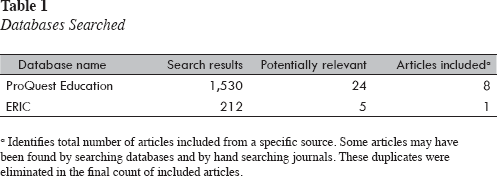
Identifies total number of articles included from a specific source. Some articles may have been found by searching databases and by hand searching journals. These duplicates were eliminated in the final count of included articles.
This search was enhanced by hand searching the table of contents of relevant music journals (see Table 2).
Journal Searched by Hand
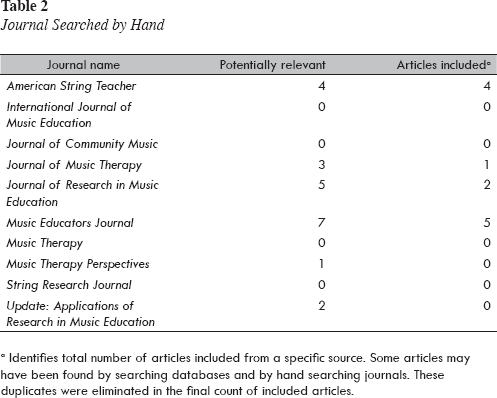
Identifies total number of articles included from a specific source. Some articles may have been found by searching databases and by hand searching journals. These duplicates were eliminated in the final count of included articles.
Reference mining was also used to identify potential literature. The search, which occurred in January and February of 2014 and was updated in July of 2014, yielded a total of 1,937 potential articles. We independently reviewed articles identified by the search using the inclusion and exclusion criteria in order to identify applicable articles. We then met to compare results and resolve discrepancies.
Inclusion and Exclusion Criteria
For the purpose of this review, we limited papers to English language articles from the United States. Papers from the United States were chosen to ensure that all work was based on similar educational practices and laws governing the education of students with disabilities. Papers were only included if they specifically referenced orchestral or string instruction with students with disabilities and provided identifiable information specific to orchestral or string education in the results section. Additionally, papers that referenced education practices and perceptions were included if the authors expressly stated that string educators (or preservice educators) were included in the sample. Examples of articles that were excluded are shown in Table 3.
Examples of Excluded Articles
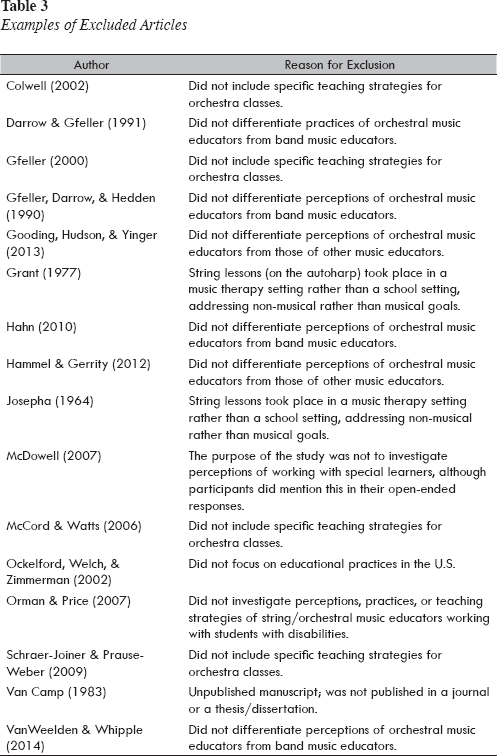
We included articles that met the following criteria: 1) studies conducted in the U.S. and written in English, 2) refer specifically to music AND string OR orchestra AND inclusion OR disability, 3) must be in the school setting, 4) must have experimental, pre-experimental, descriptive, or case study design, or be expert opinion, and 5) published articles and unpublished dissertations/theses. Articles excluded were: 1) papers that referred to music education for students with disabilities but did not explicitly refer to orchestral or string settings, or 2) informal unstructured interviews and media pieces about music programs for students with disabilities that did not identify teaching strategies.
Data Extraction
We independently read and extracted data from the relevant studies that met the inclusion criteria. Extracted data included (a) author and year of publication, (b) design, (c) participants, (d) outcomes measured, and (e) results. We then compared the mined data to verify the accuracy and ensure that all relevant information had been extracted.
Data Evaluation
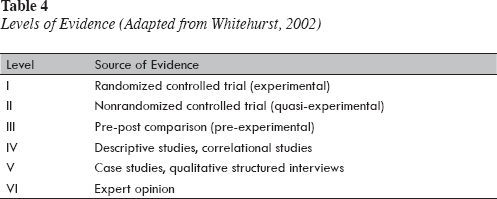
After evaluating the papers based on the above inclusion criteria and eliminating duplicates, we identified a total of 43 as potentially relevant. The numbers of articles identified for inclusion through search databases and hand searching journals are shown in Tables 1 and 2, respectively. In total, 20 papers met the parameters for inclusion. A critical appraisal was then conducted to assess the strength of evidence in papers that met the inclusion criteria. Levels of evidence were assigned based on an adaptation of those identified by the U.S. Department of Education (Whitehouse, 2002) and What Works Clearinghouse (U.S. Department of Education's Institute of Education Sciences, 2012) guidelines for evidence-based education. Levels of evidence are summarized in Table 4.
Levels of Evidence (Adapted from Whitehurst, 2002)
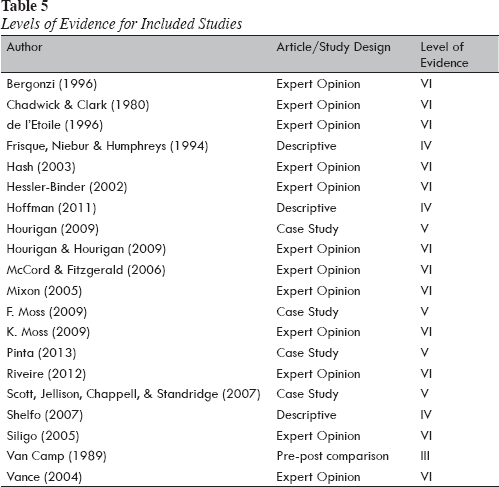
We independently appraised the articles and then met to compare results and discuss any discrepancies. Agreement was met on all articles. Included studies are shown in Table 5, along with the levels of evidence to which they were assigned.
Levels of Evidence for Included Studies
Results
Defining Characteristics of the Studies
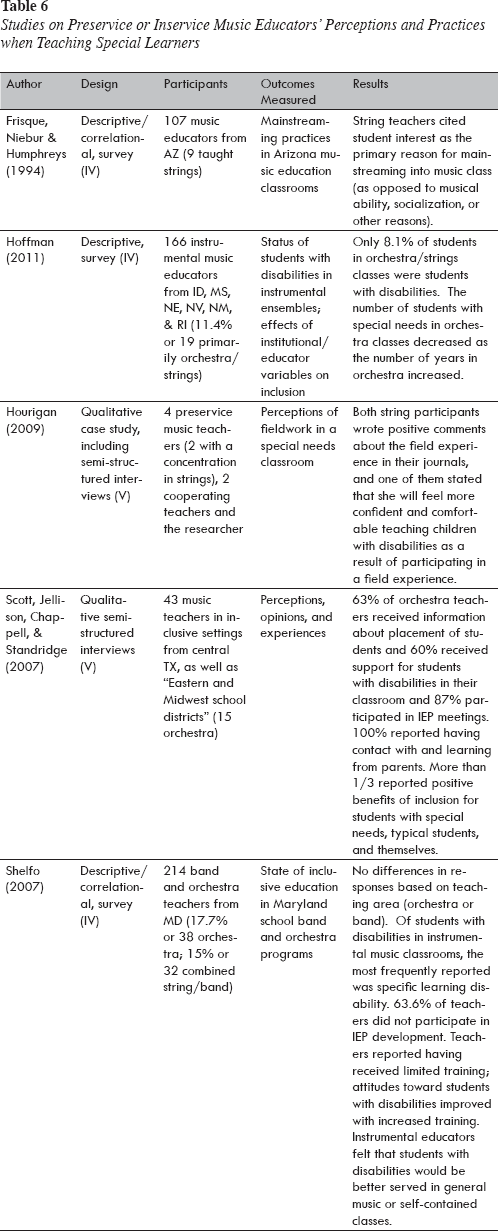
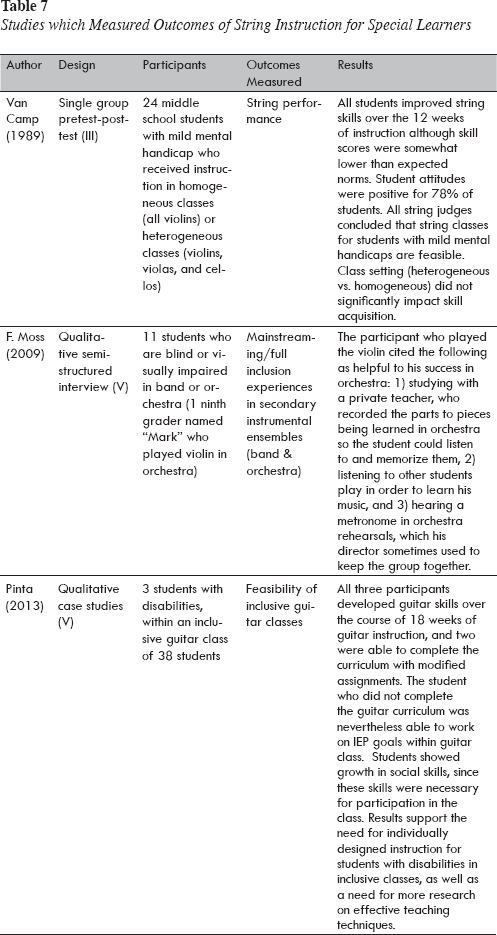
In order to organize, summarize, and present data extracted from retained papers into a manageable framework, a series of tables were constructed. Papers were grouped into three main categories: (a) those that dealt with preservice or inservice music educators’ perceptions and practices when working with students with special needs, summarized in Table 6; (b) those that empirically studied practices for string instruction with students who have special needs, summarized in Table 7; or (c) expert opinion on educational practices for teaching special learners to play string instruments, summarized in Table 8. The following data were included in Tables 6 and 7: (a) author, (b) study design, (c) participants, (d) outcomes measured, and (e) results of the study. For articles that constituted expert opinion, the following information was included in Table 8: (a) author, (b) student population, (c) purpose, and (d) key points/teaching strategies.
Studies on Preservice or Inservice Music Educators’ Perceptions and Practices when Teaching Special Learners
Studies which Measured Outcomes of String Instruction for Special Learners
Articles which Constituted Expert Opinion (Level VI)

Data Analysis
A variety of types of papers were found in the literature including Level III pre-post comparison studies (n = 1), Level IV descriptive studies (n = 3), Level V case studies (n = 4), and Level VI expert opinion articles (n = 12). No true experimental design (Level I) or quasi-experimental design (Level II) studies were found. Five of the included articles were dissertations or theses and the remaining 15 were published in music education or music therapy journals. The majority of the published studies (12 out of 15, or 80%) constituted expert opinion. The earliest included study was published in 1980, and the most recent in 2013. The majority of the included studies were published between 2000 and 2009 (n = 12), with a smaller number published in the 1980s (n = 2), 1990s (n = 3), and the present decade (n = 3).
Studies Measuring Music Educators’ Perceptions and Practices
Four of the studies investigated inservice music educators’ perceptions and practices when teaching special learners, either through surveys (n = 3) or semi-structured interviews (n = 1). A fifth study (Hourigan, 2009) investigated practices and perceptions of preservice music educators over the course of a field placement with students with special needs. In this study, results were measured using semi-structured interview, journals, and observations. Two of the studies that collected information about practices and perceptions using survey methods included correlational data (Frisque et al., 1994; Shelfo, 2007). All five of the studies of educators’ perceptions and practices included orchestral/string music educators in their sample along with music educators who taught in other areas (band, chorus, or general music). The percentage of orchestral/string music educators within each study's sample ranged from 8.4% to 50%, and the number of orchestral/string participants in each study ranged from 2 to 70. It is worth noting that none of these studies focused exclusively on teachers of string/orchestra classes. Also, string/orchestra teachers made up 50% or less of study participants, even when the only other participants were band teachers (as was the case in Shelfo's 2007 survey of instrumental music teachers, in which 17.7% of participants taught orchestra and 15% taught combined string and band classes). Two of the studies on educators’ practices and perceptions were dissertations (Hoffman, 2011; Shelfo, 2007). Two of the published studies appeared in Journal of Research in Music Education and the third appeared in Journal of Music Therapy.
Studies Measuring Student Outcomes
Three studies investigated outcomes of string/orchestra instruction for students with disabilities, either through pretest-posttest comparison (Van Camp, 1989), semi-structured interviews (F. Moss, 2009), or a collection of qualitative case studies (Pinta, 2013). All three of the studies in this category were dissertations. Participants included 24 middle school students with mild mental handicaps (intellectual disabilities) who were taught to play the violin, viola, or cello over the course of 12 weeks (Van Camp, 1989); a ninth grade student who was blind and was surveyed about his experiences playing the violin in a mainstreamed orchestra classroom (F. Moss, 2009); and high school students with autism spectrum disorders (n = 2) or a specific learning disability (n = 1) who were taught to play the guitar over the course of 18 weeks (Pinta, 2013). One of the students in Pinta's study who was on the autism spectrum also displayed challenging behaviors. One of these studies involved self-contained classes for students with special needs (Van Camp, 1989), whereas the other two involved students with special needs in inclusive music classes (F. Moss, 2009; Pinta, 2013). Both of the prospective studies that measured student achievements in learning to play string instruments reported positive results, meaning that the students made progress in learning to play stringed instruments, although not without certain modifications and challenges (Van Camp, 1989; Pinta, 2013).
Articles Containing Expert Opinion
All 12 of the articles that constituted expert opinion were published in music education journals, primarily Music Educators Journal (n = 5), and American String Teacher (n = 4), with American Music Teacher, Research & Issues in Music Education, and Teaching Music each having one publication from this category. Six articles focused on teaching strategies for a specific exceptionality, including students with physical disabilities (Chadwick & Clark, 1980), autism spectrum disorders (Hourigan & Hourigan, 2009), dyslexia (Vance, 2004), visual impairments (Siligo, 2005), and students who are blind (Hessler-Binder, 2002) or deaf/hard-of-hearing (Hash, 2003). The remaining six articles outlined suggestions that would be appropriate for use with multiple exceptionalities.
Discussion
The number of articles on teaching students with special needs in string/orchestra classes has increased over the past 35 years, possibly as a result of increased inclusion (Simeonsson, et al., 2001); however, much of the research in this area falls into the expert opinion category. The included expert opinion articles provided practical applications for individuals with specific disabilities and needs, including children who are deaf/hard-of-hearing or have visual impairments, autism, or a specific learning disability. Additionally, authors of the expert opinion articles provided suggestions to improve the environment for students with disabilities (Hash, 2003), as well as specific teaching strategies like the use of variations on a theme to accommodate different levels of learning in one group (Riveire, 2012). Although having recommendations from experts in the field are indeed helpful, educators should be aware that these suggestions may not have been rigorously tested. At times, experts disagree on educational practices, and additional research is needed in order to determine best practices for working with students with special needs in string/orchestra classrooms.
The studies on educators’ practices and perceptions of working with students with special needs provide important information that can be used to help determine future directions for research, practice, policy, and training of preservice music educators. The finding from the Hoffman (2011) study that the number of students participating in orchestra decreased as the number of years in orchestra increased raises questions about the ability of students with special needs to continue to participate in orchestra for more than one year; however, given the small number of orchestra/string teachers in this study (19), further research with a greater number of participants is necessary to elaborate upon this finding.
Both the studies by Scott et al. (2007) and Shelfo (2007) asked participants questions about involvement in IEP meetings (via semi-structured interviews or surveys, respectively), with conflicting findings. In Shelfo's survey of band and orchestra teachers in Maryland, approximately 64% reported that they did not participate in their students’ IEP development. In contrast, only 13% of orchestra teachers in Scott et al.'s study of music teachers from central Texas and other school districts in the East and Midwest reported in their semi-structured interviews that they were not involved in the IEP process. These differences could have to do with regional differences, or could be a result of differences in methodology. Future research could investigate levels of participation in the IEP process among string/orchestra teachers, particularly with regard to regional trends and potential barriers.
In response to Shelfo's (2007) survey, instrumental music educators in Maryland reported having had limited training in working with students with special needs, although those with more training reported having improved attitudes about working with special learners. In Hourigan's (2009) qualitative study of a preservice field experience that allowed music education students opportunities to work closely with special learners, one of the participants who had a concentration in string teaching reported feeling more confident and comfortable teaching students with special needs as a result of the field experience. Additional descriptive research (similar to Shelfo's study) is needed to identify specific areas in which music educators in string/orchestra settings feel the need for additional training in working with students with special needs, whereas future studies of the qualitative nature (similar to Hourigan's study) can help design effective models for providing training to preservice music educators. In addition to descriptive and qualitative research on perceptions and practices of music educators working with special learners, there is a need for further quantitative research that is experimental, quasi-experimental, and pre-experimental variety. Such research is necessary in order to establish best practices and guidelines.
Of the three studies that investigated the achievement and perceptions of students with special needs in string/orchestra classes, only one article was identified as having a pre-experimental, pre-post comparison design (Van Camp, 1989). There are inherent challenges to conducting controlled studies in educational settings, and pre-experimental studies in which students serve as their own controls are often easier to implement. Although quasi-experimental and experimental studies are helpful in developing evidence-based practice, additional case study designs and pre-experimental research may be necessary first in order to determine the feasibility of inclusive teaching practices with students with special needs. Once the feasibility of an educational practice has been determined, its effectiveness relative to other practices can later be evaluated through more controlled studies.
Recommendations
All of the studies included in this review that investigated perceptions and practices of preservice and inservice string/orchestral music educators included music educators from other teaching concentrations as well (i.e. band, chorus, and/or general music). Additional research is needed that specifically focuses on string/orchestra teachers’ perceptions and practices related to teaching students with special needs. More research is needed on effective teaching practices for meeting the needs of special learners within string/orchestra classrooms; however, there were several exceptionalities for which no empirical studies could be found, including on students who are deaf/hard-of-hearing, students who are blind/visually impaired, and students who have physical impairments. Existing research regarding string/orchestral teaching practices for students who have mild intellectual disabilities (Van Camp, 1989), autism spectrum disorders, behavioral challenges, and/or learning disabilities (Pinta, 2013) is limited; future research could replicate these studies with larger sample sizes using pre-experimental, quasi-experimental, or experimental designs.
Participants in Shelfo's (2007) study generally felt that students with disabilities would be better served in general music or self-contained classes, as opposed to inclusive instrumental music classes. This highlights the need for future research on barriers to inclusion of students with special needs in band and orchestra classes. There is also a need for investigation of teacher attitudes about inclusion in ensemble-based instrumental courses.
Five of the studies included in this review were dissertations or theses; these constituted 25% of all articles reviewed and accounted for 63% of the studies that were not considered expert opinion. This indicates a need for increased publication and wider dissemination of studies on working with students who have special needs. Likewise, there is also a lack of information about teaching exceptional students being shared via presentations and research poster sessions at conferences of professional music organizations (Orman & Price, 2007). This further illustrates the need for increased distribution of information on this topic.
Conclusion
Research on inclusion practices for students with special needs in instrumental music classes indicates that having a disability does not preclude learning to play a musical instrument. However, barriers and challenges currently exist for students with special needs who are interested in participating in orchestra or string ensembles at school. One of the first steps toward removing these barriers is to better understand them through additional research.