







Abstract
The American String Teachers Association (ASTA) has held research poster sessions as part of its national conferences annually since 2006. From 2006-2014, 98 researchers contributed 147 original research studies to these sessions. Sixty-six of these researchers presented once, and 32 presented two or more studies. Since 2008, the research poster submissions have been juried and the research poster presentation sessions have had a designated slot in the annual ASTA conference program. An average of 17 research posters have been presented annually. The consistent number of poster submissions and the breadth of research topics may indicate the vitality of string research by ASTA members.
Researchers have noted the paucity of research on professional association conferences in general (Jacobs & McFarlane, 2005) and specifically for music education conference sessions (Orman & Price, 2007; Price & Orman, 1991, 2001). Orman and Price (2007) pointed out that since conferences are integral to the mission of some music professional organizations, more research attention on conferences is warranted.
Research poster presentations are a common method for distributing and discussing research at meetings and conferences of professional music associations. These have been examined in disciplines outside of music, however systematic inquiry on music conference research poster sessions is especially scarce and may be limited to music therapy conferences (Silverman, 2008, 2014).
The leading string music association in the United States, the American String Teachers Association (ASTA), has held a string research poster session at each of its annual national conferences since 2006. The purpose of this study is to describe the available research poster abstracts from 2006-2014 quantitatively by year and by author. Three specific research questions are addressed in this study.
For the ASTA research poster sessions from 2006-2014:
How many research studies were accepted for presentation each year?
How many researchers have presented studies?
How many researchers have presented research posters twice or more, and who were the most prolific presenters?
Method
ASTA national office staff members provided titles, authors, and available abstracts or conference book descriptions for research poster sessions from 2006-2014. The content and format of this information varied across years as the research poster session submission process evolved.
In 2006 and 2007 the poster presentations combined research, best practices, and commercial posters in the same session. The ASTA national office staff, without an apparent peer-review process, administered these proposals. Hence, the available data for 2006 and 2007 does not distinguish between research and non-research poster presentations. To determine retrospectively which descriptions were most likely those of original research, an experienced research assistant and I independently read the abstracts and titles of all poster presentations for 2006 and 2007 and recorded whether or not each abstract described an original research study. Next, we compared our responses. We were in complete agreement (100% reliability) as to which and how many abstracts represented original string research.
In 2008 and 2009, an effective means of providing a peer review process for reviewing the research poster presentations was established and papers were submitted directly to the research committee chair. As a result of this submission process, only title and author were accessible for the research posters presented in those years and available records do not include any of the abstracts. Since 2010, the research poster submissions have been made and maintained through ASTA's Precis computer system and peer reviewed by members of the String Research Journal Editorial Board. The data available for this time period are the most complete, and include title, author, and abstract.
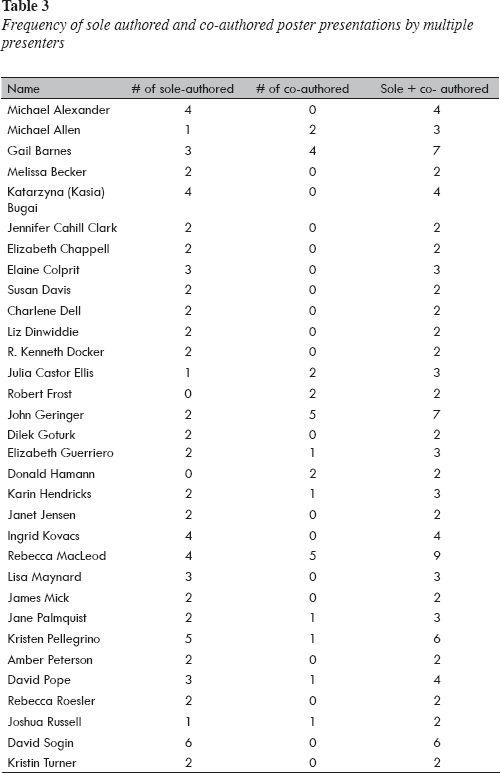
In reading these abstracts, I noted two abstracts listed in two years. After accounting for these studies that were accepted in one year but presented in the following year (see Note), I completed a frequency count of research posters from the information provided. Table 1 lists the number of research posters by year and by ASTA conference location. Next, I constructed an alphabetical list of authors and co-authors indicating years they made research poster presentations (Table 2). Finally, to examine presentation frequency, I tallied the number of sole- and co-authored papers for all researchers presenting two or more times (Table 3).
Number of research posters presented at ASTA Conferences 2006-2014
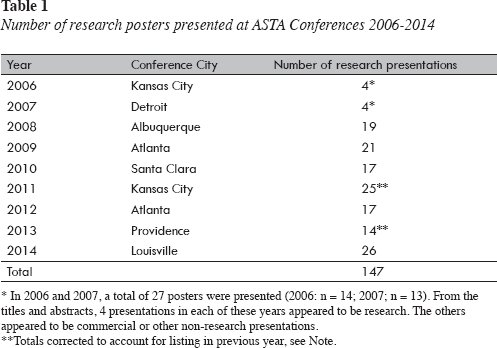
In 2006 and 2007, a total of 27 posters were presented (2006: n = 14; 2007; n = 13). From the titles and abstracts, 4 presentations in each of these years appeared to be research. The others appeared to be commercial or other non-research presentations.
Totals corrected to account for listing in previous year, see Note.
Research Poster presenters 2006-2014

poster accepted in previous year, but presentation was deferred to the year indicated.
Frequency of sole authored and co-authored poster presentations by multiple presenters
Results
A total of 147 original research studies have been presented at ASTA research poster sessions since 2006. Of these, 139 were peer-reviewed. Since 2008, between 14-26 peer-reviewed research posters have been presented annually with an average of 17.38 studies per year. The number of poster presentations has remained relatively consistent since 2008 (Table 1).
Ninety-eight researchers made at least one presentation at an ASTA research poster session (2006-2014). Of these, 66 (66%) presented once, and 32 (33%) presented twice or more as a sole- and/or co-author (Table 2).
The researchers who have participated most often in ASTA research poster sessions as sole and/or co-author are: Rebecca MacLeod (9 posters as sole- and/or co-author); Gail Barnes and John Geringer (7 posters each as sole- and/or co-author); and Kristen Pellegrino (6 posters as sole- and/or co-author). David Sogin has presented the most single-authored research poster studies (6). See Table 3.
Discussion
The total number of research posters presented annually is noteworthy, as is the stability of the number of presentations across years. This indicates a sustained, consistent interest level in string research. Additionally, although not specifically examined in this study, the research modes and topics represented in these poster sessions were observed by the investigator to be diverse in subject matter and methodology.
One limitation of this study is that the information available did not distinguish between completed research and research-in-progress. Another limitation is that the information available did not distinguish between research and non-research presentations in 2006 and 2007.
The analysis in this paper of the data for 2006 and 2007 is based on a best determination by two trained observers regarding which abstracts likely would have been considered research had the posters been peer-reviewed in those years. I included this data to describe ASTA's initial efforts in presenting research poster sessions, and to represent the work of those researchers who did present original research at these two conferences. The high degree of reliability (100%) lends credibility to the retrospective determination of research versus non-research presentation descriptions. Other researchers, however, may choose to exclude this data because it was not peer-reviewed. Future researchers should consider collecting data at the research session itself, to ensure accurate data.
Research poster presentations are an under-researched area holding much potential for future study. Motivation and rewards for participating in research poster sessions (whether as an attendee or a presenter) might be examined. Conversion rate of poster presentation to research publication, and possible barriers to publication should be studied as well. Researchers on Communities of Learning have begun to examine poster sessions as learning forums, including immediate and long-term recall of presented research, effects of divided attention at the presentation, and other variables, such as the social dynamics of research poster sessions (Jacobs & McFarlane, 2005).
The research poster session is now a well-established feature of the annual ASTA national conference. With the rich and eclectic research presented in these research poster sessions, it appears that the field of string research is healthy and stable, and poised to grow in quality and quantity, impacting string teaching and performance. As a forum for exchanging ideas—a venue for ASTA members to discuss research–the ASTA Research Poster sessions have demonstrated viability and vitality.
Note
In two instances, identical studies were found listed in separate years. I contacted the researchers and found that in each case, the study had been completed and accepted for presentation in one year, but not presented until the following year due to extenuating circumstances. To avoid double-counting these studies, I counted these studies in the presentation year only. These were: a study by J. Palmquist was accepted in 2011 but presented in 2012; a study by M. Alexander was accepted in 2013 but presented in 2014.
Footnotes
Acknowledgements
Kristen Pellegrino, past-chair of the Collegiate RoundTable, for facilitating ASTA support for posting abstracts online in the future (as a follow up to this study) and for facilitating access to the raw data for this study through the ASTA national office.
ASTA national office, especially Donna Hale and Deanna Tompkins, for providing the poster titles, authors, and abstracts from 2006-2014 as described in this study.