







Abstract
The purpose of this study was to determine the rhythm sight-reading ability of high school string players, establish a hierarchy for detaché rhythm skills in string sight-reading, and discover any effects of key or bow direction. Twenty-six rhythm skills, grouped into seven categories were embedded into four 8-measure melodies, which appeared in three different keys and with occasional designated bowings. Participants (N = 82) obtained a mean score of 19.1 (73%), with success rates ranging from 20% to 94% for individual rhythm skills. While significant differences were found between skills appearing in the major keys of D and E-flat, no significant differences were found by bow direction. Future researchers may explore whether these rhythm skills hold their relative difficulty level with less accomplished players, investigate the effects of various bowing practices, and identify any effects of anxiety levels for sight-reading when the consequences of performance quality varies.
The ability to sight-read is a necessary musical skill for the development of independent learners (Elliott, 1982; Gregory, 1972) and an indispensable part of training for musicians (Lehmann & McArthur, 2002). According to Gromko (2004), “Just as reading comprehension is a basic component of most standardized tests of language arts literacy, so music sight-reading is a critical component of music literacy and a test of comprehension of the musical symbol system” (p. 7). Without the ability to sight-read, a musician's experience of music literature is limited to their own compositions, pieces learned by rote, and those learned under the tutelage of someone else. The ability to sight-read allows a musician to explore literature on their own initiative, providing for individual discovery, interpretation, and performance.
Good sight-readers scan ahead in the music for difficult passages with an awareness of key signatures and meter (McPherson, 1994). They also perceive rhythm and pitch patterns instead of individual notes (Gromko, 2004) and can perceive more of this information at a faster rate than less successful sight-readers (Smith, 1989). Poor sight-readers do not concentrate on key and time signatures as much as they do notes and rhythms (McPherson, 1994). They also tend to focus on single notes and rests, not patterns (Goolsby, 1994).
Key has been found to have a significant effect on instrumental sight-reading (McPherson, 1994). For string players in particular, the reading of pitch skills in a melodic context was found to be more difficult in E major than D major (Alexander & Henry, 2012). This finding supports the commonly held belief that sight-reading is more difficult in keys with numerous sharps or flats in comparison to those with relatively few. In other words, sight-reading becomes more difficult when the ability to reference pitch from open strings is chromatically altered by additional sharps or flats to the key signature.
Additional music experiences have also been associated with higher achievement in sight-reading. Piano study and private lesson instruction are the two most-often measured variables in sight-reading research that examines additional musical experiences. Piano study is linked with higher scoring on sight-singing measures (Demorest, 1998; Demorest & May, 1995; Henry, 2011; Henry & Demorest, 1994; Killian & Henry, 2005) while private instrumental instruction has been related to instrumental sight-reading achievement (Alexander & Henry, 2012; Ferrin, 2004; Mann, 1991; McPherson, Bailey, & Sinclair, 1997; Stenger, 1997; Townsend, 1992; Wheeler, 1993).
Although perception of meter, key, and participation in piano lessons or private instrumental instruction has been linked to sight-reading ability, historically, the inability to read rhythmic patterns has been found to be the major source of error in sight-reading by both novices and experienced musicians (Van Nuys & Weaver, 1943; Thomson, 1953). Junior-high wind players were found to have a high correlation between the ability to read rhythm at sight and the ability to read music at sight (Boyle, 1970). High school wind instrumentalists’ rhythmic errors were found to outweigh all other types of errors in sight-reading (McPherson, 1994). Collegiate wind players’ rhythm-reading ability was found to be the single best predictor of undergraduate wind instrumentalists’ sight-reading scores (Elliott, 1982). The ability to read rhythm and, to a lesser extent, meter, key, and additional musical experiences, comprise the variables most often measured in sight-reading research.
To date, no test of individual instrumental sight-reading achievement can provide diagnostic information. The Watkins Farnum Performance Scale (Watkins & Farnum, 1962), or WFPS, was designed as a test of instrumental performance (Stivers, 1973), but is often used for research in instrumental sight-reading (Boyle, 1970; Ciepluch, 1988; Elliott, 1982; Gregory, 1972; Gromko, 2004; MacKnight, 1975; McPherson, 1994; Thompson, 1985). The Farnum String Scale (Farnum, 1969), developed from the WFPS, was designed as an assessment tool specifically for string players. In these tests, consisting of 8-10 measure exercises, only one error may be scored in each measure. Thus, one and zero are the only possible scores for any given measure. Individual players are instructed to start reading the first exercise and to continue until they score zero on two consecutive exercises, thus determining their performance level (Watkins & Farnum, 1962).
The WFPS gives a highly reliable estimate of individual sight-reading ability as compared to others who have taken the test (Stivers, 1973), however, the WFPS is not diagnostic in nature. That is, the practice of having players stop at the second score of zero results in only one diagnostic analysis: the measures performed incorrectly should be practiced. Individual skills needing remediation are not identified. Success or difficulty performing additional pitch or rhythm skills may not be evident because the player may have stopped before their occurrence in the exercises. Without a complete picture of skill deficiencies, teachers cannot formulate a thorough plan for instruction.
Boyle and Lucas's (1990) study of sight-singing within a tonal framework and Killian's (1991) study of error detection and sight-singing were identified in context as an integral part of successful sight-singing. Henry (2001) developed the Vocal Sight-Reading Inventory (VSRI) using the principle of “contextually-based units of measure” (p. 22) in which each pitch skill was embedded into melodic exercises written with a simple rhythmic context. A hierarchy of pitch skills was established based on the difficulty level of each discrete skill. Using similar guidelines, Alexander and Henry (2012) established a hierarchy of pitch skill difficulty for string players. In the same manner, Henry (2009) established a hierarchy of rhythmic skill difficulty for vocalists in which each rhythm skill was assigned to one of seven categories: whole beat, multi-beat, even division, uneven division, even-uneven division, uneven-uneven division, or steady beat. Each skill (except steady beat) contained one to four notes. All 26 rhythm skills were incorporated into four, similar, eight-measure melodies composed with simple melodic contours, so as not to act as a confounding variable on the embedded rhythmic skills. The scoring system used by Henry (2001, 2009) and Alexander and Henry (2012) represented the total number of skills performed correctly and identified the individual skills the participant did or did not perform successfully; thus providing not only a score but a diagnostic tool for establishing which skills need improvement. The scoring system used in these studies was assessed through two different procedures: A .96 correlation in Henry (2001) and a .95 correlation in Alexander and Henry (2012) between note-by-note and skill-based scoring systems, indicating that skill-based scoring is a valid measurement of string players’ sight-reading of tonal pitch skills within a melodic context. When studies where scorers were compared, it was determined that inter-scorer reliability was 97% in Henry (2001) and 93% in Henry (2009).
The majority of research on instrumental sight-reading ability among school children has focused on performers of wind and brass instruments (Walker, 1992), with relatively little research involving string players (Alexander & Henry, 2012). Differences in how rhythm is taught and performed by winds versus strings prohibit generalization from studies utilizing wind players to the population of string players. While players of brass and woodwind instruments produce rhythm with airflow in one direction, string rhythm performance may be compounded by the variable of bow direction. One of the basic bow strokes, detaché, indicates that every note is to be played with a different bow stroke, either as an up-bow or down-bow. Changing the bow direction on every note requires that the bowing variables of speed and weight must be altered to produce a similar tone on two adjacent notes of different time values. More advanced bowing styles or techniques (hooked, linked, slurred, spiccato, lift to a down bow, lift to an up bow, etc.) may add additional difficulties.
The types of note values used in beginning band and string methods differ as well. While most modern string method books begin with rhythms grouped in patterns of eighth and quarter notes, the majority of contemporary band methods begin with long tones such as half or whole notes. Rhythm performance by string players differs enough from their wind counterparts, both in technique and pedagogy, that string players’ sight-reading performance warrants further study, independent of research conducted with wind instruments. Alexander and Henry (2012) suggested that a rhythm skill hierarchy for string players be developed to compliment their research on string pitch skill sight-reading so that a diagnostic assessment of string sight-reading could be created.
The authors developed the current study to describe the ability of high school string players to sight-read detaché rhythm skills. This was done by using the methodology developed by Henry (2001, 2009) and Alexander and Henry (2012). In doing so, the following research questions emerged:
What is the success rate of high school string players in sight-reading detaché rhythm skills?
What is the difficulty hierarchy of detaché rhythm skills for string sight-reading?
What is the effect of selected keys on rhythm sight-reading achievement, when presented in a melodic context?
Does bow direction of specific detaché rhythm skills have a significant effect on sight-reading success?
Is there a significant difference in scores between students with and without additional musical experiences?
Method
The target skills identified by Henry (2009) constituted the universe of rhythm skills for the current study; twenty-six rhythm skills in seven categories (see Figure 2) were embedded into four eight-measure melodies (see example in Figure 3). The melodies contained basic melodic tasks—as determined through the previously developed pitch skill hierarchies (Henry, 2001; Alexander and Henry, 2012)—so as not to present a confounding variable when isolating rhythmic tasks. However, to attend to the possibility that the execution of a pitch task may influence the performance of a rhythm task, several of the multi-note rhythm skills occurred with differing pitch tasks, e.g., repeated pitches versus moving pitches.
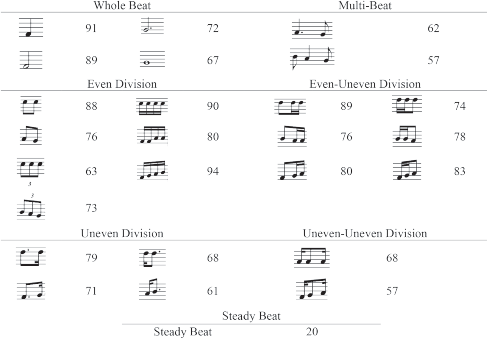
Success rates for the 26 rhythm skills.
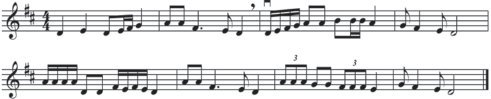
Example of sight-reading exercises.
The effect of key on students’ sight-reading of detaché rhythm skills was explored using the same methodology that Alexander and Henry (2012) used to explore the effects of key on the sight-reading of pitch skills. D major melodies were transcribed to E and E-flat Major which featured similar string crossings in each key, playable in first position (except for string bass), and represented a flat first finger pattern in E-flat with a contrasting G# extension on the other side of the hand in E. The effect of bow direction on rhythmic accuracy was investigated by alternating the starting bow direction for two of the rhythm skills (same pitch paired eighth notes and dotted quarter note - eighth note moving by step). High school string players attending a summer music camp (N = 82) participated in an evaluation of their string sight-reading skills. Participants completed a survey requesting their information regarding instrument type, grade level, and additional musical experiences. After completing the survey, participants were randomly sent into one of three testing rooms. Each participant was asked to sight-read a series of four melodies on their primary instrument—violin, viola, cello, or string bass. Testing materials in each room were identical, except for the starting key in which each melody was presented. Within each room, the testing order of the melodies and keys were counterbalanced to limit the effects of the presentation sequence. Thus, the combined scores were representative of all melodies in all keys. Scoring was done live, using the target rhythm skill scoring procedures developed by Henry (2009), resulting in individual scores ranging from 0-26, based on the number of target skills performed accurately. Test administrator/scorers were upper level music majors (music education or performance), who received training in scoring techniques prior to the summer music camp. Each trial was also recorded using digital recorders, so that inter-scorer reliability could be established by having performances scored by a second scorer at a later time.
Results
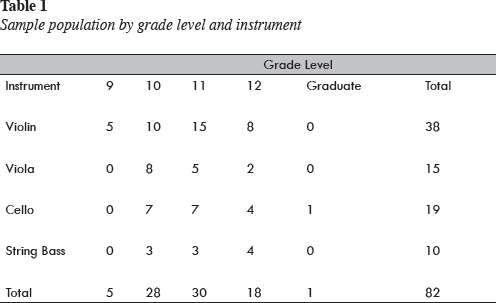
Table 1 contains the grade level and instrument totals for the sample population. Of the 82 participants, 57 had been selected for all-region, 24 had been selected for all-area, and 19 had previously been selected for membership in an all-state ensemble. Sixty-seven participants had studied privately on their primary instrument, while 37 had studied piano, and 23 had studied another instrument in addition to their primary instrument.
Sample population by grade level and instrument
The mean score for the sample population was 19.1 out of a possible score of 26, or 73% (SD = 5.40). See Figure 3 for the overall score distribution. A second scorer was utilized for 34% of the testing trials (n = 28). Using the agreement/(agreement + disagreement) formula, the scorers achieved an inter-scorer reliability of 99.4%.
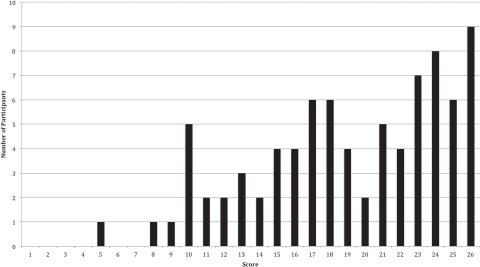
Overall score distribution (N = 82).
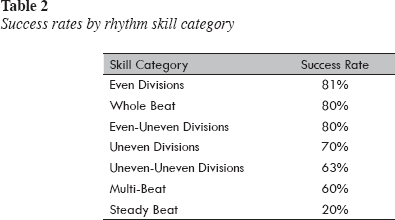
Figure 1 illustrates the success levels for each of the 26 discrete rhythm skills. The easiest rhythm skill was sets of four sixteenth notes, moving in scalar motion (94% success). The most difficult rhythm skill was maintaining steady beat (20% success). As with previous research of singers’ rhythmic sight-reading (Henry, 2009), the 26 skills were combined into seven categories, with success rates ranging from 20% - 81% (see Table 2).
Success rates by rhythm skill category
Each melody, and therefore all target rhythm skills, appeared in the keys of D, E-flat, and E, across the various testing rooms. The researchers employed a within-subjects one-way analysis of variance on individual scores for the keys and found a significant difference between keys, F (2, 325) = 5.33, p < .01. Results of a post hoc Tukey HSD revealed rhythmic accuracy scores were higher in the key of D than in E-flat, p < .01. No significant difference was found for alternate bowing direction for identical rhythmic skills. There was also no significant difference between students on the variables of piano lessons, private lesson instruction, instrument, or grade level.
Discussion
This purpose of this study was to describe the rhythmic sight-reading ability of high school string players, establish a hierarchy for detaché rhythm skills in string sight-reading, and discover any effects of key or bow direction. Data were also gathered to determine any effects of instrument type, grade level, and additional musical experiences. The scoring system was deemed a valid measurement of participants’ rhythm skills through the same method used by Henry (2001) during the initial construction of the VSRI. With an inter-scorer reliability of .99 between scorers, the assessment was found to be a reliable measurement of string players’ sight-reading of detaché rhythm skills within a melodic context.
The participants in this study achieved a moderately high level of success on the rhythm tasks contained in this assessment (19.1 out of 26, or 73% of rhythm skills performed correctly, with 9 perfect scores). While non-auditioned, the participants in this study were generally of a high caliber, as determined by the large number of all-region, all-area, and all-state players in the sample population. In addition, the participants also demonstrated a high level of motivation toward musical achievement by choosing to participate in a voluntary summer music camp.
Participants provided information regarding years of private study on their instrument and previous piano experience. The majority of participants (82%) reported receiving private instruction on their instrument. Contrary to previously cited research with vocalists and wind players, neither years of private study nor piano study correlated with the rhythmic sight-reading success of string players. With such a high rate of participation in private lessons, it may be that the non-private-lesson group was too small a percentage of the population for an adequate comparison group. Piano study may not have had a significant effect on string sight-reading because private piano and string instruction may be more similar to each other than private vocal or band instrument instruction.
Success rates for each of the 26 rhythm skills were established (Figure 1). Table 2 illustrates the success rates for each category of rhythmic skill. Participants had the highest success rate for even beat divisions and whole beat rhythms; these skill categories were also among the most accessible in previous research with vocalists (Henry, 2011). It is notable that uneven beat division (such as dotted eighth-sixteenth note) rhythms spread out over multiple beats, and the ability to keep a steady beat received the lowest rates of success from scorers. Participants may have achieved lower rates of success on skills involving uneven beat division because of the need to adjust bow weight, speed, and/or amount used for their performance as compared to the balanced distribution of these bow variables in even beat rhythms. It may also be more difficult to count odd versus even divisions of the beat. Scores on multiple beat rhythms may have been lower than single beat rhythms because the performers needed to account for beat division over a longer period.
The lowest score achieved on any rhythm skill was 20% for “steady beat”, which required participants to maintain a constant tempo through the entirety of each exercise. The measurement of this skill was different than other embedded skills and thus may have been the cause for lower scores. Scorers were asked to observe whether performers kept a steady beat throughout each eight-measure exercise, with any faltering of beat being scored as an error for the entire skill; the other skills scored occurred within a beat or two. Other factors that may have hampered maintenance of a steady beat include difficulties in string crossings, finger extensions, or shifting (whether required or voluntary).
It was surprising that the whole note rhythm task only received a 67% success rate. When discussing this with the scorers, it was ascertained that in most cases where the skill was inaccurately performed, the participants simply rushed the tempo and arrived at the next downbeat early. Inaccurate performance of the whole note, as well as problems with the steady beat skill associated with rushing, may demonstrate a lack of understanding of the overall metric framework, or lack of focus when pulse is not marked with an individual bow stroke.
When studying high school string players’ ability to sight-read pitch skills in the keys of D, E, and E-flat, Alexander and Henry (2012) found the participants obtained a higher success rate in the key of D major than in the keys of E and E-flat, with significant differences in their ability to read pitch skills between the keys of D and E. It was theorized that adding sharps or flats (relative to D major) diminished the ability to reference pitch from an open string as each string becomes chromatically altered; thus lowering sight-reading success rates. In addition, E and E-flat major involved finger extensions not needed for the melodies written in D. As anticipated, participants in the current study obtained higher success rates in D major than in the keys of E and E-flat, with a significant difference found between the keys of D and E-flat major. Although sight-reading in E major was less successful than that in D major, the difference was not significant. It may be that, for the melodies chosen or the population represented, the backward finger extension needed in E-flat major proved more difficult than the forward extension required for E major. These results for detaché rhythm skill reading, along with those found for pitch skill reading (Alexander & Henry, 2012), support the commonly-held belief that sight-reading is more difficult in keys with numerous sharps or flats in comparison to those with relatively few. In other words, sight-reading becomes more difficult when the ability to reference pitch from open strings is chromatically altered by additional sharps or flats to the key signature.
Rhythm skills were examined by key to discover whether string crossings, finger extensions, and/or shifting required for each key may have hampered player success. Of the eight skills that received scores of less than 70%, the four involving stepwise motion often-required string crossing or finger extensions (and shifting for string bass) dependent on key and instrument. String crossings were common to all instruments in all keys on these rhythms; therefore, finger extensions were likely to be responsible for the overall increase of errors by key (in relation to D Major) because they occurred more often in the keys of E and E-flat than in the key of D.
Two rhythm skills were presented with alternate bowings: same-pitch paired eighth notes and dotted quarter note-eighth note moving by step. In both cases, one occurrence started down-bow and the other started up-bow. No significant difference was found for alternate bowing direction for identical rhythmic skills. This indicates that the difficulty levels of the selected detaché rhythm skills were not affected by initial bow direction.
Recommendations
Teachers are directed to the hierarchy of detaché rhythm skills and rhythm skill categories for string sight-reading, insomuch as they provide important diagnostic and summative resources to orient pedagogy. Teachers are also encouraged to assess their string players individually as a means of sight-reading instruction, as the process in and of itself has been shown to be an effective instructional activity (Demorest, 1998). The assessment tool developed for this study may be appropriate for assessing detaché rhythm sight-reading ability for string instrumentalists in the same manner that the VSRI has been validated to assess pitch skills. It is clear that there are additional considerations to be taken into account when using these principles to construct a tool for either a comprehensive inventory of a player's rhythm sight-reading capabilities or testing a one-shot melody of a desired difficulty level: bowing techniques beyond detaché, other keys, various tempos, period style, and simultaneous tasks such as shifting, string crossing, or extensions. We recommend that researchers investigate combining this detaché rhythm hierarchy with the pitch skill hierarchy developed by Alexander and Henry (2012) in order to discover the interaction between these two variables in string sight-reading.
Researchers are encouraged to apply this line of research to younger string players to discover whether these skills develop with the same relative difficulty level. Further inquiry is needed regarding the effects of varied bowing practices on string sight-reading success. In addition, the effects of key on sight-reading success should be examined with a larger number of keys. We also suggest expanded research into any benefits of private instruction on primary and/or secondary instruments on sight-reading, and identifying possible effects of anxiety levels on sight-reading when the consequences of performance quality varies. We hope that this line of research will benefit future educators in their assessment and pedagogy of string sight-reading, and that a diagnostic tool for string sight-reading is eventually developed alongside an index of sight-reading difficulty that may be applied to both new and old compositions.