







Abstract
Three studies illustrate that mindful attention prevents impulses toward attractive food. Participants received a brief mindfulness procedure in which they observed their reactions to external stimuli as transient mental events rather than subjectively real experiences. Participants then applied this procedure to viewing pictures of highly attractive and neutral food items. Finally, reactions to food stimuli were assessed with an implicit approach-avoidance task. Across experiments, spontaneous approach reactions elicited by attractive food were fully eliminated in the mindful attention condition compared to the control condition, in which participants viewed the same items without mindful attention. These effects were maintained over a 5-minute distraction period. Our findings suggest that mindful attention to one’s own mental experiences helps to control impulsive responses and thus suggest mindfulness as a potentially powerful method for facilitating self-regulation.
Many of our actions in daily life are influenced by the presence of attractive stimuli in our living environment, to which we often automatically react without much conscious deliberation (e.g., Strack & Deutsch, 2004). When directed at attractive items such as high-fat food or alcohol, such impulsive reactions can interfere with the long-term goals of a slim figure and good health, to name but two examples. Attractive food in particular has been shown to trigger automatic eating-oriented reactions, leading to overeating against better judgment, and ultimately to weight gain (Papies, Stroebe, & Aarts, 2007; Zheng, Lenard, Shin, & Berthoud, 2009). From the perspective of grounded cognition, these automatic impulses are fueled by spontaneous, often nonconcious mental simulations or reenactments of the actual experiences that occur while actually consuming attractive foods (Barsalou, 2008). On seeing attractive food, people may begin simulating the experience of consuming it (Simmons, Martin, & Barsalou, 2005), as well as the accompanying pleasure and reward (Barsalou, 2002, 2009). Without people purposefully or consciously imagining consumption of the food (cf. Kavanagh, Andrade, & May, 2005; Morewedge, Huh, & Vosgerau, 2010), this may evoke the actual behavior of approaching and consuming the food.
Given the abundance of attractive food to which we are exposed in our “toxic” environment (Hill & Peters, 1998), an important question is how the effects of these simulations toward food can be reduced. The present work takes an innovative approach to this issue and applies the ancient principle of mindfulness to controlling impulsive reactions. In three studies, we show that observing one’s thoughts and reactions with mindful attention can effectively prevent one’s impulses to attractive stimuli.
Earlier research has revealed a variety of strategies for dealing with impulsive reactions to attractive stimuli, such as planning ahead (e.g., Adriaanse, de Ridder, & de Wit, 2009) or training new responses (Wiers, Rinck, Kordts, Houben, & Strack, 2010). Nevertheless, while these strategies help to overrule impulsive reactions, one’s initial responses toward attractive stimuli may remain in place (Verplanken & Faes, 1999 ). Instead, we suggest that focusing on impulses directly and applying the principle of mindfulness from contemplative practices offers a powerful means of preventing these responses from occurring.
Westernized mindfulness practice has been described as “the awareness that emerges through paying attention on purpose, in the present moment, and nonjudgmentally to the unfolding of experience moment by moment” (Kabat-Zinn, 2003). This involves paying sustained attention to one’s ongoing sensory, cognitive, and emotional experience, without giving in to our natural tendency to react, elaborate, or evaluate (Bishop et al., 2004). The use of mindfulness in psychological interventions has increased exponentially over the last decade. Mindfulness has been shown to be effective for dealing with a variety of problems, such as depression, anxiety, cravings and substance abuse, and stress (Alberts, Mulkens, Smeets, & Thewissen, 2010; Baer, 2003; Brown & Ryan, 2003; Chambers, Gullone, & Allen, 2009; Nyklíček & Kuijpers, 2008; Shapiro, Schwartz, & Bonner, 1998; Teasdale et al., 2000), and its effects are increasingly drawing attention also in social psychology (e.g., Koole, Govorun, Cheng, & Gallucci, 2009; Niemiec et al., 2010; Wadlinger & Isacowitz, 2011).
During mindfulness training, participants learn to observe their mental experiences as such and to watch them arise and disappear. As a result, participants increasingly view memories, thoughts, and emotions as transient mental events, rather than experiencing them as subjectively real events in the moment. This increasing meta-cognitive awareness about the impermanent nature of one’s thoughts has been argued to diminish the tendency to become immersed in thoughts or emotions as if they were real (Broderick, 2005; Chambers et al., 2009; Chambers, Lo, & Allen, 2008; Moore & Malinowsky, 2009; Ortner, Kilner, & Zelazo, 2007; Zeidan, Johnson, Diamond, David, & Goolkasian, 2010) and to underlie the effectiveness of mindfulness for emotion regulation (e.g., Breslin, Zack, & McMain, 2002; Teasdale, 1999; Wadlinger & Isaacowitz, 2011).
We suggest that mindfulness may also be effective for changing the way people react automatically to attractive, impulse-eliciting stimuli, such as attractive food. When exposed to attractive food, people may simulate the experience of eating it, as well as the accompanying pleasure and reward (Barsalou, 2002, 2009). Because these simulations may seem as if they are actually happening—what we refer to as subjective realism—they may evoke the actual behavior of approaching and consuming the food. One hypothesis about how mindfulness works is that it decreases the subjective realism of these mental simulations and therefore prevents the development of desire and impulses for attractive food. In other words, when one mindfully observes one’s reactions to attractive food items and perceives them as passing mental states—not as seemingly real experiences—they lose their powerful potential to initiate consummatory behavior. Thus, one’s initial impulses are less likely to be triggered, which may ultimately facilitate successful self-regulation.
Overview
To assess whether mindful attention can diminish impulsive responses, three studies compared the reactions to attractive food of participants who completed a mindfulness procedure, which focused on observing one’s thoughts as they arise and disappear, to those of participants in a control condition who viewed the same food items without mindful attention. Notably, participants were not practiced meditators, nor did they complete the typical mindfulness training program that lasts 8 weeks (Kabat-Zinn, 1990). Based on the principles of this program, however, our participants were taught to observe their mental reactions to external stimuli and to recognize them as transient mental events, rather than viewing them as reflections of reality (Kabat-Zinn, 1990). We refer to this way of observing one’s thoughts as mindful attention. In three studies, we tested the hypothesis that thus observing one’s thoughts prevents spontaneous approach reactions to attractive, impulse-eliciting stimuli.
Participants practiced applying mindful attention while viewing different pictures of daily life, including attractive and neutral food stimuli. As a reflection of impulses toward food, we then assessed participants’ response latencies when reacting to attractive food items in an approach-avoidance task. Here, participants viewed an attractive or neutral food picture inside a blue or a purple frame and moved the picture toward themselves or away based on the frame’s color (cf. de Houwer, Crombez, Bayens, & Hermans, 2001). If, for example, the blue frame signaled approach, participants pressed a response key that moved the picture toward them. When an attractive food appeared in the blue frame, we predicted that the food would trigger a spontaneous approach response in control participants, who have merely been exposed to attractive food items. Because this impulsive response is congruent with the approach response that the blue frame signals, relatively fast responses should result. Conversely, when an attractive food appeared inside the purple frame that signaled an avoidance response, the impulsive approach response to the food is incongruent with the avoidance response to the frame, thereby producing relatively slow responses. Neutral foods, on the other hand, should trigger no initial approach reaction, thereby producing equal response latencies on approach and avoidance trials.
Most importantly, we predicted that mindful attention training would reduce or possibly eliminate participants’ approach bias to attractive foods, compared to the control condition. In other words, mindful attention participants should respond to attractive food pictures in the same unbiased manner that they respond to neutral pictures.
Study 1
This study provides an initial test of our mindful attention procedure to prevent participants’ approach bias to attractive food.
Method
Participants and Design
Forty students participated for course credit or €3. The study had a 2 (condition: Control vs. Mindful Attention) × 2 (food type: Attractive vs. Neutral; within participants) × 2 (response: Approach vs. Avoidance; within participants) design.
Procedure
All studies took place in individual cubicles. Participants were not made aware that our studies dealt with mindfulness or meditation and were randomly assigned to conditions. Both procedures contained 5 pictures of attractive food (e.g., fries, pizza), 5 pictures of neutral food (e.g., raisins, cucumber), and 10 International affective picture system (IAPS; Lang, Bradley, & Cuthbert, 2008) filler pictures (see Appendix A found online at http://spps.sagepub.com/supplemental). Participants then performed the critical approach-avoidance task, and we briefly assessed concern for dieting by means of a 6-item scale (Herman & Polivy, 1980; see Papies et al., 2007). The complete study took about 20 minutes, before participants were paid, thanked, and debriefed.
Mindful attention instructions
Participants were told that they would view a number of pictures, to which they would probably experience all kinds of reactions, such as liking or disliking, imagining being there, or wanting to have what is in the picture. They were asked to consider the character of their thoughts and reactions to these pictures and to try to imagine that thoughts are constructions of the mind, which appear and disappear. Because reactions to external stimuli differ considerably between people and between situations, these reactions are not really part of the pictures, but rather what the mind happened to make of them at that moment. Thus, participants were asked to observe their thoughts as transient states of mind. 1
Participants were then asked to apply this principle while viewing a number of pictures and to simply observe their reactions, without suppressing or avoiding them. Participants received 20 practice pictures one at a time (see Appendix A), with a brief summary of the instructions above each. After 5 sec, participants could press the space bar for the next picture. Following this practice block, participants were briefly reminded of the instructions and asked to apply this procedure again to our critical set of pictures (5 attractive and 5 neutral food pictures; 10 IAPS filler pictures), presented in a random order.
Control instructions
Control participants were told that they would perform a “visual perception task” and were asked to “completely experience” and “get immersed” in the pictures they would see. These instructions were presented in similar style and length as the mindful attention instructions and also applied to both sets of pictures. Again, each picture was presented for 5 sec.
Approach-avoidance task
This was introduced as a new and different part of the experiment. Pictures were presented inside a blue or purple frame, and participants were instructed to respond as quickly and accurately as possible. Specifically participants made a single press on one arrow key to “move toward the picture” when it appeared inside a blue (purple) frame, and pressed another arrow key to “move away from the picture” when it appeared inside a purple (blue) frame (counterbalanced between participants). After each response, the picture grew (shrank), thus simulating approach (avoidance; Bamford & Ward, 2008).
After a practice task (20 unrelated trials), the actual task included the 20 food and filler pictures studied in the main phase of the mindfulness or control procedure, as well as 10 additional filler pictures of other food items, to make the task more varied and challenging for participants (see Appendix). Each picture was presented four times: twice as an approach-trial, and twice as an avoidance trial, all in random order.
Results
Response latencies for incorrect responses, along with latencies more than 3 standard deviations (SDs) from the mean, were excluded from analyses (5.44% of responses). Response latencies were analyzed in a 2 (condition: Mindful Attention vs. Control) × 2 (food type: Attractive vs. Neutral) × 2 (response: Approach vs. Avoid) analysis of variance (ANOVA). As Figure 1 illustrates, results 2 revealed the predicted interaction of Condition, Food Type, and Response, F(1, 38) = 13.12, p = .001, η2 p = .26.
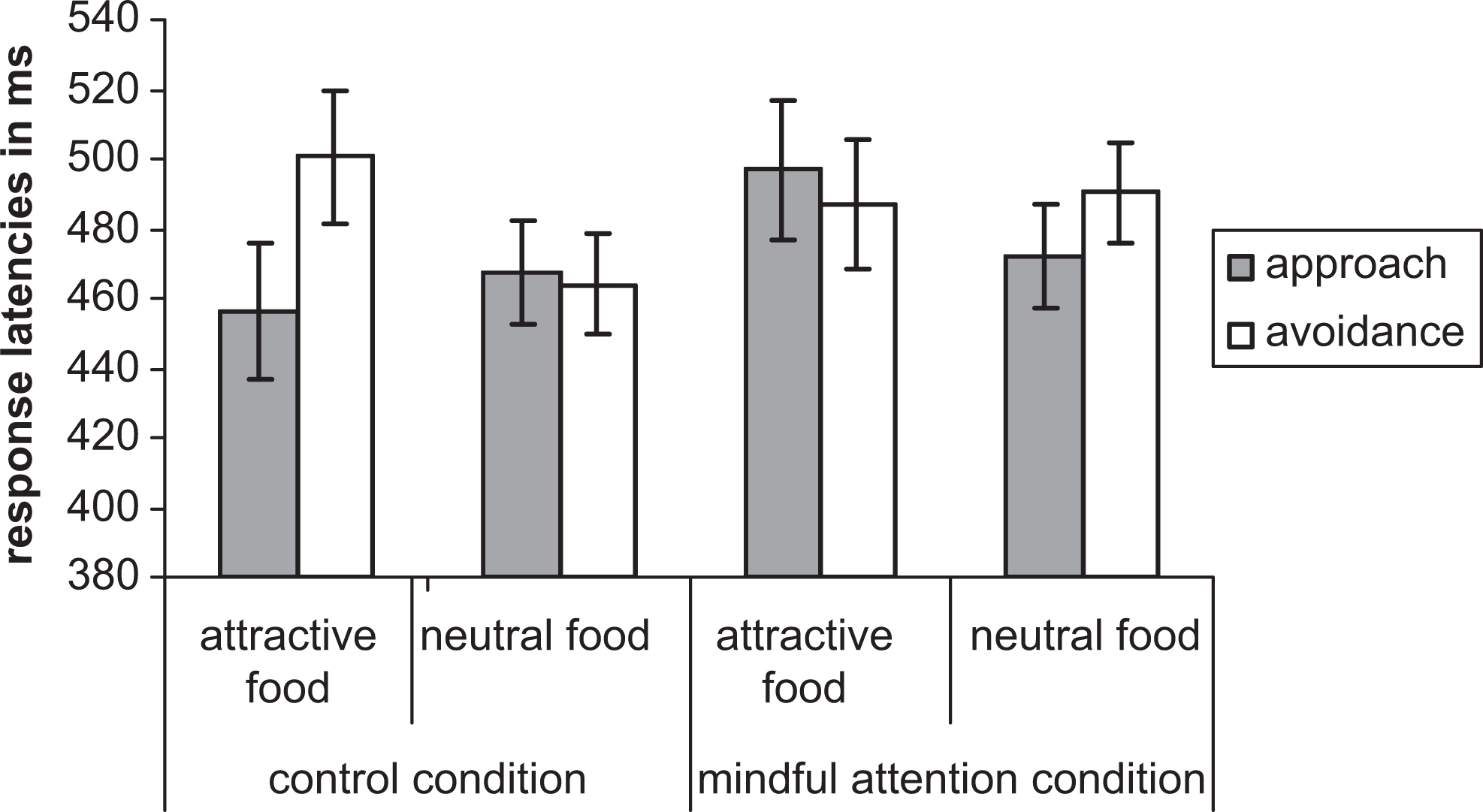
Response latencies for approach and avoidance reactions toward food pictures (Study 1; in all figures, error bars represent standard errors of the mean.).
We then examined the effects of food type and response in the control condition and the mindful attention condition separately. In the control condition, there was a main effect of response, F(1, 19) = 6.30, p = .02, η2 p = .25, qualified by a 2-way interaction with Food Type, F(1, 19) = 8.61, p = .009, η2 p = .31. Approach responses were faster than avoidance responses with regard to attractive food, F(1, 19) = 14.99, p = .001, η2 p = .44, but not with regard to neutral food, F(1, 19) = .11, p = .75, η2 p = .006. Thus, as expected, control participants had an approach bias toward attractive but not toward neutral food.
In the mindful attention condition, there was also a 2-way interaction of Food Type and Response, F(1, 19) = 4.55, p = .046, η2 p = .19. In contrast to the control condition, participants were somewhat faster to approach than to avoid neutral food, F(1, 19) = 2.86, p = .11, η2 p = .13, although this simple main effect did not reach significance. As predicted, participants were not faster to approach than to avoid attractive food, F(1, 19) = .39, p = .54, η2 p = .02. Thus, mindful attention participants did not have an approach bias toward attractive food and even had a slight approach bias toward neutral food.
Additional analyses of response latencies on filler trials with IAPS pictures and other food items revealed only a marginally significant effect of response on response latencies toward IAPS pictures, F(1, 38) = 4.09, p = .05, η2 p = .097, such that approach was faster than avoidance (all other ps > .15). Similarly, for filler food items, there was only the same main effect of response, F(1, 38) = 4.42, p = .04, η2 p = .10, and no other effects were significant, including the interaction of Response and Condition (all ps > .19).
These effects were not qualified by participants’ scores on the concern for dieting scale, all ps > .28, which suggest that the effects of mindful attention occur independent of participants’ dieting goals. There was no overall effect of mindful attention on reaction times (p > .64) or error rates (p > .25) relative to the control condition.
Study 2
Study 1 provided initial evidence that observing one’s reactions to food pictures with mindful attention can reduce—and indeed eliminate—impulsive reactions compared to a control condition: while control participants displayed an approach bias toward attractive food, this effect was absent for mindful attention participants. In Study 2, we aimed to corroborate and extend this evidence. Study 2a used a different control condition, which asked participants to simply look at the pictures, rather than to “completely experience” them. We reasoned that this should be sufficient to trigger spontaneous mental simulations of actually consuming the food in control participants, which should result in an approach bias to attractive, compared to neutral food. Moreover, we investigated whether the mindful attention effect is short-lived, only carrying over immediately from the training to the approach-avoidance task, or whether it persists over a distraction period. Thus, we included a demanding filler task before assessing approach-avoidance responses.
Study 2b used a different control condition, in which participants merely completed the approach-avoidance task, without having been exposed to the food pictures. This allows us to test whether the approach bias to attractive food is preexisting or develops during the exposure to the pictures, and thus, whether mindful attention reduces existing impulses or prevents their development.
Method
Fifty-five students participated in each study. The mindful attention condition was the same as in Study 1.
Study 2a
Control participants first performed a visual filler task and were then asked to simply look at the same critical and filler pictures as in the mindful attention condition, with each picture on screen for at least 5 seconds. Together, this procedure took as long as the mindful attention procedure. All participants then completed demanding, unrelated filler tasks 3 for about 5 min followed by the approach-avoidance task, which contained the 10 critical food pictures and the 10 IAPS filler pictures.
Results
Analyses revealed a marginally significant effect of response, F (1, 53) = 3.68, p = .06, η2 p = .07, qualified by the predicted interaction of Food Type, Response, and Condition, F(1, 53) = 3.91, p = .05, η2 p = .07.
To test our specific hypotheses, we examined the effects of food type and response in both conditions separately. As Figure 2 (top panel) illustrates, in the exposure control condition, there was a 2-way interaction of Response with Food Type, F(1, 24) = 5.97, p = .022, η2 p = .199, such that approach responses were faster than avoidance responses with regard to attractive food, F(1, 24) = 7.05, p = .01, η2 p = .23, but not with regard to neutral food, F(1, 24) = .002, p = .97, η2 p = .00. Thus, as in Study 1, participants in the exposure control condition had an approach bias toward attractive food.
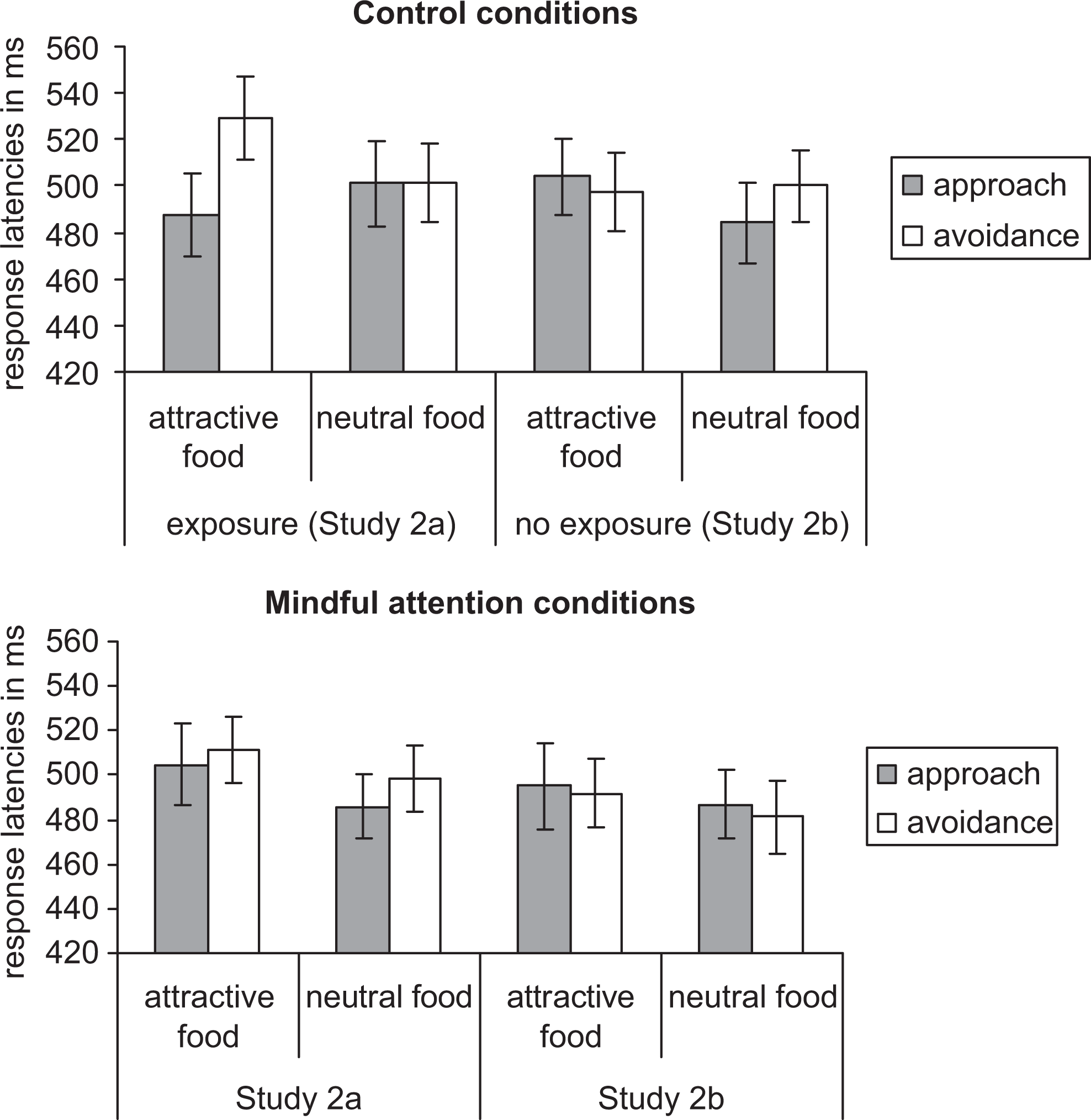
Response latencies on approach and avoidance trials to attractive and neutral food in two different control conditions (top panel) and after practicing mindful attention (bottom panel).
In the mindful attention condition, there was only a marginal main effect of food type, F(1, 29) = 3.66, p = .07, η2 p = .11, such that responses were somewhat slower to attractive than to neutral food. The 2-way interaction of Food Type and Response, however, was not significant, F(1, 29) = .12, p =.73, η2 p = .004 (Figure 2, bottom panel). Thus, as in Study 1, mindful attention participants did not have an approach bias toward attractive food, in contrast to control participants.
Method Study 2b
Control participants completed only the approach-avoidance task, while mindfulness participants completed the mindful attention procedure followed by the approach-avoidance task.
Results
Analyses of response latencies in the approach-avoidance task of Study 2b revealed no significant effects, all ps > .15, and in particular, no 3-way interaction of Food Type, Response, and Condition, F(1, 53) = 1.19, p = .28, η2 p = .02, suggesting that approach and avoidance reactions to attractive and neutral food were equally fast in both conditions.
We then proceeded to analyze response latencies in Studies 2a and 2b jointly within one design, including Study (2a vs. 2b) as an additional factor. This revealed a 4-way interaction of Study, Food Type, Response, and Condition, F(1, 106) = 4.79, p = .031, η2 p = .043. In order to further examine this interaction, we analyzed the effect of Study, Food Type, and Response in both types of conditions separately.
When analyzing response latencies in the two control conditions, there was a significant a 3-way interaction of Food Type, Response, and Study, F(1, 51) = 7.00, p = .001, η2 p = .121, which is displayed in Figure 2 (top panel). Further analyses revealed that only in the exposure-control condition of Study 2a, the interaction of Food Type and Response was significant, F(1, 24) = 5.97, p = .022, η2 p = .199, reflecting an approach bias to attractive food. This interaction was absent in the no-exposure control condition of Study 2b, F(1, 24) = 1.73, p = .20, η2 p = .06. This clearly indicates that the approach bias to attractive food is not preexisting but builds up during the exposure to the food items.
In the mindfulness conditions, there was only an effect of food type, F(1, 55) = 4.48, p = .039, η2 p = .075, such that responses to neutral food were somewhat faster than to attractive food. As expected, no other effects were significant, and most importantly, there was no interaction with Study, F(1, 55) = .13, p =.72, η2 p = .002 (Figure 1, bottom panel). This indicates the two mindful attention conditions did not differ from each other.
In summary, Study 2 shows that participants develop an approach bias toward attractive food during exposure to the food items, consistent with research on how motivation for food develops (e.g., Berridge, 2001; Cornell, Rodin, & Weingarten, 1989; Fedoroff, Polivy, & Herman, 1997; Papies, Stroebe, & Aarts, 2008). Mindfully observing one’s reactions during this exposure, however, prevents the creation of food impulses.
Study 3
Study 3 examined whether mindful attention also reduces reactions to novel food stimuli, on which participants had not directly applied mindful attention during the training phase. This may help to distinguish whether mindful attention works as a memory-based effect for specific stimuli, or rather by affecting participants’ mind-set. We included two sets of equally highly palatable and clearly neutral food pictures to test our hypothesis that the effect of mindful attention generalizes to novel, equally attractive food stimuli. As described below, one set, studied during training, served as the “old” items on the critical test, whereas the other set served as the “novel” items.
Method
Fifty students participated. We again used the “completely experience” control condition, as in Study 1. The approach-avoidance task now included 10 novel attractive and neutral food pictures in addition to the initial food pictures. A pilot study (N = 56) revealed no differences in attractiveness between the two sets of attractive items or the two sets of neutral items, both F < .21. Attractive and neutral items differed significantly, F (1, 55) = 180.88, p < .001, η2 p = .76 (initial set), and F (1, 55) = 236.22, p < .001, η2 p = .81 (novel set), and the interaction between Food Type and Set was not significant, p > .58.
Results
Response latencies were analyzed in a 2 (Food Type: Attractive vs. Neutral) × 2 (Condition: Mindful Attention vs. Control) × 2 (Set Of Pictures: Trained vs. Novel) × 2 (Response: Approach vs. Avoidance) ANOVA. This revealed only a 3-way interaction of Food Type, Response, and Training Condition, F(1, 48) = 6.22, p = .02, η2 p = .12, illustrated in Figure 3 . This three-way interaction was not qualified by a four-way interaction with picture set, F(1, 48) = .40, p = .53, η2 p = .0084, suggesting that the effect of mindful attention occurred for both practiced pictures and novel pictures.
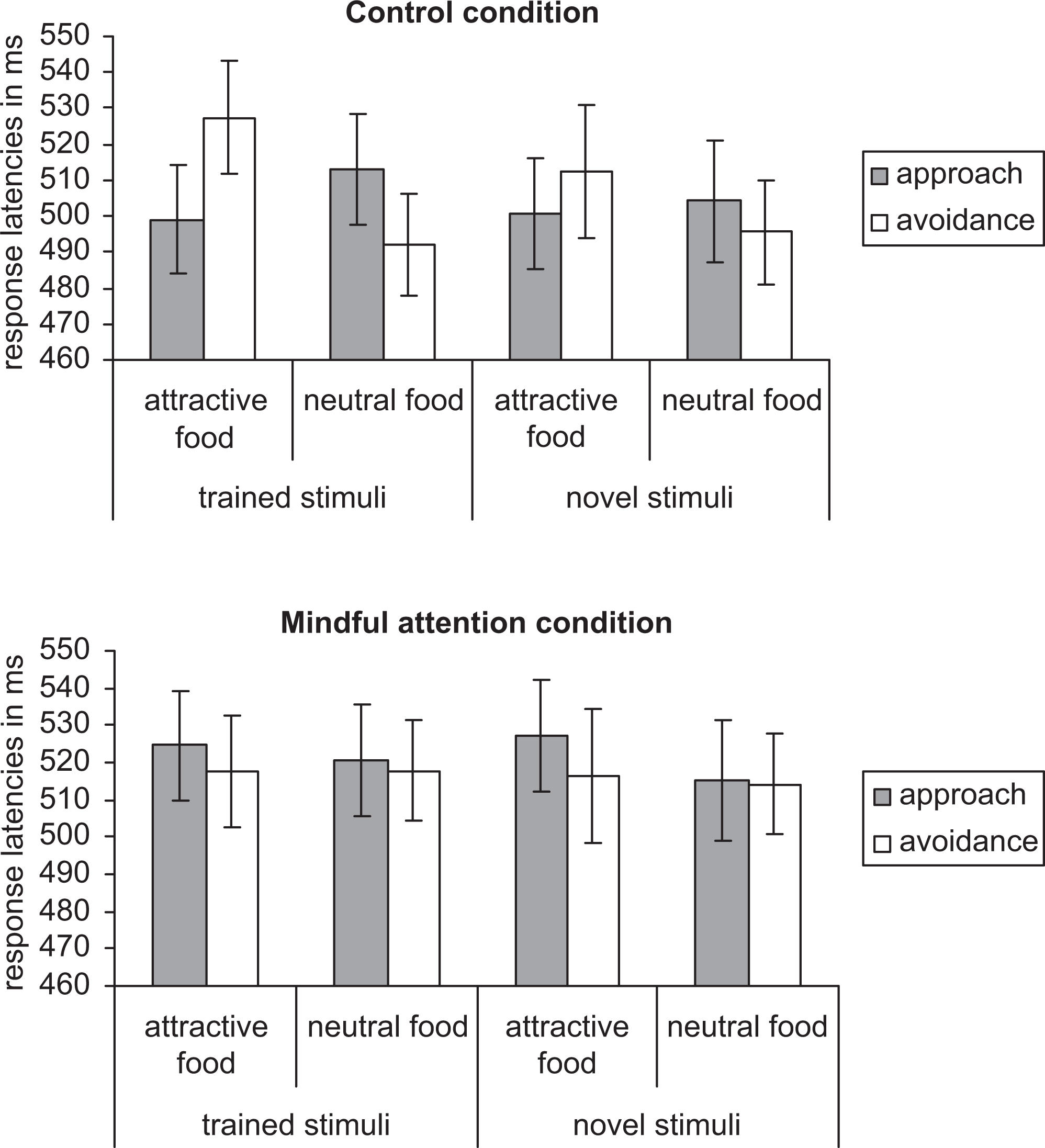
Response latencies for approach and avoidance reactions toward trained and novel food pictures in the control condition (top panel) and mindful attention condition (bottom panel).
To further examine this 3-way interaction, we examined the effects of food type, response, and picture set in both conditions separately. In the control condition, this revealed the predicted interaction of Food Type and Response, F(1, 23) = 9.46, p = .005, η2 p = .29, which was not qualified by picture set, F(1, 23) = 2.01, p = .17, η2 p = .08 (see Figure 3, top panel). Even though this indicates that the approach bias to attractive food is similar for trained and novel pictures, we tested the interaction of Food Type and Response for both sets separately. This interaction was highly significant for trained pictures, F(1, 23) = 7.41, p = .012, η2 p = .24, with approach reactions faster than avoidance reactions only with regard to attractive food, F(1, 23) = 5.49, p = .03, η2 p = .19, rather than neutral food, p > .16. The interaction of Food Type and Response was marginally significant for novel pictures, F(1, 23) = 3.00, p = .097, η2 p = .12, with both simple main effects not significant, p > .4.
In the mindful attention condition, no effects were significant, all ps > .53 (Figure 3, bottom panel). Indeed, the pattern of means shows that there is no approach bias to attractive food and that responses to trained and novel stimuli in this condition are virtually identical.
Thus, control participants again had an approach bias toward pictures of attractive food, which seemed to be less pronounced for novel pictures. In line with Study 2, this suggests that viewing attractive food items enhances the approach bias toward them, possibly because participants mentally simulate actually eating them (Kavanagh et al., 2005; Simmons et al., 2005). Importantly, mindful attention participants did not show an approach bias for either trained or novel pictures of attractive food, suggesting that viewing attractive food with mindful attention changed automatic responses toward both sets of food items in a similar way.
Analyses of response latencies on filler trials with IAPS pictures revealed only an interaction of Picture Type and Response, F(1, 48) = 6.73, p = .01, η2 p = .12, such that participants were faster to approach than to avoid positive pictures, F(1, 48) = 6.76, p = .01, η2 p = .12, but not negative pictures, F(1, 48) = 1.95, p = .17, η2 p = .04.
General Discussion
Three studies applied the principles of mindfulness to show that mindful attention can prevent spontaneous approach reactions toward attractive food. After participants in the mindful attention condition observed their spontaneous reactions to food stimuli as transient mental events rather than as subjectively real experiences, they did not display impulsive reactions toward attractive food. This effect occurred systematically in three studies, in comparison with two different control conditions, persisted over a distraction period of 5 min, and was independent of participants’ goal of dieting. Applying the mindful attention strategy most strongly reduced impulses toward the specific stimuli studied, but participants also displayed no approach bias to novel attractive food. This may indicate that the effect of mindful attention spreads to similar stimuli, or alternatively, that mindful attention induces a mind-set which diminishes impulsive responses to food.
Our studies provide initial evidence that creating meta-cognitive insight into one’s impulsive responses as transient mental events may disrupt impulsive responses. These findings are in line with recent work showing that even brief mindfulness manipulations can reduce interference from negative emotional stimuli and facilitate emotion regulation (e.g., Erisman & Roemer, 2010). In contrast to earlier studies, however, our work did not assess the affect reported following emotional or distressing experiences. Rather, we focused on impulsive reactions to appetitive stimuli, reflected in an implicit measure of approach bias, which was based on reactions most likely too fast to be controlled consciously (de Houwer & Moors, 2007). In addition, to our knowledge, this is the first demonstration that a mindfulness manipulation can be used to change responses to attractive, impulse-eliciting stimuli. While our work suggests that a complete mindfulness training may not always be necessary to obtain powerful effects of mindfulness, more extensive attentional training may produce significant additional benefits, making it possible to automatize mindful attention as a mode of thought that can be triggered habitually in response to mental simulations of consuming attractive stimuli that seem subjectively real.
While we did not examine the effects of our brief training on actual eating behavior, earlier research has shown that approach biases toward attractive stimuli are related to self-regulatory failures in different domains (e.g., Fishbach & Shah, 2006; Hofmann, Friese, & Geschwendner, 2009), and that reducing approach biases facilitates self-regulation (e.g., Wiers et al., 2010). Therefore, we suggest that mindful attention may indeed enhance self-regulation in environments where one is regularly exposed to attractive stimuli that may otherwise trigger spontaneous consummatory impulses, an important topic for future studies.
Our studies revealed no systematic approach-avoidance effects with regard to positive and negative nonfood pictures, which may be related to the fact that they mostly displayed scenes which do not directly trigger approach impulses (e.g., smokestacks, sunset; cf. Wentura, Rothermund, & Bak, 2000), and also that we did not draw attention to evaluating the stimuli, which has been shown to facilitate congruence effects in approach-avoidance tasks (Rotteveel and Phaf, 2004). Another important goal for future studies is to assess the effects of mindful attention with different dependent variables and with nonfood stimuli, examining its breadth and boundary conditions.
In contrast with earlier work on the limitations of conscious reflection, our studies speak to the benefits of conscious thought and introspection for regulating behavior (e.g., Wilson et al., 1993; Dijksterhuis & Nordgren, 2006). Crucially, however, mindfulness addresses the nature of one’s thoughts, rather than their conceptual content (Brown, Ryan, & Creswell, 2007). In this way, mindful attention also differs from other approaches that attenuate impulsive reactions. Earlier work, for example, has demonstrated that considering temptations and emotional experiences in an abstract or distanced manner (as opposed to an immersed one) has adaptive benefits (e.g., Fujita & Han, 2009; Gross, 1998; Kober et al., 2010; Kross & Ayduk, 2008), and that consciously simulating consummatory experiences repeatedly can simulate the experience of habituation and thus reduce eating behavior (Morewedge et al., 2010). Similarly, focusing on nonconsummatory features of tempting stimuli has been shown to facilitate self-regulation (e.g., Hofmann, Deutsch, Lancaster, & Banaji, 2010; Mischel & Baker, 1975). Crucially, however, mindful attention is different from these approaches as it does not require participants to focus on the conceptual content of their thoughts in response to impulse-eliciting stimuli or to change this content but rather to focus on their more general representational status.
Specifically, mindfulness trains perceivers to observe their reactions to external stimuli and acknowledge them as passing mental states, thereby allowing one to separate the processing of a stimulus from one’s reaction to it. With regard to attractive food, one may thus recognize that the desire one has for a certain food can be attributed to one’s transient, incidental thoughts, rather than to the stimulus itself. Possibly, this change in attribution dissipates food impulses, as our results indicate. Future studies are needed to further examine the precise mechanisms underlying these effects. Our work suggests that mindful attention may constitute the rediscovery of an ancient, powerful tool for attenuating the impulses that lie at the roots of many of our self-control problems.
Footnotes
Notes
Acknowledgment
We would like to thank Esther Kleynen for useful comments on the mindful attention instructions.
The author(s) declared no potential conflicts of interest with respect to the research, authorship, and/or publication of this article.
The author(s) disclosed receipt of the following financial support for the research, authorship, and/or publication of this article: The research in this paper was supported by a grant (VENI-451-10-027) from the Netherlands Organization for Scientific Research, awarded to the first author.
References
Supplementary Material
Please find the following supplemental material available below.
For Open Access articles published under a Creative Commons License, all supplemental material carries the same license as the article it is associated with.
For non-Open Access articles published, all supplemental material carries a non-exclusive license, and permission requests for re-use of supplemental material or any part of supplemental material shall be sent directly to the copyright owner as specified in the copyright notice associated with the article.
