







Abstract
The experience of physical stimuli would seem to depend primarily on their physical characteristics—chocolate tastes good, getting slapped hurts, and snuggling is pleasurable. This research examined, however, whether physical experience is influenced by the interpersonal context in which stimuli occur. Specifically, three studies examined whether perceiving benevolent intentions behind stimuli can improve their experience. Experiment 1 tested whether benevolently intended shocks hurt less, Experiment 2 tested whether benevolently intended massages were more pleasurable, and Experiment 3 tested whether benevolently intended candy tastes sweeter. The results confirm that good intentions—even misguided ones—can sooth pain, increase pleasure, and make things taste better. More broadly, these studies suggest that basic physical experience depends upon how we perceive the minds of others.
Why do grandma-baked cookies taste so much better than store-bought cookies? The obvious explanation for this effect is just memory—the warm glow that suffuses recollections of childhood makes everything back then seem better. Another possibility is that grandma’s kindness actually affected the taste of the cookies; perhaps knowing that something was benevolently intended changes how it is physically experienced. This article explores whether benevolent intentions can influence—and improve—the experience of physical stimuli in general, including electric shock, electric massages, and the taste of treats.
Social Context and Experience
The intentions of others can clearly influence the experience of complex social stimuli. In modern art, for instance, the intentions of an artist can turn a urinal into a million-dollar collectable (Goodman, 1968; Preissler & Bloom, 2008). In conversation, the intentions of the speaker can turn an apparently cruel remark into a harmless inside joke (Clark, 1996). Indeed, the meaning of social acts in general seems to hinge on the intentions of others (Searle, 1995). Is someone smiling at us in the spirit of friendship, or in the spirit of stealing our spouse? Yet, as we move from complex social stimuli to basic physical stimuli, others’ intention would seem to matter less; social acts might be harmful or beneficial depending on context, but the meaning of physical stimuli are less ambiguous. A smile may be good or bad, but a tasty sweet is good, and a slap in the face is bad.
Despite the unambiguous meaning of physical events, psychological research has revealed that negative intentions can increase the experience of pain; malicious electric shocks hurt more than accidental shocks (Gray & Wegner, 2008). This finding raises many questions, however, namely whether intentions impact experiences beyond pain (generalizability), and whether physical experience is also sensitive to positive intentions (flexibility).
Pleasure, Taste, and Generalizability
Psychology has long focused on the negative aspects of life, on pain and cruelty, but everyday life is also filled with good things, with pleasure and benevolence. Despite the rise of positive psychology (Seligman & Csikszentmihalyi, 2000), and recent interest in how pleasure works (Bloom, 2010) the factors underlying pleasure are still poorly understood. Could the interpersonal context (i.e., perceived intention) influence the experience of pleasurable stimuli? One study suggests that the contents of the experiencer’s mind can influence pleasure—people enjoy wine more when they think it is expensive (Plassmann, O’Doherty, Shiv, & Rangel, 2008)—but the question is whether the supposed contents of another person’s mind changes experience. It is similarly unknown whether perceived intention can influence taste. Past research finds that taste is affected by a variety physical factors ranging from hunger to morphine (Drewnowski, 1997), and that the acquisition of new tastes are sensitive to cultural learning (Harris, 2008), but could perceived intention affect our experience of something we already know to be tasty?
Benevolence and Flexibility
It is undeniable that cruelty has power: malicious social exclusion (Chen, Williams, Fitness, & Newton, 2008; Eisenberger, Lieberman, & Williams, 2003), sexism (Swim & Cohen, 1997), and racism (Swim, Hyers, Cohen, Fitzgerald, & Bylsma, 2003) are all more emotionally injurious than their unintentional counterparts. There is little evidence, however, that benevolence matters in the same way as cruelty to social events, let alone to physical events. Volumes of studies document the relative psychological power of bad over good (Baumeister, Bratslavsky, Finkenauer, & Vohs, 2001; Taylor, 1991), suggesting that just because malice increases pain, benevolence need not necessarily decrease it. People are also typically seen to be kind by default so benevolence is less salient than malice, likely further undermining its power to influence experience (Phillips & Knobe, 2009; Pizarro, Uhlmann, & Salovey, 2003; Ybarra, 2002).
In the case of harms, benevolently intended harms are more likely to be repeated—“I thought you liked it when I slapped your back, that’s why I always did it”—and the potential for repetition increases the painfulness of stimuli (Arntz & Claassens, 2004; Beecher, 1956). In the case of pleasurable stimuli, research finds that the thought behind social stimuli (e.g., gifts) matters only when it is initially disliked (Zhang & Epley, 2010), suggesting that intrinsically enjoyable stimuli should not be affected by benevolence. In the case of taste, if people are at all sensitive to interpersonal context, it would seem to make evolutionary sense to be sensitive to bad (i.e., being poisoned) but not good (Rozin & Royzman, 2001).
The Present Research
Despite the apparent weight of evidence suggesting the weakness of benevolence, three experiments examined whether good intentions could influence—and improve—the experience of physical stimuli, including electric shocks (Experiment 1), massages (Experiment 2), and candy (Experiment 3). If benevolence does improve physical experience, it would not only demonstrate the exceptional power of interpersonal context to influence subjective experience, but would also be a vindication for the power of good.
Experiment 1: Benevolent Electric Shocks
In this experiment, participants received a number of electric shocks perceived to be administered maliciously, unintentionally or benevolently. It was predicted that, relative to unintentional shocks, maliciously intended shocks would hurt more, but benevolently intended shocks would hurt less.
Method
Eighty-four participants (59% female) participated in a lab study of “psychophysical perception in pairs.” Twelve were excluded for suspicion/disbelief, which was assessed with a funneled debrief as outlined in Chartrand and Bargh (2000). This number is somewhat high, but can be understood given the complex nature of the study and its similarity to the Milgram paradigm.
On arrival, participants were paired with a confederate, who (they believed) would be administering to them a variety of psychophysical stimuli (e.g., dot counting, length assessment, color judgment, pitch judgment). One of these stimuli were 1-ms duration electric shocks, delivered to the wrist of the dominant hand. The shocks were precalibrated for each participant to be “very uncomfortable.” Voltages ranged from 40 to 75 V between subjects. After being shocked, participants rated its painfulness on a 7-point scale from “Not at All Uncomfortable” to “Extremely Uncomfortable.” In order to allow participants to practice the variety of psychophysical tasks, and to obtain a baseline rating of pain, participants received a block of practice trials. In these trials, all shocks were computer administered.
On each experimental trial, the participant's partner was ostensibly presented with two different tasks (e.g., dot counting vs. electric shock), and chose one to administer to the participant. In the malicious and benevolent conditions (the intentional conditions), participants always completed the task chosen by their partner. In the unintentional condition, the computer administered the opposite task to the one chosen by their partner (i.e., the computer switched the task). In the malicious and benevolent conditions, the partner selected the shock on two thirds of trials when it was available; in the unintentional condition, the partner selected the nonshock task on two thirds of trials when it was available (with the computer then switched it to shock). Thus, participants in all conditions thus got a shock on two thirds of trials when it was an option, but it was only perceived as intentional in the malicious and benevolent conditions. Importantly, on each trial, participants saw what stimulus they were to receive in advance to eliminate the possibility of surprise.
In the malicious condition, there was no clear reason why their partner was choosing to shock participants, other than they wanted them to feel pain. In the benevolent condition, participants were told that since many people were hesitant to administer shocks, their partner was led to believe that every time a shock was chosen, the participant would receive a ticket for a $50 lottery. Thus, from the viewpoint of participants, the partner had their best intentions in mind when shocking them. Of course, the very presence of such a draw could influence pain (Pavlov, 1927), so there was no draw. Instead, participants in all conditions were told—right before the beginning of the experimental trials—that they would receive an additional $5 due to the “nature of the study.”
Participants in all conditions received six experimental shocks. At the end of the study, they completed two manipulation-check questions, assessing both the intentionality of shocks and the valence of that intention. The intentionality question asked, on the trials in which they received a shock, if the other person intended that outcome. Participants responded on a 7-point scale from Definitely No (−3) to Definitely Yes (3), with Not sure (0) as the midpoint. The valence question asked the extent to which, on such trials, “your partner had your best interests at heart,” and was answered on a 5-point scale from Not at All (1) to Completely (5).
Results and Discussion
As a manipulation check, ratings of intention in each condition were submitted to one-sample t tests, with the midpoint of the scale (0) as the comparison value. Values below this midpoint demonstrate that the shocks in a given condition were perceived to be unintentional, while values above demonstrate that the shocks were perceived to be intentional. As expected, shocks in the malicious condition were seen to be intentional (M = 1.8, SD = 1.88), t(23) = 2.17, p < .05, as were those in the benevolent condition (M = 2.39, SD = .92), t(17) = 11.06, p < .01. Shocks in the unintentional condition were seen to be unintentional (M = −2.40, SD = .85), t(29) = 15.38, p < .01.
As predicted, an independent-samples t test found that the partner in the benevolent (M = 3.68, SD = .89) and unintentional (M = 4.17, SD = .95) conditions was seen to have participants’ best intentions at heart more so than the partner in the malicious condition (M = 2.63, SD = .88), ts > 3.92, ps < .01. There was no significant difference between ratings of the benevolent and unintentional condition, p > .15.
To investigate differences in experienced pain, the average pain ratings of each participant were submitted to a one-way analysis of covariance (ANCOVA) with condition (malicious/unintentional/benevolent) as the independent variable and pretest discomfort ratings as the covariate. This ANCOVA revealed a significant effect of condition, F(2,69) = 3.57, p < .05, η2 = .10. Comparing confidence intervals of the adjusted marginal means (adjusted pretest discomfort ratings = 4.29) revealed that shocks in the malicious condition (M = 4.48, SE = .13) were experienced as significantly more painful than those in both the unintentional (M = 4.23, SE = .11) and benevolent conditions (M = 3.95, SE = .14), ps < .05. Importantly, the benevolent condition was experienced as significantly less painful than the unintentional condition, p < .05 (Figure 1).
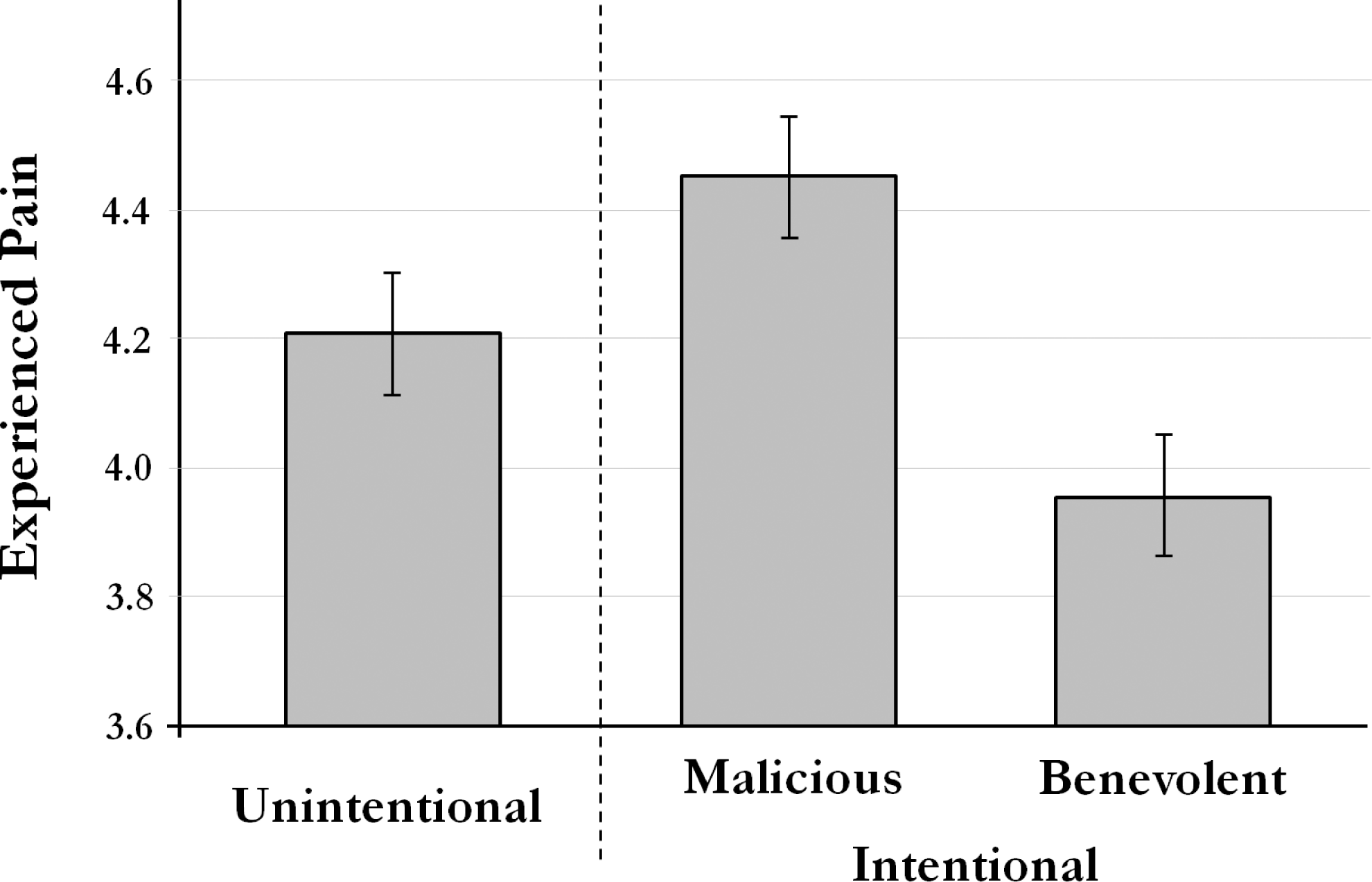
Ratings of pain from malicious, unintentional and benevolently intended shocks in Experiment 1. Error bars 1 SE.
These results replicate previous findings that malice can increase pain (Gray & Wegner, 2008), but importantly also show that benevolence can decrease pain, suggesting that the mind encodes not only the presence of intention behind stimuli but also its valence (cruel vs. kind). This conclusion is further supported by a regression analysis in which ratings of both the presence of intention (the intention question) and its perceived valence (the best interest question) were entered as simultaneous predictors of pain, after controlling for pretest ratings. Although raw intention did not predict pain, β = −.04, t(70) = .52, p > .61, the valence of this intention did, β = −.16, t(70) = 2.30, p < .05. It appears, then, that benevolence can decrease pain, demonstrating the flexibility of intentions to influence physical experience. This finding should also provide relief to doctors and even those caring parents who are sometimes compelled to inflict pain on their charges for their own good.
Experiment 2: Person versus Computer Pleasuring
Experiment 1 found that pain is soothed by perceived benevolence, suggesting that intentions can flexibly impact experience. This tested whether the power of intention generalizes beyond pain, and examined whether perceived benevolence increased the experience of pleasure. This experiment used a paradigm inspired by Davis and colleagues (e.g., Davis & Martin, 1978; Davis, Rainey, & Brock, 1976), who used a vibrating massage pad to examine “interpersonal pleasuring.” It was predicted that an intentional massage would evoke more pleasure than an unintentional computer administered massage.
Method
Twenty participants (55% female) were recruited as in Experiment 1. Two participants were excluded for suspicion after a funnel debrief, leaving a total of 18.
The procedure was similar to malicious condition from Experiment 1, save two exceptions. The first was that electric shocks were replaced with electric massages: participants received a number of different three second massages from an electric chair massage pad placed behind them (Figure 2). After each massage, participants rated how pleasurable the massage was on a 7-point scale ranging from Not at All Pleasurable (1) to Extremely Pleasurable (7).

Massage pad used in Experiment 2. Massages were ostensibly administered by either another person or a computer.
The second change in procedure was that the partner (confederate) selected the psychophysical task on only half of trials. On the other half of trials, a computer randomly selected the stimulus, and because only their partner was capable of human intention, it was expected the partner condition to be seen as more intentional than the computer condition. In both types of trials, the probability of receiving a massage when available was .5. This within subjects experiment allows us to compare the pleasure elicited by either an intentional, partner administered massage, or an unintentional computer administered massage. During the course of the study, participants received nine massages ostensibly administered by their partner and nine identical massages administered by the computer.
Two questions served as manipulation checks. The first asked which of the partner and computer trials were more intentional: “Between the partner and computer trials, on which trial type was a massage more intentional?” Participants answered on a 7-point scale ranging from Definitely partner trials (−3) to Definitely computer trials (3). The second asked “How comfortable did you feel getting the massages from your partner?” and was answered on a 5-point scale from Not at all Comfortable (1) to Extremely Comfortable (5). This question is important because though pain might hurt no matter its source, pleasure may be more context dependent. It was expected that intentional massages should feel better only for those at least moderately comfortable with their partner. In order to develop this comfort, participants briefly met their partner before moving to separate rooms. This introduction proved successful, with 16 of 18 participants reporting a three (“Moderately comfortable”) out of five on the comfort scale. The remaining two uneasy participants were excluded from subsequent data analysis.
Results and Discussion
A one-sample t test of the manipulation check, using the midpoint of the scale (0) as the comparison value, confirmed that the massages in the partner condition were indeed seen to be more intentional than those of the computer condition (M = −1.42, SD = 1.43), t(15) = 5.16, p < .001. To check whether these intentions were indeed seen to be benevolent, a 1-item survey was given to a new sample of participants (N = 65). This survey explained the experimental setup and asked them to rate the intentions of the partner administering the massages from Extremely Cruel (1) to Extremely Kind (7), with Indifferent (4) as the midpoint. As expected, a one-sample t test with four as the test value revealed that these new participants saw the person administering the massages to have benevolent intentions (M = 5.00, SD = 1.25), t(64) = 32.25, p < .001.
The pleasure ratings of participants were averaged within each condition to obtain a partner pleasure rating and a computer pleasure rating for each participant. These values were compared with a paired-samples t test, which revealed that partner massages caused significantly more pleasure (M = 4.72, SD = 1.27) than the computer massages (M = 4.44, SD = 1.54), t(15) = 2.60, p < .05. These results suggest that for those who are comfortable with their partners, receiving the identical massage is more pleasurable when it appears to come intentionally from a human being, rather than from a computer.
Although computers may be more efficient than humans at many things, pleasure is still better coming from another person. More broadly, it appears that benevolent intentions not only decrease the experience of pain, but also increase the experience of pleasure.
Experiment 3: The Taste of Kindness
The two previous experiments revealed that good intentions could decrease pain and increase pleasure. This experiment examined whether benevolence can make things taste better, perhaps explaining why food seems to taste better when lovingly prepared.
Method
Ninety-one participants (55% female) were recruited next to a busy path on campus and asked to participate in a study about snacks. Four participants were excluded for failing the instructions, leaving a total of 87.
Participants were told that, the day before, another person had picked out a snack for them to eat and placed it in an opaque tupperware box. The snack was ostensibly selected from a set of Snickers Mini, Skittles Mini, Tootsie Rolls, and Lollipops. Participants were told that the person selecting the snack was also instructed to write a brief note and place it in the box with the snack. All participants received a Tootsie Roll, but it was accompanied by one of two different notes. In the benevolent condition, it read, “I picked this just for you. Hope it makes you happy!” In the nonbenevolent condition, it read, “Whatever. I don’t care. I just picked randomly.”
In private, participants opened the box, read the note, ate the candy, and responded to four questions. Two questions focused on the taste of the candy, asking “How sweet did this snack taste?” and “How good did this snack taste?” One question focused on the perceived benevolence of the snack-chooser’s intentions and served as the manipulation check. It read, “Judging by the note, how nice are the other person’s intentions towards you?” Participants responded to these three questions on a 5-point scale from Not at All (1) to Extremely (5). The fourth question asked, “How big or small was the snack?” and was answered on a 7-point scale from Extremely Small (1) to Extremely Big (7). This was included as a control question. After filling out these questions, participants also complete a 10-item Positive and Negative Affect Schedule scale.
Results and Discussion
A between-subjects t test confirmed that the intentions of the snack-chooser were perceived to be more benevolent in the benevolent condition (M = 3.73, SD = .92) than in the nonbenevolent condition (M = 1.19, SD = .45), t(82) = 16.19, p < .001. As predicted, the snack tasted sweeter in the benevolent condition (M = 3.57, SD = .63) than in the nonbenevolent condition (M = 2.98, SD = .77), t(82) = 3.89, p < .001. It also tasted better in the benevolent condition (M = 3.33, SD = .82) than in the nonbenevolent condition (M = 2.58, SD = .91), t(82) = 4.02, p < .001 (Figure 3). Furthermore, there were significant correlations between perceived benevolence and sweetness, r(82) = .32, p < .005, and between perceived benevolence and goodness of taste, r(82) = .41, p < .001. The perceived size of the snack was not influenced by perceived benevolence, t = 1.05, p = .29, suggesting that intentions have some specificity in their ability to affect experience. Neither positive nor negative affect varied by condition, ts < 1.3, ps > .22, providing evidence that this effect could not be accounted for with the overt experience of affect. These results suggest that perceived benevolence not only improves the experience of pain and pleasure, but can also make things taste better.
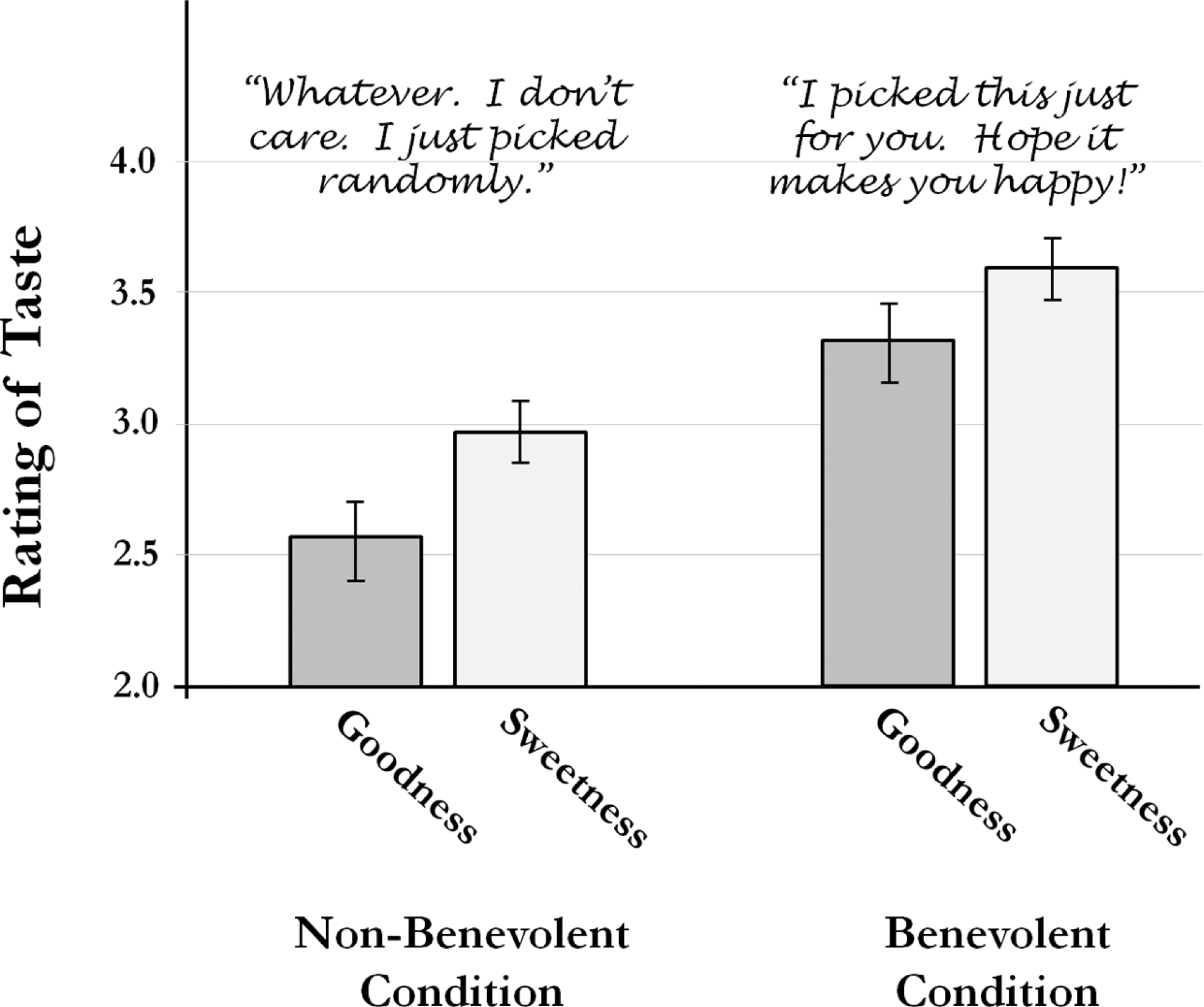
Ratings of taste in Experiment 3. Text of handwritten note included with snack is written above data. Error bars 1 SE.
General Discussion
Three experiments suggest that the basic physical experiences of pain, pleasure, and taste are influenced by the interpersonal context in which they are experienced. Specifically, perceiving benevolent intention behind physical stimuli improves their experience. In much the same way we take conversational cues from others (Clark, 1996), and use others’ evaluations of social stimuli to inform our own judgments (Zaki, Schirmer, & Mitchell, 2011), it seems we also use the intentions of others as a guide for basic physical experience.
Any set of studies suggests some potential alternative explanations, and three are reviewed here. First, it could be that participants used ratings not as indicators of experience but as a way of communicating with partners. In order to guard against this possibility, participants were explicitly told that their partner would not be privy to their responses. Second, it could be that the effects were driven by a bias in memory instead of experience. This was guarded against by having participants make their report immediately after encountering stimuli. Third, it could be that experimenter demand was influencing judgments. This was guarded against by providing no contact between experimenter and participant during experimental trials.
It could also be argued that the studies involved some kind of implicit demand characteristics, whereby people rated benevolently intended outcomes as better as a reflexive form of politeness. Future studies could rule out this concern by presenting information about intentions either before or after the experience (as was done in Lee, Frederick, & Ariely, 2006), because only intentions known in advance can influence the experience per se, rather than the simple reporting of that experience.
The Moral Dyad: An Explanatory Framework
One way to understand these results is through the lens of dyadic morality. Research suggests that people conceive of good and evil as essentially dyadic, pairing an intentional moral agent and an experiencing moral patient (Gray & Wegner, 2009, 2011). For example, assault links an intending perpetrator and a suffering victim, while rescue links an intending hero and a grateful beneficiary. This constant pairing of malice and pain (for evil) and kindness and pleasure (for good) leads people to “complete the dyad” and see pain in response to malice, and pleasure in response to kindness (Gray & Wegner, 2010). For instance, in flag burning, there is blameworthy intention without apparent suffering, but those who see it as immoral nonetheless see it as causing pain to others (DeScioli, 2008; Gray, Young & Waytz, in press). The present experiments demonstrate experiential dyadic completion: people actually feel increased pain from malice and increased pleasure from benevolence.
Implications and Extensions
These data suggest a number of future directions. For example, while perceived intention appears to influence experience independently of affect, it is clear that pain, pleasure, and taste are all affectively charged. Does the power of intention apply to nonaffective stimuli? For example, does a patch of blue seem bluer, or loud noise seem louder if someone intended it to be so?
There might also be individual differences in the extent to which intentions can impact physical experience. Perhaps those who have difficulty representing the intentions of others (e.g., autistics; Baron-Cohen, 1995; Gray, Jenkins, Heberlein, & Wegner, 2011; Happé, 1995) are unaffected by the interpersonal context of pain, pleasure, or taste. Another unique group to test would be masochists (Baumeister, 1988), who feel pleasure from pain—though typically in overall benevolent contexts.
The intentions of others are often ambiguous, and future research might undercover individual differences in baseline perceptions of benevolence—and their resulting impact on experience. Likewise, the intentions of supernatural agents are even harder to determine, and people’s views of God may determine how they react to life events. If you believe in a benevolent New-Testament God, then seeing God behind harms may lead to better coping (Pargament et al., 1990); if you believe in a malicious Old-Testament God, then perceiving God’s hand behind harms may lead to increased suffering (Gray & Wegner, 2010).
Finally, the link between perceived intention and physical experience suggests a way for people to decrease suffering and increase pleasure as they go about their days (Edmiston & Scheff, 2010). To the extent that we view others as benevolent instead of malicious, the harms they inflict upon us should hurt less, and the good things they do for us should cause more pleasure. Stolen parking spaces cut less deep and home-cooked meals taste better when we think well of others.
Conclusion
The thought behind deeds may often count for little, but physical experience appears to depend in part on the perceived intention of the person administering it. So, while subjective experience is clearly in our own mind, this research suggests it also depends on how we perceive the minds of others.
Footnotes
Acknowledgments
For help with data collection, the author thanks Lillian Asaph, Andrew Breese, David Caparrelli, Angela Chouinard, Katherine Flaschen, Alex Hacker, Brian Huh, Andrew Olsen, Tom Miller, Jason Popps, Katherine Rippe, Claire Sheldon, Dan Schreff, Carly Sheridan, Dorian Storbeck Chris Siuzdak, Abby Vigderman, and Stanley Zheng. For helpful comments, I thank Kristen Lindquist, Josh Greene, Wendy Mendes, Mike Norton, Adam Waytz, and Dan Wegner.
Declaration of Conflicting Interests
The author(s) declared no potential conflicts of interest with respect to the research, authorship, and/or publication of this article.
Funding
The author(s) received no financial support for the research, authorship, and/or publication of this article.