







Abstract
On the basis of construal level theory (Trope & Liberman, 2010), we hypothesized that political polarization on controversial issues may be reduced by increasing abstract mental construal. Using the issue of the “Ground Zero Mosque” and political polarization on it as an example, we first established that liberals and conservatives hold opposing attitudes toward building a mosque near Ground Zero (Study 1). Polarized attitudes were significantly reduced by increasing the abstract (vs. concrete) level of construal, by having participants answer a series of why (vs. how) questions before considering the issue (Study 2) or by having participants read an article about the Ground Zero Mosque in a disfluent (vs. fluent) format (Study 3). We conclude that abstract mental construal may potentially provide a means for dialogue and compromise on divisive political issues, and implications for political discourse are discussed.
The Ground Zero Mosque (a.k.a., Cordoba House or Park51) is a proposed project to build a Muslim community center and prayer space, near the site of the 9/11 terrorist attacks on the World Trade towers in New York City. This project has become a controversial political issue in the United States, evoking sharply different reactions between liberals and conservatives, as indicated by a New York State poll (Seiler, 2010) and by the analysis of the language used in conservative and liberal blog websites (Dehghani, Gratch, Sachdeva, & Sagae, 2011).
While many liberals argue that a mosque near Ground Zero is appropriate because it conveys to the world the high value of religious freedom in America (Rabinowitz, 2010), many conservatives argue that it would intrude on the sacred space of Ground Zero (Millar, 2010) and is insensitive to the 9/11 families (Halper, 2010). Previous research suggests reasons why attitudes toward the Ground Zero Mosque are so divided. In general, liberals are more open to change and experience, whereas conservatives prefer greater order and conventionality (Carney, Jost, & Gosling, 2008). Compared to liberals, conservatives are more resistant to social change (Jost, Glaser, Kruglanski, & Sulloway, 2003), show more concern for protection of the in-group (Janoff-Bulman, 2009), and have more negative attitudes toward various kinds of social out-groups (Jost, Federico, & Napier, 2009). Further, liberals and conservatives may rely on different sets of moral foundations that shape their responses to the Ground Zero Mosque (Haidt & Graham, 2007). Whereas liberals may rely on fairness in moral judgments (Graham, Haidt, & Nosek, 2009), which promotes values of religious freedom and equality, conservatives may rely more on moral concerns for respect and purity (Inbar, Pizarro, & Bloom, 2009), which place greater value on sensitivity to the families and the protection of Ground Zero as sacred space.
While it may not be possible to change the preexisting ideologies of conservatives and liberals toward the Ground Zero Mosque, it may be possible to change how much people rely on these biases when actively thinking about the issue. Here, Construal Level Theory (CLT; Trope & Liberman, 2010) may provide a promising solution. Specifically, CLT argues that a person can think about other people, objects, or ideas, in a low-level (simple and concrete) or high-level (complex and abstract) way. A high level of mental construal may be induced by creating psychological distance between the self and a target or prompting abstract thinking (Wakslak & Trope, 2009). High-level construal is associated with greater consideration of “the big picture” (Vallacher & Wegner, 1987) and an analytical, critical-thinking mind-set (Torelli & Kaikati, 2009). For example, people at a high level of construal are more creative (Jia, Hirt, & Karpen, 2009) and more comfortable with messages that convey mixed emotions (Hong & Lee, 2010), suggesting greater cognitive flexibility. Indeed, previous literature showed that when an object is distanced from the self, individuals are less likely to be “trapped” in their own preconception or knee-jerk reactions (Kross & Grossmann, 2012). Moreover, high levels of construal may enhance perspective taking toward others whose interests conflict with one’s own. Negotiators achieve more integrative agreements when their partner is further away, creating greater psychological distance (Henderson, 2011). At high levels of construal, morality concerns are less self-centered and more concerned with others (Agerström & Björklund, 2009). Inducing high-level, abstract construal may therefore reduce reliance on preconceived ideas and increase consideration of other points of view.
The same qualities of abstract construal that prompt critical thinking and perspective taking may also reduce partisan biases. At a high level of construal, both conservatives and liberals should be more likely to critically evaluate controversial issues and be less influenced by their preexisting political opinions. The current research examined this hypothesis, using the issue of the Ground Zero Mosque. Study 1 sought to establish that liberals and conservatives hold opposing attitudes toward this issue, while Study 2 and Study 3 sought to test the hypothesis by using two different approaches to manipulate abstract level of mental construal.
Study 1
Many surveys show that liberals generally support the Ground Zero Mosque, but other evidence suggests that reminders of 9/11 causes a conservative shift among liberals (Bonanno & Jost, 2006; Nail & McGregor, 2009), which could diminish support for the project. Study 1 therefore sought to establish that liberals and conservatives have highly polarized attitudes toward the Ground Zero Mosque, with liberals in favor and conservatives against the project. Participants reported political ideology, read a brief description of the proposed mosque, and rated their responses to the project on several measures.
Method
Participants
Seventy-seven American undergraduate students from a Midwestern public university in the United States (41 women and 36 men, mean age = 19.42) participated in exchange for partial course credit.
Procedure and Materials
Participants were asked about their political orientation on an 11-point scale (−5 = extremely liberal, +5 = extremely conservative). Those with score >0 were classified as conservatives (n = 33) and those <0 were classified as liberals (n = 38), while those with score = 0 (n = 6) were discarded, 1 leaving 71 participants in the analysis (38 women and 33 men, mean age = 19.44).
Evaluations of the proposed Ground Zero Mosque were assessed with a method based on the stereotype content model (Fiske, Cuddy, Glick, & Xu, 2002), a model that provides a useful framework to assess the universal dimensions of group perception. Participants viewed three images of the September 11 attacks and asked to think about the event for about 30 seconds. Participants then rated their behavioral reactions to the proposed Ground Zero Mosque on a 4-item measure (I want to protect it from being attacked; I want to attack it; I want to be associated with it; I want to protest against it), each rated on a 5-point scale (1 = not at all, 5 = very much). Participants next indicated their cognitive appraisals of the mosque on three 7-point scales (bad–good, undesirable–desirable, and unfavorable–favorable; from −3 to 3). Finally, participants reported their affective responses toward the mosque on 5-point scales (1 = not at all, 5 = very much), on three positive emotions (liking, admiration, and happiness) and three negative emotions (hatred, anger, and disgust).
Results and Discussion
To create a composite measure of evaluation of the mosque, we computed the mean of (a) the behavioral responses, (b) the affective responses, and (c) the cognitive responses. These three means were standardized without altering the means, so that their standard deviations all equal 1.00 (and thus the unit is comparable across scales), while the meaning of the mean levels is preserved. Finally, the mean of the three standardized measures was computed to form an evaluation score (α = .91). A value of 0 on the evaluation score indicated neutral evaluation, whereas positive (negative) values indicated favorable (unfavorable) evaluation. A t test showed that conservatives and liberals’ evaluations of the mosque were significantly different, t(69) = −2.97, p < .01, Cohen’s d = .70, with more negative evaluations by conservatives (M = −0.51, SD = 0.94) compared to liberals (M = 0.10, SD = 0.80). These results are consistent with previous studies that show political ideology is associated with attitudes toward social change and out-groups (Jost et al., 2009) and specifically show that liberals and conservatives indeed hold remarkably different attitudes toward Ground Zero Mosque.
Study 2
Study 1 established that liberals and conservatives hold opposing attitudes toward the proposed Ground Zero Mosque. In Study 2, we predicted that inducing an abstract mental construal would reduce the polarized attitudes of both liberals and conservatives, eliminating the differences between ideological groups. Abstract/concrete construal was manipulated by a why/how priming paradigm.
Method
Participants
One hundred seventy-four American undergraduate students from a Midwestern public university in the United States (80 women and 94 men, mean age = 19.74) participated in exchange for course requirement credits.
Procedure and Materials
As in Study 1, participants reported their political ideology on an 11-point scale. Those with score >0 were classified as conservatives (n = 48) and those <0 as liberals (n = 89), while those with score = 0 (n = 37) were discarded, leaving one hundred thirty-seven participants in the study (69 women and 68 men, mean age = 19.64). Participants were randomly assigned to either an abstract or concrete construal condition, adapted from a well-established why/how priming paradigm (Freitas, Gollwitzer, & Trope, 2004). All participants worked on a task on “improving and maintaining good health.” Participants in the abstract condition were asked to answer “why would I improve and maintain health?” and then 3 consecutive “why?” questions on their prior answers, whereas those in the concrete condition were asked to answer “how can I improve and maintain health?” and then 3 consecutive “how?” questions on their prior answers. This procedure has been used in several previous studies and has shown to effectively activate abstract/concrete mind-sets (e.g., Freitas et al., 2004; Fujita, Trope, Liberman, & Levin-Sagi, 2006; Wakslak & Trope, 2009). After manipulation, the procedure followed that of Study 1, with participants being shown three pictures associated with the 9/11 attacks, reading about the plan to build a mosque near in New York City, and then asked to evaluate the mosque proposed to be built near Ground Zero.
Results and Discussion
A two-way general linear model (GLM) of Political Ideology (conservative/liberal) × Construal Level (abstract/concrete) was performed on the evaluations of the mosque. As expected, there was a significant main effect of political ideology, F(1, 133) = 17.25, p < .001, η2 = .11, reflecting that liberals evaluated the mosque more positively than conservatives, Mconservatives = −.40, SD = .82; Mliberals = .20, SD = .88, mirroring the pattern in Study 1. More important, we found the predicted interaction effect, F(1, 133) = 10.80, p = .001, η2 = .07 (see Figure 1). In the concrete construal condition, conservatives evaluated the mosque more negatively than liberals, Mconservatives = −.70, SD = .86; Mliberals = .40, SD = .69; t(64) = −5.65, p < .001, Cohen’s d = .89, a finding that is consistent with the pattern in Study 1. However, in the abstract construal condition, conservatives and liberals did not differ in their evaluation, Mconservatives = −.14, SD = .70; Mliberals = −.01, SD = .99; t(69) < 1, ns. Therefore, the interaction reflects that both liberals and conservatives showed more moderate attitudes toward the mosque, suggesting that abstract construal caused liberals and conservatives to hold back and reconsider their strongly polarized prior attitudes.
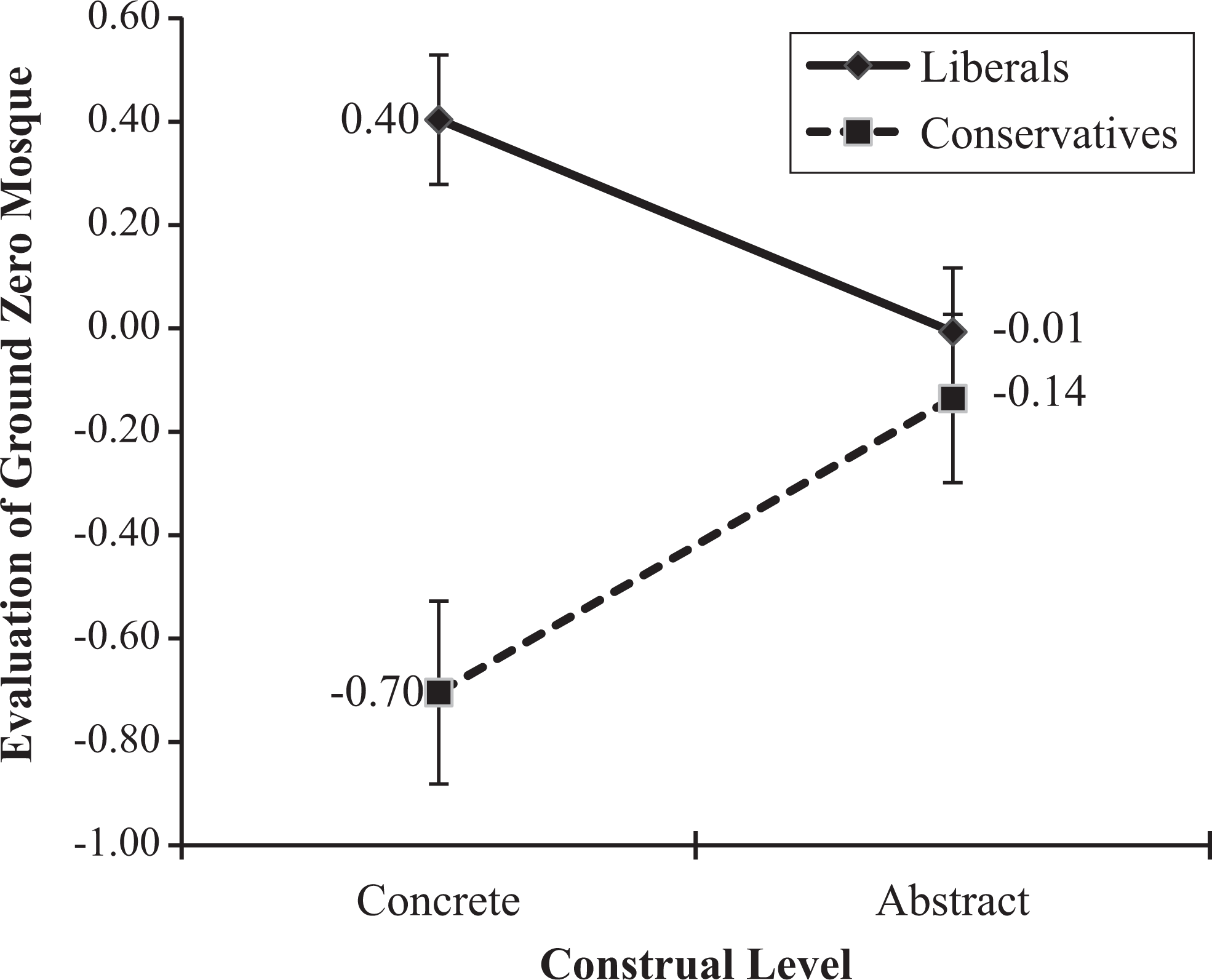
Evaluation for the mosque proposed to be built near Ground Zero, by Construal Level condition and Political Ideology. Error bars indicate standard errors of the mean.
Study 3
Study 2 demonstrated that opposing attitudes of liberals and conservatives toward the Ground Zero Mosque could be reduced by inducing an abstract mind-set. One limitation of Study 2 was that it used a sample of undergraduate participants who may be less interested in the mosque controversy than older individuals who may better recall the events of 9/11. Study 3 therefore sampled participants from a broader range of ages and regions in the United States, using an Internet survey. Furthermore, Study 3 aimed to conceptually replicate the findings of Study 2, using perceptual fluency as a manipulation of construal level. Previous research has demonstrated that texts that are disfluent (difficult to read) can increase abstract construal of the text itself (Alter & Oppenheimer, 2008) and a more critical, careful analysis of its content (Song & Schwarz, 2008). In Study 3, subjects read a description of the proposed mosque, presented in either a fluent (easy to read) or disfluent (hard to read) format. We expected to find that liberals and conservatives hold divergent attitudes toward Ground Zero Mosque when plans were presented in a fluent format, but that both liberals and conservatives would show less extreme attitudes when plans were presented in a disfluent format.
Method
Participants
One hundred and sixty-four participants sampled across the United States participated in the study through Mechanical Turk on amazon.com. Eight participants were removed from the study for double participation indicated by duplicate IP addresses. The remaining sample included 93 women and 63 men, mean age = 32.58.
Procedure and Materials
Participants were first asked to give their political orientation on a 7-point scale with end points: 1 = extremely liberal, 7 = extremely conservative. Participants who reported >4 were classified as conservative (n = 47) and participants who reported <4 were classified as liberal (n = 81). Participants at the midpoint (n = 28) were discarded, leaving 128 participants in the analysis (72 women and 56 men, mean age = 32.29).
Next, participants read an article describing the proposed mosque. The article was created by using descriptions and arguments selected from ProCon.org, a nonprofit organization dedicated to presenting controversial issues in a straightforward pro–con format. Six arguments were included in the article: three in favor and three against the Ground Zero Mosque, matched on dimension and strength. The article was formatted in the style of an Associated Press article from “Yahoo! News.”
Participants were randomly assigned to either a fluent or disfluent condition. In the fluent condition, participants read a visually easy-to-read version of the article, with a high-contrast typeface against the background. In the disfluent condition, the text font was adjusted to a lighter color so that the contrast was less defined (see also Alter & Oppenheimer, 2008; Diemand-Yauman, Oppenheimer, & Vaughn, 2011).
Following the article, participants answered some questions about their attitudes toward the proposed mosque and the most appropriate plans for how the project should proceed. Specifically, participants, were asked (a) whether they supported or opposed the project, as a dichotomous choice, (b) their overall impression of the plans (end points: 1 = very negative; 7 = very positive), and (c) if built, the closest acceptable distance of the mosque from Ground Zero (0 blocks; 1 block; 2 blocks; 3 blocks; 4 blocks; 5 blocks; 6 blocks; 7 or more blocks).
Next, participants completed several individual difference scales that measured personal values and different types of religiosity. Specifically, participants completed a revised version of the Schwartz Values scale (Stern, Dietz, & Guagnano, 1998), which measures values of traditionalism (e.g., obedience, loyalty) and openness to change (e.g., curiosity, varied life). Participants also completed measures of religious fundamentalism (McFarland, 1989) and extrinsic, intrinsic, and quest religious orientations (Allport & Ross, 1967; Batson & Scheonrade, 1991).
Results and Discussion
We sought to compute a composite attitude measure as in Studies 1 and 2. However, because the midpoint of the acceptable distance does not reflect neutral attitude, z scores for the three items on attitudes toward the Ground Zero Mosque were calculated, and a composite attitude measure was computed using the mean z scores (α = .91). Positive (negative) values indicated relatively favorable (unfavorable) evaluation. This composite measure was analyzed by a 2 (Ideology: liberal/conservative) × 2 (Fluency) GLM. There was no main effect of fluency, F < 1, ns; however, the main effect of ideology was significant, F(1, 124) = 48.84, p < .001, η2 = .28. On average, conservatives had more negative attitudes toward the Ground Zero Mosque (M = −0.62, SD = 0.69) than liberals (M = 0.36, SD = 0.85). Of greater importance, the expected interaction between Ideology and Fluency was significant, F(1, 124) = 4.79, p < .05, η2 = .03. As seen in Figure 2, in the Fluent condition, conservatives had more negative attitudes (M = −0.87, SD = 0.48) compared to liberals (M = 0.48, SD = 0.83), t(56)= −6.37, p < .001, η2 = .42. In contrast, in the disfluent condition, although conservatives still had more negative attitudes (M = −0.46, SD = 0.76) compared to liberals (M = 0.24, SD = 0.86), t(68)= −3.55, p < .001, η2 = .16, the difference between liberals and conservatives as indicated by the effect size was reduced by more than 60%. Again, polarized attitudes toward the mosque became more moderate in the disfluent condition than in the fluent condition. Along with the results of Study 2, these results provide further evidence that inducing an abstract mind-set can reduce the political ideological consequences in the evaluations of the Ground Zero Mosque.
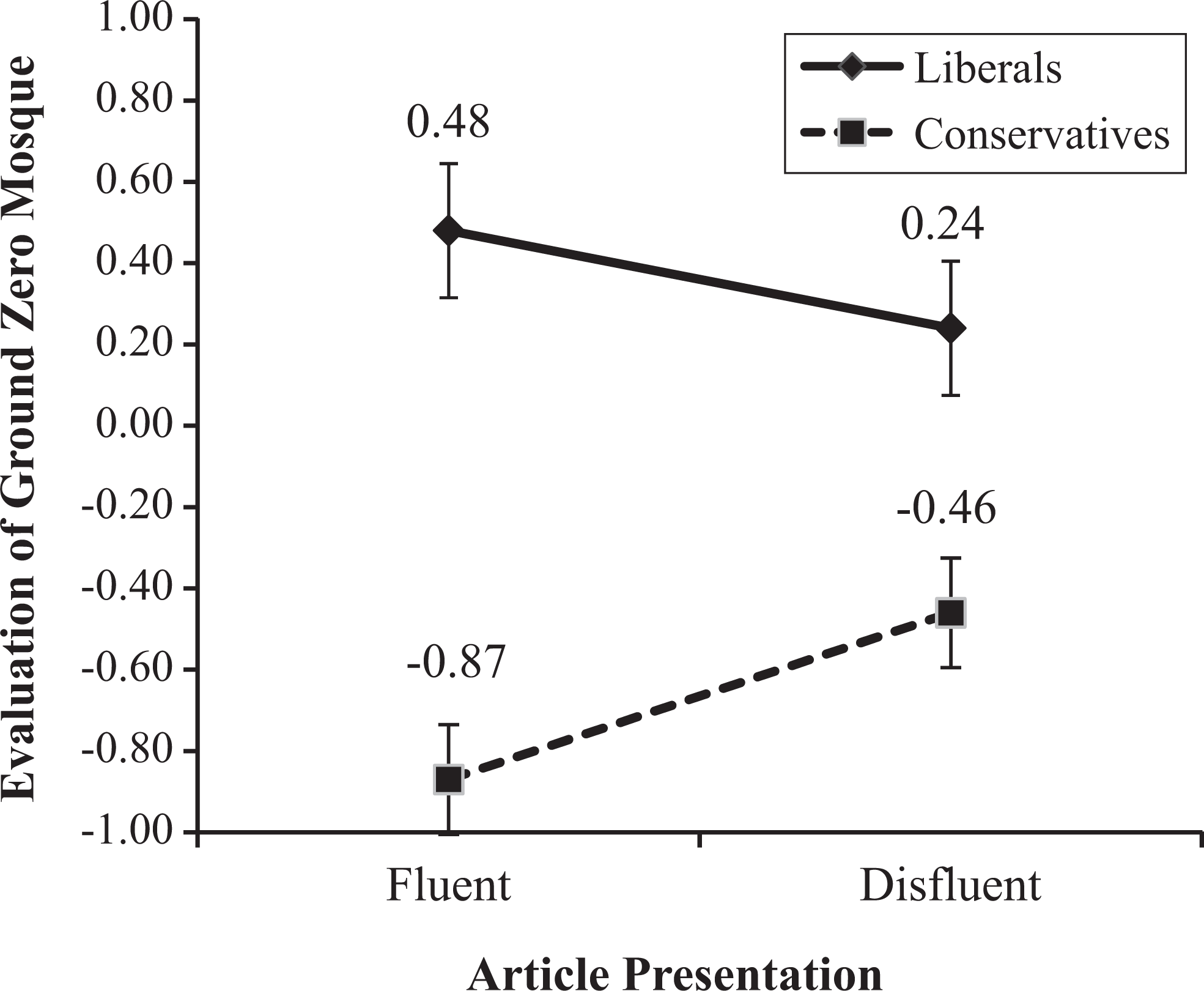
Evaluation for the mosque proposed to be built near Ground Zero, by Fluency condition and Political Ideology. Error bars indicate standard errors of the mean.
Individual Differences
Finally, we computed the correlations between composite attitude toward Ground Zero Mosque and individual differences measures. As expected, negative attitudes toward the Ground Zero Mosque were associated with greater values of traditionalism (r = .30, p < .001), religious fundamentalism (r = .47, p < .001), as well as extrinsic religiosity (r = .21, p < .01), and intrinsic religiosity (r = .36, p < .001). Openness to change was marginally associated with more positive attitudes toward the Ground Zero project (r = .16, p < .10). Important, however, there was no evidence that any of these measures mediated the interaction between fluency and ideology on attitudes toward the Ground Zero Mosque. Quest religiosity (religion as a search for personal meaning) did not correlate with attitudes (r = .06, ns).
General Discussion
The controversy surrounding the Ground Zero Mosque has become a hot-button issue in American politics, evoking strong reactions from both ends of the political spectrum. Likewise, we found that liberals and conservatives hold opposing attitudes toward the project, with liberals in favor and conservatives against building a mosque near Ground Zero (Studies 1–3). But more important, we found that the differences between conservatives and liberals can be reduced by having people engage in a high-level construal of the issue. Construal level was manipulated in two ways: inducing an abstract mind-set with a how/why task (Study 2) and by manipulating perceptual fluency (Study 3). Both these approaches resulted in significant reduction in the political differences in evaluations of the Ground Zero Mosque. To the best of our knowledge, we are the first to show that abstract thinking leads both liberals and conservatives to reduce their strong pre-formed attitudes.
Although both liberals and conservatives showed less extreme attitudes in the abstract construal conditions, it is worth noting that the influence of abstract mind-set on polarization was stronger for conservatives than for liberals in both Studies 2 and 3. One possible reason is that the magnitude of conservatives’ initial attitudes against the mosque was consistently greater than that of liberals’ initial attitudes in favor of the project. The subject of the mosque itself serves as a powerful reminder of mortality and threat of terrorist attack, which may have shifted liberals toward a slightly more conservative mind-set toward the project (Bonanno & Jost, 2006). Thus, liberals may have started with more mixed attitudes toward the idea of a mosque at Ground Zero, though overall they still sided in favor of the project. The abstract manipulations may also be more effective with conservatives because abstract construal enhances open-mindedness (Jia et al., 2009) and consideration for out-groups (Agerström & Björklund, 2009), qualities that conservatives typically score lower than liberals (Carney et al., 2008; Thórisdóttir & Jost, 2011). However, the fact that liberals also become less polarized (and not more polarized) indicates that abstract construal did not impact general openness that may result in a liberal shift. Rather, the findings suggest that abstract construal induced greater critical thinking toward a specific subject (the Ground Zero mosque) and willingness to consider alternative perspectives on this controversial topic.
The current studies fit nicely with some other recent studies on construal. For one, it is consistent with evidence that exposure to one’s national flags (e.g., the Israel flag) may depolarize political attitudes (Hassin, Ferguson, Shidlovski, & Gross, 2007). As national symbols, flags may evoke more abstract thinking, which allows people to consider other viewpoints and reconsider the relationship between a target and themselves. For another, Ledgerwood, Trope, and Chaiken (2010) recently showed that concrete thinking leads people to incorporate another person’s attitude into their own. These results may seem at odds with our own, but perhaps the key difference here is that participants expected to discuss the issue with another person. For those in a concrete mind-set, this future interaction as the immediate context of their situation would become their focus, and so may be more likely to incorporate others’ attitudes.
There are several important implications of these findings, both for the potential of political discourse and compromise and for judgment and decision making in general. The political climate in American society has become extremely contentious in recent years, polarized along party lines on many different issues (e.g., taxes on the wealthy, same-sex marriage, health care reform, etc.). At times the polarization between liberals and conservatives can seem an insurmountable obstacle for legislation and creating policies to address the many issues we face today. However, this research suggests that engaging in an abstract mind-set could provide means for a meaningful dialogue between liberals and conservatives on these divisive political issues.
The effects of engaging in abstract construal are not limited to political attitudes but could apply to any pre-formed attitudes and judgments. Abstract construal can improve decision making by encouraging critical thinking (Alter, Oppenheimer, Epley, & Eyre, 2007) and perspective taking (Kross & Grossman, 2012). In the same way, abstract construal may encourage people to reconsider their gut responses and “snap judgments,” and by doing so could reduce judgmental biases and confirmation of previously formed impressions (Hernandez & Preston, 2012). Future research may explore how abstract mind-sets can improve other forms of intergroup conflict and biased decision making.
Conclusion
As with many political issues, liberals and conservatives hold strongly opposed attitudes toward the proposed Ground Zero Mosque. And like other issues, it may seem that the ideological gap between liberals and conservatives is too great to overcome. But the current research demonstrates that attitudes on both sides may become less extreme as people engage in a high-level construal of the issue. More broadly, this research illustrates the capacity of both liberals and conservatives to consider each other’s positions and the potential to find the common ground between them. Of course, we cannot expect abstract thinking to completely eliminate partisan thinking and biases, as ideologies are guided by overarching worldviews and values that are consistent across time and situations. However, adopting an abstract construal of specific political problems can help moderate the polarized attitudes of liberals and conservatives, bringing them closer together than they ever have been before.
Footnotes
Declaration of Conflicting Interests
The author(s) declared no potential conflicts of interest with respect to the research, authorship, and/or publication of this article.
Funding
The author(s) received no financial support for the research, authorship, and/or publication of this article.