







Abstract
The present research examined how residential mobility affects the extent to which people compartmentalize friendship activities (i.e., selecting different friends for different activities) and the role of social support concerns in the relationship between mobility and friendship compartmentalization. Studies 1 and 2 showed that people who had moved frequently while growing up or who were primed to think about moving compartmentalized their friendships more if they valued social support in friendship. Study 3 showed that this effect was driven by concerns over social support availability. The findings suggest that residential mobility changes friendship structure in ways that satisfy individuals’ expectations of friendship.
Most people strive to have meaningful social relationships (Baumeister & Leary, 1995; Reis, Collins, & Berscheid, 2000). However, the ways in which people achieve and maintain these relationships differ across cultures (Adams & Plaut, 2003; Lewin, 1936; Triandis, Bontempo, Villareal, Asai, & Luca, 1988). In some cultures (e.g., Hong Kong, South Korea), people spend time with a small circle of friends, whereas in other cultures (e.g., the United States) people interact with many different friends and acquaintances (French, Bae, Pidada, & Lee, 2006; Lewin, 1936; Wheeler, Reis, & Bond, 1989). While cultural differences in friendship behaviors have been proposed to reflect adaptations to different socioecological conditions (Adams, Salter, Picket, Kurtiş, & Phillips, 2010; Oishi & Graham, 2010; Oishi, Miao, Koo, Kisling, & Ratliff, 2012; Schug, Yuki, Horikawa, & Takemura, 2009), there is little work that delineates how socioecological factors are related to the structure of social relationships (e.g., multidimensional versus unidimensional friendships, or large vs. small social networks). To that end, the present research examines how residential mobility, a socioecological factor, relates to particular friendship strategies.
Why and How Does Residential Mobility Affect Friendship Strategies?
Residential mobility changes people’s social landscape (Eidse, & Sichel, 2004). Frequent relocation increases the opportunity to interact with strangers and establish new relationships (cf. Schug et al., 2009; Schug, Yuki, & Maddux, 2010). Indeed, residents of a more mobile nation (e.g., the United States) maintain larger social networks than do residents of a more stable nation (e.g., Japan; Oishi et al., 2012), suggesting that frequent movers use different strategies to form and maintain friendships. To maintain a large friendship network, frequent movers may structure their friends by specific activities or interests shared with particular friends. This style of friendship interaction is what we call friendship compartmentalization. People who compartmentalize their friendships are more likely to select different friends for different activities (Kruglanski et al., 2002; Lewin, 1936; Snyder, Gangestad, & Simpson, 1983). For example, they may go to the movies with one friend, study with another, and exercise with a third friend. Conversely, people who do not compartmentalize their friendships engage in multiple activities with the same group of friends. Supporting the notion that friendship compartmentalization helps build and maintain a large friendship network, people who adopt a compartmentalized approach to friendship have more close friends and think that it would be easier to make new friends if they were to relocate (Kruglanski et al., 2002; Lewin, 1936). This suggests that friendship compartmentalization could help cope with friendship network disruption and allow frequent movers to maintain a large network of friends (see Linville, 1987; Showers, 1992 for the related literature on self-complexity and compartmentalization). In addition, friendship compartmentalization may facilitate friendship development by catering to each friend’s interests and personality. For example, if John likes to watch movies, going to a movie with John will nurture the relationship with John better than playing tennis with him. However, if Anne loves tennis, inviting Anne for a friendly game suits her interests better. Considering how a friend would enjoy a particular activity should lead to more satisfying friendship interactions and high quality friendships.
It should be noted, however, that different people expect different things from friends (Fehr, 2004; Monsour, 1992). As such, the effects of residential mobility and the utility of friendship compartmentalization are likely to vary, depending on people’s expectations of friendship. Some individuals seek deep emotional connections and support from friends, while others primarily want someone to spend time with and avoid emotional disclosure (Collins & Feeney, 2000; Zimmermann, 2004). Given that it takes time to develop a friendship based on emotional connection and support (Fehr, 1996), a residential move can be especially stressful for people who view friendship in terms of support because it generates a great deal of uncertainty about the availability of social support in the future (Brett, 1982; Magdol & Bessel, 2003; Starker, 1990). The disruption of friendships after relocation may leave those who value friendship support feeling anxious about whom to seek support from and whether those asked will be likely to help. These individuals might feel a greater need to quickly reestablish a friendship network that provides steady emotional support (Oishi et al., 2012). To the extent that friendship compartmentalization allows the accelerated formation of high-quality friendships, it may also increase the sense of responsibility and obligation in new friendships in which support provision will be maximized (Clark, Oullette, Powell, & Milberg, 1987). Thus, residential mobility is likely to increase friendship compartmentalization among those who believe social support to be an important part of friendship because of its adaptability to the socioecological condition based on their views of friendship.
Hypotheses and the Present Studies
We hypothesize that residential mobility increases friendship compartmentalization among those who consider social support a central feature of friendship. Studies 1 and 2 will show that frequent movers who consider social support an important part of friendship will compartmentalize their friendships to a greater extent. By contrast, people who have moved less frequently or consider social support a less important feature of friendship will be less likely to adopt this friendship strategy. In Study 3, we will present evidence that friendship compartmentalization among movers is related to concerns over social support availability. Because we are examining the psychological aspects of residential mobility at the individual level, we operationalized residential mobility as the frequency with which people have moved or expect to move in the future, as opposed to the degree to which residents of an area move during a certain period of time, which indicates residential mobility at the societal level (Oishi, 2010).
Study 1
In this study, we will test our hypothesis that people who have a history of residential mobility and who also highly value support as an important part of friendship will compartmentalize their activities with friends to a greater extent.
Method
Participants
One hundred and fifty-nine undergraduate students at the University of Virginia participated in this study to fulfill partial requirement of a psychology course. Forty-three (27%) were male, and 116 (73%) were female. Ninety-seven (61.4%) participants described themselves as Caucasian/White, 32 (20.3%) as Asian, 18 (11.4%) as African American, 4 (2.5%) as Hispanic, one (0.6%) as Middle-Easterners, 6 (3.8%) as multiethnic, and 1 (0.6%) did not provide ethnicity information. The average age of participants was 18.58 (SD = 1.25).
Procedure and Materials
After providing informed consent for a study on interpersonal relationships and perceptions, participants completed a questionnaire that included the measures described below.
Importance of friendship support
Participants first responded to an open-ended question: “To you, what is a friend?” As in Adams and Plaut (2003), we asked this question to gauge the salience of different features of friendships. We believed that people who perceive social support to be an important part of friendship would define friendship in these terms. Two female coders independently identified whether or not social support was mentioned in participants’ definition of friendship. Specifically, they coded whether participants wrote that a friend would provide support (e.g., someone supportive, caring, whom one can relate to and depend on, someone you feel comfortable with) and/or practical help when needed (e.g., someone to help you when you’re in need, someone you can count on). Coder agreement was high (84.2% and 93.0% for support and practical help, respectively) and discrepancies were resolved through discussion by the coders. Participants were more likely to mention support in their friendship definition than practical help (62.3% vs. 8.2%). Moreover, all but one of the participants who mentioned practical help in their definition also mentioned support. This suggests that these categories are highly correlated and that a friend who is supportive is perceived to be helpful as well (Semmer et al, 2008; Shrout, Herman, & Bolger, 2006). Because our hypothesis makes no distinctions regarding the type of support, we focused our analysis on the more inclusive category of emotional support. Movers and nonmovers did not have any significant differences in their friendship definition (see Online Supplemental Material found at http://spps.sagepub.com/supplemental and Table S1).
Friendship compartmentalization
After providing a definition of friendship, participants completed a friendship compartmentalization measure to assess the degree to which they do different activities with different friends. We adopted a measure from Snyder and colleagues (1983) that asked participants to rate the likelihood that they would engage in a series of social activities with five of their current friends. Participants first listed the initials of five friends (excluding their romantic partner, if applicable) with whom they spent the most time in the city where they currently live. Participants then rated the likelihood that they would go to a party, go to a movie, go out to dinner, study, and participate in recreational activities with each of these five friends using a 7-point Likert-type scale (1 = not at all likely, 7 = extremely likely). These activities were selected based on previous research showing that they are common activities for undergraduate students (Snyder et al., 1983). In other words, participants rated how likely they would be to go to a party with Friend 1, Friend 2, Friend 3, Friend 4, and Friend 5; then they rated each friend for the second activity. In total, each participant provided 25 ratings.
Residential mobility and demographic information
Finally, participants were asked to provide demographic information including their personal history of residential mobility. They listed the locations they had lived as well as what age they were while living at each location. Each participant’s personal history of residential mobility was quantified by counting the number of residential moves, including moves within the same city, experienced after the age of five and before college (Oishi, Lun, & Sherman, 2007). We also repeated our analyses excluding moves within the same city and the result did not differ. During this period, the reasons for moving are less affected by personality factors and life circumstances, which could be potential confounds (Oishi et al., 2007). Seventy-five participants (47.5%) had never moved before entering college, 37 (23.4%) moved once, 26 (16.5%) moved twice, and 10 (6.3%) moved three times. The remaining 10 participants (6.3%) had moved 4 times or more, and one participant did not complete this measure. The average number of moves was 1.04 (SD = 1.32). Participants also indicated their gender and ethnicity before the end of the questionnaire.
Results and Discussion
We hypothesized that the number of residential moves in early life would be associated with the degree to which people compartmentalize their activities with friends among those who define friendship in terms of social support. Following previous research (Snyder et al., 1983), we reduced each 5 (activities) × 5 (friends) rating matrix into a single friendship compartmentalization score. For each participant, we first subtracted each of the 25 ratings from the participant’s overall mean rating, then from the mean rating of each listed friend (i.e., friend effect), and finally from the mean rating of each activity (i.e., activity effects). This subtraction procedure removed the variance attributed to individual differences in ratings, the likelihood of interacting with a particular friend, and the likelihood of doing a specific activity. The remaining residuals were squared and averaged across the 25 cells to capture the variance contributed by both activities and friends (i.e., friend by activity effect; Rosenthal & Rosnow, 1984). A higher score indicates a greater tendency to choose particular friends for specific activities, or greater compartmentalization of friendship across activities.
To examine our hypothesis, we entered the number of moves, inclusion of support in their definition of friendship (presence = 1, absence = 0), and the interaction between these variables into a regression analysis with friendship compartmentalization score as the dependent variable. The predictor variables were centered before computing the interaction term. There was no main effect of the number of moves or the presence of social support in the friendship definition on friendship compartmentalization, ps = .56 and .33, respectively. However, consistent with our prediction, there was an interaction between the number of moves and the mention of support, β = .19, t(154) = 2.39, p = .02. 1 As shown in Figure 1, among those who mentioned support as a defining feature of friendship, there was a positive association between the number of residential moves and compartmentalization, β = .20, t(97) = 2.01, p = .05. However, the number of moves and compartmentalization score showed an opposite trend among those who did not mention support, β = −.20, t(57) = −1.51, p = .14. In sum, these findings support our hypothesis that among individuals who consider social support an important feature of friendship, the number of residential moves in early years is positively related to the extent to which they compartmentalize their friendships. To the contrary, individuals who did not mention support in their friendship definition showed the opposite trend, suggesting that they have less need for friendship compartmentalization.
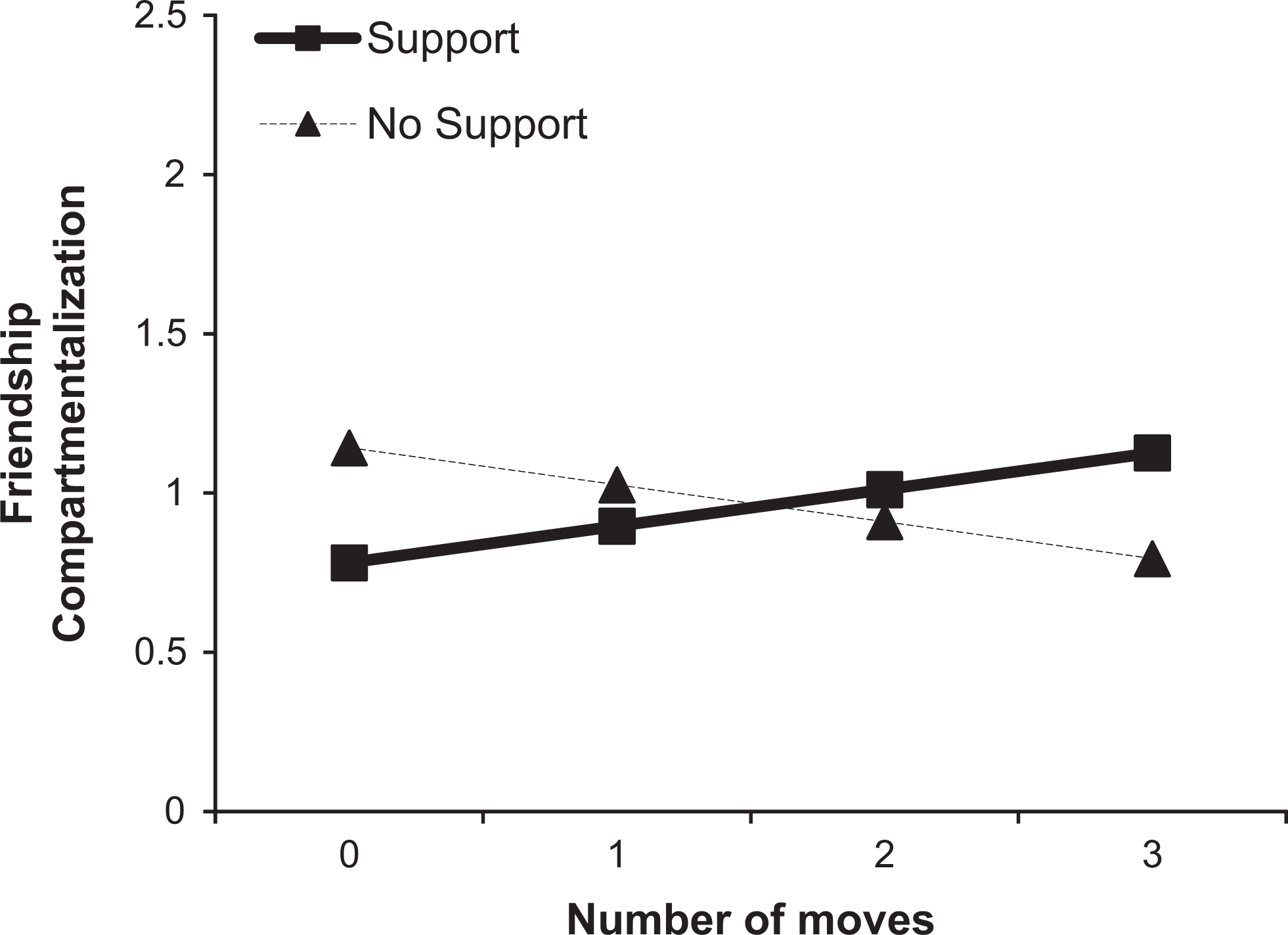
Relationship between residential mobility and friendship compartmentalization for those who mentioned or did not mentioned support in friendship definition (Study 1).
Study 2
Study 2 is a conceptual replication of Study 1 with an experimental approach to provide stronger evidence for the causal relationship between residential mobility and friendship compartmentalization. We also used a more controlled method to gauge perceived importance of social support in friendship to further investigate its role in friendship compartmentalization.
Method
Participants
One hundred and nine undergraduate students the University of Virginia participated in this study to fulfill partial requirement of a psychology course. Forty (37%) were male, and 64 (59%) were female. Seventy-five (68.8%) participants described themselves as Caucasian/White, 12 (11%) as Asian, 9 (8.3%) as African American, 3 (2.8%) as Hispanic, one (0.9%) as Middle-Eastern, and 4 (3.7%) as multiethnic or other. Five participants did not provide demographic information. The average age of participants was 18.75 (SD = 1.06).
Procedure and Materials
After informed consent, participants completed a questionnaire for a study on interpersonal relationships and perceptions. They first completed a question about their definition of friendship. Instead of receiving an open-ended question as in Study 1, participants were asked to rank the importance of five friendship features with a short description accompanied each feature adapted from Adams and Plaut (2003): help, support, disclosure, companionship, and trust (1 = most important, 5 = least important). The descriptions and the ranking procedure reduce the conceptual overlap between emotional support and other friendship features (see Online Supplemental Material found at http://spps.sagepub.com/supplemental for more detail). Based on Study 1, we were most interested in the ranking of support, in which a friend was defined as “someone who provides emotional support when needed such as agreeing, being accepting despite flaws, being a good listener, being caring and understanding.” We included help as a feature to distinguish material and practical help from emotional support, but similar to Study 1 help was considered much less important than support in friendship, t(108) = 8.38, p < .001 (see ranking of friendship features in Supplemental Materials). In the context of friendship, emotional support implies a wider range of supportive acts that often include practical help (e.g., seeking advice from friends who care about us). Therefore, we focused on the more inclusive category of emotional support.
After the friendship features measure, participants completed a writing task about having a particular lifestyle, which served as our manipulation of residential mobility (Lun, Oishi, & Tenney, 2012; Oishi et al., 2012). Participants were randomly assigned to think about either residential mobility or residential stability. Those in the mobility condition were instructed to imagine that they were offered a desirable job that involved moving to a different location every other year. In the stability condition, participants were asked to imagine getting a desirable job that involved living in one area for the next 10 years. All participants were then asked to write in as much detail as possible about what it would be like to have such a lifestyle and how it would affect their personal relationships. A research assistant read the writing to ensure manipulation fidelity; no one was excluded.
The residential mobility/stability manipulation was followed by a friendship compartmentalization measure modified from Study 1. The purpose of this modified design was to capture friendship compartmentalization without the influence of the actual characteristics of current friends. Instead of listing five actual friends, participants were presented with brief descriptions of five hypothetical people with whom they were asked to imagine they had become friends. They then rated the extent to which they would go to a party, go to a movie, go out to dinner, study, and participate in recreational activities with each of these friends in the same manner as in Study 1. Each friend was described to have positive attributes that implied their “expertise” in one of the five activities. For example, Friend A was described as smart and hardworking to suggest that Friend A could be a great person to study with. Friend B, on the other hand, was athletic and out-doorsy, so this friend could be an ideal person with whom to do recreational activities. The compartmentalization measure itself was essentially the same as in Study 1, except participants rated the likelihood of doing the activities with hypothetical rather than real friends. After participants provided these ratings, they were asked to rate how much they would like to have a friend similar to each of the hypothetical friends, using a Likert-type scale (1 = not at all, 7 = very much). This measure was used to adjust the compartmentalization measure for any liking effects (M = 5.36, SD = 0.85). Finally, participants reported their gender, age, and ethnicity.
Results and Discussion
The friendship compartmentalization score was computed in the same way as in Study 1 (i.e., the variance contributed by friends and activities jointly) with a higher number indicating greater compartmentalization. The score could not be computed for one participant who completed this measure incorrectly. A regression analysis was used to predict friendship compartmentalization from the mobility priming condition (mobile = 1, stable = 0), participants’ ranking of support as an important friendship feature, and the interaction term between support ranking and mobility priming. Support rankings were reverse-coded, so that higher numbers indicated greater importance and were centered before computing the interaction term. Participants’ averaged rating of how much they would like to have friends who are similar to the five hypothetical friends was also entered as a covariate because liking was negatively correlated with friendship compartmentalization (r = −.34, p < .001).
Conceptually replicating the findings from Study 1, the interaction between support importance and mobility priming was significant, β = .25, t(103) = 2.01, p = .05 (See Figure 2). After thinking about moving to a new place every other year (i.e., a mobile lifestyle), those who ranked support as a more important friendship feature were also more likely to select certain friends for certain activities, β = .28, t(51) = 2.32, p = .02. Participants who were asked to think about a stable lifestyle did not show a relationship between support importance and friendship compartmentalization, β = .05, t(51) < 1, p > .70. 2 Similar to Study 1, there was no main effect of mobility prime and support importance on friendship compartmentalization, ps = .82 and .50, respectively.
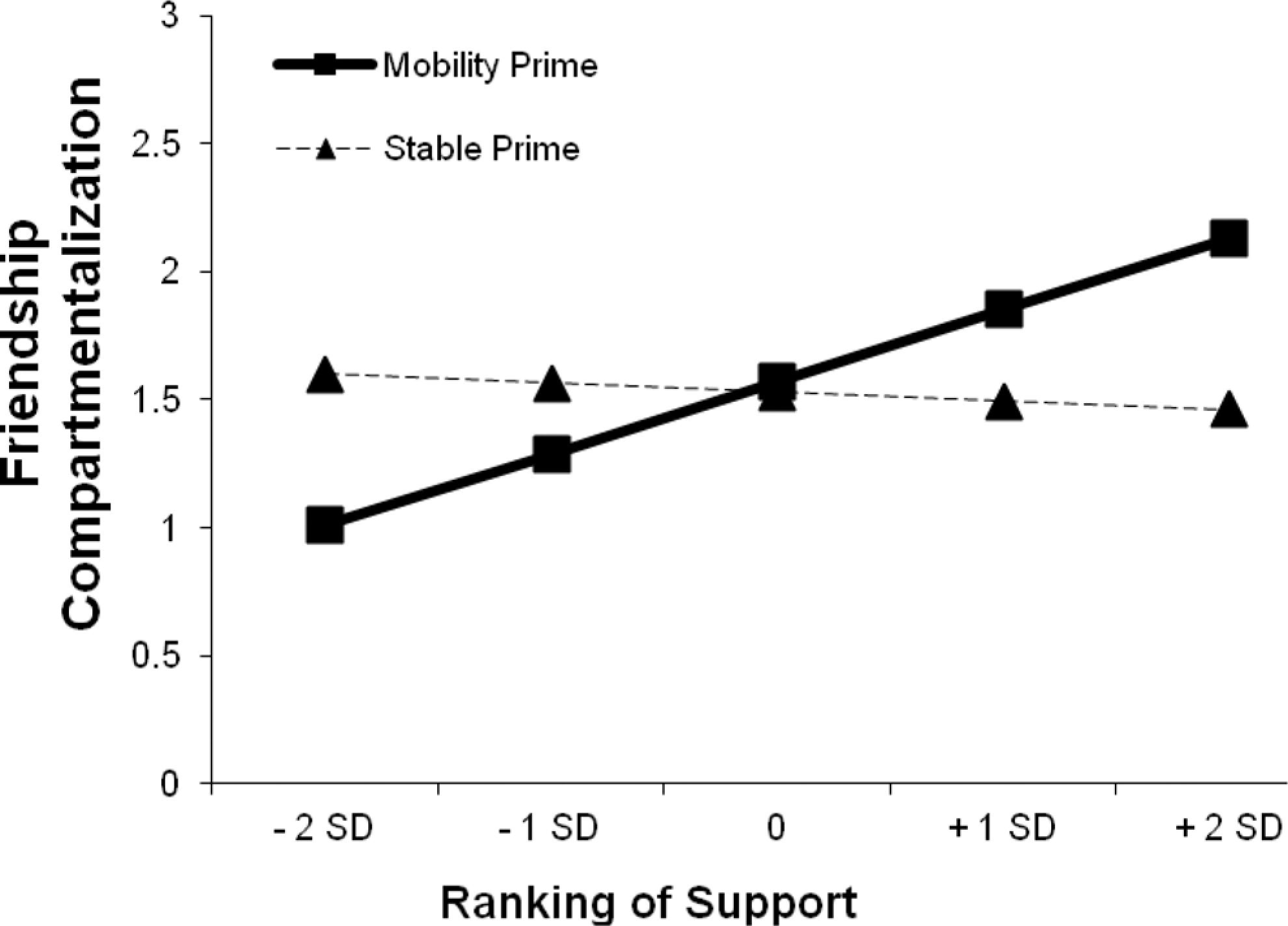
Relationship between friendship compartmentalization and importance of social support in friendship (Study 2).
Using an experimental approach, we found convergent evidence that individuals who consider support a more central feature of friendship are more likely to compartmentalize their friendships after thinking about a mobile lifestyle. Notably, we found the effect of residential mobility simply by asking participants to imagine what life would be like if they were to move around every other year. This suggests that the expectation of a residential move may be sufficient to trigger this interaction style with friends.
Study 3
Study 3 addresses the question of why movers who value support in friendship are more likely to adopt compartmentalization as a friendship strategy. We suggest that people employ friendship compartmentalization partly to reduce concerns over social support availability associated with residential mobility while they are forming new friendships. To examine this hypothesis, we manipulated social support uncertainty and assessed the degree to which movers and nonmovers demonstrated friendship compartmentalization. We expected that movers would demonstrate greater friendship compartmentalization when they thought about social support uncertainty while nonmovers would not need to adopt such a friendship strategy because their friendship networks have remained more intact.
Method
Participants
Ninety-seven undergraduates at the University of Maryland completed a questionnaire to fulfill partial requirement of a psychology course. Sixty-nine (71%) were female and 28 (29%) were male. Sixty-two participants (64%) described themselves as Caucasian/White, 16 (17%) as Asian, 10 (10%) as African American, 6 (6%) as non-White Hispanic, 2 (2%) as Persian, and 1 (1%) as multiethnic.
Procedure and Materials
Participants completed a questionnaire about social perception and relationships. To manipulate social support uncertainty, participants were randomly assigned to one of three mind-set priming conditions (Bargh & Chartrand, 2000): support uncertainty, support certainty, or a control condition. To induce the feeling of social support uncertainty, participants were instructed to write about an experience when they needed support but felt unsure about whom to ask or whether the other person would be willing to help. In the social support certainty condition, participants were instructed to write about an experience when they felt certain about whom they could turn to for help and knew that the person would surely be there to help. The remaining participants were assigned to a control condition in which they recalled and wrote about a bad day they had (see Online Supplemental Material found at http://spps.sagepub.com/supplemental for full instructions). This control condition was used to test whether or not the results of social support uncertainty were merely due to recalling a negative situation. In all three conditions, participants were asked to describe as concretely as possible what happened and how the experience felt. A research assistant read the stories to ensure manipulation fidelity. Three participants were excluded from the analysis because they did not complete the assignment correctly. After the manipulation, participants completed the hypothetical friendship compartmentalization measure from Study 2. The compartmentalization score was computed using the same procedure, except for one participant who completed this section incorrectly. Finally, participants provided demographic information including their age, ethnicity, and the places where they lived before coming to college. The number of moves was counted in the same manner as in Study 1. In this sample, 49 students (52%) had never moved, 25 (27%) moved once, 12 (13%) moved twice, and 8 (9.5%) moved 3 times or more. We also repeated the analysis excluding moves within the same city and the results did not differ.
Results and Discussion
We predicted that people who had experienced residential mobility (i.e., movers) would show a greater tendency to compartmentalize their friendships when in a state of social support uncertainty than would those who had never moved in childhood (i.e., nonmovers). This difference was not expected in the control or social support certainty conditions. We tested our hypothesis with a 2 (residential mobility experience [movers, nonmovers]) × 3 (social support priming [control, certain, uncertain]) between-participant analysis of variance. There were no main effects of mobility, F(87) = .10, p = .76, or priming condition, F(87) = 0.46, p = .63. However, as expected, the interaction between mobility and priming condition was significant, F(87) = 3.17, p = .05, η2 = .07. When people were primed to think about a bad day or social support certainty, the degree to which movers compartmentalized their hypothetical friendships was not significantly different from that of nonmovers, t(30) = −.64 and t(29) = −1.02, ps > .30 (See Table 1). However, after being primed with social support uncertainty, movers compartmentalized their friendships (M = 1.76, SD = 1.20) significantly more than nonmovers (M = 1.06, SD = 0.73), t(31) = 2.24, p = .03, d = .72. These findings suggest that when faced with social support uncertainty, movers increase friendship compartmentalization relative to nonmovers, and the effects are not merely due to being in a negative situation.
Means and Standard Deviations of Friendship Compartmentalization of Movers and Nonmovers by Priming Conditions.
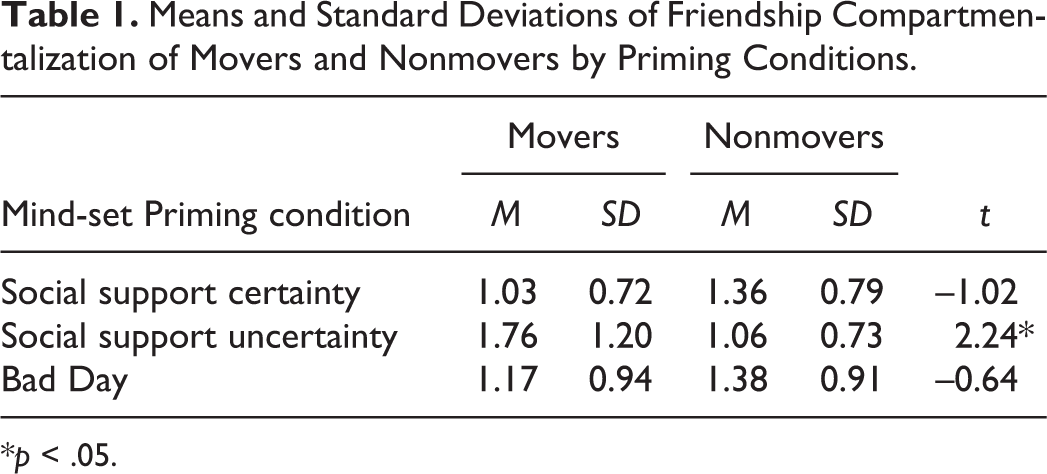
*p < .05.
General Discussion
The present work provides novel findings regarding people’s friendship strategy (i.e., friendship compartmentalization) as a function of one socioecological factor, residential mobility. Results from Studies 1 and 2 show that residential mobility, whether measured through personal history or manipulated through priming, increases friendship compartmentalization for those who consider social support an important part of friendship. These findings suggest that people who are more reliant on friendship support compartmentalize their friendships, presumably to ease support availability concerns while forming new friendships after a move. Study 3 provides evidence for this assertion with a direct manipulation of social support uncertainty. People with a history of residential mobility before college, compared to those who had never moved, compartmentalize their friendships to a greater extent when asked to think about social support uncertainty. Indeed, results from these three studies suggest that residential mobility and personal importance of support in friendship jointly guide one’s friendship strategy.
The present research illustrates the role of socioecological factors such as residential mobility and friendship expectations in the structure of social relationships (Oishi, 2010). Specifically, residential mobility increases friendship compartmentalization only among those who emphasize support in friendship or when people have concerns over social support availability from friends. Our findings concur with research on friendships that different people expect different things from friends, ranging from emotional connections and support to companionship to practical help (Fehr, 2004). The findings also have important implications for research on friendships. For example, individual differences in friendship expectations might be associated with attachment style (Collins & Feeney, 2000), which in turn affect the type of friendship strategy that is conducive to friendship quality and subjective well-being in general. It is important to explore the role of friendship expectations in friendship strategy, quality, and subjective well-being in the future.
Although the present research conceptualizes the importance of social support and social support concerns at the individual level, it may also be studied at the cultural level. People from different cultures have different expectations about friendship (e.g., Adams, 2005; Adams & Plaut, 2003), which might affect the social strategy they use to adapt to different socioecological environments. For example, emphasis on social support in friendship may reflect a self-serving orientation to social relationships that is more common in culture where friendships are based on personal choice (Adams, 2005). Future work in this direction will further illuminate the influence of cultural and socioecological factors on relationship strategies.
Because our sample consisted of college students whose residential mobility experience was during their early years, generalizability of our findings to other populations (e.g., older adults, people with children) requires further examination. For example, older adults who move with their partner or family may be less affected by the disruption of their friendship networks, but as previous research suggests, moving as an adult can be similarly challenging (Brett, 1982; Starker, 1990). Future research may further examine the function and implications of friendship compartmentalization. As the present research argues, such an approach to friendship not only yields a larger friendship network (Kruglanski et al., 2002; Lewin, 1936) but also helps maintain relationship satisfaction by catering activities to each friend’s needs, desires, or “expertise.” It would be important to ascertain whether such a friendship strategy will have any long-term effects on the quality of the friendships.
Socioecological conditions, such as residential mobility, constitute an important part of the broader cultural context that influences social relationships and behavior (Oishi & Graham, 2010). As suggested by the present research and other relevant work (Oishi, 2010; Schug et al., 2010), residential mobility affects characteristics of one’s social network (e.g., transient vs. stable, open vs. closed) that can produce different social incentive structures and promote certain relational strategies (e.g., Yamagishi, 2011; Yamagishi, Hashimoto, & Schug, 2008). Our findings suggest that adoption of particular relational strategies is also influenced by both individual and situational factors. Incorporating these perspectives into future work will help tackle the complex relationship between culture and human social behavior.
Footnotes
Declaration of Conflicting Interests
The author(s) declared no potential conflicts of interest with respect to the research, authorship, and/or publication of this article.
Funding
The author(s) received no financial support for the research, authorship, and/or publication of this article.