






Abstract
Although ethnic deviants are typically disliked, we argue that minority group members may strategically befriend them. In Study 1, Asian and White Australians (N = 536) read a Facebook profile of an Asian or White target who exhibited either stereotypically Asian or White Australian characteristics. Overall, Asian Australians liked in-group ethnic deviants less than normative in-group targets. However, among Asians who perceived high intergroup permeability, the effect reversed on measures of social acceptance: Ethnic deviants were more likely to be befriended than normative group members. This pattern was not observed among Asians who perceived low permeability or among White Australians. In Study 2, we show that Asians (N = 118) who perceive high intergroup permeability desire integration more and perceive ethnic deviance as useful in achieving it—they consequently prefer ethnically deviant White and Asian friends. We discuss minority group members’ preference for ethnic deviance in light of their social mobility motives.
As collective beings, we police the actions of the people around us to foster positive, cohesive, and distinctive group identities (Marques, Abrams, Paez, & Martinez-Taboada, 1998; Tajfel & Turner, 1986). In general, we like in-group members to behave like “us,” and out-group members to behave like “them” (Abrams, Marques, Bown, & Henson, 2000). Ethnic deviance is the term used to describe a specific type of deviance: aberration or nonconformity on ethnic or racial dimensions (Phelan & Rudman, 2010). It occurs when a member of an ethnic or racial group violates the norms and stereotypes typically associated with, and expected from, that group.
Reactions to Deviance in Minority Groups
Due to their relatively disadvantaged position in society, minorities rely heavily on in-group cohesiveness and distinctiveness to foster positive social identities, provide meaning, and furnish a launching pad from which collective action is possible (Warner, Hornsey, & Jetten, 2007). Research demonstrates that ethnic minority group members are often pressured by other members of their ethnic in-group to adhere to in-group norms in terms of style and interests (see Contrada et al., 2001). Deviance from these norms is often met with anxiety and derogation (Phelan & Rudman, 2010; Richeson & Pollydore, 2002), and ethnic deviance can be denigrated even when the behavior is status enhancing. Among Black and Hispanic students, for example, academic achievement is associated with the concept of “acting White.” By extension, Black and Hispanic students who excel academically are less popular among their same-race peers (Fordham & Ogbu, 1986; Fryer & Torelli, 2010).
In sum, a minority group member who acts in accordance with the norms of the majority group presents an identity conundrum. On one hand, the in-group members are aligning themselves with a more powerful, high-status group and in so doing embodies a type of status ascension and individual social mobility that some minority group members may favor. On the other hand, the ethnic deviant achieves this mobility by diluting or blurring the boundaries between the minority and the majority group, thus embodying distinctiveness threat. To date, the literature suggests that minority group members prioritize their needs for distinctiveness: They punish ethnic deviance and do so regardless of whether the deviance is potentially status enhancing. In the current article, however, we aim to add nuance to this conclusion. Specifically, we argue that some ethnic minority members may make concessions to the goal of social mobility. This may be particularly relevant for specific ethnic minorities for whom social mobility goals are especially salient.
Asians in Western nations, the minority group of focus in the present article, are one such example of a minority group who may possess a heightened motivation to permeate the majority group. Despite having achieved disproportionate success in Western societies relative to other minority groups, Asians are chronically perceived as foreigners within these societies (Cheryan & Monin, 2005). They seem to recognize, however, that their place in Western society is contingent on how much their behavior is in line with that of the majority group (Tafarodi, Kang, & Milne, 2002). Therefore, although there is evidence that conformity pressures are prevalent among Asians (Contrada et al., 2000), it is possible that Asians may strategically accept ethnic deviance that blurs the boundary separating them from the majority group.
Research in an unrelated political context suggests that sometimes strategic endorsement of deviance occurs. Morton, Postmes, and Jetten (2007) presented supporters of a political party with a candidate who violated group norms but was considered popular and electable. Like the ethnic deviant, this candidate represents a trade-off between the purity of the group’s identity and the strategic goal of status ascension. Compared to a more normative candidate, the popular but deviant candidate was considered dislikeable, however was more likely to be endorsed as a candidate. In other words, there was a mismatch between effects on liking (which reflected a distinctiveness-protection goal) and effects on social acceptance (which reflected a strategic, status-enhancement goal).
These findings are further supplemented by the work of Van Kleef, Homan, Finkenauer, Blaker, and Heerdink (2012). They demonstrated that people who violated norms (e.g., by stealing coffee) were granted social rewards of power and leadership to a greater extent than individuals who did not violate a norm, but only when this deviance was seen to benefit others (i.e., if the coffee was shared). This study suggests that people can strategically endorse deviants if the norm violation benefits the perceiver personally.
We suggest that a similar dynamic might emerge when people evaluate an ethnic minority group member who behaves in a way that is typical of the majority out-group. The vast majority of previous research on ethnic deviance has focused on liking, and here, we may indeed find that the ethnic deviant is downgraded. But what is unclear is whether this evaluative rejection of the deviant would extend also to social rejection. It is possible that a minority ethnic deviant might be seen as dislikeable but useful to have in one’s social circle, because they provide a possible pathway to social mobility and majority group acceptance. If this is the case, then we propose that ethnic minorities may show a preference for ethnically deviant friends even in the absence of liking.
Permeability of Group Boundaries: A Critical Moderator for Minority Groups?
Group boundary permeability can be described as the ease with which one perceives a particular group boundary can be traversed (Tajfel & Turner, 1986). The extent to which individuals believe group boundaries are permeable changes the types of psychological strategies they will use to enhance their own identity (see Ellemers, Van Knippenberg, & Wilke, 1990). Perceiving the boundary between a low-status in-group and a high-status out-group to be impermeable discourages low-status group members from engaging in strategies based on mobility and integration with the out-group. Low-status group members in this situation consequently find other ways to foster positive social identities, challenging the status quo through social change and opposition. Social mobility strategies are readily and opportunistically applied, however, when the same group boundaries are seen as permeable (see Wright, Taylor, & Moghaddam, 1990). It is this perceived possibility for social mobility that we propose as a crucial factor in determining the extent to which ethnic minority group members might accept deviance.
If ethnic deviance is considered a social mobility strategy, ethnic minorities who perceived group boundaries as impermeable, and social mobility improbable, should react to deviance as they have in the previous literature. That is, they should not be willing to accept minority in-group members who deviate toward the majority out-group. On the other hand, ethnic minorities who perceive integration into the dominant culture as viable should strategically accept into their social circle ethnic deviants who blur the minority–majority boundary (i.e., minority group members who behave like majority group members, majority group members who behave like minority group members).
Study 1
To investigate our predictions, we used an experimental paradigm based on the social networking website Facebook. Although preexisting friends can make links on Facebook, it is also possible for strangers to seek out new “friends.” This means that users are able to “accept” or “decline” friend requests from strangers, or friends of friends, making choices based on online persona of the friend candidate. This paradigm thus provided an ecologically valid way for us to manipulate the characteristics of targets and test whether ethnic deviants are more or less likely to be accepted into participants’ friendship circles in comparison to ethnic conformists.
Participants comprised both Asian Australians (minority ethnic group members in this context) and White Australians (majority ethnic group members). Participants were presented with a bogus Facebook profile that ostensibly belonged to either an Asian or a White target. This target was, in turn, portrayed as possessing either stereotypically Asian or White characteristics. We drew upon the deviance literature to predict that White participants would exhibit the classic derogation of ethnic deviance in order to preserve the status quo. That is, they were expected to like ethnic conformists (i.e., “White-acting” White targets and “Asian-acting” Asian targets) more than ethnic deviants (i.e., “Asian-acting” White targets and “White-acting” Asian targets). Moreover, we expected that White participants would be more willing to accept ethnic conformists as Facebook friends over their deviant counterparts. Most importantly, we predicted that the preference for ethnic conformity in White participants would not change based on their perceptions of the permeability of the minority–majority group boundary.
In line with past research, we also expected that Asian participants, as a whole, would like ethnic conformists more than ethnic deviants, especially in the case of the Asian in-group target. Unlike White participants, however, we made the novel prediction that Asian participants’ pattern of befriending would differ based on whether they perceived low or high permeability with the White majority. For Asian participants who perceived group boundaries as impermeable, we again expected the traditional derogation of ethnic deviance. In line with their pattern of liking, Asian participants who perceived group boundaries as impermeable were also expected to be more willing to accept ethnic conformists, rather than ethnic deviants, as Facebook friends. Extending from the extant literature, however, we predicted that Asian participants who perceived the minority–majority group boundary as highly permeable would show a preference for ethnic deviance when it came to accepting targets as Facebook friends. That is, Asian participants were expected to be more willing to befriend boundary blurrers (i.e., White-acting Asians and Asian-acting Whites) over boundary-congruent targets (Asian-acting Asians and White-acting Whites).
Pilot Study
A pilot study identified common stereotypes attributed to Asian and White Australians. A total of 60 Australian undergraduates (36 Asian, 24 White; 26 female, 34 male) participated in return for course credit. Participants rated the extent to which they thought 13 descriptors (adapted from Cheryan & Monin, 2005) were “typically associated with” Asian Australians and (separately) White Australians (1 = not at all to 7 = very much so). Within-subject t-tests compared the extent to which each descriptor was ascribed to Asian compared to White Australians. There was a consensus in stereotype attributions between Asian and White raters. All raters associated such descriptors as “nerdy/academic,” “good at maths and science,” and “hardworking” significantly more with Asian Australians than with White Australians (ts > 2.31, ps < .030). Conversely, raters ascribed the descriptors “sporty/athletic,” “reckless,” and “masculine” more to White than to Asian Australians (ts > 4.08, ps < .001). These stereotypes informed the manipulations used in the main study.
Method
Participants
Asian and White Australian undergraduates were recruited via mass e-mails and snowball sampled from social networking websites (e.g., Facebook). Non-Australian citizens were excluded from the analyses. The final sample (N = 536) included 271 self-identified Asian Australian and 265 White Australian participants (360 female, 169 male, 8 unspecified; M age = 21.33, standard deviation [SD] = 5.61).
Design and Procedure
Asian and White Australian participants were presented with a target whose race was either Asian or White. Further, the target was portrayed in such a way that they were either stereotypically Asian-acting or stereotypically White-acting. The fourth independent variable, perceived permeability, was measured. The dependent variables were liking of, and willingness to be Facebook friends with, the target.
Manipulations
Target Race
Participants were presented with a stimulus resembling a Facebook profile, including a photo of the target. In all conditions, the owner of the profile was male. Depending on the condition, the race of the target was either Asian or White (in each case we transposed an Asian or White face onto the same body and adjusted the skin tone of the body to match). The Asian target was named William Lee; the White target was named Lee Williams (see Figure 1).

Photographic manipulation of target race (Asian vs. White) and target stereotype (Asian vs. White).
Target Stereotype
The Facebook profiles were manipulated such that they portrayed the individual as either stereotypically Asian or White, incorporating all the stereotypes established in the pilot study. This was achieved through photographic manipulation of the target’s profile picture and information contained within the profile pertaining to the likes and interests of the target.
Measures
Target Stereotype Manipulation Check
Two separate items were used to verify whether these manipulations successfully captured the Asian and White stereotypes as intended (i.e., “The individual whose profile you read seemed stereotypically Asian/White Australian”; 1 = strongly disagree, 7 = strongly agree).
Perceived Permeability
Three items (adapted from Johnson, Terry, & Louis, 2009) measured participants’ perceptions of the permeability of the boundary between Asian and White Australians. All items were positively scored (e.g., “How easy is it for Asian Australians to be accepted into White Australian society?” 1 = very difficult, 7 = very easy). Responses were averaged such that higher scores indicated greater perceived permeability (α = .83).
Liking
Two items measured participants’ liking of the targets they saw (e.g., “I would like the person whose profile I just read”; 1 = strongly disagree, 7 = strongly agree). Responses were averaged such that higher scores reflected a greater liking for the target; r = .79, p < .001.
Befriending
Two items measured the likelihood that participants would “accept” and “reject” (reverse scored) a Facebook friend request made by the individual in the profile (1 = strongly disagree, 7 = strongly agree). Responses were averaged such that higher scores reflected greater social acceptance of the target in the Facebook profile; r = .64, p < .001.
Results
Preliminary Analyses
Target Stereotype Manipulation Check
A multivariate analysis of covariance (controlling for Target Race 1 ) revealed that the target stereotype manipulation was successful, F(2, 532) = 277.51, p < .001, η2 p = .51. Those presented with the Asian stereotype (M = 4.25, SD = 1.68) recognized the target as significantly more stereotypically Asian, F(1, 533) = 358.39, p < .001, η2 p = .40, than those presented with a stereotypically White target (M = 2.12, SD = 1.22). Conversely, those presented with the White stereotype (M = 5.34, SD = 1.46) saw the target as significantly more stereotypically White than those exposed to a stereotypically Asian target (M = 3.03, SD = 1.31), F(1, 533) = 396.49, p < .001, η2 p = .43.
Main Analyses
Regression analyses tested the effects of participant race (Asian = 1, White = −1), target race (Asian = 1, White = −1), target stereotype (Asian = 1, White = −1), and permeability 2 (mean centered) on liking and befriending. For all analyses, the predictors were entered in Block 1, followed by the two-way interactions in Block 2, the three-way interactions in Block 3, and the four-way interaction in Block 4.
Liking
The predictors in Block 1, F(4, 531) = 3.11, R 2 = .02, p = .015, explained significant variance in liking. A significant main effect of target stereotype emerged showing that participants, on average, liked stereotypically Asian targets more than stereotypically White targets. In Block 2, a significant Participant Race × Target Stereotype interaction emerged (β = .09, p = .049), revealing that Asian and White participants differed in their pattern of liking. Follow-up analyses revealed that Asian participants liked targets who behaved in a stereotypically Asian way more than targets who behaved in a stereotypically White way (β = .18, p = .003). White participants, conversely, liked stereotypically Asian and stereotypically White targets equally (β = .01, p = .884). No other interactions emerged, Fs <1, ps >.746 (see Figure 2).
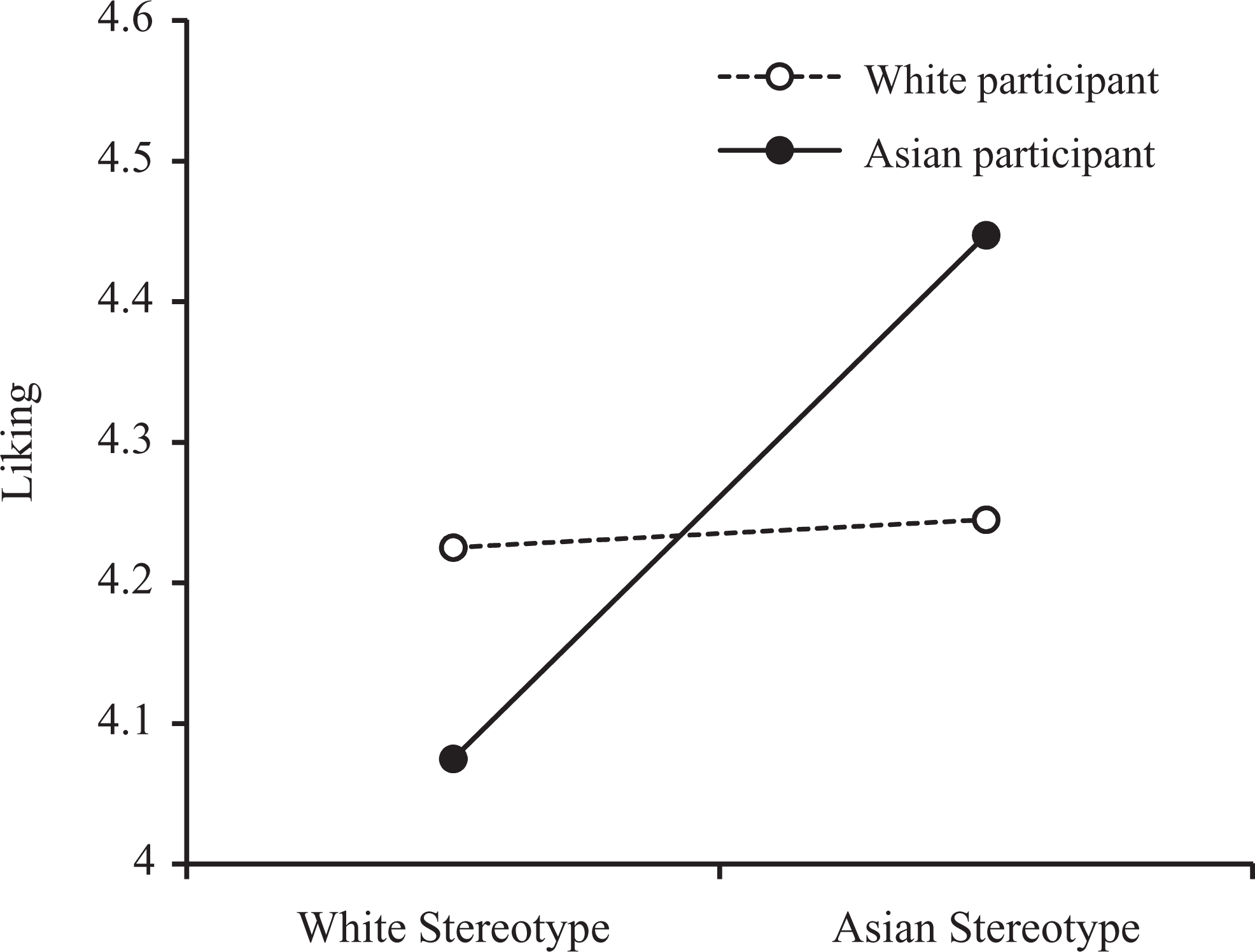
Liking as a function of participant race and target stereotype.
Befriending
On our measure of social acceptance, there were no significant main effects or two-way interactions. Rather, there was a significant Participant Race × Target Race × Target Stereotype interaction (β = −.14, p = .001) that was further qualified by the predicted four-way interaction between Participant Race, Target Race, Target Stereotype, and Permeability (β = −.10, p = .019), F(15, 520) = 1.85, R 2 = .05, p = .026.
This interaction was first followed up by examining the pattern of befriending separately for White and Asian participants. For White participants, there was no Target Race × Target Stereotype × Permeability interaction (β = .08 p = .168), but there was a marginally significant Target Race × Target Stereotype interaction (β = .12, p = .053; see Figure 3). This interaction was decomposed to reveal that White participants were more willing to befriend a White target when they were portrayed as stereotypically White than when they were portrayed as stereotypically Asian (β = −.21, p = .017) but showed no preference when it came to the Asian target (β = .03, p = .733).
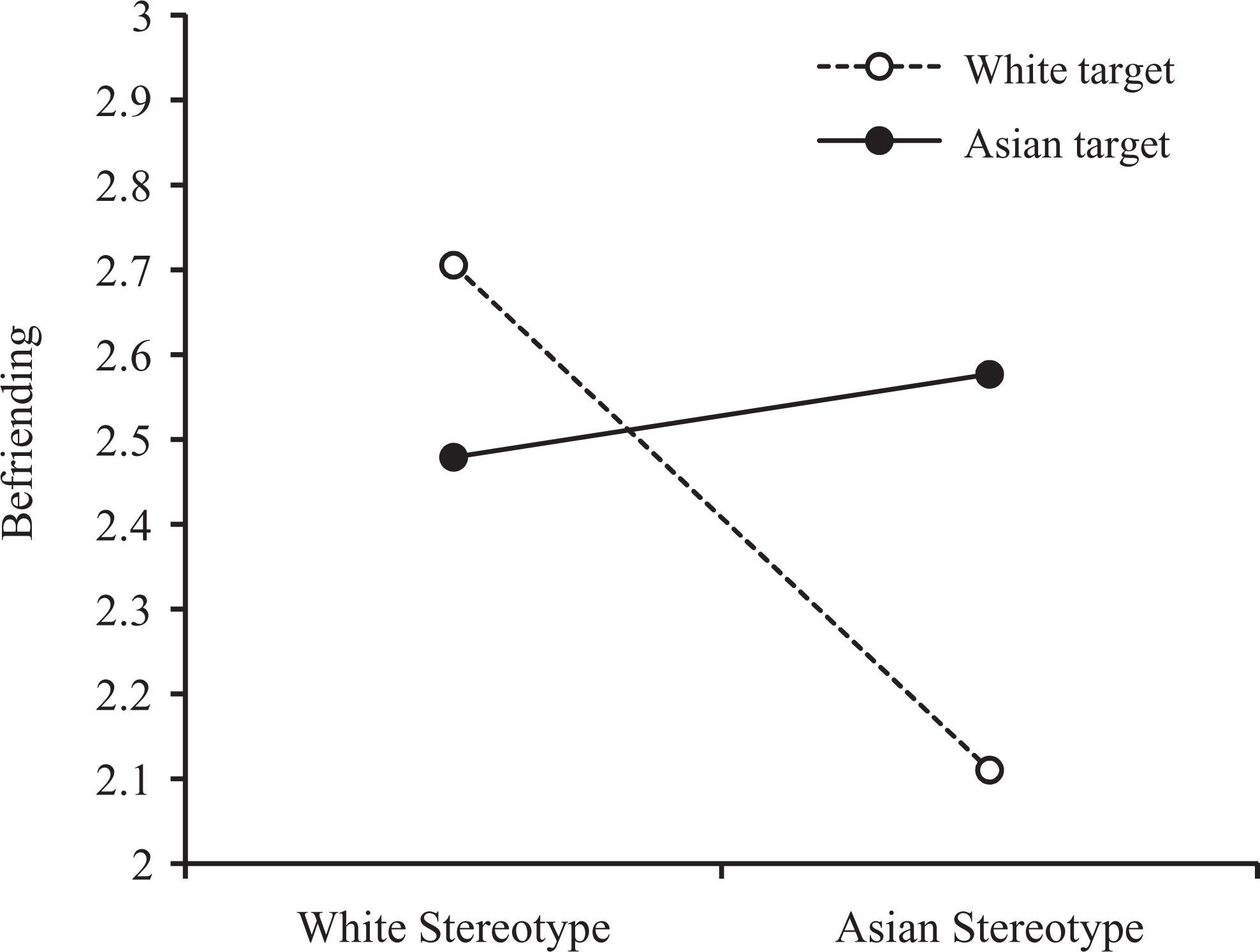
Befriending as a function of target race and target stereotype, for White Australian participants.
For Asian participants, a marginal Target Race × Target Stereotype × Permeability three-way interaction emerged (β = −.11, p = .064), suggesting that there was a difference in Asian participants’ pattern of befriending depending on whether they perceived low or high permeability with the White Australian majority. Follow-up tests examined the interaction of Target Race and Target Stereotype at low (−1 SD) and high (+1 SD) levels of permeability. For Asian participants, the Target Race × Target Stereotype interaction was not significant when perceived permeability was low (β = −.06, p = .515) but was significant when permeability was high (β = −.28, p = .001). As predicted, Asian participants perceiving high permeability were significantly more willing to befriend an Asian target who was stereotypically White rather than stereotypically Asian (β = −.25, p = .029), and a White target who was stereotypically Asian rather than stereotypically White (β = .32, p = .010; see Figure 4).
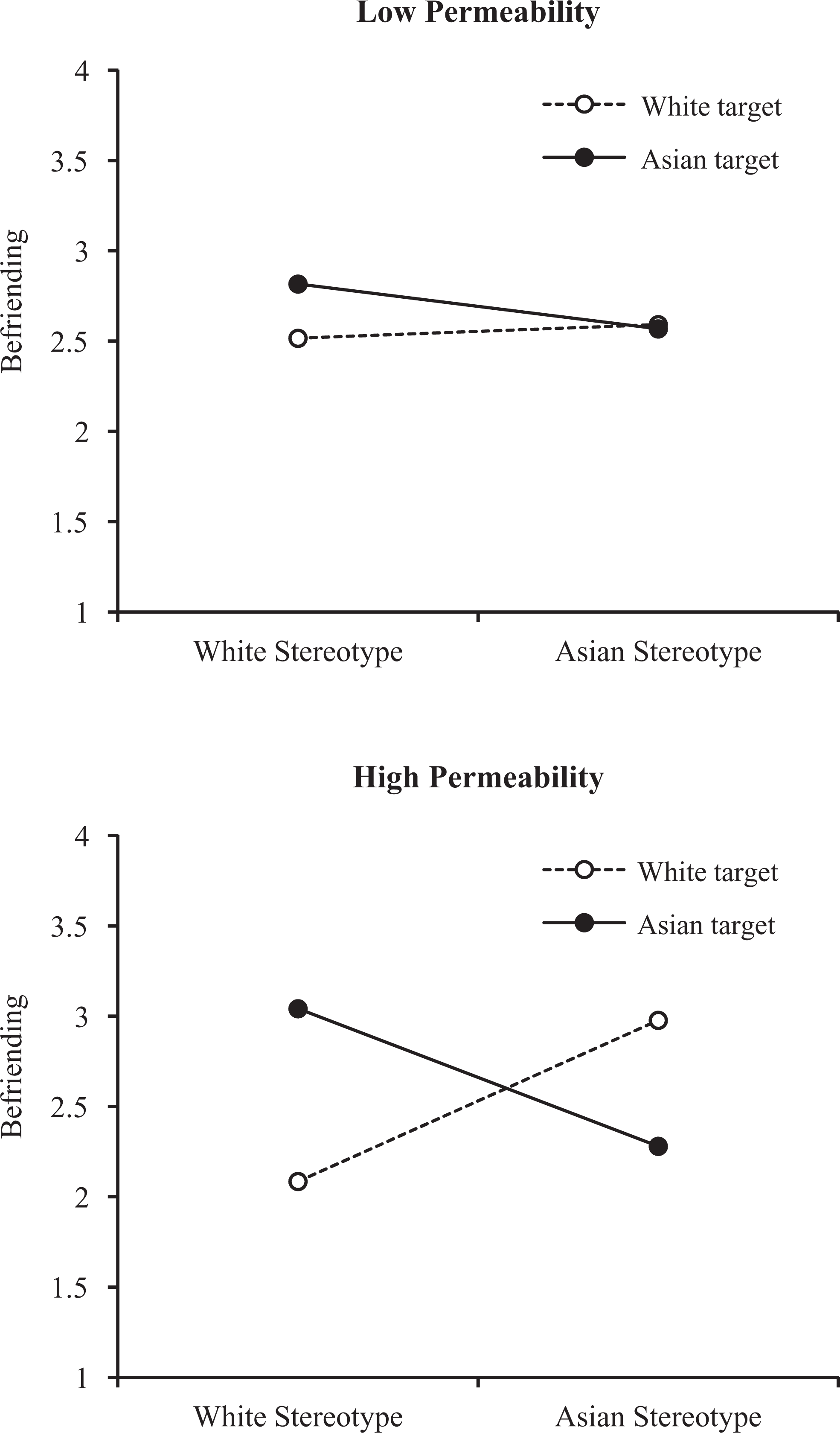
Befriending as a function of target race and target stereotype at low and high levels of perceived permeability for Asian Australian participants.
As expected, perceived permeability moderated Asian participants’ willingness to befriend ethnic deviants. As liking could be an important prerequisite for befriending, and contrasting patterns of effects were observed for these two variables, we believed that participants’ liking for the Facebook target could have had a suppressive effect on the befriending data. Therefore, we again examined the effects of the independent variables on befriending but this time controlling for liking. As expected, liking accounted for a significant amount of variance in befriending, F(2, 531) = 40.97, R 2 = .13, p < .001. After controlling for liking, however, the entire pattern of effects replicated those reported previously, only stronger (all interaction terms and simple effects reported above were significant, ps < .036).
Discussion
Members of ethnic minorities have been shown to denigrate ethnic deviance, even when such deviance facilitates acceptance within a dominant culture. This research, however, has typically focused on liking for a deviant rather than social acceptance. We argue that this focus on liking has obscured a more complex pattern of responses for members of ethnic minorities: Specifically, we argue that ethnic deviants who behave in a way that appears to blur the boundaries with a dominant majority group may be disliked but also seen as useful people to have within one’s social circle. Thus, in some circumstances, disliking an ethnic deviant might go hand in hand with social acceptance.
The results of Study 1 supported our hypotheses. Although there was clear evidence of derogation toward the in-group ethnic deviant on measures of liking, the pattern of social acceptance told a different story. In fact, Asian participants who perceived intergroup boundaries to be highly permeable were more willing to befriend a White-acting Asian target over an Asian-acting Asian target. That is, in contrast to past research on ethnic deviance, they accepted in-group ethnic deviance over ethnic conformity. Despite the fact that they actually disliked the White-acting Asian, these participants were more willing to befriend them in comparison to the normative in-group member. This preference for deviance also extended to out-group targets. Asians who perceived group boundaries to be highly permeable also preferentially accepted Asian-acting Whites. 3
If, as proposed, the acceptance of ethnic deviance is motivated by a desire to increase one’s cross-boundary mobility, then it should not have occurred for Asian participants who perceived a highly impermeable minority–majority boundary. In support of this, we found that Asian participants who saw group boundaries as relatively impermeable did not preferentially accept ethnic deviants over ethnic conformists as Facebook friends. However, rather than exhibiting a more traditional pattern of ethnic deviance rejection, low permeability-perceiving Asian participants exhibited apathy in their pattern of acceptance—they were just as willing to befriend a deviant in-group member as a conformist in-group member.
The differential preference for accepting ethnic deviants only emerged among Asian participants, for whom issues of majority group acceptance and social mobility are salient. White participants, in contrast, behaved in a more traditional way, preferentially befriending White targets conforming to White stereotypes over those deviating toward Asian stereotypes. This rejection of ethnic deviants was only evident for majority in-group members, however: Asian targets were equally likely to be befriended regardless of whether they were Asian-acting or White-acting.
Although Study 1 suggests a strategic acceptance of ethnic deviance for minority group members, it fails to demonstrate the full process. In particular, our theoretical interpretation of the data rests upon the assumption that minority group members (in this case, Asian Australians) who perceive group boundaries to be permeable (a) actually want to permeate the group boundaries and (b) see ethnic deviance as a method by which intergroup integration can be facilitated. In Study 2, we test these assumptions.
Study 2
Study 1 revealed that ethnic minority group members who perceived high permeability with the majority group exhibited a preference for befriending ethnic deviants. We argue that this pattern reflects a strategy adopted by those who want to achieve a specific goal (social mobility). In Study 2, we tested this proposition directly. We measured perceptions of permeability as well as preference for ethnically deviant friends. We further included two possible mediators to explain this relationship: desire for integration and perceived efficacy of ethic deviance at facilitating integration. Given that high permeability encourages social mobility and increases the perceived utility of social mobility strategies (see Ellemers et al., 1990), the predicted model was that perceptions of permeability would positively predict desire for integration and the extent to which ethnic deviance is perceived as capable of bringing the minority in-group and majority out-group closer together. In turn, desire for integration and perceived efficacy of ethnic deviance should fully explain the relationship between permeability and preference for ethnically deviant friends.
Method
Participants
Asian Australian university students were recruited via mass e-mails. Participants who were not Australian citizens were excluded from the analyses. The final sample comprised 118 self-identified Asian Australian participants (86 female, 32 male; M age = 20.30, SD = 3.53).
Measures
Participants were asked to complete an online questionnaire including demographics and the following measures. Perceived permeability was measured as in Study 1 (α = .88).
Desire for Integration
Eight items were used to measure participants’ desire for integration with the majority group (e.g., “I would like to see myself fully accepted into White Australian society”; 1 = strongly disagree, 7 = strongly agree). Responses were averaged with higher scores reflecting a greater desire for integration (α = .84).
Perceived Integrative Efficacy of Ethnic Deviance (Integrative Efficacy)
Eight items measured how efficacious participants perceived ethnic deviance to be in facilitating integration between the minority and the majority groups (e.g., “White Australians getting into Asian culture and Asians getting into White Australian culture are capable of bringing the two groups closer together”; 1 = strongly disagree, 7 = strongly agree). Responses were averaged, with higher scores reflecting greater perceived integrative efficacy (α = .83).
Preference for Ethnic Deviance
Six items measured the extent to which participants preferred to make ethnic deviants as friends (e.g., “I prefer to make Asian friends who are into Australian sports,” “I prefer to make White friends who get into Asian culture,” 1 = strongly disagree, 7 = strongly agree). Responses were averaged with higher scores reflecting a greater preference for general ethnic deviance (α = .70).
Results
Regression analyses were used to test the model predicting preference for ethnic deviance. These analyses showed that participants who perceived greater permeability between their group and the majority group were more likely to prefer ethnically deviant friends (β = .19, p = .043), desire integration into the majority group (β = .22, p = .016), and perceive that ethnic deviance was an efficacious way of facilitating such integration (β = .20, p = .027).
The indirect effect of perceived permeability on preference for ethnic deviance via desire for integration and perceived integrative efficacy was tested using bootstrapping procedures recommended by Preacher and Hayes (2008). Results based on 5,000 bootstrapped samples revealed that perceived permeability had a significant indirect effect on preference for ethnic deviance via both desire for integration (B = .04, BSE = .02; 95% confidence interval [CI] = [.01, .10]) and perceived integrative efficacy (B = .06, BSE = .03; 95% CI = [.003, .13]). Although the total effect (TE) of perceived permeability on preference for ethnic deviance was significant (TE = .10, SE = .04, p = .042), the direct effect (DE) was not (DE = .05, standard error = .06, p = .427), indicating full mediation (refer to Figure 5). The final model explained 27.5% of the variance in preference for ethnic deviance, F(3, 114) = 14.40, p < .001.
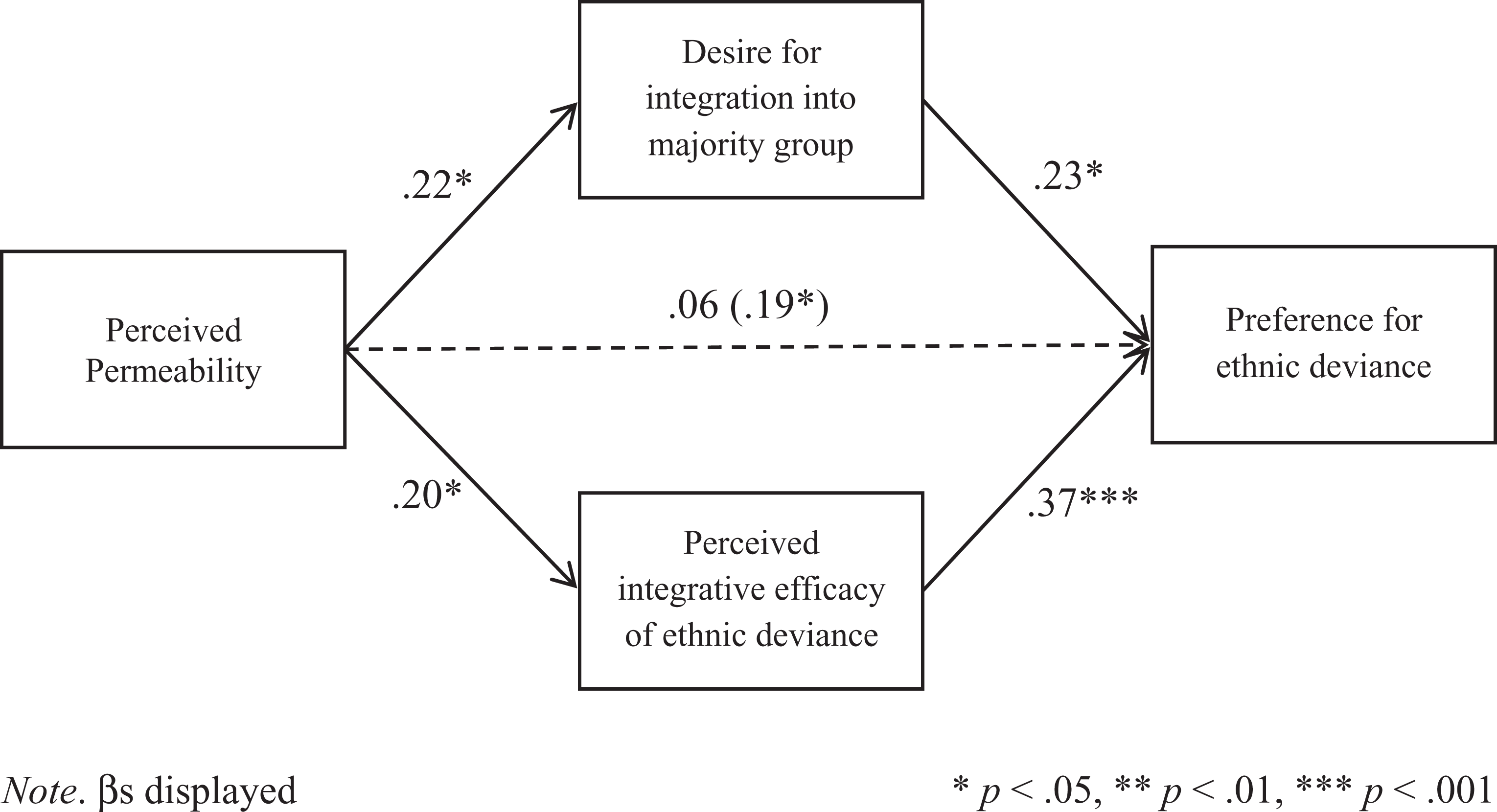
Mediated model of the relationship between perceived permeability and preference for ethnic deviance in Asian Australians.
Discussion
Building upon the results of Study 1, Study 2 provides evidence for two underlying mechanisms driving the preference for ethnic deviance found for Asian participants in Study 1 who perceived high intergroup permeability. In Study 2, Asian participants who perceived group boundaries to be permeable demonstrated a greater preference for ethnically deviant friends. Consistent with past work that has shown that people who perceive group boundaries to be permeable strive for greater social mobility (Ellemers et al., 1990), Asian participants who perceived greater permeability also desired integration to a greater extent. Further, those who perceived high permeability were more likely to think that ethnic deviance was capable of bringing minority and majority groups closer together. In line with predictions, it was through increased desire for integration and integrative efficacy that permeability predicted preference for ethnically deviant friends.
General Discussion
Although a substantive amount of past literature suggest that minority group members respond to ethnic deviance with disdain, our results indicate that under the right conditions ethnic deviants may be preferentially befriended (if not liked). Across two studies, we found that minority group members who saw transition into the majority group as possible were willing to preferentially befriend ethnic deviants over ethnic conformists.
In Study 1, Asian (but not White) Australians who perceived group boundaries as highly permeable preferentially “accepted” Facebook friend requests from ethnic deviants (i.e., White-acting Asians and Asian-acting Whites) over ethnic conformists. These findings were not a reflection of genuine liking for ethnic deviance. Rather, Asian Australians were especially punishing of in-group ethnic deviants (Asians who behaved like Whites) on indices of liking. We believe that these findings add depth and nuance to the literature on ethnic deviance, which to date focuses heavily on affect (“liking”) rather than behavioral acceptance or preference. We propose that this acceptance of ethnic deviance is a strategy by which Asian participants felt they could blur group boundaries and therefore assist their own integration into the majority group. Results from Study 2 supported our interpretation: The more Asian Australians perceived group boundaries as permeable, the more they desired integration, and the more they perceived ethnic deviance as an effective strategy with which to facilitate integration. It was through these mechanisms that permeability worked to predict a preference for ethnically deviant friends.
These studies build upon previous research by demonstrating that ethnic deviance is not always regarded unfavorably by minority groups. Past research has found that nonnormative, deviant behavior is sometimes strategically endorsed (Morton, Postmes, & Jetten, 2007; Van Kleef, Homan, Finkenauer, Blaker, & Heerdink, 2012). Similarly, our results suggest that ethnic deviants may be valued and preferentially accepted over ethnic conformists if their atypical characteristics are seen as beneficial to the in-group. A critical qualifying condition we introduce in this article, however, is that boundaries between the in-group and the high-status out-group are perceived to be permeable. Although focusing heavily on ethnic deviance, we argue that it is likely that our findings will extend beyond the racial domain. For example, low-status employees might strategically befriend fellow employees who share similarities with upper management and vice versa. Future research should examine whether permeability critically changes the way in which any minority/low-status group member responds to deviance, to the extent that they are motivated to permeate relevant majority/high-status groups.
In sum, we argue that ethnic minorities are mindful of the opportunities that allow them to enhance their status. The strategic acceptance of ethnic deviance that blurs the minority–majority group boundary may be a potent way for ethnic minorities to facilitate social mobility with the dominant majority. It is important to acknowledge, however, that not all ethnic minorities will see such integration as possible (or desirable). When looking at minority groups’ responses to deviance, each individual’s perception of the social structure in which they exist must be taken into account. For minority group members who perceive an impermeable barrier between their minority in-group and the majority out-group, accepting ethnic deviance would be an exercise in futility. As demonstrated in the present study, however, ethnic minority group members who perceive integration with the White majority as possible will respond to ethnic deviance in a more complex and tactical manner. For such people, enhancing their status may be a matter of embracing, rather than rejecting, ethnic deviants.
Footnotes
Declaration of Conflicting Interests
The author(s) declared no potential conflicts of interest with respect to the research, authorship, and/or publication of this article.
Funding
The author(s) disclosed receipt of the following financial support for the research, authorship, and/or publication of this article: The research contained within this article was in part supported by the second author’s Australian Research Council Discovery Early Career Research Award (DE120102068).