







Abstract
The present research examined the idea that people believe Black Americans think society is less fair than members of other racial groups (Study 1a), that these beliefs are out of touch with reality (Study 1b), and that Black audiences need to hear individual blame messages to bring these discrepant views more in line with reality (Study 2). We then examined a downstream consequence of these beliefs: differing third-party evaluations of speeches based on the race of the audience (Black vs. White) and the content of the message (individual vs. system blame). We found that individual blame messages were evaluated more positively when they were directed at Black audiences relative to White audiences. By comparison, evaluations did not differ for system blame messages (Studies 3a and 3b). Implications for system justification and policy endorsement are discussed.
On June 15, 2008, President Barack Obama gave a speech about the importance of fatherhood to a predominantly Black audience in Chicago. Obama’s message was clear: Men in the Black community need to take responsibility for being better fathers. His message to this predominately Black audience was one of individual responsibility, asserting that the “foundations of our families are weaker” due to individuals’ actions (e.g., Black fathers going missing). Obama’s speech is thus an example of an individual blame account of racial disparities, and an assertion that the broader system is fair and that any failures to thrive within that system are attributable to inadequacies of the individual (Jones, 1991; see also Katz & Hass, 1988; McCoy & Major, 2007). In contrast, a system blame account of racial disparities asserts that the disadvantaged status of Black Americans can be attributed to legislative, judicial, educational, and economic features of the system (Jones, 1991). Obama’s speech largely ignored such contextual systemic issues that can also impact the organization of Black families (e.g., Castillo, Welch, & Sarver, 2013). When compared to messages directed at other groups, Obama’s speeches on Black issues tend to emphasize individual factors (McDougal, 2013), and we propose this tendency may reflect broader sociocultural beliefs about Black communities and perceptions that they are apt to blame the system “too much.”
The current research examines perceptions of racial differences in propensities to blame individuals versus systems and the downstream consequences of such beliefs. Specifically, we hypothesize that because people believe Blacks blame the system too much, they will see those views as in need of correction. Although we are not aware of any research that has examined such perceptions, prior research indirectly suggests that people may think Blacks are too apt to see society as unjust. For example, White participants more positively evaluate Black speakers who do not claim discrimination (Kaiser, Dyrenforth, & Hagiwara, 2006; see also Zou & Dickter, 2013). Preference for Black speakers who minimize discrimination is consistent with theorizing within the White racial frame (WRF): a system of meanings and narratives developed to maintain racial hierarchies (Feagin, 2010). The WRF manifests in covert forms such as color-blind ideologies that claim race-based privilege is no longer responsible for disparate outcomes (e.g., Bonilla-Silva, 2010). Discourse surrounding these beliefs takes the form of personal responsibility and meritocracy. Within a system justification framework (Jost, Banaji, & Nosek, 2004), individual blame messages are appealing because they imply existing social arrangements are legitimate. We investigate whether they are especially appealing when delivered to audiences believed to attribute social arrangements to system failures.
Prior research has examined the effect of a speaker’s race when delivering these types of messages, but the current research is the first study that has manipulated the racial characteristics of a passive audience in evaluations of these messages. The present research takes into account considerations of an audience’s racial composition as a potential sociocultural mechanism through which some system justifying messages gain their appeal. Specifically, we suggest that people will prefer speeches that perpetuate White racial interests, especially when given to Black audiences.
Overview of the Current Studies
Three studies investigated perceptions of racial differences in the belief that society is fair (i.e., which groups blame individuals vs. systems). We expected people to rate Blacks as believing that society is less fair than other groups (Study 1a), less fair than it is in reality (Study 1b), and in need of messages that counteract those beliefs (Study 2). That is, we thought people might be inclined to think of Blacks as “complainers” who “blame the system” too much and thus need to hear messages emphasizing individual responsibility.
Two subsequent experimental Studies (3a and 3b) tested our prediction that participants would more positively evaluate a speech/speaker when the audience is Black and the message emphasizes individual blame. Across two studies, a 2 × 2 design was employed in which we manipulated audience race (Black and White) and message content (individual blame and system blame). Specifically, participants read an excerpt from a speech given to either a Black or a White audience. The speech was actually an excerpt from Obama’s Father’s Day speech (2008) that discussed absentee fathers and was presented as it was given (i.e., emphasizing personal responsibility) or an edited version emphasizing system blame (i.e., discrimination). Participants responded to questions about their reaction to the speaker and speech.
Study 1a
Participants
One hundred and fourteen Amazon’s Mechanical Turk (MTurk) participants from the United States (56 female; M age = 31.33, SD = 10.39) completed the study and were compensated with a payment of US$0.50. Reported racial/ethnic background included 69.3% European American, 10.5% African American/Black, 7.9% biracial/multiracial, 10.5% Asian American, 0.9% American Indian/Alaskan native, and 0.9% other.
Materials and Procedure
Beliefs about different racial groups
Participants were asked to indicate what they thought eight different groups (Black/African Americans, White/European Americans, Hispanic/Latino Americans, Asian/Asian Americans, Democrats, Republicans, men, and women) believe about the fairness of society by indicating the percentage of individuals (1 = less than 20%, 2 = 20% to 40%, 3 = 40% to 60%, 4 = 60% to 80%, and 5 = 80% to 100%) from each group they believed would agree with four different system justifying statements (e.g., “If people work hard, they almost always get what they want”; Kay & Jost, 2003). We then averaged the four responses for each racial group to compute a composite (αs > .87).
Political orientation
Political orientation was included in all five studies since it is related to the constructs under investigation (e.g., Jost, Nosek, & Gosling, 2008; Rabinowitz, Sears, Sidanius, & Krosnick, 2009). Participants indicated their political orientation on a 7-point scale (1 = very liberal and 7 = very conservative; M = 3.07, SD = 1.57).
Measures outside the scope of the hypotheses were included in all five studies. We did not drop any participants due to incomplete data or failed manipulation checks. More complete methodology and results can be found in the supplementary materials.
Results and Brief Discussion
Participants rated Blacks as having a significantly lower percentage (M = 2.30, SD = 0.99) of people who believe society is fair than any other group (ps < .05; see supplementary materials). Of particular interest for subsequent studies, the perceived difference between Blacks and Whites was large, M = 3.75, SD = 0.80; t(112) = 13.74; p < .001; d = 1.61. Further, political orientation was uncorrelated (r = .10, p = .31) with scores on what participants think Blacks believe about society, indicating that people tend to endorse the belief that Blacks think society is unfair regardless of their own political views.
Study 1a suggests that people generally think Blacks reject the idea that society is fair and, importantly, that they reject this idea at a higher rate than any other group, including other low-status groups (i.e., women and Hispanics). Study 1b further tests this idea by assessing whether people think these beliefs are discrepant from reality (not just different from other groups).
Study 1b
Participants
One hundred and thirty-eight (95 female; M age = 18.35, SD = 0.70) Texas A&M University introductory psychology students participated for partial fulfillment of a course requirement. Reported racial/ethnic background included 76.1% European American, 7.2% biracial/multiracial, 7.2% Asian American, 4.3% Hispanic/Latino, 1.4% African American/Black, and 1.4% American Indian/Alaskan native.
Materials and Procedure
Beliefs about different racial groups
Participants were asked to indicate what the average member of different racial groups believes in response to the same 4 items used in Study 1a (αs >.78). Responses were made using a slider bar that ranged from −100 (completely unfair) to 100 (completely fair), and the items were slightly reworded for this response scale (e.g., In general, how fair is society?). In addition to rating the same groups from Study 1a, participants indicated what they believe to be true “in actual fact, reality.”
Political orientation
Participants responded to the same political orientation item used in Study 1a (M = 4.77, SD = 1.52).
Results and Brief Discussion
Participants again rated Blacks as having significantly lower beliefs that society is fair (M = −4.14, SD = 38.12) than Whites, M = 42.17, SD = 32.02; t(134) = 14.10; p < .001; d = 1.31. Importantly, they also indicated that this belief is significantly discrepant from truth/reality (i.e., Blacks were seen as believing that society is less fair than it actually is, M = 12.63, SD = 39.52; t(134) = 5.59; p < .001; d = 0.43. Interestingly, Whites were rated as having the greatest beliefs that society is fair and these beliefs were also seen as discrepant from reality but in the opposite direction (i.e., Whites were seen as believing that society is more fair than it actually is, t(135) = 8.37; p < .001; d = .82. Political orientation was again uncorrelated with scores on what participants think Blacks believe about society (r = .01, p = .89), indicating that people tend to endorse the belief that Blacks think society is more unfair than it is, regardless of their own political views.
Studies 1a and 1b suggest people hold broader beliefs that Blacks’ existing societal views are detached from a system justifying “reality.” In Study 2, we elaborate on the previous studies’ findings by investigating the extent to which people think Black (vs. White) people need (vs. want) to hear messages that correspond to an individual (vs. systemic) perspective on racial inequality.
Study 2
Method
Participants
One hundred and forty-five MTurk participants from the United States (81 female; M age = 35.37, SD = 11.39) completed the study and were compensated with $1.00. Reported racial/ethnic background included 68.3% White/European American, 6.9% African American/Black, 6.9% biracial/multiracial, 3.4% Asian American, 2.1% American Indian/Alaskan native, and less than 1% Hispanic/Latino.
Materials and Procedure
Participants read a brief statement on inequality and indicated the extent to which the groups from Study 1a want or need to hear that message. We utilized a 2 (message: individual blame, system blame) × 2 (audience motive: want, need) × 2 (audience race: Black, White) mixed factorial design in analysis. Message and motive type were between-subjects variables, and audience race was a within-subjects variable.
Message
The statement began, “There are several different ideas about why there are different life outcomes for different racial groups in the United States. One perspective is that racial disparities stem from failures or inadequacies of ….” Then, message content was manipulated (i.e., “… individuals within those groups who fail to take advantage of opportunities” or “… institutions and systems that fail to provide equal opportunities”).
Audience motive
Audience motive was manipulated within a single response question: “to what extent do you believe the following groups (see Study 1a) need [want] to hear this message.” Participants used a 7-point scale (1 = very unlikely and 7 = very likely).
Political orientation
Participants responded to the political orientation item used in the prior studies (M = 3.34, SD = 1.62).
Results and Brief Discussion
The 2 (individual blame, system blame) × 2 (want, need) × 2 (Black, White) repeated measures analysis of variance (ANOVA) revealed a main effects of motive, F(1, 137) = 10.61, p = .001, η2 = .07. Generally, inequality messages were more needed (M = 4.76, SD = 2.08) than wanted (M = 4.06, SD = 2.03). Results did not reveal main effects of message, F(1, 137) = 2.34, p = .13, η2 = .02, nor audience race, F(1, 137) = 1.03, p = .31, η2 = .009. There was a significant Audience Race × Message interaction, F(1, 137) = 21.39, p < .001, η2 = .10, but it was qualified by the higher order three-way interaction, F(1, 137) = 55.69, p < .001, η2 = .26 (Figure 1).
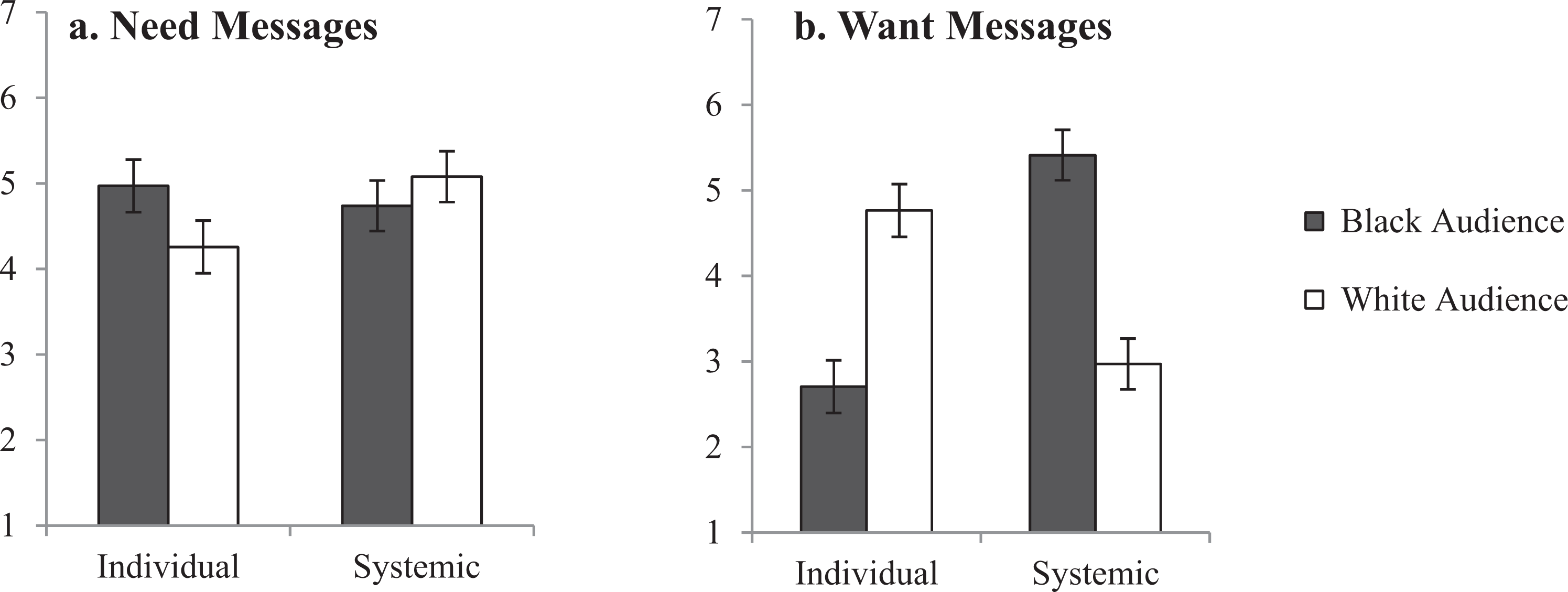
Evaluations of responsibility message by audience race and motive, Study 2.
Paired samples t-tests revealed that participants believe Black audiences (M = 4.97, SD = 1.77) need to hear individual blame messages more than White audiences (M = 4.26, SD = 1.87), t(34) = 2.88, p = .007; d = 0.39, but that White audiences (M = 5.08, SD = 2.16) and Black audiences (M = 4.74, SD = 2.08) need to hear system blame messages to a similar extent, t(37) = −0.97, p = .34; d = 0.16. Results also indicate that participants believe White audiences (M = 4.76, SD = 1.79) want to hear individual blame messages more than Black audiences (M = 2.71, SD = 1.88), t(33) = −4.548, p < .001; d = 1.12, but that Black audiences (M = 5.41, SD = 1.46) want to system blame messages more than White audiences (M = 2.97, SD = 1.36), t(33) = 5.958, p < .001; d = 1.73 (see supplementary materials for additional pairwise comparisons).
Supplementary repeated measures analyses were conducted that included political orientation, potential two-way interactions, and the potential three-way interaction between the manipulations and the political orientation in the model. Results revealed that political orientation was not directly related to ratings nor did it significantly interact with the manipulations (ps > .16). The three-way interaction of primary interest remained significant when controlling for political orientation, F(1, 127) = 61.36, p < .001, η2 = .30.
Together, these results suggest people think Blacks are complainers (e.g., Kaiser & Miller, 2001; Kaiser et al., 2006; Kaiser & Pratt-Hyatt, 2009) who see society as less fair than anyone else (Study 1a), less fair than it actually is (Study 1b), and in need of messages that they may not want to hear that counteract that view (Study 2). This may lead to a preference for messages emphasizing individual blame (vs. system blame) when a speaker addresses a Black audience because people believe Blacks are already apt to system blame too much. By comparison, people think Whites see society as more fair than it is (Study 1b) and potentially in need of system blame messages (relative to an individual need message; Study 2). This suggests that audiences may prefer a system blame message to an individual blame message when a speaker addresses a White audience. The next two studies address this prediction by examining the interactive influence of audience race and message content on third-party evaluations.
Study 3a
Method
Participants
One hundred and two (76 female; M age = 18.46, SD = 0.76) introductory psychology students at Texas A&M University participated for partial fulfillment of a course requirement. Reported racial/ethnic backgrounds included 72.5% European American, 9.8% Asian American, 6.9% Hispanic/Latino, 3.9% biracial/multiracial, 2% African American/Black, and 2% Indian/native American (three participants were missing data on race).
Materials and Procedure
Participants were randomly assigned to one of the four conditions consistent with a 2 (audience race: Black, White) × 2 (message content: individual blame, system blame) design.
Audience race and blame
Audience race was manipulated in the introduction: “On the next page, you will read a speech by a real politician that was given at Apostolic Church of God, a predominantly African American (White) church in Chicago.” Participants then read an excerpt from Barack Obama’s 2008 Father’s Day speech. The final paragraph manipulated blame: But we also need African American fathers to realize that responsibility does not end at conception. We need them to realize that what makes you a man is not the ability to have a child—it’s the courage to raise one. We need families to raise our children. [Individual Blame] But we need people to realize that the breakdown of African American families is due to a broken system. As a nation, it is our job to create a fairer playing field and foster an environment in which all fathers can raise their children. We need families to raise our children. [System Blame]
Reaction questions
Following the speech, participants indicated their agreement with 9 items assessing the speech/speaker such as “How would you rate the speech overall?” “How much do you like the speech?” and “How important is the message of the speech?” Participants used a 7-point scale with varying anchors depending on question wording (higher numbers always represented more positive evaluations). Responses were averaged to create a composite evaluation score (α = .94, M = 4.95, SD = 1.13).
Political orientation
Participants responded to the same political orientation item from prior studies (M = 4.78, SD = 1.64).
Results
We conducted a two-way ANOVA (Audience Race × Message Content) on participants’ reactions to the speech. Results revealed that the main effects for audience race, F(1, 98) = 0.001, p = .97, η2 < .001, and blame message, F(1, 98) = 2.00, p = .16, η2 = .02, were not significant. However, as predicted, the interaction between audience race and blame message was significant, F(1, 98) = 6.75, p = .011, η2 = .06; Figure 2.
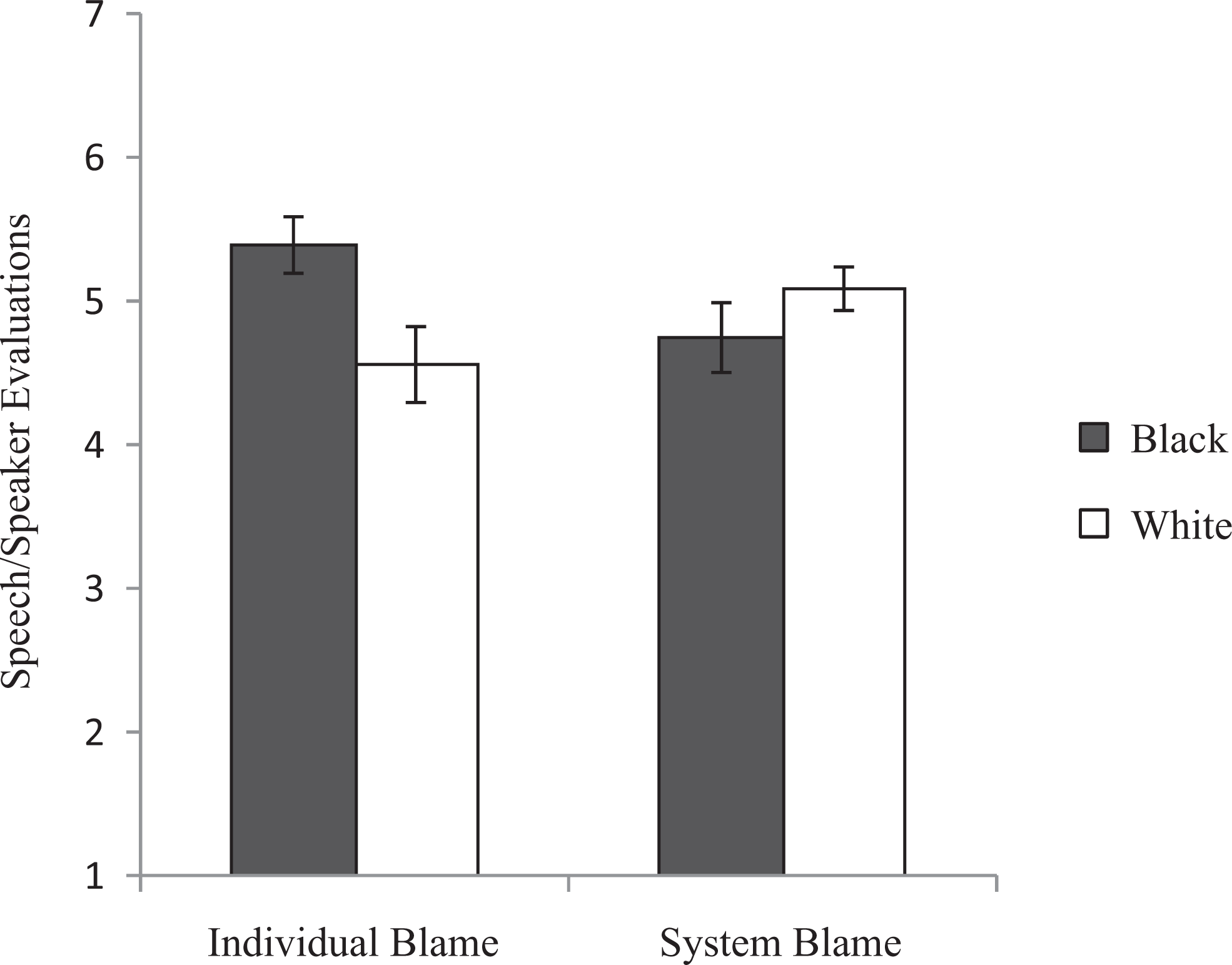
Evaluations of speech/speaker by audience race and responsibility message, Study 3a.
First, we compared the simple effect of message within race. When the audience was Black, evaluations differed based on message content, t(49) = 2.77, p = .008, d = 0.77, with participants reporting more positive reactions to an individual blame message (M = 5.43, SD = 1.00) than a system blame message (M = 4.56, SD = 1.24). This is consistent with the idea that people believe Black people blame the system too much and need to hear individual blame messages. By comparison, when the audience was White, evaluations did not differ based on message content, t(49) = −.86, p = .393; d = 0.24, with participants reporting similar reactions to individual (M = 4.86, SD = 1.30) and system blame messages (M = 5.12, SD = .80). This suggests that even though people believe Whites blame the system too little and need to hear system blame messages, this does not actually influence their preference for speeches that emphasize one message over the other. We revisit this issue in the discussion.
We also examined the simple effect of race within message type. This revealed two marginally significant simple effects. Participants somewhat preferred the individual message when given to a Black audience relative to a White audience, t(49) = 1.78, p = .082; d = 0.51, and somewhat preferred a system blame message when given to a White audience relative to a Black audience, t(49) = −1.91, p = .062, d = 0.55, though this latter effect did not replicate in Study 3b.
Supplementary hierarchical multiple regression analyses were conducted that included political orientation, potential two-way interactions, and the potential three-way interaction between the manipulations and the political orientation. Results revealed that political orientation was not directly related to speech evaluation nor did it significantly interact with the manipulations (ps > .19). Finally, the two-way interaction of interest remained significant after controlling for political orientation, b = −.216, SE = .44, t(95) = 2.58, p = .011. Study 3b provides a direct replication in a less conservative, adult sample.
Study 3b
Method
Participants
One hundred and ninety-seven MTurk participants from the United States (109 female; M age = 37.64, SD = 14.48) completed the study and were compensated with a payment of $0.50. Reported racial/ethnic background included 80.7% European American, 5.1% African American/Black, 5.1% biracial/multiracial, 4.1% Asian American, 1.5% American Indian/Alaskan native, and 2% Hispanic/Latino.
Materials and Procedure
Participants completed the same procedures from Study 3a. They were presented with the same manipulation, speech reaction questions (α = .94; M = 5.22, SD = 1.36), and political orientation measure (M = 3.24, SD = 1.68).
Results and Brief Discussion
A two-way ANOVA (Audience Race × Message Content) was again conducted on participants’ evaluations. A main effect emerged for audience race, F(1, 193) = 11.01, p = .001, η2 = .05, but not for blame message, F(1, 193) = 3.36, p = .16, η2 = .009. More importantly, the interaction between audience race and blame message was significant, F(1, 193) = 7.13, p = .008, η2 = .03; Figure 3.
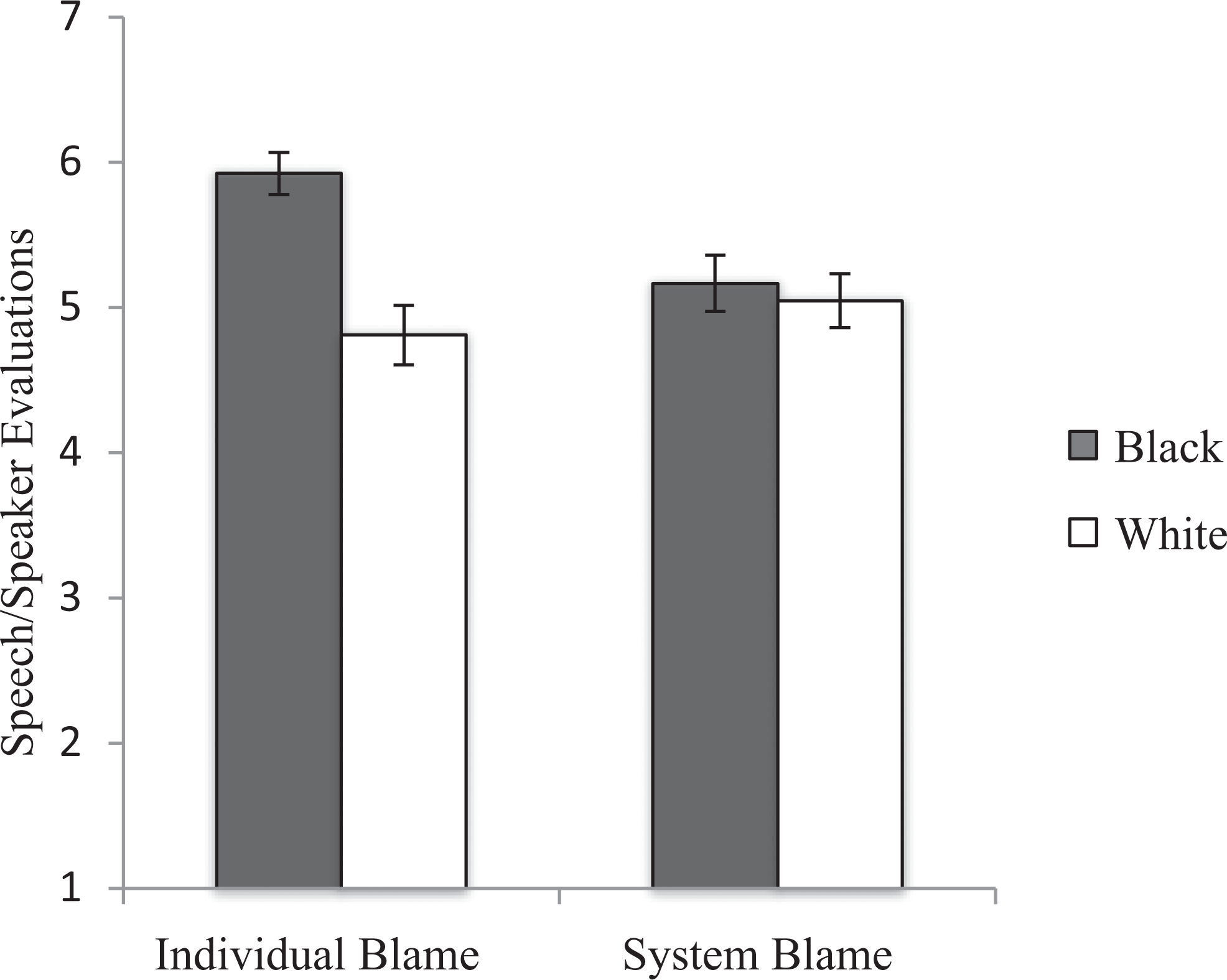
Evaluations of speech/speaker by audience race and responsibility message, Study 3b.
We again compared the simple effect of message within races. When the audience was Black, evaluations again differed based on message content, t(95) = 3.08, p = .003; d = 0.62, with participants reporting more positive reactions to an individual blame message (M = 5.91, SD = 1.00) than a system blame message (M = 5.17, SD = 1.38). Also consistent with the previous study, evaluations did not differ based on message content when the audience was White, t(98) = −.84, p = .401; d = 0.17, with participants reporting similar reactions to individual (M = 4.81, SD = 1.46) and system blame messages (M = 5.05, SD = 1.31).
Comparing audience race within each message condition revealed that participants preferred individual blame messages when delivered to a Black audience relative to a White audience, t(96) = 4.36, p < .001, d = 0.89. By comparison, participants had no preference for system blame messages depending on audience race, t(97) = .66, p = .66, d = 0.13. This is consistent with the pattern in Study 2 that both races need to hear system blame messages.
Hierarchical multiple regression analyses were conducted that included political orientation, potential two-way interactions, and the potential three-way interaction between the manipulations and the political orientation. With the exception of a two-way interaction between political orientation and speech content, b = −.227, SE = .11, t(188) = −1.99, p = .047 (see supplementary materials), political orientation was unrelated to speech evaluation and the other two- and three-way interactions were also nonsignificant (ps > .17). Again, the two-way interaction of interest remained significant after controlling for political orientation, b = 1.06, SE = .37, t(188) = 2.85, p = .005. Taken together, this suggests the effect of interest occurs regardless of one’s political orientation.
Results of Studies 3a and 3b provide converging support for our predictions that audience race and speech content play an important role in people’s reaction to a political speech. Importantly, these effects did not appear to be due to individual differences in political orientation. This suggests that there is something in particular about audience race that influenced third-party evaluations in ways that go beyond one’s own personal preferences for personal versus social responsibility messages. Across both studies, third-party evaluators preferred an individual blame message given to a Black audience versus a White audience. There were no significant differences in third-party evaluations of system blame messages when the audience was Black or White.
General Discussion
Studies 1a and 1b revealed that people generally think that Blacks reject the idea that society is fair and reject this idea at a higher rate than other groups. This suggests that people believe that Blacks have a tendency to blame the system too much. Study 2 suggested that third-party observers would prefer individual blame messages delivered to Black audiences, as this is the perceived message Black audiences “need to hear” (e.g., so that their beliefs can be more consistent with “mainstream” beliefs and reality). We tested this through two studies that experimentally manipulated audience race and message content. Both Studies 3a and 3b revealed a significant interaction between audience race and content of message, showing that participants indeed preferred individual blame messages when given to a Black audience compared to a White audience.
Given the data from Studies 1a–2, we might have expected the reverse pattern for system blame messages. After all, Whites were seen as holding beliefs that society is far more fair than reality and as needing a systemic message more than they wanted it. If the individual message constituted a “hard truth” for Black audiences, a system blame message would be the parallel hard truth for Whites. Although there was a marginal preference for the system blame messages when given to a White audience in Study 3a, this difference was not replicated in Study 3b. This suggests our results are not likely explained by a preference for politicians who do not pander. Rather, we interpret these results as an example of a sociocultural mechanism that perpetuates system justifying messages. That is, Whites’ views may not need adjusting because their discrepant views of society do not threaten the status quo.
Our results suggest that people prefer speeches that perpetuate White racial interests, especially when given to Black audiences. This preference serves to perpetuate Black disadvantage through a “double bind” (Jones, 1991). That is, by supporting an individual blame framework (i.e., adhering to the belief that Blacks cause their own circumstances by not working hard enough), Blacks are ultimately held responsible for their own disadvantage, even when structural inequality persists. This double bind allows Whites to maintain their dominant status in society by (1) allowing Whites to define what it takes to succeed and (2) structuring an environment in which it is difficult for Blacks to attain the tools necessary to succeed through meritocracy (e.g., employment opportunities).
Endorsement of individual blame views has broad implications. For example, even events that represent racial progress are negatively affected by system-justifying beliefs. Following Obama’s presidential victory, people were more likely to minimize racism and express decreased support for policies aimed at furthering racial equality (Kaiser et al., 2009). This decrease in support for antiracist policies (e.g., affirmative action) suggests that Obama’s victory ironically served to further individual blame ideology and perpetuate social inequality. Events that represent exceptional accomplishments of a few minority group members are used to demonstrate that race does not matter and, in turn, render policies that address racial inequality irrelevant. Thus, some interpreted the election of Obama as evidence that now anyone, regardless of their racial backgrounds, is able to overcome societal barriers and achieve the American dream if they just work hard enough.
These results make important contributions to our understanding of the contextual factors that influence people’s judgments of speakers. Third-party judgments are particularly relevant in today’s society given the amount of media coverage that public speeches can garner, particularly those that deal with race. Returning to Obama’s Father’s Day speech, our results suggest that third-party observers (e.g., television watchers) not only care about what he says but also to whom he says it. Prior research (Rasinski & Czopp, 2010) has found that Black individuals who confront discrimination are viewed by third parties as ruder and less persuasive. Our results complement these previous findings and suggest that system blame messages are evaluated negatively not just in the case of Black speakers but also among Black audiences who simply hear claims of discrimination.
Limitations and Future Directions
One limitation to the current studies is the homogeneity of our samples. Although we find preliminary evidence suggesting similar patterns of responding among ethnic/racial minorities (see supplementary material), our data cannot speak to whether there are differences among Black respondents. A predominantly Black sample may ultimately reject an individual blame message when delivered to a Black audience (but perhaps not, given the pervasive nature of the meritocracy ideology; Major et al., 2002; Major, Kaiser, O’Brien, & McCoy, 2007; McCoy & Major, 2007). Although our sample was not diverse enough to conduct such comparisons, this is a fruitful avenue for future research. Our studies were also limited in that we did not explicitly manipulate the race of the speaker (though see supplementary materials).
Conclusions
Obama’s 2008 Father’s Day message—that the problem of missing fathers can be addressed if Black fathers would just take more responsibility for their absence—seems to be the type of message (i.e., individual blame) delivered in the “right” context (i.e., in front of a Black audience) for favorable third-party evaluations. Preference for this type of message is consistent with status-legitimizing beliefs and reproduces the idea that disadvantaged groups are responsible for their subordinate social positions while ignoring the structural and historical roots of such social inequalities. The present research offers initial empirical evidence of the consequences of this type of political strategy.
Footnotes
Declaration of Conflicting Interests
The author(s) declared no potential conflicts of interest with respect to the research, authorship, and/or publication of this article.
Funding
The author(s) received no financial support for the research, authorship, and/or publication of this article.

References
Supplementary Material
Please find the following supplemental material available below.
For Open Access articles published under a Creative Commons License, all supplemental material carries the same license as the article it is associated with.
For non-Open Access articles published, all supplemental material carries a non-exclusive license, and permission requests for re-use of supplemental material or any part of supplemental material shall be sent directly to the copyright owner as specified in the copyright notice associated with the article.
