







Abstract
This research examined whether framing a natural disaster as the product of climate change impacts attitudes toward disaster victims and humanitarian relief. Participants (n = 211) read an article about a famine caused by severe droughts, with one condition attributing the droughts to climate change and the other condition made no mention of climate change. All participants then responded to measures of justifications for or against providing aid, attitudes toward the possibility of donating, and climate change beliefs. As predicted, those high in climate change skepticism reported greater justifications for not helping the victims when the disaster was attributed to climate change. Additional moderated mediation analyses showed there was an indirect effect of climate change framing on attitudes toward donating through donation justifications.
Climate research is beginning to link extreme weather events to climate change, and the Intergovernmental Panel on Climate Change’s (IPCC) Fifth Assessment report warns that climate change could result in increased incidences or intensity of heat waves, heavy precipitation events, and droughts (IPCC, 2013). While it is not possible to directly attribute any single disaster to climate change in the immediate aftermath, media outlets often discuss this link in the wake of natural disasters (e.g., typhoon Haiyan; Sobel, 2013; Vidal & Carrington, 2013). As scientific consensus about the risks of climate change has grown more solid, research has also documented an increase in ideological polarization of public attitudes about climate change (Guber, 2013; McCright & Dunlap, 2011). This polarization affects individuals’ decision making on environmentally related issues. For example, recent research has shown that framing product purchases in pro-environment terms (e.g., “Protect the Environment”) can actually result in reduced intentions for purchasing the product among those likely to be skeptical of climate change (Gromet, Kunreuther, & Larrick, 2013).
In the current research, we investigated whether individuals’ preexisting ideological beliefs about climate change might influence how they perceive natural disasters (in particular, food deprivation due to drought) and associated relief efforts when these events are framed as caused by climate change. We incorporate prior findings from the motivated reasoning literature and propose a distinct second order motivated reasoning effect: Ideological biases might extend beyond the interpretation of evidence about an issue itself (i.e., direct motivated reasoning effects) and have second-order effects on how individuals construe information about world events framed in light of this polarizing issue (e.g., influencing reactions to a natural disaster when it is linked to climate change).
A wealth of past research on motivated reasoning indicates that people are often not even handed evaluators of facts and evidence and instead construe information to justify their preferred beliefs and outcomes (Kunda, 1990; Uhlmann, Pizarro, Tannenbaum, & Ditto, 2009). These motivational processes have been found to influence outcomes ranging from attitudes about capital punishment (Liu & Ditto, 2013) to demands for justice for torture victims (Leidner, Castano, Zaiser, & Giner-Sorolla, 2010). Important for the current study, research on motivated reasoning and the related process of cultural cognition also suggests that individuals construe scientific information in ideologically motivated ways (Kahan, 2013). Individuals’ beliefs about climate change and perceptions of scientific consensus are, according to this research, molded in part by their preexisting beliefs; ideology and worldviews, rather than scientific illiteracy, may be to blame for low levels of public concern about climate change (Hart & Nisbet, 2012; Kahan, Jenkins-Smith, & Braman, 2011; Kahan et al., 2012). Beliefs about the benefits and risks of technological advances also appear to be shaped by ideological motives, which influences attitudes toward important policy issues such as the use of nanotechnology (Kahan, Braman, Slovic, Gastil, & Cohen, 2009) and nuclear energy (de Groot, Steg, & Poortinga, 2013).
This ever-growing body of literature demonstrates the power of ideological biases in affecting judgments of information relevant to public policy, scientific knowledge, and risk perception. What has not yet been explored is whether the ideological biases one holds about a polarizing issue such as climate change could also have secondary effects on how individuals respond to world events, such as natural or technological disasters, that are framed as being caused by this issue (e.g., reactions to victims of a drought that is linked to climate change). Although misconstruing facts about climate science itself bears a direct motivational link to the ideology of climate change skeptics, their perceptions of victim need following a natural disaster should not logically be influenced by whether the disaster is linked to climate change or not. We propose that this disaster framing might motivate skeptics to disengage from helping the victims by downplaying the severity of the disaster and endorsing beliefs that aid will be ineffective. Thus, not only should climate change skepticism influence the perceptions of whether the cause of the disaster is anthropogenic or not, but it should also have distal (i.e., not logically connected), second-order effects on how they perceive the victims and need for aid following a disaster framed as being caused by climate change.
To test this hypothesis, we examined participants’ attitudes toward disaster victims after reading about a famine ostensibly caused by anthropogenic climate change compared to a famine caused by “normal” droughts. We predicted that those skeptical of climate change would be motivated to construe information about victim need and the effects of the disaster differently when it is framed as resulting from climate change. Due to the inconsistency of this disaster framing with their ideology, we hypothesized that skeptics would react against this frame by utilizing any aid-related justifications that would allow them to disengage from the helping context and downplay the disaster, such as perceiving less need for outside aid, blaming the victims, and describing aid as ineffective or corrupt. Given the conceptual and empirical link between aid justifications and donation decisions (e.g., Zagefka, Noor, Brown, Hopthrow, & Randsley de Moura, 2012), we predicted that the increase in negative justifications would in turn predict less positive attitudes toward donating to relief efforts. Conversely, for those low in skepticism, we predicted that this disaster framing could increase positive justifications (e.g., greater perceived need) since the climate change framing is consistent with non-skeptics’ beliefs that current climate changes are at least partially human caused. Furthermore, while we expected a significant relationship between political conservatism and climate change beliefs (e.g., McCright & Dunlap, 2011), we predicted that participants’ climate change beliefs (rather than political ideology) would form the specific motivational foundation for disengagement from a disaster scenario framed as related to climate change. Therefore, we measured individuals’ beliefs about climate change as well as political ideology to test the relative influence of each on reactions to victims of a disaster linked (or not) to climate change.
Method
Participants
We recruited participants with the goal of having 100 participants in each of the two conditions. Because we did not know the effect size for this manipulation, we couldn’t conduct a formal power analysis, but we chose 100 participants per condition as a conservative sample size. We knew from past experience that we would have some attrition (due to inattention to the manipulation, etc.) in our MTurk sample. On the day on which our MTurk sample size was over 200, we let the study continue for the remainder of the day. At this point, we had a sample of 235. Prior to analysis, 24 participants were excluded for either indicating on a self-report measure that they did not take the study seriously or for spending unusually short or long amounts of time reading the manipulation materials (less than 15 s or greater than 18 min). The final sample used for analyses consisted of the remaining 211 participants (Mage= 36.79, SD = 13.39; 51.7% male; 82% White; 100% U.S. citizens). Participants were paid 50 cents for completing the study.
Materials and Procedure
The study was described to participants as a survey of individuals’ attitudes toward relief efforts after disasters. All participants completed a consent form prior to participation and were debriefed using an online form at the end of the survey. During the study, participants read a news article containing the manipulation and then answered a series of survey questions about justifications for or against helping the victims, attitudes about donating, and climate change beliefs. At the end of the study, participants answered demographic questions (age, sex, etc.).
The news article described a famine in Sub-Saharan Africa caused by a series of severe droughts (adapted from Zagefka, Noor, Brown, Randsley de Moura, & Hopthrow, 2011). We manipulated whether the famine was caused by severe droughts (control condition) or by severe droughts linked to climate change (climate change condition). Other than the climate change manipulation, content was constant across conditions.
After reading the news story, participants completed a set of dependent measures and individual difference measures. To determine whether linking the droughts and famine to climate change increased the degree to which participants perceived the disaster as human caused, two questions regarding perceived cause of the disaster were included at the end of the survey (e.g., “To what extent do you think the disaster mentioned in the article was caused by human actions,” 1 = not at all, 7 = very much). These 2 items were combined into a composite with higher scores indicating greater belief that the disaster was human caused (M = 3.57, SD = 1.55, α = .78).
Donation decision justifications and attitudes about donating
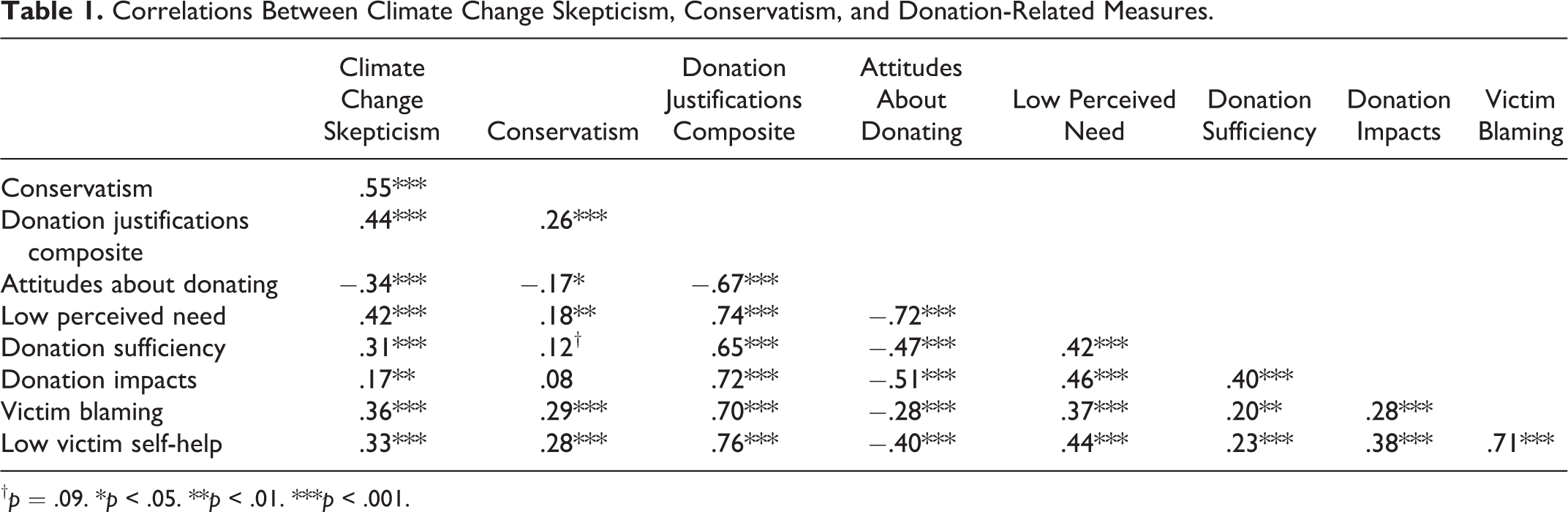
After the manipulation, participants responded to measures addressing their attitudes toward donating to relief operations as well as their justifications to provide or withhold aid. These measures were adapted from recent research by Zagefka and colleagues and are described at length subsequently (for a complete discussion, see Zagefka et al., 2012; Zagefka et al., 2011). All donation-related measures were scored on 7-point scales (1 = strongly disagree, 7 = strongly agree). Table 1 displays the correlations between climate change skepticism, conservatism, and each of the donation-related measures.
Correlations Between Climate Change Skepticism, Conservatism, and Donation-Related Measures.
† p = .09. *p < .05. **p < .01. ***p < .001.
Participants first responded to a measure of donation attitudes, which assessed their intentions to donate as well as their beliefs that donating to the victims was the right thing to do in this disaster context. These attitudes about donating were assessed with a 5-item composite (e.g., “I would be willing to give donations to the victims of this disaster,” M = 4.60, SD = 1.32, α = .91). This measure was coded such that higher scores indicated more positive attitudes toward donating.
We then measured justifications to provide or withhold donations using five interrelated constructs, each of which have been demonstrated to influence donation decisions in past research on natural and human-caused disaster events (see Zagefka et al., 2012; Zagefka et al., 2011, for a detailed discussion). Zagefka, Noor, Brown, Hopthrow, and Randsley de Moura (2012) found that when asked to provide rationales for donating (or not) to various disasters, participants’ most frequently cited rationales included those relating to perceptions of need, perceived impact of donations, beliefs about how much others have donated, the cause of the disaster, and victim blaming. Also frequently mentioned were beliefs about the extent to which victims were seen as helping themselves, which has been shown in experimental research to also play an important role in aid decisions (Zagefka, et al., 2011). Given these findings and the additional experimental research by Zagefka and colleagues, we selected these five constructs (excluding “cause of the disaster,” as this was our manipulation) to include as our measures of donation justifications. Theoretically, these constructs broadly encapsulate perceptions of the disaster victims (e.g., are the victims to blame, are they taking steps to help themselves) as well as beliefs about the efficacy of donating to the relief efforts (e.g., is aid likely to reach those most in need, are enough other people likely donating). All five measures of donation justifications were coded such that higher scores indicated greater justifications to withhold donations (e.g., greater victim blame, less perceived victim need).
Two items measured perceived need of relief donations, which were designed to address the perceived severity of the disaster and the necessity for donations to help the victims (e.g., “I believe that there is a huge need for outside help after this disaster,” M = 2.68, SD = 1.20, r = .70). Four items measured victim blaming, focusing on the extent to which the victims were perceived as at fault for their current situation (e.g., “I think the victims of the disaster might have been responsible for their plight themselves at least to some extent,” M = 2.18, SD = 1.26, α = .94).
Perceived victim self-help was also measured with 4 items focusing on perceptions of whether the victims were actively trying to improve their situation or not (e.g., “I believe that the victims did everything humanly possible to improve their situation the best they could,” M = 2.72, SD = 1.26, α = .91).
Two items measured participants’ beliefs about donation sufficiency (i.e., do donations by others make personal donations unnecessary? “I believe that so many other people have or will still donate to the victims of this disaster that my own help is unnecessary,” M = 3.19, SD = 1.40, r = .85). These items addressed assumptions about how others are or are not responding to the disaster (for an extended discussion, see Zagefka et al., 2012). Participants then responded to 4 items assessing their beliefs about donation impacts, including whether they believed that aid would be effective and reach those most in need (e.g., “I believe that money donated to the victims of this disaster most likely doesn’t reach the victims, but just benefits corrupt politicians and fanatics in power positions,” M = 3.57, SD = 1.40, α = .92).
Climate change skepticism and political ideology
After the donation-related measures, participants responded to a battery of items designed by the researchers to assess attitudes related to climate change. Five items were designed to assess general climate change beliefs (e.g., “I am certain that climate change is happening”). These 5 belief items, which served as our measure of climate change skepticism, were scored on 9-point scales (1 = strongly disagree, 9 = strongly agree) and coded such that higher scores indicate greater skepticism and less concern about climate change (M = 3.38, SD = 2.03, α = .93). As expected, scores on climate change skepticism were not influenced by the climate change framing (M = 3.42 in climate change condition, M = 3.34 in control, t(209) = −.29, ns).
At the end of the study, we also included a single item measure of political ideology (1 = Very Liberal, 6 = Very Conservative; M = 3.05, SD = 1.34). Conservatism and climate change skepticism were positively correlated, r(208) = .55. In addition, as exploratory measures, we included four other brief measures regarding climate change policies, attitudes about America’s contribution to climate change, identification with environmentalism, and perceived geographical distance of climate change effects.
Results
The Effects of Disaster Framing on Beliefs About Disaster Cause
We first tested whether framing the droughts and famine as the product of climate change significantly affected the degree to which participants attributed the disaster to human causes. Participants in the climate change condition (M = 4.19, SD = 1.54, n = 101) were significantly more likely to attribute the disaster to human causes, t(209) = −6.08, p < .001, 95% confidence interval (CI) = [−1.59, −0.812], d = .83, than in the control condition (M = 2.99, SD = 1.33, n = 110). As predicted, there was also a significant interaction between skepticism and condition (0 = control condition, 1 = climate change condition) on perceptions of the disaster as human caused, controlling for political ideology (b = −.31, SEb = 0.08, t = −3.68, p < .001, 95% CI = [−0.475, −0.144]). In the control condition, skepticism did not predict attributions of the disaster to human causes (b = −.10, SEb = 0.06, ns). Conversely, skepticism was strongly associated with disaster attributions in the climate change condition, such that higher skepticism was associated with lower belief that the disaster was attributable to human causes (b = −.41, SEb = 0.07, t = −6.11, p < .001, 95% CI = [−0.539, −0.276]).
The Impact of Disaster Framing on Donation Justifications
Given our prediction that there would be an overall second-order motivated reasoning effect whereby linking the disaster to climate change would cause climate change skeptics to utilize any justification to withhold aid presented to them as a means of disengaging from the helping context, we opted to create a global composite of the five justification measures (perceived need, donation sufficiency, donation impacts, victim blaming, and perceived self-help). Combining these five scales together formed a reliable composite (M = 2.87, SD = 0.93, α = .76), with higher scores indicating greater justifications for withholding donations.
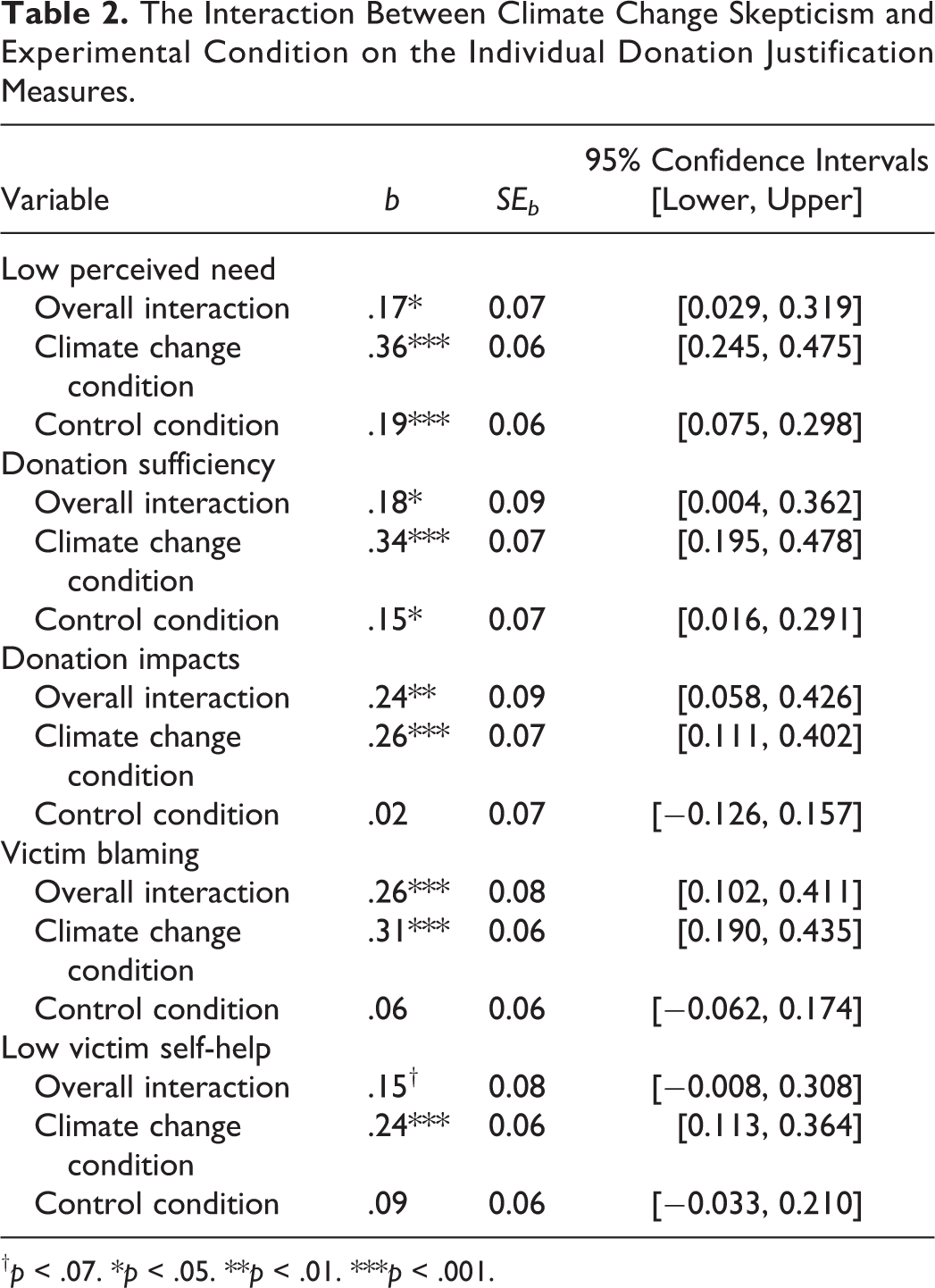
However, to provide a thorough examination of this second-order motivated reasoning prediction, we also tested for the interaction between climate change skepticism and condition on each of the justification measures individually (see Table 2). Consistent with our hypothesis, in each case, we observed the predicted interaction pattern between climate change skepticism and disaster framing that mirrors the results of the full justifications composite.
The Interaction Between Climate Change Skepticism and Experimental Condition on the Individual Donation Justification Measures.
† p < .07. *p < .05. **p < .01. ***p < .001.
When examining the full composite, there was a significant interaction between climate change skepticism and condition (controlling for political ideology) on justifications to withhold aid, consistent with our predictions (b = .20, SEb = 0.06, t = 3.62, p < .001, 95% CI = [0.092, 0.310]). 1 In the climate change condition, climate change skepticism strongly predicted greater justifications for withholding aid (b = .30, SEb = 0.04, t = 6.84, p < .001, 95% CI = [0.214, 0.388]). Skepticism also predicted greater justifications to withhold aid in the control condition, although to a lesser extent (b = .10, SEb = 0.04, t = 2.35, p = .02, 95% CI = [0.016, 0.184]). Figure 1 displays the interaction between skepticism and framing condition on the donation justifications composite.
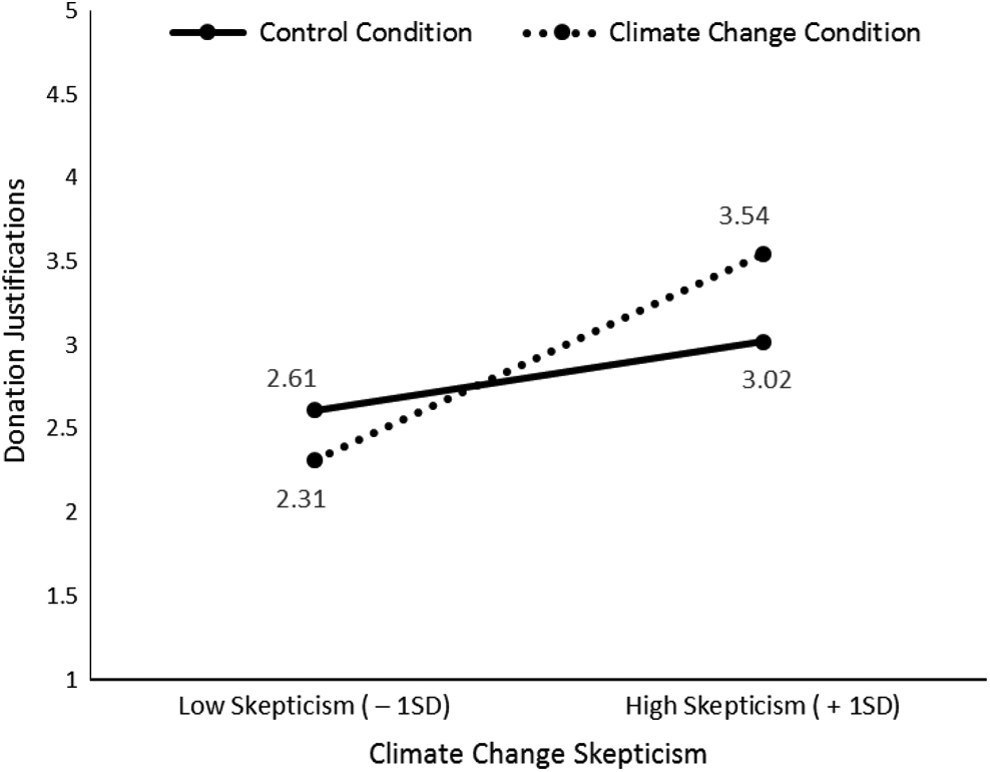
Donation justifications scores as a function of the interaction between climate change skepticism and experimental condition.
As predicted, there was a significant effect for those high in skepticism when comparing the climate change condition and the control condition, with skeptics (+1 SD on skepticism) exhibiting more negative donation justification attitudes in the climate change condition (M = 3.54) than in the control condition (M = 3.02; b = .52, SEb = 0.16, t = 3.27, p = .001, 95% CI = [0.207, 0.835]). There was also a marginal effect for those low in skepticism (−1 SD) in the opposite direction such that non-skeptics exhibited less negative justifications in the climate change condition (M = 2.31) than in the control condition (M = 2.61; b = −.30, SEb = 0.16, t = −1.87, p = .063, 95% CI = [−0.613, 0.017]).
Donation Justifications and Attitudes About Donating: Moderated Mediation Analysis
Because past research has also outlined a link between the donation justification measures and actual attitudes about donating (Zagefka et al., 2012; Zagefka et al., 2011), we also tested whether the donation justifications would mediate the relationship between climate skepticism and participants’ attitudes toward donating to relief efforts. To examine this prediction, we conducted moderated mediation analyses with the donation justification composite as a mediator between climate change skepticism and attitudes about donating. We tested moderation of both the indirect path from skepticism through donation justifications and the direct path from skepticism to attitudes about donating by experimental condition (Hayes, 2013; model 8).
Although recent methodological research on mediation (e.g., Hayes, 2009; Rucker, Preacher, Tormala, & Petty, 2011; Zhao, Lynch, & Chen, 2010) indicates that it is not required for there to be a significant overall relationship between the IV and distal outcome variable (in this case, donation attitudes), from our second-order motivated reasoning perspective, we also anticipated there would be an interaction between climate change skepticism and experimental condition on attitudes about donating that would mirror the effects shown for donation justifications. Thus, we tested for the interaction of climate skepticism and framing condition on donation attitudes, controlling for political ideology. Consistent with the findings for the donation justification measures, there was a significant interaction on attitudes about donating (b = −.17, SEb = 0.08, t = −2.10, p = .041, 95% CI = [−0.336, −0.007]). In the climate change condition, greater climate change skepticism predicted less positive attitudes toward donating (b = −.32, SEb = 0.07, t = −4.85, p < .001, 95% CI = [−0.452, −0.191]). There was also a weaker (but significant) relationship in the control condition (b = −.15, SEb = 0.06, t = −2.33, p = .021, 95% CI = [−0.276, −0.023]). Thus, climate change skepticism predicts donation attitudes, and this relationship is significantly stronger in the climate change framing condition than the natural drought condition. Therefore, next we tested whether this relationship was mediated by the justifications for/against providing aid.
Using Hayes’ PROCESS macro for SPSS 22 (Model 8), we conducted a moderated mediation analysis testing moderation (by experimental condition) of both the direct and indirect paths (i.e., mediated by donation justifications) from skepticism to donation attitudes. As predicted, Hayes’ index of moderated mediation (which uses bootstrapping methods to test for moderated mediation, see Hayes, 2015) did not pass through zero (95% bootstrapped CIs (b = −.19, SE boot = 0.06, 95% CI = [−0.316, −0.071]). This test indicates that the strength of the indirect effect from skepticism to attitudes about donating through donation justifications was significantly different in the climate change and natural drought conditions. Follow-up examination of each of these conditional indirect effects indicates that there was a significant indirect effect of skepticism on donation attitudes through donation decision justifications for participants in the climate change condition (b = −.28, SE boot = 0.05, 95% CI = [−0.393, −0.185], 95% CIs generated using 10,000 bootstrapped samples). There was also a significant indirect effect in the natural drought condition, although to a lesser extent (b = −.09, SE boot= .04, 95% CI = [−0.181, −0.008]). Furthermore, after accounting for the indirect (i.e., mediated) effects, there was no significant conditional direct effect in the control (b = −.06, SEb = 0.05, ns) or the climate change condition (b = −.04, SEb = 0.06, ns). 2
Discussion
The present research suggests that framing a disaster as caused by climate change can impact the degree to which individuals justify providing or withholding humanitarian support. Consistent with our second-order motivated reasoning hypothesis, participants high in climate change skepticism utilized greater justifications for withholding aid when the disaster was framed as climate change caused, which also had a negative effect on their attitudes toward donating to victims. These findings contribute to the growing literature on the role of motivated reasoning and ideology in the construal of scientific information and its effects on public policy (Kahan, 2013; Kahan et al., 2012; Roh, McComas, Rickard, & Decker, 2015). In particular, this study further extends the implications of ideologically motivated construal by providing novel evidence for a second order motivated reasoning effect. The biases one holds about a politicized issue such as climate change can affect perceptions and responses to the distal consequences of disaster events that are framed as connected with this politicized issue.
As discussed previously, much of the literature on ideology and interpretation of scientific evidence has focused on how motivated reasoning processes affect the public’s interpretation of scientific evidence (e.g., Kahan et al., 2011; Kahan et al., 2012). In this context, motivated construal of the scientific information is directly related to one’s ideological beliefs (i.e., direct motivated reasoning effects). Our findings suggest that future work should also explore the potential for second order effects, whereby individuals construe information about world events differently depending on whether they are linked with a polarizing issue. This could possess significant implications for how scientific information about present and future risks is communicated to the public. It is rarely the case that the discussion of these issues in the media is free of ideological framings. Media speculation about climate change as the cause of recent natural disasters is commonplace. This is further exemplified in much of the recent dialogue regarding the ongoing droughts in California (e.g., Samenow, 2015). What our research suggests is that making this connection between the scientific evidence and a real disaster could have quite troublesome effects for how (certain) members of the public respond to these disasters. Given the real possibility that some ongoing and future disasters are/will be, in fact, related to climate change, understanding how individuals reason about these events and construe disaster-related information in light of their ideological beliefs seems particularly pertinent. Future research, therefore, should extend the scope of inquiry beyond the effects of worldview biases on the construal of scientific information to also examine how linking this information with real disasters affects individuals’ responses to the victims of such events and their perceptions of future, related, disaster risks (e.g., likelihood of impending wildfires).
This study also contributes to research on the psychology of charitable giving by indicating that disagreement over a heavily divided political issue can affect helping behaviors. The issue of polarization of relief efforts as a product of dimensions of the disasters themselves has been largely unexplored in the literature. In the most relevant preexisting research, Zagefka et al. (2011) found that people look at human-caused disasters differently than “natural” disasters. In their work, famine caused by war generally led to less support for donations than a famine caused by naturally occurring drought. The current research shows the influence of beliefs about climate change is also important when droughts are framed as being caused by climate change. For climate change skeptics, in particular, support for aid was lower when the drought was caused by climate change. Intriguingly, there was also some evidence of an opposite effect for those low in skepticism showing particularly low levels of justifications for withholding aid when the drought was described as being caused by climate change. Although the current study showed that the framing effect was stronger for climate change skeptics, future research should examine in more detail the ways in which climate change framings may impact climate change believers as well as skeptics. Outside of the work of Zagefka and colleagues, there is still little known about how the different causes of disasters and related dimensions of ideology influence the donation decision process and this is an important topic for future research.
These findings also possess implications for media portrayals of disaster events, particularly when large amounts of external public donations are required to respond to these events. These data suggest that organizations appealing for aid (and media outlets reporting on natural disasters) should be cautious of blending aid appeals with the discussion of contentious ideological topics, as it could result in an unintended backlash against the disaster victims. While our findings indicate that framing a natural disaster as the product of climate change may affect donations, future research should build on these findings by testing them in the context of future disasters as they unfold.
Although the scientific evidence about the role of human activity in causing climate change has reached consensus, there remains great uncertainty about the role of climate change in any specific weather event and even longer term patterns such as recurring drought. This inherent uncertainty means that many, if not all, events that may be caused by climate change will be subject to debate and divergent interpretations. As the current work shows, these interpretations and divergent perspectives may even affect people’s perceptions of the victims of disaster events via motivated reasoning processes.
Footnotes
Acknowledgment
The authors wish to thank Hanna Zagefka for helpful comments on an earlier version of this article.
Declaration of Conflicting Interests
The author(s) declared no potential conflicts of interest with respect to the research, authorship, and/or publication of this article.
Funding
The author(s) received no financial support for the research, authorship, and/or publication of this article.