






Abstract
The present research tested the unique associations between attachment and basic psychological need fulfillment in relationships. Past research shows that anxious and avoidant attachment are associated with distinct patterns of relationship behaviors, wherein anxious attachment is related to excessive attention to the relationship and avoidant attachment is related to detachment from the relationship. Specifically, we explored the role of romantic partner’s attachment in predicting each other’s experiences of relatedness, autonomy, and competence. Across two samples of undergraduate romantic couples (n sample 1 = 156, n sample 2 = 264), one’s own anxious and avoidant attachment predicted generally lower basic psychological need fulfillment. Having a more anxiously attached partner predicted higher relatedness but lower autonomy, whereas having a more avoidantly attached partner predicted lower relatedness but higher autonomy need fulfillment. These results extend prior research, suggesting that one’s partner’s anxious and avoidant attachment has distinct implications for one’s own outcomes.
Over the last several decades, researchers have paid increasing attention to the ways in which close relationships promote or hinder psychological well-being. One such perspective emerges from work on self-determination theory (SDT), which outlines three basic psychological needs (autonomy, competence, and relatedness) that are essential for optimal growth, development, and well-being (Deci & Ryan, 2000). Fulfillment of basic psychological needs promotes relationship quality (Patrick, Knee, Canevello, & Lonsbary, 2007) and is associated with less anxious and avoidant attachment (La Guardia, Ryan, Couchman, & Deci, 2000). However, little is known about dyadic factors that promote or inhibit basic psychological needs. That is, what characteristics of partners are associated with individuals’ basic psychological need fulfillment? To begin to address this question, we examine the role of adult attachment, primarily because the theory provides useful information regarding potential individual differences that support or undermine close others’ need fulfillment. In doing so, this research was designed to examine how a romantic partner’s attachment supports or undermines different dimensions of an individual’s well-being.
Basic Psychological Need Fulfillment
According to SDT, basic psychological needs are innate psychological nutriments which are essential for psychological growth and well-being (Deci & Ryan, 2000). SDT proposes three basic psychological needs: autonomy, competence, and relatedness (for a discussion, see Deci & Ryan, 2000; Ryan & Deci, 2000). Autonomy reflects the degree to which one’s behavior is initiated by one’s true self, and that one is perceived as the origin of one’s behavior (Ryan & Deci, 2002). Autonomy in this context does not simply mean independence or detachment, but rather encompasses the feeling that one’s actions are freely chosen and not compelled (Ryan, 1993; Ryan & Lynch, 1989). Competence reflects feeling capable and effective at what one does. A broad literature has supported the importance of ongoing feelings of competence for optimal functioning and well-being (Bandura, 1977; Carver & Scheier, 1990; White, 1959). Relatedness reflects the experience of a sense of belonging and intimacy (Deci & Ryan, 2000). Relatedness is echoed across many other perspectives, such as the need to belong (Baumeister & Leary, 1995) and the interpersonal process model of intimacy (Reis & Patrick, 1996). Past research has reviewed extensive evidence on belongingness as a vital human motivation. For example, Reis and Patrick (1996) defined intimacy in terms of reciprocal responsiveness to feeling understood, validated, and cared for, and experiencing these ingredients of intimacy results in optimal psychological and relationship functioning.
Importantly, previous research has shown that all three basic psychological needs are important for a variety of outcomes. For instance, need fulfillment promotes an individual’s mental well-being, such as increasing vitality and positive affect and decreasing negative affect (Reis, Sheldon, Gable, Roscoe, & Ryan, 2000; Ryan, Sheldon, Kasser, & Deci, 1996; Sheldon & Kasser, 1998; Uysal, Lin, & Knee, 2010; Uysal, Lin, Knee, & Bush, 2012). Further, need fulfillment promotes relational well-being, predicting better relationship quality (Knee, Hadden, Porter, & Rodriguez, 2013; Patrick et al., 2007). Finally, need fulfillment has been found to predict cognitive and motivational orientations. For instance, when people perceive that a given relationship supports their basic psychological needs, they are less likely to be insecurely attached (La Guardia et al., 2000; Ryan, La Guardia, Solky-Butzel, Chirkov, & Kim, 2005) and more likely to exhibit self-determined motivation (Patrick et al., 2007).
In sum, a central component of SDT is the notion that partners support each other’s growth and well-being through a multicomponent process. That is, SDT specifies that growth and well-being emerge from partners promoting several distinct factors: (a) fostering a sense of relatedness by seeking intimacy; (b) facilitating autonomy by providing partners a nonjudgmental atmosphere and not being controlling, demanding, or overbearing; and (c) encouraging competence by signaling that partners are capable in their actions. People must be available should partners need help while simultaneously providing autonomy support by not interfering and undermining the partner’s confidence. Given the importance of psychological need fulfillment to individuals’ well-being, it is important to understand the role that romantic partners play in supporting or undermining each psychological need. Although research has examined intrapersonal factors that are related to people’s own need fulfillment such as less anxious or avoidant attachment (e.g., La Guardia et al., 2000; Patrick et al., 2007), little research has considered dyadic factors that may promote or undermine each psychological need. Two notable exceptions found that people report higher overall need fulfillment if their romantic partners conceal less (Uysal et al., 2012) or exhibit more self-determined motivation (Hadden, Rodriguez, Knee, & Porter, 2015). In the present research, we integrate attachment orientations with need fulfillment, exploring the unique associations between an individual’s experience of basic psychological needs as a function of his or her romantic partner’s attachment, highlighting the importance of romantic partner’s attachment in predicting each other’s well-being.
Attachment
Attachment theory provides a useful framework regarding individual differences in supporting romantic partners’ fulfillment of each basic psychological need. Attachment orientations reflect people’s beliefs about relationship partners and emerge from past experiences in important relationships (e.g., Bowlby, 1973, 1980; Hazan & Shaver, 1994). Anxious attachment reflects an uncertainty that partners can be relied upon to be available in times of need. People who are more anxiously attached worry about being rejected by their partner and tend to be hypervigilant to cues of relationship distress. Avoidant attachment reflects a certainty that romantic partners cannot be relied upon to be available. People who are more avoidant tend to be less comfortable with intimacy (Hazan & Shaver, 1987; Shaver & Mikulincer, 2005; Shaver & Mikulincer, 2007). Although attachment theory specifies secure attachment as a third orientation, secure attachment is usually operationally defined as being relatively low in anxious and avoidant attachment.
In what ways might romantic partners’ attachment predict each other’s need fulfillment? We suggest that an individual’s psychological needs may be differentially promoted or undermined by his or her partner’s anxious and avoidant attachment. Specifically, a partner’s anxious attachment will undermine an individuals’ autonomy and competence while promoting relatedness, and a partner’s avoidant attachment will undermine an individual’s relatedness while possibly promoting autonomy and competence. Although no attachment research has examined dyadic need fulfillment directly, research suggests that attachment orientations have distinct patterns of implications for support processes (Collins & Feeney, 2000, 2004; Feeney, 2007; Feeney & Thrush, 2010). Specifically, anxious attachment is strongly linked to a desire for extreme closeness with romantic partners. As such, it is possible that if a partner is higher in anxious attachment, he or she will take an active role in one’s own interests, indicating care and concern, and ultimately foster an individual’s sense of relatedness. This boost in relatedness, however, may come with a price. As anxious attachment is also denoted by hyperactive awareness of relationship distress and fear of rejection, a partner’s desire for closeness may come with increased judgment and be perceived as controlling, overbearing, or demanding. That is, a partner who is higher in anxious attachment may react to neutral actions (such as spending a night alone) negatively and be less likely to give one room to express his or her autonomy. By being overinvolved in one’s life, a partner who is higher in anxious attachment may also undermine one’s sense of competence, in a manner similar to visible support (Bolger, Zuckerman, & Kessler, 2000). In other words, the partner undermines one’s sense of efficacy, signaling that one cannot succeed on one’s own. These predictions are also consistent with research on secure base support (Feeney & Thrush, 2010), which found that partners who are more anxiously attached are less encouraging of and more likely to interfere with individual’s exploration during a lab task but did not similarly predict less availability.
Avoidant attachment, on the other hand, leads people to reject closeness and seek to maintain psychological distance from their romantic partners. For instance, partners who are more avoidantly attached tend to avoid self-disclosure (e.g., Wei, Russell, & Zakalik, 2005), do not effectively seek support (e.g., Collins & Feeney, 2000), and are generally not available should individual’s need help or comfort (Feeney & Thrush, 2010). Following from this, it is likely that partner’s avoidant attachment undermines individuals’ relatedness because the partner resists intimacy building. Partners’ avoidance could also come with a cost to individuals’ autonomy in that it could communicate, neglect, or detach rather than autonomy support. However, aversion to closeness could lead an avoidant partner to be less controlling, demanding, or overinvolved in one’s daily activities, thus supporting these aspects of autonomy. We are also agnostic about the relationship between partners’ avoidant attachment and an individuals’ competence. On one hand, partners’ avoidance may encourage competence, as a lack of involvement may increase one’s perception that he or she is the one who “makes the relationship work.” On the other hand, an avoidant partner would be less likely to acknowledge and facilitate one’s successes (Shallcross, Howland, Bemis, Simpson, & Frazier, 2011), and thus, an individual may feel less competent. In sum, given the unique patterns of behavior exhibited by anxious and avoidant attachment, it is likely that partners’ anxious and avoidant attachment have unique implications for individuals’ basic psychological need fulfillment and, thus, psychological well-being.
Current Research
The present research was designed to test the dyadic implications of attachment for need fulfillment in romantic relationships, examining the specific routes through which a romantic partner’s attachment supports or undermines psychological well-being. We tested whether romantic partners promote or undermine each other’s basic psychological needs based on their attachment orientations. As the issue of direct (not just conceptual) replication remains a concern in psychological science (Open Science Collaboration, 2012), we tested our hypotheses in two samples using identical recruitment methods. Two samples were collected as part of larger separate studies but included identical surveys of primary interest. However, they contained different measures of satisfaction, which were used as covariates. We expected distinct patterns to emerge regarding associations between partner A’s attachment and partner B’s experience of need fulfillment. Of secondary interest was to replicate the associations between one’s own attachment and need fulfillment which have been reported elsewhere (Patrick et al., 2007). In that work, individuals’ attachment anxiety and avoidance were both negatively associated with individuals’ own need fulfillment. We made the following predictions: Partner’s anxious attachment would (a) positively predict individual’s relatedness, (b) negatively predict individual’s autonomy, and (c) negatively predict individual’s competence. Partner’s avoidant attachment would (a) negatively predict individual’s relatedness. We were agnostic about how partner’s avoidant attachment would predict individual’s (b) autonomy or (c) competence. Replicating prior research, individual’s anxious and avoidant attachment would negatively predict individual’s own (a) relatedness, (b) autonomy, and (c) competence.
Method
Participants and Procedure
Both samples were recruited from a large, metropolitan Southwestern university. All participants were dating or married heterosexual couples who reported being in a committed romantic relationship for at least 3 months. At least one member of the dyad was an undergraduate student currently enrolled in a psychology course and was offered course credit for participation. Individuals were recruited via classrooms, flyers, and an online research management system. Partners were e-mailed a link to the study and were asked to complete the survey independently. Samples were collected across separate semesters, and data collection was cutoff at the end of each sample’s respective semester.
Sample 1
Participants included 78 romantic dyads (total n = 156). Participants ranged in age from 21 to 55 years (M = 25.0 years and SD = 5.9). The sample was racially diverse, with 28.8% Caucasian, 16.7% Asian, 7.7% African American, and 9.0% “Other.” More than a third of the participants reported being Hispanic/Latino (37.9%). Average relationship duration was 3.4 years (SD = 4.1 years). Four percent of the sample reported casually dating, 50% exclusively dating, 23% nearly engaged, 8% engaged, and 15% married.
Sample 2
Participants included 132 romantic dyads (total n = 264) who ranged in age from 18 to 67 years old (M = 24.2 years and SD = 5.8). The sample was racially diverse: 41.9% Caucasian, 17.0% Asian, 8.3% African American, 1.2% Native American, 1.7% Native Hawaiian, and 29.9% multiethnic or Other. Average relationship duration was 3.4 years (SD = 3.3 years). Four percent of the sample reported casually dating, 52% exclusively dating, 20% nearly engaged, 8% engaged, and 16% married.
Power analyses
Power analyses for the Actor–Partner Interdependence Model (APIM; Ackerman, Ledermann, & Kenny, unpublished manuscript) assuming small-to-medium effects, equal magnitude of actor and partner effects (βs = 25), and moderate correlations between actor and partner variables (r = .30) estimate power of .92 for 78 dyads in Sample 1 and .99 for 132 dyads in Sample 2.
Measures
Attachment
Attachment was measured with the Experiences in Close Relationships Scale–Short Form (Wei, Russell, Mallinckrodt & Vogel, 2007). Items (6 each for attachment anxiety and avoidance) asked participants about their experiences in romantic relationships and were measured on a 5-point Likert-type scale with response options from 1 (strongly disagree) to 5 (strongly agree). Anxiety items include, “I need a lot of reassurance that I am loved by my partner” (αsample 1 = 76 and αsample 2 = 72). Avoidance items include, “I try to avoid getting too close to my partner” (αsample 1 = 80 and αsample 2 = 79).
Need fulfillment
Basic psychological need fulfillment derived from one’s relationship was assessed with the 9-item Basic Psychological Needs Scale (La Guardia et al., 2000). Three subscales (3 items each) all followed the stem, “When I am with my romantic partner … ” and measured relatedness (e.g., “I feel loved and cared about”; αsample 1 = 83 and αsample 2 = 75), competence (e.g., “I feel like a competent person”; αsample 1 = 82 and αsample 2 = 73), and autonomy (e.g., “I have a say in what happens and can voice my opinion”; αsample 1 = 78 and αsample 2 = 70) on a 7-point rating scale ranging from 1 (strongly disagree) to 7 (strongly agree).
Relationship satisfaction
Sample 1 used the Quality of Marriage Index (Norton, 1983), reworded to apply to people in both dating and married relationships (e.g., “marriage” was reworded to “relationship”). Six items asked partners to report the extent to which they agree with the statements about their relationship (e.g., “We have a good relationship”; αsample 1 = 93). Participants responded to each item on 7-point scales from 1 (very strong disagreement) to 7 (very strong agreement). Sample 2 used the satisfaction subscale of the Rusbult Investment Model Scale (Rusbult, Martz, & Agnew, 1998), composed of 5 items (e.g., “I feel satisfied with our relationship”; αsample 2 = 95). Participants responded to each item on 9-point scales from 0 (do not agree at all) to 8 (agree completely).
Results
Analysis Plan
The APIM (Kenny, Kashy, & Cook, 2006) is a dyadic data analytic approach used to model nonindependence in interpersonal relationships and allows for a study of the stability and reciprocity unique to partners in relationships. Nonindependence was estimated by the correlation between partner reports. All analyses were run with SAS PROC MIXED (Version 9.4). Primary analyses simultaneously examined actor and partner effects of anxiety and avoidance on each of the three needs. Actor effects represent associations between an individual’s own attachment and need fulfillment. Partner effects represent associations between partner’s attachment and an individual’s need fulfillment. To estimate the unique associations of attachment with individual needs, actor and partner need fulfillment of the other two needs were included as covariates. Gender was also included as a main effect in all models.
Ancillary analyses included: (a) We ran follow-up analyses that included both actor and partner interactions with gender; (b) interactions between both actor and partner anxious and avoidant attachment; (c) because of the high overlap between need fulfillment and satisfaction (Patrick et al., 2007) we also ran analyses controlling for relationship satisfaction to test whether effects emerge regardless of how happy individuals are; and (d) because attachment is influenced by relationship duration (Hadden, Smith, & Webster, 2014), we controlled for relationship duration to ensure that such effects are not a result of how long couples have been together.
Descriptive Statistics and Preliminary Associations
Zero-order correlations and descriptive statistics, reported separately by sample, are presented in Table 1. Correlations showed that actor anxious and avoidant attachment were negatively associated with all three types of need fulfillment in both samples.
Zero-Order Correlations Among All Study Variables (Samples 1 and 2).

Note. Correlations are provided above the diagonal for men and below the diagonal for women (collapsed descriptives below). Correlations between male and female responses are presented along the diagonal. NF = need fulfillment.
*p < .05. **p < .01. ***p < .001.
APIMs
APIM were utilized to examine actor and partner effects of anxious and avoidant attachment on fulfillment of relatedness, autonomy, and competence. Results from the APIMs, separated by sample, including confidence intervals and effect sizes (standardized regression coefficients) are presented in Table 2.
Actor and Partner Effects of Attachment Anxiety and Avoidance on Need Fulfillment (NF; Samples 1 and 2).
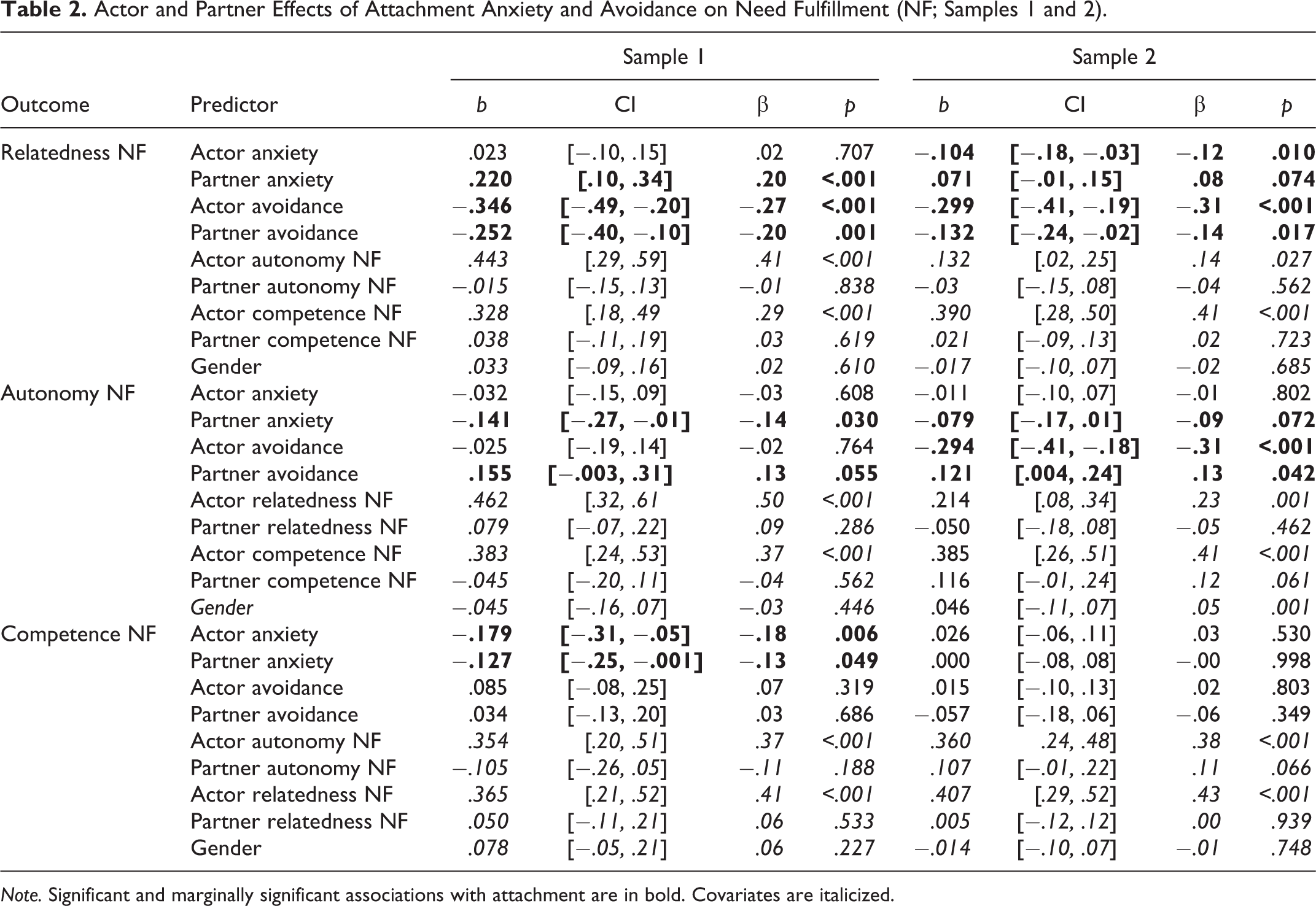
Note. Significant and marginally significant associations with attachment are in bold. Covariates are italicized.
The primary research question focused on partner effects of anxiety and avoidance on need fulfillment. As expected, for relatedness, a positive partner effect of anxiety (Samples 1 and 2) suggested that individuals with anxious partners reported higher relatedness fulfillment (Hypothesis1a). Also as hypothesized, a significant partner effect of avoidant attachment (Samples 1 and 2) suggested that partners of avoidant individuals reported lower relatedness fulfillment (Hypothesis 2a). Additionally, a negative actor effect of anxiety in Sample 2 but not Sample 1 tentatively suggested that anxious individuals reported lower relatedness need fulfillment (Hypothesis 3a). A negative actor effect of avoidance (Samples 1 and 2) suggested that avoidant individuals reported lower relatedness fulfillment (Hypothesis 3a).
For autonomy fulfillment, the hypothesized partner effect of anxious attachment emerged (Samples 1 and 2), suggesting that individuals with anxious partners reported lower levels of autonomy support (Hypothesis 1b). Further, a partner effect of avoidant attachment (marginal in Sample 1, significant in Sample 2), showed that individuals with avoidant partners reported higher levels of autonomy fulfillment (Hypothesis 2b). We found no evidence of an actor effect of anxious attachment on autonomy need fulfillment (Hypothesis 3b). Additionally, there was a negative actor effect of avoidance in Sample 2 but not Sample 1, tentatively suggesting that avoidant individuals reported lower levels of autonomy support (Hypothesis 3b).
Finally, for competence need fulfillment, a negative partner effect of anxious attachment emerged in Sample 1 but not Sample 2 tentatively suggesting that individuals with anxious partners felt less competent (Hypothesis 1c). There were no significant partner effects of avoidant attachment in either sample (Hypothesis 2c). A negative actor effect of anxious attachment in Sample 1 but not Sample 2 tentatively suggested that people with higher anxious orientations also experienced lower feelings of competence (Hypothesis 3c). There was no actor effect of avoidant attachment on competence (Hypothesis 3c).
Ancillary analyses
Ancillary analyses were run including interactions with gender for the above models. Gender did not moderate any of the partner effects of attachment, suggesting that our primary findings are consistent for both men and women. 1
Next, we conducted a series of exploratory interaction analyses. First, we examined all actor Anxious × Avoidant and partner Anxious × Avoidant interactions in order to test if there was a unique prediction of secure attachment. No actor interactions emerged as significant in either sample. Further, no partner interactions emerged in Sample 1, and only one partner interaction (b = −.110, p = .019) emerged in Sample 2. The nature of this interaction was such that the already negative association between partner anxious attachment and autonomy fulfillment was stronger at higher levels of actor avoidant attachment. However, because this effect was only found in one sample and we found no evidence of such a pattern with other outcomes, we urge caution in interpreting this finding.
Second, we computed models that included Actor × Partner attachment interactions (e.g., Actor anxious × Partner anxious) to test for the possibility that an individual’s attachment style moderates the partner effects. Regarding relatedness, actor anxious attachment marginally moderated the partner effect of anxious attachment (b = −.120, p = .059) in Sample 1 (not Sample 2), such that the positive association between partner anxious attachment and actor relatedness is stronger for individuals who are more anxiously attached. Regarding autonomy, actor anxious attachment moderated the partner effects of avoidant attachment (b = .203, p = .010) and (marginally) anxious attachment (b = −.130, p = .062) in Sample 1 (not Sample 2). The pattern of the interactions was such that the positive association between partner avoidant attachment and actor autonomy and the negative association between partner anxious attachment and actor autonomy were both stronger for individuals who were themselves more anxiously attached. Regarding competence, actor avoidant attachment moderated the partner effect of avoidant attachment (b = −.080, p = .006) in Sample 2 (not Sample 1) such that the null association between partner avoidant attachment and actor competence was positive for individuals who were higher in avoidant attachment. No other interactions emerged as significant. Given the underpowered nature of these models and the lack of replication, we urge caution in interpreting these findings and consider these interactions to be exploratory.
Finally, results generally held when controlling for both relationship satisfaction and duration. The only exceptions were that, in Sample 1, the marginal positive partner effect of avoidant attachment on autonomy fulfillment became significant (p = .037) and the significant negative partner effect of avoidant attachment on relatedness fulfillment became marginal (p = .076). In Sample 2, the significant positive partner effect of avoidant attachment on autonomy fulfillment became marginal (p = .064) when controlling for duration. 2
Discussion
Our findings provide novel insight regarding our understanding of both need fulfillment and attachment processes in relationships by examining the dyadic implications of partner’s attachment for perceptions of different needs within the relationship. By integrating attachment with SDT’s concept of basic psychological needs, we were able to capture how attachment is associated with distinct theoretically relevant dimensions of well-being. In the present research, we found consistent support for partner (between-individual) associations among attachment and need fulfillment in romantic relationships, underscoring the distinct implications of anxious and avoidant attachment for relational well-being. Specifically, the degree to which one’s partner is anxiously attached was found to significantly (Sample 1) and marginally (Sample 2) positively predict one’s own relatedness (Hypothesis 1a) and negatively predict one’s own autonomy (Hypothesis 1b; both samples). Partner anxious attachment also negatively predicted one’s own competence (Hypothesis 1c; Sample 1 but not Sample 2). Avoidant attachment exhibited the opposite pattern, with partner avoidant attachment predicting lower levels of one’s own relatedness (Hypothesis 2a; both samples) and significantly (Sample 2) and marginally (Sample 1) higher levels of one’s own autonomy (Hypothesis 2b). Further, we found no evidence that avoidant attachment (whether actor or partner) was associated with one’s own perceptions of competence (Hypothesis 1c and 2c, both samples). This is consistent with prior work that found no significant association between avoidant attachment and competence fulfillment (Patrick et al., 2007).
Results suggest that both dimensions of attachment have potential implications for how partners perceive the relationship and how their psychological needs are supported. That is, anxious and avoidant attachment are not related to partners’ perceptions in the same way, consistent with prior literature suggesting that anxious and avoidant attachment influence relationships in distinct patterns. Having a partner who is higher in attachment anxiety is associated with feeling that one’s autonomy and (tentatively) competence are undermined while simultaneously feeling closer to one’s partner. Anxious attachment appears to predict need fulfillment in a pattern that is consistent with prior work demonstrating that anxious attachment is marked by desire for extreme closeness and lack of trust (Shaver & Mikulincer, 2007). However, people with partners who are high in anxious attachment also experience less autonomy, as they may see their partner as demanding or controlling. Having a more avoidant partner is associated with greater perceptions of autonomy but lower levels of relatedness, which is consistent with research suggesting that more avoidant individuals tend to detach from the relationship and reject closeness. When a romantic partner is more avoidant, individuals also reported more autonomy, suggesting that they perceived their partner as allowing space and freedom. However, this comes at the cost of decreased relatedness. Although we suggest that attachment orientations likely predict need fulfillment patterns by way of how the partner behaves and is perceived (e.g., anxious partners seeking closeness but also being perceived as potentially demanding and controlling), these were not directly measured in these data but are consistent with behavioral patterns observed in previous research (e.g., Feeney & Thrush, 2010). Further, despite the partially positive outcomes of partner’s insecure attachment, we do not suggest that either dimension of insecure attachment is overall beneficial for relationships. It is likely that the presence of anxious or avoidant attachment has overall long-term negative consequences (Hadden et al., 2014). Rather, we interpret our findings as suggesting distinct patterns in the way partners’ anxious and avoidant attachment influence each other’s perceptions of the relationship.
We also replicated previously established actor associations between attachment and need fulfillment (e.g., La Guardia et al., 2000; Patrick et al., 2007), albeit with mixed results. Actor anxiety was negatively associated with relatedness (Hypothesis 3a; Sample 2 but not Sample 1) and competence (Hypothesis 3c; Sample 1 but not Sample 2) but was not associated with autonomy fulfillment in either sample. Actor avoidance was negatively associated with relatedness (Hypothesis 3a; both samples) and autonomy (Hypothesis 3b; Sample 2 but not Sample 1) but was not associated with competence in either sample. That more anxious and avoidant individuals perceived lower levels of relatedness in their relationship is consistent with research, suggesting that insecure attachment is associated with more pessimistic relationship evaluations (Murray, Holmes, Bellavia, Griffin & Rose, 2001; Segal & Fraley, 2015). The actor effect of avoidance on autonomy is consistent with work showing that the closeness that typifies intimate relationships may be perceived as a lack of autonomy to avoidant individuals. It is also possible that avoidant individuals have a higher threshold for autonomy support in their relationships, such that they would prefer more autonomy to be fulfilled. Among the future directions from this research is a better understanding of the importance of each basic psychological need based on attachment orientations.
Although we believe that our results provide compelling dyadic evidence that partners’ attachment is important for understanding the degree to which people’s needs are fulfilled, it is important to note that both samples used cross-sectional designs, and as such, we were unable to determine causation or how partners’ attachment may affect perceptions of need fulfillment over time. Recent evidence also shows that attachment security varies somewhat over time (Finkel, Burnette, & Scissors, 2007). As such, an important next step is to follow these findings up with longitudinal designs that better assess ongoing levels of partners’ need fulfillment as a function of attachment orientations.
Further, although we conducted exploratory tests of possible interactions between actor and partner attachment orientations, the findings were largely inconsistent. We believe that this may be because the current studies are underpowered to test such moderation analyses. As such, future work may shed further light onto the dyadic nature of attachment by exploring interactions in more well-powered studies.
Finally, recent research suggests that need fulfillment and thwarting are distinct constructs with separate motivational components (Vansteenkiste & Ryan, 2013). As such, exploring how partners’ attachment relates to both fulfillment and thwarting of needs may provide a more complete understanding of these relationships. For instance, it is possible that the positive associations between partner avoidance and autonomy are the result of lower autonomy thwarting but not higher autonomy fulfillment.
Conclusion
The present research used a dyadic perspective to integrate SDT with attachment in order to better understand how attachment orientations predict the degree to which romantic partners support or undermine each other’s psychological well-being. Using reports from both partners, we provide novel insight into the dyadic nature of both attachment and need fulfillment. Across two samples of romantic couples, we found evidence that partner’s anxious and avoidant attachment have distinct implications for one’s own psychological need fulfillment. These findings build on past research highlighting the difference between anxious and avoidant attachment by examining relationship partner’s well-being. Additionally, the present work identifies factors that predict the support of specific psychological needs, identifying more specific ways in which anxious and avoidant attachment might related to dyadic well-being.
Footnotes
Declaration of Conflicting Interests
The author(s) declared no potential conflicts of interest with respect to the research, authorship, and/or publication of this article.
Funding
The author(s) received no financial support for the research, authorship, and/or publication of this article.