







Abstract
Adults can be made to experience state attachment security (e.g., feel calm, cared for, and trusting) when they recall experiences, in which others were accepting and responsive. In two experiments, we tested whether receiving affectionate touch in the context of a close relationship naturally promotes state attachment security. As hypothesized, participants who imagined receiving touch had greater accessibility of secure words on a memory task (Experiment 1) and participants who physically received touch from their romantic partners self-reported greater state security (Experiment 2) than participants who did not receive touch. Neither the relationship context (romantic partner or close friend) nor the attribution for the touch moderated touch’s effect on state security. However, consistent with predictions, touch promoted security more for individuals low in avoidant attachment than highly avoidant individuals. By promoting state security, touch may facilitate positive relational behaviors and cognitions to improve and protect adult relationships.
Warm, affectionate touch occurs commonly in adult close relationships. For instance, close friends and romantic partners may hug during reunion or departure, tap one another on the arm during a conversation, or touch affectionately while watching television. However, the outcomes of touch receipt in adulthood have been largely unexplored. Building on attachment theory and previous empirical research on touch (e.g., Ainsworth, Blehar, Waters, & Wall, 1978; Anisfeld, Casper, Noyzce, & Cunningham, 1990; Bowlby, 1969/1982; Debrot, Schoebi, Perrez, & Horn, 2013), we propose that touch is an attachment-relevant behavior with important consequences. Specifically, we propose that receiving touch in an adult close relationship promotes state attachment security: felt security (feelings of safety and closeness) and the activation of a secure attachment schema (expectations that others are trustworthy and accepting; memories of secure relational experiences; e.g., Baldwin, 2007; Carnelley & Rowe, 2010).
Trait and State Attachment Security
Attachment theory posits that individuals are motivated to form and maintain close relationships across the life span because proximity to close others offers a survival advantage (Bowlby, 1969/1982, 1973). When close others demonstrate their availability and care, individuals experience felt security (e.g., feel safe, protected, and cared for). Through repeated responsive experiences, individuals may develop secure working models of attachment in which the self is viewed as deserving of love and acceptance, and close others are perceived as trustworthy, available, and responsive (e.g., Bowlby, 1969/1982, 1973; Mikulincer & Shaver, 2003). Alternatively, if caregivers are not consistently available and responsive, individuals may develop insecure working models of attachment (see Mikulincer, Shaver, & Pereg, 2003).
These working models can be viewed as relational schemas that shape expectations, motivation, and behavior (Baldwin, 1992; Collins & Read, 1994). Typically, an individual has a chronically accessible relational schema (referred to as one’s trait attachment orientation) as well as other relational schemas that can be activated by the context (Sibley & Overall, 2010). Thus, an individual has a trait secure or insecure attachment orientation but can experience state security or insecurity as the result of a specific experience or prime (Baldwin & Fehr, 1995; Baldwin, Keelan, Fehr, Enns, & Koh-Rangarajoo, 1996). Individuals who are primed with security temporarily feel more secure (e.g., safe, loved, and cared for; Luke, Sedikides, & Carnelley, 2012), have more positive relational expectations (Rowe & Carnelley, 2003), and experience greater empathy and behave more prosocially (Mikulincer, Shaver, Gillath, & Nitzberg, 2005) than nonprimed individuals. We propose that receiving affectionate touch in the context of a close relationship may be one salient relational experience that naturally promotes state attachment security.
Affectionate Touch and Security
A core component of security primes is that they demonstrate acceptance (Baldwin, 2007). Security priming is achieved by presenting words or images associated with love and acceptance subliminally or by having individuals reflect consciously on experiences in which others were accepting and responsive (Mikulincer & Shaver, 2007). Touch also indicates acceptance as it is a behavior reserved for close relationships, and touch is often intended to demonstrate acceptance, intimacy, and warmth (Jones & Yarbrough, 1985). Touch may therefore promote state security in adulthood because, like traditional security primes, it serves as a reminder that one is accepted, cared for, and safe.
There is empirical evidence that touch is related to attachment security. Ainsworth, Blehar, Waters, and Wall (1978) noted differences in the frequency and quality of touch interactions between mother–infant dyads in their strange situation paradigm, and these differences were related to attachment classifications. Specifically, children classified as secure received the most touch and were most accepting of touch, and children classified as insecure (especially avoidant) received less touch or “inept” touch (i.e., abrupt, interfering, or nonaffectionate touch). Experimental research confirmed that infants who receive frequent touch from their caregivers are more likely to develop secure attachment bonds than infants touched less frequently (Anisfeld et al., 1990).
In adulthood, touch has been linked to state security in correlational studies; receiving touch from (and providing touch to) one’s romantic partner predicts increases in feeling “close to, secure with, cared for, and understood by” one’s partner (Debrot, Cook, Perrez, & Horn, 2012; Debrot et al., 2013). However, touch was measured rather than manipulated in these studies, so the possibility of a confounding variable remains. The current studies built on this existing research by manipulating touch receipt in a rigorous experimental design. In this way, we sought evidence that touch, and not an associated variable, promotes state security (or decreased insecurity) in adulthood. We assessed the impact of imagining touch (Experiment 1) and physically receiving touch (Experiment 2) on state security, and we predicted that individuals who imagined or received touch would experience greater state attachment security than individuals who did not imagine or receive touch.
Moderation of Touch Effects
A secondary aim of this research was to investigate whether affectionate touch impacts state security differentially based on the relational context (romantic partner or close friend touch provider; Experiment 1), the touch’s recipient’s attributions for the touch (i.e., partner chose to or was instructed to provide touch; Experiment 2), or the recipient’s trait attachment orientation (Experiment 2). Although we expected that touch would normatively promote security overall, we investigated whether these factors influence the magnitude of touch’s effect on security. Romantic relationships are considered the primary attachment context in adulthood (Hazan & Shaver, 1987); thus, partner touch may promote state security more strongly than friend touch. Touch may also promote security most effectively when the recipient believes it is a volitional (i.e., freely chosen) behavior. Volitional touch indicates the touch provider’s positive regard and acceptance, whereas prescribed touch may not generate this interpretation. Alternatively, prescribed touch may promote security if touch has a bond-enhancing effect through physiological pathways (i.e., oxytocin or endogenous opioids; Dunbar, 2010) or if individuals ascribe volition to the quality of prescribed touch (i.e., the way their partner chose to touch them). Individuals do make dispositional attributions for behaviors they know were prescribed (Gilbert & Jones, 1986), and participants have experienced stress-buffering benefits from touch they knew to be prescribed by an experimenter (Coan, Schaefer, & Davidson, 2006; Ditzen et al., 2007), so touch may remain effective when prescribed.
Finally, we tested whether touch impacts state security differently based on the touch-recipient’s trait attachment orientation (see Mikulincer et al., 2003). We theorized that touch promotes state security by indicating acceptance and thereby activating a secure schema. Accordingly, the meaning one ascribes to touch or the quality of memories that are activated by a touch experience should matter. Individuals who have learned to eschew closeness or have a history of infrequent/uncomfortable touch experiences (i.e., adults high in avoidant attachment) should benefit less from touch than individuals who desire closeness and tend to be comfortable receiving touch (i.e., securely and anxiously attached individuals; Ainsworth et al., 1978; Brennan, Clark, & Shaver, 1998; Brennan, Wu, & Loev, 1998; Chopik et al., 2014). Therefore, we predicted that touch would be least effective to promote state security for individuals high in attachment avoidance.
Experiment 1: Imagined Touch Promoting Security
Method
Participants
Participants were 177 (125 female) individuals recruited through Mechanical Turk (MTurk), an online marketplace. Sample size was determined by a power analysis (η2 estimated at .07 to achieve 95% power, see Supplemental Materials). All participants were in a romantic relationship for at least 3 months and located in the United States. Participants’ ages ranged from 18 to 69 (M = 34.83, SD = 11.84), and they were compensated US$0.25 for their participation.
Procedure and Measures
Participants were directed to a survey hosted by Qualtrics.com. They were randomly assigned to provide the first name and gender of their romantic partner or a close friend. Next, participants were randomly assigned to complete a visualization activity in which their partner/close friend touched them affectionately or did not touch them. These two manipulations produced a 2 (manipulation: touch vs. control) × 2 (companion: romantic partner vs. close friend) between-subjects factorial design.
Guided visualization
In all conditions, participants read visualization instructions and were prompted to provide details of what they imagined to ensure their active participation. Participants in the touch conditions visualized their companions touching them in a manner appropriate to the relationship while they had a conversation. Participants in the control conditions imagined and described the details of a room in which they had a conversation with their companion. See Table 1 for the complete instructions. All participants visualized the interaction with their eyes closed for 1 min and imagined how the interaction would feel before the webpage advanced to the next task.
Schematic of 2 × 2 Visualization Instructions.
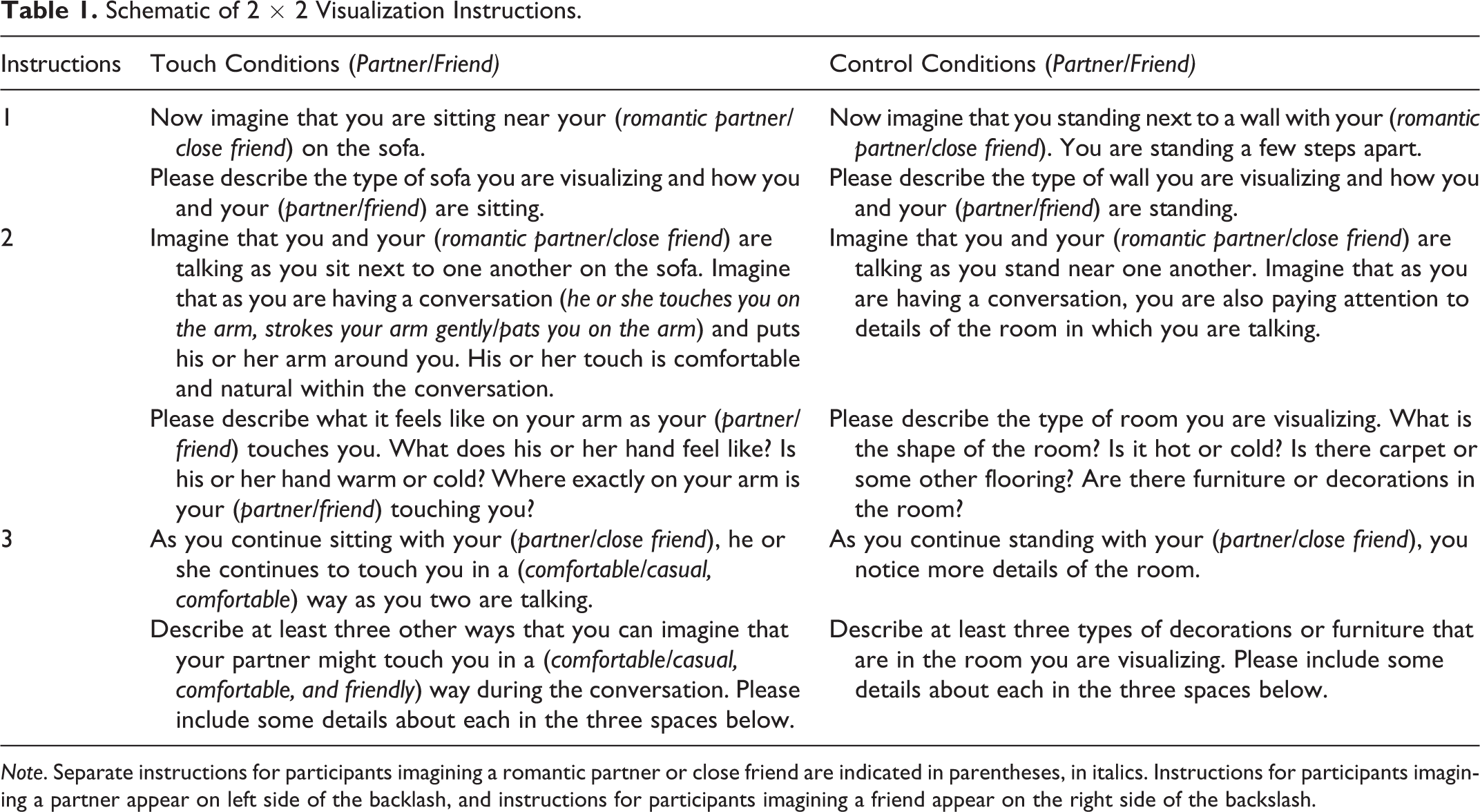
Note. Separate instructions for participants imagining a romantic partner or close friend are indicated in parentheses, in italics. Instructions for participants imagining a partner appear on left side of the backlash, and instructions for participants imagining a friend appear on the right side of the backslash.
Memory task
Participants completed a memory task to assess state security. They were instructed that they would view a list of words and would later be asked to recall them. Participants studied each word and advanced when they were ready (up to 10 s). They studied 30 words (Beckes, Coan, & Morris, 2013) presented randomly including 10 security words (e.g., belong, calm, and trust), 10 insecurity words (e.g., distress, fear, and rejection), and 10 neutral words (e.g., bend, cabinet, and gallon). Three words from the original list were modified (see Supplemental Materials). Next, participants completed a 4-min serial subtraction task as a distraction before word recall.
State security measures
Participants were instructed to recall as many words from the memory task as possible and to list the words in the order they came to mind. As the primary state security measure, we assessed accessibility of secure and insecure words by classifying the first five words recalled as secure, insecure, neutral, or incorrect (see Supplemental Materials). Participants recalled 1.36 secure words (SD = 1.01) and 1.27 insecure words (SD = 0.92) in the first five words, on average. Participants also completed a self-report measure of felt security (Luke et al., 2012) after recall. Participants rated the extent to which they felt secure by rating a set of nine adjectives (e.g., comforted, safe, and secure) embedded in a mood questionnaire from 1 (not at all) to 6 (very much), α = .88. Finally, participants provided demographic information.
Results and Discussion
To test whether imagining touch increased state security, we conducted three 2 (manipulation: touch or control) × 2 (companion: partner or friend) analysis of variance (ANOVAs) to predict the number of security and insecurity words recalled (of the first five words recalled) and self-reported felt security. Consistent with predictions, participants who imagined receiving touch recalled more security words (M = 1.54, SD = 1.07) than participants who imagined the control (M = 1.16, SD = 0.90), F(1, 173) = 6.37, p = .012, η2 = .036, 95% confidence interval (CI) [0.08, 0.68] (see Figure 1). This main effect did not differ based on whether a romantic partner or close friend provided the touch, F(1, 173) = 0.01, p = .981, and there was no main effect of companion, F(1, 173) = 0.13, p = .715. The relative accessibility of secure words after imagining touch suggests that touch fosters state security.
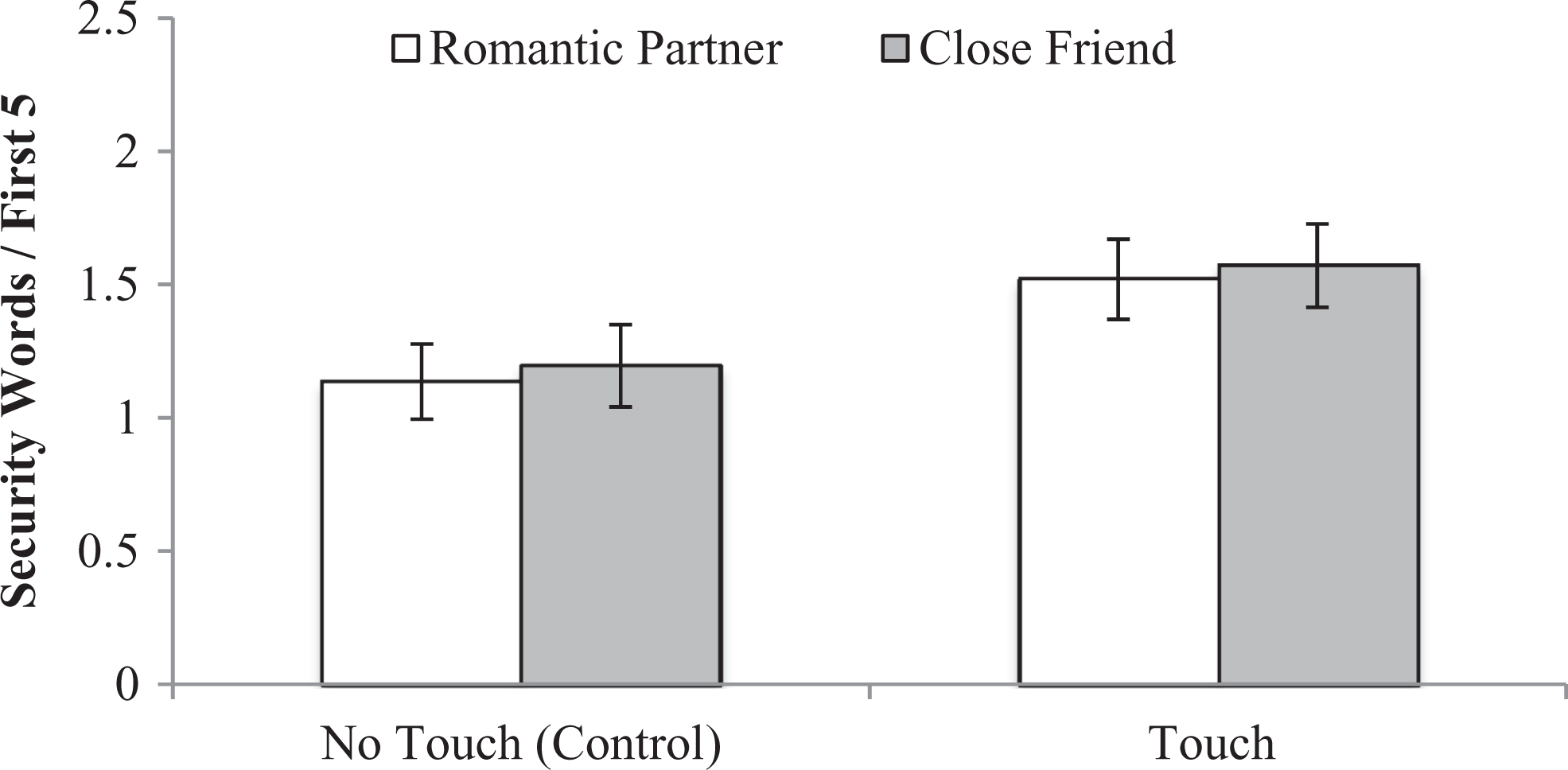
Number of security words out of the first five recalled by condition. Error bars represent standard error of the mean.
A second ANOVA revealed no significant effects on the number of insecurity words recalled; there was no main effect of manipulation, F(1, 173) = 0.76, p = .386, or companion, F(1, 173) = 0.16, p = .692, and no interaction, F(1, 173) = 0.82, p = .368. Therefore, although touch increased state security, there was no evidence that it diminished state insecurity. A mixed ANOVA with word type (security or insecurity) as a within-subjects factor confirmed that touch impacted recall for secure and insecure words differently (see Supplemental Materials). Finally, we did not observe significant effects of the manipulation, F(1, 173) = 0.11, p = .743, companion, F(1, 173) = 2.44, p = .120, or their interaction, F(1, 173) = 0.51, p = .475, on self-reported felt security. Because all participants viewed secure and insecure words during the memory task, this intervening recall activity may have obscured the impact of the imagined touch manipulation on this outcome.
Overall, this study provided initial evidence that touch from a close friend or romantic partner promotes the accessibility of security-related words. To follow up, we conducted a laboratory study using a physical touch manipulation to replicate and extend this effect.
Experiment 2: Physical Touch Promoting Security
In Experiment 2, we examined whether physically receiving affectionate touch promotes state security. Additionally, we investigated whether touch that a participant knows is prescribed by the experimenter is as effective as touch that appears to be volitional. In Experiment 2, task instructions manipulated whether the participant attributed their partner’s touch or no touch behavior to their partner’s choice or the experimenter’s instructions for a 2 (manipulation: touch vs. no touch) × 2 (attribution: volitional vs. prescribed) between-subjects factorial design. Finally, we assessed whether an individual’s trait attachment orientation moderates the impact of receiving touch on state security.
Method
Participants
Participants were 141 couples from an urban area. Sample size was determined by a power analysis (η2 estimated at .10, to achieve 95% power, see Supplemental Materials). The participant who registered for the study was assigned to the role of target and was asked to bring their romantic partner—assigned to the role of partner—to the laboratory. Couples were eligible to participate if they had been in a romantic relationship for at least the past 3 months (M = 17.69, SD = 19.12) and were both at least 18 years old (M target = 20.66, SD = 2.59; M partner = 20.73, SD = 2.73). Targets were prescreened to ensure that they had no history of receiving violent touch; no targets were excluded based on this requirement. Targets identified themselves predominantly as female (62.8%) and Asian (43.0%) or White/Caucasian (38.5%). Eight couples’ data were excluded from analysis: three couples did not complete the session due to laboratory technical problems, two couples were excluded because the partner revealed the manipulation to the target, and three couples were excluded because the target failed the manipulation check.
Procedure and Measures
Before the experimental session, targets completed a prescreen questionnaire to assess eligibility and to measure their trait attachment orientation. Trait attachment orientation was measured with a 26-item version of the Experiences in Close Relationships Scale (ECR; Brennan, Clark, et al., 1998). Participants rated their agreement with items to assess attachment anxiety (i.e., “I worry about being abandoned; α = .92) and attachment avoidance (i.e., “I am very uncomfortable being close to people”; α = .89) on a scale from 1 (disagree strongly) to 7 (agree strongly). Attachment avoidance and anxiety were correlated (r = .28, p = .002).
During the experimental session, the experimenter told the couple members that they would first complete questionnaires separately, and the experimenter escorted the partner to another room for privacy. While the target completed a packet containing general personality questionnaires (i.e., items from the Big 5 personality inventory), the experimenter spoke privately to the partner in the next room to recruit the partner’s help with the manipulation.
Manipulation instructions
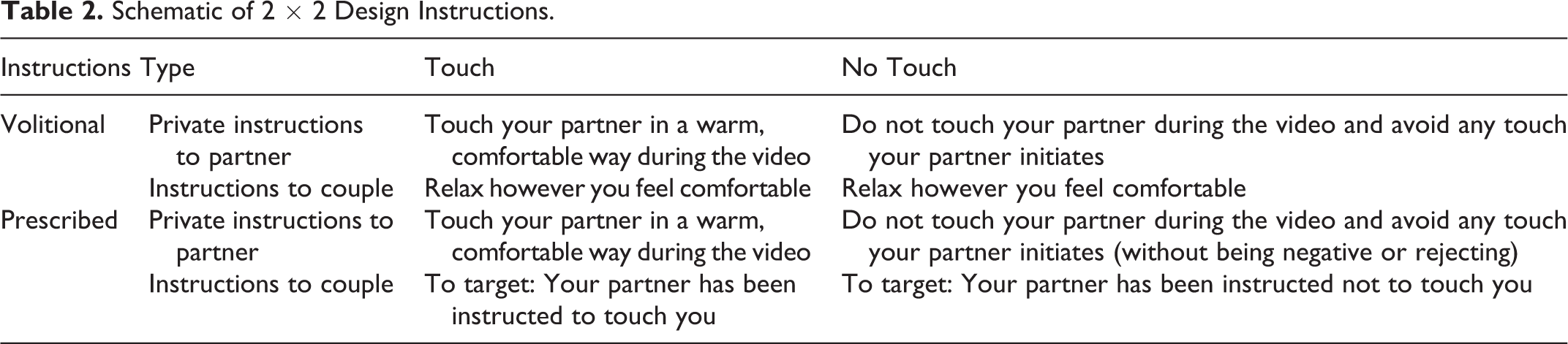
The experimenter asked the partner to touch or not touch the target during the next (video watching) activity according to their manipulation condition. In the two touch conditions, the experimenter requested that the partner touch the target in a warm, comfortable, and positive way (e.g., holding hands and putting an arm around the target) throughout the video. In the two no touch conditions, the experimenter asked the partner to sit near the target but to avoid touching the target and not to reciprocate any touch the target initiated. The partner was instructed not to be rejecting if the target tried to touch. In all conditions, the experimenter asked the partner if he or she would be willing to follow the instructions, and all partners agreed.
Attribution manipulation and video activity
Then, the partner returned to the main laboratory room, set up like a living room, and the experimenter told the couple that for the next part of the study, they would watch a segment of a television show together. The 10-min video was of a neutral valence and unrelated to relationships or touch.
The target’s attribution for the touch/no touch was manipulated by the experimenter’s instructions to both couple members immediately prior to the video activity. For the volitional conditions, the experimenter told the couple members to relax in whatever way they felt comfortable (and did not mention touch). This instruction was intended to make the target believe that the partner’s behavior was volitional, although the partner was previously instructed to touch or not to touch. In the prescribed conditions, the experimenter told the couple that the partner had been instructed to touch the target (prescribed touch) or that the partner had been instructed not to touch the target (prescribed no touch) during the video. Table 2 provides a summary of the instructions for the four randomly assigned conditions.
Schematic of 2 × 2 Design Instructions.
State security measures
When the video ended, the target and partner were separated to complete questionnaires. We assessed the target’s state security using three scales. First, targets completed the same 9-item Felt Security Scale described in Experiment 1 (α = .84). The second scale, the State Adult Attachment Measure (SAAM; Gillath, Hart, Noftle, & Stockdale, 2009), was adapted from the ECR to measure state rather than trait attachment. Targets rated the extent to which they agreed with items assessing state attachment security (e.g., “Right now, I feel secure and close to other people”; α = .89), state attachment avoidance (e.g., “Right now, I’m afraid someone will want to get too close to me”; α = .82), and state attachment anxiety (e.g., “I really need to feel loved right now”; α = .83) from 1 (disagree strongly) to 7 (agree strongly). Finally, participants completed an 8-item measure of state trust (Rempel, Holmes, & Zanna, 1985) by indicating their agreement with statements regarding trusting their romantic partner (e.g., “Right now, I am confident that my partner will always love me”; α = .82) from 1 (disagree strongly) to 7 (agree strongly).
The security scales (felt security, state attachment security subscale, and state trust) were significantly correlated (see Table 3). Thus, we standardized these scales to create a state security composite (α = .75). State attachment anxiety and state attachment avoidance were significantly but not highly correlated; therefore, we analyzed these subscales separately.
Correlations of Security-Related Outcome Variables.
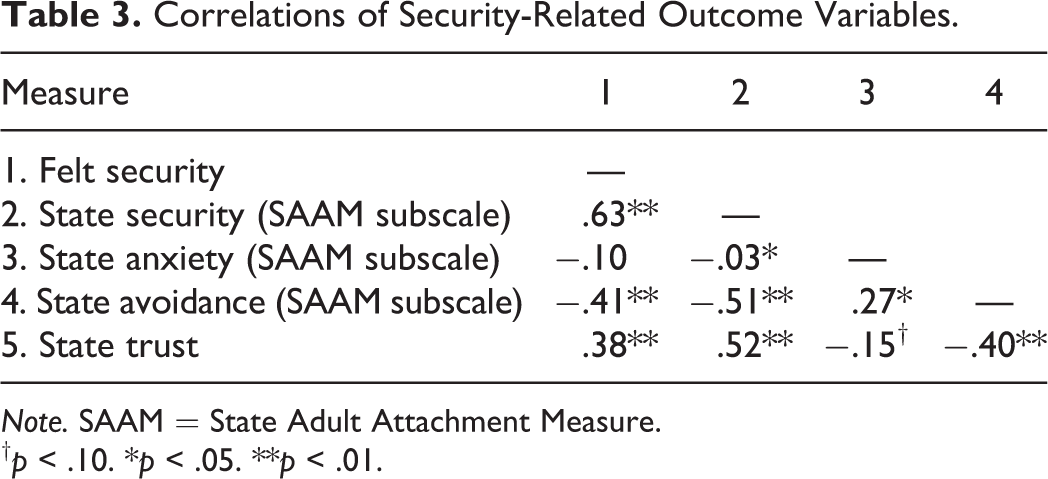
Note. SAAM = State Adult Attachment Measure.
† p < .10. *p < .05. **p < .01.
Manipulation check
Questionnaires assessed targets’ awareness that they had received or not received touch from their partner during the video as well as their attributions for their partner’s behavior. Targets indicated whether they had been touched by their partner during the television-watching task and why they believed their partner touched or did not touch them (i.e., something about the self, partner, relationship, or situation because they wanted to, chose to, liked to, and were asked to) on scales from 1 (strongly disagree) to 7 (strongly agree). Additionally, targets who reported receiving touch reported their perceptions of the touch (e.g., comfortable, loving, and annoying) from 1 (not at all) to 5 (extremely).
Results and Discussion
Manipulation Checks
All but one target in the touch conditions reported partner touch during the video activity, and all but two targets in the no touch conditions reported no partner touch. These targets were excluded from analyses. Targets who received touch from their partner evaluated the touch positively, as intended (M = 4.47, SD = 0.41). The attribution manipulation also was effective, as evidenced by targets’ responses to questions about why their partner touched them (see Supplemental Materials).
State Security
We conducted three two-way ANOVAs to test the prediction that receiving touch promotes state security. These analyses also tested whether the effect of the manipulation on state security/insecurity differed based on the target’s manipulated attribution for their partner’s behavior. As predicted, there was a main effect of manipulation condition on the state security composite, F(1, 129) = 14.65, p < .0005, η2 = .102, 95% CI [0.25, 0.79], such that targets who received touch reported greater state security (M = 0.25, SD = 0.77) than targets who did not receive touch (M = −0.27, SD = 0.79; see Figure 2). There was no main effect of attribution on the state security composite, F(1, 129) = 0.75, p = .387, and there was no significant interaction between manipulation and attribution, F(1, 129) = 0.04, p = .840.
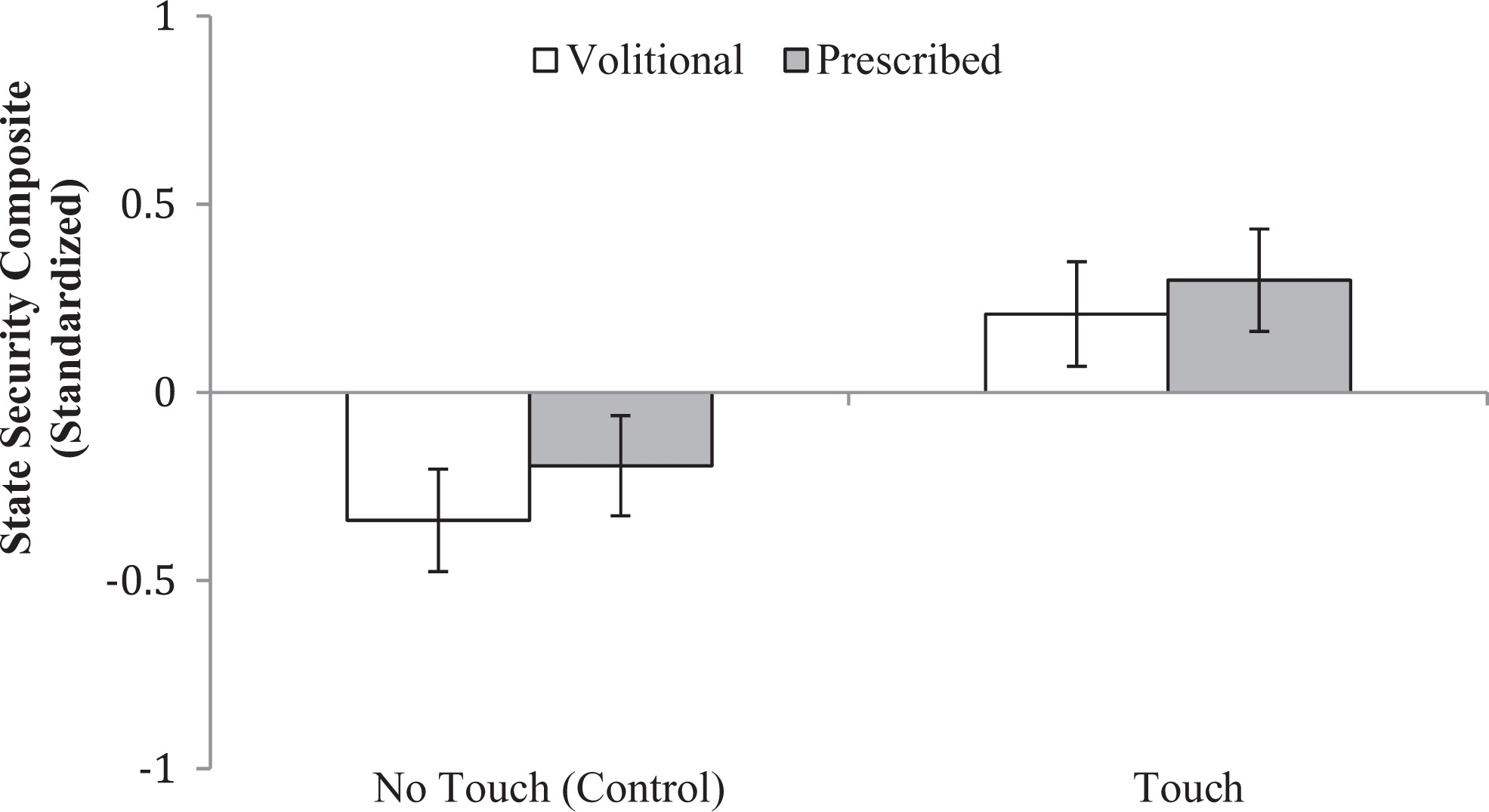
State security composite scores by condition. Error bars represent standard errors of the mean.
Regarding the state attachment insecurity outcomes, there were no significant effects. Participants in the touch condition did not report less attachment avoidance, F(1, 129) = 2.61, p = .109, or attachment anxiety, F(1, 129) = 1.43, p = .233, although the means for both avoidance (M touch = −0.14, SD = 1.04; M control = 0.21, SD = 1.01) and anxiety (M touch = −0.10, SD = 0.95; M control = 0.10, SD = 1.05) were in the predicted directions. Consistent with Experiment 1, receiving touch promoted state security by increasing security rather than by decreasing insecurity. A mixed ANOVA with outcome (state security composite, state anxiety, and state avoidance) as a within-subjects factor confirmed this interpretation (see Supplemental Materials). Additionally, touch promoted state security both when the touch was attributed to the partner’s choice or the experimenter’s instructions.
Alternative Explanation
One alternative interpretation of the results is that participants who received no touch from their partners experienced a decrease in security. Participants may have believed that their partner’s decision not to provide touch (in the no touch volitional condition) was a form of rejection. To assess this possibility, we conducted an ANOVA to predict rejection following the video activity. Participants who received no touch reported feeling more rejected (M = 1.76, SD = 1.14) than participants who received touch (M = 1.23, SD = 0.77), F(1, 129) = 13.01, p < .0005, η2 = .092, 95% CI [0.26, 0.88]. This main effect was qualified by a marginal interaction between manipulation and attribution, F(1, 129) = 3.19, p = .076, η2 = .024. Targets who received no touch and thought this was their partner’s choice (M = 2.03, SD = 1.43) felt more rejected than targets who knew the experimenter had instructed their partner not to touch (M = 1.51, SD = 0.71), F(1, 129) = 5.25, p = .024, η2 = .039, 95% CI [0.07, 0.96]. To assess whether feelings of rejection in the no touch conditions could explain our primary results, we used an analysis of covariance to test the impact of the manipulation and attribution conditions on the state security composite, controlling for feelings of rejection. In addition to a significant effect of rejection on security, F(1, 128) = 17.23, p <.0005, there was a significant main effect of the touch manipulation on security, F(1, 128) = 6.83, p = .010, η2 = .051, 95% CI [0.09, 0.62]. Therefore, even controlling for rejection, participants who received touch reported significantly greater security than participants who received no touch.
Individual Differences
Finally, we used hierarchical multiple regression to test whether individuals benefited differently from receiving partner touch based on their trait attachment orientation. In two analyses, we entered touch condition (0 = control, 1 = touch) and trait attachment subscale (i.e., avoidance or anxiety) centered on the first step, and we entered their interaction on the second step of the equation, predicting the state security composite. 1 Standardized βs are reported. Results revealed that the effect of touch condition on state security was moderated by attachment avoidance (B = −0.28, p = .008, 95% CI [−0.56, −0.10]). As predicted, simple slope tests revealed that receiving touch was positively related to state security for participants low (1 SD below the mean) on avoidance (B = .515, p < .0005, 95% CI [0.47, 1.24]) but was unrelated to security for participants high (1 SD above the mean) on avoidance (B = .056, p = .639, 95% CI [−0.30, 0.49]; see Figure 3). The effect of receiving touch on the state security composite was not moderated by attachment anxiety (B = −0.16, p = .222). As expected, individuals who prefer to avoid closeness benefited least from receiving touch. 2

Interaction between attachment avoidance and touch condition.
General Discussion
Attachment theory proposes that close relationships with caring and accepting others have important implications throughout the life span (e.g., Bolwby, 1969/1982, 1973, 1988); individuals who have these relationships experience feelings of security and develop secure attachment relationships based on trust. The current research assessed whether affectionate touch, one common relational behavior that may saliently indicate caring and acceptance, promotes state attachment security in adulthood. In two experiments, we found that individuals who received touch (or imagined receiving touch) experienced greater state attachment security than individuals who did not receive touch. Specifically, imagining touch from one’s romantic partner or close friend increased the accessibility of security-related words (Experiment 1), and receiving touch from one’s romantic partner increased self-reported state security (Experiment 2). These results build on previous nonexperimental research (e.g., Debrot et al., 2013) and suggest that touch is one behavioral indicator of caring and acceptance that can activate a secure attachment schema to make individuals feel deserving of love and perceive close others as dependable and responsive. Touch increased most measures of state security but did not impact state insecurity. Therefore, touch may foster secure expectations rather than discount attachment concerns, which may indicate that security is more malleable than insecurity. Alternatively, the null results for state insecurity could indicate a floor effect. In both experiments, the means for state insecurity measures were in the expected direction, but state insecurity was low overall (see Supplemental Materials).
Relatedly, individuals with trait avoidant attachment benefited less from touch receipt than individuals lower in trait avoidance. Individuals who are high in avoidant attachment have learned to use a strategy of “compulsive self-reliance” to limit closeness, and they may have fewer positive touch experiences (e.g., Ainsworth et al., 1978; Bolwby, 1969/1982). Therefore, touch may not have indicated acceptance and closeness to foster security for these individuals, or they may have perceived closeness from touch but resisted it. This result provides support for our theoretical position that touch is interpreted and does not solely impact security through physiological mechanisms (e.g., oxytocin and endogenous opioids) that would be unaltered by trait attachment avoidance (Jakubiak & Feeney, 2016). Trait attachment anxiety did not similarly moderate the relationship between touch receipt and state security. Both individuals high and low in anxious attachment value closeness and seek confirmation of their partners’ acceptance; thus, touch may have provided a salient cue of closeness and acceptance to promote security for these individuals. Individuals who are anxiously attached especially crave closeness and might therefore have been expected to receive an added benefit of touch; however, our results are consistent with previous research indicating that attachment anxiety is unrelated to preferences for touch (e.g., Chopik et al., 2014). Anxiously attached individuals desire closeness but are sensitive to rejection, so they may both desire and resist touch.
Neither contextual factor (the relational context or attribution for the touch) moderated the effects of touch on state security; that is, touch promoted state security when it was provided by a romantic partner or a close friend and when it was believed to be volitional or prescribed. This latter result suggests that touch may have an impact either through physiological pathways or because individuals infer another’s acceptance even when touch is prescribed. The effectiveness of prescribed touch to promote security is particularly noteworthy and suggests that touch could be targeted as an intervention to promote security and downstream consequences of security.
Specifically, by facilitating state security, affectionate touch may (1) encourage prorelational thoughts or behaviors to enhance relational well-being (e.g., satisfaction and commitment) or (2) buffer stress to protect individual physical health. Indeed, state security promotes positive relational expectations and prosocial behaviors, and state security is fundamental for the formation of secure attachment bonds (Mikulincer et al., 2005; Mikulincer, Shaver, Sahdra, & Bar-On, 2013; Rowe & Carnelley, 2003). Empirical evidence also suggests that touch may promote relational well-being; frequent affectionate touch in romantic relationships is associated with greater relational intimacy, satisfaction, and commitment, less relational distress, and increases in relationship quality over time (Brennan, Wu, et al., 1998; Floyd et al., 2009; Gulledge, Gulledge, & Stahmann, 2003; Mackey, Diemer, & O’Brien, 2000; Muise, Giang, & Impett, 2014). Touch—and the resulting state security—may also buffer stress to prevent health problems associated with stress (e.g., Cohen, Janicki-Deverts, & Miller, 2007). State security allows individuals to feel calm and to downregulate their threat reactivity because they expect that close others will provide support if necessary (e.g., Coan, 2008; Norman, Lawrence, Iles, Benattayallah, & Karl, 2014). Previous research has linked touch receipt with less perceived stress and better stress recovery (e.g., Burleson, Trevathan, & Todd, 2007; Robinson, Hoplock, & Cameron, 2015), and experimental touch interventions confirmed that touch buffers stress (e.g., Ditzen et al., 2007; Holt-Lunstad, Birmingham, & Light, 2008; Jakubiak & Feeney, in press). Future research may investigate whether touch impacts relational well-being and buffers stress by promoting state security.
The current research provided the first experimental evidence that touch is an attachment-relevant behavior that promotes state security in adulthood. This research demonstrates an immediate benefit of touch and may help to explain how touch in adult close relationships is linked to long-term relational and physical outcomes.
Footnotes
Declaration of Conflicting Interests
The author(s) declared no potential conflicts of interest with respect to the research, authorship, and/or publication of this article.
Funding
The author(s) received no financial support for the research, authorship, and/or publication of this article.
Notes

References
Supplementary Material
Please find the following supplemental material available below.
For Open Access articles published under a Creative Commons License, all supplemental material carries the same license as the article it is associated with.
For non-Open Access articles published, all supplemental material carries a non-exclusive license, and permission requests for re-use of supplemental material or any part of supplemental material shall be sent directly to the copyright owner as specified in the copyright notice associated with the article.
