







Abstract
Previous research has distinguished authentic and hubristic facets of pride, which can be assessed by the Authentic and Hubristic Pride Scales (AHPS). To examine the relations between self-ratings and others’ ratings of pride, this study recruited 110 participants and obtained their self-ratings on the AHPS and ratings by two friends and three strangers in a round-robin design. In addition, participants’ social status was self-reported and their leadership style (dominance vs. prestige) was evaluated by friends and strangers. Results revealed higher self-friend agreement than self-stranger agreement on authentic pride and higher friend–stranger agreement than self-other (friend and stranger) agreement on hubristic pride, suggesting that authentic pride is noticed by close friends as well as oneself, but hubristic pride is obvious only to others. Consistent with this, there was also some evidence that other-rated hubristic pride was significantly associated with social status and dominant leadership style.
Introduction
Pride is one of self-conscious emotions resulting from our own positive self-views (Tangney & Wagner, 1995; Tracy & Robins, 2007a , 2007b). Several researchers have provided theoretical support and empirical evidence for the differentiation between two forms of pride: authentic and hubristic (Lewis, 2000; Tangney & Wagner, 1995; Tracy, Cheng, Robins, & Trzesniewski, 2009; Tracy & Robins, 2007a , 2007b; Tracy, Robins, & Cheng, 2010). Tracy and Robins (2004) used the attributional theory to divide pride into authentic and hubristic pride. Hubristic pride results from attributing success to internal, stable, and global causes (e.g., “I won because I’m always great”), whereas authentic pride results from attributing success to internal, unstable, and specific causes (e.g., “I won because I practiced”; Tracy & Robins, 2007a).
Consistent with the two-facet model of pride, Tracy and Robin (2007b) developed a self-report measure of authentic and hubristic pride. They found that the Authentic and Hubristic Pride Scales (AHPS) showed a clear two-factor structure, with high internal consistency within each subscale (αs = .80 to .89 for Authentic Pride, .84 to .93 for Hubristic Pride; Tracy & Robin, 2007b). Furthermore, these two subscales showed differential associations with attributional styles and personality traits. Finally, these two facets of pride have been linked to distinct styles of leadership at both explicit and implicit levels (Cheng, Tracy, & Henrich, 2010; Liu, Lu, Yu, & Chen, 2012; Shariff & Tracy, 2009). Specifically, Cheng, Tracy, and Henrich (2010) found that individuals with high dispositional authentic pride perceived themselves, and were perceived by their peers, as prestigious leaders, whereas individuals with high dispositional hubristic pride perceived themselves, and were perceived by their peers, as dominant leaders.
Although the two-facet structure of pride has been established based on self-report data, it is not known whether self-reported pride corresponds with that as reported by others. Furthermore, it is important to understand the process of pride detection because accurate perceptions of the nature of others’ pride are important for how people relate to each other. Specifically, when authentic pride is shown by a prestigious individual, deference is the appropriate response in order to facilitate learning, but when hubristic pride is shown by a dominant superior, compliance is warranted in order to avoid unnecessary harm. Indeed, previous research has shown that individuals with high prestige attain high social status by using their own knowledge and skill, whereas individuals with high dominance attain high social status by using intimidation or coercion (Henrich & Gil-White, 2001). Specifically, highly prestigious leaders tend to teach their subordinates skills and knowledge, and in return, the subordinates tend to provide resources to their leaders. Highly dominant leaders, on the other hand, tend to threaten their subordinates and take their resources by force. These subordinates often obey their leaders out of fear. To investigate the perception of pride, the current study aimed to examine the agreement between self, friends, and strangers in their evaluations of authentic and hubristic pride and the relations of authentic and hubristic pride with social status and leadership style.
Self-other agreement may differ by facet of pride for two main reasons. First, the two facets of pride may involve different levels of social desirability and self-serving biases. Holbrook, Piazza, and Fessler (2014) recently found that hubristic pride is a socially undesirable trait, whereas authentic pride is a socially desirable trait. Feeling hubristic pride is thus not desirable and expressing it not acceptable, especially in eastern collectivistic societies such as China and Japan (Eid & Diener, 2001; Kitayama, Mesquita, & Karasawa, 2006; Mesquita & Karasawa, 2004). Consequently, self-ratings of hubristic pride are likely to be distorted by self-serving biases, which are automatic processes used to protect and enhance self-view (Dunning, 1993, 1999; Dunning & Cohen, 1992; Dunning, Meyerowitz, & Holzberg, 1989; Dunning, Perie, & Story, 1991; Greenwald, 1980; Paulhus & John, 1998; Robin & Beer, 2001; Taylor & Brown, 1988). Second, self-other agreement in ratings of pride is also affected by observability of the two facets. Holbrook et al. (2014) recently found that authentic pride is more of an internal affective state, whereas hubristic pride is more of an external display of pride. Overt behavior is judged more easily by an outside observer than is an internal state (Funder, 1991; Hofstee, 1994; Jones & Nisbett, 1971). Taking into account the factors of social desirability and observability, we hypothesized that other people’s ratings would be more informative for hubristic pride than self-ratings, whereas self-ratings would be more informative for authentic pride than others’ ratings.
In terms of behavioral correlates of authentic and hubristic pride, previous research has shown, as mentioned earlier, that authentic pride is associated with prestige, whereas hubristic pride with dominance (Cheng et al., 2010). Social status has also been associated with pride. For example, high-status individuals reported greater feelings of pride than did low-status individuals after performing a task (Tiedens, Ellsworth, & Mesquita, 2000). Given the differential informativeness as discussed earlier, it was hypothesized that other-rated hubristic pride would be associated with social status and leadership style.
Method
Participants
A total of 110 college students (57 male, 53 female; mean age = 20.63 ± 2.12 years, ranging from 16 to 26) at Renmin University of China participated in this study for monetary remuneration. All participants were recruited through both physical and electronic advertisements aimed at the students on campus. Participants came from diverse levels (32% freshman, 13% sophomore, 11% junior, 25% senior, and 19% first-year graduate students). Most participants (74%) came from departments of social sciences (e.g., sociology, public management, and international relation), but 26 participants (24%) majored in sciences, one participant (1%) in arts, and one participant (1%) did not report his major.
Participants were asked to sign up in groups of three same-gender friends. We excluded opposite-gender friends from this small-scale study because they may include romantic relationships, which have been found to affect accuracy of other ratings of personality (Biesanz, West, & Millevoi, 2007; Watson & Humrichouse, 2006). On average, participants had known their group members for over 3 months (M = 19.84 months, SD = 24.5). There were 37 friend groups (36 three-friend groups and 1 two-friend group) in this study.
Procedure
In the first phase, after three or four friend groups arrived at the laboratory (scheduled to the same time), each group member was asked to complete a battery of measures including round-robin ratings of their friends in the group and themselves. Information about social status was also collected by asking the participants whether they had held leadership positions in their college classes and student organizations. They also provided their judgment about their friends’ leadership type (dominance or prestige).
In the second phase, all participants were rearranged, so that new groups of previously unacquainted, same-gender participants were formed. These “stranger groups” ranged in size from three to four participants. Each stranger group was then led to a separate room, seated at a table, and asked to complete a discussion task (see Materials). After the discussion task, each member in this new group was asked to complete a battery of measures including round-robin ratings of their group members on pride and leadership style.
Before each round of ratings, all participants were told that their ratings are completely confidential. They would never see each other’s ratings.
Materials
Authentic and hubristic pride
Participants completed the 14-item AHPS (αs = .80 to .89 for Authentic Pride and .84 to .93 for Hubristic Pride in the original study; Tracy & Robins, 2007b). The Authentic Pride subscale included seven descriptive words (accomplished, achieving, confident, fulfilled, productive, self-worth, and successful), and the Hubristic Pride subscale also included seven descriptive words (arrogant, conceited, egotistical, pompous, smug, snobbish, and stuck-up). In the current study, the Cronbach’s αs of the Authentic and Hubristic Pride subscales were .83 and .85 for self-ratings, .88 and .92 for friend ratings, and .88 and .95 for stranger ratings, respectively.
Discussion task
The discussion task used in this study was the “Desert Survival Task” (Lafferty & Pond, 1974), a task that has been used to examine group interactions and different leadership styles. Participants received the following instruction: Thank you for taking part in this task. It is a discussion task. You should first read the material and then have a discussion and aim to draw a conclusion in 10 min and finally elect one person to describe and explain the conclusion of your discussion to the Experimenter in 2 min. The Experimenter will be absent during your discussion and will return to hear your conclusion 10 min later.
Leadership style (dominance vs. prestige)
Participants’ leadership style (dominance vs. prestige) was assessed by asking their friends and strangers to indicate whether the participants showed prestige (0) or dominance (1) based on the measure used by Cheng et al. (2010). To help participants understand the distinction between dominance and prestige, definitions of leadership styles (based on Cheng et al., 2010; Henrich & Gil-White, 2001) were provided. Ratings by group members were averaged.
Social status
Social status was measured in terms of whether the participants had held any leadership positions in their college classes or student organizations (0 = no, 1 = yes).
Results
Because data were collected from groups, we analyzed the interdependence of individuals’ data within groups using intraclass correlation (ICC; Griffin & Gonzalez, 1995; Shrout & Fleiss, 1979). For authentic pride, the ICCs were .11 (self-ratings), .01 (friends’ ratings), and .03 (strangers’ ratings). The corresponding ICCs for hubristic pride were .00, .29, and .00. The ICCs for dominance/prestige were .00 (friends’ ratings) and .02 (strangers’ ratings). Finally, the ICC for self-reported social status was .52 perhaps because individuals with similar social status are likely to become friends (Buss & Barnes, 1986; Byrne, Clore, & Worchel, 1966) and hence go to the sessions together. It should be mentioned that social status differences preceded the grouping of strangers in the current study, so it was not an effect of the grouping/clustering. Finally, this somewhat high ICC might have also been responsible for the modest ICC for hubristic pride, which was related to social status (see below). Because of little evidence for the clustering effect that might have biased the results, we conducted the remaining analyses using conventional correlational and regression methods.
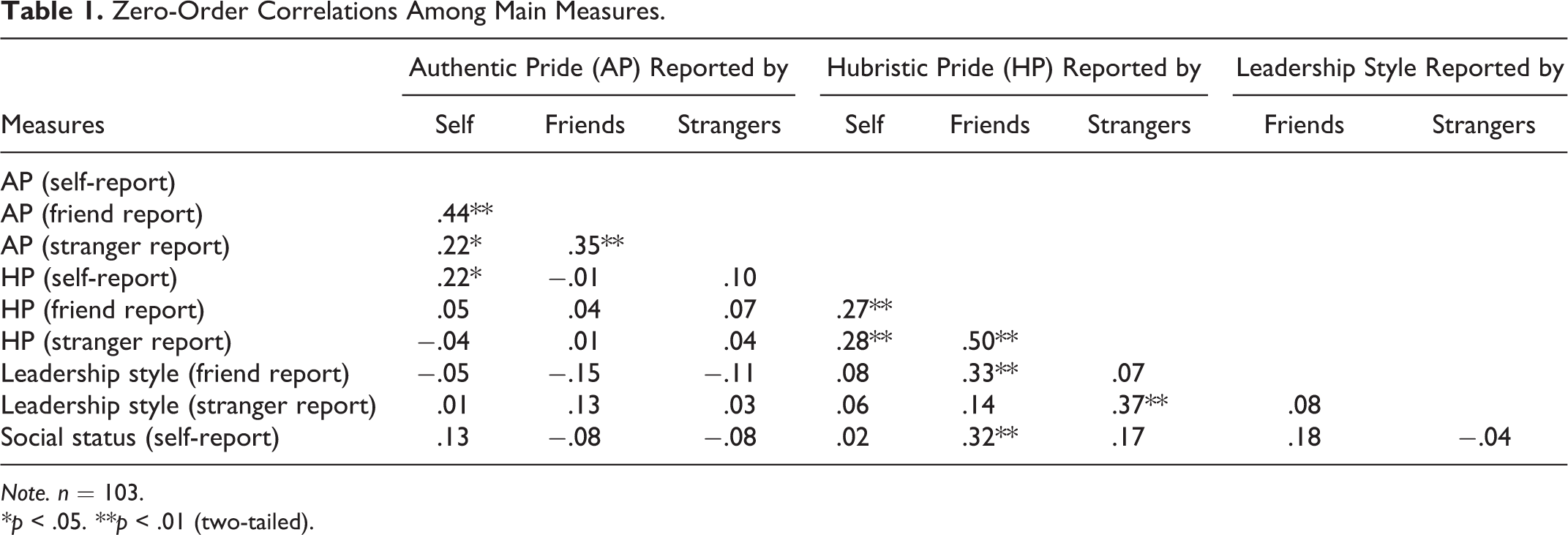
Self-friend, self-stranger, and friend–stranger agreements on ratings of authentic and hubristic pride were calculated by computing the correlations among the target’s self-ratings, friends’ ratings (averaged across two or three friends), and strangers’ ratings (averaged across two or three strangers from the stranger groups). We used averaged ratings because they have been shown to have an increased reliability (Vazire, 2010), and this procedure has often been used in previous studies (e.g., Connelly & Ones, 2010; Jing et al., 2015; Vazire, 2010). Self-friend, self-stranger, and friend–stranger agreements were overall positive and significant for both authentic and hubristic pride (see Table 1), indicating that friends and strangers were aware of the target’s authentic and hubristic pride. However, there were differences in the magnitude of these correlations based on the Williams modification of the Hotelling’s test of differences between correlated correlations (Kenny, 1987; Kenny, Kashy, & Cook, 2006). For authentic pride, self-friend agreement was stronger than self-stranger agreement, t(100) = 2.23, p = .03, but no significant differences were found between self-friend agreement and friend–stranger agreement, t(100) = 0.80, p = .43, and between self-stranger agreement and friend–stranger agreement, t(100) = 1.42, p = .16. For hubristic pride, friend–stranger agreement was stronger than self-friend agreement, t(100) = 2.30, p = .02, and self-stranger agreement, t(100) = 2.20, p = .03, but no significant differences were found between self-friend agreement and self-stranger agreement, t(100) = −0.11, p = .91.
Zero-Order Correlations Among Main Measures.
Note. n = 103.
*p < .05. **p < .01 (two-tailed).
Table 1 also shows that hubristic pride (friends’ ratings) was significantly correlated with social status (self-reports) and that hubristic pride was correlated with dominant leadership style within raters (friends and strangers) but not across raters. To further assess how much the combination of pride variables can predict social status and leadership style and to assess which measures made unique contributions, regression analyses were conducted.
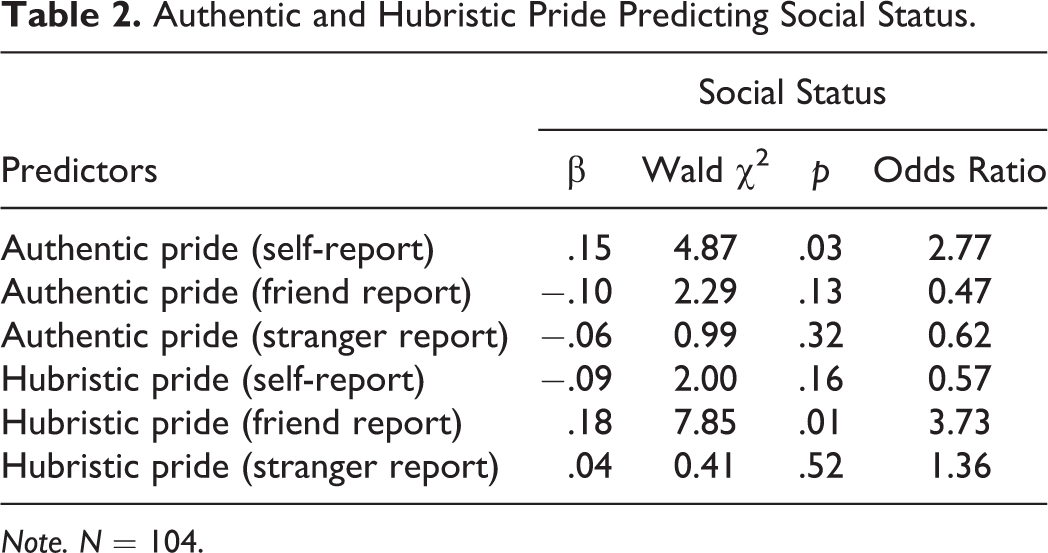
First, we conducted logistic regression using self-rating, friend rating, and stranger rating of authentic and hubristic pride to predict social status. All independent variables were entered into the model simultaneously. The overall model was statistically significant, χ2(6, N = 104) = 18.65, p = .005. The model was able to correctly classify 56.8% of those with leadership roles (i.e., high social status) and 80.0% of those without leadership roles (i.e., low social status) for an overall success of 70.2%. Table 2 shows that self-reported authentic pride (β = 1.02, p < .05; 95% CI [1.12, 6.86]) and friend-reported hubristic (β = 1.32, p < .01; 95% CI [1.49, 9.35]) pride were significant predictors of the target’s social status. It appears that after controlling for other measures of pride, self-reported authentic pride made a unique contribution to predicting social status, even though the bivariate correlation efficient did not reach significance (r = .13, p = .19). In sum, individuals with high self-reported authentic pride and friend-reported hubristic pride showed higher social status than those with low self-reported authentic pride and friend-reported hubristic pride.
Authentic and Hubristic Pride Predicting Social Status.
Note. N = 104.
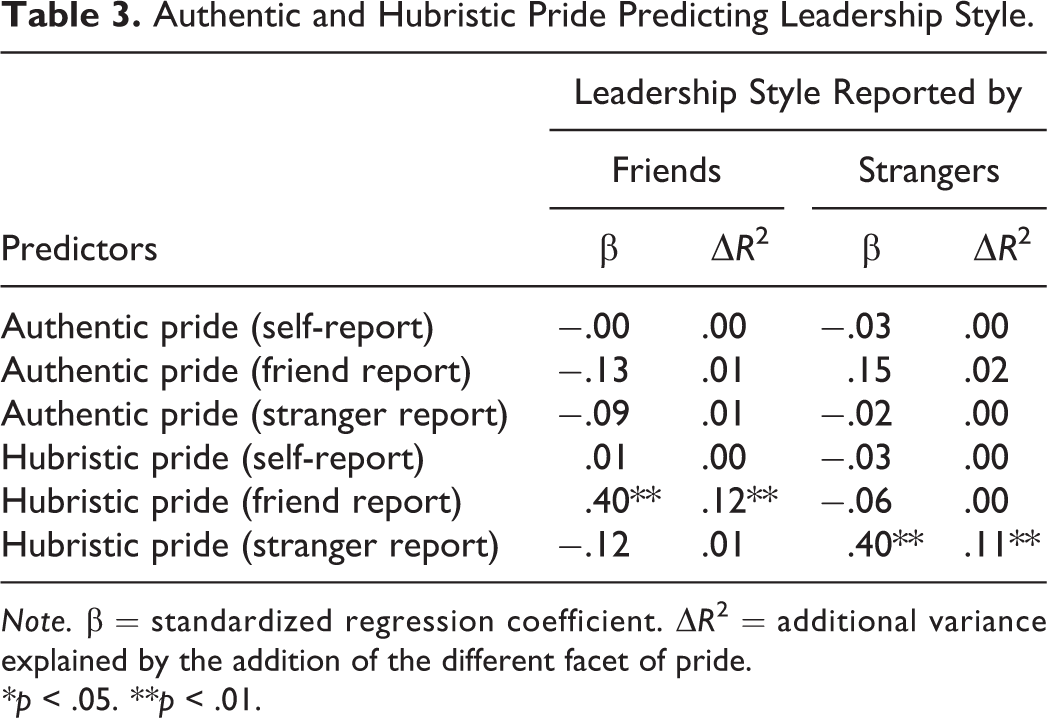
Second, we conducted regression analysis using self-rating, friend rating, and stranger rating of authentic and hubristic pride to predict leadership style of the participants (as rated by friends and strangers). The overall model explained 9.9% of the variance of friend-rated leadership style, F(6, 97) = 2.88, p < .05, and 10.1% of the variance of stranger-rated leadership style, F(6, 96) = 2.91, p < .05. We found that higher friends’ and strangers’ ratings of hubristic pride were associated with greater dominance as assessed by friends (β = .40, t = 3.62, p = .000; 95% CI [0.07, 0.25]) and strangers (β = .40, t = 3.60, p = .001; 95% CI [0.08, 0.28]), respectively (Table 3). Confirming the correlational results, we did not find significant prediction across raters.
Authentic and Hubristic Pride Predicting Leadership Style.
Note. β = standardized regression coefficient. ▵R 2 = additional variance explained by the addition of the different facet of pride.
*p < .05. **p < .01.
Discussion
In previous studies, self-ratings were used to investigate authentic and hubristic pride (Tracy & Robins, 2007b; Tracy et al., 2009; Wubben, De Cremer, & VanDijk, 2012). The current study extended the previous research by using self-rating and other rating to examine the agreement of self-rating, friend rating, and stranger rating of authentic and hubristic pride and the relationships between authentic and hubristic pride on the one hand and social status and leadership style on the other.
Consistent with earlier research (Cheek, 1982; Funder & Dobroth, 1987), our results showed that self-friend, self-stranger, and friend–stranger agreements on authentic and hubristic pride were all statistically significant and of moderate size (rs = .22 to .50, p < .05). Furthermore, we found that self-friend agreement was higher than self-stranger agreement for authentic pride, which was consistent with many earlier studies showing that well-acquainted individuals agreed in their judgments to a greater extent than less well-acquainted individuals (Colvin & Funder, 1991; Funder & Colvin, 1988; Jackson, Neill, & Bevan, 1973; Norman & Goldberg, 1966; Watson, 1989).
In addition, friend–stranger agreement was higher than self-friend and self-stranger agreement for hubristic pride, which was consistent with a similar finding in an earlier study (John & Robins, 1993). That study found that negatively evaluative items (a category to which hubristic pride belongs, as mentioned earlier) elicited less self-other agreement than peer–peer agreement. One possible explanation is that the self-serving bias might distort self-ratings more strongly than other ratings of socially undesirable items (Dunning, 1993, 1999; Dunning & Cohen, 1992; Dunning et al., 1989, 1991; Paulhus & John, 1998; Robin & Beer, 2001; Taylor & Brown, 1988). People are more ego involved in their self-evaluations than in their evaluations of others. Ego involvement may trigger affective and defensive processes that influence our self-perceptions to a greater extent than our perceptions of others, which typically do not involve threats to self-worth. Consequently, motivational factors (such as self-esteem and self-enhancement) may affect self-perception rather than perceptions of others (McCrae & Weiss, 2007; Paunonen & O’Neill, 2010; Taylor & Brown, 1988).
Another possible explanation is self-other knowledge asymmetry (SOKA; Vazire, 2010; Vazire & Carlson, 2010, 2011). The SOKA model states that for highly evaluative traits (of which hubristic pride is an example), other ratings could be more accurate than self-ratings. In that sense, our findings suggest that others’ reports of hubristic pride could be used to improve the validity of assessments of this particular trait (Vazire, 2006).
Finally, a third explanation is that hubristic pride is more of an external display of pride than an internal state (Holbrook, Piazza, & Fessler, 2014). It is easier for others to judge overt behaviors than to judge internal states (Funder, 1991; Hofstee, 1994; Jones & Nisbett, 1971). It is not clear from our study, however, what types of overt behaviors provide the cues of hubristic pride. Future research should examine the cue display and utilization in this context following the Brunswikian lens model (Brunswik, 1952, 1956). Because a perceiver cannot observe directly an expresser’s inner states (emotions), the perceiver can only indirectly infer the expresser’s inner states from his or her behavioral cues (e.g., facial expressions). These cues serve as the lens with two sides: On one side is the cue display (or ecological validity of the behavioral cue) that refers to the correlation between the expresser’s inner states and the behavioral cues, and on the other side is the cue utilization that refers to the correlation between the behavioral cues and perceiver’s judgment.
There was also evidence that the two facets of pride were associated with different behavioral outcomes. In some sense, behavioral prediction is the gold standard in personality judgment (Funder, 2012). In our current study, we found that self-ratings of authentic pride and friend ratings of hubristic pride were predictive of social status. Individuals with high social status showed high self-rated authentic pride and friend-rated hubristic pride. Furthermore, we found that friend ratings and stranger ratings of hubristic pride were, respectively, predictive of friend ratings and stranger ratings of the participants’ dominance leadership style. These results are consistent with previous studies showing positive relations between feeling and expressing pride and high social status (Cheng et al., 2010; Liu et al., 2012; Liu, Lai, Yu, & Chen, 2014; Shariff & Tracy, 2009; Williams & DeSteno, 2009). In terms of the lack of cross-rater correlations in the prediction of leadership style, one possible explanation is that friends and strangers detected different behavioral signals, the former through long-term interactions, whereas the latter through a brief session. Consequently, friends and strangers (and of course the individuals themselves) have different perspectives and develop their unique and overlapping domains of knowledge (Vazire & Mehl, 2008). Indeed, the correlations between friends’ and strangers’ ratings of leadership style were not statistically significant.
Our study had several limitations. First, the present study used Chinese college students as participants, which is a strength in terms of expanding the research literature in non-Western cultures but also a weakness. It is not known whether the accuracy of self-ratings and other ratings of authentic and hubristic pride we found can be replicated with participants from other cultural backgrounds (especially Western cultures such as North American), who have different norms of experiencing and expressing pride, as mentioned earlier. The second limitation of our study was its use of gender-segregated groups. Further study should include mixed-gender groups (separating romantic from nonromantic relationships) to examine the accuracy of evaluations of pride of the opposite sex. The third limitation of our study was its relatively small sample size with small groups of three or four members. Larger groups would allow for different types of analyses that need at least four members (e.g., Lashley & Kenny, 1998), and larger sample sizes would also allow for examinations of moderating variables in self-other agreement. The fourth limitation of our study was that our finding of within-rater correlations between hubristic pride and leadership style could be explained either by different domains of knowledge (as discussed above) or by a methodological artifact (common source variance). Further study should provide additional measures to help address this issue. For example, video recordings of the behavioral interactions during the group discussion can be used for an analysis of behavioral display of authentic and hubristic pride.
Footnotes
Acknowledgment
The authors thank Joey T. Cheng for her comments on an early draft of this article.
Declaration of Conflicting Interests
The author(s) declared no potential conflicts of interest with respect to the research, authorship, and/or publication of this article.
Funding
The author(s) disclosed receipt of the following financial support for the research, authorship, and/or publication of this article: This work was supported by National Science Foundation of China (81571337), the Research Funds of Renmin University of China (14XNLQ05), and the Major Project of National Social Science Foundation (13&ZD155).