







Abstract
Do we have the necessary perceptual abilities to set goals that are congruent with our own values and needs? In a prospective study, participants (n =185) identified three goals that they planned to pursue throughout the week. For each goal, they then rated their motivation for pursuing it and made predictions about the extent to which goal attainment would satisfy their needs for autonomy, competence, and relatedness. One week later, participants rated their progress on each goal, as well as the actual need satisfaction they experienced. Using Bayesian analysis, we found support for our (null) hypothesis that participants predicted that their goals would satisfy their psychological needs, irrespective of goal self-concordance. While people sometimes overestimated need satisfaction, we found that people who pursued more self-concordant goals actually benefited more from their pursuits, both compared to others who pursued less concordant goals and among their own goals.
If you were to ask what makes for a happy and fulfilling life, more often than not people will begin to discuss their hopes and dreams—or the goals—that they wish to attain in the future. Such discourse is likely to occur because, as humans, we strive for coherence and self-actualization (Rogers, 1964), and our goals serve as our guide on the road to living a meaningful life. While people have a natural tendency to pursue goals that are conducive to happiness and well-being (e.g., Sheldon, 2005), the problem is that what we want (or at least what we think we want) may not always be as beneficial as we think. For example, in Western societies, it is often believed that owning many expensive possessions, being physically attractive, or being popular will make us happy, but ultimately such feats leave us longing for more (e.g., Sheldon, Gunz, Nichols, & Ferguson, 2010). Similarly, we may select short-term goals to pursue because we believe they will bring a sense of satisfaction. For example, a graduate student might decide to stay late to finish a project at work (instead of spending more time with her family) because she believes this will impress her supervisor. Although research has examined our (in)accuracy in identifying how we feel after specific events (e.g., Wilson & Gilbert, 2003, 2005), the purpose of this article is to examine whether such fallacies occur during goal pursuit over time. Drawing from self-determination theory (Deci & Ryan, 2000; Ryan & Deci, 2017), we are interested in whether people are able to accurately assess the extent to which the goals they pursue will satisfy their psychological needs for autonomy, competence, and relatedness.
According to self-determination theory, optimal human functioning occurs as a function of satisfying the psychological needs for autonomy, competence, and relatedness (Deci & Ryan, 2000). Autonomy is defined as an experience in which behavior is volitional and reflectively self-endorsed, competence refers to feeling capable and effective in one’s environment, and relatedness is concerned with positive and mutual relationships with important others. Much like plants need water, sunshine, and soil to grow, self-determination theory proposes that humans need to experience autonomy, competence, and relatedness in order to flourish, whereas the thwarting of these needs is detrimental to growth and wellness (Ryan, 1995; Vansteenkiste & Ryan, 2013). Additionally, these needs provide the energy and direction needed for successful goal pursuit—that is, being in need supportive contexts facilitates the pursuit of self-concordant goals (i.e., “want-to” goals that are in line with one’s core values and emanate from the self; Milyavskaya, Nadolny, & Koestner, 2015), which are associated with greater attainment (e.g., Koestner, Otis, Powers, Pelletier, & Gagnon, 2008) and well-being (Sheldon & Elliot, 1999).
While the psychological needs are at the core of successful goal pursuit, it is currently unclear whether people are actually in-tune with these needs when setting their goals. According to the self-concordance model (Sheldon, 2014; Sheldon & Elliot, 1999), conscious processes play an important role in goal setting. Congruent with this idea, the organismic perspective suggests that an individual who is in touch with their genuine sense of self “knows what he likes and dislikes, and the origin of these value choices lie strictly within himself. He is the center of the valuing process, the evidence for his choices being supplies by his own senses” (Rogers, 1964, p. 161). From this perspective, we should naturally and consciously select self-concordant goals since they are based on our own preferences and needs (Grouzet, 2013; Sheldon, Arndt, & Houser-Marko, 2003). However, as humans, we are also vulnerable to societal pressures that may distract us from pursuing what we really want in favor of what we think we have to do. Therefore, selecting self-concordant, or “beneficial” goals may actually be a “difficult skill, requiring both accurate self-perceptual abilities and the ability to resist social pressures that may sometimes push one in inappropriate directions” (Sheldon & Houser-Marko, 2001, p. 162). In an effort to test this idea, we turned to affective forecasting to examine whether people are able to predict whether their goals satisfy their psychological needs.
Affective forecasting refers to the ability to make predictions about emotional reactions to future events (Wilson & Gilbert, 2005). Given that goal setting is largely based on the evaluation of future outcomes, such projections have the potential to help people choose which goals to set, in part to attain the desired emotions (e.g., exercising for pleasure) or to avoid the undesired ones (e.g., meeting the deadline to avoid feeling ashamed). The problem, however, is that we are not very good at developing this skill. While people are subject to a number of affective forecasting biases (e.g., immune neglect; see Wilson & Gilbert, 2005, for a review), the most prominent is the impact bias. Indeed, one of the most common judgment errors is to overestimate an emotional response to both positive and negative future events (Wilson & Gilbert, 2005). For example, sports fans tend to overestimate how happy they will be when their team wins (Wilson, Wheatley, Meyers, Gilbert, & Axsom, 2000), individuals in relationships overestimate how distressed they may feel following a break-up (Eastwick, Finkel, Krishnamurti, & Loewenstein, 2008), and pre-tenure professors tend to overestimate how happy they will feel after receiving tenure (Gilbert, Pinel, Wilson, Blumberg, & Wheatley, 1998). With respect to values, Sheldon, Gunz, Nichols, and Ferguson (2010) found that people predicted that attaining materialistic goals (i.e., extrinsic goals for money, fame, image) would make them happier, when in reality such goals do not contribute to happiness (Sheldon et al., 2010) or well-being (e.g., Niemiec, Ryan, & Deci, 2009). Despite evidence indicating that attaining such goals is unrelated to need satisfaction (Niemiec et al., 2009), people incorrectly presumed that these materialistic goals would actually satisfy the needs for autonomy and competence (Sheldon et al., 2010).
While focusing on goal contents is fascinating in its own right, past research indicates that both “what” you pursue (intrinsic and extrinsic goal contents) and the reasons “why” (self-concordance, i.e., “want-to” or “have-to” motivation) uniquely contribute to well-being (Sheldon, Ryan, Deci, & Kasser, 2004). Additionally, intrinsic and extrinsic goal contents are typically conceptualized at the values level (e.g., Kasser, 2002), and so these life goals tend to be more abstract, often do not have a meaningful or finite endpoint, and instead require active maintenance throughout one’s lifetime (e.g., valuing personal growth is not “attained” just because you experienced a single transformative event; rather, this value is maintained through a series of events throughout the individual’s lifetime). While specific goal contents do sometimes emerge among an individual’s more concrete personal goals (e.g., Sheldon, Ryan, Deci, & Kasser, 2004), extrinsic goals are less frequent and less strongly endorsed (Sheldon & Kasser, 1995, 1998). Most importantly, intrinsic and extrinsic goal contents may not necessarily apply to all personal goals (e.g., the goal to get an A on my term paper is neither inherently intrinsic or extrinsic in nature), and so we argue that it would be more meaningful to focus on the underlying motives associated with personal goals. Therefore, we were interested in the following questions: Do people believe that pursuing self-discordant goals (i.e., goals that people feel they have to do) would satisfy their psychological needs to the same extent as self-concordant goals (i.e., goals that people genuinely want to do)? And, more importantly, are people accurate in their forecasts of how much need satisfaction they will obtain as a function of pursuing concordant versus nonconcordant goals?
Present Study
The purpose of the present research was to examine whether people are able to accurately predict the extent to which their goals will satisfy their psychological needs for autonomy, competence, and relatedness. With respect to initial forecasts, we hypothesized that participants would initially predict that all of their goals will satisfy their psychological needs, regardless of whether their goals were self-concordant or not (Hypothesis 1). Then, in accordance with the self-concordance model (Sheldon & Elliot, 1999), we hypothesized that self-concordance would be positively associated with need satisfaction (Hypothesis 2a) and that this relation would be moderated by goal progress (Hypothesis 2b). Specifically, we expected that those who make more progress on self-concordant goals would experience greater need satisfaction than those who make less progress on self-concordant goals. Conversely, we expected that there would be no difference in need satisfaction for less self-concordant goals regardless of the amount of progress made. Finally, we expected that self-concordance would predict the accuracy of need forecasts, such that pursuing more self-concordant goals would be associated with smaller discrepancies between initial predictions and actual reports of need satisfaction (Hypothesis 3).
Statement of Transparency
The data used in the present study were initially collected as part of a larger exploratory study on goal pursuit, with the following constructs added for the purposes of testing the ideas discussed herein. Related measures that were not analyzed include a measure of general need satisfaction and need frustration (Chen et al., 2015), 1 a single-item assessing goal re-engagement (i.e., “I would set this goal again for myself in the future”), 2 and predictions regarding need frustration. 3 All research questions and hypotheses, as well as a draft of the analytical strategy for this particular manuscript were posted on the Open Science Framework (OSF) prior to data analysis. All study materials (including all measures from the larger study), statistical output, and amendments documenting any changes pertaining to this study are also available (project link: osf.io/hyvb2).
Method
Participants and Procedure
Given the exploratory nature of the larger study, as well as to account for attrition, we aimed to collect around 300 participants. This sample size is consistent with previous longitudinal goal studies of this kind (e.g., Milyavskaya & Inzlicht, 2017; Werner, Milyavskaya, Foxen-Craft, & Koestner, 2016). While 288 participants completed the initial session (T1), we had a total of 196 undergraduate students who were successfully matched on both T1 and the follow-up 1 week later (T2). Participants were asked to identify three goals that they planned to pursue over the next week. They were asked to rate the reasons why they were pursuing each goal and the extent to which they believed attaining these goals would satisfy their psychological needs. Then, 1 week later, participants were reminded of the goals that they identified and completed a series of questionnaires assessing their actual need satisfaction and the progress they made toward each goal. We also incorporated a series of attention checks, 4 which an additional 11 participants failed, resulting in a final sample of 185 participants and 555 goals (70% female, M age = 21.80, SD age = 6.17). Due to missing data for specific goals, the sample for within-person analyses ranges from 542 to 547. Accordingly, the specific number of goals for each statistic and the breakdown of missing data are reported.
Measures
Goal descriptions
Participants were asked to list three personal goals that they planned to pursue throughout the week, using the following instructions (e.g., Koestner et al., 2008): Personal goals are projects and concerns that people think about, plan for, carry out, and sometimes (though not always) complete or succeed at. They may be more or less difficult to implement; require only a few or a complex sequence of steps; represent different areas of a person’s life; and be more or less time consuming, attractive, or urgent. Please think of your three most important personal goals that you plan to pursue over this coming week.
Self-concordance
Participants were asked to rate their motivation for pursuing each goal using 5 items that assessed external, introjected, identified, integrated, and intrinsic reasons for goal pursuit (e.g., Milyavskaya et al., 2015). Responses were made on 7-point Likert-type scale from 1 (not at all for this reason) to 7 (completely for this reason). Consistent with previous research (e.g., Sheldon & Elliot, 1999), a general measure of self-concordance was calculated by subtracting the average for controlled motivation (external, introjected) from the average of autonomous motivation (identified, integrated, intrinsic).
Need forecasting
During the initial (T1) questionnaire, participants were asked, for each goal, “Imagine you had just made progress on your goal listed above. How much do you think you would experience the following?” Participants rated 12 items corresponding to the needs for autonomy (4 items; e.g., “I will feel a sense of choice and freedom in the things I undertake”), competence (4 items; e.g., I will feel insecure about my abilities), and relatedness (4 items; e.g., “I will feel close and connected with other people who are important to me”). One week later (T2), participants were presented with the same items, except this time they were presented with the following instructions: “During the past week, how much did you experience the following when you were pursuing this goal?” Items were rated on a 1 (strongly disagree) to 7 (strongly agree) Likert-type scale. Cronbach’s α for need forecasts and need satisfaction ranged from .78 to .87. To calculate forecasting accuracy, we followed the procedure of Dunn, Brackett, Ashton-James, Schneiderman, and Salovey (2007) and took the absolute value of the difference between T1 predicted and T2 actual scores. This score was used because, in line with existing research on affective forecasting (Dunn et al., 2007; Gilbert, Killingsworth, Eyre, & Wilson, 2009), we were primarily interested in the magnitude of (in)accuracy and did not have any clear predictions about the direction of errors (although these were included as additional analyses; see Note 7).
Goal progress
Goal progress was assessed 1 week later using 3 items for each goal: “I have made a lot of progress toward this goal,” “I feel like I am on track with my goal plan,” and “I feel like I have achieved this goal.” All ratings were made on a 7-point Likert-type scale ranging from 1 (strongly disagree) to 7 (strongly agree).
Analytic strategy
Since each person listed three goals, we used Mplus version 7.4 (Muthén & Muthén, 2015) to conduct multilevel analyses with goals nested within person. For all analyses, missing data were handled using maximum likelihood estimation, all effects were modeled as fixed, and we report the standardized results from the STDYX procedure. 5 In order to obtain the intraclass correlations (ICCs), we tested a series of unconditional models for all study variables.
Results
Table 1 presents the means, variances, ICCs, and bivariate correlations for all study variables. Results suggest that approximately 37% of the variance in self-concordance, 50% in T2 need satisfaction, 15% in forecast estimation, 27% in forecasting accuracy, and 0% in T1 need forecasting was between-person, with the remaining variance attributed to the within-person level (including error). Consistent with previous research, only 15% of the variance in goal progress was between-person.
Descriptive Statistics and Bivariate Correlations for All Study Variables.
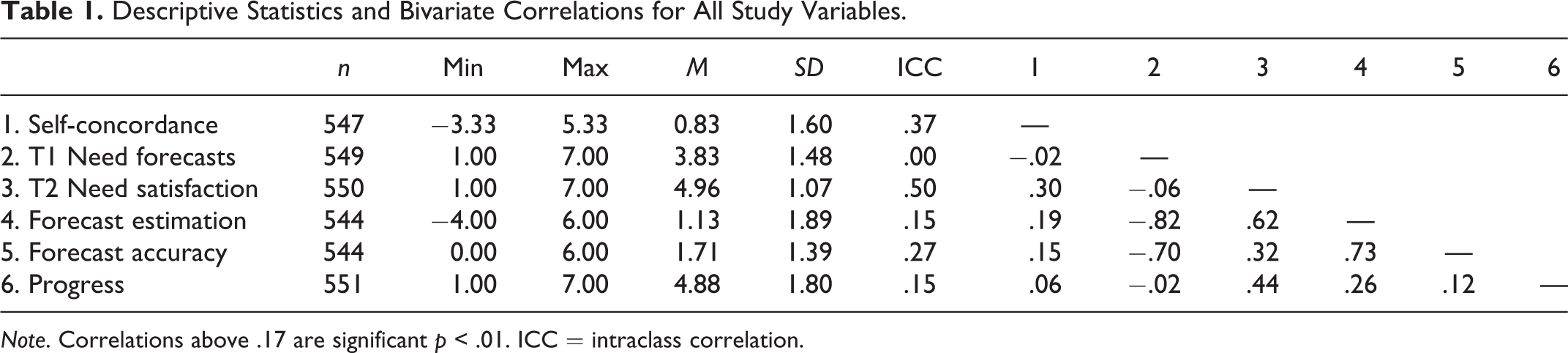
Note. Correlations above .17 are significant p < .01. ICC = intraclass correlation.
We tested our first hypothesis examining the relation between self-concordance and T1 need forecasts. 6 Results suggest that neither the within (b = –.02, SE = .05, p = .628, 95% CI [–.12, .07]) or between-person (b = –.08, SE = .97, p = .993, 95% CI [–1.98, 1.82]) effects were significant. However, given that we expected participants to predict that their goals would satisfy their needs regardless of their underlying reasons, we were essentially interested in testing the null hypothesis that self-concordance is unrelated to need forecasts. As it currently stands, our findings suggest that we cannot reject the null hypothesis, however, we still do not have sufficient evidence to accept it as being true. As such, we used Bayesian analyses that enable us to directly test a null effect, which is not possible with frequentist statistics (Wagenmakers, 2007). We compared the Bayesian Information Criteria (BIC) for the model with self-concordance predicting initial need forecasts (Model 1) against a model with the self-concordance parameter (at both the between and within levels) fixed to 0 (Model 0). We then compared the BIC for Models 1 and 0, where a difference of BIC (ΔBIC = |BICM1 – BICM0|) greater than 10 provides “strong evidence” for the more parsimonious model (Raftery, 1995). Results suggest that Model 0 (BIC = 3995.610) is a better fit than Model 1 (BIC = 4007.610), where ΔBIC10 = 12.32. We also computed the Bayes factor (BF01), 7 which represents a ratio contrasting the likelihood of the data under the null compared to the alternative hypotheses—in this case, BF01 represents evidence in support of the null hypothesis based on the observed data. The Bayes factor, BF01 = 473, indicates that the null model (Model 0) predicts the observed data 473 times better than the alternative (Model 1), which is generally considered an overwhelming level of statistical support. Therefore, our analyses suggest that participants’ initial need forecasts were unrelated to their underlying reasons for pursuing those goals.
Next, we aimed to replicate the self-concordance model (Sheldon & Elliot, 1999), whereby the interaction between self-concordance and goal progress predict T2 need satisfaction. As presented in Table 2, results suggest that there is no evidence of an interaction at either the within or between-person levels. To further substantiate this null effect, we ran a follow-up model with the interaction term fixed to 0 at both the within and between-person levels (Model 0). Results suggest that Model 0 (BIC = 8,277.568) is a better fit than then unconstrained Model 1 (BIC = 8,288.944), where ΔBIC = 11.38. We again computed the Bayes factor, BF01 = 295, which indicates that the null model (Model 0) predicts the observed data 295 times better than the alternative (Model 1). Despite the lack of this synergistic relation, results at the within-person level indicate that both self-concordance and progress independently predict T2 need satisfaction. This indicates that both the pursuit of more self-concordant goals and making progress on one’s goals is associated with greater need satisfaction, compared to their other goals. A similar pattern of findings was found at the between-person level, indicating that participants who pursued more self-concordant goals (vs. those who pursued less concordant goals), or those who made more progress (vs. those who made less progress) on their goals reported greater need satisfaction.
Multilevel Model for Hypothesis 2: Self-Concordance and Goal Progress Predicting Need Satisfaction.
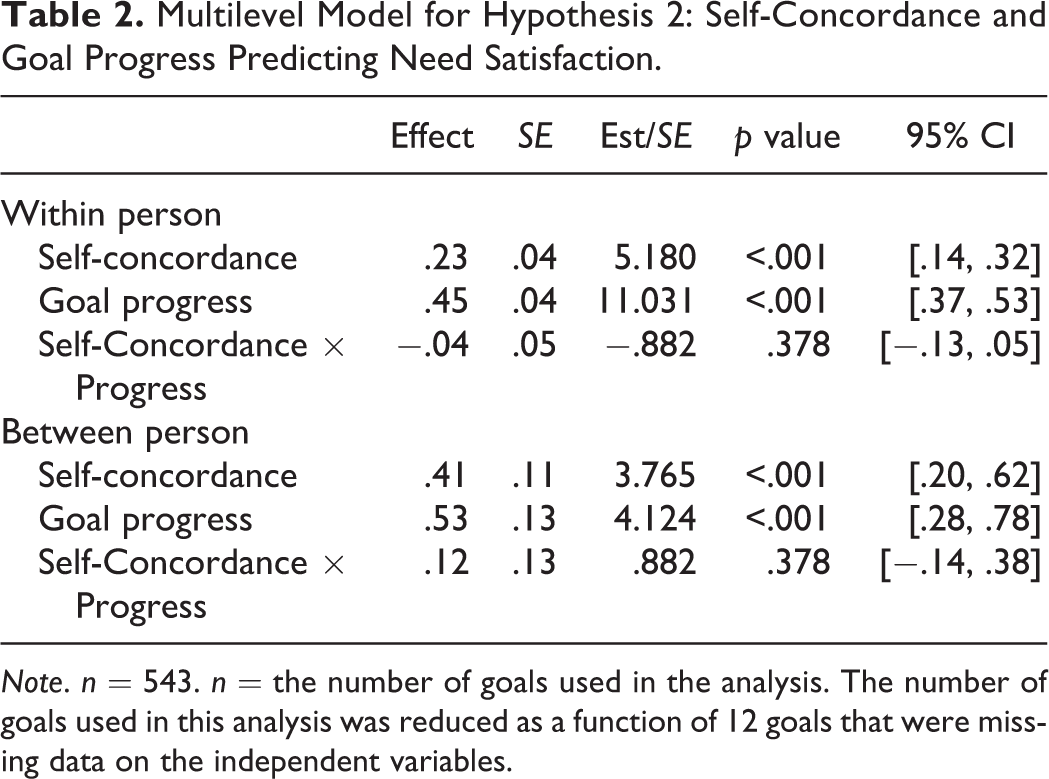
Note. n = 543. n = the number of goals used in the analysis. The number of goals used in this analysis was reduced as a function of 12 goals that were missing data on the independent variables.
Finally, we tested whether self-concordance would predict forecasting accuracy (Hypothesis 3; see Table 3). Because our primary interest was the magnitude of (in)accuracy, 8 the current analyses included the absolute value score. Controlling for T1 need forecasts (cf. Dalecki & Willits, 1991), results suggest that self-concordance significantly predicted forecasting accuracy at the between-person level, but not the within-person level. In other words, pursuing more self-concordant goals was associated with more accurate predictions, such that participants experienced approximately as much need satisfaction as they initially expected. Interestingly, having higher initial forecasts for a specific goal was associated with less accurate predictions, compared to goals where expectations were lower. Given that the predicted ratings of need satisfaction were quite high, it is likely that when a participant expected even greater need satisfaction for a given goal, they overestimated, so that their predictions were less accurate.
Multilevel Model for Hypothesis 3: Self-Concordance Predicting Need Forecasting Accuracy.
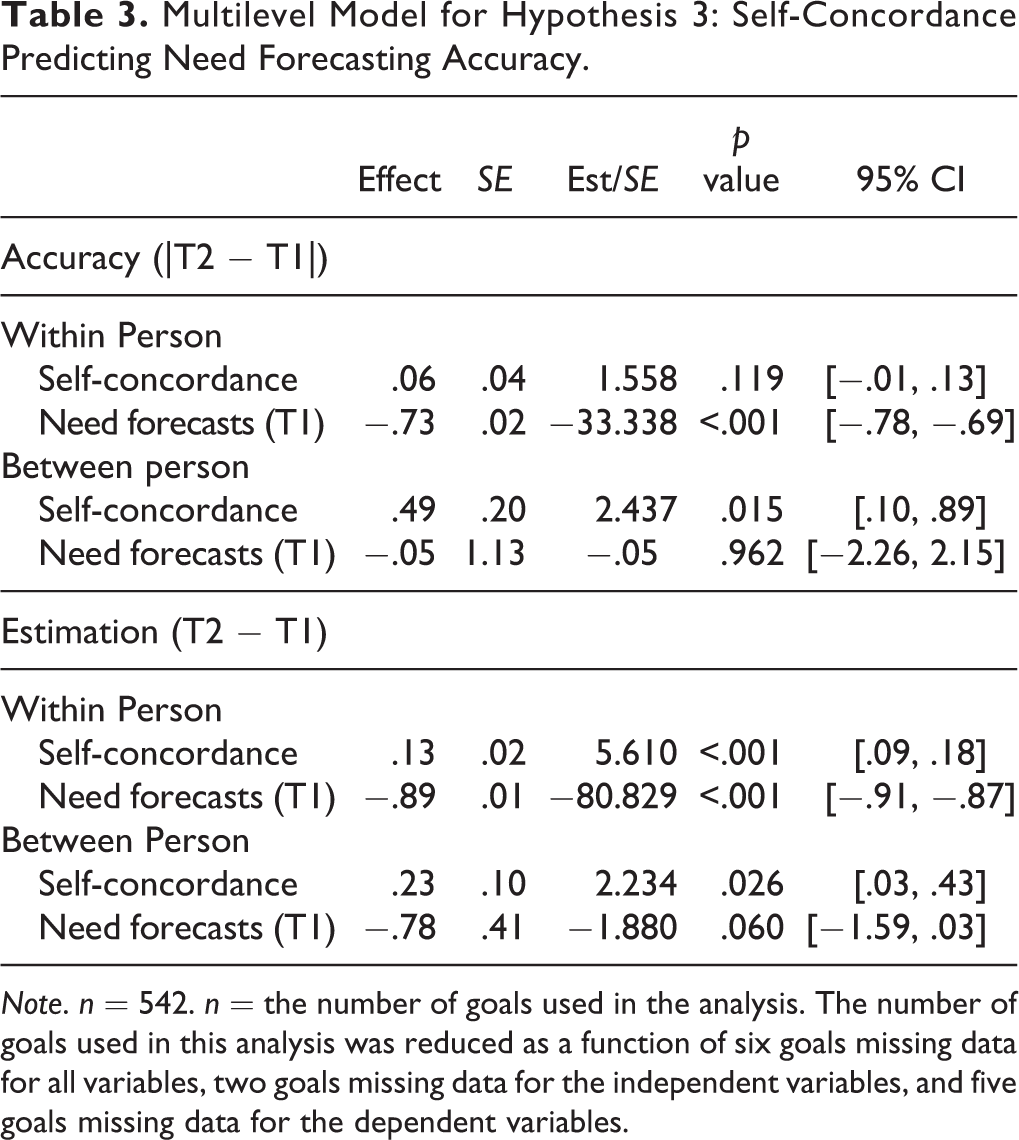
Note. n = 542. n = the number of goals used in the analysis. The number of goals used in this analysis was reduced as a function of six goals missing data for all variables, two goals missing data for the independent variables, and five goals missing data for the dependent variables.
In order to actually examine the directionality of forecasting errors, we regressed the estimation score (T2 – T1) on self-concordance while controlling for T1 need forecasts at both the within and between-person levels (see Table 3). Specifically, positive scores indicate underestimation, negative scores indicate overestimation, and 0 represents perfect accuracy. Results suggest that participants tended to underestimate the extent to which their self-concordant goals actually satisfy their psychological needs, both compared to their other goals and compared to participants who pursued goals that were less self-concordant. That is, pursuing more self-concordant (vs. less concordant) goals was associated with greater need satisfaction than initially expected.
Post Hoc Analysis
It may be the case that self-concordance leads to greater accuracy only in those cases when people actually make progress on their goals. To test this, we examined whether self-concordance and goal progress interact to predict forecasting accuracy (Model 1). Results suggest that there is no evidence of an interaction at either the within (b = .02, SE = .05, p = .720, 95% CI [–.08, .12]) or between-person (b = .16, SE = .31 p = .595, 95% CI [–.44, .76]) levels. We followed up with a second model, where we fixed the interaction term to 0 at both the within and between-person levels (Model 0). Bayesian analyses indicate that Model 0 (BIC = 8829.943) is a better fit than the unconstrained Model 1 (BIC = 8841.839), where ΔBIC = 11.90. The Bayes factor, B01 = 384, indicates that the null model (Model 0) predicts the observed data 384 times better than the alternative (Model 1).
General Discussion
The purpose of the present study was to examine whether people are able to accurately predict the extent to which their goals will satisfy their psychological needs for autonomy, competence, and relatedness. As expected, we found that participants generally expected that their goals would satisfy their psychological needs, therefore indicating that sometimes we may fall into the trap of the impact bias during goal pursuit. This appears to be the case during the pursuit of less concordant, or have-to goals, as participants tended to overestimate how much satisfaction they would experience during the pursuit of such goals. We also found that the pursuit of more self-concordant, or want-to goals, was associated with greater accuracy compared to the pursuit of have-to goals. Interestingly, participants seemed to benefit more from their want-to goal pursuits than originally expected, both compared to others who pursued more have-to goals and among their own goals. These findings have important implications for the goal-setting process, because while theory suggests that all people strive to satisfy their psychological needs (e.g., Deci & Ryan, 2000), some people appear to be misguided in their pursuits. This is also consistent with previous research, which suggests that some people think that pursuing materialistic goals will increase happiness even though the attainment of such goals does not actually contribute to their well-being (Sheldon et al., 2010). However, it should be noted that these findings come from a Westernized student sample, and so future research would benefit from replicating these findings among different ages and cultures.
From both a theoretical and practical perspective, our findings also indicate that the mere pursuit of want-to goals may have positive outcomes beyond goal attainment. Instead of focusing on goal attainment, we asked participants to report on the need satisfaction they felt during the pursuit of their goals throughout the entire week. Interestingly, we found that both goal progress and goal self-concordance independently contribute to need satisfaction during goal pursuit. In other words, it is important to pursue more want-to goals, as well as to make progress on our goals in general. From a theoretical perspective, this finding does not fully support the self-concordance model (Sheldon & Elliot, 1999), which suggests that the relation between goal attainment and need satisfaction should be moderated by self-concordance—we find no evidence of this interaction. To further support this finding, Bayesian analysis indicates that the model with this interaction fixed to zero substantially outperforms the model including the interaction term. In other words, it is not the case people need to actually attain their goals, but the mere pursuit of more want-to goals has the potential to yield positive benefits for our psychological well-being. From a more practical perspective, these findings indicate that, while people may not actively focus on satisfying their needs in their daily life, it seems as though people who pursue more want-to goals are more in-tune with their needs, which is then translated into their weekly goal pursuits.
As for the people who experienced a disconnect in the goal-setting process (i.e., those who overestimated need satisfaction), it would be interesting to assess whether they learn from their mistakes and subsequently choose “better” goals the next time around. Indeed, Sheldon and Houser-Marko (2001) find evidence of an “upward spiral,” such that attaining self-concordant, or want-to goals leads to increased want-to motivation and attainment in the pursuit of subsequent goals. Conversely, this would suggest that people who pursue more have-to goals are less likely to attain their goals, which may not necessarily lead to increased motivation for subsequent goals. However, past research also finds that when the need for autonomy is thwarted, people tend to actively seek to restore it (Radel, Pelletier, Sarrazin, & Milyavskaya, 2011). Taking into consideration both these findings, it may be the case that people seek to actively restore their thwarted needs, however, because they are unaware of the type of goals that they need to set (as evidenced by their forecasts in the present study), they instead opt for need substitutes, or goals that people use to compensate for need frustration (Vansteenkiste & Ryan, 2013). For example, a student may set a goal that would please their parents (e.g., get an A on a test) in the hopes to foster a sense of relatedness, but because the relatedness is contingent upon performance, it would not be as genuine and therefore less satisfying (e.g., Werner, 2015). Such behaviors would ultimately result in a vicious cycle of people continuously setting the “wrong” goals (i.e., those contingent upon external indicators of self-worth), and so future research should delve more deeply into (a) developing strategies that help people set goals that are more in-line with their needs, and (b) figuring out the person-specific factor(s) that distract people from their needs in the first place.
Conclusion
Taking into consideration, research on goal pursuit and affective forecasting, the present study indicates that people may not always be in in-tune with their needs when setting which goals to pursue. As a result, some people may overestimate the benefits gained from goal attainment, resulting in the pursuit of goals that may seem satisfying but actually are not. Identifying this key problem highlights the importance of setting “better” goals that are congruent with what we really want instead of pursuing goals based on what we feel that we have to do.
Footnotes
Acknowledgments
We would like to thank our reviewer, Alexander Etz, for his insightful and educational comments that helped improve the interpretation of our Bayesian analyses.
Declaration of Conflicting Interests
The author(s) declared no potential conflicts of interest with respect to the research, authorship, and/or publication of this article.
Funding
The author(s) disclosed receipt of the following financial support for the research, authorship, and/or publication of this article: This research was supported by a grant from the Social Science and Humanities Research Council (SSHRC) of Canada to Marina Milyavskaya.