







Abstract
Numerous studies have shown that acting prosocially promotes the altruist’s well-being. What has been less clear, however, is when the effect is the strongest and what mechanism is behind the well-being benefits of prosocial action. We asked a community sample (N = 383) to record their prosocial engagement, well-being levels, and autonomy, relatedness, and competence 4 times daily for 2 weeks using an app-based event-sampling method. We found that only one’s competence—and neither autonomy nor relatedness—at one time point (t − 1) moderated the effect of prosocial engagement on hedonic and eudaimonic well-being at a subsequent time point (t). Specifically, when participants reported lower competence levels at t − 1, the relationship between acting prosocially and well-being was stronger at t. We further demonstrated that this interaction was mediated by competence levels at t.
There is broad policy and public interest in understanding what actions can help promote well-being (Diener & Seligman, 2004; Kuykendall, Tay, & Ng, 2015). One of the most intriguing possibilities proposed in the last decade has been prosocial action—acting kindly or generously toward others. While it is relatively self-evident that prosociality is beneficial to the recipient, numerous correlational and experimental studies have shown that acting prosocially also promotes the altruist’s well-being (Dunn, Aknin, & Norton, 2008; Plagnol & Huppert, 2010). Yet this effect is neither strong nor uniform. In fact, a recent meta-analysis has shown that the average link between prosociality and well-being is actually weak—average r = .12—and is heavily moderated by a confluence of methodological and psychological factors (Hui, Berzaghi, Cunningham-Amos, & Kogan, 2016).
Thus, two key questions in this research area are when and why prosociality promotes well-being—and when it does not. Building upon self-determination theory (Deci & Ryan, 1985, 2000) and a two process model of basic psychological needs (Sheldon, 2011), we propose a new framework for understanding within-person variations of the link. Our framework suggests that state-like psychological need satisfaction at a given time point (t − 1) within a person uniquely moderates the effect of prosocial engagement on well-being at a subsequent time point (t). Furthermore, we theorize that such an interaction effect on well-being is most likely explained by state-like psychological need satisfaction at same time point t. According to Muller, Judd, and Yzerbyt (2005), since our conceptual model starts with a moderation on an overall treatment effect, and we expect this effect is further explained by a mediating process, we propose a mediated moderation model for the within-person prosocial effect on well-being. We test these hypotheses through an event-sampling method in order to study prosociality and well-being naturalistically.
Self-Determination Theory and Prosociality
Self-determination theory stipulates that satisfaction of three basic psychological needs—autonomy (the need to experience choice and psychological freedom), competence (the need to feel effective or a sense of mastery), and relatedness (the need to feel connected with significant others)—determines human well-being (Sheldon & Niemiec, 2006). Self-determination theory researchers suggested that each need is a basic and distinct psychological nutriment, thus having independent potential to influence well-being (Reis, Sheldon, Gable, Roscoe, & Ryan, 2000). Prosocial behavior can be a way to fulfill these needs (Dunn, Aknin, & Norton, 2014). Therefore, we theorized that satisfaction of competence, autonomy, and relatedness could all be independently functional in linking individuals’ prosocial engagement to well-being.
Some empirical evidence exists supporting these links. For example, some prosocial spending research concludes that individuals garner more subjective well-being when their monetary donations have a significant impact on others (Aknin, Dunn, Whillan, Grant, & Norton, 2013) and individuals experience higher positive affect (PA) after recalling a time of prosocial spending on a stronger tie (vs. weaker tie; Aknin, Sandstrom, Dunn, & Norton, 2011). Other research has reported that people experience more well-being only if they have autonomous motivation for a prosocial act, and this relationship is mediated by overall psychological needs, particularly by autonomy and relatedness (Weinstein & Ryan, 2010).
Collectively, previous research has suggested that satisfaction of the three needs potentially moderates or mediates the prosocial engagement to well-being relationship. However, as the dearth of empirical studies mentioned above illustrates, there are still few studies explicitly investigating the role self-determination theory plays in the prosociality to well-being link. Even more critically, past work from the self-determination theory perspective has not considered the unique impact of the three basic needs—past work has examined each need separately. Given the collinearity between the three self-determination theory dimensions, it is an important next step for the current study to incorporate all three factors into the same models to study their independent effects, with a view to investigate the extent to which each need satisfaction specifically influences the prosociality to well-being link.
Toward a Two Process Model of Prosociality
What remains unclear is how self-determination theory involved in the prosociality to well-being relationship. We propose that satisfaction of the needs may act as both moderators (explaining when people will benefit from acting prosocially and when they will not) and mediators (explaining why people benefit from acting prosocially). Our view aligns with two process model of psychological needs proposed by Sheldon (2011). Psychological needs in the two process model are defined as both innate behavioral motives and experiential requirements necessary for wellness and growth. Past self-determination research has mainly treated psychological needs as experiential requirements—the presence or absence of which affects well-being. However, according to the needs-as-motives perspective, the psychological needs can also be internal processes that affect behavior (Atkinson & Birch, 1970) and motivational force when they are unsatisfied (Sheldon & Gunz, 2009). Putting this together, two process model is a coupled regulatory process linking behavioral motives and experiential requirements: When there is initially a salient absence of the required experience (need dissatisfaction), the unmet needs call upon behavioral motives to remedy and improve the situation through need-relevant and adaptive behavior. Subsequently, the particular behavior that successfully reduces those motives reinforces the experience of need satisfaction at the final phase.
In the context of prosociality and well-being, we propose a mediated moderation model of satisfaction of state-like psychological needs (Figure 1). Specifically, when a person’s particular need satisfaction is relatively low, this unmet need will become a behavioral motive to improve need satisfaction through adaptive behavior—in our case, prosocial engagement. In turn, this need satisfaction through prosocial engagement leads to increased well-being. When the same person’s need satisfaction is relatively high, prosocial engagement will help the person maintain/enhance the experience of high need satisfaction and, in turn, well-being; however, this increase is substantially lower than in the previous case of low need satisfaction. In other words, Patty will feel better when she acts kindly toward others—but how much better depends on Patty’s state of mind earlier in the day t − 1. If Patty already had a particular psychological need satisfied (e.g., competence), then Patty will get a small boost in well-being from acting kindly. However, if Patty was relatively unsatisfied in a particular domain (e.g., competence), then she will get a big boost in well-being from acting kindly. The reason why Patty has these different patterns of well-being boosts is due to the mechanism: Acting kindly satisfies a psychological need (e.g., competence), which in turn translates into greater well-being. If Patty is already high in satisfaction of a particular need, there is little room for her kind act to boost her satisfaction—hence the negligible to small boost in well-being. But if she has a lot of space to improve in her satisfaction of a need, then that boost can in turn translate into a larger increase in well-being for her. Importantly, we are predicting that the change in well-being is greater for Patty if she is low in need satisfaction at t − 1. It is entirely possible—and even likely—that Patty’s absolute levels of well-being are higher when she already had high need satisfaction at t − 1 since she was already likely at a high level of well-being.

Conceptual model of mediated moderation of satisfaction of state-like psychological needs.
Present Study
We employed event-sampling method to study how the need satisfaction trio is related to the effect of prosociality on (a) hedonic and (b) eudemonic well-being in daily life. In particular, we were interested in establishing whether each need moderated and mediated the link between prosociality and well-being.
The event-sampling approach provided us several advantages. First, we were able to study the processes in daily life, tapping real-world acts of prosociality rather than artificial laboratory scenarios. Second, time-sensitive analyses can be conducted. In particular, for the moderation, we reasoned that if individuals were low in a particular need at t − 1, they would benefit more from acting prosocially at t. For the mediation, in contrast, we reasoned that the mediation would occur immediately and thus study the mediational process at the same time point t as the prosocial engagement and well-being effect.
Method
Participants and Procedure
Figure 2 shows the participants and procedure of data collection for our event-sampling study. Sample size and power analyses were not conducted prior to data collection but assuming a medium effect size, 1 our sample size (Level-1 average group size = 27.36, Level-2 group size = 383) was sufficient to produce a power estimate of .90 (Scherbaum & Ferreter, 2009) and unbiased and accurate estimates and standard errors in multilevel analysis (Maas & Hox, 2005).
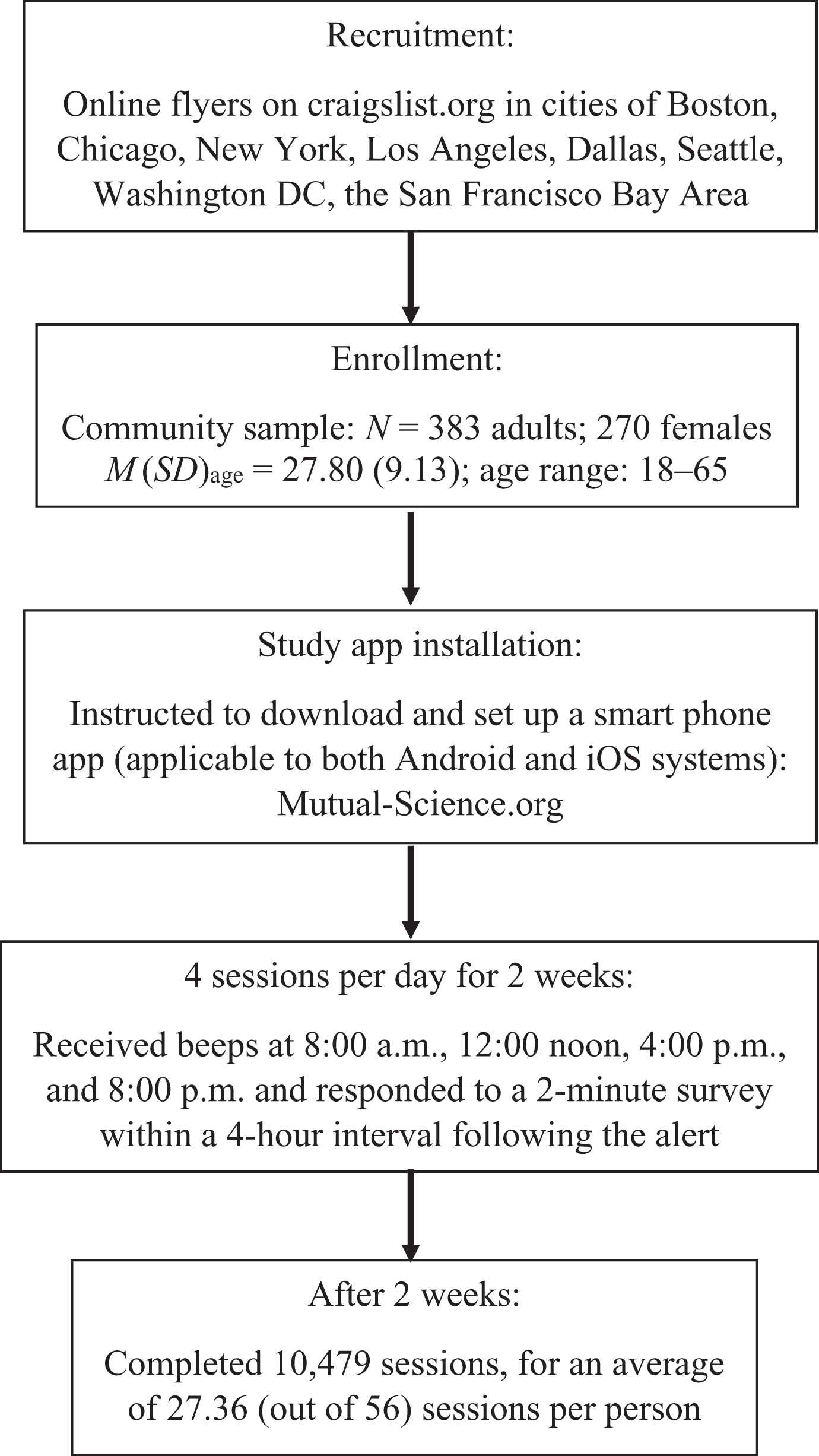
Participants and procedure of our event-sampling study.
Session Measures
Prosocial engagement
In each session, participants answered a modified version of a previous scale (Weinstein & Ryan, 2010): “How many acts have you engaged in in the past couple of hours that involved helping someone else or doing something for a good cause?” Participants indicated the number of prosocial acts on a drop-down menu ranging from 0 to 10+. Forty percent of the sessions showed the presence of prosocial engagement, with an average of 2.14 prosocial acts per session. The response of “0” was classified as “no prosocial engagement,” and the responses of “1” or more were classified as “had prosocial engagement”; we used contrast coding of “−0.5” and “0.5” for them, respectively (see Online Supplemental Material).
State basic psychological needs
The satisfaction of basic psychological needs was assessed using a 9-item Basic Psychological Needs Scale (La Guardia, Ryan, Couchman, & Deci, 2000). Each of the subscales for competence (e.g., “In the past couple of hours, I felt very capable and effective”), autonomy (e.g., “In the past couple of hours, I felt to be who I am”), and relatedness (e.g., “In the past couple of hours, I felt loved and cared about”) consists of 3 items on 7-point scales (1 = not at all true to 7 = very true).
State affect
Positive and negative affect (NA) were assessed by the 9-item Emmons Mood Indicator (Diener & Emmons, 1985). Participants were asked to indicate “How much of each did you feel in the past couple of hours?” using 7-point scales (1 = not at all to 7 = extremely). Score for state affect was computed by the formula: positive effect (PA) − negative effect(NA).
State happiness
Participants reported their general happiness on an abbreviated 2-item version of the Subjective Happiness Scale (Lyubomirsky & Lepper, 1999): “In the past couple of hours, in general, I considered myself: 1 = not a very happy person to 7 = a very happy person” and “In the past couple of hours, compared to most of my peers, I considered myself: 1 = less happy to 7 = more happy.”
State self-esteem
Self-esteem was evaluated using 2 items from the Rosenberg Self-Esteem Scale (Rosenberg, 1965). The items were “In the past couple of hours, I was satisfied with myself” and “In the past couple of hours, I thought I was a person of worth” (Weinstein & Ryan, 2010). Ratings were made on a 4-point scale (1 = strongly disagree to 4 = strongly agree).
State subjective vitality
Vitality refers to the positive feeling of aliveness and energy, indicating optimal functioning in the eudaimonic tradition (Ryan & Frederick, 1997). Participants responded to 3 representative items (Weinstein & Ryan, 2010) from the 7-item Subjective Vitality Scale (Ryan & Frederick, 1997). One sample item was “In the past couple of hours, I felt alive and vital.” All items were rated on a 7-point scale (1 = not at all true to 7 = very true).
A state hedonic well-being composite was derived from summing up the z-scores of PA, NA (reversed), and happiness. A state eudaimonic well-being composite was also derived from summing up the z-scores of self-esteem and subjective vitality.
Results
Participants’ session-level data (Level 1) were nested within person-level data (Level 2). We analyzed participants’ multiple time-point responses using multilevel modeling (MLM). We were particularly interested in within-person (state like) variation in Level-1 predictors and outcomes. Fortunately, MLM allows us to analyze the Level-1 data while controlling for shared variance between levels (Raudenbush & Bryk, 2002). To do so, we employed person-mean centering for all Level-1 predictors except prosocial engagement. The within-person correlation results were conducted in Mplus (Muthén & Muthén, 1998–2010), and the other analyses were estimated in the lme4 package in R (Bates, Maechler, Bolker, & Walker, 2015).
Preliminary Analysis
In Table 1, the intraclass correlations indicated that a substantial amount of variance came from between-person and within-person variations across sessions, and thus within-person level analyses were appropriate. Specifically, the total within-person variance of the key variables ranged from 23% to 72%. Within-person correlation results supported our prediction that prosocial engagement significantly predicted all well-being indicators in the same session: affect, r(10,208) = .21; happiness, r(10,172) = .17; self-esteem, r(9,963) = .13; subjective vitality, r(10,133) = .25; hedonic well-being composite, r(10,143) = .20; and eudaimonic well-being composite, r(9,954) = .23; all ps < .001.
Summary of Means, Standard Deviations, ICCs, and Within-Person Correlations for Measures.
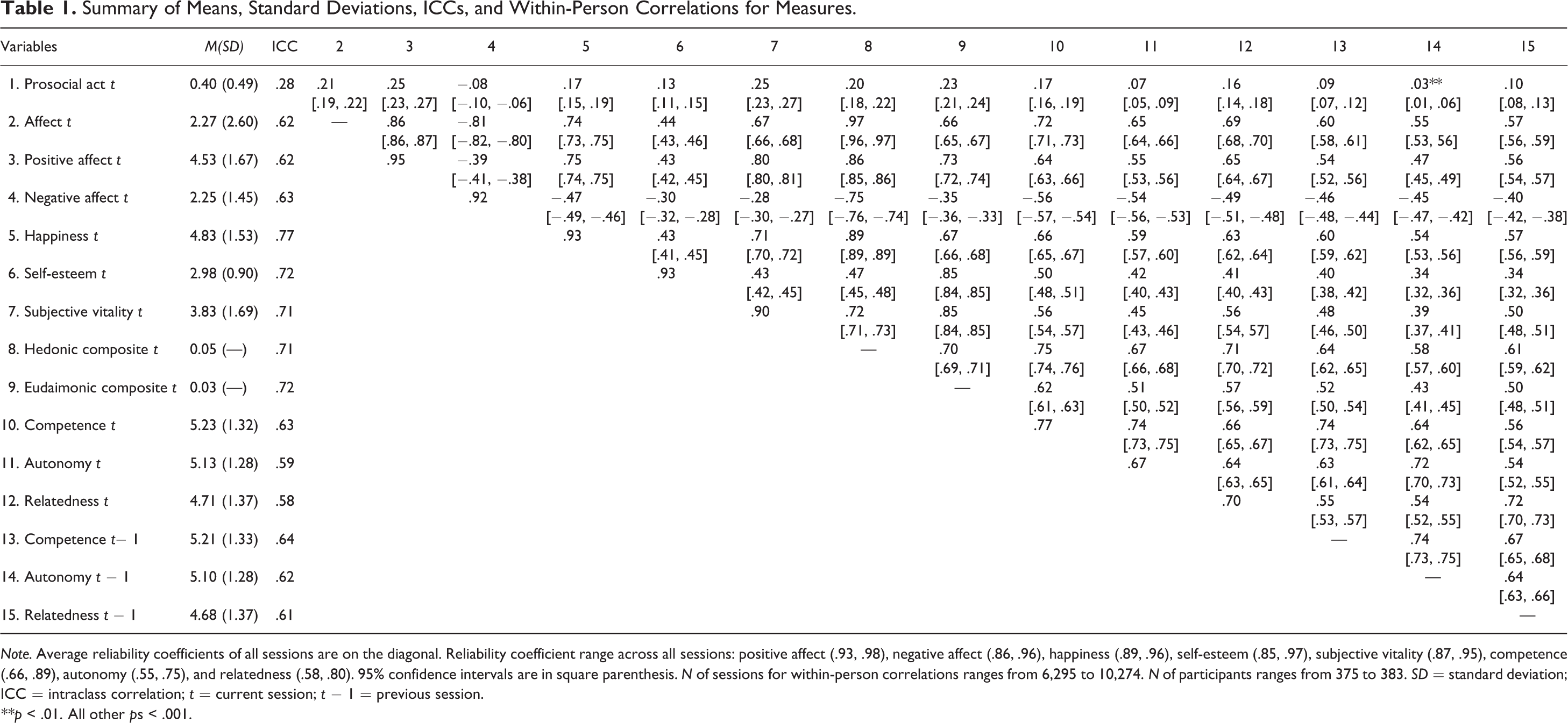
Note. Average reliability coefficients of all sessions are on the diagonal. Reliability coefficient range across all sessions: positive affect (.93, .98), negative affect (.86, .96), happiness (.89, .96), self-esteem (.85, .97), subjective vitality (.87, .95), competence (.66, .89), autonomy (.55, .75), and relatedness (.58, .80). 95% confidence intervals are in square parenthesis. N of sessions for within-person correlations ranges from 6,295 to 10,274. N of participants ranges from 375 to 383. SD = standard deviation; ICC = intraclass correlation; t = current session; t − 1 = previous session.
**p < .01. All other ps < .001.
Moderation Model of Separate Psychological Needs
We first demonstrated that satisfaction of the three psychological needs at t − 1 could separately moderate the effect of prosocial engagement on well-being at t. Well-being (WB ti ) at t was estimated by the following equation:

where PE ti and NS(t − 1)i represent the value on each session (t) for each person (i) of prosocial engagement at t and need satisfaction—competence, relatedness, or autonomy—at t − 1 on the same day (person-mean centered); PE ti × NS(t − 1)i is the interaction term between prosocial engagement at t and satisfaction of psychological needs at t − 1, corresponding to the key coefficient, γ30, which tests our prediction.
We found that the interaction of competence satisfaction at t − 1 and prosocial engagement at t significantly predicted all well-being indicators at t: affect, γ30 = −2.21, t(6,133) = −4.35, p < .001; happiness, γ30 = −1.02, t(5,084) = −4.26, p < .001; self-esteem, γ30 = −0.72, t(5,956) = −4.55, p < .001; subjective vitality, γ30 = −1.55, t(6,070) = −5.48, p < .001; hedonic well-being composite, γ30 = −2.09, t(6,006) = −4.55, p < .001; and eudaimonic well-being composite, γ30 = −1.73, t(5,949) = −6.13, p < .001 (see Table 2).
Moderation of State Competence for Predicting the Effect of Prosocial Engagement on State Well-Being Indicators in Hierarchical Linear Modeling.
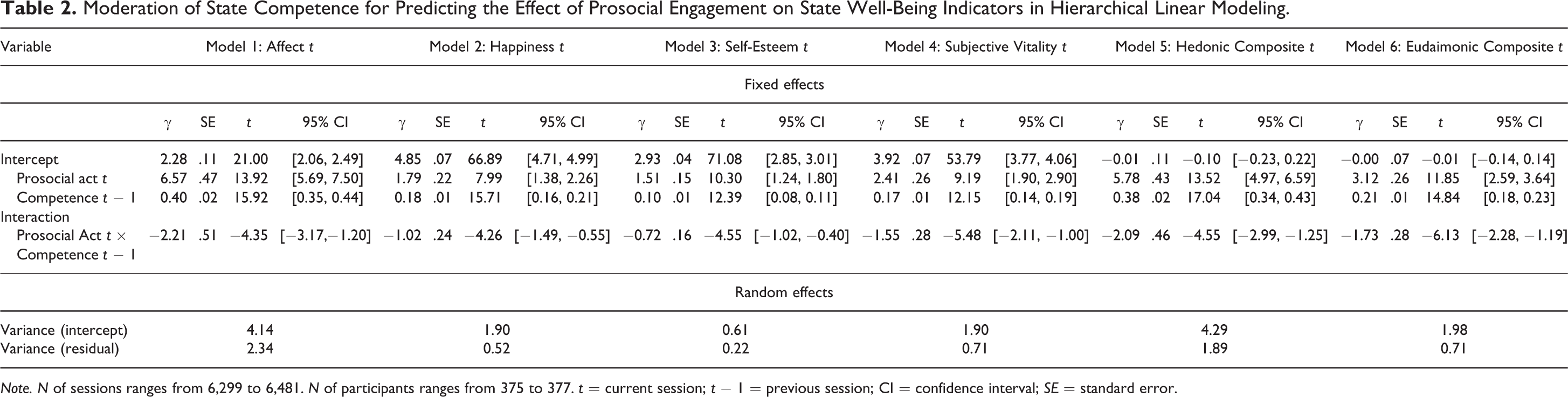
Note. N of sessions ranges from 6,299 to 6,481. N of participants ranges from 375 to 377. t = current session; t − 1 = previous session; CI = confidence interval; SE = standard error.
Autonomy satisfaction at t − 1 significantly moderated the effect of prosocial engagement on affect, γ30 = −1.43, t(6,133) = −2.76, p = .006; subjective vitality, γ30 = −0.90, t(6,070) = −3.14, p = .002; hedonic well-being composite, γ30 = −1.13, t(6,005) = −2.42, p = .016; and eudaimonic well-being composite, γ30 = −0.84, t(5,951) = −2.90, p = . 004 at t, while not moderating the effect of prosocial engagement on happiness, γ30 = −0.41, t(6,087) = −1.66, p = .097, and self-esteem, γ30 = −0.25, t(5,958) = −1.57, p = .116, at t (see Table 3).
Moderation of State Autonomy for Predicting the Effect of Prosocial Engagement on State Well-Being Indicators in Hierarchical Linear Modeling.
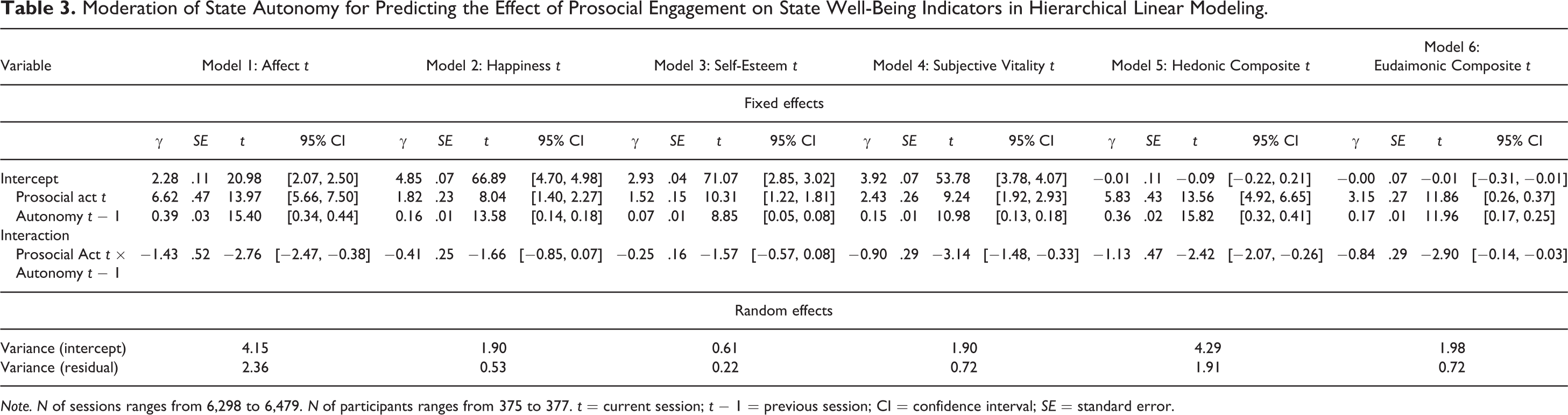
Note. N of sessions ranges from 6,298 to 6,479. N of participants ranges from 375 to 377. t = current session; t − 1 = previous session; CI = confidence interval; SE = standard error.
Relatedness satisfaction at t − 1 significantly moderated the effect of prosocial engagement on happiness, γ30 = −0.83, t(6,080) = −3.72, p < .001; subjective vitality, γ30 = −0.70, t(6,065) = −2.69, p = .007; hedonic well-being composite, γ30 = −0.87, t(6,003) = −2.04, p = .042; and eudaimonic well-being composite, γ30 = −0.71, t(5,944) = −2.70, p = .007 at t, while not moderating the effect of prosocial engagement on affect, γ30 = −0.80, t(6,130) = −1.69, p = .091, and self-esteem, γ30 = −0.26, t(5,951) = −1.75, p = .081, at t (see Table 4).
Moderation of State Relatedness for Predicting the Effect of Prosocial Engagement on State Well-Being Indicators in Hierarchical Linear Modeling.
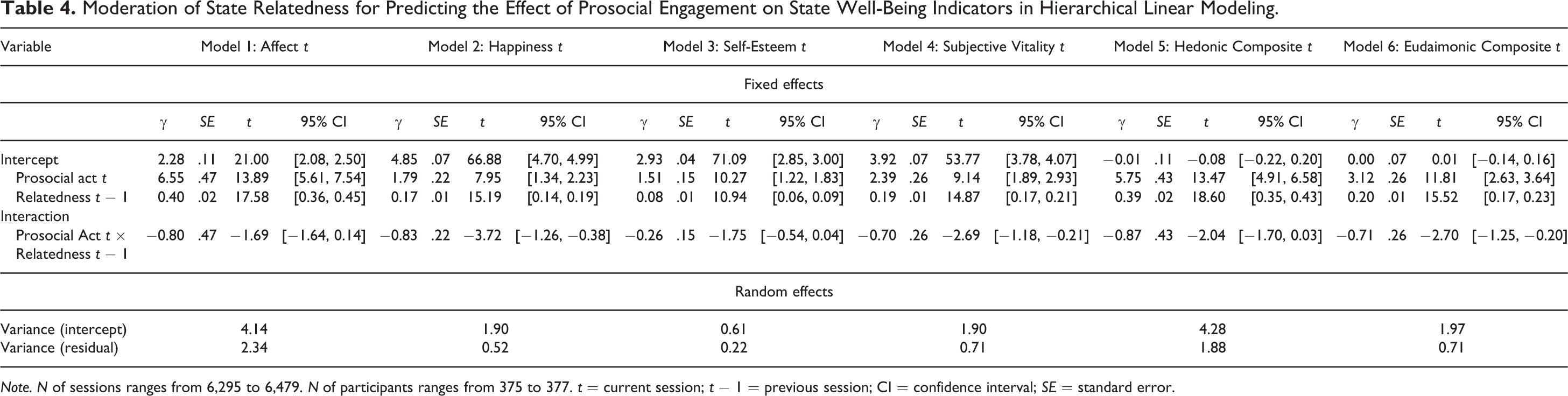
Note. N of sessions ranges from 6,295 to 6,479. N of participants ranges from 375 to 377. t = current session; t − 1 = previous session; CI = confidence interval; SE = standard error.
Independent Moderation Models
The above results highlight that all three psychological needs moderate the effect of prosociality on well-being when treated separately. One of our study goals was, however, to test whether each of the psychological needs at t − 1 uniquely moderated prosocial engagement to well-being link at t. To achieve it, we conducted a series of moderation models again, but in which we controlled for the other two psychological needs at t − 1, and their interaction terms with prosocial engagement at t. Therefore, well-being at t was estimated by the following equation:
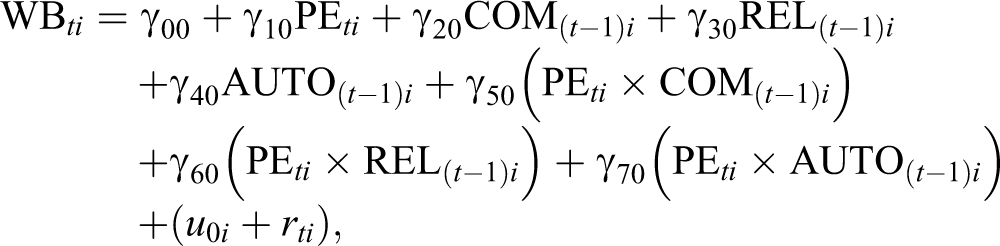
where PE ti is the same as the first equation; COM(t − 1)i, REL(t − 1)i , and AUTO(t − 1)i represent the value on each session (t) for each person (i) of competence, relatedness, and autonomy at t − 1 on the same day, respectively (person-mean centered); PE ti × COM(t − 1)i , PE ti × REL(t − 1)i , and PE ti × AUTO(t − 1)i are the interaction terms between the corresponding variables; and γ50 to γ70, the key coefficients of our interest, represent the overall slopes between the interaction terms and well-being at t.
Analyses revealed that the interaction of prosocial engagement at t and competence at t − 1 significantly predicted affect, γ50 = −2.15, t(6,126) = −3.52, p < .001; happiness, γ50 = −0.90, t(6,077) = −3.11, p = .002; self-esteem, γ50 = −0.81, t(5,948) = −4.26, p < .001; subjective vitality, γ50 = −1.48, t(6,061) = −4.36, p < .001; hedonic well-being composite, γ50 = −2.10, t(5,999) = −3.82, p < .001; and eudaimonic well-being composite, γ50 = −1.79, t(5,942) = −5.24, p < .001 at t, even after controlling for the other basic psychological needs at t − 1—relatedness and autonomy—as well as their interaction terms with prosocial engagement at t. However, critically neither autonomy nor relatedness at t − 1, in any models, moderated the prosocial engagement to well-being link in the presence of the other two psychological needs (see Models 1a and 1b in Table 5–7).
Hierarchical Linear Modeling of Mediated Moderation for Predicting State Affect and State Happiness.
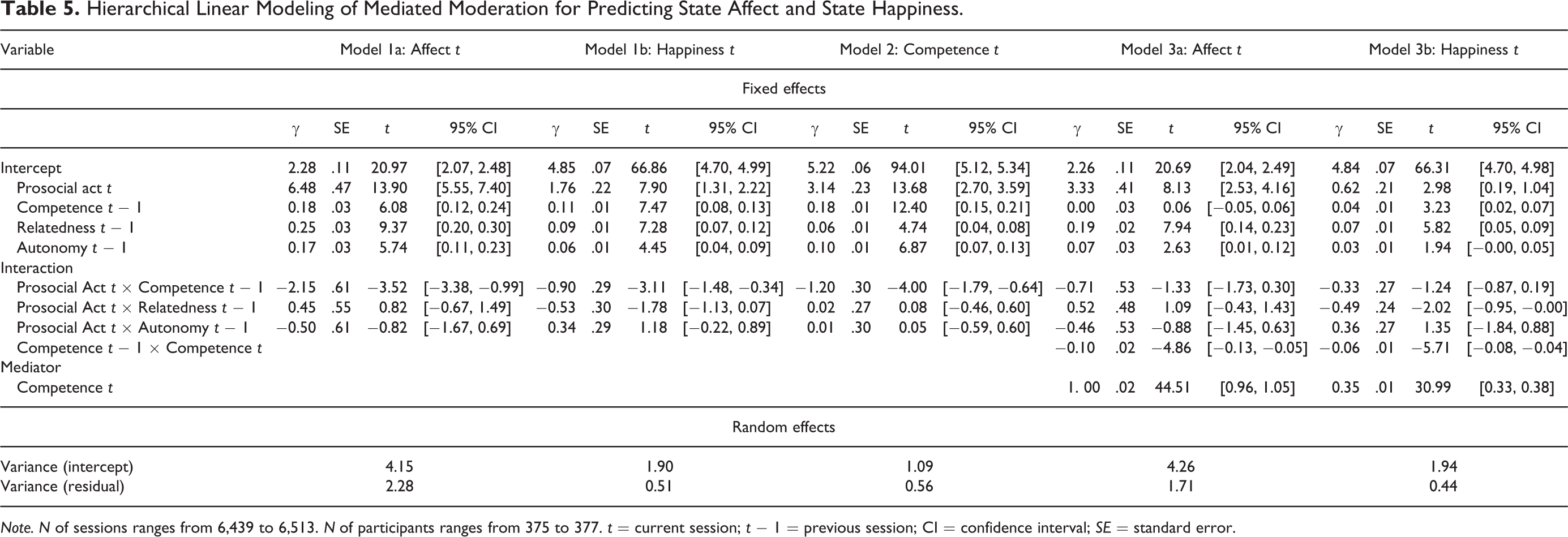
Note. N of sessions ranges from 6,439 to 6,513. N of participants ranges from 375 to 377. t = current session; t − 1 = previous session; CI = confidence interval; SE = standard error.
Hierarchical Linear Modeling of Multilevel Mediated Moderation for Predicting State Self-Esteem and State Subjective Vitality.
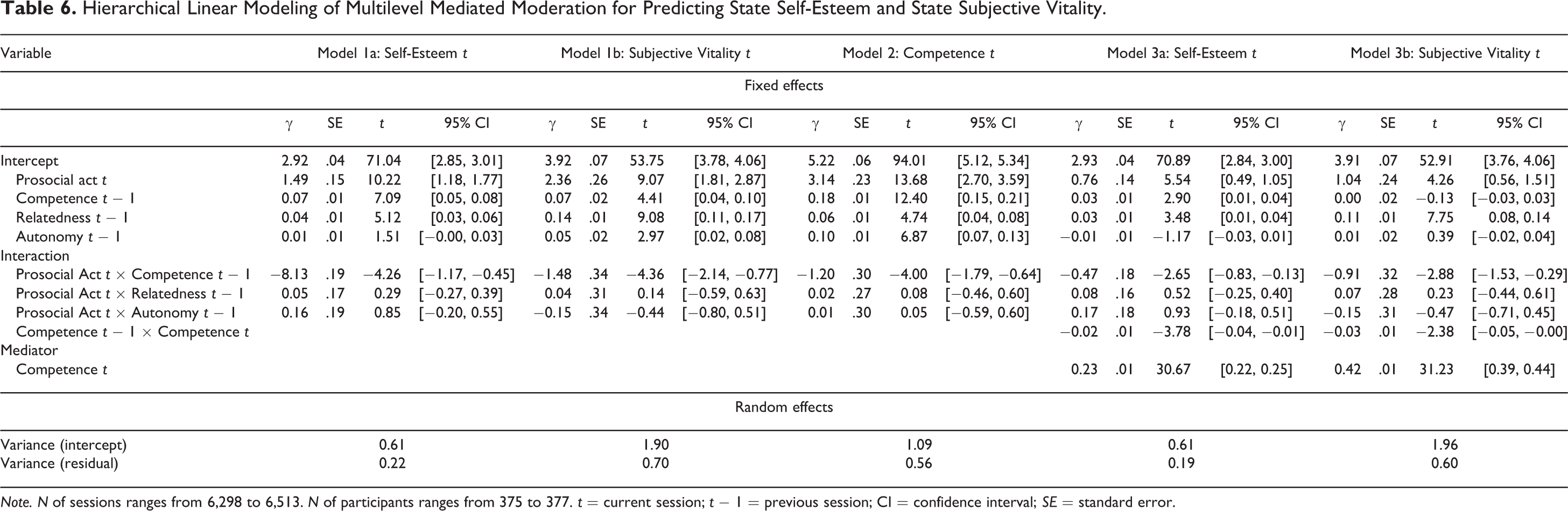
Note. N of sessions ranges from 6,298 to 6,513. N of participants ranges from 375 to 377. t = current session; t − 1 = previous session; CI = confidence interval; SE = standard error.
Hierarchical Linear Modeling of Multilevel Mediated Moderation for Predicting State Hedonic Composite and State Eudaimonic Composite.
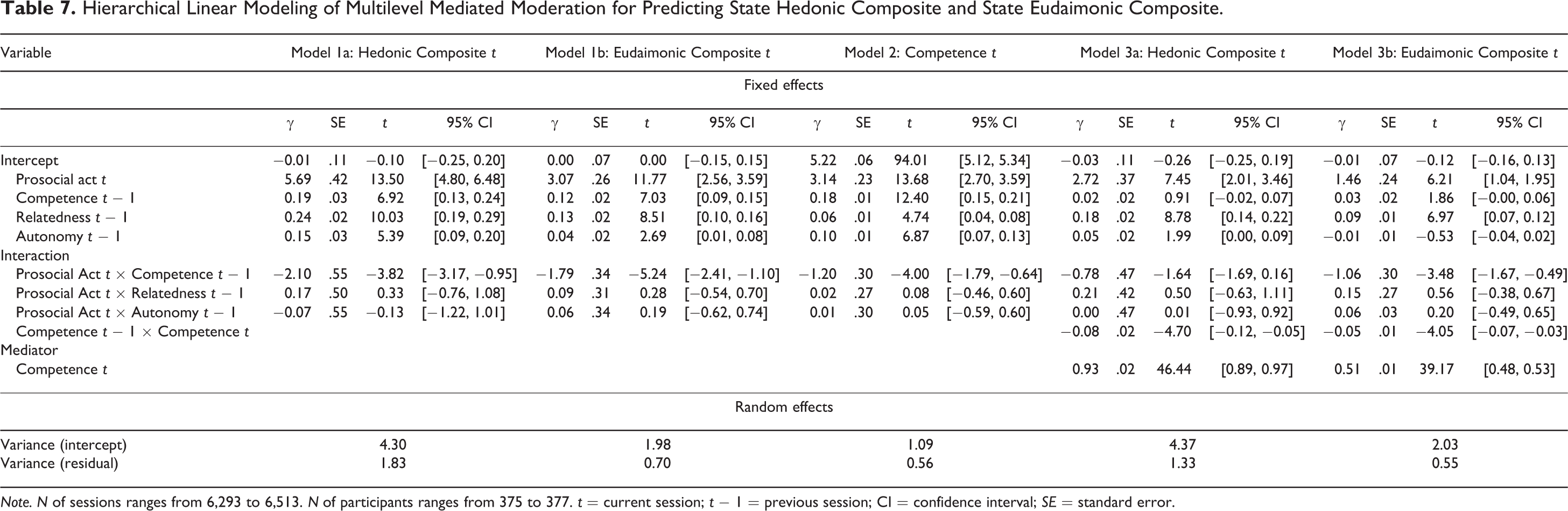
Note. N of sessions ranges from 6,293 to 6,513. N of participants ranges from 375 to 377. t = current session; t − 1 = previous session; CI = confidence interval; SE = standard error.
We tested simple slopes at one standard deviation above and below the mean of competence level at t − 1. The significance of the slopes is inferred from the confidence intervals. As shown in Figures 3 –5, all simple slope tests revealed a significant positive relationship between prosocial engagement and all well-being indicators at t. While there was a positive relationship between prosocial engagement and well-being for both the low and high satisfaction of competence groups, the strengths were radically different. In particular, we found the slopes for the low satisfaction of competence group ranged from 111% to 420% stronger than the slopes for the high satisfaction of competence group in all models.
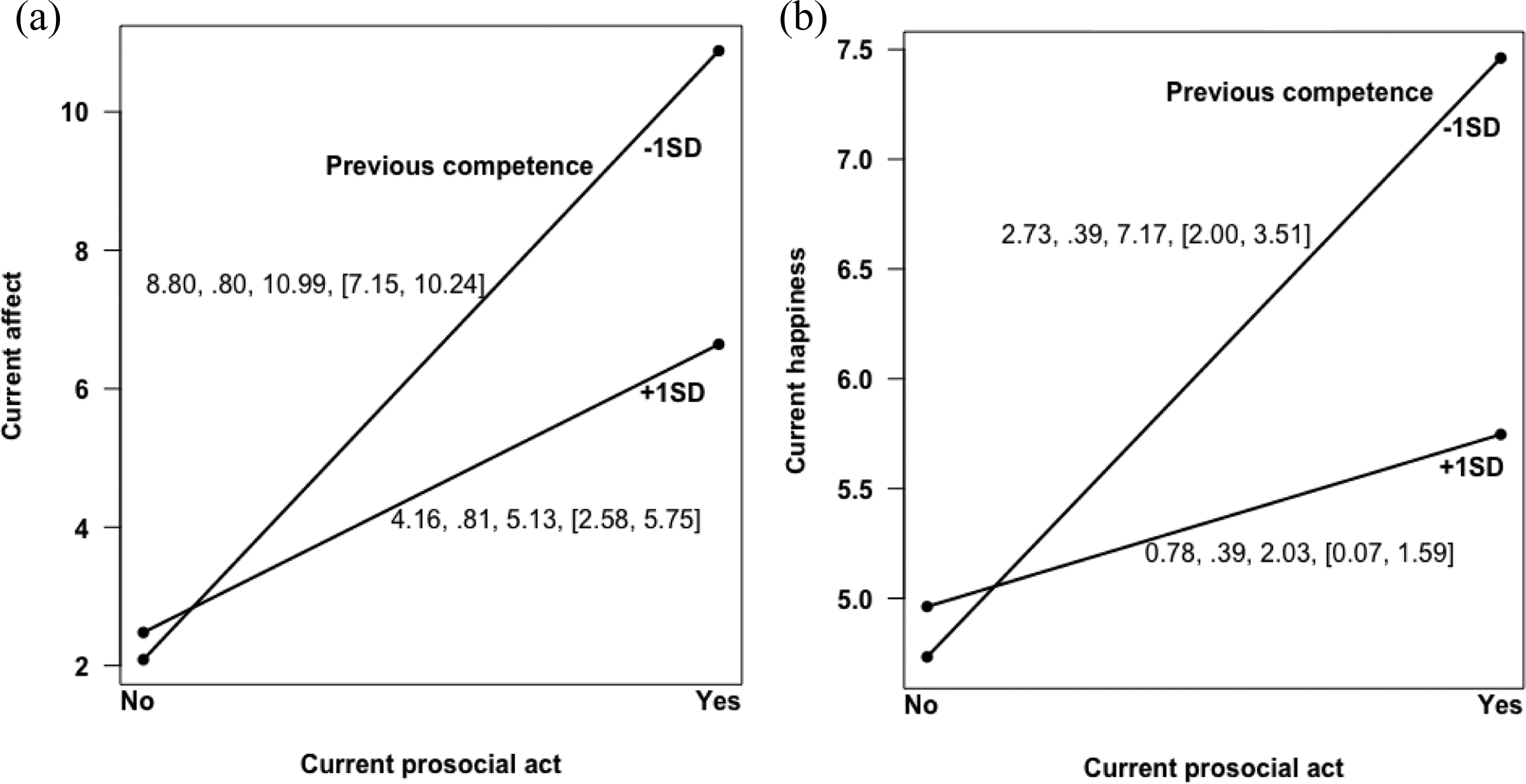
Prosocial engagement at t at varying levels of competence at t − 1 (lines) predicting well-being indicators of affect (a) and happiness (b) at t. Statistics are simple slope coefficient, standard error, t value, and 95% confidence interval, respectively.
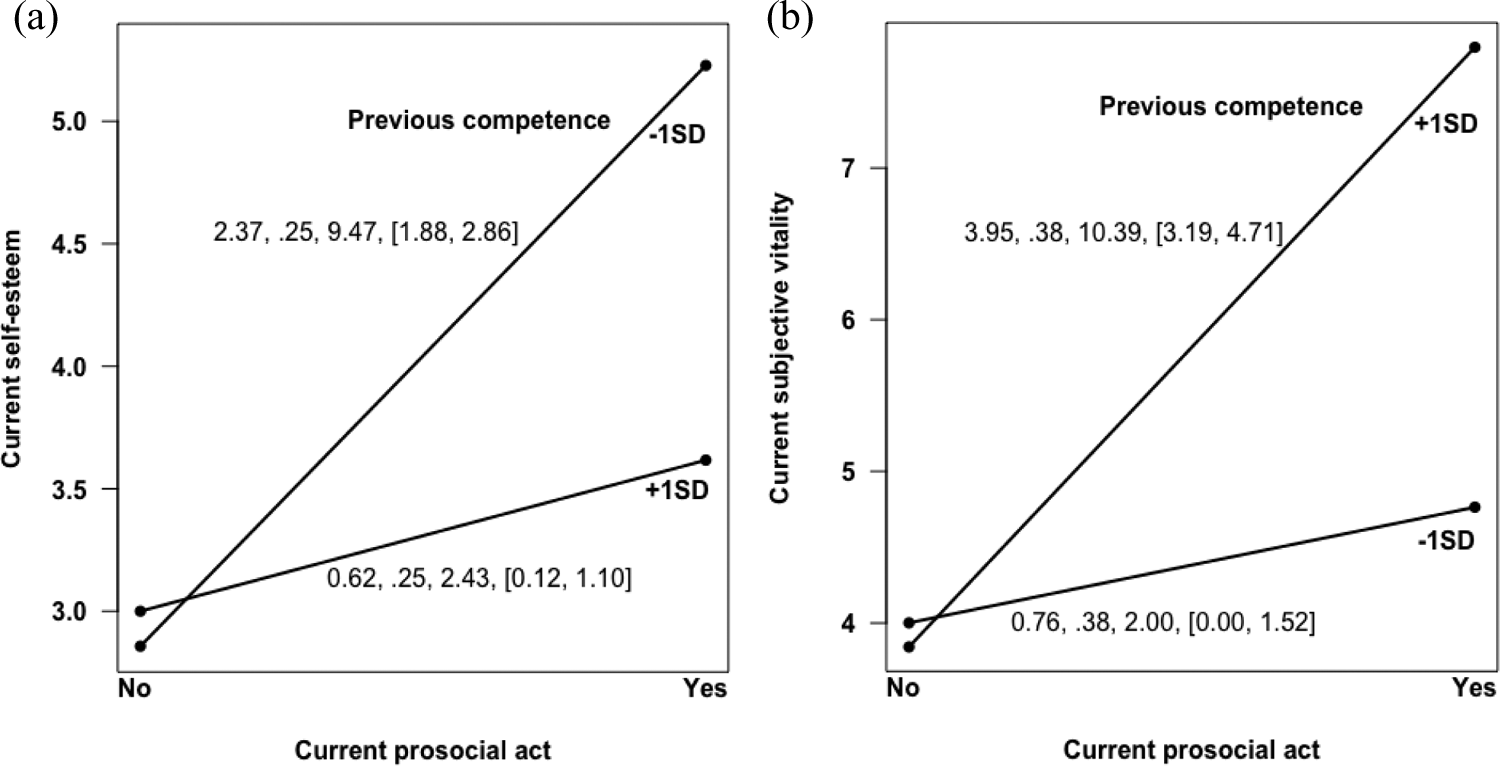
Prosocial engagement at t at varying levels of competence at t − 1 (lines) predicting well-being indicators of self-esteem (a) and subjective vitality (b) at t. Statistics are simple slope coefficient, standard error, t value, and 95% confidence interval, respectively.
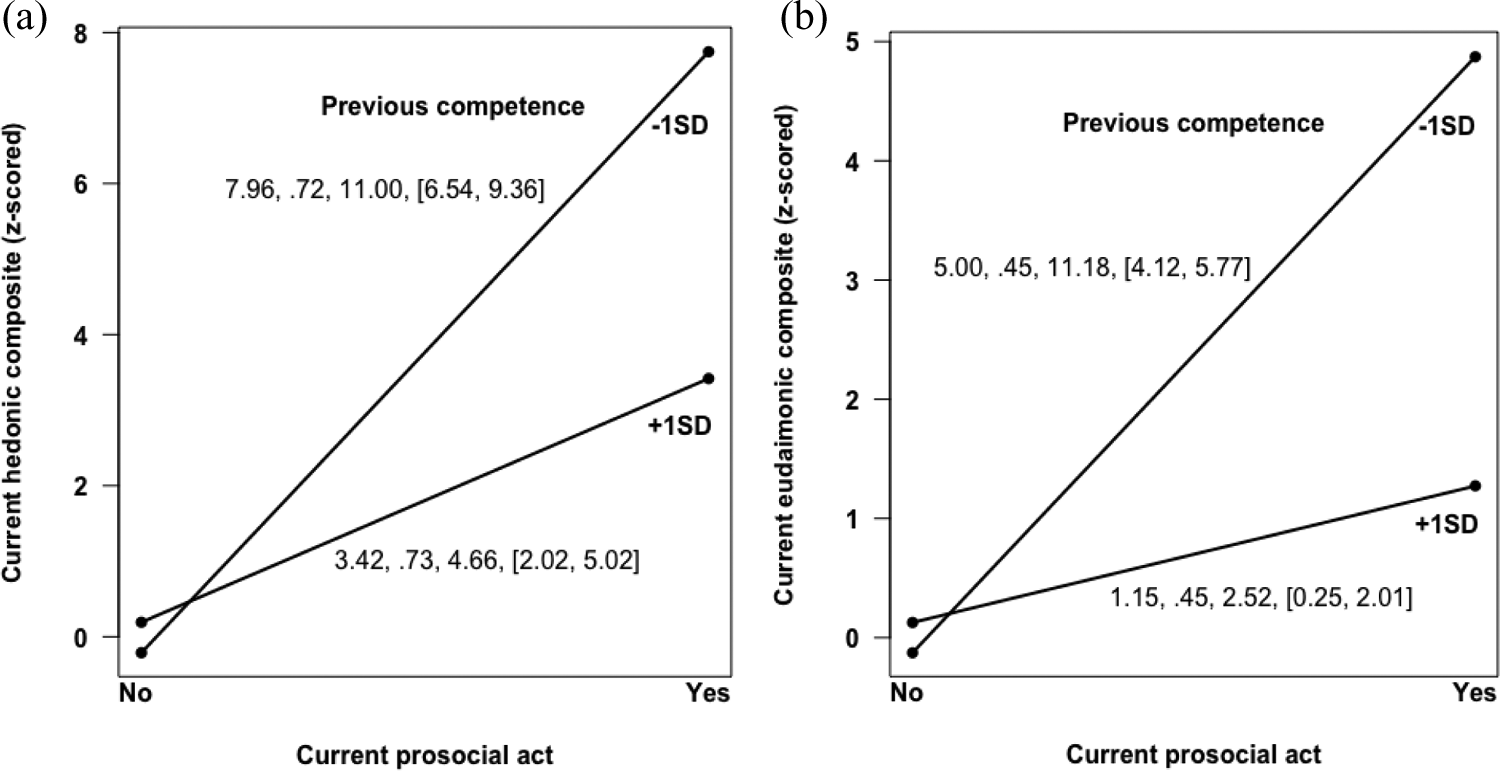
Prosocial engagement at t at varying levels of competence at t − 1 (lines) predicting well-being indicators of hedonic well-being composite (a) and eudaimonic well-being composite (b) at t. Statistics are simple slope coefficient, standard error, t value, and 95% confidence interval, respectively.
Mediated Moderation Model of Competence
We next added competence at t as a mediator into the above moderation model to form a mediated moderation model. To test this model, we followed the procedures suggested by Judd, Yzerbyt, and Muller (2014) and Muller et al. (2005). Three-step approach was employed to support a mediated moderation model (e.g., Sun, Song, & Lim, 2013). We had demonstrated that there was a significant interaction effect of prosocial engagement at t and competence at t − 1 on well-being indicators in the above analyses.
Then, we had to show that prosocial engagement at t and competence at t − 1 significantly interact to determine competence at t (i.e., mediator). The equation for this model was the same as the second equation above but with a different outcome—competence at t. The interaction of prosocial engagement at t and competence at t − 1 significantly predicted competence at t, even after controlling for the other basic psychological needs at t − 1—relatedness and autonomy—as well as their interaction terms with prosocial engagement at t, γ50 = −1.20, t(6,164) = −4.00, p < .001 (see Model 2 of Tables 5–7). Similarly, the simple slope test revealed a significant positive relationship between prosocial engagement and competence at t (see Figure 6). In short, the interaction analysis showed that prosocial engagement at t was more strongly related to competence for lower levels of competence than their higher cohort at (t − 1).
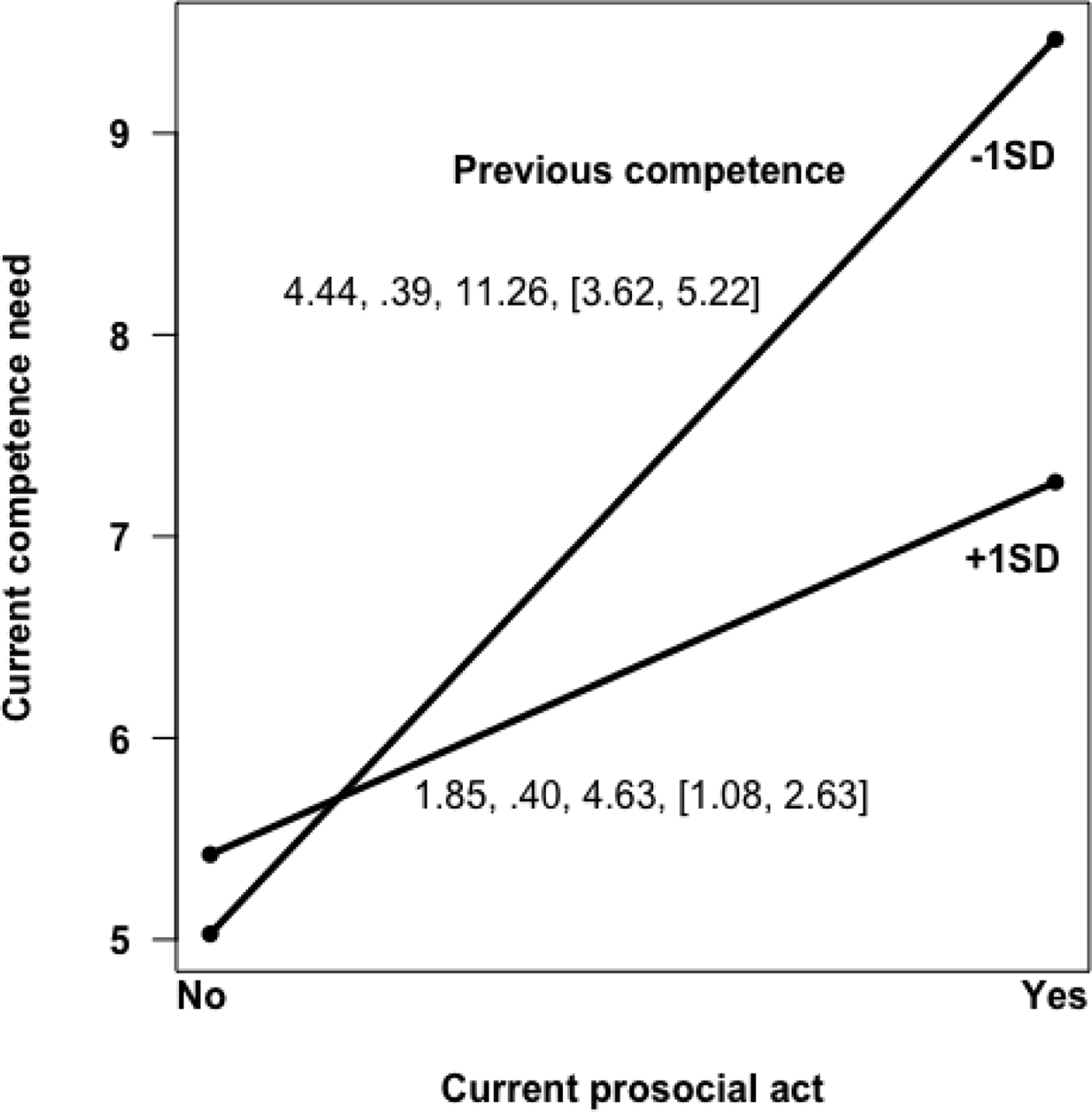
Prosocial engagement at t at varying levels of competence at t − 1 (lines) predicting competence at t. Statistics are simple slope coefficient, standard error, t value, and 95% confidence interval, respectively.
In the final step, we added competence at t (i.e., the mediator) into the second equation, while controlling for the interaction term of competence at t and competence at t − 1 (i.e., moderator). In the mediated moderation model, well-being at t was estimated as follows:
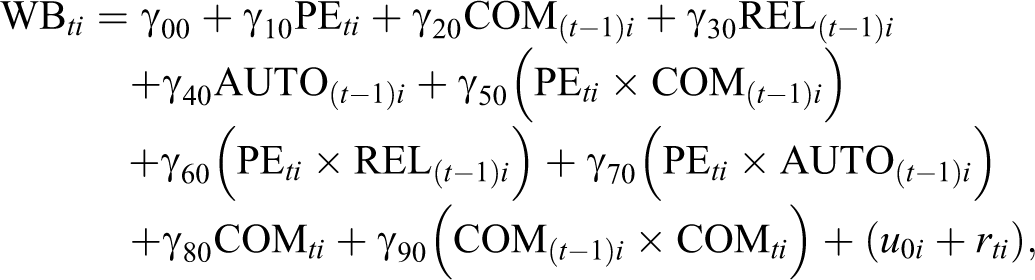
Regarding hedonic well-being, we found that competence at t significantly predicted affect, γ80 = 1.00, t(6,128) = 44.51, p < .001; happiness, γ80 = 0.35, t(6,080) = 30.99, p < .001; and hedonic well-being composite, γ80 = 0.93, t(6,003) = 46.44, p < .001, respectively (see Model 3a and 3b in Table 5; Model 3a in Table 7). The interaction terms (i.e., γ50) of prosocial engagement at t and competence at t − 1 were reduced to nonsignificance in all models: affect, γ50 = −0.71, t(6,121) = −1.33, p = .182; happiness, γ50 = −0.33, t(6,075) = −1.24, p = .216; and hedonic well-being composite, γ50 = −0.78, t(5,996) = −1.64, p = .101. All these results supported a fully mediated moderation model. The estimates of the three most important mediated moderation pathways for hedonic well-being composite are depicted in Figure 7a.
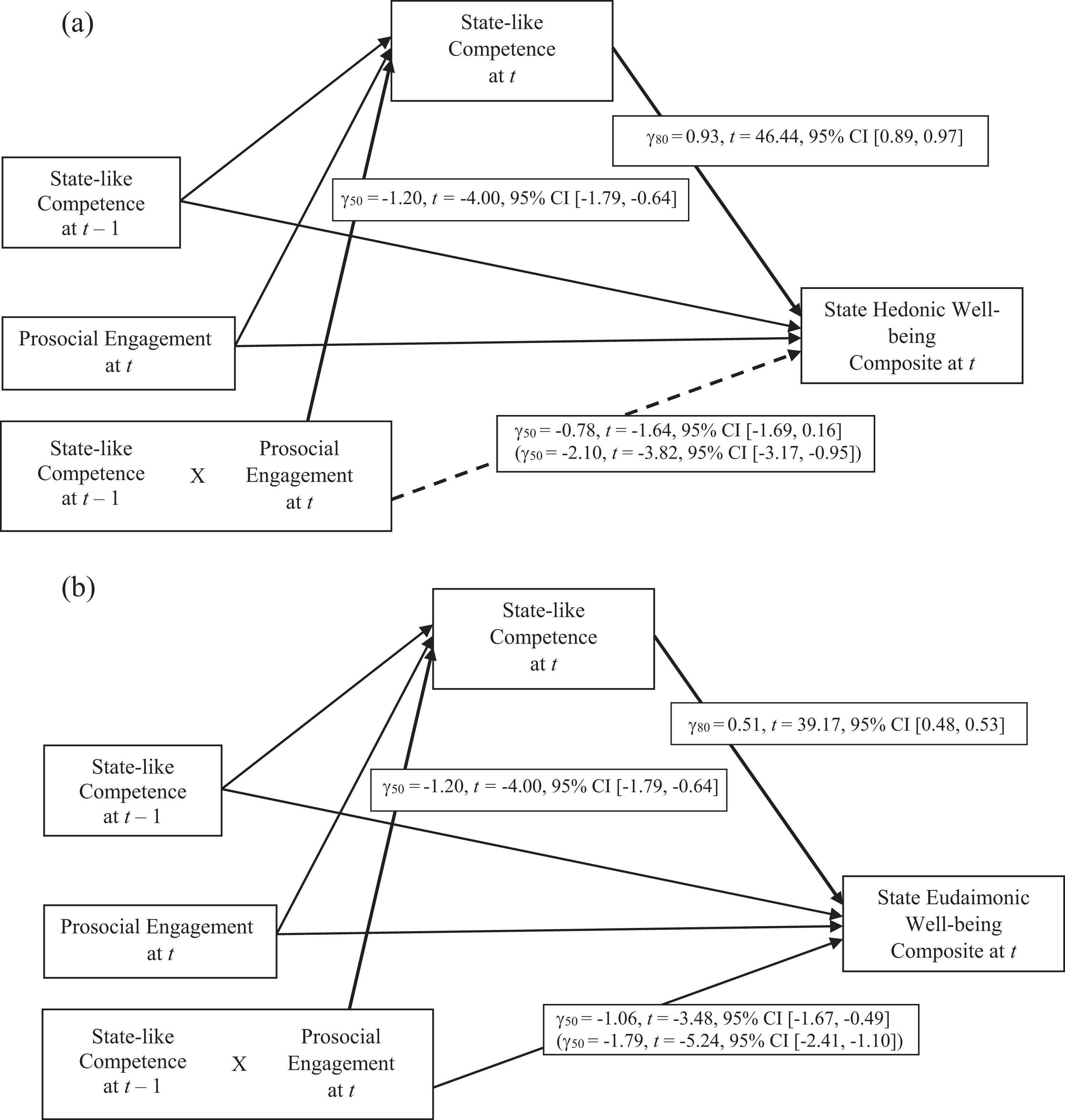
Mediated moderation pathways for state hedonic well-being composite (a) and eudaimonic well-being composite (b). Statistics in parentheses illustrate the moderating effect before introducing the mediator of state-like competence. The dotted line means the path is no longer significant after adding the mediator.
As for eudaimonic well-being, we showed that competence at t significantly predicted self-esteem, γ80 = 0.23, t(5,952) = 30.67, p < .001; subjective vitality, γ80 = 0.42, t(6,063) = 31.23, p < .001; and eudaimonic well-being composite, γ80 = 0.51, t(5,943) = 39.16, p < .001, respectively (see Model 3a and 3b in Table 6; Model 3b in Table 7). The interaction terms (i.e., γ50) of prosocial engagement at t and competence at t − 1 in all models were reduced in size but still significant: self-esteem, γ50 = −0.47, t(5,945) = −2.65, p = .008; subjective vitality, γ50 = −0.91, t(6,057) = −2.88, p = .004; and eudaimonic well-being composite, γ50 = −1.06, t(5,936) = −3.48, p < .001. All these results supported a partially mediated moderation model. The estimates of the three most important mediated moderation pathways for eudaimonic well-being composite are depicted in Figure 7b.
We also ruled out alternative hypotheses by testing possible mediators of autonomy and relatedness, time effect, effect of missing data, and effect of between-person differences (see Online Supplemental Material).
Discussion
The present study aimed to understand when and why prosocial engagement promotes hedonic and eudaimonic well-being. We used self-determination theory and two process model as framework for generating hypotheses—intending to test what unique effects autonomy, competence, and relatedness each had as both moderators and mediators of the prosociality to well-being effect. We found that only competence uniquely acted as both a moderator and a mediator. In particular, we found that individuals with lower state-like competence at t − 1 received a relatively bigger boost in state hedonic and eudaimonic well-being from acting prosocially at t than when they had higher state-like competence at t − 1. Consistent with our theory, we found that competence at t mediated these effects. Furthermore, all of the observed effects remained significant after controlling for autonomy and relatedness at t − 1 as well as their interaction terms with prosocial engagement at t. Our analyses further revealed that only competence at t could act as the mediator—neither autonomy nor relatedness was able to perform the task. In fact, perceived social impact and worth have been found to be a mediator in organizational behavior literature (e.g., Grant, 2008; Grant et al., 2007).
Taken together, we provided substantial evidence for a mediated moderation model of state-like competence for the within-person prosocial effect on well-being. Although this study is correlational and cannot adequately address the issue of causality, prior experimental studies have shown that prosocial behavior leads to better well-being (Dunn et al., 2008), low competence makes people react in a way to feel less incompetent (Sheldon & Gunz, 2009), and altruists feeling more impactful experience a bigger happiness boost (Aknin et al., 2013). Therefore, we believe our data are convergent with existing experimental evidence in providing suggestions of causal pathways—though we recommend future research using naturalistic experiments to be carried out to definitively establish causality.
Our study has several implications for the study of prosociality and well-being. First, our work is the first to document the unique role of competence—over autonomy and relatedness—in affecting the prosociality to well-being link. This effect is neither obvious nor expected. Two plausible explanations for why prosociality may boost well-being are that prosocial engagement may strengthen altruists’ social integration (Piliavin & Siegl, 2007) and make them feel volitional (Weinstein & Ryan, 2010). However, our data suggest otherwise; both relatedness and autonomy failed to act independently as moderators or mediators. Second, this is the first research on prosociality to employ two process model as a framework for understanding when and why prosocial engagement predicts well-being. As predicted, our results are generally in line with two process model, which provides an intelligible explanation for our mediated moderation model of state-like competence for the within-person prosocial effect on well-being. If an individual’s competence is relatively low or in dissatisfaction, this unmet competence acts as a behavioral motive to strengthen competence through prosocial engagement, which, in turn, makes the individual garner a greater well-being boost. Conversely, if the same individual’s competence is high or in satisfaction, prosocial engagement helps provide an experiential requirement of competence, which, in turn, helps maintain a good well-being state. While the state-like competence is found to be a full mediator in all hedonic well-being models, it is only a partial mediator in all eudaimonic well-being models. This suggests that the interaction term of the previous session’s state-like competence and prosocial engagement still has an independent effect of eudaimonic well-being indicators. This also opens up a new question as to whether other mediators—apart from competence—could further explain the effect of prosocial engagement on eudaimonic well-being. Third, our work provides further ammunition of prosociality-based well-being interventions. We both (a) provide new empirical basis for the validity of such interventions and (b) hone in on a specific pathway—through competence—that such interventions may aim to utilize in future incarnations. Fourth, the present work is one of the first to study within-person effects of prosociality. We did so using event-sampling method, complementing and extending past between-person research by providing data of moment-by-moment within-person variability in prosocial engagement, state-like psychological needs, and well-being in a naturalistic setting. Thus, our study succeeds in complementing previous laboratory and one-shot questionnaire studies by being more ecologically valid and minimizing retrospection bias. Finally, our study also adds to a group of recent studies that employ psychological needs to explain the established relationship between prosociality and well-being (e.g., Aknin et al., 2013; Weinstein & Ryan, 2010).
It is prudent to highlight several caveats, which may drive future research directions. Because of the self-report nature of prosocial engagement, it is possible that our results may be confounded by social desirability processes. Future work could include field experiments on prosocial behavior, with observers recording participants’ reactions (e.g., Gueguen & Stefan, 2016). The event-sampling approach also can suffer from practice and boredom effects. Although these effects are impossible to eliminate completely, future research may consider shortening the study period to fewer days. Finally, our study was conducted entirely in the United States; thus, cultural variation cannot be ruled out, and in fact, we highly encourage replicating our work in other cultures. It is possible that in other cultures or prosocial settings that emphasize social connection, relatedness may stand out as a significant moderator and mediator in this prosocial to well-being relationship.
Research on well-being has an ultimate goal of developing interventions that can help people improve and sustain higher well-being (e.g., King, 2001; Sheldon & Lyubomirsky, 2006). Our work helps build toward that goal by highlighting a specific mechanism in the prosocial context that within-person variabilities and satisfaction of state-like competence, but not autonomy or relatedness, contribute most to the well-being boost. Our findings—in addition to future work examining its edge cases—thus help provide the bedrock for more personalized, adaptive well-being interventions. We view the future of well-being interventions as bright, with many opportunities to augment people’s experiences through careful learning algorithms predicated on basic research.
Supplemental Material
Supplemental Material, SPPS722197_suppl_mat - Daily Ups and Downs: An Event-Sampling Study of the Mediated Moderation of Prosocial Engagement on Well-Being
Supplemental Material, SPPS722197_suppl_mat for Daily Ups and Downs: An Event-Sampling Study of the Mediated Moderation of Prosocial Engagement on Well-Being by Bryant P. H. Hui, and Aleksandr Kogan in Social Psychological and Personality Science
Footnotes
Declaration of Conflicting Interests
The author(s) declared no potential conflicts of interest with respect to the research, authorship, and/or publication of this article.
Funding
The author(s) disclosed receipt of the following financial support for the research, authorship, and/or publication of this article: This research was supported in part by grant from the Economic and Social Research Council National Centre for Research Methods and the Economic and Social Research Council Future Research Leaders award.
Supplemental Material
The supplemental material is available in the online version of the article.
Note
References
Supplementary Material
Please find the following supplemental material available below.
For Open Access articles published under a Creative Commons License, all supplemental material carries the same license as the article it is associated with.
For non-Open Access articles published, all supplemental material carries a non-exclusive license, and permission requests for re-use of supplemental material or any part of supplemental material shall be sent directly to the copyright owner as specified in the copyright notice associated with the article.
