







Abstract
If there ever was a key to happiness, this key would open a door that leads straight to a rich social life. And in the era of smartphones, this key to social connection is in our pockets anytime and anywhere. Or is it? Using the experience sampling method (ESM), we explore the use of computer-mediated communication (CMC) in the context of face-to-face (FtF) social interactions, testing two competing hypotheses: (1) a complementarity hypothesis stating that more channels of communication should be associated with higher well-being and (2) an interference hypothesis stating that FtF interactions could be impoverished by adding computer-mediated channels of communication. We surveyed 174 millennials (M age = 19.28; range: 17–22) 5 times a day over a period of a week (4,508 episodes). When participants reported a mix of CMC and FtF socializing in the same episode, they felt worse and less connected than when solely interacting FtF.
Keywords
Two guys walk into a bar. They grab a beer and start catching up. Before long, nature calls one of them to the bathroom, and the other fills his time by responding to a few new text messages from friends. Even when his friend returns from the bathroom, he continues to message sporadically with his other friends. Although this story is not particularly funny, it is indicative of social life in the digital age: We are now able to communicate with others remotely while engaging in face-to-face (FtF) interactions. We examine whether adding computer-mediated communication (CMC) to FtF interactions is associated with feeling better or worse than solely interacting FtF.
A great deal of past research has established that social interaction is one of the most robust factors in cultivating well-being (e.g., Epley & Schroder, 2014; Kahneman, Krueger, Schkade, Schwarz, & Stone, 2004; Reis, Sheldon, Gable, Roscoe, & Ryan, 2000; Sandstrom & Dunn, 2014). Indeed, FtF interactions are an essential component of subjective well-being (Diener & Seligman, 2002). Socializing with others fulfills basic psychological needs for social connectedness (Reis et al., 2000), which albeit under different names—belonging, connectedness, relatedness, and affiliation—features prominently in virtually all influential models of human motivation (Baumeister & Leary, 1995; Fiske, 2014; Kenrick, Griskevicius, Neuberg, & Schaller, 2010; Maslow, 1943; Ryan & Deci, 2000; Ryff, 1989). Is this fundamental social motive to feel connected, supported, or undermined in the face of ubiquitous digital communication?
Today, we live in the era of ubiquitous communication technology, which is, by definition, designed to connect us with others. With a smartphone in our pocket, we can initiate—or be drawn into—a social interaction with virtually anyone from our existing social circles and beyond. Are more channels of communication in a given amount of time better (complementarity hypothesis), or do additional CMC channels detract from the well-documented benefits of in-person interactions (interference hypothesis)?
Complementarity Hypothesis of CMC
CMC holds great potential for fostering a sense of connection with others and reaping the emotional benefits of socializing by providing unlimited additional channels of communication. Smartphone messaging, the form of CMC most readily available—literally at our fingertips—is most often used for brief messaging exchanges (Birnholtz, Hancock, Smith, & Reynolds, 2012). Given these minimal requirements for maintaining phone-mediated interactions, such interactions might supplement the feelings of connection and happiness of interacting with others FtF; that is, remote communication may increase the volume of interaction partners in a given moment without reducing the quality of in-person interactions and their benefits. Indeed, according to the idea of multicommunicating, people should be able to successfully engage in two or more overlapping conversations because humans can think faster than they can talk (Turner, Reinsch, & Tinsley, 2008).
In addition to increasing the volume of available social interactions, CMC might also be actively used to complement and support our FtF social interactions. A husband browses Facebook at dinner, discovers some new photos that his daugher just posted, and shows them to his wife. A group of friends all open Snapchat—a picture-based social networking site—thus interacting both with each other and with their shared friends remotely. Beyond these anecdotes, a representative poll found that 7 in 10 Americans reported using their phones for purposes directly related to their FtF social interactions; most of such complementary phone use involved social functions, such as sharing posts or pictures of the gathering with others or getting in contact with other friends of the group (Rainie & Zickuhr, 2015). Furthermore, Americans are more than twice as likely to say that their smartphones are connecting than to say they are distracting (Pew Research Center, 2015). If these lay beliefs are accurate, FtF and CMC may occupy two different social spheres that complement each other to maximize emotional well-being.
Interference Hypothesis of CMC
Despite the evidence in support of the complemetratity hypothesis discussed above, research also points to potential psychological detriments of using CMC (e.g., Hall & Baym, 2012; Kross et al., 2013; Pielot, Church, & Oliveira, 2014; Pollet, Roberts, & Dunbar, 2011; Wilson, Gosling, & Graham, 2012). One reason for such negative effects of CMC could be that people use their phones too frequently, including during FtF interactions—potentially interfering with the benefits of these interactions. Indeed, people have been documented to exchange more than 100 messages everyday (Experian Marketing Services, 2013; Meeker & Wu, 2013; Park, Lee, & Chung, 2016), and, in a U.S. nationally representative survey, one in two millennials reported commonly checking their phones during social interactions and even in the middle of a conversation (Braun Research, 2015).
Just as evidence continues to amount on people’s constant use of CMC, a great deal of basic research in psychology demonstrates that people are poor at multitasking (Liefooghe, Barrouillet, Vandierendonck, & Camos, 2008; Ophir, Nass, & Wagner, 2009; Rubinstein, Meyer, & Evans, 2001). And even theorizing on multicommunicating predicts that people should become increasingly poor at simultaneous conversations as the intensity of the communication increases (Turner et al., 2008). To the extent that frequent CMC can constitute high-intensity communication, our communication devices may interfere with FtF communication—especially those that require cognitive resources (e.g., a meaningful conversation) and also bring the greatest benefits to well-being (Reis et al., 2000).
Representative surveys suggest that people recognize the potential of CMC to interfere with FtF interactions. Eight of every 10 American smartphone users, for example, believe that using these devices can hurt concurrent FtF conversations; only 4% say phone use never hurts FtF conversations (Rainie & Zickuhr, 2015). In another representative poll, Americans ranked being constantly available as the most undesirable quality of having a phone—beating expensive bills, dropped calls, and poor battery life (Smith, 2012). A quintessentially social device like the smartphone may thus ironically interfere with the richness of social life.
The idea that CMC might interfere with FtF communication is, of course, far from a new argument. Sherry Turkle (2011, 2015), for example, has written extensively on the dangers of mixing our remote and physical social activities. Yet, despite arguments, opinion polls, and even theory in support of this interference hypothesis, there is a dearth of quantitative research on the emotional effects of mixing CMC with FtF interactions.
The Present Research
In the present research, we pit the complementarity and interference hypotheses against each other. We employ the experience sampling method (ESM)—the most ecologically valid methodology for assessing current feelings (Hektner, Schmidt, & Csikszentmihalyi, 2006; Kahneman et al., 2004; Larson & Csikszentmihalyi, 1983). In particular, we sample experiences in 174 millennials 5 times a day over 1 week. We focus on the two most well-documented benefits of social interactions: emotional well-being and feelings of social conenctedness (Reis et al., 2000). Specifically, we examine how people feel during episodes when only FtF interactions are reported (FtF-only episodes) compared to epsiodes when both FtF and CMC interactions are reported (i.e., mixed episodes). If people feel better during mixed episodes, we would have found evidence in support of the complementarity hypothesis. If, however, people feel better when they socialize FtF only, we would have found evidence in support of the interference hypothesis.
Method
Participants
We drew upon multilevel modeling simulation research to determine the minimum sample size. This research suggests that estimates of both fixed effects and variance components become stable when the sample size of the highest level of the model is at least 50 (Maas & Hox, 2005). We conservatively collected a sample over 3 times this size (N = 174). Sensitivity analyses indicated that this sample size allowed us to detect even very small effects, r = .06 with 80% power. 1
Participants were 174 university students, M(SD)age = 19.28(0.90); 63.9% women, who earned class credit for participating in the study. All participants provided informed consent; one participant was 17-years-old and had obtained prior parental consent for participation. The study was advertised only with a code; in lieu of advertisement, potential participants were simply advised that they would complete brief surveys 5 times a day for a week. All participants were included in analyses regardless of response rate. Together, they responded to 4,508 surveys.
Procedure and Measures
Smartphone ownership was required to complete the ESM surveys; all interested students met this eligibility criterion. After providing informed consent, participants completed general demographic questions as well as measures of general subjective well-being and personality; these measures are beyond the scope of the present investigation.
Participants then provided their phone number to receive the ESM surveys, which were administered via text messages using surveysignal.com (Hofmann & Patel, 2015). In each message, participants received a link to a Qualtrics-hosted survey. The surveys were administered 5 times a day on a semirandom schedule between 9 am and 9 pm; specifically, participants received one survey at a random time during each of five equal intervals (2 hr, 24 min) in this time period (9 am–11:24 am; 11:25 am–1:49 pm, etc.). This semirandom administration was adopted to represent experiences across the entire day. Regardless of the time interval cutoffs, participants had 1 hr to complete the survey (though, at baseline, participants agreed to complete the surveys as soon as they safely could); to prevent survey overlap, the minimum amount of time between surveys was also set to 1 hr. Each survey was sent once, and no further prompts were provided. After 7 days, participants were sent one final link containing debriefing information.
Affect
Consistent with past research using experience sampling, we measured how people felt with single items (e.g., Hektner et al., 2006; Killingsworth & Gilbert, 2010) asking how they felt “right now.” We measured affect valance (mood; Killingsworth & Gilbert, 2010) by asking participants to indicate how they felt on a scale from 0 (bad) to 6 (good). In addition to valence, participants also rated their feelings of tense arousal (Schimmack & Grob, 2000) from 0 (calm) to 6 (tense).
Social connectedness
Participants next rated their current feelings of social connectedness—a central psychological need (e.g., Baumeister & Leary, 1995; Ryan & Deci, 2000). They reported the degree to which they felt connected to others on a scale from 0 (distant from others) to 6 (close to others). This scale asked about general feelings of connectedness without referencing particular (e.g., one’s current) social interactions.
Socializing behavior
After reporting how they felt, participants indicated if and how they had socialized in the past 15 min. Participants could select from a list that included socializing in-person/FtF (2,812 episodes), phone: texting/messaging (2,209 episodes), phone: social media (876 episodes), phone: calling/video calling (255 episodes), and Internet (not phone; 215 episodes); we computed a composite measure of CMC by combining the four types of CMC socializing (2,549 episodes; smaller than the sum since people engaged in multiple types of CMC in some episodes).
If participants indicated that they engaged in both FtF and any type of CMC in a given episode, the episode was coded as a mixed episode (1,658 episodes). After accounting for the 1,658 mixed episodes, we had 1,154 episodes in which people solely interacted FtF (FtF-only episodes) and 891 episodes in which people solely interacted remotely (CMC-only episodes). Finally, in 805 episodes, participants did not report engaging in any social interactions (no-socializing episodes).
By inferring rather than explicitly asking about mixed episodes, we sought to obscure the purpose of our research—to quantify the effects of mixed episodes. Concealing the purpose of the research seemed particularly important in the context of our intensive repeated-measures design and of the abundance of public speculation about the effects of mixing CMC and FtF interactions (e.g., Turkle, 2011, 2015). In any given 15-min episode, however, our approach likely captures not only simultaneous FtF and CMC socializing but also consecutive FtF and CMC socializing (e.g., 7 min of FtF socializing, followed by 8 min of CMC). To diagnose this possibility and the effects on our results and conclusions, we explicitly asked approximately ⅓ of the subsample (66 participants reporting 1,372 episodes) to report whether they engaged in CMC while simultaneously having an FtF interaction.
Nonfocal measures
As part of a larger effort to understand the effects of various computer-mediated behaviors on well-being, the ESM surveys included additional measures beyond the scope of the present investigation. The full battery of questions can be found on the Open Science Framework (OSF) at: https://osf.io/9wjc6/?view_only=688de74774414c5fa8ee87934a98adca
The key ESM data presented in this report is also available on OSF: https://osf.io/asg32/?view_only=f85e09a2acd14accb15d9c11e05b1bcd
Results
Response Rate Checks
Participants responded to an average of 25.91 surveys (SD = 9.59) with a median of 28. A quarter of the sample responded to 23 or fewer surveys and a quarter responded to 33 or more. Of the key outcome and predictor variables, the response rate was only related to participants’ average arousal level, r = −.18, p = .020; the response rate was not significantly related to any of the other key variables described below, including average person mood, r = .08, p = .269, and connectedness, r = .10, p = .204, as well as the proportion of reported episodes with the presence of FtF, r = .06, p = .404, or CMC socializing, r = .02, p = .781. Thus, all reported episodes were included in analyses.
Analytic Strategy
Our main goal was to explore whether mixed episodes (i.e., those with both CMC and FtF socializing) are associated with higher or lower social and emotional well-being than FtF-only episodes. In omnibus tests of interaction between FtF and remote socializing, we separately predicted each of the three outcomes (mood, arousal, and connectedness) from the occurrence of FtF socializing (0 = absent, 1 = present), the occurrence of CMC, and their interaction term. To perform the key test of hypotheses, when this omnibus test of interaction was significant, we ran an additional model with dummy codes for FtF-only, CMC-only, and no-socializing episodes; the reference category was thus mixed episodes (FtF + CMC). See Table 1 for descriptives and for within-person and between-person correlations between all predictors and outcomes.
Correlations: Between-Person (Below Diagonal) and Within-Person (Above Diagonal).
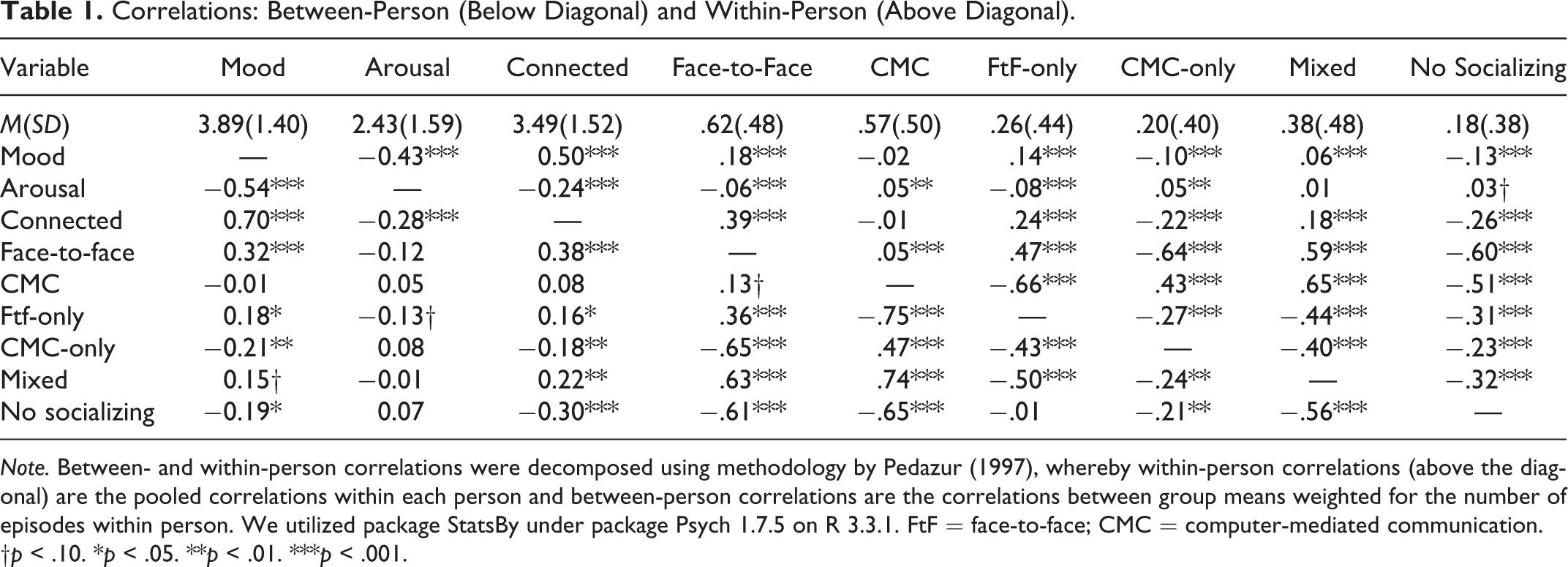
Note. Between- and within-person correlations were decomposed using methodology by Pedazur (1997), whereby within-person correlations (above the diagonal) are the pooled correlations within each person and between-person correlations are the correlations between group means weighted for the number of episodes within person. We utilized package StatsBy under package Psych 1.7.5 on R 3.3.1. FtF = face-to-face; CMC = computer-mediated communication.
†p < .10. *p < .05. **p < .01. ***p < .001.
Because episodes were nested within person, we employed multilevel modeling for all models described above; we used the MIXED command in SPSS21 with unstructured covariance matrix and restricted maximum likelihood estimation. The intercept-only models of the omnibus tests of moderation indeed suggested that the observations are nonindependent (Intra-class correlations [ICC]: ICCmood = .32; ICCarousal = .30; ICCconn = .20). For full models, we estimated the fixed and random intercepts, the fixed and random effects of type of socializing, and error (see Table 2 for model equations). Due to model nonconvergence in some models, some random effects were not estimated as explained below. The fixed effects of type of episode provide the focal test of hypotheses and are reported in the text below (see Table 2 for random components). For the key analyses, we also report standardized effect sizes. Specifically, reflecting the correlational nature of the data, we computed Pearson correlation coefficients (r); we computed these coefficients as recommended by Kashdan and Steger (2006). As defined by Cohen (1992), r = .10 indicates small effect, r = .30 indicates medium effect, and r = .50 indicates large effects.
Multilevel Models.
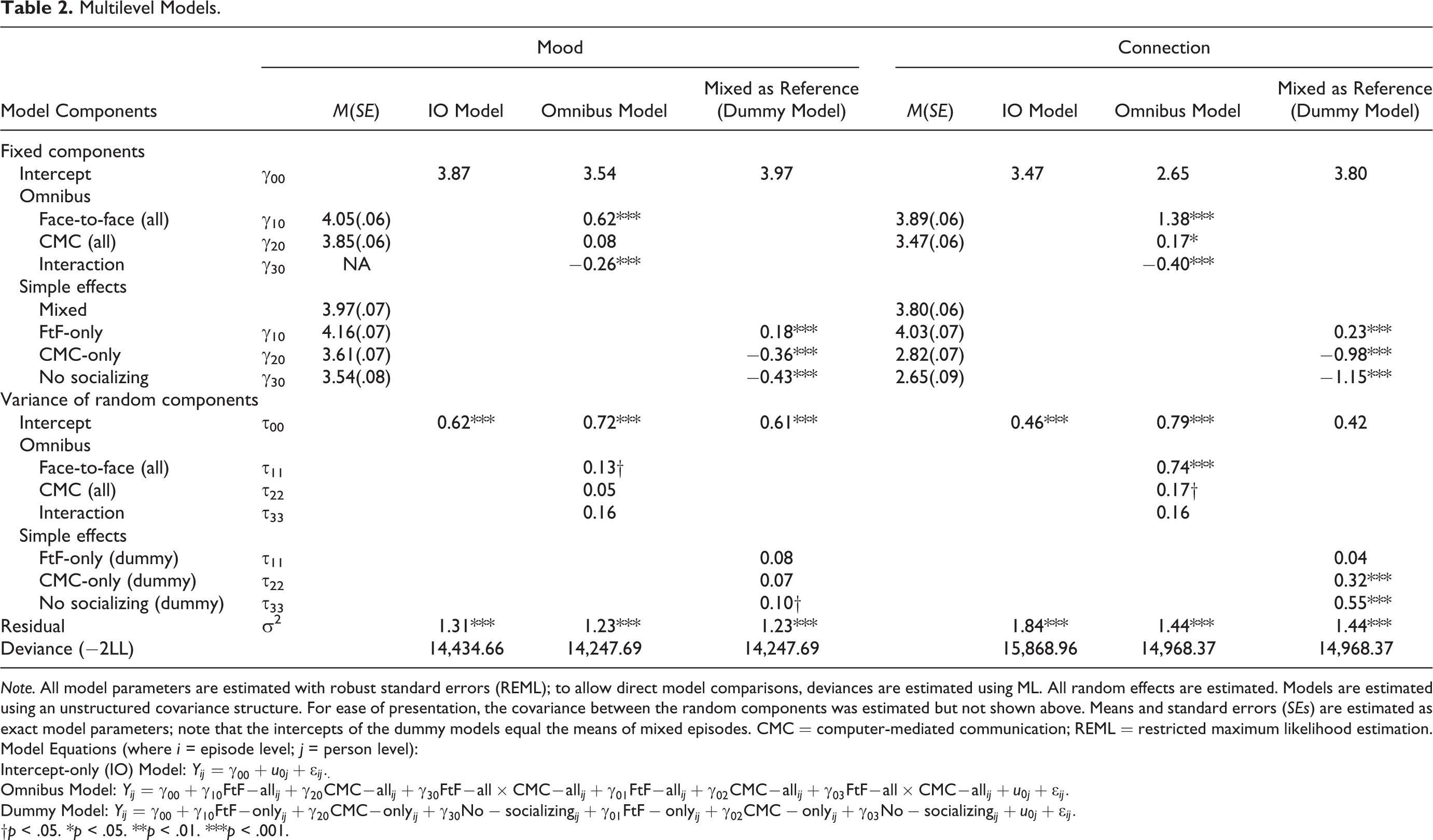
Note. All model parameters are estimated with robust standard errors (REML); to allow direct model comparisons, deviances are estimated using ML. All random effects are estimated. Models are estimated using an unstructured covariance structure. For ease of presentation, the covariance between the random components was estimated but not shown above. Means and standard errors (SEs) are estimated as exact model parameters; note that the intercepts of the dummy models equal the means of mixed episodes. CMC = computer-mediated communication; REML = restricted maximum likelihood estimation.
Model Equations (where i = episode level; j = person level):
Intercept-only (IO) Model:
Omnibus Model:
Dummy Model:
†p < .05. *p < .05. **p < .01. ***p < .001.
Interaction Between FtF and CMC Socializing
In omnibus tests of moderation, we found a significant interaction between the occurrence of FtF socializing and the occurrence of CMC socializing on mood, b = −0.26, SE = .08, p = .002, and social connectedness, b = −0.40, SE = .09, p < .001. We found only a marginal interaction for tense arousal, b = 0.14, SE = .09, p = .096; 2 we thus conservatively focus only on mood and connectedness when exploring the simple effects reported next.
Simple effects analyses in this omnibus model indicated that in the absence of remote socializing, the presence of FtF socializing was associated with both better mood, b = 0.62, SE = .06, p < .001, r = .67, and higher social connectedness, b = 1.38, SE = .08, p < .001, r = .78. In other words, people felt better when solely interacting FtF (FtF-only episodes) than when not socializing at all (no-socializing episodes). In contrast, in the absence of FtF socializing, CMC did not predict significantly better mood, b = 0.08, SE = .06, p = .225, r = .10, though CMC did predict somewhat greater social connectedness, b = 0.16, SE = .07, p = .025, r = .17. Thus, people felt no better and only slightly more connected when solely interacting remotely (CMC-only episodes) than when not socializing at all (see Table 2 for model details).
Mixed Episodes
To perform the focal analyses for mixed episodes, we ran an additional model for each outcome with dummy codes for FtF-only, CMC-only, and no-socializing episodes (i.e., using the mixed episodes as the reference category). Positive coefficients thus indicate lower mood/connectedness in mixed episodes (and vice versa). As demonstrated by the model deviances in Table 2, this model (for each outcome) contained the same variance as the omnibus model of interaction reported above. Compared to mixed episodes, participants felt better, b = 0.18, SE = .05, p < .001, r = .29, and more socially connected, b = 0.23, SE = .05, p < .001, r = .39, during FtF-only episodes (Table 2). Consistent with the interference hypothesis, then, people felt worse and less connected when mixing FtF and CMC interactions in a single episode than when interacting solely FtF (Figure 1).
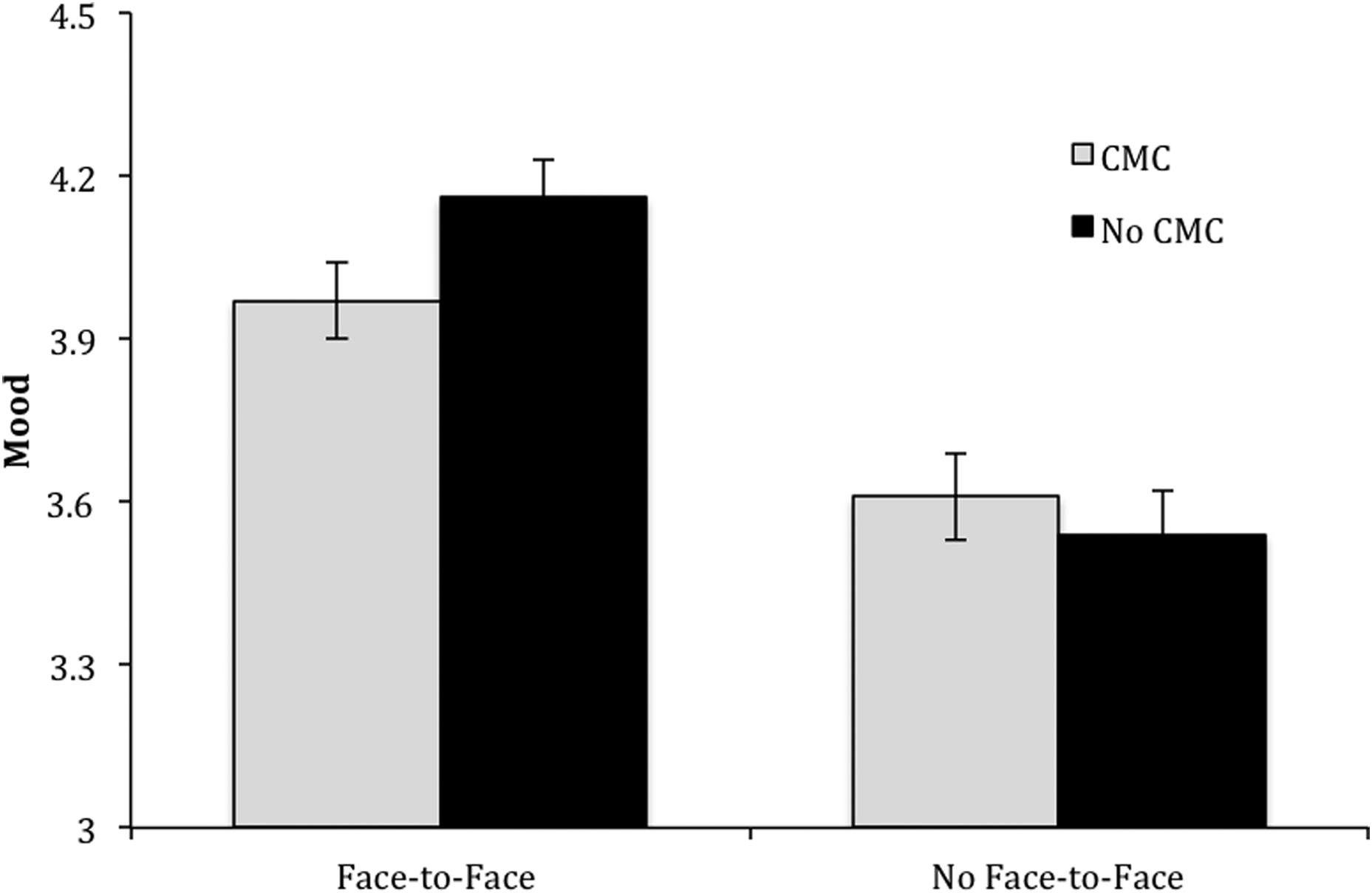
Mood as a function of type of episode: People report worse mood during episodes with both face-to-face and computer-mediated communication (CMC) interactions than during episodes with face-to-face interactions only; in episodes without face-to-face interactions, CMC is not associated with feeling better than not socializing at all. Error bars represent standard errors.
Mixed episodes versus CMC-only and no-socializing episodes
Mixed social interactions were associated with feeling worse than socializing FtF alone, but is mixed socializing also worse than solely socializing remotely or even not socializing at all? During mixed episodes, people felt better, b = −0.36, SE = .05, p < .001, r = −.49, and more socially connected, b = −0.98, SE = .07, p < .001, r = −.75, than during CMC-only episodes. During mixed episodes, people also reported better mood, b = −0.43, SE = 06, p < .001, r = −.53, and higher social connectedness, b = −1.14, SE = .08, p < .001, r = −.75, than during episodes when they did not socialize at all (Table 2).
Testing Potential Confounds and Alternative Explanations
Time of episode
One factor that could have influenced our central associations is the time of the episode. We thus concurrently controlled for time of day and day of the week. To capture meaningful variance, we coded day of the week as weekdays (Monday to Friday) and weekends (Saturday and Sunday). Time of day was analyzed as a continuous predictor (hours since midnight). Due to model nonconvergence with some, all control variables discussed below were estimated as fixed effects only.
People felt happier, b = 0.18, SE = .04, p < .001, and more connected, b = 0.27, SE = .05, p < .001 on weekends than on weekdays; they also tended to feel better, b = 0.02, SE = .005, p < .001, and more socially connected, b = 0.04, SE = .01, p < .001, later in the day. Controlling for time of day and day of the week, however, did not substantively change the key observed difference between mixed and FtF-only episodes: mood (b = 0.17, SE = .05, p = .002) and social connectedness (b = 0.21, SE = .05, p < .001). Controlling for time of day and day of the week also did not account for the other significant simple effects: CMC versus no socializing on social connectedness: p = .027; all other ps < .001. The overall interaction effects between FtF and CMC socializing also remained significant: mood: p = .003, connectedness, p < .001.
Reverse causality
Another alternative explanation for the observed relationships is the possibility of reverse causality: During episodes with FtF socializing, people could be more likely to engage in CMC when they are already feeling bad or less socially connected. To examine this possibility, we controlled for previous mood and previous social connectedness (as reported during the preceding episode) in models predicting current mood and social connectedness, respectively. Even though in those models previous mood predicted current mood, b = 0.23, SE = .01, p < .001, and previous connectedness predicted current connectedness, b = 0.17, SE = .01, p < .001, we found little change in the observed differences between mixed and FtF-only episodes on current mood, b = 0.19, SE = .05, p < .001, or current connectedness, b = −0.21, SE = .06, p < .001. All other significant associations and the interaction effects also remained significant: CMC versus no socializing on connectedness: p = .017; all other ps < .001. 3
Mixed episodes with consecutive versus simultaneous socializing
We inferred the presence of mixed episodes from participants’ indication that both FtF and CMC socializing occurred during the episode. To understand the nature of this inferred variable, we explored data from the subsample (n = 66) who explicitly answered whether or not they engaged in simultaneous FtF and CMC socializing. Participants self-reported simultaneous FtF and CMC socializing in 401 episodes. In a smaller number of episodes (229), participants separately reported both FtF and CMC socializing without reporting that they occurred simultaneously. When comparing the mixed episodes with simultaneous use (401) with those with consecutive use (229), we found negligible differences in our main outcome measures: mood, b = −0.03, SE = .11, p = .771; connectedness, b = 0.08, SE = .13, p = .521. Indeed, the sizes of the effects were almost negligible (e.g., mood: r = −.04), and the signs of the effects were inconsistent. This pattern—and the larger number of episodes with simultaneous use—suggests that the presence of mixed episodes with consecutive use in our approach is unlikely to systematically influence our conclusions.
Discussion
A great body of evidence has placed social interactions in the pantheon of primary causes of human happiness and well-being. Today, we live in the era of pervasive connectivity—we can connect with others through our smartphones virtually anytime and anywhere. But does this unprecedented ability to connect with others complement or interfere with the well-established benefits of FtF socializing? In the first test of these competing possibilities, we sampled the experiences of over 174 millennials 5 times a day over a period of a week. In support of the interference hypothesis and in contrast to the complementarity hypothesis, people felt worse and less close to others when mixing computer-mediated and FtF communication than when interacting solely FtF. A higher volume of social interactions at a given time is not better than fostering the quality of one’s FtF interactions. Even with the power to connect with anybody—whether it is our best friend, our romantic partner, our favorite star on Twitter, or our entire social network on Facebook—people felt best during good old-fashioned FtF interactions unadulterated by digital social distractions.
Complementarity-Interference Framework
The present research is novel not only in its findings but also in its theoretical approach of studying the effects of communication technology. Past research has mainly focused on studying the effects of different types of CMC—from text messaging and e-mail to Facebook and Instagram (Kross et al., 2013; Kushlev & Dunn, 2015; Park et al., 2016; Pittman & Reich, 2016; Wilson et al., 2012). In contrast, the present research focuses on how our computer-mediated social lives interact with our in-person social lives. To our knowledge, no existing theoretical framework focuses specifically on the outcomes related to mixing these two types of communication. Our approach thus provides a new theoretical blueprint for future research to examine how the ubiquity of digital activities is affecting our nondigital lives. The complementarity-interference framework presented here can, for example, be applied to study the effects of digital activities in other life domains and on other important outcomes (e.g., productivity).
The complementarity-interference framework proposed here is, of course, a causal model. Although our findings held when accounting for alternative explanations, causality cannot be established in the present correlational research. Even though controlling for affect during the previous episode did little to change the observed relationships, it is still possible that when people were not particularly happy or connected with their FtF social partners, they were more likely to reach out for their phones and start socializing remotely. Speaking against this possibility, a recent representative poll showed that few Americans had used their phones specifically to avoid group conversations (10%) or group activities (15%); even 18- to 29-year-olds rarely did so: 21% and 26%, respectively (Rainie & Zickuhr, 2015). Still, the present research should be seen only as laying the groundwork for future experimental work.
FtF Versus CMC
Beyond the effects of mixing digital and nondigital channels of communication, we observed notable patterns of solely interacting FtF versus solely interacting digitally. While people felt better when solely interacting FtF than when not socializing at all, they did not feel any better when solely interacting digitally than when not socializing at all. While surprising, this finding is consistent with media richness theory, which posits that CMC suffers from various types of impoverishment compared to FtF interactions (Daft & Lengel, 1986); CMC might therefore not materialize the same benefits as FtF interactions. Indeed, some past research has also found no relationship between social phone use and feelings of well-being and connectedness (e.g., Pollet et al., 2011). Notably, however, past research has also found both benefits and costs to well-being of socializing remotely (e.g., Hall & Baym, 2012; Kross et al., 2013; Pielot et al., 2014; Valkenburg & Peter, 2007). This state of the evidence suggests that the effect of CMC may be highly context dependent. Remote socializing, for example, has proven to be an effective way of receiving social support when social partners are not available in the immediate environment. In one study, patients randomly assigned to text during minor surgery required less analgesic for their pain than patients in a distraction condition—playing a phone video game (Guillory, Hancock, Woodruff, & Keilman, 2015). In addition, the effects may depend not only on what else people are doing in the nondigital world but also on what they are doing in the digital world (Burke & Kraut, 2016; Park et al., 2016; Pittman & Reich, 2016). The current findings urge future research exploring the contextual factors that determine when CMC is associated with benefits versus detriments for well-being.
Strengths and Limitations
A notable strength of the present research is the use of the best methodology for capturing people’s moment-to-moment experiences: the ESM (Hektner et al., 2006; Larson & Csikszentmihalyi, 1983). This method provides measures of people’s current experience and behavior without relying on participants’ memory, which is prone to well-known biases (Miron-shatz, Stone, & Kahneman, 2009). Given people’s intuitions about the effects of technology (Rainie & Zickuhr, 2015), relying on a recall method or even experimentally inducing remote socializing could have lead to strong demand characteristics. The in vivo methodology used in the current study—and our inferring rather than asking explicitly about episodes mixing FtF and CMC socializing—was thus particularly suitable as an initial test of the complementarity versus interference hypotheses.
The present study relied on a convenience sample of university students (i.e., young millennials). Millennials are more likely to use CMC frequently throughout the day than people from older generations (Braun Research, 2015). And a recent British survey suggests that younger adults are particularly likely to feel lonely (Griffin, 2010). From this perspective, then, older people might less often forego the benefits of FtF interactions due to CMC. Still, when mixed interactions occur, we might expect older people to be even less skilled than their younger counterparts at leveraging the power afforded by constant connectivity. Younger people, for example, are more likely to use image-based social networking sites, such as Instagram and Snapchat (Duggan, 2013), which have been associated with a greater feeling of happiness and connectedness than text-based media, such as Twitter (Pittman & Reich, 2016). More research is needed to directly examine the effects of mixed socializing on well-being in older generations.
Coda
“This will change everything,” promised Steve Jobs when he introduced the first popular smartphone. Ten years later, we are connected to our entire social network everywhere we go and during everything we do. This pervasive connectivity is no doubt useful for creating new social opportunities and navigating our social lives. The present research suggests, however, that our computer-mediated social activities may be interfering rather than complementing the benefits of our nondigital social lives.
Footnotes
Declaration of Conflicting Interests
The author(s) declared no potential conflicts of interest with respect to the research, authorship, and/or publication of this article.
Funding
The author(s) disclosed receipt of the following financial support for the research, authorship, and/or publication of this article: This work was supported by the Frank C. Diener Foundation.