






Abstract
Emerging adulthood is one of the most important life stages for self and identity development. The present research tracked the development of implicit self-esteem during emerging adulthood at both the group and individual levels. We used the implicit association test to assess implicit self-esteem with the improved D score as the index. We surveyed 327 students each year from the beginning of their first year of university until their graduation, with an extra assessment run in the middle of the first year. First-order autoregressive structural equation modeling indicated that implicit self-esteem remained quite stable during the university years in terms of rank-order stability. Latent growth modeling showed that implicit self-esteem decreased slightly during the university years with females initially manifesting a higher level. These findings enrich our understanding of implicit self-esteem and its development as well as self-construction during emerging adulthood.
As a kind of self-evaluation, self-esteem has attracted ongoing interest from researchers. In recent years, a large number of studies have been devoted to the development of self-esteem as well as its potential consequences (for reviews, see Robins & Trzesniewski, 2005; Orth & Robins, 2014). Existing studies, however, have focused primarily on explicit self-esteem. We still know little about the development of implicit self-esteem. Implicit self-esteem can predict many daily behaviors (Krause, Back, Egloff, & Schmukle, 2016), serve as a buffer against threat (DeHart, Tennen, Armeli, Todd, & Mohr, 2009; Dijksterhuis, 2004; Greenwald & Farnham, 2000; Haeffel et al., 2007; Jones, Pelham, Mirenberg, & Hetts, 2002), as well as moderate a defensive response (Jordan, Spencer, Zanna, Hoshino-Browne, & Correll, 2003). Temporally, implicit self-esteem is more variable than its counterpart of explicit self-esteem (Gawronski, Morrison, Phills, & Galdi, 2017). Hence, it is crucial to examine how implicit self-esteem itself changes across a life span.
Emerging adulthood, roughly ranging from 18 to 25 years, constitutes an important transitional stage from adolescence to adulthood (Arnett, 2000). During this critical period, most individuals move away from home for the first time to explore diverse possibilities in the future development of both work and relationships as well as of their worldview, as they struggle to become solid adults. According to Arnett, this unique period of life is characterized by identity exploration, instability, self-focus, feeling in-between, and possibilities (Arnett, 2007). Great uncertainties and frequent life changes offer ample opportunities for self-esteem to change during this period because self-esteem is dynamic and responsive to life events (Donnellan, Kenny, Trzesniewski, Lucas, & Conger, 2012; Kuster & Orth, 2013; Trzesniewski, Donnellan, & Robins, 2003). Much research already has tracked the development of explicit self-esteem during this period. In this study we focused on the development of implicit self-esteem during emerging adulthood. In doing so, we employed a longitudinal design, allowing us to simultaneously examine stabilities and shifts in implicit self-esteem during emerging adulthood.
Implicit Self-Esteem and Its Development
Implicit self-esteem has been defined in two ways: “introspectively unidentified effect of the self-attitude on evaluation of self-associated and self-dissociated objects” (Greenwald & Banaji, 1995) and “the association of the concept of self with a valence attribute” (Greenwald et al., 2002). Correspondingly, researchers have tended to assess it using two distinct methodologies: the name-letter test (NLT) and the implicit association test (IAT, Greenwald & Farnham, 2000; Greenwald, McGhee, & Schwartz, 1998). While the former measure assesses how much people project their implicit self-love onto a self-associated object, the latter assesses how much people automatically associate themselves with positive valence. A multitude of research has established that implicit self-esteem is disassociated from explicit self-esteem, as indicated by the lack of a correlation between them (Bosson, Swann, & Pennebaker, 2000; Buhrmester, Blanton, & Swann, 2011).
Past research has linked implicit self-esteem to various important psychological outcomes. For instance, implicit self-esteem predicted various behaviors (e.g., self-confident behavior, Krause et al., 2016), affect (Conner & Barrett, 2005; Spalding & Hardin, 1999), and buffered against any harmful influence from negative life experiences such as failure feedback, unsatisfactory interpersonal interactions, and self-related threats (DeHart et al., 2009; Dijksterhuis, 2004; Haeffel et al., 2007; Jones et al., 2002).
Implicit self-esteem is malleable: It has been shown to be not only sensitive to experimental manipulations such as classical conditioning manipulations and self-related information (Baccus, Baldwin, & Packer, 2004; Dijksterhuis, 2004; Riketta & Dauenheimer, 2003) but also responsive to various life events (DeHart & Pelham, 2007). For instance, a lab study showed that exposure to self-threating information led to a momentary increase in implicit self-esteem (Jones et al., 2002; Rudman, Dohn, & Fairchild, 2007). In another field study, participants were followed for 3 weeks during which their implicit self-esteem was assessed daily by the NLT (DeHart & Pelham, 2007). Results showed that implicit self-esteem fluctuated day to day. In particular, people with low explicit self-esteem or low self-concept clarity experienced a greater decrease in implicit self-esteem when they experienced negative life events.
Emerging research has examined the development of implicit self-esteem. Studies showed that implicit self-esteem emerged quite early: Children as young as 5 years old exhibited positive implicit self-esteem (Cvencek, Greenwald, & Meltzoff, 2016). Nevertheless, research about developmental changes has yielded mixed findings. While some studies suggested that implicit self-esteem was quite stable across different ages (e.g., children and adults, Dunham, Baron, & Banaji, 2007; young adults and old adults, Hummert, Garstka, O’Brien, Greenwald, & Mellott, 2002), others found that implicit self-esteem changed during some specific age periods. For instance, by using the NLT, Hoorens, Nuttin, Herman, and Pavakanun (1990) identified an increasing levels of implicit self-esteem among elementary school students (Grades 2, 4, and 6); by using the IAT, Cai, Wu, Luo, and Yang (2014) observed a decreasing trend of implicit self-esteem among the ages 12–18. Regarding the rank-order stability of implicit self-esteem, a relatively low rank-order stability (.08 to –.69) was detected within a few days or a few weeks (Bosson et al., 2000; DeHart, Pelham, & Tennen, 2006; Gawronski et al., 2017; Gregg & Sedikides, 2010).
Extant studies on the development of implicit self-esteem are informative but limited. First, most studies have relied on cross-sectional comparisons and inferred the development of implicit self-esteem from mean differences across age-groups (e.g., Cai, Wu, Luo, & Yang, 2014; Dunham et al., 2007; Hummert et al., 2002). For instance, Dunham and his colleagues found no mean difference in implicit self-esteem between young adults (18–29) and two separate groups of old adults (55–74 and 75–93). They thus concluded that implicit self-esteem registered no developmental change. This approach, however, provides no information about the rank-order stability of implicit self-esteem. Conclusions based on comparisons across age-groups, moreover, may be misleading because age difference can be the result of developmental change, cohort effect, or both (Costa & McCrae, 1982). As a result, a mean difference across age-groups does not necessarily suggest developmental change, and likewise, a null mean difference does not necessarily suggest zero developmental change. Second, the few longitudinal studies on implicit self-esteem only tracked participants for a relatively short period of time (over several weeks; e.g., Bosson et al., 2000; Gawronski et al., 2017). This interval may be too short to reveal the developmental process of implicit self-esteem. Third, no research has investigated the development of implicit self-esteem during emerging adulthood, an important transitional stage for young generations. We therefore conducted a longitudinal study to examine changes in and the stability of implicit self-esteem across 4 university years.
The Development of Self-Esteem During Emerging Adulthood
A number of studies have examined the development of self-esteem during emerging adulthood, though to date they have focused exclusively on explicit self-esteem. Regarding mean-level changes, overall, a gradual increase was found during this period (Galambos, Barker, & Krahn, 2006; Tetzner, Becker, & Baumert, 2016; Wagner, Lüdtke, Jonkmann, & Trautwein, 2013). Annual examinations of college students, however, revealed a somewhat complicated picture: While one early study found no significant average change during the 4-year college period (van der Velde, Feij, & Taris, 1995), another two studies found that there was a significant decline during the first year (Shim, Ryan, & Cassady, 2012) or within the first half year of college (Chung et al., 2014), despite the overall rising trend. For the rank-order stability of self-esteem, while a meta-analysis revealed moderate stability (r = .55; Trzesniewski et al., 2003) during college, a recent longitudinal study showed high stability (r = .88; Chung et al., 2014). Beyond the discrepancies in these individual studies, substantial stability of self-esteem during this period was evident (Wagner, Lüdtke, & Trautwein, 2016).
Research has also identified some factors that may influence the development of self-esteem during emerging adulthood. For instance, while transitions such as entering into one’s first romantic relationship and joining the work force after being in school were associated with an increase in self-esteem (van der Velde et al., 1995; Wagner et al., 2016), negative life events such as illness and family conflict were associated with decreases in self-esteem (Galambos et al., 2006; Tetzner et al., 2016). Specific to university students, academic achievement was found to be an important moderator: While actual high performance was associated with a larger increase in self-esteem, the expectation of high performance was associated with a smaller increase in self-esteem (Chung et al., 2014; Shim et al., 2012).
The Present Study
We conducted a five-wave longitudinal study across 4 years to examine the absolute (or mean-level) change and relative (or rank-order) stability of implicit self-esteem during emerging adulthood in China. The IAT was used to measure implicit self-esteem (Greenwald & Farnham, 2000). A sample of Chinese university students were tracked from the beginning to the end of their university years. A first-order autoregressive (AR[1]) model was used to evaluate the rank-order stability with measurement errors taken into account. Latent growth modeling (LGM) was employed to examine the mean-level change of implicit self-esteem during emerging adulthood. In addition to the basic model, we examined how the starting point and trajectory slope vary with demographic variables, such as with gender and socioeconomic status (SES). Previous studies established that males displayed higher explicit self-esteem than females (Bleidorn et al., 2016; Kling, Hyde, Showers, & Buswell, 1999; Robins, Trzesniewski, Tracy, Gosling, & Potter, 2002), and individuals with high SES possessed higher explicit self-esteem than those with low SES (Orth, Maes, & Schmitt, 2015; Orth, Robins, & Widaman, 2012; Orth, Trzesniewski, & Robins, 2010; Wagner, Lang, Neyer, & Wagner, 2014). Since implicit self-esteem was independent of explicit self-esteem (Bosson et al., 2000), its development might not follow the same trajectory, nor be influenced similarly by the same factors. Given these circumstances, we did not make any specific hypotheses.
Method
Participants
We obtained our data from a 4-year longitudinal study at Zhejiang University which aimed to study college students’ well-being. We assessed participants at the beginning of their first, second, third, and fourth years of their studies. Previous research on the development of explicit self-esteem suggested that there could be a significant change during the first year (e.g., Chung et al., 2014). Accordingly, we added an extra assessment in the middle of the first year (6 months after the first wave) to reduce the possibility of missing any significant changes. In total, there were five waves of data. Participants were recruited from those students who took introductory psychology in their first semester of study. For each assessment, participants completed a 1-hr survey separately in a quiet room in exchange for 30 (Chinese yuan).
The initial sample included 327 first-year students enrolled at Zhejiang University in 2010 (207 males and 120 females), with a mean age of 18.54 years (SD = .75) at the first assessment. Due to attrition, the remaining waves consisted of 321 (second wave, 202 males), 289 (third wave, 180 males), 256 (fourth wave, 162 males), and 236 (fifth wave, 145 males) students, respectively. Attrition in the study was primarily due to a student’s unavailability during data collection periods for various reasons (e.g., international exchange, internship, or scheduling conflict). In some cases, students dropped out of the study due to loss of interest (nearly 100% of students graduate from university in China). To investigate the potential impact of attrition, we compared the participants who completed the final assessment with those who did not on the target variables assessed in the first wave. The results revealed that the two groups did not differ in any of the target variables. Based on these findings, we concluded that the attrition was random and would not introduce any bias into the final analysis.
Procedure and Measures
During the first assessment, participants were asked to report basic demographic information including their gender, major field of study, SES and whether they were born in an urban or rural area. SES was measured by a single item whereby participants were asked to indicate on a 5-point Likert-type scale (1 = very poor, 5 = very rich) how affluent they believed they were in comparison to other students. They were then required to complete the self-esteem IAT.
Implicit Self-Esteem
Implicit self-esteem was assessed by a self-esteem IAT. Following the standard IAT procedure (Bae et al., 2012; Greenwald et al., 1998; Greenwald & Farnham, 2000), seven blocks were included, among which two combined blocks are critical: the self + pleasant block and self + unpleasant block (see Table 1). In the self + pleasant block, participants were instructed to map self-related (mine, my, me, I) and pleasant stimulus (beautiful, lovely, valuable, attractive, smart) onto one computer key, and other-related (his, he, they, their) and unpleasant stimulus (ugly, useless, stupid, banal, disgusting) to another key (20 practice trials, 40 test trials). For the self + unpleasant block, participants were asked to map self-related and unpleasant stimulus onto one computer key and other-related and pleasant stimulus to another key (20 practice trials, 40 test trials). The two critical blocks were counterbalanced across participants. In other words, half of the participants completed the self + pleasant block first followed by the self + unpleasant block, while the other half completed the same two blocks but in reverse order. For all blocks, participants were asked to respond rapidly but with as few errors as possible. In accordance with previous research (Greenwald, Nosek, & Banaji, 2003), the improved D score was calculated as the index of implicit self-esteem. To compute the D score, latencies from all four critical blocks were used. We first discarded the trials with a latency greater than 10,000 ms. For all remaining trials, the mean latency difference between the two types of critical blocks was calculated by subtracting the mean latency of the self + pleasant block from that of the self + unpleasant block. The pooled standard deviation was computed using latency from all trials with a correct response. Finally, the D score was calculated by dividing the mean latency difference with the pooled standard deviation (Greenwald et al., 2003; Lane, Banaji, Nosek, & Greenwald, 2007). Similar to the Cohen d (Cohen, 1992), the D score can be used as an index of effect size, representing the standardized mean latency difference between two critical blocks. A positive D score suggests positive implicit self-esteem. The larger the D score, the higher the degree of implicit self-esteem.
Sequence of Blocks of Self-Esteem Implicit Association Test.
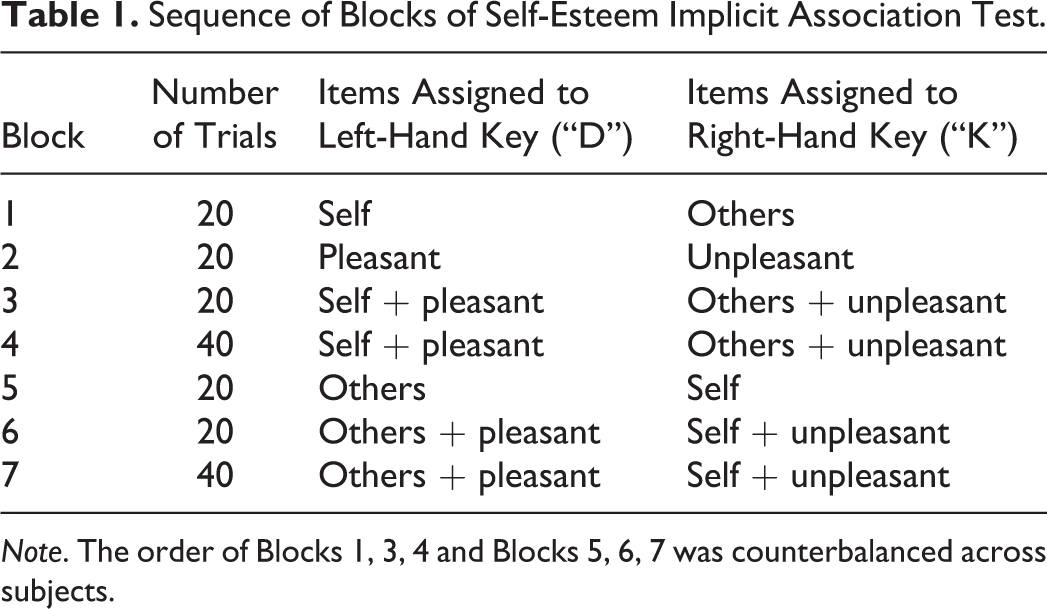
Note. The order of Blocks 1, 3, 4 and Blocks 5, 6, 7 was counterbalanced across subjects.
Results
Rank-Order Stability of Self-Esteem
The means and correlations of implicit self-esteem across the five waves are displayed in Table 2. As shown in Table 2, the self-esteem IAT manifested rather high split-half reliability across all of the five waves. Moreover, significant correlations existed not only between adjacent waves but also between distant waves, indicating a modest to moderate stability of implicit self-esteem during the university years. To further examine the rank-order stability of implicit self-esteem with the measurement errors controlled, we fitted a AR[1] model to the data with the latent implicit self-esteem of each wave being indicated by the corresponding single IAT score (see Figure 1). The AR[1] model regressed subsequent assessments on immediately preceding assessments to account for the dependency of adjacent assessments. By doing so, it partitioned the variance in each assessment into two components: variance due to the immediately preceding assessment and variance due to residuals. Thus, the AR[1] model allowed for stability estimates corrected for measurement error. For identification purpose, the measurement error was constrained to be equal across assessments (see Chung et al., 2014), assuming that all IATs had measured implicit self-esteem to the same degree. Moreover, since the estimated regression residual variance for the latent variable in the fifth wave was negative though close to zero (–.003), we fixed it at zero. Results showed that the model-data fit was good, χ2(6, N = 327) = 1.923, the root mean square error of approximation (RMSEA) < .001, 90% confidence interval (CI) [.000, .022], p closefit = .989, the comparative fit index (CFI) = 1.000, Tucker–Lewis index (TLI) = 1.000 (see Figure 1). The rank-order stability for self-esteem was consistently high, except for that between the first and second assessments. 1
Means and Correlations of Implicit Self-Esteem (D Score) Across Five Waves.

Note. Numbers along diagonal are reliabilities. ISE = implicit self-esteem.
*p < .05. ***p < .001.
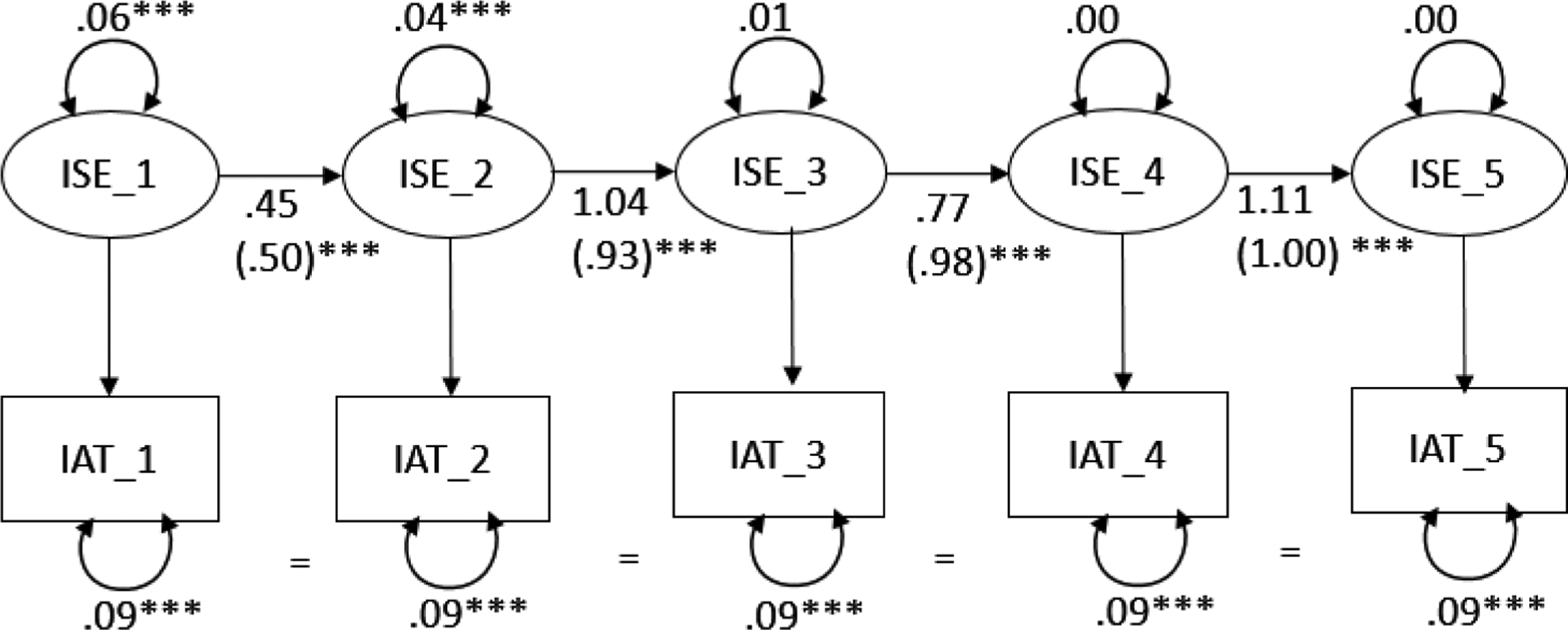
First-order autoregressive model of implicit self-esteem across five assessments over 4 years. Unstandardized estimates are presented in the figure. Standardized stability estimates are presented in parentheses. Implicit self-esteem refers to a latent variable indicated by the corresponding manifest variable (in rectangles). ***p < .001.
Mean-Level Change of Implicit Self-Esteem
Figure 2 shows how the mean-level implicit self-esteem changed over the five assessments. To examine this trend, we fitted the data with a linear LGM. The LGM included two correlated factors: a latent intercept factor and a latent slope factor. In the model, the time for each of the five waves was fixed at 0, .5, 1, 2, and 3, respectively. 2 With these specifications, the intercept represented the initial status of implicit self-esteem and the slope represented the rate of change of implicit self-esteem per year.
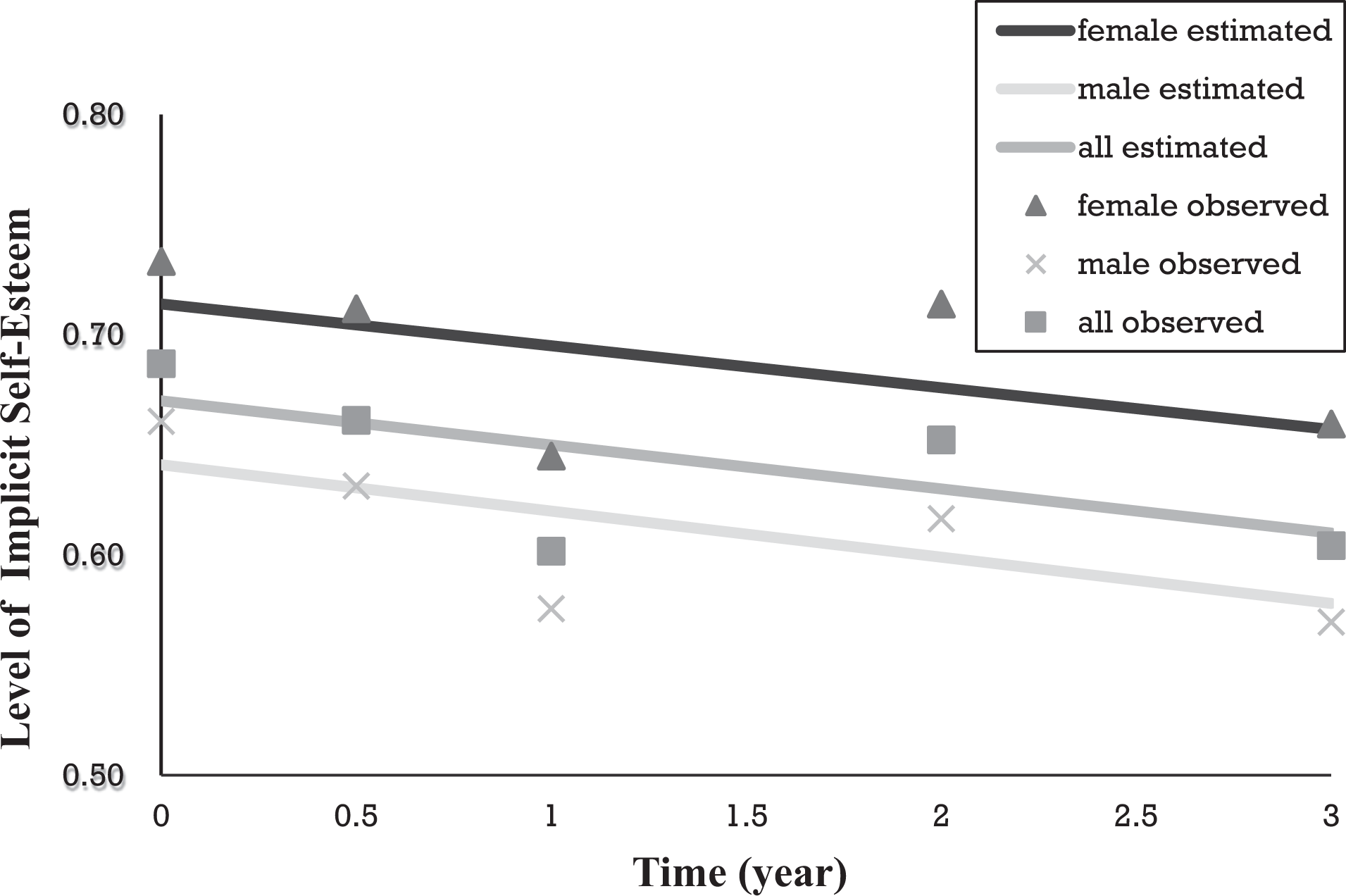
Mean-level change of implicit self-esteem across 5 waves.
The primary model (Model 1) was estimated to determine whether there was an average or typical trajectory of implicit self-esteem throughout the university years. The model yielded acceptable fit (see Figure 3), χ2(10, N = 327) = 15.031, RMSEA = .039 with 90% CI [.000, .077] and p closefit = .630, CFI = .949, TLI = .949. The mean intercept (M = .67, p < .001) and the mean slope (M = –.02, p < .05) were both significantly different from 0. The students started out with an average level of implicit self-esteem of 0.67, while the mean implicit self-esteem tended to decrease continually over time in university. The intercept variance was significant (.03, p < .001) while the slope variance was not (.00, p = .655), indicating that significant individual difference surfaced in the mean level of implicit self-esteem upon entry to university even as the declining trend over time was comparable across individuals. Figure 2 displays the trend of the mean-level change.
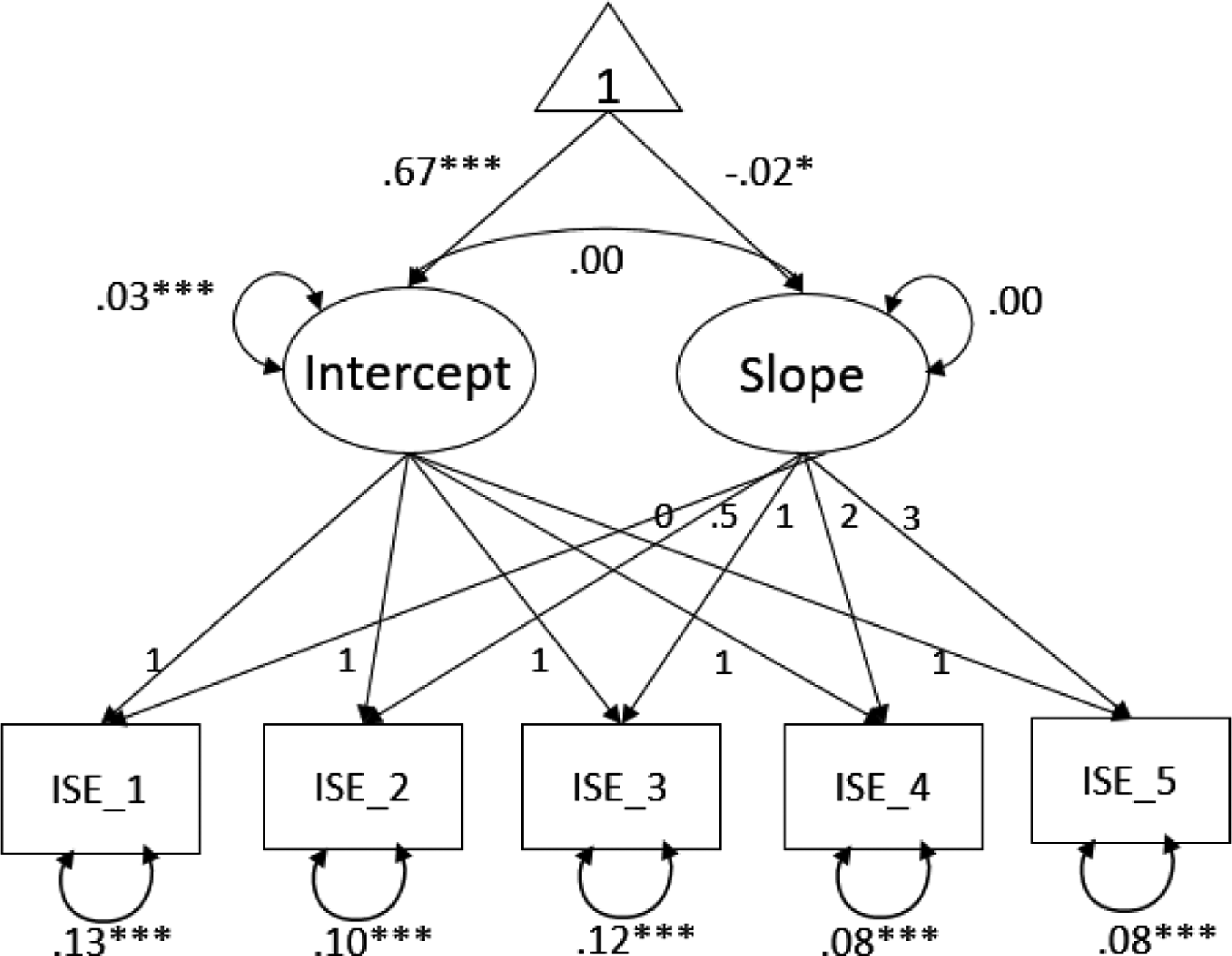
The latent growth model (Model 1) for implicit self-esteem across 4 years. In the model, the path from slope factor to the assessment of the five waves was fixed at 0, .5, 1, 2, and 3, respectively, according to the actual interval of assessment. Unstandardized estimates are presented in the figure. *p < .05. ***p < .001.
To explore the correlates of the latent intercept and slope, we added demographic variables (i.e., birthplace, SES, and gender) that enabled us to examine, in particular, their potential influence on the initial level as well as the change rate of implicit self-esteem (Model 2). The model fitted the data well, χ2(19, N = 327) = 18.875, RMSEA = .000, 90% CI [.000, .048], p closefit = .961, CFI = 1.000, TLI = 1.000. Among the three covariates, only the effect of gender on the intercept was significant (βgender = –.08, p < .05; βbirthplace = –.01, p = .805; βSES = .02, p = .477). Specifically, female students on average tended to possess higher implicit self-esteem than male students upon entry to university.
Discussion
Previous research has examined the development of implicit self-esteem during the elementary school years (Hoorens, Nuttin, Herman, & Pavakanun, 1990), among adolescents (Cai et al., 2014), and from young adulthood to old adulthood (Dunham et al., 2007; Hummert et al., 2002). We extended this line of research to emerging adulthood. Unlike earlier research, we used a longitudinal design, allowing us to examine both rank-order stability and normative change. Using AR[1] structural equation modeling, we found that after controlling for measurement error, the rank order of implicit self-esteem remains quite stable during one’s university years: those who hold a certain rank of implicit self-esteem at the beginning of their university end up with a similar rank. Through latent growth modeling, we found that on average, implicit self-esteem decreased, significantly though slightly, during the 4 years of university. This trend toward change holds for both males and females, with females starting at a higher level.
These findings enrich our understanding about the developmental process of self-esteem during emerging adulthood. Self-esteem manifests at both explicit and implicit levels (Greenwald & Banaji, 1995). Previous studies have only examined explicit self-esteem development during emerging adulthood. Thus, this is the first study demonstrating how implicit self-esteem changes across the 4 years of university. Some of our findings form a contrast with the findings from previous research on explicit self-esteem. First, while previous studies showed that explicit self-esteem during the university years increased gradually (e.g., Chung et al., 2014), our study showed that implicit self-esteem gradually declined. Second, whereas previous studies showed that males tended to have higher explicit self-esteem than females (McMullin & Cairney, 2004; Robins et al., 2002; Twenge & Campbell, 2001), and people with a higher SES tended to have higher self-esteem than those with a lower SES (Orth et al., 2010, 2012, 2015; Wagner et al., 2014), our study found that implicit self-esteem is higher among females than males and does not differ among people with a different SES. These divergent findings indicate that the findings related to explicit self-esteem may not be applicable to implicit self-esteem, highlighting the distinct nature of the two types of self-esteem as well as the importance of investigating their developmental processes separately.
Why did implicit self-esteem decline over the 4 years of university? The data we have collected do not allow us to examine the possible reasons and provide an empirically sound explanation. One plausible explanation is the big-fish-little-pond effect (BFLPE, Marsh & Hau, 2003). According to BFLPE, a student will have a lower self-evaluation in a highly selective school than in a nonselective school. In our study, all participants are college students from a top university in China. They would be considered big fish in a small pond when they were in high school, which may have afforded them a high implicit self-esteem. Upon entering university, however, the majority of these students would have become small fish in a big pond, thus gradually undermining their original high implicit self-esteem. Such speculation requires empirical examinations in the future.
Previous studies typically found a small but significant gender difference in explicit self-esteem favoring males (Bleidorn et al., 2016; Kling et al., 1999) but null gender difference in implicit self-esteem (e.g., Bosson et al., 2000; Cai et al., 2014; Pelham et al., 2005). Our study, however, revealed females exhibiting higher average implicit self-esteem than males. Given that sociocultural factors may influence gender difference in self-esteem (Bleidorn et al., 2016) and girls tend to outperform boys academically from elementary school to university in China (Lai, 2010; Zhang & Tsang, 2015), this finding may make sense. Nevertheless, future research is needed to replicate our current findings, and if they are confirmed, the causes for gender-specific results call for further inquiry.
Our results facilitate understanding about the stability of implicit self-esteem, particularly as measured by the IAT. Previous research has demonstrated relatively low stability of implicit self-esteem across a few days to a few weeks (e.g., Bosson et al., 2000; Gawronski et al., 2017; Gregg & Sedikides, 2010). Our study replicates these findings and extends them to a few years. The low stability may suggest that implicit self-esteem is transient in nature (Buhrmester et al., 2011). Our auto-regressive model analysis, however, reveals that the low stability is probably caused by measurement error. Once measurement error is removed, implicit self-esteem is very stable. In summary, our findings demonstrate the trait nature of implicit self-esteem beyond its state nature.
Our results further convey that studying implicit social cognition longitudinally with the IAT should be both possible and enlightening. Previous cross-sectional research based on mean age-group differences has yielded the impression that implicit social cognition is relatively stable and resistant to change (e.g., Dunham, Baron, & Banaji, 2008; Dunham, Chen, & Banaji, 2013; Gregg, Seibt, & Banaji, 2006; Schmidt & Nosek, 2010). This impression may be problematic. Mean age-group difference could be confounded by cohort effect. Moreover, mean-level stability could conceal substantial instability at the level of individual difference, which entails a longitudinal design with multiple assessments at different time points and stability analysis based on rank order. Before concluding that implicit social cognition is developmentally immutable, more studies with sophisticated designs are needed.
Our study is limited in various ways. First, we recruited our sample from a single, highly selective university, which may limit the generalizability of the results. Similarly, the specific measurement occasions may also have an influence on the developmental trajectory. Replications based on different samples and measurement occasions are needed. Second, we only examined implicit self-esteem as measured by the IAT. There are considerable debates surrounding the IAT in the literature, such as whether it provides an absolute measure for the implicit construct (Blanton & Jaccard, 2006; Greenwald, Nosek, & Sriram, 2006; Karpinski, 2004; Pinter & Greenwald, 2005) and whether it measures personal or extrapersonal associations (Nosek & Hansen, 2008; Olson & Fazio, 2004). For the self-esteem IAT, in particular, both construct validity (Karpinski, 2004; Pinter & Greenwald, 2005) and predictive validity have been questioned (Buhrmester et al., 2011; Falk & Heine, 2015; Falk, Heine, Takemura, Zhang, & Hsu, 2015). Given these criticisms of the IAT, it would be interesting to determine whether the findings hold when other implicit measures are used. Third, we have relied on only one indicator for the latent construct at each time point. As a result, we had to restrict the measurement error per time point to be equal, so that the model could be identified. This may not be appropriate because in our study internal consistencies of the self-esteem IAT vary to some extent across five waves. Future studies may incorporate multiple indicators for implicit self-esteem at each time point, so that the model can be identified without imposing this restriction. Finally, we conducted our study in the context of a single culture. Culture may exert influence on both explicit (Cai, Brown, Deng, & Oakes, 2007; Heine, Lehman, Markus, & Kitayama, 1999) and implicit self-esteem (e.g., Hetts, Sakuma, & Pelham, 1999). This possibility may shed doubt on the generalizability of our findings. Hence, replications with samples from different cultural backgrounds are necessary. Despite these limitations, by using the longitudinal design, our research offers the first delineation of the developmental trajectory of implicit self-esteem during emerging adulthood. It also extends our understanding of the development of self-esteem and implicit social cognition along with the psychological changes that occur in emerging adulthood.
Footnotes
Declaration of Conflicting Interests
The author(s) declared no potential conflicts of interest with respect to the research, authorship, and/or publication of this article.
Funding
The author(s) disclosed receipt of the following financial support for the research, authorship, and/or publication of this article: This work is supported by a Grant from the National Natural Science Foundation of China (No. 31571148) awarded to Huajian Cai.