







Abstract
Humans evolved to attend to valence and group membership when learning about their environment. The political domain offers a unique opportunity to study the simultaneous influence of these two broad, domain-general features of human experience. We examined whether the pervasive tendency for negatively valenced frames to “stick” in the mind applies to both intergroup and intragroup political contexts. In a preregistered experiment, we tested the effects of negative-to-positive (vs. positive-to-negative) reframing on people’s candidate preferences, first in the absence of party cue information and then in two partisan contexts: an intergroup context (analogous to a U.S. general election between opposing political parties) and an intragroup context (analogous to a U.S. primary election between candidates of the same party). We observed a persistent negativity bias in reframing effects, even in the presence of party cues. The results pave the way for future research at the intersection of psychology and political science.
Democracies run on competing messages. Citizens are inundated with news stories, campaign ads, Facebook posts, and tweets—one after another, often delivering messages that portray the same issue or candidate in every light from the rosy glow of overwhelming positivity to the shadowy cast of impending doom. Given this fast-paced, competitive information environment where people often seem to follow whichever message is endorsed by their own political party, how do policy makers get their preferred positive or negative portrayals to stick?
A wealth of research across multiple disciplines points to positive and negative framing as an especially important vehicle for message delivery (Kühberger, 1998; Levin, Schneider, & Gaeth, 1998). We know that how a policy or candidate is described, or framed, can dramatically influence citizens’ perceptions, thereby shaping political behavior in its many forms (Berinsky & Kinder, 2006; Chong & Druckman, 2007b; Entman, 1993; Gross, 2008). Yet we know much less about reframing effects—that is, what happens when an item that was initially framed one way gets reframed in a second way. Importantly, in the real world, citizens rarely see an issue or candidate framed just once. Rather, they tend to see different—and often contradictory—frames in quick succession. For example, a citizen scanning the morning headlines might see one news story that describes (frames) a candidate’s platform positively, by focusing on the number of jobs it could save in the face of an economic downturn, only to see another story that describes (reframes) the same platform negatively, by focusing on the number of jobs that would still be lost.
Recognizing this competitive framing environment, opposing sides of a political race often fight to be the first to spin a political event or campaign using their own side’s preferred frame. But if people simply respond to the frame that they see in the current moment, as the interdisciplinary framing literature has traditionally assumed, why would it matter which frame lands first? This article will examine whether the effectiveness of reframing for shaping political preferences can vary depending on the valence (positive vs. negative) of an initially encountered frame.
Sequential Framing Effects
The few studies that have begun to examine sequential framing effects in political science suggest that unless an initial frame is hammered home through repetition or other means, reframing tends to “work.” That is, people tend to respond to the frame right in front of them (Chong & Druckman, 2010; Druckman, Fein, & Leeper, 2012), with effects sometimes moderated by individual differences (Chong & Druckman, 2013; Lecheler & de Vreese, 2011). Yet thus far, this initial research has focused on so-called issue framing—that is, messages that highlight different considerations about an issue. 1 For instance, participants might read an editorial that argues for allowing (vs. opposing) a Ku Klux Klan (KKK) rally because it promotes free speech (vs. because it endangers public safety; Nelson et al., 1997). Because these “issue frames” include different content, thereby exposing the message audience to substantively different arguments for or against an issue, studies that examine issue framing make it difficult to disentangle the effects of valence alone (positive vs. negative) from the effect of particular frame content (e.g., arguments about free speech vs. public safety; Chong & Druckman, 2007a). Perhaps unsurprisingly then, most research on sequentially encountered issue frames has implicitly assumed that various types of frames are interchangeable; that is, that all frames are equally susceptible to reframing. By challenging this assumption, we can move the interdisciplinary study of framing in an important new direction: toward accounting for the fact that reframing effects depend on the type of frame encountered first.
In particular, given the very basic human tendency to attend to valence (Allport, 1935; Baumeister, Bratslavsky, Finkenauer, & Vohs, 2001; Markus & Zajonc, 1985), we zero in on the fundamental dimension of frame valence to consider the possibility that people may respond very differently to sequentially encountered frames depending on whether the initial frame is positive or negative. Elucidating how humans think about positive and negative information they encounter in sequence is crucial for understanding not only political decision-making but also human behavior more generally. Humans’ evolved cognitive architecture enables them to attend to positive and negative information in their environment and to integrate that information in a way that helps them attain rewards, avoid punishments, and interact effectively with their social world (Baumeister et al., 2001; Cacioppo & Berntson, 1994; Katz, 1960; McDermott, Fowler, & Smirnov, 2008; Schultz, 2000). Importantly, humans learn about positive and negative information sequentially, over time, rather than all at once. Thus, in order to fully understand how people learn and think about valenced information, we must consider the potential importance of the order in which that information is encountered.
Indeed, sequencing has proven to be a crucial factor in shaping the impact of positive and negative information across multiple domains (Asch, 1946; Gawronski, Rydell, Vervliet, & De Houwer, 2010; Glanzer & Cunitz, 1966; Murdock, 1962; Schwarz, 1999). For instance, research on impression formation has documented the importance of information encountered first or last in a sequence for shaping adults’ and children’s impressions of other people (Asch, 1946; Rholes & Ruble, 1986). The sequencing of an actor’s positive and negative behaviors can influence people’s forecasts for what the actor is likely to do in the future (Lagattuta & Sayfan, 2013). And the sequencing of positive and negative information can influence people’s attention to context when forming automatic evaluations of novel targets, presumably because people look to the context to help explain counterattitudinal information (Gawronski et al., 2010). Most relevant to the current study, recent research suggests that the order in which the same information is framed and then reframed over time may be important for understanding how evaluative responses change in response to reframing (Ledgerwood & Boydstun, 2014).
A Negativity Bias in Frame Stickiness
Building on this recent work, we argue that just as negative frames can be more powerful than positive frames in shaping people’s judgments (Kahneman & Tversky, 1979), they can also be “stickier” than positive frames, in that they have a stronger tendency to lodge in people’s minds and resist the effects of a subsequently encountered frame. When people encounter an especially sticky frame, they mentally label the framed issue in a way that makes subsequent attempts to relabel it difficult. Consistent with theory and research suggesting that humans often prioritize negative over positive information (Baumeister et al., 2001; Rozin & Royzman, 2001), we suggest that whereas it is relatively easy to shift from thinking of an issue or candidate in terms of positives (e.g., jobs saved) to thinking of it in terms of negatives (e.g., jobs lost), it is cognitively much more difficult to shift from negative to positives. As a result, the effect of reframing should depend on what frame is encountered first. When frames switch from positive to negative, people’s support for a policy or candidate should follow; in contrast, when frames switch from negative to positive, people’s thinking should get “stuck” in the initial, negative frame.
Recent findings provided initial evidence for such a negativity bias in reframing effects: Participants found it more difficult to switch from thinking about an abstract scenario in terms of negatives (e.g., number of lives lost, in a classic “unusual disease” framing scenario) to thinking about it in terms of positives (e.g., number of lives saved) than to move in the opposite direction, from positives to negatives (Ledgerwood & Boydstun, 2014). Similar asymmetries have been observed in several studies on impression formation; for example, participants’ attraction to a target person changed less when the person’s behavior switched from negative to positive (vs. positive to negative; Afifi & Burgoon, 2000), and participants’ attitudes toward a novel target changed less when sequentially encountered information changed from negative to positive (vs. positive to negative; Seuntjens & Ratliff, 2017).
The Impact of Party Cues
However, it remains unclear whether the negativity bias observed in initial research on reframing would ever translate to political preferences in a partisan-divided world. Considerable research in both psychology and political science has demonstrated the substantial power of party cues to shape political preferences (Bartels, 2002; Campbell, Converse, Miller, & Stokes, 1960; Hart & Nisbet, 2011; see also Fleming & Petty, 2000). For instance, simple party cue information (e.g., whether a proposed policy is endorsed by one’s own political party vs. the opposing political party) can override the actual objective content of a policy (e.g., whether a welfare program provides stringent or generous benefits) in determining whether people support the policy (Cohen, 2003).
Thus, it seems possible that the presence of political party cues will moderate the negativity bias in reframing effects observed in previous research, either by entirely swamping the potentially subtle effects of framing or perhaps by creating opportunities for motivated reasoning to diminish the negativity bias for in-group candidates while exacerbating it for out-group candidates (see, e.g., Goren, 2002; Howard & Rothbart, 1980; Schaller, 1992). Alternatively, perhaps the negativity bias in reframing effects is fundamental enough to survive in a partisan context, underscoring the power of negative and positive frames to shape preferences even in the presence of other influential cues.
The Present Research
To examine the effects of reframing in the political context of candidate preferences, we conducted a preregistered experiment to test (a) whether negative (vs. positive) frames have stronger carryover effects on candidate preferences and (b) whether such a negativity bias is moderated by the presence of party cues. Our basic study design built on classic framing studies (e.g., Tversky & Kahneman, 1981) but added a twist: After initially framing a hypothetical scenario in terms of positives or negatives, we reframed the same scenario in terms of the opposing frame. We tested the effects of reframing on candidate preferences both in the absence of any party cue information (control condition) and across two common partisan contexts: (a) an intergroup context in which a Democrat or Republican incumbent is challenged by an opponent from the other party (as occurs in general elections in the United States, when one candidate from each party competes for election) and (b) an intragroup context in which a Democrat or Republican incumbent is challenged by an opponent from the same party (as occurs in primary elections in the United States, when multiple candidates from within a single party compete to be their party’s general election candidate). By testing these questions within a single study, we could compare each of these contexts to the same control condition. Within each context, we also varied whether the incumbent belonged to the participants’ political in-group (i.e., a Republican candidate for Republican participants; a Democrat candidate for Democrat participants) or political out-group (i.e., a Democrat candidate for Republican participants; a Republican candidate for Democrat participants). Toward this end, we included in our study only participants who self-identified as being (or “leaning” toward) Democrats or Republicans.
Method
Following recent calls across scientific disciplines for improving research practices to increase the replicability of published research (Chambers, 2014; Ledgerwood, Soderberg, & Sparks, 2017), we preregistered our method, inclusion/exclusion criteria, target sample size/stopping rule, and analysis plan in a public repository (see https://aspredicted.org/va8pe.pdf). We used a meta-analytic estimate of the expected effect size in the control condition based on past research (Ledgerwood & Boydstun, 2014; Sparks & Ledgerwood, 2017) to conduct a power analysis in G*Power, which suggested a target cell size of n = 74 to have 80% power to test our first research question with a two-sided test (we would actually have higher power since we planned to use a one-sided test). Because our other two key research questions involved interactions, we doubled this target cell size to n = 148 (Simonsohn, 2014) and multiplied by the 10 cells of our design (see below), yielding a total N = 1,480. We followed our preregistered stopping rule for data collection; however, because Qualtrics counted the number of people who responded to our inclusion criterion question, rather than the number of people who met the criterion and continued on to take the study, our final sample ended up being smaller than our target N of 1,480. All materials are available in Supplemental Material.
Participants and Design
Participants were 1,257 adults (688 female, 561 male, and 8 who did not identify with either label) aged 18–79 (M = 35.41, SD = 12.18) who identified as Democrat (n = 530), Republican (n = 241), Independent leaning Democrat (n = 295), or Independent leaning Republican (n = 191) in an initial screening question. (Respondents who identified as Independent or Other were piped to a different, unrelated study.) Participants completed the 5-min study online in exchange for 25 cents paid through Amazon’s MTurk platform (aligning with average MTurk compensation rates; Bohannon, 2016). Participants could only complete the study if they had never participated in another framing study conducted by our lab. To ensure that participants were paying attention, we asked them to close background windows and minimize distractions. Note that our previous research on reframing has always shown similar patterns of effects in MTurk and laboratory samples (see additional studies in Supplemental Material and Ledgerwood & Boydstun, 2014), which increases our confidence in the generalizability of findings obtained using either type of sample.
Participants were randomly assigned to one cell in a 2 (frame valence order: negative first vs. positive first) × 5 (group context: control, intergroup with in-group incumbent, intergroup with out-group incumbent, intragroup with in-group incumbent, intragroup with out-group incumbent) design.
Frame Valence Order
To test whether candidate preferences would change less when framing switched from negative to positive (vs. positive to negative), we adapted typical framing paradigms used in past research (Ledgerwood & Boydstun, 2014; Tversky & Kahneman, 1981). All participants learned about the percentage of jobs that had been saved (positive frame) or lost (negative frame) under “the current Governor of an important state [who] is running against an opponent.” Participants were told that “when the current Governor took office, statewide budget cuts were expected to affect 10,000 jobs, which would in turn affect the state and national economies.”
In the positive-first condition, participants read that under the current Governor’s leadership, 40% of these jobs had been saved. In the negative-first condition, participants read that 60% of these jobs had been lost. Participants then rated how they felt about the election on a 100-point, unmarked scale from “completely favor current governor” to “completely favor opponent,” as well as how likely they would be to vote for the current governor and how likely they would be to vote for the opponent (on scales from “not at all” to “extremely”).
Next, participants read “additional information” that simply reframed the prior information using the opposite frame, pointing out that 60% (40%) of the jobs in question had been lost (saved). Importantly, then, the information presented at the two time points was mathematically identical, but the language used to describe the governor’s administration switched either from positive to negative or from negative to positive.
Participants then rerated their attitudes toward the current governor versus the opponent using the same three scales from Time 1. The first and third ratings were reverse coded and the three ratings averaged to form a composite measure of preference for the incumbent (vs. opponent) at each time point (α = .90 and α = .91 for Time 1 and Time 2, respectively). Our key dependent variable was captured by the extent of attitude change that participants displayed in the direction of the Time 2 frame (i.e., the amount each participant shifted away from the Time 1 frame and toward the Time 2 frame).
Group Context
In the control condition, participants simply saw the information described above, without any additional information about the political parties of the candidates. In the intergroup context conditions, participants also read: “You can assume that both candidates are originally from this important state, that the current Governor is a Democrat, and that the opponent is a Republican” or “…that the current Governor is a Republican and that the opponent is a Democrat.” In the intragroup context conditions, participants instead read that both the current Governor and the opponent were either Democrats (in one condition) or Republicans (in the other). These conditions were then recoded based on participants’ own political party such that a Democrat incumbent counted as an in-group incumbent for participants who identified as Democrat or Independent leaning Democrat, whereas a Republican incumbent counted as an in-group incumbent for participants who identified as Republican or Independent leaning Republican.
Funnel debriefing
At the end of the survey, participants saw a series of open-ended questions designed to elicit, in a nonleading way, whether they had any knowledge of framing effects or suspected that framing research was relevant to the study.
Results
We followed our preregistered exclusion criteria. For 19 participants, more than 1 item of the dependent variable failed to record due to a computer error, and 26 participants indicated familiarity with research on framing effects in the funnel debriefing. Analyses were conducted on the resulting sample of 1,212 participants. 2
We preregistered three analyses, designed to answer three questions (see Figure 1).
Question 1: In the absence of party cue information (i.e., in the control condition), will participants’ candidate preferences change less in response to negative-to-positive reframing (vs. positive-to-negative reframing)? A planned one-sided independent samples t test comparing the two framing conditions (negative-to-positive vs. positive-to-negative) in the control condition revealed that, as predicted, negative-to-positive reframing produced smaller changes in candidate preferences (M
change = 12.17, SD = 13.87) compared to positive-to-negative reframing (M
change = 19.96, SD = 23.77), t(229) = 3.04, p = .002, d = .40, 95% confidence interval (CI) = [.14, .66].
Question 2: Does providing intergroup party cues modulate the size of the sequential framing effect described in Question 1? A 2 (framing condition: negative-to-positive vs. positive-to-negative) × 3 (intergroup party cue: control vs. in-group incumbent vs. out-group incumbent) between-subjects analysis of variance (ANOVA) on preference change scores revealed no moderating effect of intergroup party cues on the sequential framing effect observed in the control condition, F(2, 700) = .535, p = .586,
Question 3: Does providing intragroup party cues modulate the size of the sequential framing effect described in Question 1? A 2 (framing condition: negative-to-positive vs. positive-to-negative) × 3 (intragroup party cue: control vs. in-group candidates vs. out-group candidates) between-subjects ANOVA on preference change scores revealed no moderating effect of intragroup party cues on the sequential framing effect observed in the control condition, F(2, 688) = .470, p = .625,
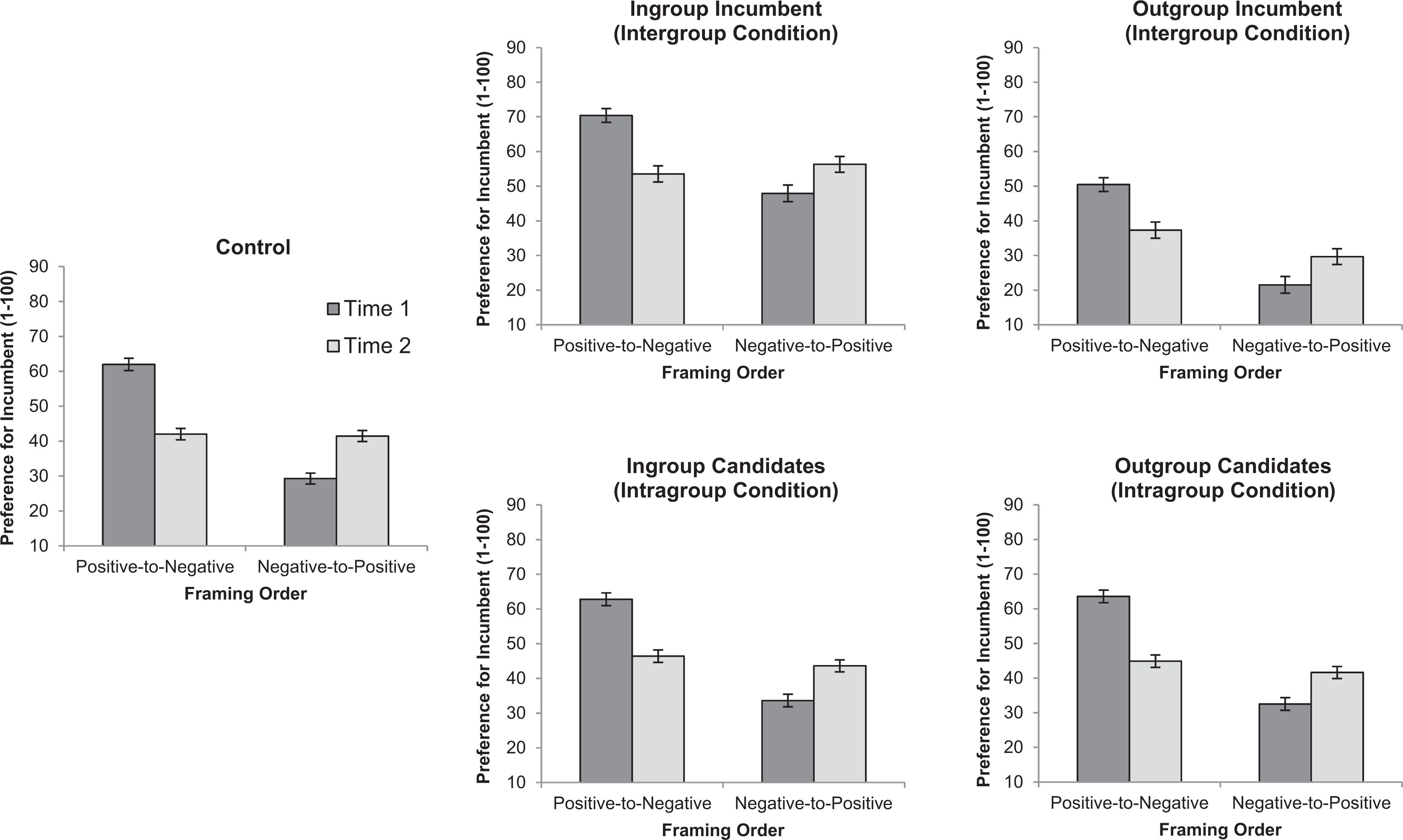
Preferences for incumbent candidate (vs. opponent) as a function of frame order, time point, and party cue condition. Error bars indicate one standard error above and below the mean.
Exploratory analyses: Independent-samples t tests (two-sided) within each party cue condition suggested that the same sequential framing effect observed in the control condition replicated in each of the intergroup and intragroup contexts (all ps < .032). We also checked whether participants generally preferred candidates who belonged to their own (vs. the opposing) political party, and (unsurprisingly) they did: In the two intergroup conditions, participants generally showed a much stronger preference for the incumbent when the incumbent belonged to their own party rather than the opposing party, F(1, 471) = 131.54, p < .001,
We also explored whether the answers to Questions 1–3 above might change depending on participants’ political party. We found no evidence suggesting they do: Party did not moderate any of the key analyses described above (see Supplemental Material for full details).
Taken together, then, our planned and exploratory analyses suggest that initial exposure to negative (vs. positive) frames mutes the effectiveness of subsequent reframing and that this effect holds in the presence of both intergroup and intragroup party cues and for both Democrats and Republicans alike.
Discussion
The results of our preregistered experiment showed a robust negativity bias in reframing effects, even in the face of intergroup and intragroup party cues. Replicating prior research on reframing effects (Ledgerwood & Boydstun, 2014) and extending it to the political domain, in the absence of party cue information, participants’ candidate preferences changed less when framing switched from negative to positive (vs. positive to negative). This finding is consistent with research suggesting that in many circumstances, it is cognitively more difficult for people to reconceptualize a negatively framed concept as a positive one than to move in the opposite direction (Ledgerwood & Boydstun, 2014, studies 3–5).
Of particular relevance to the question of how reframing effects might translate to political preferences in a partisan-divided world, we observed no moderating effect of either intergroup or intragroup party cue information on the tendency for negative (vs. positive) frames to have greater sticking power. Thus, despite the fact that party cues have been shown to overwhelm many other aspects of political messages—including the actual content of a policy proposal (Cohen, 2003; see also Bartels, 2002; Campbell et al., 1960; Chang, 2003)—they did not overwhelm or even mute the negativity bias in reframing effects observed in our control condition (an alternative, exploratory analysis reported in Supplemental Material supports the same conclusion).
Neither did party cue information interact with framing condition to produce an exaggerated negativity bias toward out-group candidates, nor a muted negativity bias toward in-group candidates, as one might have expected based on past research on motivated reasoning. For instance, considerable research suggests that the motivation to see one’s own group (vs. an out-group) in a more favorable light can bias information processing (Hastorf & Cantril, 1954; Ledgerwood, Callahan, & Chaiken, 2014; Tajfel & Turner, 1986; Westen, Blagov, Harenski, Kilts, & Hamann, 2006). Based on this research, one might have anticipated that at least in the intergroup context conditions of our study, participants would show a stronger negativity bias in reframing effects when evaluating the out-group (vs. in-group) incumbent. Instead, the greater sticking power of negative (vs. positive) frames was consistent across conditions.
One might wonder if the absence of a moderating effect of party cue information could reflect the fact that our manipulation was simply too weak to have any influence on participants’ preferences. This seems unlikely: We observed a strong effect (
In short, our results suggest a pervasive and potent negativity bias in reframing effects that can persist across both intragroup and intergroup contexts. These findings fit well with research suggesting that in many circumstances, humans show a presumably adaptive tendency to prioritize safety and potential negatives (see Baumeister et al., 2001; Rozin & Royzman, 2001, for reviews). For instance, people show enhanced attention to and memory for negative versus positive stimuli (Fiske, 1980; Hansen & Hansen, 1988; Peeters & Czapinski, 1990; Pratto & John, 1991). The present experiment leverages such research on negativity bias to help expand our understanding of framing effects beyond the literature’s predominant focus on the single-shot effect of a current frame on a current judgment. Our results suggest that past frames can substantially constrain the impact of a current frame on people’s political preferences and that negative (vs. positive) frames can be more resistant to reframing.
Constraints on Generality
Following recent recommendations to include an explicit statement describing the generality of a study’s findings (Simons, Shoda, & Lindsay, 2017), we outline here the anticipated boundary conditions for the results observed in the present study. We expect that our results would generalize to any sample of U.S. participants below age 50 who identify as Democrat, Republican, or Independent leaning Democrat or Republican. Indeed, given the presumably fundamental nature of both in-group bias and negativity bias (Baumeister et al., 2001; M. B. Brewer, 1999), it seems likely that these results would also generalize more broadly to any sample in which people identify with a particular political group (e.g., the Labour party in England), but this level of generalization seems important to test in future research and would not constitute a direct replication of the present study. We do not expect our results to generalize to participants over age 50, given developmental changes in negativity biases that occur across the life span (Carstensen, 2006; Sparks & Ledgerwood, 2017). In addition, we suspect that both our instructions to participants and the unmarked slider scales we used to assess our dependent variable (see Supplemental Material) may be important for ensuring that participants do not feel constrained to respond either consistently or inconsistently from one time point to the next.
Perhaps most importantly, we have reason to expect that our findings will generalize to similar scenarios in the loss domain (e.g., not only jobs lost vs. saved but also lives lost vs. saved, the success or failure rate of a program designed to prevent a bad event from occurring, etc.; see Ledgerwood & Boydstun, 2014; Sparks & Ledgerwood, 2017; preliminary studies reported in Supplemental Material). In contrast, we do not expect them to generalize to scenarios in the gain domain (e.g., a program designed to generate new positive outcomes), given recent research suggesting that reframing effects operate differently in the gain domain (Sparks & Ledgerwood, 2017).
It is possible that presenting party cue information earlier in the study, constraining the sample to include only participants who strongly identify with a political party, and/or conducting the study when intergroup tensions are especially high could influence the results, and future research should test the extent to which the findings observed here would generalize across these contexts. (We conducted this study in May 2016, in the mid of the Democratic and Republican primary elections but before the general election season began; political identity salience was probably somewhat heightened for participants, but not yet at its peak.) We have no reason to believe that the results depend on other characteristics of the participants, materials, or context.
Implications for Political Discourse and Voting Behavior
Our findings hold implications for understanding the role of conflicting information—and misinformation—in political discourse. Studies show that a portion of citizens are fairly astute (Converse, 2000) and that less informed citizens can use information shortcuts to form opinions resembling those of the more informed (Lupia & McCubbins, 1998). In light of such results, it may be surprising to consider other research showing that exposure to competing information does nothing to help (and perhaps even hurts) the gap between informed and uninformed voters (Claassen & Highton, 2006) and that opinion can be swayed by misconceptions fueled by conflicting rhetoric and flat-out falsehoods (Kuklinski, Quirk, Jerit, Schwieder, & Robert, 2000; Wells, Reedy, Gastil, & Lee, 2009). Indeed, it is disconcerting to realize just how easily—and deeply—misinformation can lodge in people’s minds, often with a partisan bias (e.g., Bullock, Gerber, Hill, & Huber, 2015). How do we reconcile research suggesting that people can seem fairly informed about political issues with evidence that people are also easily swayed by misinformation? Our results suggest one possible answer: Since conflicting information and misinformation often hinge on fear-based loss frames, it makes sense that once citizens use this information to conceptualize an issue or candidate, it is very difficult to shift perspectives, yielding entrenched attitudes. This finding is again especially stark because it persists despite observing exactly the kind of direct effects of partisanship on candidate choice that we would expect from research on in-group favoritism and partisan bias (Bonneau & Cann, 2015; Campbell et al., 1960; Tajfel et al., 1971).
There are, of course, several factors in the complex political world that might moderate the negativity bias observed in our controlled experiment. For instance, whereas our study involved novel political candidates, real candidate evaluations are usually based on an accumulation of observations about the candidate made over months or years. Although we found that party cues were not strong enough to moderate the negativity bias in reframing, incumbent familiarity is also a strong predictor of vote choice (Jacobson & Carson, 2015). Thus, negativity bias in reframing might be weakened in the case of voters receiving negative information about an incumbent who not only shares their party but is also a familiar and beloved public figure. Moreover, voters who care deeply about a particular issue (Bélanger & Meguid, 2008) may be less susceptible to framing effects in general. Still, across all the boundary conditions we might imagine, a truism of politics is that political actors will always work to frame and reframe their messages in the best positive or negative light. Thus, although future research may find that the psychological tendency to get stuck in the negatives is more or less severe in different contexts, the negativity bias in reframing observed here is likely to be fundamentally relevant for understanding how people perceive politics.
Supplemental Material
Supplemental Material, SPPS733520_suppl_mat - A Negativity Bias in Reframing Shapes Political Preferences Even in Partisan Contexts
Supplemental Material, SPPS733520_suppl_mat for A Negativity Bias in Reframing Shapes Political Preferences Even in Partisan Contexts by Amber E. Boydstun, Alison Ledgerwood, and Jehan Sparks in Social Psychological and Personality Science
Footnotes
Authors’ Note
Amber E. Boydstun and Alison Ledgerwood contributed equally.
Declaration of Conflicting Interests
The author(s) declared no potential conflicts of interest with respect to the research, authorship, and/or publication of this article.
Funding
The author(s) disclosed receipt of the following financial support for the research, authorship, and/or publication of this article: This research was supported by National Science Foundation Grant 1226389 to Alison Ledgerwood and Amber E. Boydstun.
Supplemental Material
The supplemental material is available in the online version of the article.
Notes
References
Supplementary Material
Please find the following supplemental material available below.
For Open Access articles published under a Creative Commons License, all supplemental material carries the same license as the article it is associated with.
For non-Open Access articles published, all supplemental material carries a non-exclusive license, and permission requests for re-use of supplemental material or any part of supplemental material shall be sent directly to the copyright owner as specified in the copyright notice associated with the article.
