







Abstract
People are better able to correctly identify the faces of individuals who belong to their own race. Research linking the cross-race effect in face recognition to racial attitudes has been limited to explicit measures and sequential presentation formats. Using a simultaneous lineup task, our results from two studies revealed a systematic relationship between explicit racial bias and increased false identification of Black faces. We observed inconsistent evidence to suggest that individual differences in implicit attitudes impact judgments of Black faces. Nevertheless, nonconscious activation of crime-related concepts prior to encoding facial targets impaired White perceivers’ accuracy for Black faces. Nonconscious priming of crime concepts did not affect White perceivers’ judgments of White faces. Thus, among Whites, racial bias, as a function of both individual differences and contextual cues, can increase the false identification of Black faces in simultaneous lineups. Theoretical and legal implications for face recognition and eyewitness memory are discussed.
People have difficulty accurately recognizing the faces of individuals who belong to another race. Evidence for this cross-race effect (CRE) in face recognition is robust and reliable. Research on the CRE primarily comes from laboratory studies (e.g., Sporer, 2001a) but has also been documented in field experiments (e.g., Platz & Hosch, 1988) and archival analysis (e.g., Wright & McDaid, 1996). A meta-analysis (39 independent studies, N = 5,000) indicates that individuals are 1.4 times more likely to correctly identify someone of the same race (SR) and 1.56 times more likely to falsely recognize someone of another race. This pattern is consistent across methodologies, contexts, and even nations (Meissner & Brigham, 2001).
The ability to process and accurately recall the facial characteristics of others is an important skill acquired by humans early in social and psychological development (Sangrigoli & de Schonen, 2004). Facial recognition is fundamental to interpersonal functioning, and errors can undermine the quality of social interactions. In the context of intergroup relations, the inability to differentiate among members of out-groups is, for example, associated with stereotyping (Lebrecht, Pierce, Tarr, & Tanaka, 2009).
The CRE is also consequential for the criminal justice system. Eyewitness evidence is essential to criminal investigations and legal proceedings. Information provided by witnesses is often the starting point for police investigations, and their testimony can be compelling evidence of defendants’ guilt (Pozzulo, Lemieux, Wells, & McCuaig, 2006). Yet witness memory is imperfect and can be undermined by viewing conditions and lineup procedures (Wells, Memon, & Penrod, 2006). For example, cross-race identifications occurred in approximately 30% of documented wrongful convictions (Innocence Project, 2015). Understanding the psychological underpinnings of cross-racial face recognition is therefore of both social and legal importance.
Early research failed to establish an empirical link between self-reported attitudes and the CRE (Meissner & Brigham, 2001). However, the conceptualization and measurement of racial attitudes now recognizes that contemporary prejudicial attitudes are often expressed with subtlety, such that group-based disparities and prejudices are rationalized or justified in socially acceptable terms (Henry & Sears, 2002). We provide the first test of the hypothesis that contemporary measures of racial attitudes are consequential for OR face recognition. Further, individuals may not be willing or able to report their attitudes on intergroup relations (Greenwald, Poehlman, Uhlmann, & Banaji, 2009). Yet little work has investigated the relationship between implicit attitudes and cross-racial face recognition (for an exception, see Ferguson, Rhodes, Lee, & Sriram, 2001). To our knowledge, no work has examined implicit processes or the role of contemporary explicit attitudes in simultaneous presentation lineup formats.
Much work on eyewitness evidence demonstrates that simultaneous lineups facilitate relative (vs. absolute) judgments (e.g., Lindsay & Wells, 1985), which, by enabling eyewitnesses to compare each lineup member and choose the one that best matches their memory, can increase false identification (Wells & Bradfield, 1999). Absolute judgments involve direct comparisons of memory to a target face, which can reduce false identifications (Steblay, Dysart, & Wells, 2011). Because prior work examining the impact of explicit racial attitudes on the CRE used sequential presentation formats, it may have obfuscated the relationship. Individual-level biases may influence relative decision-making in a simultaneous presentation format.
The inattention to implicit processes and contemporary forms of prejudice in this domain is a significant oversight. Using correlational and experimental methods, we demonstrate that racial bias, as a function of individual differences and contextual cues, can increase the false identification of Black faces in simultaneous presentation formats.
Theoretical Perspectives on Cross-Racial Difference in Face Recognition
Theory and research examining the psychological underpinnings of cross-racial face recognition have primarily emphasized the role of perceptual expertise (e.g., interracial contact; Anzures et al., 2014) and social cognitive processes (e.g., categorization; MacLin & Malpass, 2001). People are more motivated and able to perceive, encode, and recall individuating (vs. category) characteristics of SR (vs. other-race [OR]) faces in a way more diagnostic of identity (Linville, Fischer, & Salovey, 1989; Sporer, 2001b; Valentine, 1991). Because people have more experience and increased motivation individuating SR (vs. OR) faces, cross-racial differences in recognition memory persist (Hugenberg, Young, Bernstein, & Sacco, 2010). Individual differences and situational cues that increase motivation (e.g., target-status; Shriver & Hugenberg, 2010) and experience (e.g., intergroup contact; Chiroro & Valentine, 2015) in evaluating facial stimuli can promote individuating processing strategies and improve recognition memory.
Racial Attitudes and the CRE
Although many researchers assumed a link between self-reported racial attitudes and the CRE, a quantitative meta-analysis detected no relationship (Meissner & Brigham, 2001). Importantly, attitudes can be represented at both implicit and explicit levels. Explicit associations are consciously accessible and can be retrieved and reported with accuracy, whereas implicit associations can operate quickly and without awareness (Gawronski, Hofmann, & Wilbur, 2006).
Little research has determined whether and to what extent implicit racial attitudes contribute to the CRE. Implicit measures can predict behavior in socially sensitive domains (Greenwald, Smith, Sriram, Bar-Anan, & Nosek, 2009) or when individuals lack conscious awareness of their attitudes (e.g., Arcuri, Castelli, Galdi, Zogmaister, & Amadori, 2008), particularly in ambiguous circumstances (Gawronski et al., 2006). For example, eyewitnesses do not always encode facial characteristics under optimal viewing conditions, may render judgments long after the event in question, or may be uncertain if the original target is present at the time of recall. Given these concerns, eyewitness judgments in cross-racial criminal encounters may be ripe for the influence of unconscious bias.
There are several reasons why we expect racial attitudes to influence the CRE. First, individuals have positive evaluations of themselves and their in-groups (e.g., Turner, & Brown, 1978). Higher levels of racial bias might increase group differentiation, which, although capable of increasing perceived within-group homogeneity for both in-group and out-groups (Wilson & Hugenberg, 2010), could also promote more categorization of OR (vs. SR) faces. If a relative increase in category-based processing of OR faces recurs over time, it might lead to less experience and skill individuating, even when motivated to do so. Individual differences in racial attitudes may therefore reflect cumulative histories of relatively higher levels of automatically categorizing and failing to effectively individuate OR faces.
Second, attitude accessibility can direct attention allocation and promote confirmatory processing of visual stimuli (Levin, 2000; Roskos-Ewoldsen & Fazio, 1992; Smith, Fazio, & Cejka, 1996). Attitude-evoking social categories draw attention and processing to category-consistent attributes, particularly among individuals for whom such attitudes are cognitively accessible. Individuals for whom the category “race” is cognitively accessible should be particularly likely to attend to and categorize targets based on race (Fazio & Dunton, 1997). Consequently, we expect racial attitudes to undermine judgment accuracy for OR faces. Similarly, when category-based characteristics are made salient prior to the encoding of a target, facial stimuli should be attended to and processed consistent with category-distinctive attributes, not individual characteristics. Thus, we expect that activating crime-related stereotypes, prior to the encoding of Black faces, will undermine OR recognition memory by increasing the cognitive accessibility of race.
The Present Research
We examined the relationship between racial bias and cross-race face recognition in a simultaneous lineup presentation format. We also examine the effect of crime-related stereotype activation, prior to target face exposure, on face recognition. Because simultaneous lineups facilitate relative judgments, we expect it to be vulnerable to racial bias during the recognition stage. Hence, simultaneous lineups provide a suitable context to test our hypothesis that racial bias can increase false identification of Black faces.
White individuals characterized by implicit or explicit racial bias should have less experience and motivation in processing other race (OR) faces in an individuating manner, thereby leading to relatively worse judgment accuracy for OR faces (Hypothesis 1). Because we expect the unconscious activation of crime-related stereotypes prior to encoding to trigger categorization of OR (but not SR) faces, it should also reduce judgment accuracy of OR faces (Hypothesis 2). Furthermore, we do not expect these effects to be accounted for by differential choosing rates or response bias (discussed below).
We test these hypotheses across two studies using a simultaneous presentation face-recognition paradigm with experimental stimuli, target photos, and lineups that were extensively pilot tested prior to data collection (see Online Appendix B).
Study 1
Design
Data collection for each participant in Study 1 occurred at 2 times, separated by no less than 2 days and no more than a week (mean number of days = 2.5, SD = 2.72). At Time 1 (T1), participants were randomly assigned to complete one of two Implicit Association Tests (IAT; i.e., evaluative IAT or stereotype IAT). At Time 2 (T2), participants completed a memory test in person at the laboratory. Prior to the memory test, participants were randomly assigned to the priming or control condition. This study was a 2 (evaluative vs. stereotype IAT) × 2 (crime-prime × control) × (target race: White vs. Black) between- and within-subjects design using a simultaneous lineup paradigm. All experimental stimuli, target photos, and lineups were extensively pilot tested to ensure that all photos were judged similarly in perceived attractiveness and distinctiveness and that the lineups were comparably fair and unbiased. See Online Appendix B for a detailed description of these pilot studies.
Participants
Participants were undergraduate psychology students, recruited to complete a study investigating memory for faces in exchange for extra course credit. Only students who described themselves as Caucasian were included in subsequent analyses, leaving 297 participants (189 female, 105 male; age: M = 19.47, SD = 2.59) and excluding 116. Of these participants, 45 (15.15%) did not complete both parts of the study, leaving a final sample of 252 participants (158 female, 91 male; age: M = 19.51, SD = 2.75). With this sample size of White participants (N = 252), we estimated that we had 48% power to detect a small effect size (Cohen’s d = .2) and 99% power to detect a medium effect size (Cohen’s d = .5) in regression analyses examining the bivariate relationship between a single predictor and dependent variable. We also retained 95% power to detect medium (Cohen’s d = .5) mean level differences between experimental conditions.
Procedure
At T1, individual difference measures and demographics were collected using an online survey. The priming paradigm and memory test were administered at T2 at a campus computer lab. At the start of T2, participants were instructed that they would be completing a face-recognition task that involved an encoding and recognition stage, and they would need to remember target photos to pick out of lineups later in the study. Encoding and recognition stages were blocked by race and the order in which participants completed the blocks was counterbalanced. Prior to each encoding stage, participants were instructed to complete an attention task, which served as a cover story for the crime-prime manipulation. Below, we provide a brief overview of our methodology. Online Appendix B provides a more detailed description.
Crime-priming paradigm
The experimental-priming paradigm was based on the procedure employed by Eberhardt, Goff, Purdie, and Davies (2004). Participants were first instructed to focus their attention at the center of the screen while images (i.e., priming stimuli) randomly flashed in one of the four corners. Each priming stimulus was preceded by a masking image (displayed for 25 ms or three frames on the 120 Hz monitors) and was presented for 25 ms, followed immediately by a masking image that remained until participants responded. Using the keyboard, participants indicated in which corner each image flashed. In actuality, these images were either crime-related or in the control condition, an indistinguishable composite image. Each priming task consisted of 10 practice trials followed by four blocks of 25 trials. A pilot test of this procedure (N = 140) provided strong support for the validity of this paradigm (see Online Appendix B).
Target encoding
The order in which participants viewed a block of Black or White target faces during the encoding stage was counterbalanced. Within each encoding block, five target photos were presented to participants in random order, each for a randomly selected duration from 3 to 10 s to simulate variability in viewing conditions common to eyewitness identification conditions. The recognition stage for each respective race immediately followed the encoding stage.
Target recognition
During each recognition stage, participants were presented with five lineups. Drawing from the five target-present (TP) and five target-absent (TA) lineups that extensive pilot testing (see Online Appendix B) had indicated were unbiased and fair, each participant was randomly assigned to view either 2 TP and 3 TA lineups or 3 TP and 2 TA lineups. 1 Which of the TP and TA lineups participants were presented and the order of photos within the lineups was fully randomized. Participants were instructed to indicate which, if any, of the six photos in each lineup was a target photo or to indicate that the target was absent from the lineup.
Measures
Table 1 contains the means, standard deviations, and correlations among all measures used in the analyses for Study 1. All of the measures are fully described in Online Appendix C, including measures not used in this analysis: interracial contact, motivation to control prejudiced reactions (Dunton & Fazio, 1997), and threat-based concerns about appearing prejudiced (e.g., Goff, Steele, & Davies, 2008). None of these measures were pertinent to the set of predictions tested in the present research.
Correlations Between All Continuous Variables used in Analyses for Study 1.
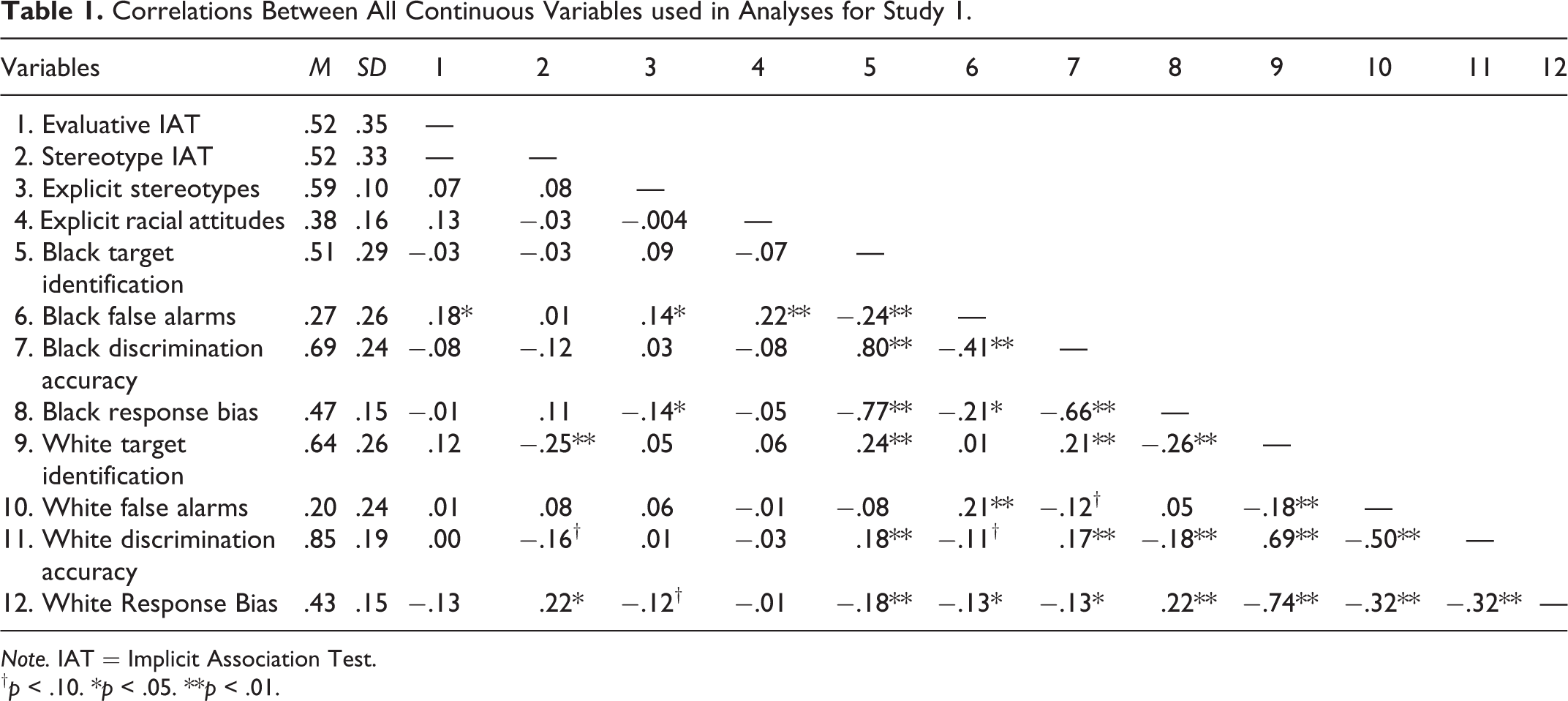
Note. IAT = Implicit Association Test.
†p < .10. *p < .05. **p < .01.
Implicit measures of racial attitudes and stereotypes
At T1, 128 participants were randomly assigned to complete an evaluative IAT (assessing good–bad attributes with White–Black faces) and an additional 122 participants were randomly assigned to complete a stereotype IAT assessing associations between race and crime. IAT scores were computed using the algorithm from Greenwald, Nosek, and Banaji (2003). Higher scores represent stronger associations between White-positive and Black-crime, and lower scores represent stronger associations between Black-positive and White-crime.
Explicit measures of racial attitudes
We assessed explicit racial attitudes using the Symbolic Racism Scale (Henry & Sears, 2002), a measure of contemporary prejudice toward Blacks through which existing racial disparities are viewed as justified. This construct captures the belief that prejudice and discrimination against Blacks no longer exists, that racial disparities are a product of the moral failings of Black culture, and that efforts to remediate racial discrimination are unnecessary and counterproductive (Henry & Sears, 2002). We averaged responses across 8 items from each participant to calculate their explicit racial attitude score (α = .82).
Explicit measures of racial stereotypes
Participants reported their perceptions of what the average White American thinks about the dangerousness, propensity toward violence, and aggresiveness of Blacks or Whites (0–100%). Perceptions of beliefs about Whites (α = .95) were subtracted from perceptions of beliefs about Blacks (α = .86). Higher values represent greater endorsement of racial stereotypes about Blacks.
Judgment accuracy
We relied upon multiple distinct indicators of judgment accuracy, separately for each race. First, we computed false alarms, the proportion of identification of all nontarget photos (i.e., innocent suspects or fillers). Second, we computed target identifications, operationalized as the proportion of target identifications for target-present lineups only. We also employed a signal detection framework for computing nonparametric indicators of discrimination accuracy to evaluate judgments in the simultaneous lineup paradigm using Palmer and Brewer’s (2012) method. An advantage to this approach is that it differentiates between two distinct dimensions of recognition memory, including (1) discrimination accuracy, or the ability to distinguish between signal (targets) and noise (fillers and innocent suspects) from (2) participants’ threshold or level of psychological certainty required to respond that a stimulus had been seen before (response bias).
Results
Analysis Overview
To test our hypotheses, each indicator of judgment accuracy for each race, including response bias, was regressed separately on each of our independent variables. We also examine the main effect of the crime-prime manipulation in the same way, using a dummy-coded variable to represent condition assignment (1 = crime-prime condition, 0 = control). These analyses all involve a series of independent regression models for each bivariate relationship. Robust standard errors were used in tests on coefficients for Hypotheses 1 and 2.
CRE
First, we present evidence that we replicated the CRE. Paired sample t tests was used to compare differences in correct and false identifications, discrimination accuracy, and response criterion for judgments of White and Black targets. We observe a significant CRE on judgment accuracy and response bias, such that participants were more accurate and employed a more conservative response criterion for SR (vs. OR) faces (Figure 1 and Table 2).
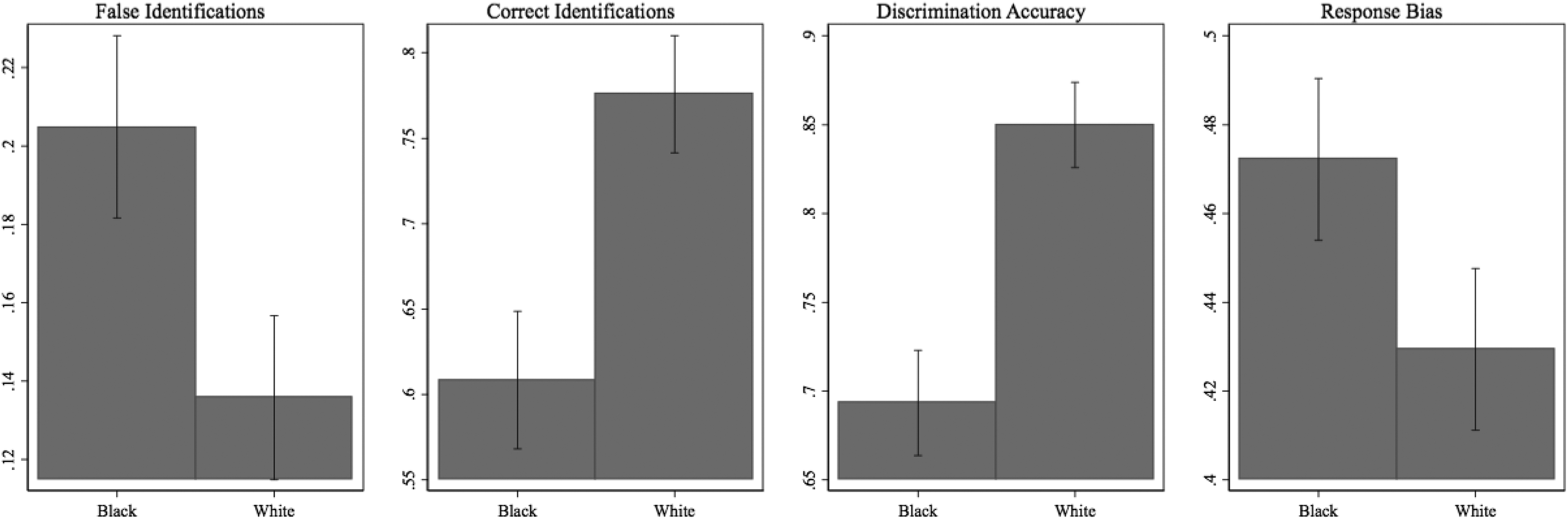
Mean judgment accuracy and response bias separated by race. Error bars represent 95% confidence intervals in Study 1.
Paired Sample Tests for Judgment Accuracy, Between Target Race, Study 1.
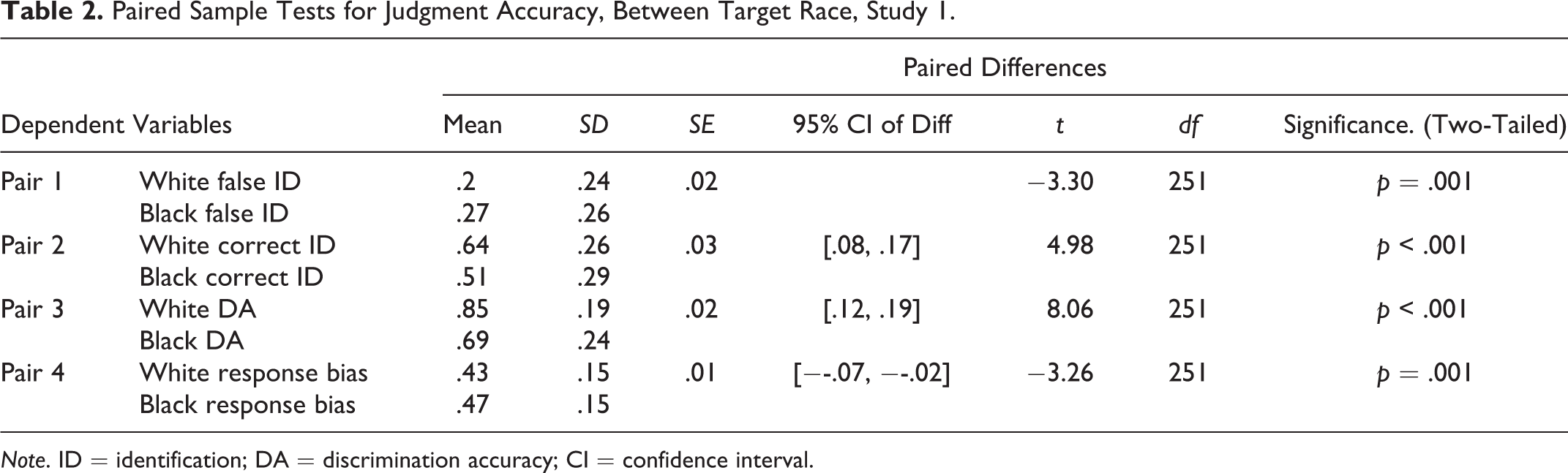
Note. ID = identification; DA = discrimination accuracy; CI = confidence interval.
Judgment Accuracy: Individual Differences
Figure 2 represents an unstandardized coefficients plot for the estimated effect of each individual difference in each dependent variable, obtained from separate regression models, with 95% confidence intervals (CIs), separated by target race (tables 3–10 of Online Appendix A).
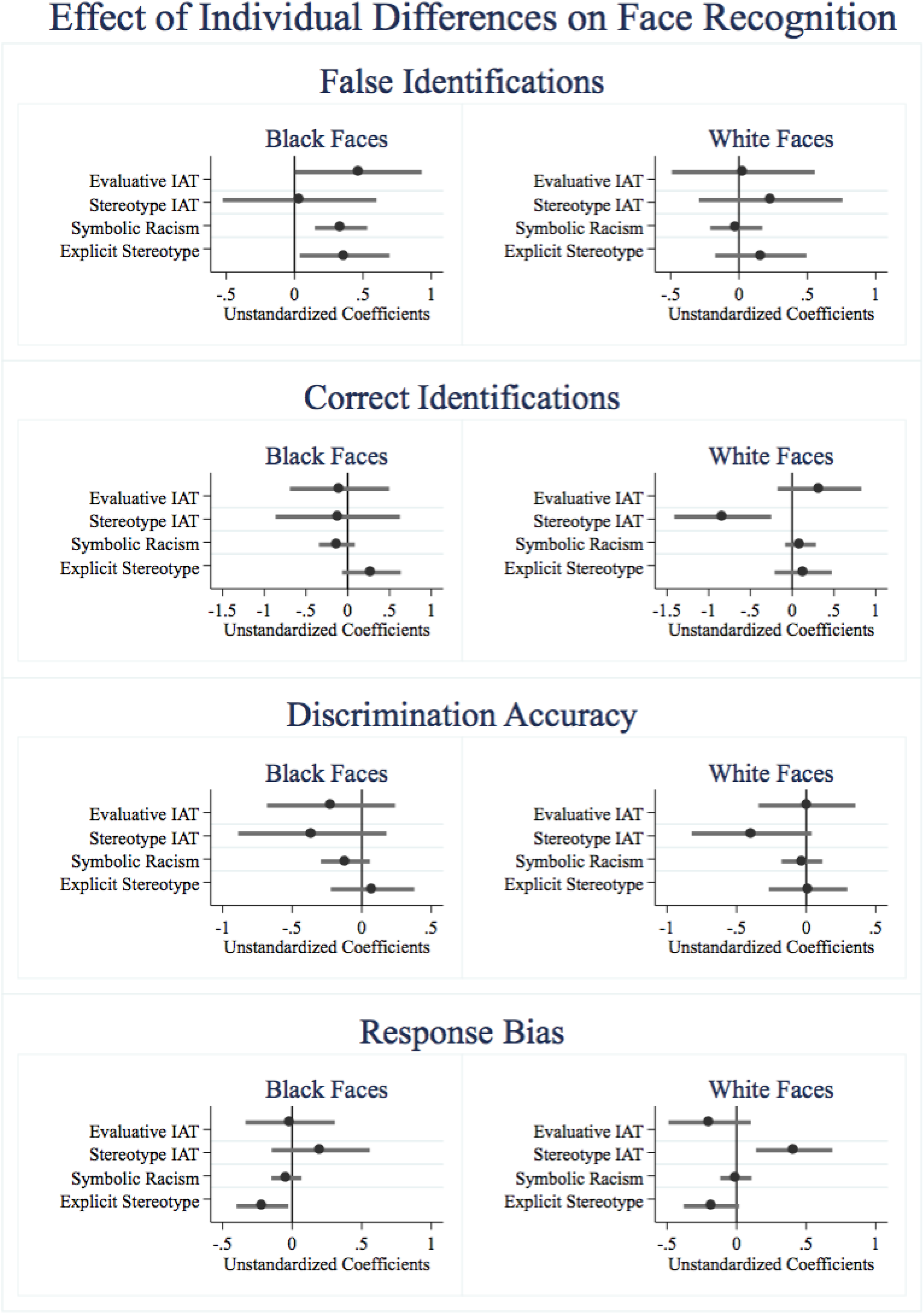
Estimated relationship between individual differences and judgment accuracy and response bias separated by target race, Study 1.
Black faces
Individual differences in racial attitudes increased false identification of Black faces; evaluative IAT, t(126) = 2.00, p = .048, b = .12, 95% CI for b[.001, .23], Cohen’s d = .35; symbolic racism t(250) = 3.50, p = .001, b = .34, 95% CI for b[.15, .53], Cohen’s d = .46; and explicit endorsement of Black (vs. White) stereotypes, t(248) = 2.20, p = .029, b = .37, 95% CI for b[.04, .69], Cohen’s d = .29 increased Black false alarms.
Importantly, the effects of racial attitudes on the observed increase in Black false alarms cannot be accounted for by response bias—neither the evaluative IAT, stereotype IAT, nor symbolic racism covaried with response bias for Black faces. However, explicit Black (vs. White) stereotype endorsement was associated with a more conservative response bias for Black faces, t(248) = −2.26, p = .025, b = −.21, 95% CI for b[−.40, −.03], Cohen’s d = .29.
White faces
We did not observe significant effects on false alarms, target identifications, discrimination accuracy, or response bias for White faces (ps > .05), with one exception; implicit stereotypes that more strongly associated White-crime than Black-crime led to an increase in White target identification, t(120) = −2.83, p = .005, b = −.83, 95% CI for b[−1.41, −0.25], Cohen’s d = .51, and a conservative response criterion, t(120) = 2.99, p = .003, b = .41, 95% CI for b[.14, .69], Cohen’s d = .45.
Judgment Accuracy: Crime-Prime Manipulation
Figure 3 presents the estimated marginal means for the effect of the crime-prime manipulation (tables 11 and 12 of Online Appendix A). Participants in the crime-prime (vs. control) condition were significantly more likely to falsely identify a Black face, t(250) = 2.35, p = .019, b = .08, 95% CI for b[.01, .14], Cohen’s d = .30. This translated into a nonsignificant reduction in Black discrimination accuracy, t(250) = −1.82, p = .07, b = −.54, 95% CI for b[−1.13, 0.05], Cohen’s d = .23. No effects of experimental condition were observed on correct identification, discrimination accuracy, or response bias for White faces (ps > .05).
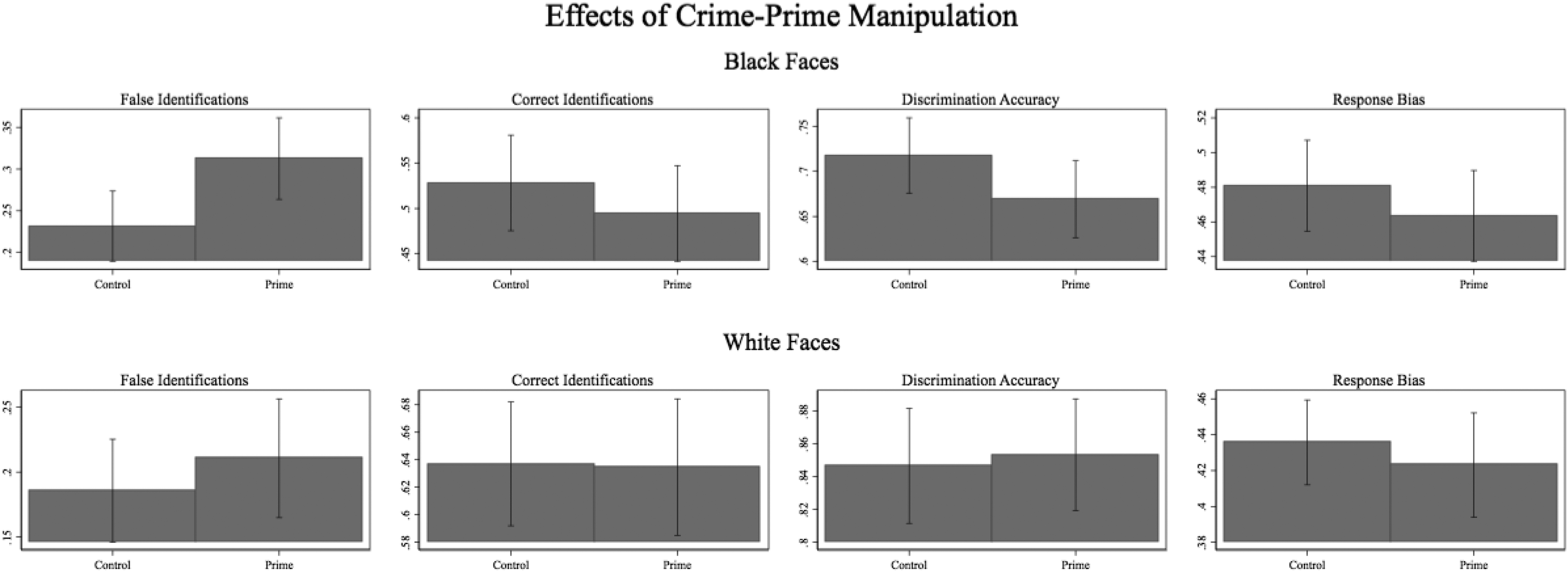
Estimated marginal means of judgment accuracy as a function of manipulated unconscious stereotypes about race and crime separated by target race.
Study 2
The results of Study 1 indicate that individual differences in implicit and explicit racial attitudes, as well as nonconscious activation of category-based stereotypes for OR faces (i.e., crime), increased false identification of Black faces in a simultaneous presentation format. Given concerns about replicability in psychology (e.g., Open Science Collaboration, 2015) and the failure of preexisting investigations to observe this relationship in sequential presentation formats (e.g., Appleby, Vitriol, & Borgida, 2014), we sought to replicate these effects on an independent sample. In Study 2, we recruited a large sample of adults from Amazon’s Mechanical Turk (MTurk) platform. MTurk samples are more diverse than typical samples of university students and more representative than typical Internet samples (Berinsky, Huber, & Lenz, 2012; Buhrmester, Kwang, & Gosling, 2011; Mason & Suri, 2012). Study 2 is a partial replication of Study 1 on a large and independent, nonstudent sample. Because online studies lack the experimental control needed to implement the nonconscious-priming manipulation, we focus only on the effects of individual difference variables.
Procedure and Measures
Data collection occurred at 2 times, separated by no less than 2 days and no more than a week (mean number of days = 3.57, SD = 2.55). There was no between-subject manipulation for Study 2. At T1, participants completed the same measure of explicit racial attitudes, explicit racial stereotypes, implicit racial attitudes (evaluative IAT), and demographic variables as for Study 1. Implicit measures of racial stereotypes were not administered in Study 2. At T2, participants completed an online memory test hosted by Inquisit Web Version 4.0 software. The same experimental procedure, stimuli, and lineups were used as in Study 1. However, unlike in Study 1, the presentation time for target photos during encoding were held constant at 5 s. Judgment accuracy and response bias were computed the same way as for Study 1 (Table 3), and variables were again recoded to run from 0 to 1 for easier comparison and estimation of effect sizes. All measures and manipulations are fully reported for Study 2.
Correlations Between All Continuous Variables Used in Analyses for Study 2.
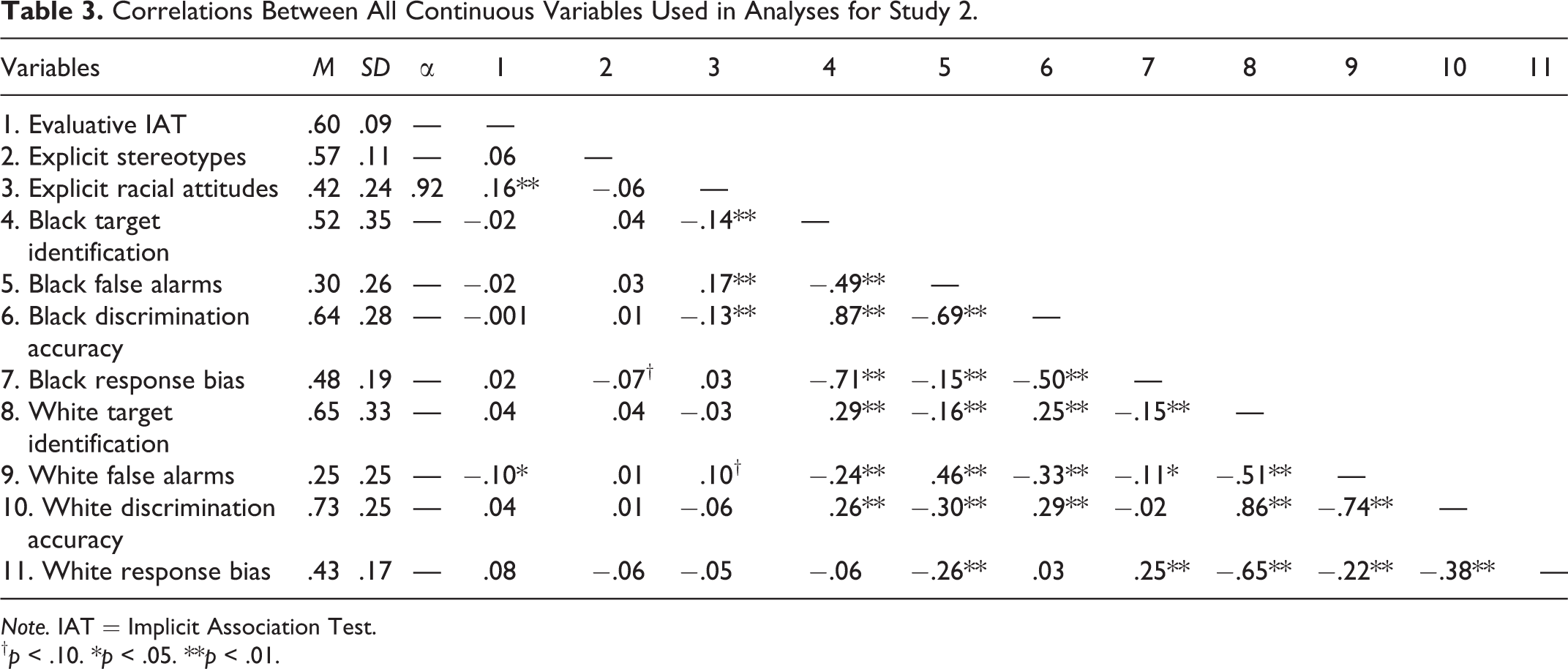
Note. IAT = Implicit Association Test.
†p < .10. *p < .05. **p < .01.
Participants
Participants were recruited from MTurk. Only respondents who described themselves as Caucasian were included in subsequent analyses, leaving 540 participants at T1 who were eligible for T2 (365 female, 172 male; age: M = 39.26, SD = 13.56) and excluding 120. Of these participants, 140 (25.93%) did not complete both parts of the study, leaving a final sample of 400 participants (272 female, 127 male; age: M = 40.16, SD = 13.54). With this sample size of White participants retained for both sessions (N = 400), we estimated that we had 88% power to detect a small effect size (Cohen’s d = .2) and >99% power to detect a moderate effect size (Cohen’s d = .5) or larger in regression analyses examining the bivariate relationship between a single predictor and dependent variable.
Results
Analyses for Study 2 were conducted following the same approach as in Study 1.
CRE
We again obtain clear evidence for a significant CRE on judgment accuracy and response bias, such that participants were more accurate and employed a more conservative response criterion for SR (vs. OR) faces (see Figure 4 and Table 4).
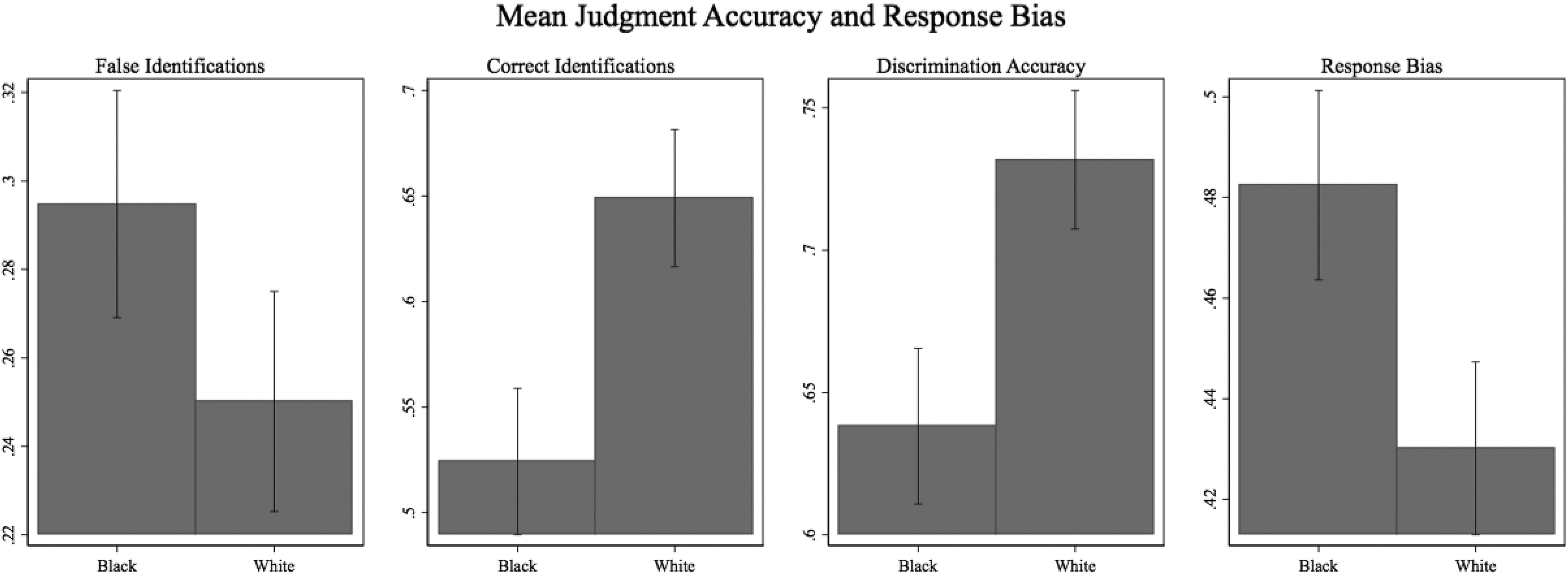
Mean judgment accuracy and response bias separated by race. Error bars represent 95% confidence intervals in Study 2.
Paired Sample Tests for Judgment Accuracy, Between Target Race, Study 2.
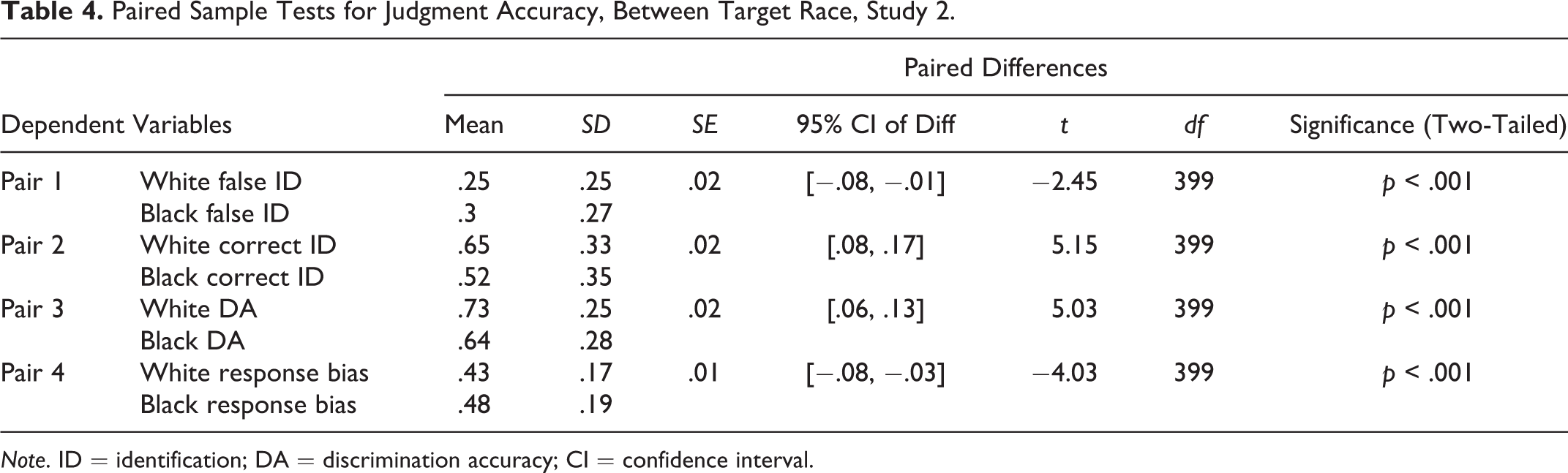
Note. ID = identification; DA = discrimination accuracy; CI = confidence interval.
Judgment Accuracy: Individual Differences
Figure 5 represents an unstandardized coefficients plot for the estimated effect of each individual difference in each dependent variable, obtained from separate regression models, with 95% CIs, separated by target race (tables 15–18 of Online Appendix A).
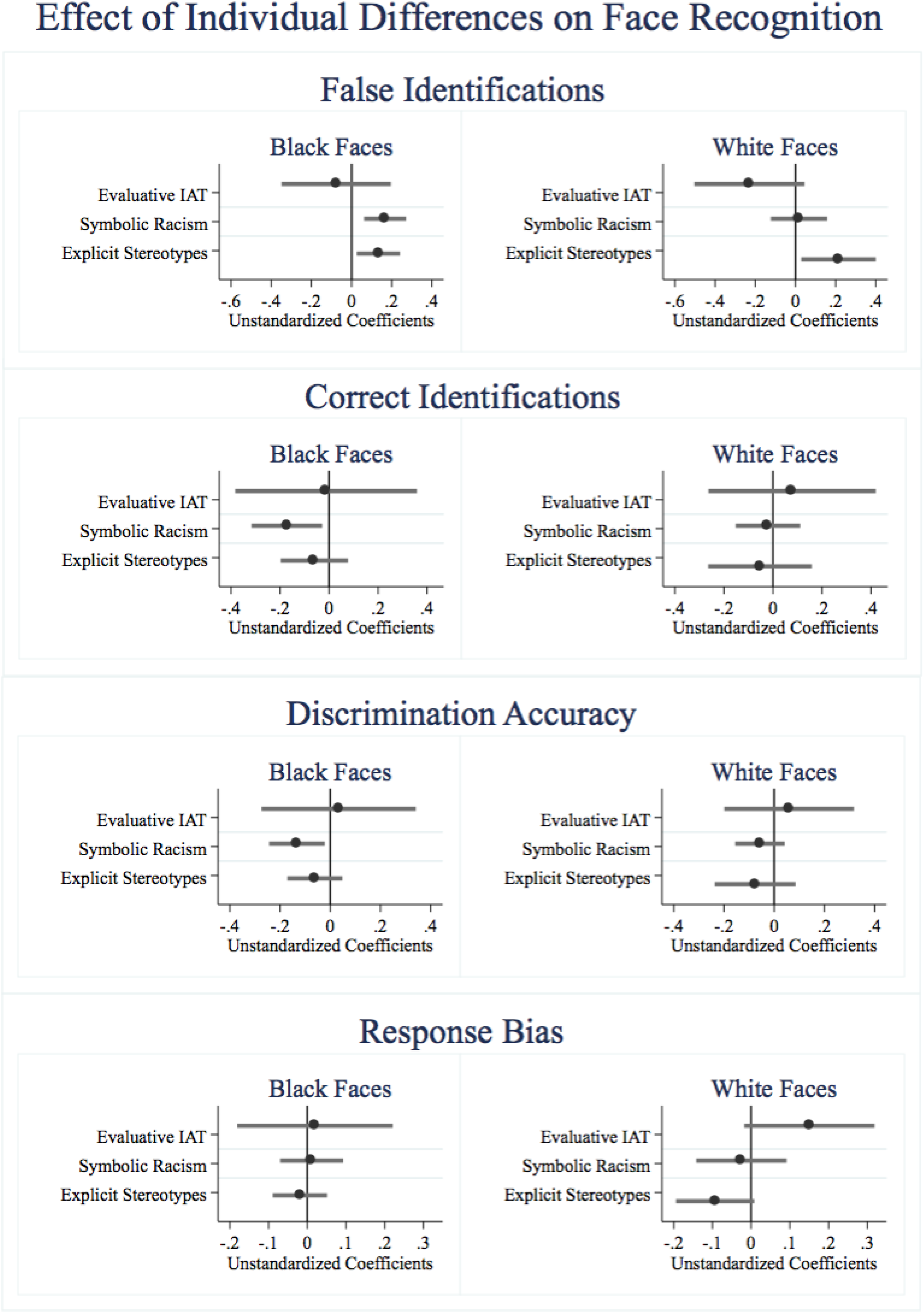
Estimated relationship between individual differences and judgment accuracy and response bias separated by target race, Study 2.
We find consistent evidence that explicit racial attitudes influenced judgments of Black faces. In particular, symbolic racism was associated with a significant increase in Black false alarms, t(397) = 3.53, p < .001, b = .18, 95% CI for b[.08, .28], Cohen’s d = .35, and decrease in target identification, t(397) = −3.00, p = .003, b = −.21, 95% CI for b[−.35, −.07], Cohen’s d = .29, and discrimination accuracy, t(397) = −2.84, p = .005, b = −.15, 95% CI for b[−.26, −.05], Cohen’s d = .26. Symbolic racism was not significantly related to response bias for Black faces (ps > .05).
Finally, and unlike Study 1, we did not observe any effect of the evaluative IAT or explicit stereotypes on judgments of Black faces, and none of our individual difference variables were associated with judgments of White faces (ps > .05).
Discussion
Extant research has failed to link the CRE to racial bias, but the efforts to date have largely been limited to outdated explicit measures and sequential presentation formats. Using a simultaneous lineup task, we recruited two independent samples of White Americans to investigate whether the CRE is (1) related to both explicit and implicit racial attitudes and stereotypes and (2) sensitive to nonconscious priming of crime-related images. Our results reveal a systematic relationship between multiple individual difference measures of racial bias and increased false identification of Black faces. In particular, we observe consistent and reliable evidence across both samples to suggest that explicit racial attitudes undermine judgment accuracy for Black faces, a finding that cannot be accounted for by shifts in response bias. However, we observe inconsistent evidence to suggest that individual differences in implicit racial attitudes impact recognition memory for Black faces. Nevertheless, in Study 1, we find that implicit activation of concepts related to crime prior to encoding facial targets impairs White perceivers’ accuracy in identifying Black faces. Priming crime concepts did not affect White perceivers’ judgments of White faces. Thus, across multiple indicators, our results support the conclusion that, among Whites, racial bias, as a function of both individual differences and contextual cues, can increase the false identification of Black faces in simultaneous presentation formats.
The current research addresses the failure of prior research to identify a link between intergroup attitudes and face recognition by focusing on sequential presentation formats. Prevailing perspectives on the psychological underpinning of the CRE emphasizes the role of motivation and experience for the individuation of target faces, both of which improves recognition memory (Hugenberg et al., 2010). Negative intergroup attitudes may reflect the cumulative history of automatic categorization of OR faces and should therefore relate to the CRE for novel stimuli. The deleterious effects of categorization on recognition memory for OR faces can also emerge from nonconscious racial biases. While our results are consistent with these perspectives on the psychological underpinnings of the CRE, additional research should more directly explore the impact of racial bias on differential categorization of OR (vs. SR) faces. Regardless, our findings add to a large literature documenting the discriminatory effect of racial bias (e.g., Jost et al., 2009), particularly in regard to racial disparities with legal implications.
These effects extend beyond individual differences. Nonconscious activation of category-based stereotypes for OR faces (i.e., crime; Eberhardt, Goff, Purdie, & Davies, 2004) undermined recognition memory. Because there is no strong stereotypical connection between Whites and crime, we did not expect nor find an analogous effect on SR faces. Situational cues that activate group-based stereotypes—as may be common to crimes and face-recognition contexts (i.e., the presence of a weapon)—may be sufficient to produce cross-racial differences in judgment accuracy by increasing the false identification of OR faces. Future research should explore how different kinds of intergroup attitudes can impact recognition memory across different social groups, but we expect that the activation of any group-based stereotype will undermine recognition memory for stereotyped targets.
It is important to note that prior research has found that threatening facial stimuli can increase attention allocation and recognition memory for both SR and OR targets (e.g., Ackerman et al., 2006). We recognize that the activation of crime-related stereotypes may increase perceived threat of target faces. However, our pattern of evidence is more consistent with the expectation that crime-related stereotypes would increase categorization of stereotyped target groups, not increase perceived threat of facial stimuli. Furthermore, unlike prior research, we used an established experimental paradigm to directly activate group-based stereotypes prior to and independent of the presentation of standardized, expression-neutral facial stimuli. While the particular stereotype manipulated in Study 1 may be associated with threat-based perceptions, it is possible that increased threat prior to the presentation of facial stimuli does not impact face recognition. Alternatively, and perhaps more likely, the activation of group-based stereotypes in the present research was sufficient to overwhelm whatever memorial gains might have been associated with threat-based processing. Future research should seek to replicate these findings and extend our observations by independently manipulating threat and activating threatening stereotypes about target groups to better understand this dynamic.
While we find strong and consistent evidence to suggest that explicit racial attitudes influenced OR judgments, unlike prior work utilizing sequential formats, in Study 2, we did not replicate our findings from Study 1 that individual differences in implicit attitudes contributes to the CRE. These findings serve as a reminder that the linkages between implicit processes and behavior are probably more complex and subtle than scholars commonly assume (see Gawronski & Bodenhausen, 2011; Greenwald, Banaji, & Nosek, 2015; Oswald, Mitchell, Blanton, Jaccard, & Tetlock, 2013) and are perhaps context dependent and short lived (Forscher et al., 2017). The relationship between implicit processes and face recognition is likely no exception.
However, contextual cues about crime reduced judgment accuracy for Black targets in Study 1, likely by activating and increasing the salience of pervasive cultural associations between racial minorities and criminal behavior prior to target encoding. If the linkages between implicit processes and OR face recognition are context-specific, we expect to observe stronger evidence for the impact of individual differences in implicit attitudes on OR face recognition when these attitudes are assessed in the context in which memory was also encoded. In Studies 1 and 2, we assessed these attitudes up to a week prior to the memory paradigm, raising the possibility that the inconsistency in our findings may be due the possibility that the effect of implicit attitudes on face recognition are not the product of stable individual differences, but rather context-specific mechanisms that increase categorization processes prior to the encoding of target faces. Future research should investigate this possibility by replicating our priming paradigm and measuring implicit attitudes in close proximity to memory encoding in order to advance our understanding of the conditions under which, individuals for whom, and mechanisms by which implicit bias can impact face recognition.
Still, that explicit racial attitudes increased the rate of false identification and undermined recognition accuracy of Black faces in simultaneous presentation formats represents a novel contribution to our scientific understanding of the psychological underpinning of face recognition, person perception phenomena, and eyewitness memory. We are the first to demonstrate this relationship. These findings add to a robust literature documenting the liabilities associated with simultaneous presentation formats in eyewitness evidence (Steblay et al., 2011). Because sequential, but not simultaneous, presentation forces individuals to compare stimuli directly to their memory, such a procedure may help to reduce the undesirable effects of racial attitudes on false identification of OR faces. For example, research utilizing a large sample of adults (n = 697) indicates that the impact of racial attitudes on the CRE may be null in sequential presentation formats (Appleby et al., 2014). These results are suggestive of the potential for sequential presentation to reduce the impact of racial bias on the CRE. Future work should explore these processes in sequential presentation formats as well as the extent to which activating OR target stereotypes prior to encoding can influence recognition memory in these contexts.
Supplemental Material
Supplemental Material, SPPS784889_suppl_mat - Racial Bias Increases False Identification of Black Suspects in Simultaneous Lineups
Supplemental Material, SPPS784889_suppl_mat for Racial Bias Increases False Identification of Black Suspects in Simultaneous Lineups by Joseph A. Vitriol, Jacob Appleby and Eugene Borgida in Social Psychological and Personality Science
Footnotes
Acknowledgments
The authors would like to thank Kyle Kurowski for his role in the initial study concept; Thomas Lindsey, Andrew Sell, Pernu Menheer, and Alica Hofelich Mohr for software design; SPSSI for supporting this research program; Christian Meissner (Iowa State) and Matthew Palmer (University of Tasmania) for statistical advise; Whitney Thurman for standardizing the photos; and our RAs Colin Farley, Michael Swenson, Jamie White, Chelsea Wahl, Harold Melcher, Hami Lee, and Hayden Lim Joon.
Author Contributions
J. A. Vitriol led the project and, with E. Borgida, developed the study concept. All authors contributed to study design. J. A. Vitriol and J. Appleby performed pilot testing of stimuli, software development and testing, and data collection. J. A. Vitriol and J. Appleby performed data analysis and interpretation, with E. Borgida, providing supervision and feedback. J. A. Vitriol and J. Appleby drafted the manuscript, and E. Borgida provided critical revisions. All authors approved of the final version of the article for submission.
Declaration of Conflicting Interests
The author(s) declared no potential conflicts of interest with respect to the research, authorship, and/or publication of this article.
Funding
The author(s) disclosed receipt of the following financial support for the research, authorship, and/or publication of this article: Society for the Psychological Study of Social Issues, Research Grant-in-Aid.

Supplemental Material
The supplemental material is available in the online version of the article.
Note
References
Supplementary Material
Please find the following supplemental material available below.
For Open Access articles published under a Creative Commons License, all supplemental material carries the same license as the article it is associated with.
For non-Open Access articles published, all supplemental material carries a non-exclusive license, and permission requests for re-use of supplemental material or any part of supplemental material shall be sent directly to the copyright owner as specified in the copyright notice associated with the article.
