







Abstract
Despite the public outrage in response to police violence against unarmed Black men, work on the psychological dynamics of reactions to these incidents is relatively rare. The present research examined whether empathy for a Black male victim of White police interracial violence would vary as a function of victim stereotypicality (stereotypic/counterstereotypic) and Black participant racial identity. In Study 1, 140 Black participants were recruited from Amazon Mechanical Turk (MTurk). As hypothesized, Black participants low in racial identification reported less empathy for the stereotypical relative to the counterstereotypical victim. Those high in racial identification showed relatively high levels of empathy regardless of the characteristics of the Black victim. Study 2 replicated these effects with 263 Black MTurk participants. This research highlights the value of considering individual differences in the Black observers (racial identification) and the characteristics of Black victims to better understand the psychological processes involved in intragroup responses to police violence.
Incidents of White police officer violence toward unarmed Black men have received significant national and international attention (United Nations Committee on the Elimination of Racial Discrimination, 2007), and much of the research on this topic has explored factors that influence the occurrence of such White police interracial violence. For example, police officers are more likely to select Black faces than White faces when asked, “Who looks criminal?” (Eberhardt, Goff, Purdie, & Davies, 2004) and in simulations to erroneously “shoot” an unarmed Black than White man (“shooter bias”; Correll, Park, Judd, & Wittenbrink, 2002; Plant & Peruche, 2005). However, despite the public outrage in response to incidents of police violence against Blacks, work on the psychological dynamics of reactions to these incidents is relatively rare. The present research, consisting of two experiments, investigated the response of Black participants toward a Black male victim of White police interracial violence as a function of victim stereotypicality and Black participant racial identity. We focused on empathy across our two studies because it is a key motivating factor in terms of active responses to victims (Batson, 2016).
There are at least two limitations to the extant research. First, there has been minimal exploration of societal responses to White police interracial violence. Indeed, Culhane, Bowman, and Schweitzer (2016) contend that “the public’s perception of controversial criminal actions and legal responses is a major factor in cases, as public pressure and media coverage put a tremendous amount of stress and pressure on legal actors” (p. 253). Not surprisingly, there is evidence that Black Americans have been most likely to respond (i.e., protest and call for legal remedies) to such violence (Murray, 2014; Nazaryan, 2017). Consequently, it is important to explore the factors that might influence their responses to the suffering of a Black victim of police violence.
Second, civil rights advocates have strongly emphasized that greater attention should be devoted to facilitating empathic responding toward Black victims of White police violence (Obeidallah, 2013; Rasheed, 2016). An examination of emotion-related responding toward Black victims of police violence is relevant because of the evidence that empathy for suffering minorities is positively associated with support for government policy that assists these individuals (J. D. Johnson, Olivo, Gibson, Reed, & Ashburn-Nardo, 2009). In addition, empathy toward the victim is linked to the endorsement of greater punitive responding toward their harm doer (Deitz, Blackwell, Daley, & Bentley, 1982; Deitz & Byrnes, 1981).
A focus on Black intragroup emotional responding is especially significant because Black Americans, due to their shared history of oppression in the United States, report particularly high levels of empathy toward suffering members of their racial in-group (Brown, Bradley, & Lang, 2006; Roberts & Levenson, 2006). Such empathy can be facilitated when another Black person is portrayed as being more closely affiliated with his or her racial group (having more Black friends in their social network; J. D. Johnson & Ashburn-Nardo, 2014) or experiencing group-based disadvantage to a greater degree (being less wealthy; J. D. Johnson & Kaiser, 2013). However, it is also possible that emphasizing particular, context-related aspects of Black stereotypes could inhibit Black observers from experiencing empathy for a Black victim. In the present research, we examined whether, despite Black Americans’ recognition of the extensive historical and contemporary discriminatory treatment from American law enforcement agencies toward Black men and women (Maguire & Pastore, 2004; Nazaryan, 2017; Pastore & Maguire, 2007; Walker, Spohn, & DeLone, 2012), portraying a Black person in a stereotypical (vs. counterstereotypical) manner may lead Black participants to have less empathy for a Black victim of police violence. Like White Americans, Black Americans experience significant “stereotype-related” socialization and cultural experiences regarding Black people in America. As a consequence, many Black individuals readily activate negative stereotypical beliefs about their racial group, including characterizations of Blacks as violent and criminal (Duncan, 1979; J. Johnson, Trawalter, & Dovidio, 2000; Sagar & Schofield, 1980).
Although people may not directly endorse beliefs that Blacks are violent or criminal, making other aspects of a Black person’s stereotypicality (e.g., liking rap music and basketball) salient can activate these qualities and facilitate attributions of these qualities toward a Black target not only for White observers (J. D. Johnson, Bushman, & Dovidio, 2008) but also for Black individuals (J. Johnson et al., 2000). Thus, Blacks who learn of a Black victim of a police shooting may experience less empathy when the victim is portrayed in stereotypical ways, even when these characteristics do not involve criminality or violence, than when the person is described in counterstereotypical ways (e.g., liking classical music and golf).
The present research also investigated how individual differences, specifically in terms of racial identity, can moderate the effects of target stereotypicality on Blacks’ empathy for a Black victim of a police shooting. Such moderation should occur because Black racial identity serves as an influential filter for interpreting race-based information and interracial encounters (Carter, 2007; Helms, 2001). For example, high racially identified Blacks are more likely than low-identified Blacks to report “expectations” that Whites are likely to engage in discriminatory and racist behavior toward Blacks (Lecci & Johnson, 2008) and are less likely to endorse system-justifying beliefs (O’Brien & Major, 2005), which legitimize status relations between Blacks and Whites in the United States (Jost, Gaucher, & Stern, 2015; Major, 1994; Major et al., 2002).
Importantly, O’Brien and Major (2005) found that endorsement of system-justifying beliefs among highly identified Blacks was negatively associated with psychological well-being. Conversely, for low identified Blacks, endorsement of such system-justifying beliefs was positively associated with their psychological well-being. Consequently, less identified Blacks would be likely to report greater empathy toward those suffering Blacks whose behaviors are more consistent with the ideology of the dominant system (i.e., counterstereotypical victims) and relatively low empathy for Blacks whose behaviors deviate from the dominant system ideology (i.e., stereotypical victims). This stereotypicality effect should be less pronounced among Blacks who are high in their personal identification with “Blackness” because they would likely experience relatively high empathy for members of their group, regardless of the individual qualities of the targeted racial group member.
Study 1
In Study 1, Black participants read an article, modeled after actual incidents, describing a White police officer’s shooting of an unarmed Black man. Participants saw, as part of the article, a photograph of the Black shooting victim; we did not vary the phenotypic characteristics (facial features) of the victim. However, we varied other characteristics to portray him with stereotypic or counterstereotypic qualities. In particular, the article contained a description of the victim that included characteristics stereotypically associated with Black Americans (e.g., likes to listen to rap music) or counterstereotypic of Black Americans (e.g., likes to listen to classical music). In the stereotypic condition, the man was dressed in a “hoody,” and in the counterstereotypic condition, he wore a shirt and tie. Participants then completed a measure of racial identity and reported their empathic responding toward the victim. The primary hypothesis was, for Black participants low in racial identity, those in the stereotypical condition would report less empathy for the victim than those in the counterstereotypical condition. However, for participants high in racial identity, we expected that this effect would be less pronounced.
Method
Participants
Sixty-one male and 79 female Black participants were recruited from Amazon Mechanical Turk (MTurk), a crowdsourcing website that typically results in more demographically diverse samples relative to college students (Buhrmester, Kwang, & Gosling, 2011). Participants responded to a study entitled “Decision Making.” All participants were U.S. residents aged 19–72 (M = 33.19, SD = 9.92). In order to take part in the study, participants had to indicate that they were Black in the demographic questions (White participants were directed to another study with different variables) and to have a reputation score of .90 or greater in order to ensure the quality of the data (Chandler & Shapiro, 2016; Peer, Vosgerau, & Acquisti, 2014). Participants also responded correctly to at least one of three attention checks (e.g., “If you are reading this item, respond with “strongly agree”). All 140 Black participants recruited for the study met these criteria and were included in the analyses. Participants were compensated with 75 cents and took approximately 12 min to complete the survey.
Procedure
Participants read that the American court system involves “interesting and complicated” legal matters on a daily basis and were informed that the researchers were interested in their perceptions of “legal encounters.” Participants then learned that they would be reading about a legal case “randomly chosen” from a Washington DC newspaper. The scenario was modeled after actual incidents in which a White police officer shot an unarmed Black man multiple times, and the Black man survived to later provide testimony against the officer (see https://www.nydailynews.com/new-york/cops-shoot-wound-man-arm-brooklyn-article-1.2845760 and https://filmingcops.com/cop-shoots-child-three-times-running-away-lawsuit/). The scenario we used described an incident that began as a traffic stop in which a White police officer pulls over a Black male for going 3 miles over the speed limit in an affluent neighborhood. When asked for his identification, the motorist dropped his hands and moved toward the glove compartment. The officer then shot the motorist 3 times in the chest. The officer reported feeling threatened because he feared that the motorist may have been reaching for a gun. The motorist, after receiving medical care, stated that he was simply complying with the police officer’s commands, as the glove compartment only contained his identification.
Participants were randomly assigned to one of the two conditions (70 participants each) regarding the stereotypicality of the victim. They were informed that they would be given “more information about the case” so that they could make more informed judgments. In the stereotypical condition, participants read ostensible “Facebook information” that included a photograph of the Black motorist named Joshua Reynolds wearing a hoody and his “likes” included “listening to rap music, playing basketball…keeping it real.” In the counterstereotypical condition, participants were shown the same individual wearing a collared shirt and tie (see Supplemental Material for images) and his likes included “listening to classical music, modern opera, art galleries,…playing golf.” All participants were exposed to the same picture of the White police officer.
The stereotypical and counterstereotypical images and descriptions have been used in research (J. D. Johnson & Lecci, 2019) and were previously validated by 81 independent raters (none of whom were involved in this research). These participants rated the stereotypical victim as having significantly more characteristics that are consistent with “the common Black stereotype in America” relative to the counterstereotypical victim.
Central Measures
After reading the scenario, racial identity was assessed by combining 8 items from the Importance and Private subscales of the Collective Self-Esteem Scale (Luhtanen & Crocker, 1992) with reference to their racial identity (e.g., The racial/ethnic group I belong to is an important reflection of who I am). The response scale ranged from 1 (strongly disagree) to 7 (strongly agree) and demonstrated good internal reliability (Cronbach’s α = .81). These subscales have been employed as a measure of minority racial identification in previous research (e.g., Constantine, Donnelly, & Myers, 2002; Verkuyten & Lay, 1998).
Then a series of items measured empathic responding to the victim and other perceptions of the incident. Empathic feelings were assessed by averaging responses (α = .93) to items assessing five emotions (compassion, moved, soft-hearted, warmth, and sympathy) toward the gunshot victim (see Batson, 2016) on 7-point (1—very little to 7—very much) rating scales.
Additional Measures
Although the central outcome variable for the current study was victim-directed empathy, other victim-related measures were included for exploratory purposes (with no particular hierarchy of importance). These measures, to which participants responded using a 1—not certain at all to 7—very very certain scale, included (a) their certainty that the victim was responsible for the incident and (b) perception that the victim was an “actual threat” to the police officer. Participants also reported, from 1—not traumatic at all to 7—very traumatic, their perception of the degree of trauma that the victim endured from the shooting. Analyses for these measures are provided in the Supplemental Materials. There were also victim-unrelated measures that were beyond the scope of the current study. These measures were perceived officer racism, perceived appropriate punitive responding (i.e., indictment, serving time in jail) toward the officer, and empathic responding toward the officer.
Statistical Analysis Plan
Because racial identification is a continuous variable, PROCESS Model 1 was run (Hayes, 2013) to determine the significance of the interaction. PROCESS is a software application that executes path analysis–based moderation and mediation analysis using ordinary least squares (OLS) regression. Racial identity scores were centered at their mean (Aiken & West, 1991). To indicate effect sizes, β is reported for regressions and η2 for comparisons between experimental conditions.
To probe the expected interaction in the stereotypical condition, the Omnibus Groups Regions of Significance (OGRS, Hayes & Montoya, 2017; Montoya, 2016) Macro was employed. OGRS probes the effect of X on Y using an approximation of the Johnson–Neyman procedure. The macro produces a table of the lowest to highest values of the continuous variable (centered racial identity scores) and F ratios for the effect of the dichotomous variable (victim stereotypicality) at each of those values with the corresponding R 2 and p values. This approach produces a robust and fairly accurate algorithm with maximum error estimates under 0.5% (Montoya, 2016).
Power Analysis
For the main effect of victim stereotypicality with the achieved sample size (70 participants per condition) and an estimated medium effect size (Cohen’s d = .48), the power would be .81, when α = .05 with a two-tailed test of significance. For the individual difference variable of racial identity, the average effect size is d = .44 when predicting other attitudes (see the Internalization subscale; Franklin-Jackson & Carter, 2007) resulting in an estimated power of .73. For the predicted interaction with a small to medium effect size (d = .38), the estimated power would be .61. A recent meta-analysis suggests that the average effect size for racial identity may vary as a function of participant race, with Blacks generally having larger effect sizes (in this case when examining racial identity and achievement; Miller-Cotto & Byrnes, 2016). Thus, it is possible that the actual power for both the main effect of racial identity and the interaction involving racial identity could be larger than the above-noted values if the effects are in fact larger for Blacks.
Results and Discussion
The stereotypicality manipulation (stereotypical vs. counterstereotypical victim) did not affect participants’ level of racial identification, t(138) = 1.34, p = .182, η2 = .013. Thus, it can be concluded that the measured individual difference variable of participant racial identification (i.e., moderator variable) was independent of the experimentally manipulated victim stereotypicality.
The primary analysis tested the effects of victim stereotypicality (stereotypical vs. counterstereotypical), participant racial identity (a continuous predictor), and the victim stereotypicality × participant racial identity interaction on empathy for the victim. Overall, participants reported less empathy for the stereotypical victim (M = 5.27, SD = 1.41) than for the counterstereotypical victim (M = 6.11, SD = .95), t(138) = 4.12, p < .001, η2 = .11. 1 In addition, there was a direct effect for participant racial identification, B = .36, SE = .09, β = .33, p < .001. Participants higher in racial identification reported more empathy for the victim.
Consistent with the central hypothesis, a PROCESS Model 1 analysis revealed the racial identity × victim stereotypicality interaction for victim empathy, illustrated in Figure 1, was significant, R 2 Change = .027, F(1, 136) = 4.78, p = .03, B = .18, 95% CI [.018, .35]. 2 As expected, the impact of victim stereotypicality (i.e., less empathy for the stereotypical victim) was limited to those low in racial identification. Regions of significance, based on the OGRS analyses, are noted in the Figure caption. 3
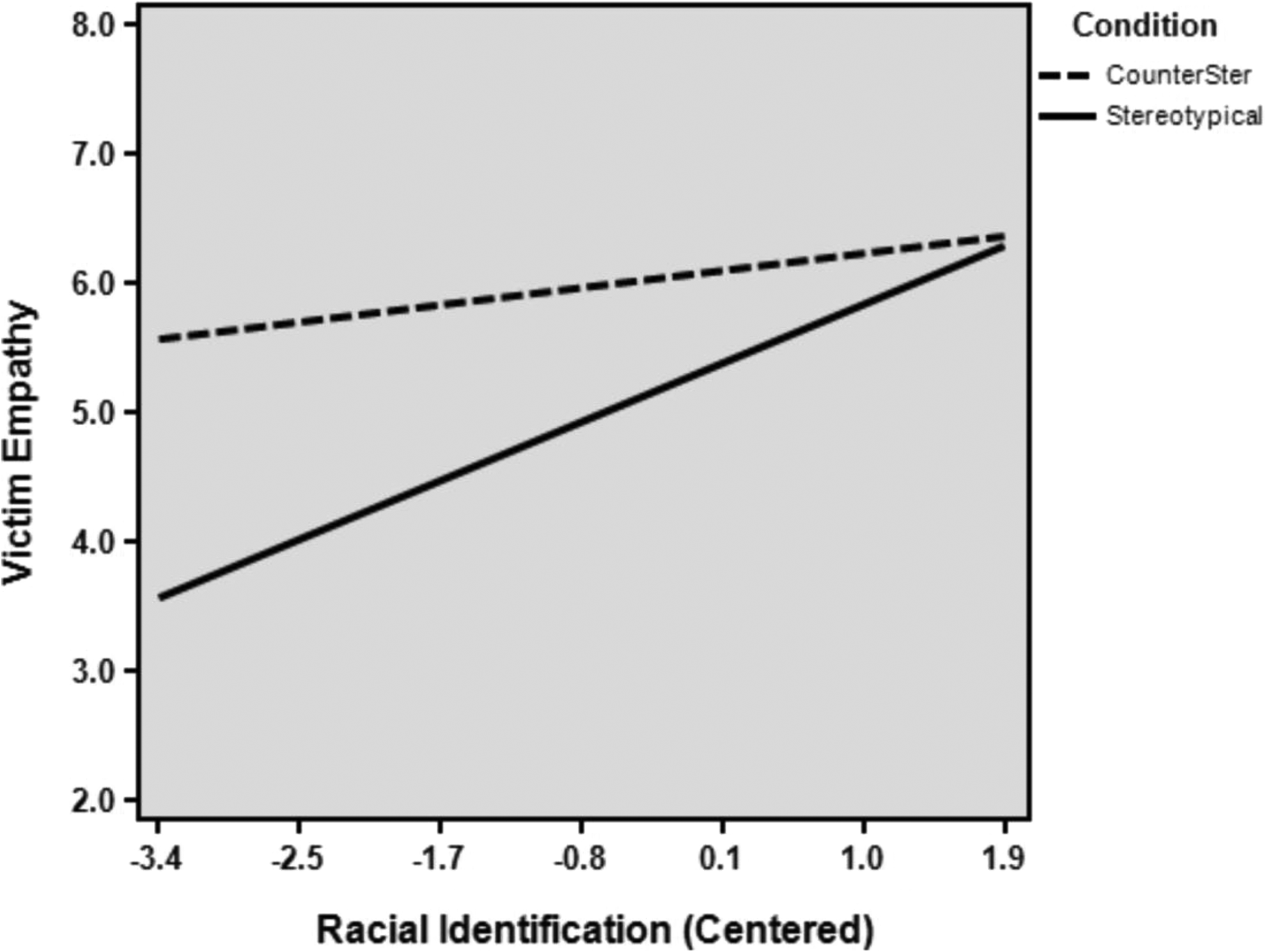
Study 1 victim empathy as a function of centered racial identification and victim stereotypicality. Greater values indicate greater empathy and racial identification. The Omnibus Groups Regions of Significance analysis demonstrated that at lower levels of racial identification (values of .78 and below), participants reported less empathy for the stereotypical victim relative to the counterstereotypical victim. However, at higher levels of racial identity (1.04 and above), there was no significant impact of victim stereotypicality on victim empathy.
The results of Study 1 revealed that when a Black male victim of police violence was described in stereotypical rather than counterstereotypical terms, Black participants had less empathy for him. Racial identification was also a significant predictor of empathic responding (i.e., positive association). With respect to our central hypothesis, the impact of victim stereotypicality on intragroup empathic responding for a victim of White police violence was moderated by the extent that the participants were identified with their race. Specifically, Black participants low in racial identification had significantly less empathy for a stereotypical than a counterstereotypical Black victim. By contrast, participants high in racial identification displayed equivalent and relatively high levels of empathy (see Figure 1) for the Black victim of police violence across the two stereotypicality conditions. Study 2 was designed to replicate the stereotypicality × racial identification effect on empathy in a different sample.
Study 2
In Study 2, Black participants, varying in racial identification, read the same scenario involving a shooting of an unarmed Black victim by a White policeman used in Study 1. We again varied the stereotypicality of the victim (stereotypical or counterstereotypical). We again examined the effects of victim stereotypicality and participant racial identification on empathy.
Method
Participants and Procedure
There were 267 (162 men, 104 women, and 1 person who did not report their gender) Black participants, recruited from MTurk, in Study 2. Participants were U.S. residents aged 19–68 (M = 34.21, SD = 10.13). The general procedure, including how participants were selected, was identical to Study 1. Payment in Study 2 was increased to $1.50 in U.S currency to increase participation and statistical power. Of the 267 participants, 4 males from the stereotypical condition failed to complete the racial identification measure and were excluded from the analysis.
Central Measures
As in Study 1, racial identity was assessed using the Collective Self-Esteem Scale (Luhtanen & Crocker, 1992) with reference to their racial identity (α = .81). Empathic feelings toward the victim were assessed by averaging responses (α = .96) in a similar manner as Study 1.
Additional Measures
While the central outcome variable for the current study was victim-directed empathy, as in Study 1, other victim-related measures were included for exploration purposes (with no particular hierarchy of importance). The measures of perceived victim responsibility and perceived victim threat were identical to those in Study 1. They also answered other questions, on scales ranging from 1—very little to 7—very much, which assessed (a) perception of the degree of victim pain (i.e., an average of perceived emotional and physical pain) and (b) victim blame, which involved an assessment of perceptions that the victim should not have been in the neighborhood, their appearance provoked the officer, and any reasonable person would be threatened by the victim. There were also assessments of (a) dehumanization of the victim which averaged participant responses to items assessing the frequency with which they projected the Black victim engaging in five mental activities (see Gray, Gray, & Wegner, 2007), (b) victim-directed feelings as measured by a feeling thermometer, numerically labeled at 10 °C intervals from 0 °C (cold or unfavorable) to 99 °C (warm or favorable; Alwin, 1997; Lolliot et al., 2015), (c) valuing of the victim (i.e., caring about his welfare, liking him; see Batson, 1987, 1991), (d) support for victim financial compensation, which involved the extent that the participants agreed that the victim should be compensated, and (e) victim compensation amount which was the perceived appropriate amount of the compensation. Analyses for these measures are provided as Supplementary Material.
There were also victim-unrelated measures that were beyond the scope of the current study. These measures included perceived officer racism, perceived appropriate punitive responding (i.e., indictment, serving time in jail) toward the officer, empathic responding toward the officer, feelings toward the officer, officer-directed blame, feelings toward Black Americans in general, and feelings toward Black American men.
Power Analysis
Because Study 1 was underpowered especially for the interaction, a larger sample was recruited for Study 2, with a total of 267 participants (135 in the stereotypical condition and 132 counterstereotypical). With an estimated medium effect size (Cohen’s d = .48) for the effect of victim stereotypicality (condition), the calculated power would be .97, when α = .05 and with a two-tailed test of significance. For the individual difference variable of racial identity using an effect size of d = .44, the calculated power would be .95. For the hypothesized interaction with a small to medium effect size (d = .38), the power is estimated at .87.
Results
As in Study 1, the manipulation of victim stereotypicality did not affect racial identification, t(261) = −.10, p = .921, η2 = .00, our proposed moderator of the effect of stereotypicality on empathy.
In this study, there was no significant overall effect of victim stereotypicality on empathy, t(261)=1.12, p = .262, η2 = .00. There was, however, a direct effect for participant racial identification, B = .47, SE = .07, β = .38, p < .001. Participants higher in racial identification reported more empathy for the victim. The predicted racial identity × victim stereotypicality interaction (using PROCESS Model 1) on empathy was also significant, R 2 Change = .028, F(1, 259) = 8.92, p = .003, B = .41, 95% CI [.14,.69], representing a pattern similar to that in Study 1 (see Figure 2). As indicated by the regions of significance in the caption of Figure 2, the impact of victim stereotypicality (i.e., less empathy for the stereotypical victim) was limited to those low in racial identification.
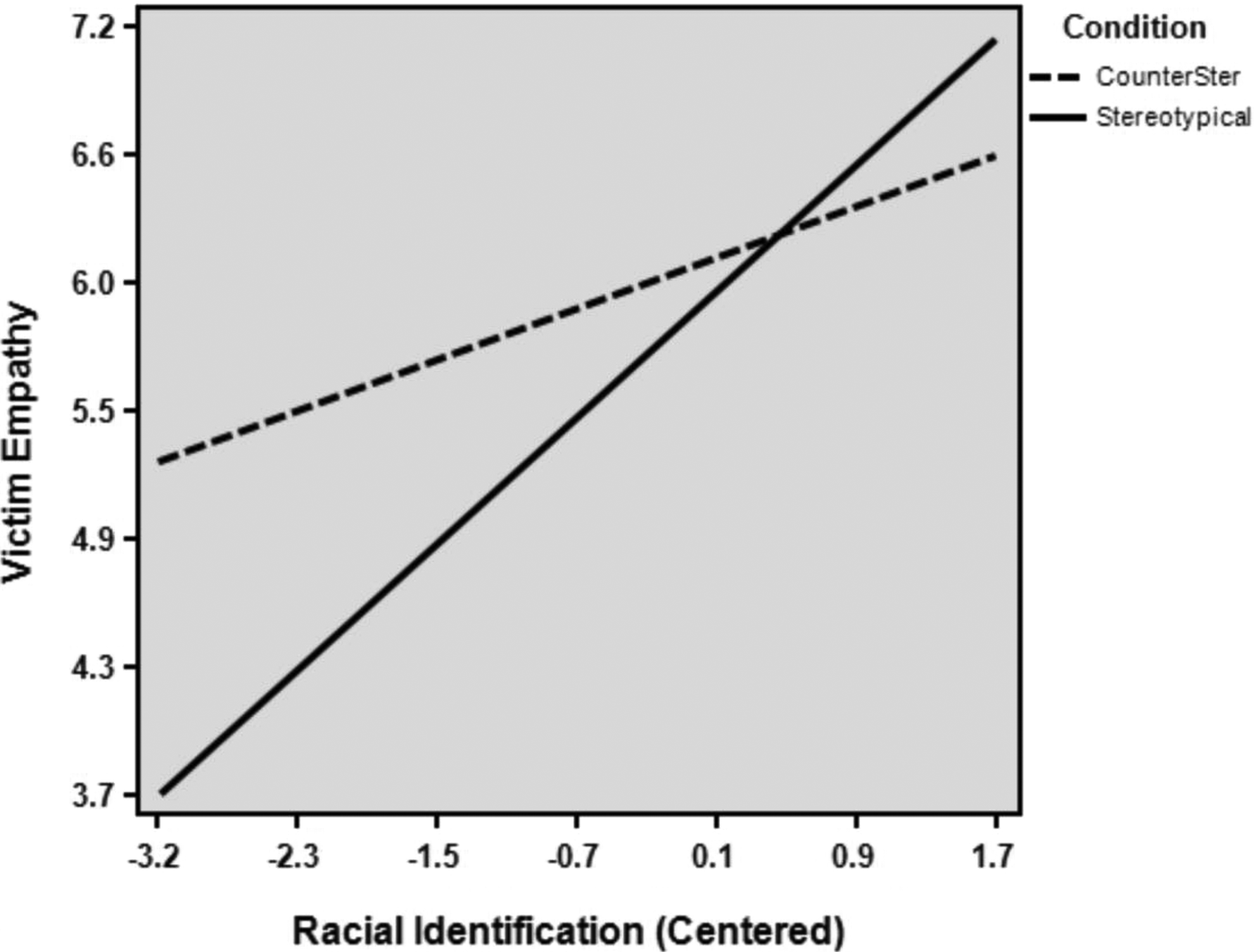
Study 2 victim empathy as a function of centered racial identification and victim stereotypicality. Greater values indicate greater empathy and racial identification. The Omnibus Groups Regions of Significance analysis indicated that, at lower levels of racial identification (values of −.47 and below), participants reported less empathy for the stereotypical victim relative to the counterstereotypical victim. However, at higher levels of racial identity (−.23 and above), there was not a significant impact of victim stereotypicality on empathic feelings.
Overall, the results of Study 2 replicated the key victim stereotypicality × participant racial identification interaction for victim empathy, in both significance and form.
General Discussion
Recently, social scientists have begun to give empirical attention to factors that might influence the occurrence of police violence against unarmed Black males. For example, a series of studies on “shooter bias” illustrates the tendency to shoot Black suspects relative to White suspects in simulations (e.g., Correll et al., 2002), and the more stereotypically “Black” a suspect physically appears, the more likely individuals are to mistakenly shoot him (Kahn & Davies, 2011). Despite this research, the present study represents one of the first empirical attempts at identifying factors that might influence societal responding, in this case among Black Americans, to those events (see also J. D. Johnson & Lecci, 2019). Although there is significant anecdotal evidence of Black Americans’ extremely negative reaction to White police interracial violence (Murray, 2014; Nazaryan, 2017), the current study demonstrates that intragroup empathic responding toward a victim of such violence is not inevitable. Specifically, Black empathic responding toward a Black victim of police violence was driven by the interplay of victim stereotypicality and observer racial identification. Across two studies, Black participants low in racial identification reported less empathy for the stereotypical relative to the counterstereotypical victim, whereas those high in racial identification showed relatively high levels of empathy regardless of the stereotypicality of the Black victim.
Empathic Dampening
Blacks, more than any other racial group, have been shown to report empathy toward suffering members of their in-group (Brown et al., 2006; Roberts & Levenson, 2006). This typical pattern of empathy toward one’s in-group is based upon the notion that the in-group is unified and cohesive and that in-group members are interchangeable group exemplars (Tajfel & Turner, 1979). However, there is some recent evidence that minority group members also report differential empathic responding toward in-group members who suffer. Specifically, Blacks have been shown to report greater empathy for the more prototypical Blacks-in-need relative to less prototypical Blacks-in-need because the former are perceived to have greater psychological connection to their “Blackness” (J. D. Johnson & Kaiser, 2013; J. D. Johnson & Ashburn-Nardo, 2014). The present research extends these prior findings by illuminating the key moderating role of Blacks’ level of racial identification. In contrast to the previous general findings, in both studies representing the current research, Blacks low in racial identification expressed less empathy toward a stereotypical Black man than toward a counterstereotypical Black man who was an unarmed victim of a police shooting. These findings suggest that greater attention should be given to the extent that intragroup empathic responding among Blacks might be influenced by individual differences among Black observers and how these differences interact with characteristics of the Black person who is suffering and, potentially, how these responses may vary systematically as a function of context.
More broadly, there is a growing and substantial body of research illustrating dampened or absent empathic responses (and associated physiological indicators) for social or cultural outgroups. The bulk of the research in this area has focused on intergroup empathic dampening involving the majority group member evidencing less empathy (i.e., empathic dampening) toward minority group members (e.g., Avenanti, Sirigu, & Aglioti, 2010; Chiao & Mathur, 2010; Cikara, Bruneau, Van Bavel, & Saxe, 2014). Moreover, Cikara, Bruneau, Van Bavel, and Saxe (2014) contended that greater attention should be given to such failures of empathic responding because of their role “in the tolerance, and even perpetration, of harm” (p. 111) against certain members of society. The present study addressed this call for research by providing one of the first direct examinations of the extent that individual differences among Black Americans might moderate dampened intragroup empathic responding toward a victim of police interracial violence.
Implications for Stereotypicality Research
A number of studies have shown that phenotypical stereotypicality (i.e., how a Black person looks) can have a significant influence on responses toward Black “defendants” in the criminal justice system (Blair, Judd, & Chapleau, 2004; Eberhardt, Davies, Purdie-Vaughns, & Johnson, 2006; Eberhardt et al., 2004). However, there has been less empirical attention given to the role of social stereotypicality (i.e., how a Black person acts) on responses to Black “victims” in the same system. An examination of social stereotypicality seems relevant for victims of White police interracial violence because there is some anecdotal evidence that negative responding toward the Black victim can be affected by directing attention to instances that the victim “acted Black” in their everyday lives (Kane, 2014). The present findings demonstrated that, under certain conditions (i.e., low racial identification of the observer), such stereotypical behaviors can reduce intragroup empathic responding toward those who suffer from police interracial violence.
Additionally, the present experiment provided one of the first demonstrations of factors that might moderate the impact of Black target stereotypicality on subsequent intragroup responses. Specifically, the findings revealed that the deleterious impact of stereotypicality was limited to those individuals who reported minimal psychological connection to their Blackness. While the present study focused on social stereotypicality, it would be interesting for future research to examine whether similar moderating effects of perceived bias will emerge for variations in phenotypical stereotypical presentations (especially if they are “defendants” in the legal system).
Limitations and Conclusions
Although the scenario of the police shooting of the Black victim is consistent with a number of high-profile police shootings in which the Black victim was not engaging in any illegal behavior (e.g., Philando Castile, in Falcon Heights, MN), one limitation of the current research was that it employed a vignette, which is not as realistic as a video recreation. It is unclear whether greater realism would impact the findings. Additionally, the central findings focus on how observer variables affect Black perceptions of White police violence toward a Black male victim, which is a problem that has garnered considerable attention (United Nations Committee on the Elimination of Racial Discrimination, 2007). Whether these same findings also manifest in other scenarios involving Black officers, White victims, or even other minority groups are certainly of interest but does not undermine the relevance of the current study, which specifically investigated the parameters that influence intragroup responding among Blacks. Importantly, the central findings involving the interaction between empathy and racial identity were replicated across two studies, and the robustness of the effect is important given recent challenges in reproducing findings in psychological research (Open Science Collaboration, 2015).
The incident in the present study involved a Black victim whose only “crime” was driving 3 miles over the speed limit (something virtually everyone has done), and whose compliant behavior resulted in his being shot by police 3 times in the chest; which is a clear example of excessive force. The central and most provocative finding of the current study was that, even under such circumstances, low identified Blacks reported empathic dampening (with greater dehumanization, less valuing, and less positive feelings; see exploratory findings in the supplemental materials) toward the prototypical (i.e., stereotypical) victim. This is especially concerning given that stereotypical Blacks are those most likely to be the victims of inappropriate police behavior such as unjustified shootings (see Kahn & Davies, 2011). The current findings also suggest that such Black victims may be further “punished” by not receiving the full degree of in-group support (i.e., intragroup empathy) that would normally occur for victims of inappropriate violence from police, and this could also impact legal remedies that might otherwise be available.
Supplemental Material
Supplemental_Materials_and_Analyses_Final_Version_10 - Black Intragroup Empathic Responding to Police Interracial Violence: Effects of Victim Stereotypicality and Blacks’ Racial Identification
Supplemental_Materials_and_Analyses_Final_Version_10 for Black Intragroup Empathic Responding to Police Interracial Violence: Effects of Victim Stereotypicality and Blacks’ Racial Identification by James D. Johnson, Len Lecci and John Dovidio in Social Psychological and Personality Science
Footnotes
Declaration of Conflicting Interests
The author(s) declared no potential conflicts of interest with respect to the research, authorship, and/or publication of this article.
Funding
The author(s) received no financial support for the research, authorship, and/or publication of this article.

Supplemental Material
The supplemental material is available in the online version of the article.
Notes
References
Supplementary Material
Please find the following supplemental material available below.
For Open Access articles published under a Creative Commons License, all supplemental material carries the same license as the article it is associated with.
For non-Open Access articles published, all supplemental material carries a non-exclusive license, and permission requests for re-use of supplemental material or any part of supplemental material shall be sent directly to the copyright owner as specified in the copyright notice associated with the article.
