







Abstract
A survey experiment, carried out in a field setting among Sunni Arab Syrian refugees (N = 2,479), examined the effect of exposure to wartime trauma, ethnoreligious group affiliation, and degree of hostility of intergroup relations on altruism and positive emotional regard. The results showed that in-group targets were met with more positive emotional regard and altruism than relatively neutral out-group targets, which in turn were met with more positive emotional regard and altruism than individuals from a hostile out-group. These tendencies were elevated among participants with a high degree of exposure to wartime trauma. Emotions mediated the effect of ethnoreligious group affiliation on altruism, and this mediating effect was moderated by exposure to wartime trauma.
In a famous biblical verse, we are told not to “take vengeance or bear a grudge against the sons of your own people” but rather to “love thy neighbor as yourself” (Leviticus 19:9-18). This passage is often cited in relation to the commandment to be kind and generous to our fellow human beings. But when making actual trade-offs between one’s own welfare and the welfare of others, will people love any neighbor as themselves or will this mainly apply to “the sons of your own people,” as the first part of the passage implies? The current research examines to what degree trade-offs between one’s own and others’ welfare are influenced by the ethnoreligious group affiliation of the target individual. We further examine the effect of antagonistic intergroup relations, as well as personal exposure to wartime trauma, on such kindness calculations. We take an evolutionary social–psychological perspective in our attempt to uncover the mechanisms underlying such tendencies.
When determining whether or not to take a cooperative and generous stance toward a fellow human, one has to decide whether he or she can be trusted or poses a potential threat. The evolutionary threat management approach suggests that one of the central challenges in our ancestral environment was being able to detect significant threats to survival (Neuberg & Schaller, 2016; Schaller & Neuberg, 2012). Since others’ aggressive intentions and inherent trustworthiness are hidden from sight, people tend to rely on easily recognizable and quickly processed external cues in order to remain vigilant to threats such as group affiliation (Schaller & Neuberg, 2012). The end result of these essentially adaptive tendencies, however, is a human threat detection system that may be overly sensitive and lead to generalized negative perceptions of out-groups (Cesario & Navarette, 2014; Maner et al., 2005; Neuberg, Kendrick, & Schaller, 2011; Schaller, Park, & Mueller, 2003) and, consequently, decreased pro-sociality toward out-group individuals.
In order to determine whether we should activate a state of high alert, we rely on environmental cues that indicate the possibility of approaching danger. We therefore come to rely more on group stereotypes in threatening circumstances. For example, we are more likely to rely on group stereotypes when approaching someone in a dark alley than in a well-lit street (Schaller et al., 2003). A personal history of trauma can further lead to a near chronic state of vigilance. The literature on the effect of exposure to trauma on prejudice and intergroup pro-sociality provides a complex picture. On the one hand, personal exposure to terror and war has been shown to be related to endorsement of exclusionist attitudes toward out-group members (e.g., Canetti-Nisim, Halperin, Sharvit, & Hobfoll, 2009). On the other hand, a separate body of research has consistently found that people exposed to war violence tend to behave more cooperatively after war (see Bauer et al., 2016, for a review). Existing research has, however, either made little separation between in- and out-group pro-sociality (e.g., Bauer et al., 2016), only examined attitudes toward out-groups (e.g., Canetti-Nisim et al., 2009), or focused on a simple in-group–out-group dichotomy (e.g., Bernhard, Fischbacher, & Fehr, 2006; Choi & Bowles, 2007), not taking into account the degree of antagonism between the groups in question. No research to date has systematically examined the effect of exposure to trauma on altruism toward in-groups as well as out-groups with a varying degree of antagonistic relations. The current research aims to address this gap in the literature. We predict that exposure to wartime trauma will have a conducive effect on pro-sociality for in-group targets while having a destructive effect on altruism toward out-group targets, but only to the extent that the in-group–out-group relationship is characterized by antagonism and hostility.
We conceptualize pro-sociality and altruism as the willingness to compromise one’s own welfare for the sake of the welfare of someone else. In determining whether or not to trade off our personal welfare to enhance the welfare of someone else, we carry out a mental computation, determining the relative value afforded to our own and the other’s welfare (Delton & Robertson, 2016). In order to calculate welfare trade-offs, people are dependent on input that determines the relative importance of the welfare of the target individual (Cosmides & Tooby, 2013; Delton & Robertson, 2016; Tooby, Cosmides, Sell, Lieberman, & Sznycer, 2008). There are a number of such inputs including kinship, formidability, reciprocity, and emotion. We focus on the role of emotions as an explanatory, mediating, variable in this article.
We suggest that emotions felt toward the target can account for differences in altruistic responses toward in- and out-group targets. Certain emotions are particularly relevant for this analysis. Anger, disgust, and fear are often considered basic emotions, shaped by natural selection to automatically address survival-related problems (Ekman, 1999). Other emotions such as empathy and respect have more likely evolved to manage the complexities of repeated social interaction (Cottrell & Neuberg, 2005). We expect that hostile out-group members will be met with more negative emotions (anger, fear, and disgust) and less positive emotions (empathy and respect) and that these differing emotional responses can account for differences in altruism shown toward in- and out-group members. Stated in testable terms, we expect emotions to mediate the relationship between ethnoreligious group affiliation and altruism. These tendencies are expected to be elevated among individuals with a high degree of exposure to wartime trauma.
Hypotheses
Based on the above reasoning, we posit the following hypotheses:
We are further interested in examining the mechanisms by which group affiliation translates into altruism. We suggest that, particularly among individuals with a high degree of exposure to trauma, the ethnoreligious group affiliation of the target individual will affect the valence of the emotional reaction to the target. The valence of the emotional reaction is further expected to affect the degree of altruism shown to the target in question. We thus pose the following hypothesis.
The Current Research
In order to examine these hypotheses, we carried out a large-scale survey experiment in a field setting. The fieldwork took place between August 8 and September 8, 2017, in a refugee camp located in the Mardin region, southeastern Turkey. The residents of the camp are refugees from Syria and Iraq and reside in separate areas of the camp, based on country of origin (Syria or Iraq) and ethnoreligious affiliation (Sunni Arab, Yazidi, Shia Arab). The camp constitutes a highly structured, but safe, environment for the refugees, with strict limitations regarding interaction between refugees from different ethnoreligious groups. Around 60% of the refugees who reside in the refugee camp are Syrian Sunni Arabs, the remaining 40% mainly Iraqi Yazidi (United Nations High Commissioner for Refugees, 2015). The civil war in Syria was at its peak at the time of data collection. This tragic conflict has to a large extent taken place along ethnoreligious lines, with Bashar al-Assad’s government representing the Shiite Arab Alawite minority in the country, while the majority of the rebel groups opposing Assad’s rule are Sunni Arab. The conflict has accentuated the tension and hostility between Sunni and Shia Arabs in the country. The country is also home to a small minority of Yazidis, a group that is not clearly associated with either side in the conflict. In order to determine sample size, we carried out power analysis, using G*Power (Faul, Erdfelder, Buchner, & Lang, 2009), which indicated that a sample size of 1,548 (1 − β > .95) was sufficient to detect a small effect (effect size f = .10), given the 12 experimental conditions.
Method
Participants
The sample consisted of Syrian Arab refugees (N = 2,479, 50% female, median age-group 25–34 years). The sampling frame included all Sunni Arab adults living in the camp at the time of the study. The participation rate was >95%. The sample is thus the representative of the Sunni Arab population of the camp and included around 80% of this population. Participants who stated another ethnoreligious group affiliation than Sunni Arab (N = 97, 3.77% of the sample) were excluded from the analysis.
Procedure
Each participant was approached by a research assistant (RA) and was offered to participate in the study. Those who chose to participate were given a small sum of money (20 Turkish Lira) as compensation. The RAs were locals, fluent in Arabic, and acquainted with local customs. The RAs had received training and instructions by the first author, were well versed in research methodology, and had extensive experience from carrying out similar research. Female RAs were used when approaching female participants. The participants carried out the study in a secluded area of a local tea shop and completed the study questionnaire on a tablet computer in the absence of the RA. The sole exception from this seclusion was for illiterate participants who carried out the study as an oral interview.
After providing demographic information, the participants carried out the welfare trade-off ratio (WTR) task in which they were asked to make a series of decisions involving the division of money between themselves and a fictitious target. In order to examine the effect of social categorization on altruism, the ethnoreligious affiliation (Sunni Arab, Yazidi, or Shia Arab), gender (male or female), and age (25 or 65 years old) of the target were experimentally varied. The participants were thus randomly assigned to 1 of the 12 conditions (3 × 2 × 2 between-subjects design), based on all possible combinations of ethnoreligious group affiliation, age, and gender of the target. The participants were then given the Harvard Trauma Questionnaire (HTQ). The final part of the questionnaire included items assessing post-traumatic stress, post-traumatic growth (PTG), trust, and attitudes toward other refugee communities. These items were included in order to examine a separate research question—how exposure to wartime trauma affects post-traumatic stress disorder, PTG, and trust toward other refugee communities—a research question that is beyond the scope of this article. The analyses of these items are therefore not presented in this article. The project was approved by the Uppsala Ethical Review Board in May 2016 (Dnr 2016/189).
Measures
Translation
A professional editor of Arabic texts conducted the original translation to Arabic. We then subjected the instrument to several rounds of testing with the help of the locally recruited team in order to ensure a colloquial and appropriate instrument for Syrian and Iraqi participants. This translation was validated and its accuracy compared to the English original verified by the professional editor. The HTQ, for which we had the Arabic translation from the original authors, was left unchanged.
WTR
WTR measures the relative value placed on one’s own welfare relative to the welfare of another individual. In this task, the participants are asked to make 13 consecutive decisions and are instructed to consider each decision on its own. In each of the scenarios, the participant is asked to imagine a target individual, presented as a refugee with a certain ethnoreligious group affiliation (i.e., Sunni Arab, Yazidi, or Shia Arab), a certain age (25 or 65 years old), and a certain gender (male or female). The characteristics of the target individual are held constant across all 13 scenarios. In each scenario, the participants are asked to make a choice between giving the target individual a sum of money, held constant in all scenarios (30 Turkish Lira), or receiving a certain sum of money for themselves. In each scenario, the monetary reward that they would get for themselves becomes progressively lower (see Online Appendix). To calculate the WTR, we first determine the subjects “switch point,” that is, the average of the last sum of money the participant chose to allocate to him or herself and the first sum of money at which they chose to allocate to the other person. The WTR is calculated by dividing the switch point by the sum allocated to the other person. The WTR ranges between −1.67 and 2.67, with higher values indicating a greater degree of altruism. 1
Emotions
Emotional reactions to the target were assessed by asking the participants to what extent they experience a list of feelings when thinking of the individual they considered in the preceding WTR task. The listed emotions were fear, anger, disgust, empathy, and respect. The response scale ranged from 1 (not at all) to 9 (extremely). We calculated a composite of positive emotional regard (anger disgust and fear reverse coded), α = .69.
Exposure to wartime trauma
Exposure to wartime trauma was assessed using Part I of the HTQ (Mollica et al., 1992). The version of the HTQ used in the study contained a checklist of 16 traumatic life events, determined to be relevant for Syrian refugees. These included lack of food or water, ill health without medical care, lack of shelter, imprisonment, physical abuse, serious injury, combat situation, indiscriminate shelling or bombing, being close to death, forced evacuation, forced separation from family, murder of family or friend, unnatural death of family or friend, murder of stranger or strangers, kidnapping, and torture. Participants were asked to indicate whether they had experienced any of these events before arriving in Turkey. They were not limited in the number of events they could choose. We classified participants based on their degree of exposure to wartime trauma using latent class analysis (LCA), a statistical analysis that classifies individuals into mutually exclusive and exhaustive types, or latent classes, based on their pattern of answers on a set of binary categorical variables such as the ones used in the HTQ (Hagenaars & McCutcheon, 2002). Based on LCA, we divided the participants into three latent classes, which we termed exposure to severe trauma, exposure to intermediate trauma, and exposure to low-intensity trauma. The full reporting of the LCA can be found in the Online Appendix.
Results
Altruism
We carried out a four-way analysis of variance (ANOVA), examining the effect of target group (Sunni Arab, Shia Arab, or Yazidi), exposure to wartime trauma (exposure to low-intensity/intermediate/severe trauma), gender of target (male, female), and age of target (younger: 25, older: 65) on altruism (WTR), controlling for participants’ age and gender. The analysis revealed a main effect of target group on altruism, F(2, 2361) = 5.56, p = .004, η2 = .005. As hypothesized (H1), simple effects analysis showed that participants were more altruistic toward Sunni Arab targets (i.e., in-group members; M = 1.24, SD = 1.30) than toward Shia Arab targets (M = 1.03, SD = 1.38, p = .002), that is, an out-group member with which the in-group participants’ were currently in conflict. Out-group targets belonging to the Yazidi group, however (i.e., an out-group with which the in-group enjoyed relatively harmonious relations), were shown an equal degree of altruism (M = 1.21, SD = 1.30) compared to the in-group (p = .788) and significantly more altruism compared to Shia targets (p = .006).
There was further a main effect of exposure to wartime trauma, F(2, 2361) = 28.24, p < .001, η2 = .02, indicating that participants with exposure to severe trauma showed an overall lower degree of altruism (M = 0.77, SD = 0.88) than participants with exposure to intermediate trauma (M = 1.18, SD = 1.38, p < .001), who in turn showed a lower degree of altruism than participants exposed to low-intensity trauma (M = 1.55, SD = 1.51, p < .001). In accordance with our hypothesis (H3), these main effects were qualified by a Group × Exposure interaction, F(4, 2361) = 3.42, p = .008, η2 = .01. Simple main effects analysis revealed that, among participants exposed to low-intensity trauma, levels of altruism did not differ depending on the ethnicity of the target, F(2, 2361) = 0.67, p = .512. In contrast, ethnicity of the target had a significant effect on altruism among participants with exposure to intermediate trauma, F(2, 2361) = 4.57, p = .010, η2 = .004, as well as among those with exposure to severe trauma, F(2, 2361) = 8.26, p < .001, η2 = .01. In essence, the more severe the trauma the participants were exposed to, the more they differentiated between Sunni Arab targets (most altruism), Yazidi targets (less altruism), and Shia Arab targets (least altruism). We illustrate these differences graphically in Figure 1. There were no main effects of target gender, F(1, 2361) = 0.01, p = .922, or target age, F(1, 2361) = 0.52, p = .470, nor were there any significant interactions involving target age or target gender. We also carried out analyses treating exposure to wartime trauma as a continuous variable, using a two-class LCA solution and separate analyses for exposure to violent and nonviolent events. Each of these analyses produced the same pattern of results as the above analysis, indicating robustness of the results to measurement effects. Full reporting of these additional analyses can be found in the Online Appendix.
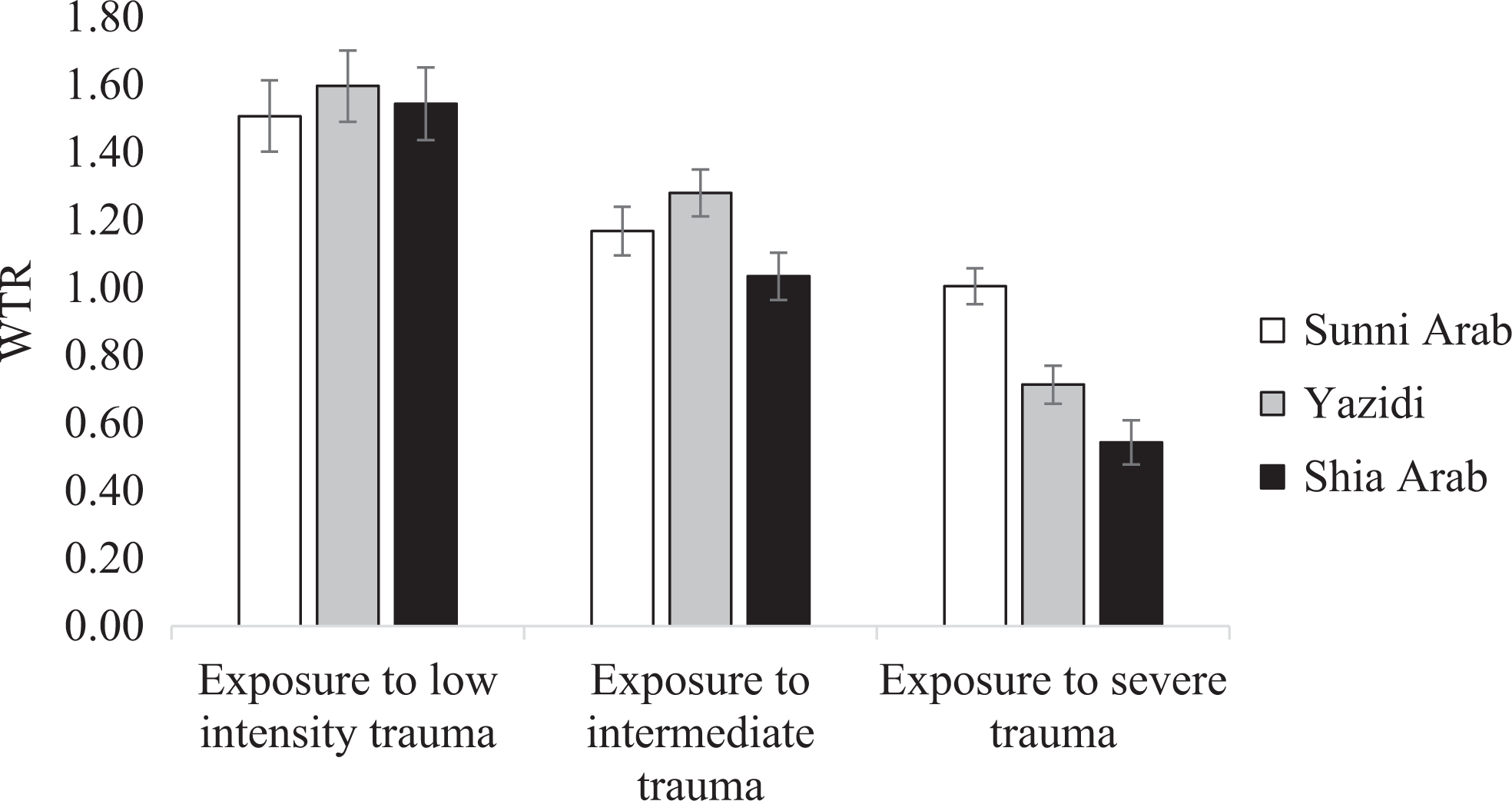
Welfare trade-off ratio for Sunni Arab, Yazidi, and Shia Arab targets among participants exposed to low-intensity, intermediate, and severe wartime trauma. Error bars indicate standard error of the mean.
Emotions
We were further interested in whether ethnoreligious group affiliation and exposure to trauma would affect emotional reactions to the target. We therefore carried out a four-way ANOVA, examining the effect of target group, target age, target gender, and exposure to wartime trauma on positive emotional regard (composite measure), controlling for participants’ age and gender. There was a main effect of ethnoreligious group affiliation, F(2, 2349) = 459.34, p < .001, η2 = .28. As hypothesized (H2), simple main effect analysis revealed that Sunni Arab targets were met with more positive emotional regard (M = 6.41, SD = 1.50) than Yazidi targets (M = 5.52, SD = 0.61, p < .001), who in turn faced more positive emotional regard than Shia Arab targets (M = 4.85, SD = 1.18, p < .001). We also carried out separate four-way ANOVAs for the discrete emotions and the results for each of the emotions, except fear, followed the same pattern as those of the composite (see Online Appendix for detailed results). There were no significant differences in the level of fear for targets with different ethnoreligious group affiliation.
There was further a main effect of exposure to trauma, F(2, 2349) = 8.29, p < .001, η2 = .01, indicating that participants with exposure to severe trauma showed an overall higher degree of positive emotional regard to the targets (M = 5.83, SD = 1.91) both compared to participants with exposure to intermediate trauma (M = 5.52, SD = 1.18, p < .001) and compared to participants exposed to low-intensity trauma (M = 5.51, SD = 0.53, p < .001). Separate analyses for the discrete emotions showed the same pattern of results, with the exception of fear, for which participants exposed to severe trauma reported lower overall levels compared to participants exposed to traumas of lesser intensity and severity (see Online Appendix for detailed results).
Importantly, and in accordance with our hypothesis (H3), these main effects were qualified by an ethnoreligious Group × Exposure interaction, F(4, 2349) = 172.59, p < .001, η2 = .23. Simple main effects analysis revealed that the more severe the exposure, the greater the difference in positive emotional regard depending on target group. There was no effect of target group among participants exposed to low-intensity trauma, F(2, 2349) = 0.03, p = .968. Among participants exposed to intermediate trauma, there was a significant effect of target group, F(2, 2349) = 136.39, p < .001, η2 = .10, and among participants exposed to severe trauma, the effect of target group was very strong, F(2, 2349) = 677.88, p < .001, η2 = .37 (see Figure 2 for a graphical illustration). There were no main effects of target gender, F(1, 2349) = 0.14, p = .704, or target age, F(1, 2349) = 1.82, p = .177, nor were there any significant interactions involving these variables. We again ran separate analyses for the discrete emotions, and all emotions except fear followed the same pattern (see Online Appendix). There were no significant differences in in-group bias for fear depending on intensity and severity of trauma exposure.
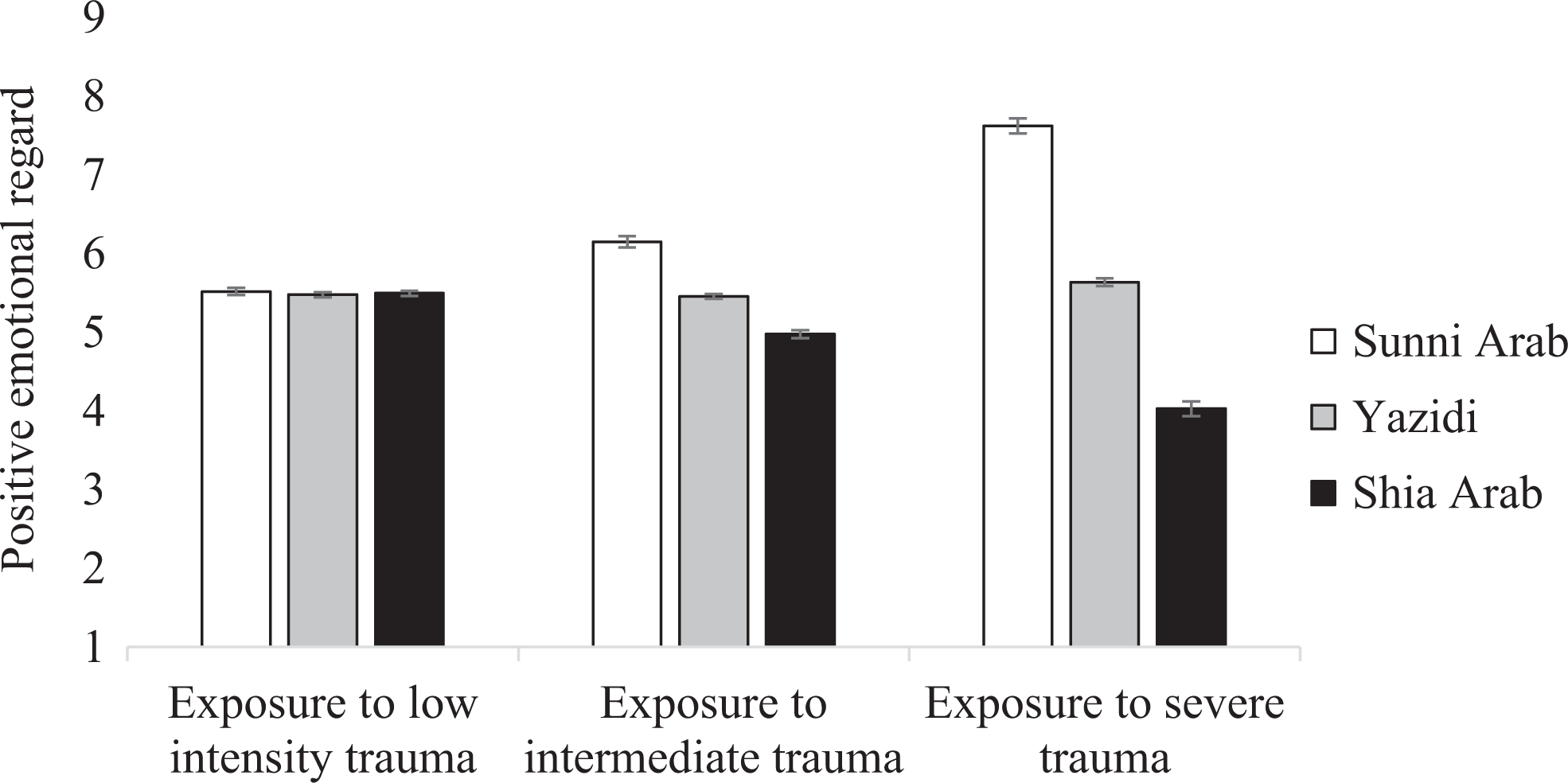
Positive emotional regard (composite of empathy, respect, anger [reversed], disgust [reversed], and fear [reversed]) for Sunni Arab, Yazidi, and Shia Arab targets among participants exposed to low-intensity, intermediate, and severe wartime trauma. Error bars indicate standard error of the mean.
Moderated Mediation
We further expected emotions to mediate the relationship between ethnoreligious group affiliation and altruism, and this mediation was expected to be moderated by degree of exposure to trauma (H4). In order to examine this hypothesis, we carried out moderated mediation analysis, using Hayes’ (2013) PROCESS macro (Model 7). We entered ethnoreligious group affiliation (coded as 1 = Sunni Arab, 2 = Yazidi, 3 = Shia Arab) as independent variable, positive emotional regard as mediator (results for each of the discrete emotions followed the same pattern as those of the composite—see Online Appendix), the WTR as dependent variable, and exposure to wartime trauma as moderating variable (coded as 1 = low-intensity, 2 = intermediate, 3 = severe), controlling for participants’ age and gender. Ethnoreligious affiliation of the target (b = 1.04, p < .001), exposure (b = 1.91, p < .001), and the Exposure × Ethnoreligious Affiliation interaction (b = −.90, p < .001) all significantly predicted positive emotions toward the target. When controlling for emotions, ethnoreligious affiliation of the target did not significantly predict altruism toward the target (b = −.05, p = .181). Conditional indirect effects showed that the mediating effect of emotions on the relationship between ethnoreligious group affiliation and altruism depended on intensity and severity of exposure to wartime trauma. For participants who had been exposed to low-intensity trauma, the indirect effect was b = −.01, SE = .00, CI: [−.02, −.00], and p < .05; for participants exposed to intermediate trauma, the indirect effect was b = −.04, SE = .02, CI: [−.08, −.02], and p < .05; and for participants exposed to severe trauma, the corresponding effect was b = −.08, SE = .03, CI: [−.14, −.03], and p < .05. Exposure thus moderated the mediating effect of emotions on the relationship between ethnoreligious group affiliation and altruism, indicated by the index of moderated mediation (b = −.05, SE = .02, CI: [−.09, −.02], p < .05).
Discussion
The present study showed that altruism as well as emotional reactions varies as a function of ethnoreligious affiliation of the target as well as exposure to wartime trauma. Target individuals belonging to a hostile out-group were met with less altruism and less positive regard, and these effects were elevated among individuals who had experienced severe wartime trauma. The current study is the first survey experiment in a field setting to compare different out-groups in the effect of ethnoreligious group affiliation on welfare trade-offs. Thus far, research on welfare trade-offs has either not taken into account the group affiliation of the target (e.g., Bauer et al., 2016) or focused on a simple in-group–out-group dichotomy (e.g., Bernhard et al., 2006; Choi & Bowles, 2007), without reference to the degree of antagonism with the out-group in question. The results further elucidate the process by which ethnoreligious affiliation of the target affects altruism. Among individuals with a high degree to exposure to wartime trauma, ethnoreligious group affiliation affects the emotional stance toward the target, which in turn affects the degree of altruism shown.
According to the evolutionary threat management approach, the tendency to favor in-group members over out-group members stems from an evolutionary tendency to use external cues, such as group affiliation, in order to provide quick and intuitive information of degree of threat and trustworthiness of individuals who we come into contact with (Neuberg & Schaller, 2016; Schaller & Neuberg, 2012). Further, according to the theory of reciprocal altruism (Trivers, 1971), we are more likely to show positive regard to individuals with whom we expect to be in future exchanges and with whom our fate is intertwined. There was, however, one notable exception—the emotion of fear. Surprisingly, ethnoreligious affiliation of the target did not matter for this emotion, and individuals exposed to severe trauma expressed less fear. The expression of fear entails an estimation of a threat to be greater than one’s own coping ability (Halperin, 2015; Lazarus & Folkman, 1984). Expressing fear thus involves an attribution of relative weakness and vulnerability to the self, in addition to the perception of the target as a threat. In order to avoid a display of vulnerability, individuals may therefore have been reluctant to express fear in relation to other groups. Further, while fear involves a general negative stance toward the target (which should involve a lowered WTR), it also involves attribution of formidability to one’s opponent (which should involve higher WTR).
Exposure to trauma elevated the difference in emotional reactions between in- and out-groups. Since the activation of the threat vigilance system is physically and psychologically costly and runs the risk of foregoing potential benefits from cooperative behavior, the activation of this system will depend on contextual cues that indicate the existence of threat (Neuberg & Schaller, 2016; Schaller et al., 2003). Past personal exposure to wartime trauma serves as one such cue, indicating the existence of potential danger and the need to be vigilant in relation to others. This finding constitutes an important contribution to the literature on the effect of exposure to violence and trauma on pro-sociality. The current dominant view in the literature is that exposure to violence and wartime trauma leads to increased cooperation and pro-sociality (e.g., Bauer et al., 2016). This literature, however, has to a large extent disregarded the group affiliation of the individuals involved in the social exchange. The findings from the current research refine and clarify earlier results and indicate that exposure to wartime trauma indeed seems to increase pro-sociality and altruism when the target is an in-group member but rather decreases pro-sociality and altruism when the target individual belongs to the rival group in an ongoing conflict.
It should be noted, however, that the comparison made in the present research compares individuals with a differing degree of exposure to wartime trauma within a war-stricken population. It may thus still be the case that the population as a whole is more pro-social than comparable populations that have had no exposure to war. Indeed, the overall level of altruism in the sample was decidedly higher than that of several earlier studies (e.g., Forster, Pedersen, Smith, McCullough, & Lieberman, 2017; Kirkpatrick, Delton, Robertson, & de Wit, 2015). This is a problematic comparison, however, since the target individual in the present study was presented as a refugee, while this has not been the case in these previous studies. It is therefore difficult to know whether the higher overall level of altruism in the population is due to effects of war experiences on altruism or higher levels of altruism showed toward refugees at the hands of fellow refugees. Indeed, previous research has shown that exposure to war-related violence under some circumstances can increase positive attitudes toward refugees (Hartman & Morse, 2018).
The classification of exposure to wartime trauma, using LCA, into three latent classes—exposure to severe trauma, exposure to intermediate trauma, and exposure to low-intensity trauma—constitutes a methodological advancement. Previous research has usually treated exposure to wartime violence and trauma either as a dichotomous variable (exposed/not exposed) or as a continuous variable, where exposure to a greater variety of trauma is seen as equal to the amount of trauma that the individual has been exposed to. The terms exposure to severe/intermediate/low-intensity trauma were chosen in order to emphasize that the entire sample could be seen as belonging to the category “exposed to wartime trauma.” What differentiated between the participants in our sample was rather the intensity and severity of the trauma the participants were exposed to. This highlights the contribution of the current research to the field of violence and pro-sociality. While previous research has usually contrasted those “exposed” and “not exposed” to wartime violence and trauma, we contribute by studying the effects of traumas of varying intensity and severity within the “exposed” category.
The decisions involved in the welfare trade-off task involved hypothetical individuals and did not result in actual monetary outcomes. We do not presume that the specific choices our participants made would have been identical in a real-life setting. We do suggest, however, that our results show that past exposure to wartime trauma will increase reliance on group affiliation and result in greater differences in emotional regard as well as altruism between in- and out-group members, even in a real-life setting.
The present study was carried out in a naturalistic setting in a large-scale non-WEIRD (Western, educated, industrialized, rich and democratic) sample (Henrich, Heine, & Norenzayan, 2010), representative of the population of the refugee camp. Understanding mechanisms underlying altruism and the lack thereof between different refugee groups is a particularly important challenge in an age of increased refugee mobility and migration. Absorbing societies often face the challenge of conflicts and violence between different groups of refugees, and understanding the factors that foster altruism and reduce such conflicts is important in order to deal effectively with these challenges. The current research indicates that people are highly calibrated in their perception of out-groups and that detrimental effects of exposure to wartime trauma on intergroup relations are limited to the out-groups with which the in-group has been in conflict. In other words, exposure to wartime trauma does not necessarily lead to a generalized prejudiced perception of out-groups, as some previous research has suggested (e.g., Canetti-Nisim et al., 2009). Instead, the experience of wartime trauma, and the threat it gives rise to, results in negative perceptions of the group from which the threat emanated but does not necessarily lead to a generalized ethnocentric perception of out-groups.
It would seem then that the degree to which we love our neighbor as ourselves is contingent on a number of factors. Group affiliation matters, and we tend to have more positive feelings and be more altruistic toward “the sons of our own people.” This tendency is further exacerbated in intergroup conflict settings, particularly when we have personally been exposed to wartime trauma.
Supplemental Material
Online_appendix_final - Exposure to Wartime Trauma Decreases Positive Emotions and Altruism Toward Rival Out-Groups (But Not Nonrival Out-Groups): A Survey Experiment in a Field Setting Among Syrian Refugees
Online_appendix_final for Exposure to Wartime Trauma Decreases Positive Emotions and Altruism Toward Rival Out-Groups (But Not Nonrival Out-Groups): A Survey Experiment in a Field Setting Among Syrian Refugees by Jonathan Hall and Dennis T. Kahn in Social Psychological and Personality Science
Footnotes
Declaration of Conflicting Interests
The author(s) declared no potential conflicts of interest with respect to the research, authorship, and/or publication of this article.
Funding
The author(s) disclosed receipt of the following financial support for the research, authorship, and/or publication of this article: The data for this project were collected with the support of the Swedish Research Council through Grant 421-2014-1347. The analysis of these data was supported by the U. S. Army Research Office through the Minerva Initiative under grant number W911NF1810089.
Supplemental Material
Supplemental material for this article is available online.
Notes
References
Supplementary Material
Please find the following supplemental material available below.
For Open Access articles published under a Creative Commons License, all supplemental material carries the same license as the article it is associated with.
For non-Open Access articles published, all supplemental material carries a non-exclusive license, and permission requests for re-use of supplemental material or any part of supplemental material shall be sent directly to the copyright owner as specified in the copyright notice associated with the article.
