







Abstract
Research shows that inclusive identities are effective for improving intergroup relations. Little work, however, asked what happens once a sense of common identity is formed, but then lost. Given increasing diversity and integration attempts that might fail, this question is realistic and timely. We studied a religious minority in Israel, Arab-Druze (N = 178), constituting 1.6% of the population. Druze have always had strong common ties with the Jewish majority, particularly younger Druze who serve in the Israeli army. We surveyed Druze in the aftermath of the nationality bill, which was considered by many to be highly exclusionary toward non-Jews. Drawing on research on minority exclusion, we expected that for younger Druze, a sense of common identity loss will predict radical forms of action. This was supported by our cross-sectional data and remained stable after controlling for more classic predictors of violent and nonviolent action.
They have chosen to make New Zealand their home, and it is their home. They are us.
The statement of Ardern, in her reference to Muslim immigrants, underscores the power of inclusive identities. By explicitly incorporating Muslims into the in-group she represents (New Zealanders), in both words and actions (wearing a hijab), Ardern communicated that the sorrow of the Muslim community is the sorrow of the nation (Reicher, Haslam, & van Bavel, 2019). Much research shows that inclusive identities are an effective platform for improving intergroup relations. Once two groups feel part of the same superordinate category, a sense of common identity predicts intergroup tolerance (Wohl & Branscombe, 2005), helpfulness (Kunst, Thomsen, Sam, & Berry, 2015), and even respect for the lives of out-group members (Schori-Eyal, Halperin, & Saguy, 2019). We here study common identities from a novel perspective, by asking what happens once a sense of common identity is formed, but then lost. Whereas much research looked at the positive consequences of a common identity, the potential for negative consequences following a dissolution of common identity (such as when legislation is passed targeting a subset of the superordinate group) has rarely been considered. Given increasing global diversity and related challenges, this perspective places common identity processes in a realistic and timely context and can shed important light on its potential downsides.
To study common identity loss, we capitalized on recent political occurrences in Israel. We studied Arab-Druze, a hardly investigated minority that is unique in its religion, history, and relations with the Jewish majority. Like other minorities in Israel, Druze are disadvantaged relative to Jews on a range of socioeconomic measures. However, Druze are also connected to the Jewish majority in strong emotional and political ties and have been considered, and often felt, part of the Israeli identity (Dana, 2003). In the summer of 2018, the Israeli parliament passed a law that was considered by many to be highly exclusionary toward non-Jews (Fuchs, 2018). Given the common connections between Druze and Jews, this law could potentially give rise to a sense of a common identity loss. This enabled us to test this process and to examine what it might predict.
Common In-Group Identity
According to the common in-group identity model (Gaertner & Dovidio, 2000), intergroup bias can be reduced if group members conceive of themselves as part of an inclusive category. Drawing on social identity theory (Tajfel & Turner, 1979) and self-categorization theory (Turner, Hogg, Oakes, Reicher, & Wetherell, 1987), the model proposes that by redefining who is considered an in-group member, processes that typically apply to the in-group (e.g., in-group favoritism) are redirected to the more inclusive category. A common in-group identity increases a variety of positive intergroup outcomes such as helping (Dovidio et al., 2010; Kunst et al., 2015), support for cooperative policies (Beaton, Dovidio, & Léger, 2008), and positive out-group attitudes (Houlette et al., 2004). Moreover, the common in-group identity model was applied to explain how intergroup contact (Allport, 1954; Pettigrew & Tropp, 2006), which guides many reconciliation interventions (Paluck & Green, 2009), psychologically operates to reduce bias and improve intergroup relations (Dovidio, Gaertner, Saguy, & Halabi, 2008).
Inclusive identities, and particularly commonality-focused encounters, were further found to shape disadvantaged group members’ expectations regarding how they will be treated by the advantaged group (Saguy, 2018). For example, a laboratory study manipulated group position (advantaged vs. disadvantaged) and had participants then convene and discuss either cross-group commonalities or differences (Saguy, Tausch, Dovidio, & Pratto, 2009). Commonality-focused (vs. difference-focused) contact improved out-group attitudes but also led disadvantaged group members to trust the advantaged group more and to expect out-group fairness (see also Wright & Lubensky, 2008). Similarly, minorities in the United States who were led to focus on a superordinate (vs. a dual identity) representation of intergroup relations had a lower motivation to advance change that could benefit their in-group (Glasford & Dovidio, 2011; Ufkes, Calcagno, Glasford, & Dovidio, 2016). Among European Kurds (Ufkes, Dovidio, & Tel, 2015), stronger identification as Europeans predicted less collective action tendencies. Thus, by creating a meaningful connection to the majority group, a common identity can lead disadvantaged group members to become less mobilized for social change and to expect more fairness from the majority group. The key question we raise is what happens once such expectations are not met?
When a Common Identity Fails
To theorize about the consequences of a sense of a common identity loss, we relied on research on minority exclusion. While this previous work does not assume that a common identity was formed in the first place, it provides indications of how minorities react when feeling excluded from society. For example, across different contexts (Turkey, France, Belgium, and Brazil) minorities’ sense of alienation (e.g., feeling discriminated against, not cared for) predicted support for violent collective action (Troïan et al., 2019). Similarly, a study among immigrants in Germany revealed that those who felt they could not reconcile their in-group identity with their German identity were likely to support violent collective action after 1 year (Simon, Reichert, & Grabow, 2013). Both papers refer to a loss of meaning as paving the way to destructive forms of politicization. This terminology fits with work on radicalization, relating it to a need to restore one’s sense of control in the face of perceived threats and humiliations (Kruglanski et al., 2014).
Thus, past research has illustrated the potential benefits of common in-group identity and the detriments of exclusion from a common in-group identity. Here, we argue that exclusion might be particularly damaging if a common in-group identity was previously formed. Thus, we are focusing on a particular sense of alienation, resulting from a sense of a broken promise, a promise for integration and inclusion. Losing a sense of connection to the superordinate national group might be particularly disappointing for minority group members who have had hopes for a better future, for being equal, and for upward mobility—and these hopes were shuttered. Thus, we expect a sense of common identity loss to predict radicalism, particularly for those whose common identity was linked to high expectations of positive change.
The Nationality Bill and the Case of Druze in Israel
Druze is a religion that separated from Islam around the 11th century in Egypt (Dana, 2003). About 140,000 Druze reside in Israel, constituting 1.6% of the Israeli population. Unlike the tension that characterizes relations between Jews and Arabs in Israel, Arab-Druze have been always considered Jewish-allies. This was reflected in the state’s promotion of the notion of shared destiny to Druze and Jews (Hajjar, 2000) and in the fact that Druze (unlike other Arab minorities) are serving in the Israeli military. Accordingly, the majority of Druze in Israel view themselves as Israeli (Dana, 2003). Nevertheless, on socioeconomic indicators, Druze are disadvantaged relative to Jews, and many Druze come to experience this relative disadvantage when attempting to gain financial independence (Halabi, 2006).
In July 2018, the nationality bill was passed in the Israel congress. The bill specifies that Israel is “the nation-state of the Jewish people” including clauses that reserve the right to exercise “national self-determination” to Jews alone and indicate that the state will ensure the safety of Jews in trouble “due to the fact of their Jewishness or their citizenship” (Wootliff, 2018). Thus, the bill prioritizes the Jewish nature of the state, over its democratic values, and was met with sharp criticism by minorities in Israel. Druze in particular expressed strong disappointment and a sense of being slapped in the face (Mackie, 2018). Following the passing of the bill, a large demonstration was organized and attracted many Druze, particularly from the younger generation. We focused on this point in time (few days before the demonstration) to study whether a sense of a common identity loss would predict intentions to partake in violent forms of action. Given their unique status in Israel throughout the years, involving little resistance overall (Halabi, 2006), we anticipated Druze participants to have overall low levels of intentions to partake in violent action. However, we were interested to examine whether, even within such expected low levels, a sense of identity loss would predict stronger intentions to partake in radical action.
We further expected this process to be particularly relevant for Druze who are during, or recently completed, their service in the Israeli army. Right upon finishing high school, Druze enlist to the army in Israel. Given that commonality and meritocracy are highly stressed during army service (Halabi, 2006), being close in time to the service can involve greater expectations for integration into Israeli society, and a greater sense of common identity loss as a result of an event such as the nationality bill. Second, due to their limited experience with the actual lack of social mobility in Israeli society, younger Druze may be unrealistically optimistic about their chances of real societal inclusion (see Kraus & Tan, 2015). Therefore, we expected that Druze around the age of 20 would experience the loss of common identity as a more precipitous drop, and for them, the sense of common identity loss would be particularly likely to predict radicalism.
The Current Research
Right after the nationality bill had passed, we conducted a survey among Druze in Israel. We assessed participants’ intentions to partake in violent forms of collective action in protest of the bill. This was a timely measure given that Druze were planning to protest in the days following the bill. As predictors, we assessed a range of demographic (including age), as well as the known predictors of violent action (out-group hostility, politicized identity; Simon & Klandermans, 2001; Tausch et al., 2011), and of nonviolent action (anger, legitimacy, efficacy, and identification; van-Zomeren, Postmes, & Spears, 2008). Critically, we added a measure of a common identity loss, in attempt to test whether it would be a unique predictor of motivation to partake in violent action among young Druze, and whether it would explain radical action over and above the other known factors.
For exploratory purposes, we also assessed intentions to partake in more traditional, normative action (e.g., signing petitions). This type of normative action conforms to the norms and laws of the social system and reflects a belief that change is possible (Shuman, Cohen-Chen, Hirsch-Hoefler, & Halperin, 2016). For example, anger, a central predictor of normative action, is associated with a sense of control over, and attempt to correct, the situation (Fischer & Roseman, 2007). Given that a sense of a common identity loss can be deeply disappointing and alienating, we explored whether its relationship with this type of hopeful action would be weak or even negative. We also assessed intentions to partake in nonnormative forms of action that are nevertheless nonviolent (e.g., blocking roads). Even though this type of action shares elements with radicalism by being nonnormative, it is still not violent. This enabled us to fine-tune our outcome measure and to explore whether a sense of identity loss would predict “lighter” forms of radicalism, or particularly, violent action.
Method
Participants
Participants were recruited through an online platform in Israel (Ipanel; www.ipanel.co.il). Due to limited access to this particular population, the survey company anticipated recruiting a maximum of 150 Druze. In attempt to increase this anticipated sample, we also conducted, in parallel, online recruiting of participants via snowball sampling (initiated by the authors via social media). We ended up recruiting 15 participants via the snowball sampling, while the survey company recruited 163 participants, a total of 178 Druze participants. After excluding 24 participants who failed two attention checks, the resulting sample included 154 Druze (12 of whom were recruited via the snowball sampling; M age = 28.70, SD = 8.27; 71.4% female, M education = 3.72; M SES = 2.30). 1 A series of t tests revealed that participants recruited via the snowball sampling (N = 12), were older (M = 39, SD = 9.69) relative to those recruited via the survey company (N = 142; M = 27.98, SD = 7.41), and had a higher socioeconomic status (SES; M = 3.00, SD = .95 vs. M = 2.26, SD = 1.17) and greater intentions to pare-take in nonnormative action (M = 4.69, SD = 1.70 vs. M = 3.31, SD = 1.74). We therefore controlled for the sampling source throughout the analyses reported (we also conducted all analyses only on participants recruited via the survey company and findings did not change).
Procedure and Measures
Participants were surveyed about “reactions to the nationality bill” a few days following its passage by the Israeli parliament. The survey was in Arabic, participants’ native language. 2
Background variables
Participants first filled out demographic details (sex, age, religion, education, and SES). Then, to validate our assumptions regarding common identity, we assessed with 4 items the extent to which, prior to the passing of the bill, participants experienced common connections to Jews (“Prior to the bill I felt I had much in common with Jews”; α = .84). We further asked participants how much they felt “surprise” by the passing of the bill.
Predictors of action
We first assessed classic predictors of normative action (van Zomeren, Postmes, & Spears, 2008): Participants’ identification with their subgroup (e.g., “To what extent do you feel identified with your group” and “to what extent your group is a central part of how you define yourself”; r = .57, p < .001), the extent to which they perceive the passing of the bill as illegitimate (3 items, e.g., “I feel the bill is not just”; α = .79), their anger (i.e., “Given the passing of the bill I feel anger toward the government”), and their sense of group efficacy (4 items, e.g., ”We, as a group can change our situation in Israel for the better”; α = .90). We assessed predictors of violent action by measuring participants’ out-group hostility (i.e., “I feel hostility toward Jews”) and politicized identity (i.e., “To what extent do you feel connected to the Palestinian people?”). Given the long-lasting tension associated with the intractable conflict between Jews and Palestinians in the region, association with Palestinians is often considered a politicized form of identification among Arabs in Israel (Sorek, 2011).
To assess common identity loss, we developed a 3-item scale. One of the items addressed the explicit distancing from the national identity (“Given the passing of the nationality bill, the chances of me seeing myself as an Israeli has never been so slim”), one addressed the loss of connections with the Jewish majority, which dominates the national identity (“I feel that the Nationality bill distanced me from anything that ever connected me to Jews”) and the third item assessed the strengthening of one’s Arab identity (“The nationality bill strengthened my identity as an Arab”). In the case of Druze in Israel, who generally view themselves as both Druze and Israeli, and distinct from Muslim and Christian Arabs (Dana, 2003; Kurt, Abass, & Walters, 2012), the strengthening of their Arab identity may reflect them feeling they no longer belong to the national, Jewish dominated, identity. The 3 items produced a reliable scale (α = .71). 3
Outcome variables
We assessed willingness to partake (1) in violent actions to protest the nationality bill (4 items: throwing stones, partaking in confrontations with the police, partaking in violent protest, and inducing anti-Jewish incitement; α = .94); (2) in nonnormative, nonviolent actions (4 items: blocking roads, disturbing public events with public figures who signed the bill, shaming political figures who signed the bill, and refusing to clear protests; α = .82); and (3) in normative actions (3 items: signing petitions, helping organizing protests, sharing relevant material on social media; α = .82). A factor analysis confirmed a three-factor solution (accounting for 75.34% of the variance) with corresponding items loading on separate factors. There were two actions that loaded on both the normative factor and the nonnormative one (blocking roads and refusing to clear protests)—suggesting that in this context, there is more overlap between the normative and the nonnormative (nonviolent) actions and that both are distinct from the violent forms of protest.
Results
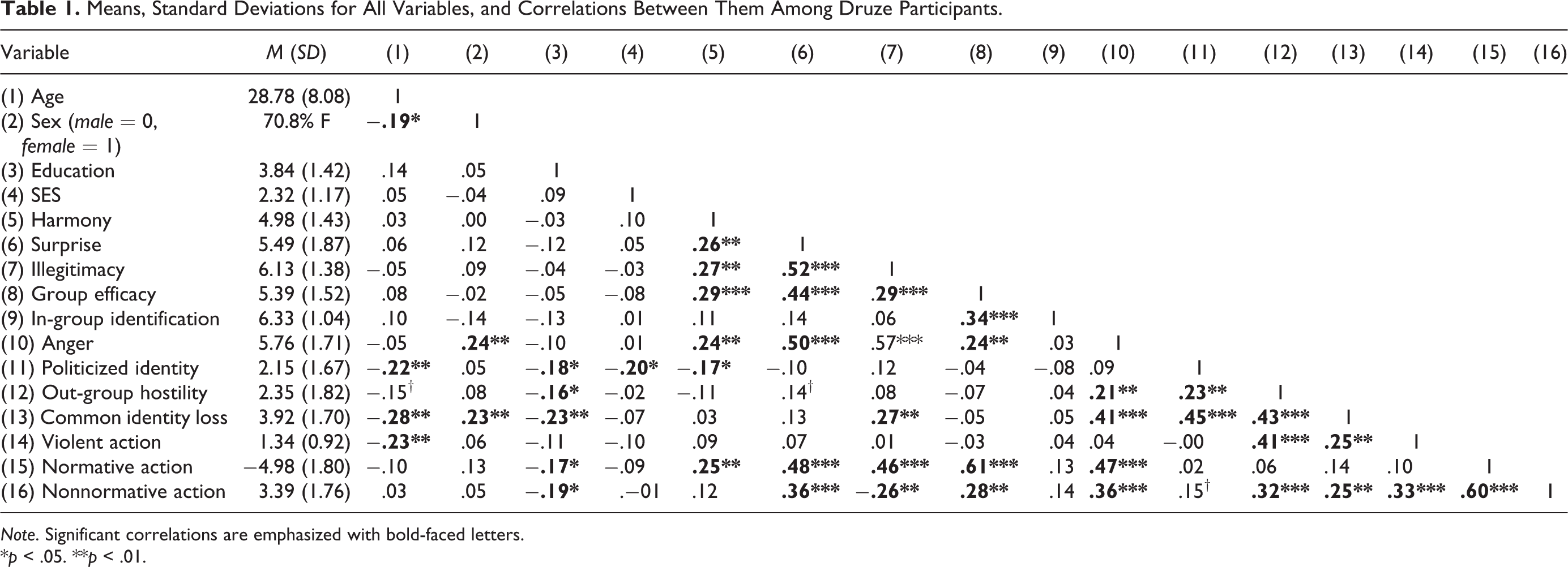
Table 1 presents descriptive statistics. As expected, age was negatively correlated with both common identity loss and tendencies for violent action, indicating that younger (vs. older) Druze scored higher on both measures. Druze also reported feeling relatively high levels of harmony with Jews prior to the bill, M = 4.98; SD = 1.43, significantly higher than the mid-scale level of 4; t(153) = 8.53, p < .001, and indicated the passing of the bill surprised them, M = 5.49; SD = 1.88, significantly higher than the mid-scale level of 4; t(153) = 9.83, p < .001. The mean on violent action was expectedly low (M = 1.35, SD = .93), significantly lower than nonnormative (nonviolent) action tendencies, M = 3.39; SD = 1.76; t(136) = −14.02, p < .001, and also from normative action tendencies, M = 4.98; SD = 1.80; t(136) = −21.89, p < .001).
Means, Standard Deviations for All Variables, and Correlations Between Them Among Druze Participants.
Note. Significant correlations are emphasized with bold-faced letters.
*p < .05. **p < .01.
These statistics are in line with our assumptions that relations of Druze with Jews, prior to the bill, were experienced as harmonious and that the bill surprised them. It further confirms our assumption that younger Druze experienced a deeper sense of common identity loss and had more intentions to protest radically (even though this tendency overall was low).
Violent action
To test our central prediction that particularly for younger Druze (1 SD below the mean of 28.78, SD = 8.08), common identity loss would be a meaningful predictor of violent action, we run a hierarchical multiple regression model with violent collective action as the outcome variable. We chose this analysis to verify that our proposed predictor, common identity loss in combination with age, adds to the explanation of violent action over and above other known predictors of violent and nonviolent action. Across regression models predictors were mean centered.
The first step included demographic variables (sex, age, SES, and education) and sampling source (R 2 = .10, p = .02). Age was a significant predictor (b = −.03, SE = .01, t = −3.10, p = .002), indicating that younger Druze are more motivated for violent action. The source was also a significant predictor (b = .72, SE = .36, t = 2.01, p = .047), indicating that those sampled via the snowball sample were more motivated for violent action. In the second step (R 2 = .28; p < .001), we added predictors of both violent and nonviolent action, as well as common identity loss (R 2 = .17, for the change from Step 1 to Step 2, p < .001). In this step, age remained a significant predictor (b = −.03, SE = .01, t = −2.47, p = .02), sampling source was no longer a significant predictor, and the known predictors of violent action, out-group hostility (b = .18, SE = .05, t = 4.08, p < .001) and politicized identity 4 (b = −.14, SE = .05, t = −2.65, p = .01), were significant predictors.
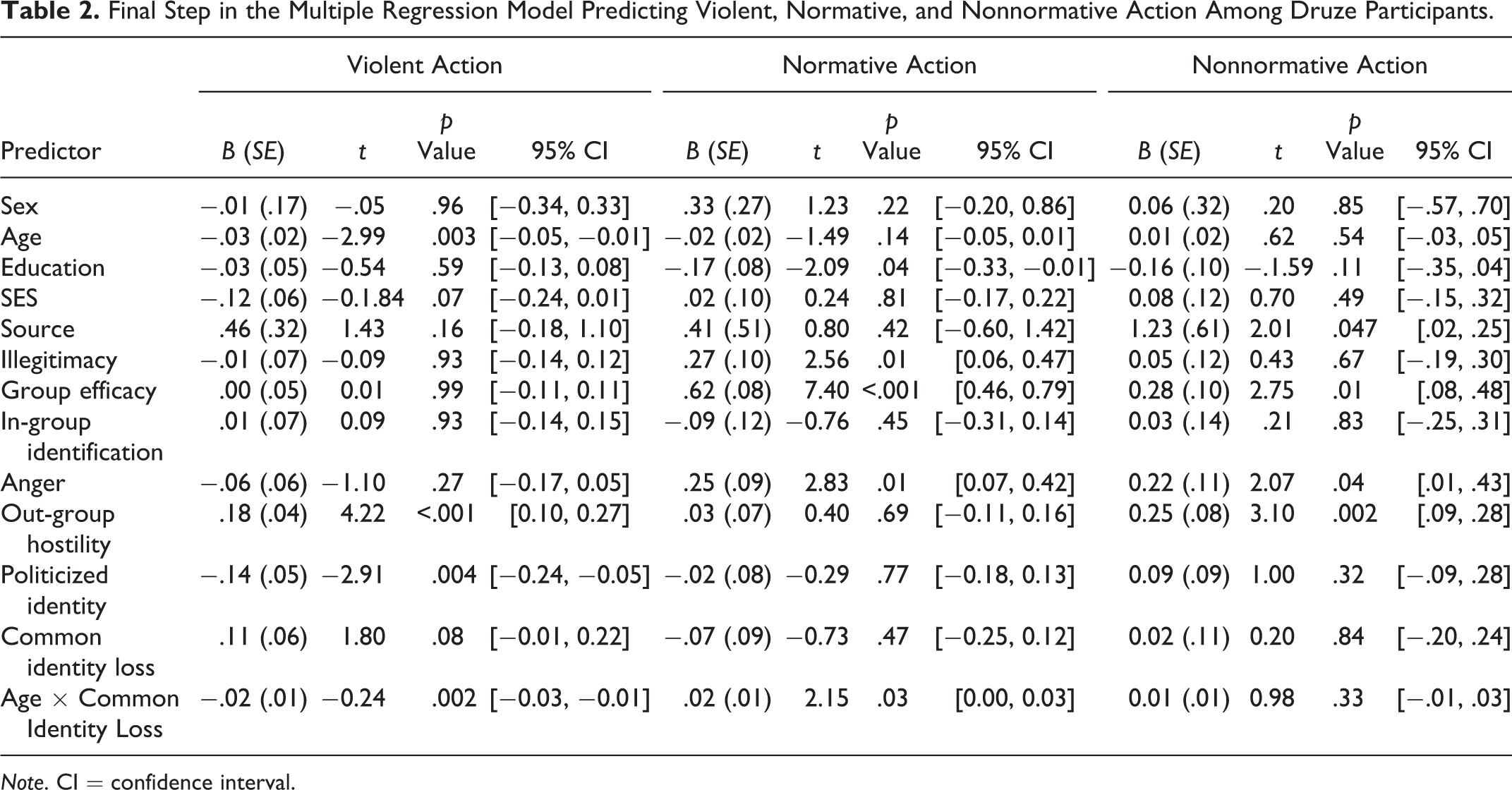
In the third step (R 2 = .33, p < .001), we included the interaction between age and common identity loss (R 2 = .05 for the change from Step 2 to Step 3, p = .002). Table 2 presents all variables in this step. Out-group hostility, politicized identity and age were all significant predictors. Moreover, as predicted, the interaction between age and common identity loss was significant.
Final Step in the Multiple Regression Model Predicting Violent, Normative, and Nonnormative Action Among Druze Participants.
Note. CI = confidence interval.
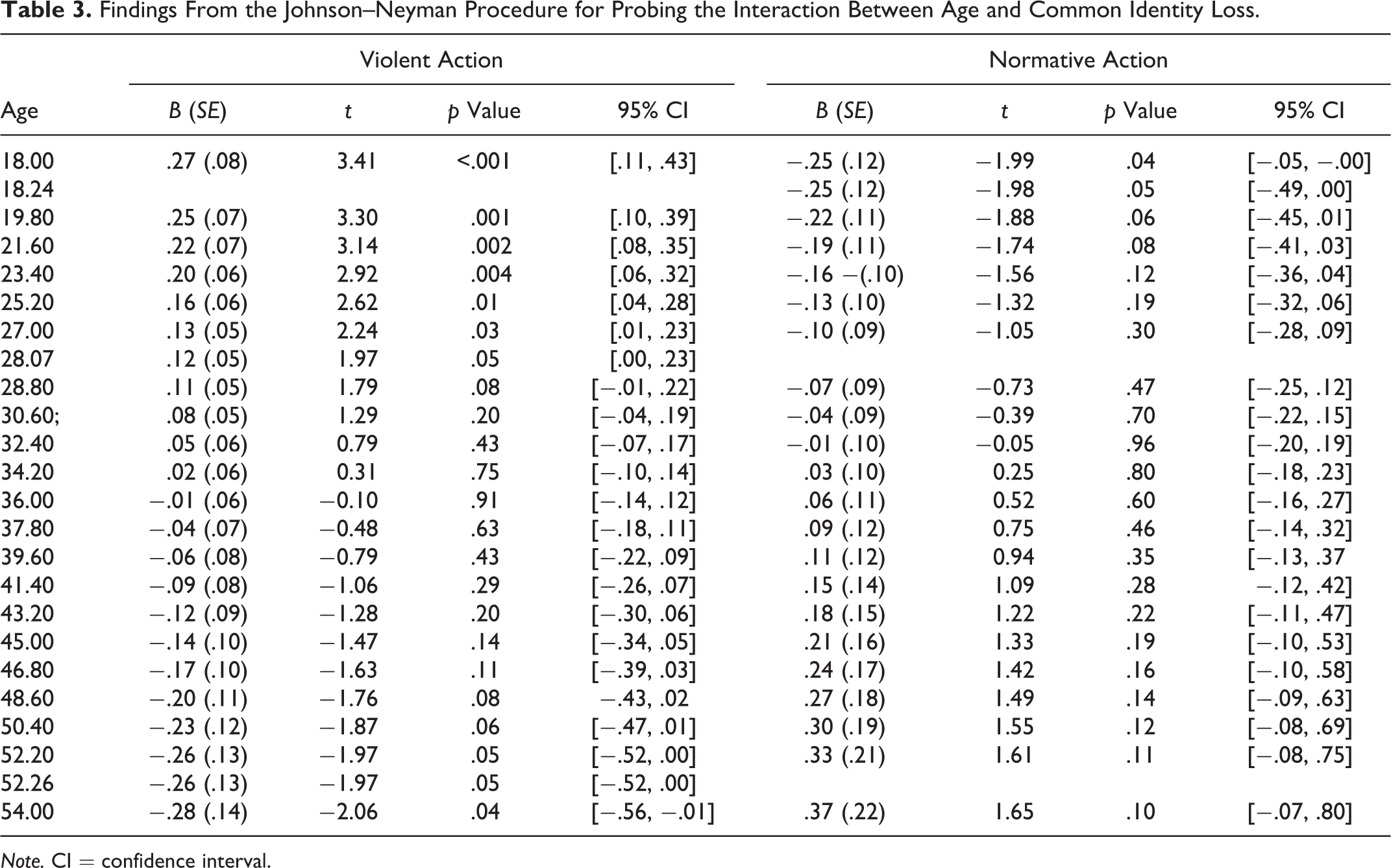
Follow-up tests examining simple slopes (controlling for all variables included in the previous steps), indicated that, as expected, for young Druze (1 SD below the mean, around the age of 21), common identity loss predicted violent action (b = .23, SE = .07, t = 3.21, p = .002), whereas for older Druze (1 SD above the mean, around 37 years old), there was no association between common identity loss and violent action (b = −.02, SE = .07, t = −.32, p = .74). To further corroborate our prediction, we followed up on this interaction using the Johnson–Neyman procedure, which enables to detect at which level of the continues moderator (i.e., age), the effect transitions from being statistically significant to nonsignificant or vice versa. As indicated in Table 3, the association between a sense of common identity loss and violent action was strongest at the age of 18 (the age at which Druze enlist to the army) and became consistently weaker, yet still significant, every year until the age of 27. At the age of 28, the association became nonsignificant.
Findings From the Johnson–Neyman Procedure for Probing the Interaction Between Age and Common Identity Loss.
Note. CI = confidence interval.
Normative action
To explore the association between a loss of common identity and other, more traditional forms of action, we repeated the analysis with normative action as the outcome. Step 1 was overall not-significant (R 2 = .06, p = .17), and there was only a marginally significant effect of education (b = -.21, SE = .11, t = −1.89, p = .06), such that more educated Druze were somewhat less motivated for normative action. In Step 2 (R 2 = .55, p < .001,R 2 = .49, p < .001), education remained a marginally significant predictor (b = −.16, SE = .08, t = -1.97, p = .05), illegitimacy (b = .26, SE = .11, t = 2.44, p = .02), and group efficacy (b = .62, SE = .09, t = 7.24, p < .001), and anger (b = .25, SE = .09, t = 2.79, p = .01) were all significant predictors—confirming much of the (nonviolent) collective action literature (van Zomeren et al., 2008).
Step 3 added significant explained variance to the model (R 2 = .56, p < .001,R 2 = .02, p = .03) and revealed that the significant predictors were again, illegitimacy, group efficacy, anger, and also education and age (see Table 2). Moreover, the interaction between age and common identity loss was significant in this third step as well. Simple slopes analyses did not reveal any significant effects for Druze that were 1 SD below the mean, at the mean, or above the mean of age. The Johnson–Neyman procedure (see Table 3), nevertheless, indicated that for Druze that are 18 years old (just enlisted to the army) the association between a sense of common identity loss and normative action was significant and negative, indicating that for them, a greater sense of loss predicts less intentions to partake in normative action. This association remained negative, albeit weaker, until the age of 32, in which it transformed to become positive, yet nonsignificant. These findings, although weak, suggest that those deeply burdened by a sense of a common identity loss may not only radicalize but also tend to refrain from more normative action that would be inline with the dominant group laws and norms.
Nonnormative action
We repeated the analysis with nonnormative action as the outcome. Step 1 was overall not-significant (R 2 = .08, p = .06), and there was a significant effect of education (b = −.25, SE = .11, t = −2.35, p = .02), indicating that more educated Druze were less motivated to engage in nonnormative action. Sampling source was a significant predictor as well (b = 1.52, SE = .68, t = 2.21, p = .03), indicating that those sampled via the snowball technique were more motivated to pare take in nonnormative action. In Step 2 (R 2 = .32, p < .001,R 2 = .24, p < .001), the significant predictors were group efficacy (b = .28, SE = .10, t = 2.73, p = .01), out-group hostility (b = .25, SE = .08, t = 3.10, p = .002), and anger (b = .22, SE = .11, t = 2.07, p = .04). Step 3 did not explain a significant amount of additional variance (R 2 = .33, p < .001, R 2 = .00, p = .33) and revealed the same predictors (see Table 2), in addition to the sampling source. Loss of common identity did not emerge as a significant predictor at any step, not as a main effect and not when entered as part of an interaction between age and common identity loss. 5
Discussion
The present work considered the consequences of a sense of common identity loss among Druze, a unique ethnic minority group that has been historically connected to the majority Jewish group. We examined the reactions of Druze following the passing of a bill, which was considered by many to be discriminatory toward non-Jews (Fuchs, 2018). Previous work indicates that feelings of societal exclusion can deeply burden the self, inducing feelings of meaninglessness that can give rise to radical forms of mobilization (Simon et al., 2013; Troïan et al., 2019). Drawing on this work, we expected a common identity loss to predict radical forms of action, particularly for those whose sense of common identity loss is strong and reflects shuttering of expectations. In the case of Druze, we expected the younger generation, for whom the army service and related expectations might be at a peak, to be most likely to show radicalization as a function of common identity loss.
We found that for Druze who were during, or close in time to, their army service, the passing of the bill was associated with a sense of a common identity loss that predicted intentions to partake in violent forms of action. Druze had overall very low levels of radical intentions, which is expected given their history (Halabi, 2006). Nevertheless, particularly because Druze are so unlikely to partake in violent protest, predicting an increase in this tendency is highly relevant for understanding the consequences of a loss in common identity. We also found some weak indication that a sense of identity loss was associated with lower intentions to protest the bill via normative forms of action. Intentions to engage in nonnormative forms of nonviolent action were not predicted by a sense of identity loss. This suggests that identity loss relates specifically to violent forms of mobilization, and might also, sometimes inhibit intentions to partake in forms of action that are normative.
The current evidence is limited in several respects. It relies on a relatively small sample of Druze. Moreover, the data are cross-sectional and do not enable to conclude directionality of the effects. We cannot determine whether a sense of common identity loss precedes radical tendencies or the other way around. While both directions are possible, we assume that when the study was conducted, the intentions to partake in action were a result of the political occurrences which presumably gave rise to a sense of common identity loss. We also capitalized on an assumption, well grounded in political reality, that Druze have had a sense of deep connection to Jews prior to the passing of the bill. This, nevertheless, was not specifically captured in our data. We did have a measure of retrospective harmony, but it did not enable us to assess actual levels of commonality prior to the bill. In future work, we attempt to manipulate or directly assess in an overtime design, the baseline sense of commonality or connection to the majority group, which should be a necessary condition for the experience of common identity loss.
Given the vast use of establishing common identity as a way to reduce intergroup hostility, understanding the long-term consequences of a common identity can be of great theoretical and practical value. For example, programs that stress common connections may want to focus also on creating realistic expectations on part of minority group members, to avoid potential backlash, and have in place mechanisms to continue contact and dialogue between groups after the official program has ended. Theoretically, our work stresses the importance of moving beyond traditional predictors of collective action (e.g., identification, efficacy; van Zomeren et al., 2008) to study the expectations minority group members have of their relation to the majority group. Future work can deepen the understanding obtained in this research by identifying the goals of the disappointed minority group when turning to violence. Is it an attempt to restore common identity? To be heard? To punish? A response to humiliation? Although future research will have to verify causality, the current findings suggest that a sense of identity loss can be meaningful and consequential to intergroup relations in certain contexts, specifically by increasing willingness by the excluded group to engage in violent actions against the excluding group. We believe that deeper investigation of these processes can also shed light on what can be done to attenuate such effects.
Supplemental Material
Supplemental Material, identity_dissapointment_Supplementary_revision - When a Sense of “We” Is Lost: Investigating the Consequences of a Lost Common Identity Among Druze in Israel
Supplemental Material, identity_dissapointment_Supplementary_revision for When a Sense of “We” Is Lost: Investigating the Consequences of a Lost Common Identity Among Druze in Israel by Tamar Saguy, Danit Sobol-Sarag, Samer Halabi, Katherine Stroebe, Emile Bruneau and Siwar Hasan-Aslih in Social Psychological and Personality Science
Footnotes
Declaration of Conflicting Interests
The author(s) declared no potential conflicts of interest with respect to the research, authorship, and/or publication of this article.
Funding
The author(s) received no financial support for the research, authorship, and/or publication of this article.

Supplemental Material
The supplemental material is available in the online version of the article.
Notes
References
Supplementary Material
Please find the following supplemental material available below.
For Open Access articles published under a Creative Commons License, all supplemental material carries the same license as the article it is associated with.
For non-Open Access articles published, all supplemental material carries a non-exclusive license, and permission requests for re-use of supplemental material or any part of supplemental material shall be sent directly to the copyright owner as specified in the copyright notice associated with the article.
