







Abstract
Agency is a basic dimension of evaluations of social groups. More agency is assigned to in-groups than to out-groups, and verb intergroup bias (VIB) captures this tendency in language use. Four studies that performed large-scale quantitative analysis of natural language use, which covered more than 200 billion words, 20 countries, and various time spans, support the VIB model. Verbs, which are prototypically associated with actions, serve as agency indicators, and thus generic in-groups are more often described with verbs (we vs. they). Moreover, VIB is present in specific between-group comparisons: for Americans as an in-group reference and various out-groups (e.g., Mexicans, Russians, and Palestinians), as well as for Americans, Canadians, Britons, and Australians as in-group references and immigrants as a generic out-group. VIB is a useful tool in diagnosing intergroup discourses. Furthermore, VIB attests to the importance of analyzing language’s role in the formation and maintenance of social biases.
Keywords
Minimal effort is needed to categorize people into in-groups or out-groups (i.e., us or them). This rudimentary tendency (Tajfel & Turner, 1979) is, unsurprisingly, ingrained in language (Giles, 1978). In language, the distinction between groups is marked by what we say about others using, for example, exclusive (Sczesny, Formanowicz, & Moser, 2016) or derogatory language (Bianchi, Carnaghi, Piccoli, Stragà, & Zotti, 2019; Carnaghi & Maass, 2007; Greenberg & Pyszczynski, 1985; Simon & Greenberg, 1996). It is also marked by how we talk about them in terms of syntax (Carnaghi et al., 2008; Maass, Milesi, Zabbini, & Stahlberg, 1995) or word order (Cooper & Ross, 1975; Hegarty, Watson, Fletcher, & McQueen, 2011; McGuire & McGuire, 1992).
Verb intergroup bias (VIB) captures a previously unrecorded manifestation of intergroup bias in the latter aspects of language. It is based on the premise that agency (i.e., striving to achieve goals) is a basic dimension of evaluation of social groups (Koch, Imhoff, Dotsch, Unkelbach, & Alves, 2016); in-groups are generally considered to have higher agency than out-groups (Fiske, Cuddy, & Glick, 2007; Fiske, Cuddy, Glick, & Xu, 2002). In this article, I hypothesize that the importance of agency in the intergroup domain is likely to manifest in language, which is inherently involved in the formation and maintenance of social biases (Maass, Arcuri, & Suitner, 2014) and affects intergroup relations (Idan, Halperin, Hameiri, & Reifen Tagar, 2018). Given that verbs are prototypically associated with actions (Vigliocco, Vinson, Druks, Barber, & Cappa, 2011), they serve as indicators of agency (Formanowicz, Roessel, Suitner, & Maass, 2017). Thus, according to VIB, in-groups should be described with verbs more often than out-groups.
Intergroup Biases in Language
Intergroup processes are inherent parts of social reality and this is represented in language. The way in which language can differentiate between in-groups and out-groups was first addressed in the influential work on linguistic intergroup bias (LIB; Maass, Salvi, Arcuri, & Semin, 1989). LIB is based on the linguistic category model (LCM), which differentiates between grammatical categories based on the abstractness of the information they convey (Carnaghi et al., 2008; Semin & Fiedler, 1988). Descriptive action verbs (DAVs), which are the most concrete grammatical units, refer to behavior in a specific situation. They have low interrater variability as action verbs evoke convergent representations. For example, in the phrase, he kicked the dog, kicking always refers to leg movement. Interpretative action verbs represent a larger class of behaviors; for example, in the phrase, he hurt the dog, hurt is subject to interpretation and is not necessarily related to kicking, as in the example related to DAV. The smallest class of verbs, state verbs (SVs), describes psychological states at a higher level of abstraction (e.g., he hates the dog). The most abstract units are adjectives (e.g., he is an aggressive person) and nouns (e.g., he is a perpetrator), which are mainly used to express general dispositional judgments (Carnaghi et al., 2008; Gelman & Heyman, 1999; Walton & Banaji, 2004; for an alternative account, see Geschke, Sassenberg, Ruhrmann, & Sommer, 2007; for a study without any abstractness bias, see Collins & Clément, 2018).
In line with the LCM, LIB is present, when intergroup relations are expressed as a function of abstractness and valence. An in-group is described with abstract positive and concrete negative qualities to maximize positive stable associations, whereas an out-group is described with abstract negative and concrete positive qualities to maximize negative ascriptions and highlight the ephemeral nature of the positive qualities (Maass, Ceccarelli, & Rudin, 1996; Maass et al., 1995, 1989).
There are two mechanisms underlying LIB. One is motivational and aims to protect the in-group (Maass et al., 1996). For example, people may use LIB in order to protect their social identity (Brewer, 1979; Brown & Hewstone, 2005; Brown & Zagefka, 2008). Motivated LIB is particularly strong when one’s identity is threatened (Maass et al., 1996) or in cases of purposeful (as opposed to purposeless) communication (Semin, Gil de Montes, & Valencia, 2003). The second mechanism underlying LIB is cognitive (Maass et al., 1995) and based on linguistic variations in whether stereotypes are described consistently (i.e., with expected information) or inconsistently (i.e., with unexpected information). People tend to describe expected things in abstract terms and unexpected things in concrete terms. For an in-group (out-group), positive (negative) associations are the default—and hence the pattern observed in LIB. Both LIB mechanisms have been found to operate in relation to various groups (for a review, see Maass et al., 2014).
Yet, although important, valence and abstractness are not the only dimensions that are relevant to intergroup relations; groups are also subject to evaluation based on their agency and communion (Abele & Wojciszke, 2014; also referred to as competence and warmth in stereotype content model; Cuddy, Fiske, & Glick, 2008; Fiske et al., 2007). Agency refers to traits related to goal achievement, such as activity and efficacy, while communion refers to traits related to relationship maintenance, such as friendliness and helpfulness (Abele & Wojciszke, 2014). While both dimensions play a crucial role in the social perception of groups (Cuddy et al., 2008), I will focus only on agency in this study. First, agency is undoubtedly important for evaluation of social groups (Koch et al., 2016). It is used for intergroup differentiation; in-groups are generally considered to have higher agency than out-groups (Fiske et al., 2007). It is also closely related to perceptions of humanity (Formanowicz et al., 2018), respect (Wojciszke, Abele, & Baryla, 2009), and status (Fiske et al., 2002), all of which play a fundamental role in defining intergroup relations.
However, the main reason that this article focuses on agency is that there is a family of linguistic agency biases that can play important roles in intergroup relations. Various studies have documented that different linguistic agency ascriptions align with stereotypical evaluations of groups (e.g., Formanowicz et al., 2017; Hegarty et al., 2011; Madera, Hebl, & Martin, 2009; Tipler & Ruscher, 2014). For example, men tend to be described with more agency-related terms than women, which perpetuate gender stereotypes (Madera et al., 2009). Additionally, agency plays a role in dehumanizing metaphors about out-groups (Tipler & Ruscher, 2014). Word order within word pairs can also express linguistic agency bias; for example, a sentence with both a female and a male referent will usually mention the male first (Hegarty et al., 2011). Mentioning entities with higher agency first also has effects outside the gender domain; when referring to a pair or group of people, people tend to mention first the person or group that is more powerful (Benor & Levy, 2006) or has higher social status (McGuire & McGuire, 1992). Although agency is usually reflected in semantic references or word order, recent evidence (Formanowicz et al., 2017) suggests that agency bias can also occur at a grammatical level.
Verbs as Markers of Agency
There is strong evidence of an embodied link between verbs and denoting actions. Research has documented the role of verbs (e.g., those referring to manual activity) in inducing activity in the motor and premotor regions of the brain (e.g., Cappa & Pulvermüller, 2012). For example, the zygomatic major muscle is more strongly activated when participants are exposed to the verb smile than when they are exposed to the adjective funny (Foroni & Semin, 2009). Also, neurodegenerative diseases related to impairments in motor functioning are linked to deficits in the processing of verbs (García et al., 2017).
However, verbs do not only indicate activity but also agency. The verb–agency link has been demonstrated in studies applying a pseudo-word paradigm to disentangle the effects of the semantical and syntactical properties of verbs, adjectives, and nouns (Formanowicz et al., 2017). Pseudo-verbs are consistently evaluated as more closely related to agency than pseudo-adjectives and pseudo-nouns. The meta-semantic effect of grammatical categories is limited to agency and does not affect other important social or psycholinguistic properties of words (i.e., communion, valence, or abstractness). Studies examining real utterances confirmed the effect of the verb–agency, finding that targets followed by a verb are believed to be responsible for their action (Fausey & Boroditsky, 2010).
The psychological link between verbs and activity—and, by extension, agency—is also supported by findings in linguistic research. It is more likely that entities with higher semantic prominence will be assigned the thematic role of an agent (i.e., the one performing the action signaled by a verb) or the grammatical function of a sentence subject (i.e., associated with the verb; Aissen, 1999; de Hoop & Lamers, 2006). The dimension of prominence in linguistics coincides with social hierarchies, for example, animate objects are seen as more prominent than inanimate ones (Bornkessel-Schlesewsky, Schlesewsky, & von Cramon, 2009), and men are seen as more prominent than women (Esaulova, Reali, & Von Stockhausen, 2015). Similarly, and consistent with the instances of linguistic agency bias described above, groups stereotypically associated with high agency, such as men or young people, were more often paired with verbs than groups stereotypically associated with low agency, such as women or elderly people (Formanowicz et al., 2017). Importantly for this article, linguistic prominence also relates to pronouns; first- and second-person pronouns are viewed as more prominent than third-person pronouns (Aissen, 1999). Thus, we (which refers to an in-group) can be followed by a verb more often than they (which refers to an out-group).
General Method
Overview
To test whether verbs are used in reference to an in-group more often than to an out-group, a culturomics approach was used (Michel et al., 2010). That is, I performed a quantitative analysis of cultural phenomena expressed through human linguistic behaviors (Ireland & Mehl, 2014). Importantly, the results of such textual archival analyses are highly convergent with the results of experiments investigating the same phenomena (Formanowicz et al., 2017). For example, men, a social category stereotypically associated with agency, is followed by verbs more frequently than women, a social category stereotypically not associated with agency, in large-scale corpora analysis (Formanowicz et al., 2017). Similarly, eye-tracking studies show that masculine (but not feminine) role nouns are expected to serve as agents in a sentence (Esaulova et al., 2015).
Based on the notions that verbs are linguistic markers of agency and that the culturomics approach can reveal significant cultural trends, I hypothesize that an in-group (i.e., a prominent target with agency) is more often associated with verbs than an out-group (i.e., a less prominent target with lower agency). In Studies 1 and 2, this hypothesis was tested in different corpora from a variety of sources, considering more than 200 billion words and using and comparing generic targets (i.e., we vs. they). In Study 3, I focused on a U.S. corpus. References to the in-group Americans were contrasted with references to various out-groups chosen from a Gallup poll (https://news.gallup.com/poll/181961/canada-great-britain-americans-favored-nations.aspx?g_source=link_NEWSV9&g_medium=TOPIC&g_campaign=item_&g_content=Canada%2c%2520Great%2520Britain%2520Are%2520Americans%27%2520Most%2520Favored%2520Nations) on Americans’ views of foreign nations (i.e., Canadians, Germans, Indians, Israelis, Mexicans, Egyptians, Cubans, Russians, Palestinians, Syrians, Afghans, and Iranians). In Study 4, I used American, Canadian, British, and Australian corpora to compare the frequency at which verbs are used for four different in-groups (Americans, Canadians, Britons, and Australians) and immigrants. As immigrants are generally evaluated negatively (Fiske et al., 2002), according to the above hypothesis, they should be associated with verbs less often. In addition, they may be evaluated with more negative verbs than the in-groups. In such cases, the semantic effect (i.e., valence) could overlap with the grammatical effect (i.e., usage of verbs), making the contribution of each unclear. In Study 4, I tested for this possibility by comparing the valence of the verbs used to describe the in-groups and out-groups.
Procedure
I used the part of speech tagging function within the Constituent Likelihood Automatic Word-tagging System (Garside, 1987), which has an accuracy of 96–97% for written texts and is available freely for the analyzed corpora. Given that English sentences usually place the subject before the verb and object of the sentence (Dryer, 2013), this syntax should be most effective for capturing different subject–verb pairings (Formanowicz et al., 2017). I searched for collocations of we [verb] and they [verb]. Moreover, given that the agency-related components of verb processing are clearest in the present tense (Carrera et al., 2014; Carrera, Muñoz, Caballero, Fernández, & Albarracín, 2012), only the base forms of lexical verbs (e.g., give, work) were included. This also means that passive sentences were not included in the investigation; due to differences in the effort required to process active and passive sentences, and the latter being used much less frequently in everyday speech (Ferreira, 1994). Moreover, following the LIB approach, I excluded the most common auxiliary and linking verbs, to have and to be (Coenen, Hedebouw, & Semin, 2006), because they refer to a subject’s disposition (e.g., they are smart) rather than to their actions. Finally, to ensure comparability of we and they references, I focused on the 100 most popular target word (verb) collocates, excluding very rarely used words, typos, and out-of-vocabulary units (for a similar approach that focused on representative words, see Pietraszkiewicz et al., 2019). A sensitivity analysis provided in the Supplemental Online Material (SOM), which used other cutoff points defined in absolute terms (i.e., the 500 most popular target word [verb] collocates) or relative terms (i.e., collocates that occurred more often than 1, 0.10, and 0.01 times per million words) gave results comparable to the one described in the main article.
Data Analysis
In order to determine whether verbs are used differently in reference to the target words, a meta-analytical approach using the metafor package in R was employed (Viechtbauer, 2010). Every corpus was treated as a separate study, in which I assessed (1) the overall occurrence of the target words (to assess the base rates) and (2) the frequency of target words representing the in-group (vs. those representing the out-group) that were immediately followed by a verb (e.g., a search command for instances of we [verb base form]—as in we want). This approach allowed to compute odds, odds ratios (ORs), and log ORs with the corresponding sampling variance—the latter two of which were required for the meta-analysis. An OR equal to one indicated that the in-group and out-group are described with verbs at similar frequencies, while an OR with confidence intervals (CIs) above (below) 1 indicated that the in-groups are described with more (fewer) verbs than the out-groups. All the meta-analyses were conducted using the restricted maximum likelihood estimation. In all studies, the size of the OR was interpreted according to the recommendations of Chen, Cohen, and Chen (2010). The data entries and R code for all the studies are available at the following website (https://osf.io/r9afe/).
Study 1: We Versus They Across Corpora
Method
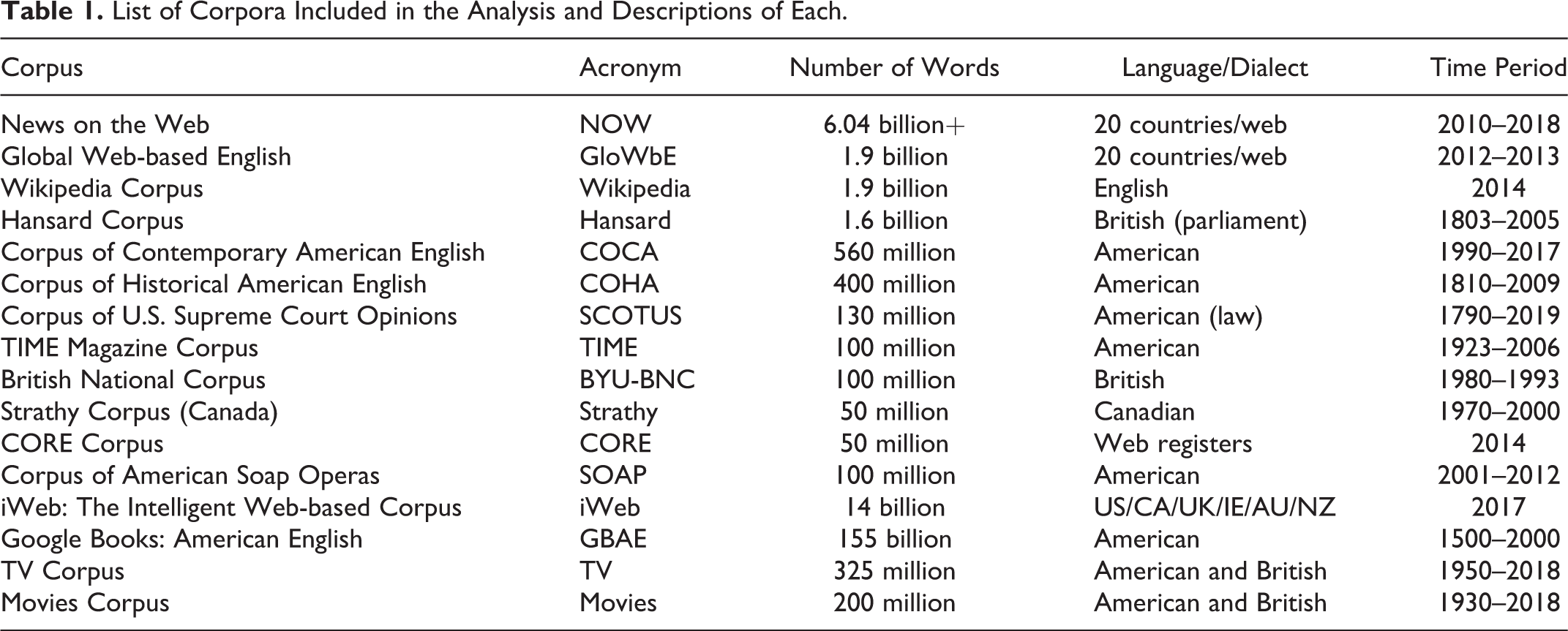
In the analysis, 17 contemporary large-scale English corpora (available at https://corpus.byu.edu) were employed to examine whether a generic reference to the in-group, we, was associated with higher usage of verbs than a reference to they. Sources included Google Books (Michel et al., 2010), the corpus of Global Web-based English (GloWbE; Davies, 2013a), and the News on the Web (NOW) corpus (Davies, 2013b). These corpora provided access to many language registers in legal documents, print and online newspapers, spoken language, web-related content, scientific articles, and books. The full list of corpora and descriptions of each are presented in Table 1. The full list of references is provided in the SOM.
List of Corpora Included in the Analysis and Descriptions of Each.
Results
The analysis revealed a small but significant effect size (OR = 1.40, 95% CI [1.17, 1.67]), indicating that on average verbs were used more often in relationship to we rather than they. The results of the first meta-analysis are presented in Figure 1. There were three corpora, however, in which a higher number of verbs was used in reference to they: Corpus of American Soap Operas (Davies, 2011), Movies (Davies, 2019a), and TV corpus (Davies, 2019b). These corpora include spoken language (other sources predominantly included written language), and they are all related to entertainment. Therefore, it is possible that spoken language or other informal sources use a lower number of verbs in reference to we (vs. they). Despite this result in three sources, the average effect remained unaltered.
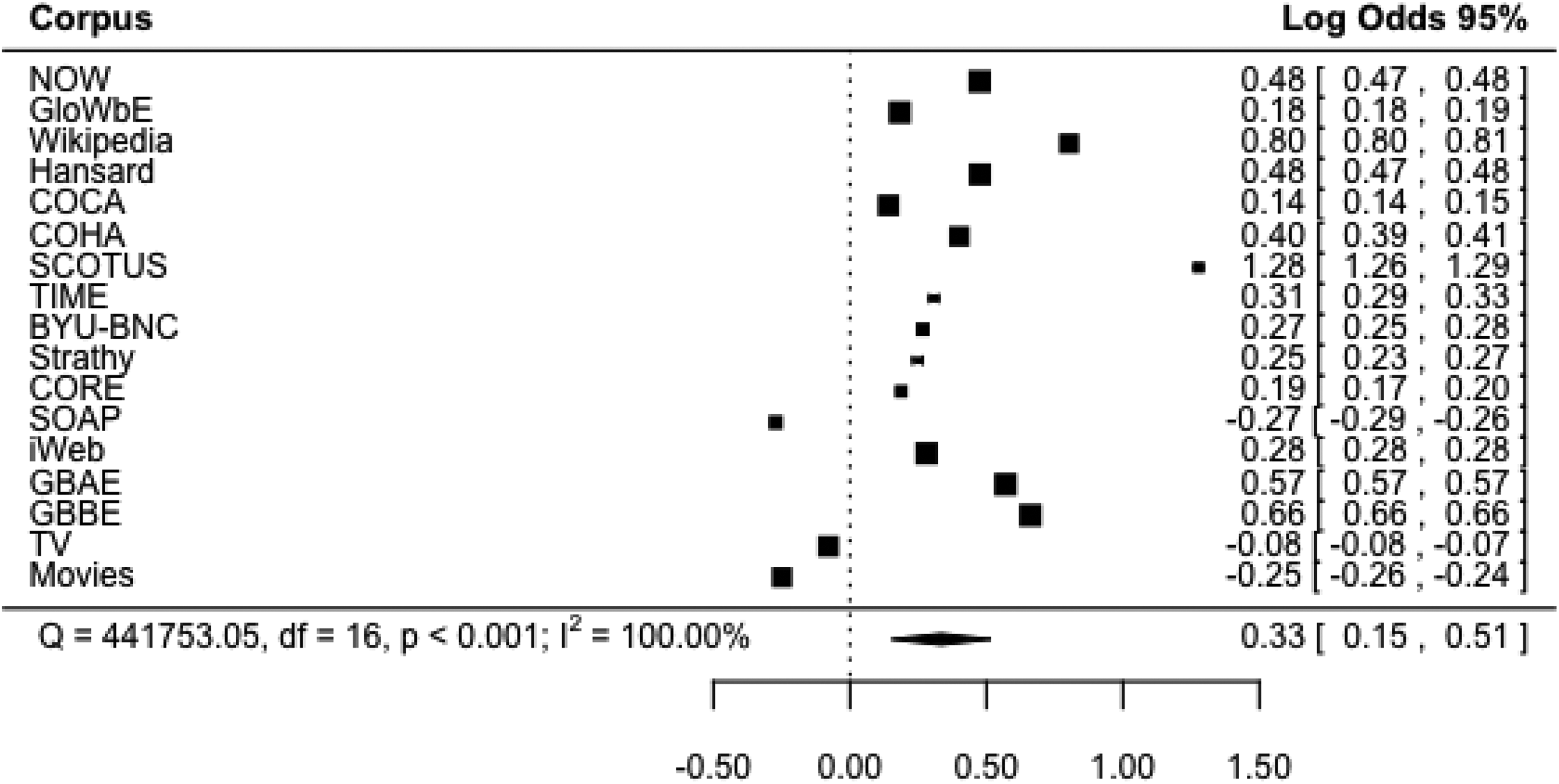
Forest plot of individual and pooled random effects estimates of the log odds ratios examined across 17 corpora. The effects within each corpus (country or time point) are represented by symbols with different areas, which are proportional to each item’s weight in the meta-analysis.
Study 2: We Versus They Across Countries
Method
The same method was applied to the GloWbE corpus (Davies, 2013a), a collection of web-related content in English from 20 countries (United States, Canada, Great Britain, Ireland, Australia, New Zealand, India, Sri Lanka, Pakistan, Bangladesh, Singapore, Malaysia, Philippines, Hong Kong, South Africa, Nigeria, Ghana, Kenya, Tanzania, and Jamaica) that includes more than 1.9 billion words. Country was used as the unit of analysis.
Results
The analysis revealed a small but significant effect size (OR = 1.21, 95% CI [1.18, 1.25]). For all countries, the effect observed in Study 1 was replicated. The results of the meta-analysis are presented in Figure 2.
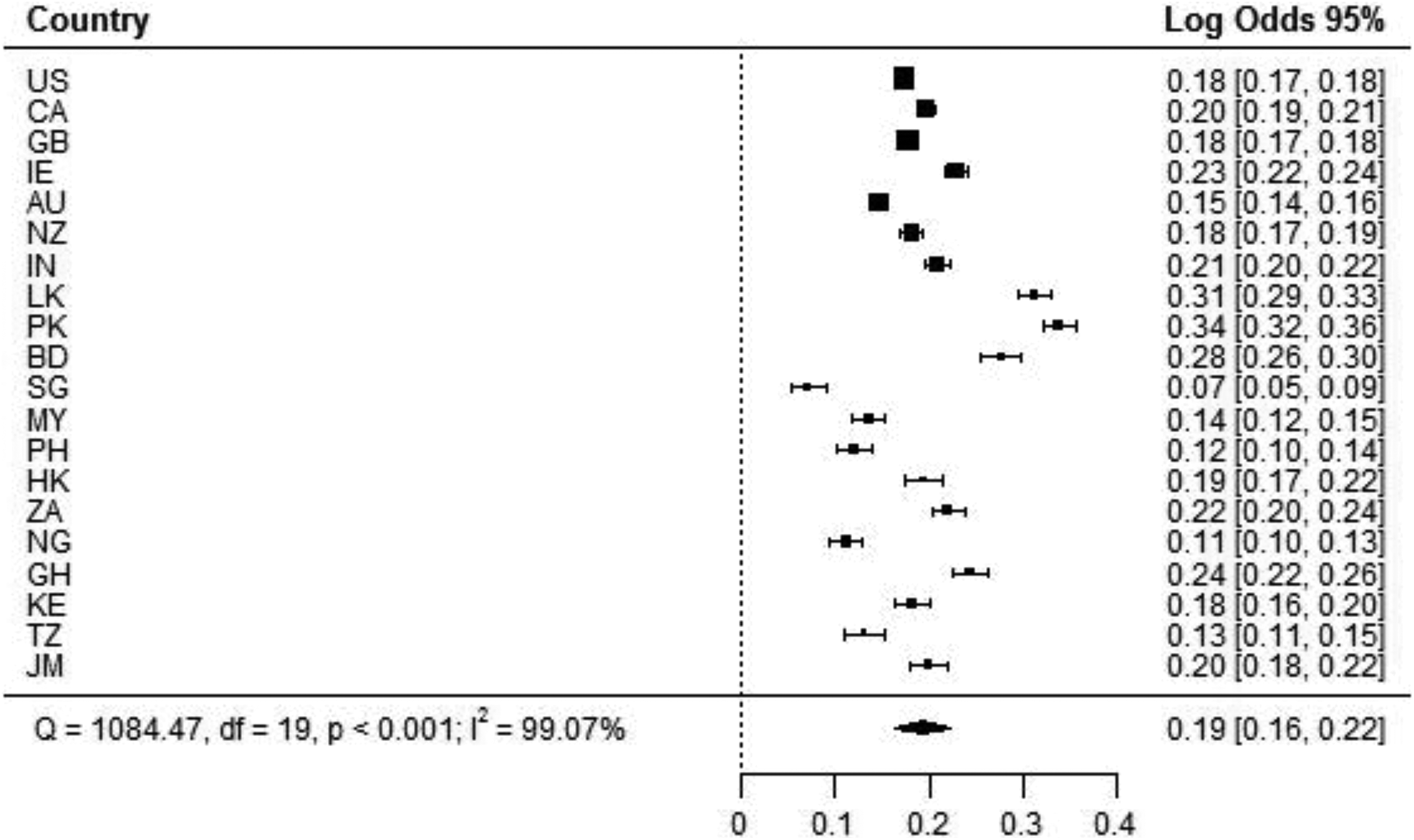
Forest plot of individual and pooled random effects estimates of the log odds ratios examined across 20 countries.
Study 3: Americans Versus Other Out-Groups
Method
The same method as described above was applied to the NOW corpus (Davies, 2013b), a collection of web-based newspapers and magazines that includes more than 6.8 billion words. NOW covers publications from 2010 to the present, split into half-year intervals. Time points were used as the unit of analysis. The largest subcorpus of textual data from the United States was used to analyze whether the in-group reference Americans appeared with verbs more often than out-groups chosen from a Gallup poll referenced above on Americans’ views of foreign nations. Twelve out-groups were chosen for which the group name was a one-word unique reference (thus, the analyses included Germans, but not the French, and Canadians, but not North Koreans) and for which at least 100 verbs that were associated with the out-group name appeared. This approach resulted in the following comparison out-groups: Canadians, Germans, Indians, and Israelis (evaluated favorably); Mexicans, Egyptians, and Cubans (evaluated moderately favorably); and Russians, Palestinians, Syrians, Afghans, and Iranians (least favorably evaluated).
Results
Table 2 presents a summary of the ORs, log ORs, and corresponding CIs. For the corresponding forest plots, see the SOM. The VIB effect (i.e., in-group names were more often paired with verbs than out-group names) was observed for all but one group. Canadians were judged as similar to Americans, likely due to the geographical closeness and common language. Out-groups similar to the in-groups may be viewed as sharing their positive qualities (Fiske et al., 2002), and this perception may elicit collaboration rather than competition (Riketta & Sacramento, 2008). As collaboration is positively related to the use of verbs (Albarracín, Noguchi, & Fischler, 2011), hyper-positively evaluated groups could be described with a similar number of verbs to the in-group, while the number of verbs may be lower for less similar out-groups. However, it should be noted that this may be a chance finding, and, thus, the above interpretation needs to be treated with caution.
Summary of the Results Comparing Americans and Various Out-Groups.
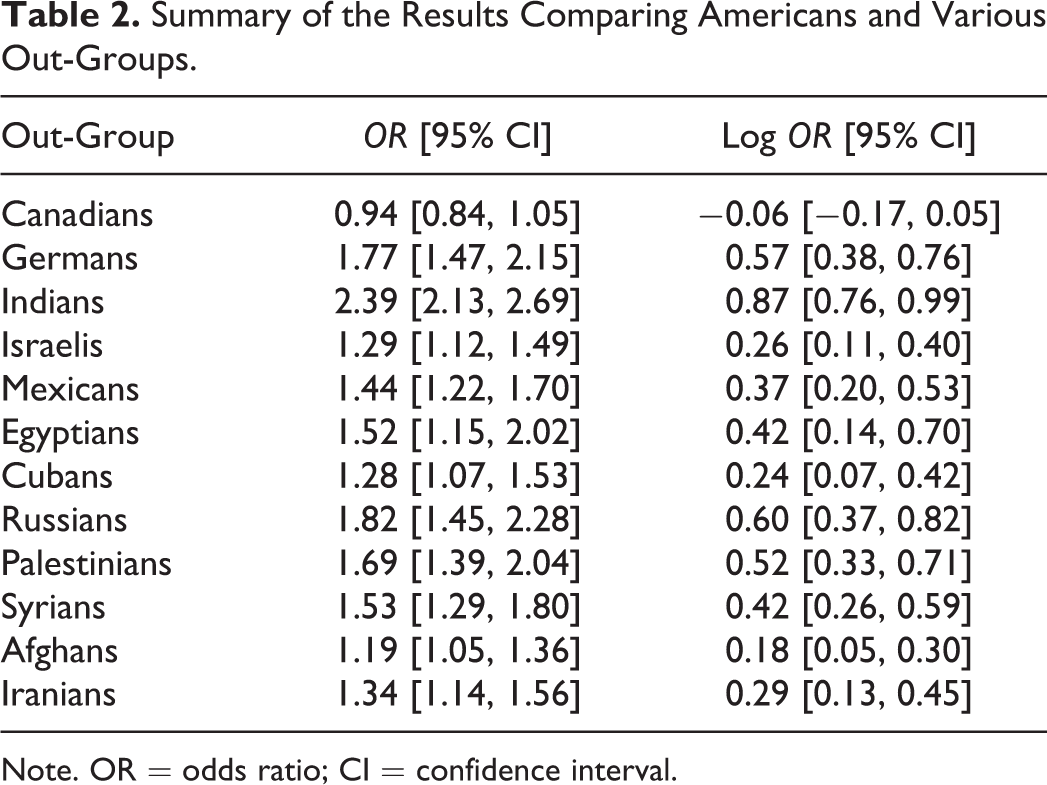
Note. OR = odds ratio; CI = confidence interval.
Study 4: Americans, Canadians, Britons, and Australians Versus Immigrants
Method
Study 3 was extended by using the four largest national subsets of NOW: United States, Canada, Great Britain, and Australia (Davies, 2013b). For all the subsets, I analyzed whether the in-group name (Americans, Canadians, Britons, or Australians) was associated with higher usage of verbs than immigrants. Using a highly negatively evaluated out-group (Fiske et al., 2002) as a contrast allowed to (1) replicate VIB in a societally relevant context and (2) determine whether it is the use of verbs or the meaning of verbs that differentiates an in-group from an out-group by checking whether the verbs used in reference to the in-group are more positive than the verbs used in reference to the out-group. For each group, the 100 most often used verbs were assigned valence based on existing word ratings (Warriner, Kuperman, & Brysbaert, 2013), allowing to compare the content of the utterances. The weights R package was applied to compare the valences of the 100 most popular words weighted by frequency (Pasek, 2011).
Results
Table 3 presents a summary of the ORs, log ORs, and corresponding CIs as well as the results of the valence comparison. For the corresponding forest plots, see the SOM. The results indicate that in all four corpora, the in-groups were associated with a higher number of verbs than immigrants. Importantly, the verbs used in reference to the in-groups and immigrants had similar valances. Thus, it was only grammar, rather than valence, that differentiated the linguistic representation of the out-groups.
Summary of Results of a Comparison of Various In-Groups and Immigrants.

Note. OR = odds ratio; CI = confidence interval.
General Discussion
Across four large-scale textual analyses, I found a robust pattern in which the generic in-group, we, was more often associated with verbs than the generic out-group, they (Studies 1 and 2). This effect was pronounced for the majority of out-groups that were notable to the U.S. population (Study 3), especially immigrants (Study 4). The latter effect in reference to immigrants was noted also in language of three other in-groups, namely, Canadians, Britons, and Australians.
This is the first study to document VIB, a powerful intergroup bias in English written language that corresponds with previous findings by (1) highlighting the possibility of language to differentiate in-groups from out-groups (Maass et al., 1996, 1989) and (2) implying the importance of linguistic manifestations of agency to the intergroup domain (Formanowicz et al., 2017; Hegarty et al., 2011; Madera et al., 2009; Tipler & Ruscher, 2014). VIB fits well into these two streams of literature, showing that in-groups ( more so than out-groups) are portrayed as having agency through grammatical means.
In this way, VIB shares the general principle outlined by the LIB (Maass et al., 1989) in that the use of grammatical categories allows to distinguish intergroup attitudes and differentiate between linguistic representations of in-groups and out-groups. However, it is difficult to determine the relationship between VIB and LIB at this point due to measurement differences between the two accounts. LIB has been predominantly measured with two methods. In the first, participants view an image depicting a behavior and are given four possible answers with various positions on the concreteness–abstractness spectrum (Maass et al., 1989). Usually, a value of 1 is assigned to the most concrete DAV, and a value of 4 is given to an adjective. The total of participants’ responses is calculated as an average of multiple indicators and can vary between 1 and 4. The abstraction scores provided in the literature often remain within the 1–3 range (e.g., Douglas & Sutton, 2003; Douglas, Sutton, & Wilkin, 2008; Maass et al., 1996, 1989; Werkman, Wigboldus, & Semin, 1999). This means that verbs are most common in reference to both in-groups and out-groups, although it is impossible to use this indicator to determine the raw frequency of such answers and whether more verbs are used for in-groups than out-groups. The second method involves manual coding of answers freely provided by participants or available in archival sources (Maass et al., 1989). References to in-groups and out-groups are classified based on the valence of the entire utterances (positive and negative) and on their abstractness using an elaborate coding system (Coenen et al., 2006). Based on the weighted averages (weights varying from 1 to 4, as described above), a numerical value is determined for a given response (Anolli, Zurloni, & Riva, 2010; Maass et al., 1989; Semin et al., 2003). This method, like the first, does not allow to determine the number of verbs assigned to in-groups and out-groups. Moreover, coding is designed to reflect the stability of the references and their abstractness rather than purely the grammatical categories they used. For example, he always kicks the dog would be coded as the most abstract even though it is using a DAV (Maass et al., 1989). Furthermore, in some studies, SVs are considered to be just as abstract as adjectives and thus span grammatical categories (Dragojevic, Sink, & Mastro, 2017; Salès-Wuillemin et al., 2014).
The methods described above highlight the general aspects of LIB (and LCM) concrete implementation which does not allow to fully disentangle the semantic and structural aspects of analyzed sentences (Formanowicz et al., 2017). The stability component of LIB seems to be most important for determining intergroup differences, sometimes surpassing the importance of the grammatical component of actual language use.
Similarities Between VIB and LIB
In general, the two methods of measuring LIB do not provide information about the possibility of VIB. However, a few of the studies that provided raw frequencies of the use of particular grammatical categories show that in-groups were described with a higher number of verbs than out-groups. For example, the ORs of using verbs for in-groups in comparison to out-groups in different studies were 1.26 (Maass et al., 1989), 1.24 (Anolli et al., 2010), and 3.05 (when raw frequencies were extracted based on a sample and the percentage of occurrences of each grammatical category; Gorham, 2006).
This suggests that both biases can be present together. Indeed, on a very crude level, they both describe how groups can be differentiated with substantively different use of language. Moreover, both lead in-groups to be described in more positive terms. According to LIB, positive references to in-groups are more stable than those to out-group and often are only found for behaviors with a positive valence (see, e.g., Douglas & Sutton, 2003; Maass et al., 1989; Schmid, Fiedler, Englich, Ehrenberger, & Semin, 1996). Similarly, VIB can lead agency to be subtly conveyed to mark in-groups as positive, as agency is positively valanced (Suitner & Maass, 2008).
If the two biases involve the same underlying mechanism, VIB can be a useful method to analyze group differences in discourse because in order to capture LIB in natural language use, texts require an elaborate coding system to distinguish not only the abstractness of phrases but also their valence. Using human coders is costly, which usually limits textual analysis to small samples of texts (Pennebaker & Beall, 1986; for a recent development in coding abstract phrases, see Johnson-Grey, Boghrati, Wakslak, & Dehghani, 2019). The automatized part of speech tagging method employed in this article preserves the ability to differentiate between in-groups and out-groups. Although language use under VIB is less complex than that under LIB, as only verbs referencing a target group are considered, rather than the range of grammatical categories involved in LIB, examining VIB still allows to gauge the language of intergroup relations in a fast and effective manner.
Differences Between VIB and LIB
Yet VIB and LIB can also mark two distinct intergroup processes. In other words, there may be an essential difference between the LIB and the VIB in terms of which intergroup dimension they capture. LIB signals groups’ distinctiveness via in-group favoritism and out-group derogation (Maass et al., 1996) utilizing valence and abstractness in language. VIB focuses on agency, a dimension of social perception that plays a crucial role in intergroup relations (Fiske et al., 2007; Formanowicz et al., 2018; Koch et al., 2016), and thus, it extends the possibilities of intergroup differentiation in language beyond abstraction and valence.
Given that agency is correlated with power and status (Abele & Wojciszke, 2014), pairing in-groups with verbs may be a meaningful signal of in-groups’ real or projected privileged position (Fiske et al., 2007). Moreover, verbs signal agency, and pairing in-groups with verbs can thus subtly convey the possibility that in-groups can take actions. Likewise, priming studies attest to a clear link between goal-related words, which serve as primes, and subsequent goal-oriented behavior (Weingarten et al., 2016). For example, a recent study found that girls were more likely to take action when prompted with a verb slogan Let’s do science than a more abstract Let’s be scientists (Rhodes, Leslie, Yee, & Saunders, 2019). Furthermore, VIB is consistent with other linguistic agency biases, in which the linguistic representations of groups match their stereotypical associations by differentially attributing agency to the groups (Formanowicz et al., 2017; Hegarty et al., 2011; Madera et al., 2009; Tipler & Ruscher, 2014).
The association between verbs and agency can also shed new light on the findings obtained in previous research within the LCM domain. For example, when looking at the closing speeches of defense and prosecution lawyers (Schmid & Fiedler, 1998), their result is consistent with linguistic agency bias perspective. Reanalysis of the raw frequencies provided by Schmid and Fiedler (1998) indicate that the defense, in comparison to the prosecution, uses fewer verbs when describing the defendant (OR = 0.64; for a similar pattern of results in regard to the actual speeches of prosecutors and defense attorneys in the Nuremberg trials, see Schmid & Fiedler, 1996) and more verbs when describing victims (OR = 1.74). This implies that the prosecution can highlight the agency (responsibility) of the defendant, while the defense will highlight the agency of the victims (Fausey & Boroditsky, 2010).
Conclusion
Studying subtle biases in language, such as LIB and VIB, is crucial today, when hate speech and efforts to reduce this type of speech are prevalent. Subtle linguistic biases are likely to pass under the radar of public discourse monitoring methods and may go unaddressed if the public is not made aware of them. Language is the most accessible and efficient tool for transmitting culture; therefore, documenting such linguistic biases is an important first step toward understanding the power of language and its ability to reflect intergroup relations.
Supplemental Material
Supplemental Material, VIB_SOM_2019_09_30supp - Verb Intergroup Bias: Verbs Are Used More Often in Reference to In-Groups than Out-Groups
Supplemental Material, VIB_SOM_2019_09_30supp for Verb Intergroup Bias: Verbs Are Used More Often in Reference to In-Groups than Out-Groups by Magdalena Formanowicz in Social Psychological and Personality Science
Footnotes
Acknowledgment
The author would like to thank Petra Mueller for her help in preparing R syntax for forest plots, Joanna Dolzycka and Jan Nikadon for their help with preparing the datasets for Study 4.
Declaration of Conflicting Interests
The author(s) declared no potential conflicts of interest with respect to the research, authorship, and/or publication of this article.
Funding
The author(s) disclosed receipt of the following financial support for the research, authorship, and/or publication of this article: This research was funded by the OPUS 14—2017/27/B/HS6/01049 grant of the Polish National Science Center awarded to Magdalena Formanowicz.

Supplemental Material
The supplemental material is available in the online version of the article.
References
Supplementary Material
Please find the following supplemental material available below.
For Open Access articles published under a Creative Commons License, all supplemental material carries the same license as the article it is associated with.
For non-Open Access articles published, all supplemental material carries a non-exclusive license, and permission requests for re-use of supplemental material or any part of supplemental material shall be sent directly to the copyright owner as specified in the copyright notice associated with the article.
