







Abstract
Social influence is an inevitable part of human social interaction. Although past research has demonstrated that testosterone has a key role in social interaction, no study has examined its role in social influence so far. Building on previous research showing that minority positions are perceived as risky options and that testosterone is positively associated with status seeking and risk-taking, we hypothesized that basal testosterone renders individuals more receptive to minority positions. In two studies, participants (total N = 250) read messages that were supported by either a numerical majority or minority. As hypothesized, individuals’ levels of basal testosterone were positively related to susceptibility to minority influence. In contrast, susceptibility to majority influence was unaffected by basal testosterone. Given the importance of minorities for innovation and change within societies, our results suggest that individuals with high levels of testosterone may play an important role as catalysts of social change.
Social change often begins with the emergence of a new point of view initially endorsed by a minority (Prislin, 2010). To explain how minority views can spread, past research has focused on the conditions that minorities should meet in order to exhibit social influence (for reviews, see Martin & Hewstone, 2010; Wood et al., 1994). In this article, we take a new approach to this question by focusing on individuals’ hormonal characteristics, which might render them more or less receptive to minorities or majorities. In particular, we argue that basal testosterone renders individuals more receptive to minority positions, thereby abolishing the persuasive power of majorities.
Testosterone as a Social Hormone
Contrary to the conventional wisdom that testosterone is directly associated with domineering, antisocial personality traits and behaviors, correlations between testosterone and aggression in humans have been found to be small and inconsistent (for reviews, Carré et al., 2011; Geniole & Carré, 2018). In fact, there is a growing consensus among scholars that the effects of testosterone can be best understood in terms of the goal to enhance and protect one’s social status (i.e., the status hypothesis; Eisenegger et al., 2011). For example, testosterone has been found to induce status seeking, particularly in situations that constitute a challenge to an individual’s status (Eisenegger et al., 2011). Thus, rather than being directly associated with dominant behavior, testosterone tends to increase behavior to earn status dependent on individual differences and social contextual factors. Since the social situation dictates which behavior is instrumental to enhance and protect one’s social status, testosterone can be implicated in a wide range of behaviors (e.g., aggression, prosocial behavior, sports, trading; Carré & Archer, 2018; Coates et al., 2010; Eisenegger et al., 2011). Furthermore, basal testosterone (i.e., the endogenous level of testosterone) cannot be considered to be a direct correlate of explicit, self-reported trait dominance. Thus, no stable association has been found with self-report measures, and only associations in the low positive range were found with implicit power motivation (Dekkers et al., 2019; Knight et al., 2020; Stanton & Schultheiss, 2009). Additionally, exogenous state-like changes in testosterone level seem to be more closely related to behavior than the endogenous trait-like level of testosterone (Knight et al., 2020; Wu et al., 2016). This led some researchers to postulate that behavior in response to status relevant situations is the result of an interaction between (implicit) power motivation and (basal) testosterone (Slatcher et al., 2011; Stanton & Schultheiss, 2009). Others have postulated that (basal) testosterone is only related to status-related behavior or traits when (trait) cortisol is low (i.e., dual-hormone hypothesis, Dekkers et al., 2019; Grebe et al., 2019; Mehta & Prasad, 2015). Finally, another line of research suggests that (basal) testosterone is positively related to risk-taking (Kurath & Mata, 2018), which is an important prerequisite for status attainment (Coates et al., 2010). We will return to this issue below.
Testosterone and Social Influence
Surprisingly, the role of testosterone in social influence has not yet been examined, although social influence is an inherent part of human interaction. Ubiquitously, others deliberately or accidentally attempt to influence our opinions, decisions, and attitudes. These attempts can come from a multitude of directions—reading customer reviews or listening to your children who want you to increase their pocket money. Frequently, people aim to support their point of view (or to dismiss an opposing point of view) by arguing that this position is endorsed by the majority (or the minority). For example, your children might argue that almost all of their classmates’ parents have increased the amount of their pocket money.
In the present article, we focus on hormonal characteristics that might render individuals more or less receptive to minority or majority influence. Specifically, we test the hypothesis that basal testosterone renders individuals more receptive to minority positions. This hypothesis can be derived by integrating findings from social psychology and endocrinology. Psychological research has shown that people perceive minority positions as riskier than majority positions (Baddeley, 2009; Clark, 1988; Erb et al., 2015; Tindale et al., 1993; Weber et al., 2002; Yu et al., 2013). In particular, this literature leads to the following reasoning (cf. Erb et al., 2015): Adopting the minority position is associated with high gains if correct but with high losses if incorrect. To illustrate, suppose you are the only group member who holds a particular position (i.e., a minority position) and it turns out that you are correct. In this case, you would be considered as “the only one who knew better” which would be highly rewarding. However, if your position turns out to be incorrect, you would seem to be foolish since “everybody else knew better.” By contrast, adopting the majority position is rather safe because the difference between the possible outcomes is small (e.g., going along with a majority option, which turns out to be correct or incorrect, neither enhances nor impairs one’s image or status in the group).
Interestingly, several studies suggest that testosterone is positively related to risk-taking, which is an important prerequisite for status attainment (Coates et al., 2010). Although correlational as well as experimental evidence (e.g., Wu et al., 2016; Wu et al., 2020) is mixed and plagued by methodological heterogeneity and low statistical power (Knight et al., 2020), a recent meta-analysis (Kurath & Mata, 2018) of 108 effect sizes found a small, positive association (r = .12) between basal testosterone and risk-taking personality traits that were robust against the different ways risk-taking was measured.
Connecting these findings with the reasoning outlined above yields a very interesting prediction: Individuals with high levels of basal testosterone should be more likely to adopt a minority position than individuals with low levels of basal testosterone. After all, only individuals taking the risk of adopting a minority opinion have the chance to show their superiority over the majority of the group and, thus, gain status. At the same time, the likelihood of adopting the majority position should be unrelated to basal testosterone. Since conformity maintains the status quo in a group (i.e., the status hierarchy), it is equally appealing to members across all levels of status motivation and, hence, basal testosterone. Put differently, individuals with high levels of testosterone should be equally receptive to minority and majority positions because the former indicates an opportunity to gain, whereas the latter represents an opportunity to protect one’s status. In contrast, individuals with low levels of testosterone should be more receptive to majority than to minority positions because they generally prefer to go for the “safe” option. In conclusion, we predict that basal testosterone renders individuals more receptive to minority positions, while it does not alter individuals’ susceptibility to majority positions (Hypothesis 1a).
However, there is also a competing hypothesis. Note that previous research has shown that testosterone is positively associated with more autonomous or even egocentric decision making. In particular, several studies have found that testosterone is positively related to the traits of dominance and narcissism (Archer, 2006; Pfattheicher, 2016; Sellers et al., 2007; Stanton & Schultheiss, 2009; Turan et al., 2014), which other studies have found to be negatively related to susceptibility to social influence (Kausel et al., 2015; Schultze et al., 2018; Tost et al., 2012). More importantly, studies using testosterone administration suggest that testosterone decreases trust (Boksem et al., 2013; Bos et al., 2010) and leads individuals to overweight their own relative to others’ judgments during a joint decision-making task (Wright et al., 2012). These studies suggest that basal testosterone renders individuals less susceptible to social influence in general (Hypothesis 1b). More precisely, individuals with high levels of testosterone might generally give less weight to whether a minority or a majority supports a position than individuals with low levels of testosterone.
In sum, two hypotheses can be derived from the current literature that provides conflicting views of how basal testosterone shapes individuals’ receptivity toward majority and minority positions (i.e., they predict different forms of interaction effects). The present study aimed to pit these competing hypotheses against each other.
The Present Research
To demonstrate that minority influence—and not social influence in general (Hypothesis 1b)—is related to basal testosterone (Hypothesis 1a), two requirements have to be met (Erb & Bohner, 2007; Kruglanski & Mackie, 1990). First, we have to show that basal testosterone is positively related to receptivity to minority positions. Second, we have to show that this relationship is specific for minority positions and does not occur (or reverse) for majority positions. To meet these requirements, we employed a paradigm that builds on the mere consensus approach (Erb & Bohner, 2007, 2010; Erb et al., 1998). The central idea of this approach is that majority and minority positions can be defined by consensus because it is the only variable that necessarily discriminates between these two positions. Majorities represent a high consensus (i.e., a position most individuals agree on), whereas minorities represent a low consensus (i.e., a position only a few individuals agree on). Erb et al. (1998) found that a persuasive message had a greater impact when it was supported by a numerical majority (85%) rather than by a minority (15%). Specifically, high consensus increased (i.e., enhanced) whereas low consensus decreased (i.e., undermined) the impact of a persuasive message. This held even under “impoverished” conditions, where consensus information was independent of any variables often confounded with consensus in past research (e.g., social conflict, social identification, or social power; cf. Erb & Bohner, 2007; Kruglanski & Mackie, 1990).
The mere consensus approach (Erb & Bohner, 2007, 2010) provides a methodologically sound test of minority and majority influence since it allows the examination of whether consensus itself—detached from other variables—produces evaluative consequences (e.g., attitude change). Following this approach, we investigated how basal testosterone is related to individuals’ receptivity to minority (low consensus) versus majority influence (high consensus). We conducted two studies using a different persuasive message in each. Participants were randomly assigned to either the high (i.e., majority) or the low consensus (i.e. minority) condition. As a dependent variable, we measured participants’ attitude toward the message position. As a mediator variable, we measured participants’ cognitive responses toward the message using thought listing (Erb et al., 1998).
If high basal testosterone only increases the appeal of minority positions (Hypothesis 1a), individuals with high basal testosterone should agree more to a position supported by a minority than individuals with low basal testosterone. In contrast, when the same position is supported by the majority, an agreement should be unrelated to individuals’ level of basal testosterone. Hence, this hypothesis predicts an asymmetric interaction effect (see Figure 1).
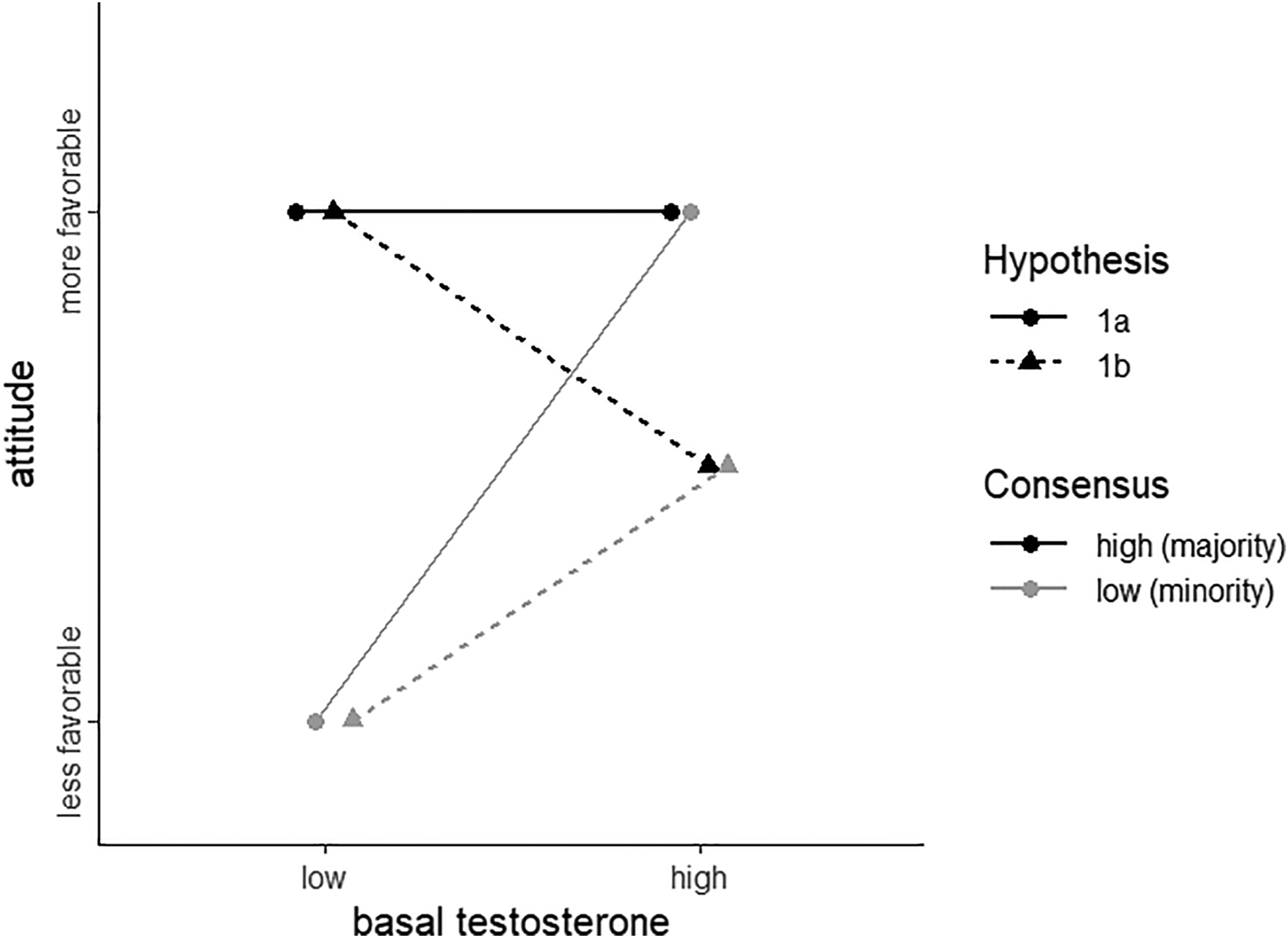
Illustration of the competing hypotheses. See text for details.
However, when the competing hypothesis is true (i.e., basal testosterone renders individuals less susceptible to social influence in general, Hypothesis 1b), we should find that as an individual’s level of basal testosterone increases, the appeal of a position depends decreasingly on its source (minority vs. majority). Since individuals with high levels of testosterone give less weight to whether a minority or a majority supports a position than individuals with low levels of testosterone, these individuals should not agree more (vs. less) with a position solely because it is supported by a majority (vs. minority). Thus, this hypothesis predicts a symmetric interaction, where the agreement with a majority- (vs. minority-) supported position decreases (vs. increases) as individuals’ levels of basal testosterone increase (see Figure 1). Importantly, this hypothesis does not predict a full crossover interaction. Rather, it predicts that the agreement with the majority and minority position converges at higher levels of basal testosterone.
Method
Samples, Design, and Sensitivity Power Analysis
Since there were no published effect sizes on the interaction between consensus and basal testosterone, we planned to collect enough data to detect the effects of consensus on attitude (i.e., the dependent variable) and on thought valence (i.e., the mediator) as reported by Erb et al. (1998). The smallest effect was d = .67 (thought valence, Study 1). Hence, we had to collect data from at least N = 72 participants (α = .05, 1−β = .80). Accordingly, we collected data from N = 82 participants for Study 1. To replicate the results of Study 1 with increased statistical power, we decided to roughly double the sample size. Hence, we collected data from N = 180 participants for Study 2.
Twelve participants (Study 1: n = 3; Study 2: n = 9) had to be excluded from analyses because either their data sets were incomplete (n = 3) or their testosterone data were identified as outliers (n = 9, see below). The final total sample was N = 250 (160 females; Study 1: N = 79, 45 females; Study 2: N = 171, 115 females).
Stimulus Material
We used the same persuasive messages as Erb et al. (1998), which were simply structured, short, and moderately persuasive. They contained six arguments each. In Study 1, the message argued in favor of building a tunnel underneath Rotterdam harbor. In Study 2, the message promoted a holiday resort named “Curutao Lake.”
Procedure
To control for circadian variation in participants’ hormonal reactivity (Campbell et al., 1982), all sessions started at 2 or 3 p.m. (Study 1) or at 12 noon and 2 p.m. (Study 2).
As a cover story, participants were informed that the study investigated the hormonal correlates of text processing. Next, the first saliva sample was collected (for details, see below). After 10 min, the second saliva sample was collected. Meanwhile, participants filled out the first half of the screening questionnaire by Schultheiss and Stanton (2009), which collects sociodemographic and medical information (e.g., gum bleeding). Then, participants were given 2 (Study 1) or 1½ min (Study 2) to read the persuasive message. Thereafter, participants were asked to respond to the dependent measures (see below), filled out personality questionnaires (for exploratory purposes), and completed the second half of the screening questionnaire. Finally, they were probed for suspicion, debriefed, and paid.
Manipulation of Consensus
Employing a between-subjects design, participants learned that the persuasive message was supported by either a majority or a minority. Specifically, in Study 1, the introduction of the message stated that either 85% or 15% of Rotterdam residents agreed with the tunnel project. In Study 2, the introduction stated that a survey showed that either 86% or 14% of tourists agreed that “Curutao Lake” was a rewarding place to spend a vacation.
Dependent Variables
After reading the message, participants were given 3 min to list any thoughts they had had while reading the text (Erb et al., 1998). Then, they were asked to categorize each thought as either agreeing, disagreeing, neutral but issue-related, or as irrelevant to the messages and the issue. Following Erb et al. (1998), we calculated thought valence (i.e., the possible mediator) by subtracting the proportion of disagreeing from the proportion of agreeing thoughts. Hence, positive (negative) values of thought valence indicate that participants had more agreeing (disagreeing) thoughts toward the message.
Participants then reported their attitude toward the tunnel project (Study 1) or the holiday resort (Study 2) by responding to 1 general item (Study 1: “The tunnel in Rotterdam should be built”; Study 2: “Generally, Curutao Lake is a rewarding vacation spot”) as well as to three (Study 1, e.g., “The tunnel would be economically worthwhile.”) or six items concerning specific aspects (Study 2, e.g., “Curutao Lake is a well-priced holiday area”). An attitude index was calculated by averaging across the attitude items (αStudy 1 = .67; αStudy 2 = .56).
Participants also answered other items, which were not related to their attitude (e.g., source perception). Since these items are beyond the scope of this article, the results concerning these items are reported in the Supplemental Material (https://osf.io/ft5sc/).
Testosterone Sampling and Data Preprocessing
Saliva samples were collected using passive drool. After the samples were collected, they were immediately transported to a deep freezer. At the end of data collection, samples were shipped to an independent lab at TU Dresden, where they were analyzed using chemiluminescence-immunoassays with high sensitivity (IBL International, Hamburg, Germany). The intra- and interassay coefficients (CVs) were below 7% and 10%.
Since the distribution of testosterone was right skewed, values were transformed to their natural logarithm (e.g., Mehta & Josephs, 2006). Then, testosterone data were scanned for outliers using the median absolute deviation criterion (Leys et al., 2013). Nine participants were identified as outliers (Study 1: n = 3, Study 2: n = 6) and excluded from the analyses. The two testosterone samples were averaged within participants (r Study 1 = .92, r Study 2 = .91). In line with previous research (e.g., Mehta & Josephs, 2010), we z-standardized individual values separately for men and women to combine men and women in the same analyses.
Open Data and Materials
Data and materials from both studies can be retrieved from https://osf.io/ft5sc/.
Results
Tables 1 and 2 display descriptive statistics and zero-order correlations for both studies. Below, we report the results of each study. Following Mehta et al. (2015), we additionally conducted an internal meta-analysis based on the pooled sample using z-standardized variables. To further increase the informational value of our results, we also report Bayes Factors for the internal meta-analysis (Wagenmakers et al., 2017).
Correlations.
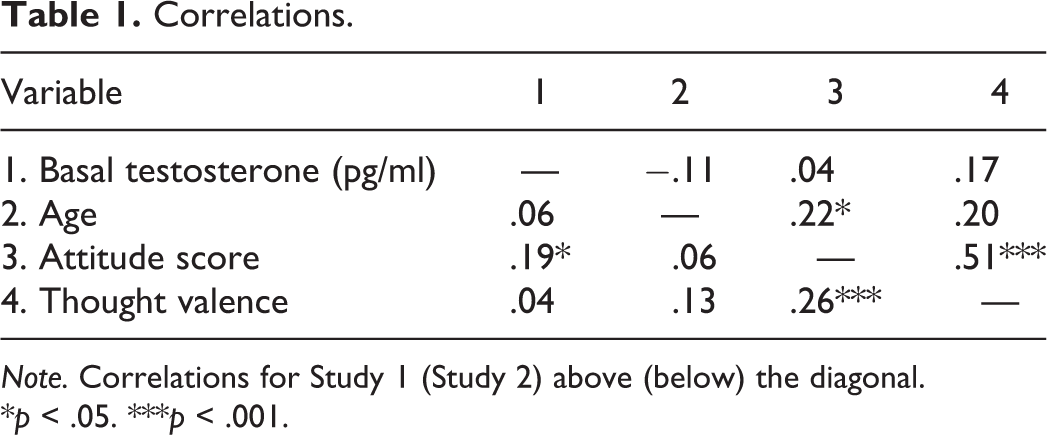
Note. Correlations for Study 1 (Study 2) above (below) the diagonal.
*p < .05. ***p < .001.
Means (Standard Deviations).
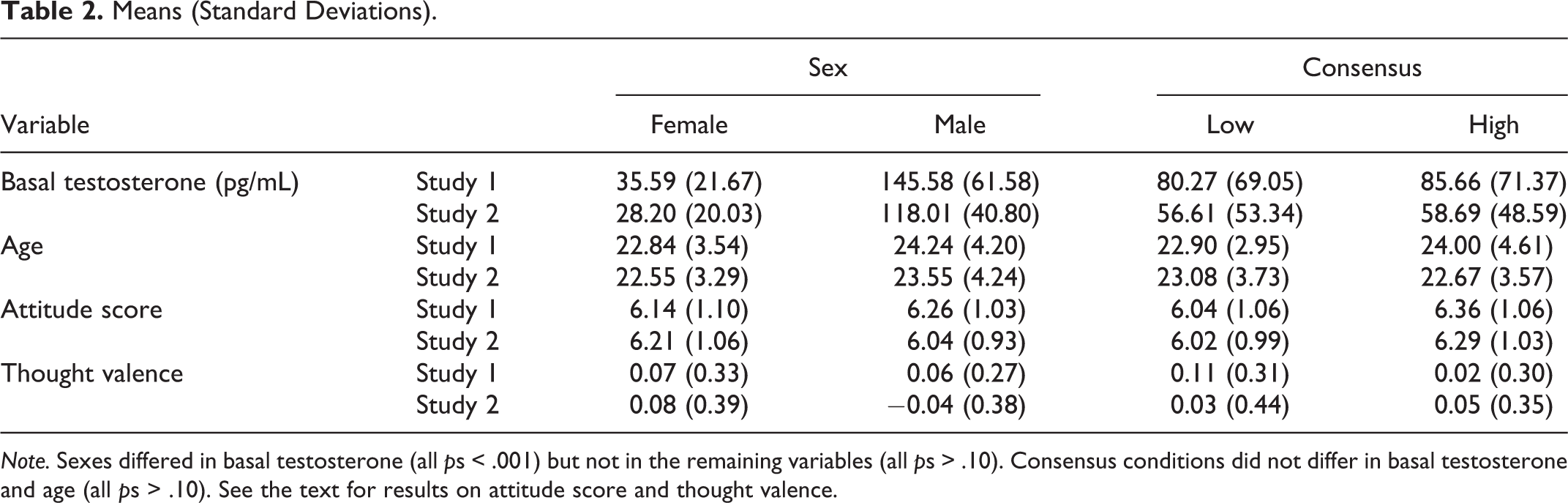
Note. Sexes differed in basal testosterone (all ps < .001) but not in the remaining variables (all ps > .10). Consensus conditions did not differ in basal testosterone and age (all ps > .10). See the text for results on attitude score and thought valence.
Attitude (Dependent Variable)
In line with the mere consensus effect (Erb & Bohner, 2007, 2010), participants in the high consensus condition held a more favorable attitude toward the message position than those in the low consensus condition (Study 1: b = .35, 95% CI [−.12, .82], p = .15; Study 2: b = .24, 95% CI [−.06, .54], p = .12; meta-analysis: b = .25, 95% CI [.01, .50], p = .04, BFinclusion = 3.46). Furthermore, basal testosterone was positively associated with the attitude toward the message position (Study 1: b = .06, 95% CI [−.19, .31], p = .64; Study 2: b = .21, 95% CI [.05, .38], p = .01; meta-analysis: b = .16, 95% CI [.02, .29], p = .02, BFinclusion = 4.81). More importantly, however, these main effects were qualified by the predicted interaction between basal testosterone and consensus (Study 1: b = −.50, 95% CI [−.99, −.002], p = .049; Study 2: b = −.34, 95% CI [−.68, −.004], p = .047; meta-analysis: b = −.38, 95% CI [−.65, −.11], p = .005, BFinclusion = 9.81; see Figure 2). Given low consensus, basal testosterone was positively associated with the attitude toward message position (Study 1: b = .31, 95% CI [−.06, .67], p = .09; Study 2: b = .38, 95% CI [.15, .62], p = .002; meta-analysis: b = .35, 95% CI [.16, .53], p < .001, BFinclusion = 65.18). By contrast, given high consensus, there was no such association (Study 1: b = −.19, 95% CI [−.54, .16], p = .28; Study 2: b = .04, 95% CI [−.20, .29], p = .73; meta-analysis: b = −.03, 95% CI [−.23, .16], p = .72, BFinclusion = 0.20). Hence, the interaction was due to basal testosterone altering the effect of minority (low consensus) but not of majority (high consensus) influence, which is in line with Hypothesis 1a but at odds with Hypothesis 1b. Introducing participants’ sex as a covariate revealed no (moderating) effects (Study 1: all ps > .31; Study 2: all ps > .05, meta-analysis: all ps > .41).
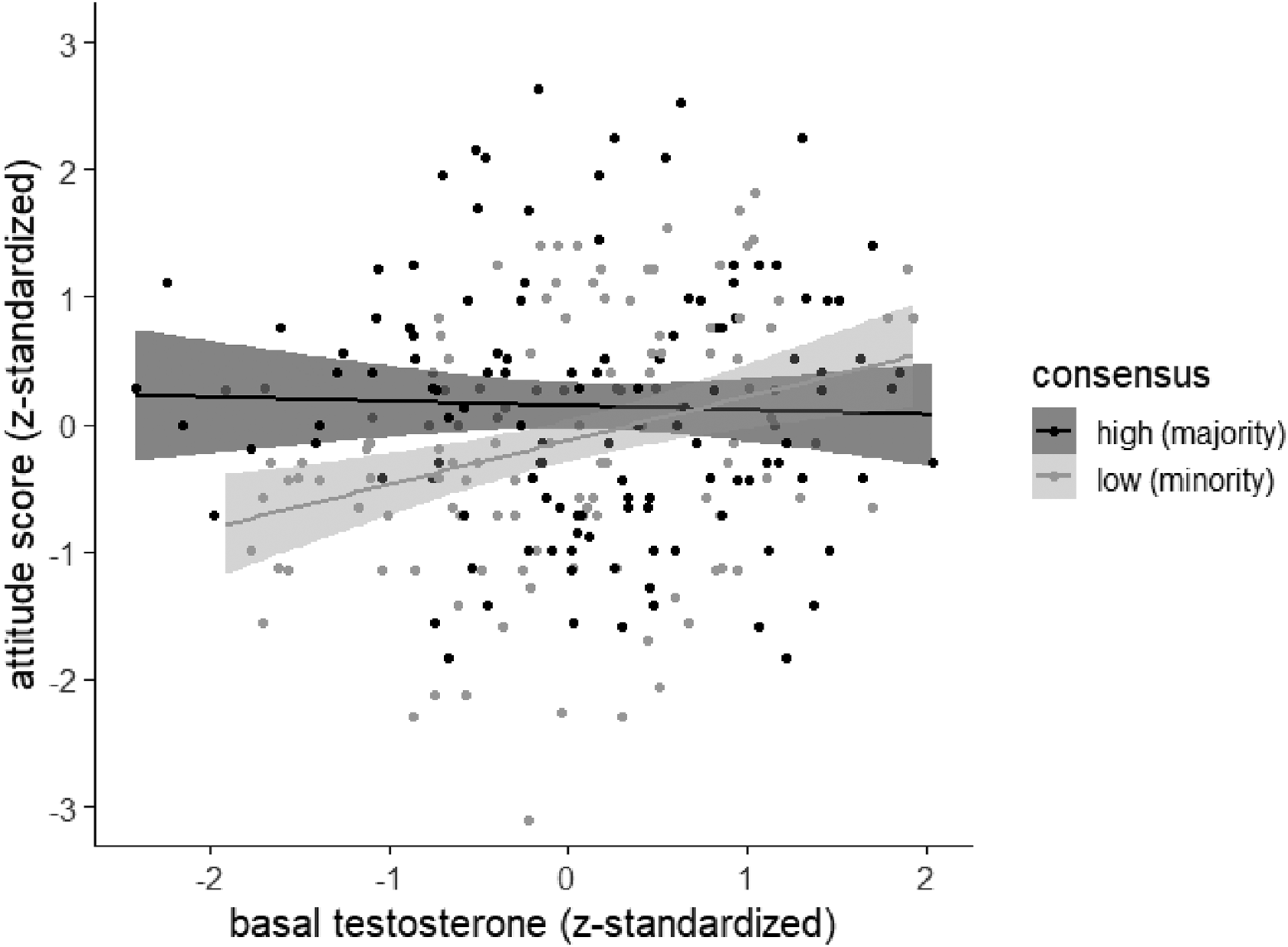
Pooled sample, attitude scores as a function of basal testosterone (x-axis) and consensus (colors). Note. Points represent individual participants. Slopes (with 95% CI) represent the relation between basal testosterone and attitude scores depending on consensus.
Thought Valence (Mediator Variable)
Unexpectedly, participants’ thought valence did not differ between high and low consensus (Study 1: b = −.08, 95% CI [−.21, .05], p = .23; Study 2: b = .01, 95% CI [−.11, .13], p = .86; meta-analysis: b = −.08, 95% CI [−.33, .17], p = .51, BFinclusion = 0.18). Basal testosterone was not associated with thought valence (Study 1: b = .05, 95% CI [−0.01, 0.13], p = .09; Study 2: b = .02, 95% CI [−.05, .09], p = .55; meta-analysis: b = .10, 95% CI [−.03, .24], p = .13, BFinclusion = 0.29). Interestingly, however, there was an interaction between basal testosterone and consensus (Study 1: b = −.15, 95% CI [−.29, −.01], p = .03; Study 2: b = −.06, 95% CI [−.20, .07], p = .38; meta-analysis: b = −.27, 95% CI [−.54, −.001], p = .05, BFinclusion = 0.48; see Figure 3). Again, this interaction was due to basal testosterone altering the effect of low but not of high consensus. Given low consensus (i.e., minority influence), basal testosterone was positively associated with thought valence (Study 1: b = .13, 95% CI [.04, .23], p = .01; Study 2: b = .05, 95% CI [−.06, .16], p = .36; meta-analysis: b = .24, 95% CI [.01, .50], p = .03, BFinclusion = 1.82). Given high consensus (i.e., majority influence), there was no such association (Study 1: b = −.02, 95% CI [−.11, .08], p = .74; Study 2: b = .24, 95% CI [−.06, .54], p = .12; meta-analysis: b = −.03, 95% CI [−.21, .14], p = .71, BFinclusion = 0.20). Introducing participants’ sex as a covariate revealed no (moderating) effects (Study 1: all ps > .50; Study 2: all ps ≥ .05, meta-analysis: all ps > .07).
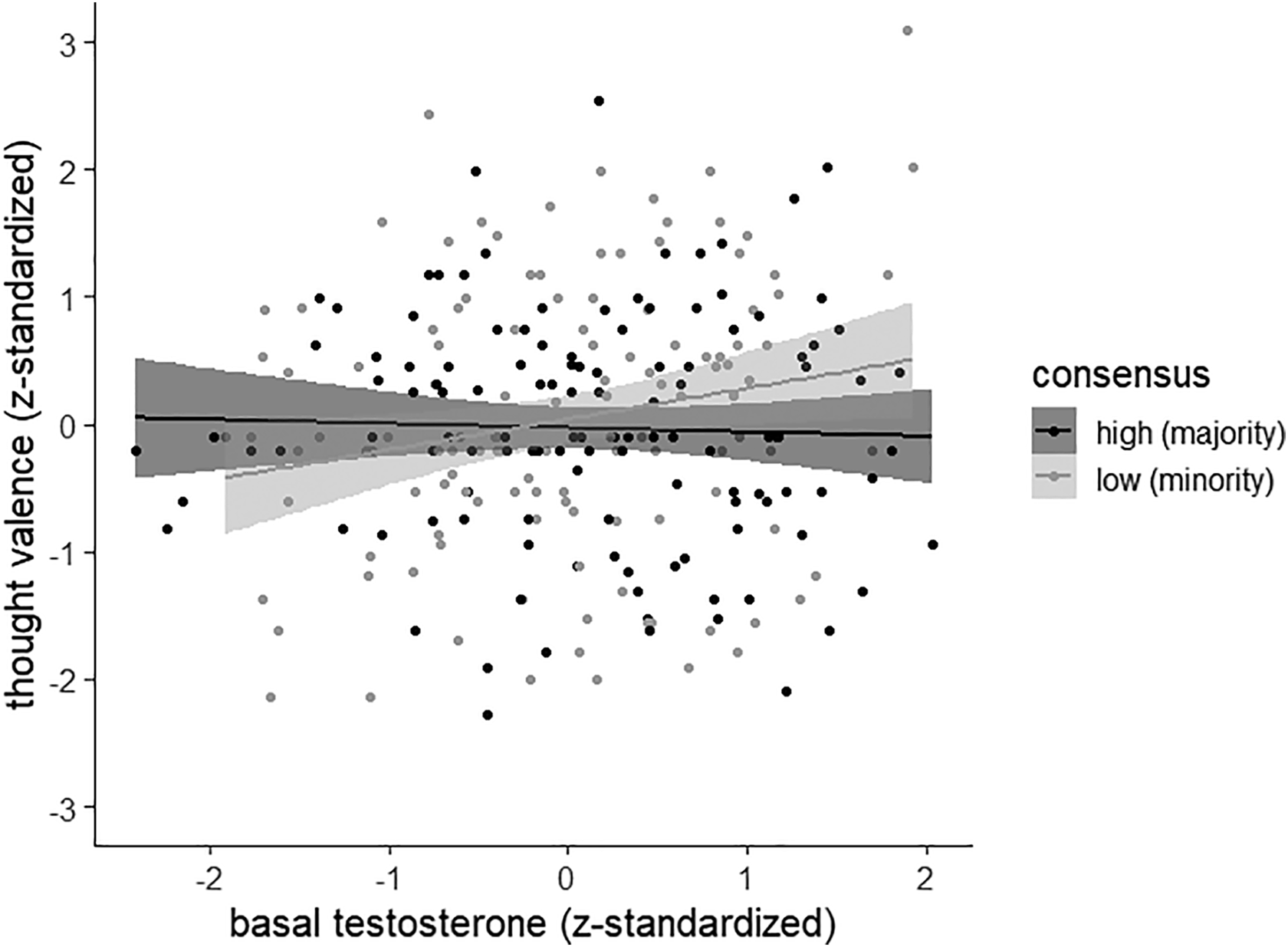
Pooled sample, thought valence as a function of basal testosterone (x-axis) and consensus (colors). Points represent individual participants. Slopes (with 95% CI) represent the relation between basal testosterone and thought valence depending on consensus.
Mediation Analysis
There was no indirect effect of consensus via thought valence on attitude (i.e., no simple mediation; Study 1: a × b = −.16, 95% CI [−.44, .09]; Study 2: a × b = 0.01, 95% CI [−.08, .10]; meta-analysis: a × b = −0.02, 95% CI [−.12, .07]; Monte Carlo resampling, 10,000 iterations, Yzerbyt et al., 2018). Since basal testosterone moderated the effect of consensus on thought valence (i.e., a moderated a-path) as well as on attitude (i.e., a moderated c-path), we explored whether there was a first-stage mediated moderation (Muller et al., 2005). Indeed, the moderated indirect effect was significant (Study 1: a*Mod × b = −0.29, 95% CI [−.61, −.03]; Study 2: a*Mod × b = −0.04, 95% CI [−.14, .05]; meta-analysis: a*Mod × b = −0.09, 95% CI [−.19, −.001]), while the interaction between consensus and basal testosterone (i.e., the direct moderated c′-path) was reduced (Study 1: b = −.23, 95% CI [−.67, .21], p = .31; Study 2: b = −.30, 95% CI [−.62, .02], p = .07; meta-analysis: b = −.28, 95% CI [−.53, −.03], p = .03). These results suggest that the moderating influence of basal testosterone on the consensus effect can be partially explained by the fact that cognitive responses toward the minority position became more favorable as basal testosterone increased.
Personality Traits (Exploratory Analyses)
For exploratory purposes, participants completed the following personality scales: Social Value Orientation (Murphy et al., 2011) and the Initial Preference Task (Stieger et al., 2012) in Study 1, and the Hope and Fear subscales of the Unified Motive Scales measuring explicit affiliation and power motivation (Schönbrodt & Gerstenberg, 2012), and Need for Cognition (Bless, 1991) in Study 2. None of the scales correlated with basal testosterone (all |rs| < .13, all uncorrected ps > .08). Furthermore, none of the scales moderated the consensus effect or the interaction between basal testosterone and consensus (all |bs| < 0.26, all uncorrected ps > .08). Finally, consensus conditions did not differ in any of these scales (all ts < 1.71, all uncorrected ps > .08).
Discussion
Across two studies, we found that the more levels of basal testosterone increased, the more positive participants’ attitudes became toward the minority position. By contrast, there was no relationship between basal testosterone and participants’ attitudes toward the majority position. More specifically, individuals with high levels of basal testosterone were equally receptive to the minority and the majority position. These results support the hypothesis that basal testosterone renders individuals more receptive to minority but not majority positions (Hypothesis 1a). At the same time, our results contradict the hypothesis that basal testosterone renders individuals less susceptible to social influence in general (Hypothesis 1b).
Although statistically less reliable, the effect of basal testosterone on social influence was reflected in the cognitive responses toward the persuasive message. Basal testosterone was associated with an increase in the valence of the cognitive responses toward the minority but not toward the majority position. Finally, the mediated moderation effect suggests that basal testosterone increases individuals’ receptivity to the minority position because it renders their cognitive responses toward the persuasive message more positive.
One reason for the low reliability of the findings regarding thought valence might be that thought valence was explicitly measured. As research suggests that testosterone operates in concert with implicit power motivation (Stanton & Schultheiss, 2009), implicit measures (e.g., reaction time tasks or physiological methods) might be more adequate to uncover the effects of testosterone on information processing. Interestingly, our explorative analyses revealed no evidence that the effects of testosterone were due to or moderated by explicit power motivation, which fits with the idea that testosterone is more robustly linked to implicit measures of power motivation than to self-reported measures.
We predicted that basal testosterone abolishes the persuasive power of majorities because it increases individuals’ receptivity to minorities while it does not affect receptivity to majorities. This hypothesis rests on the assumption that going along with the majority potentially protects whereas going along with the minority potentially increases one’s status. Hence, when testosterone regulates status-related behavior (Eisenegger et al., 2011) and when it renders individuals less risk averse (Kurath & Mata, 2018), it should decrease individuals’ willingness to reject a minority position which is generally seen as riskier than the majority position (Erb et al., 2015). Although our results support this reasoning, they do not provide direct evidence. Since we did not measure risk perception, we cannot rule out that other processes regulated by testosterone produced the same asymmetric interaction effect. Also, since we measured rather than manipulated testosterone, we cannot rule out that another unknown variable confounded with testosterone caused the observed effects. To directly test our assumptions, future studies could independently manipulate (a) whether adopting a given position provides an opportunity to gain (or maintain) status and (b) the source of influence. If our assumptions are true, the first factor should primarily determine whether testosterone decreases or increases individuals’ likelihood to adopt the respective position. Furthermore, the perceived risk of gaining versus losing one’s status should mediate this effect. Also, future studies could use acute single-dose testosterone administration to provide causal evidence for the effects of testosterone on social influence.
Building on the dual-hormone hypothesis (Mehta & Prasad, 2015), which argues that testosterone and cortisol jointly regulate risk-taking, future research could also investigate whether cortisol moderates the relation between testosterone and social influence. Given that previous research found a positive association between basal testosterone and risk-taking among individuals with low but not high basal cortisol (Mehta & Prasad, 2015), the hypothesis that basal testosterone abolishes the persuasive power of majorities should particularly hold for individuals with low basal cortisol.
Our results also advance social psychological research. Until now, social psychological research on social influence has mainly focused on motives unrelated to status (e.g., goals of accuracy, affiliation, and uniqueness, Cialdini & Goldstein, 2004; Imhoff & Erb, 2008). Furthermore, research on testosterone (and cortisol) has mainly focused on situations of conflicting interests (e.g., competitions, economic games; Eisenegger et al., 2011; Knight et al., 2020). By adopting a status perspective (Eisenegger et al., 2011), our research advances these fields. Specifically, our research suggests that testosterone might regulate a wider range of psychological processes (e.g., attitude formation) in a wider range of social situations (e.g., political discourse) in ways that are instrumental to the enhancement and protection of one’s social status.
In conclusion, our research shows that individuals with high levels of testosterone are more balanced when they process majority and minority positions. This is important since societies often do not take kindly to those who oppose the popular course, that is, minorities. Our results suggest that individuals with high levels of testosterone may function as catalysts of social change since they are more open-minded toward minority opinions, which ultimately facilitates social change.
Footnotes
Declaration of Conflicting Interests
The author(s) declared no potential conflicts of interest with respect to the research, authorship, and/or publication of this article.
Funding
The author(s) disclosed receipt of the following financial support for the research, authorship, and/or publication of this article: This work was funded by the Volkswagen Foundation through their European Platform program.
