







Abstract
The present study explored the antecedents of solidarity amid the COVID-19 pandemic. Given that solidarity during mass emergencies involves the development of a social identity encompassing those facing a common fate, we examined how national in-group satisfaction (IS, a belief that the national in-group and one’s membership in it are of high value) versus national collective narcissism (CN, a belief that the national in-group is exceptional and entitled to privileged treatment but not sufficiently recognized by others) predicted solidarity with those affected by the pandemic in Poland. The results of cross-sectional and dynamic analyses from a panel study on a representative sample of Polish adults indicate that IS predicted greater COVID-19 solidarity, whereas CN predicted reduced COVID-19 solidarity.
“Across the European Union, countries, regions and cities are stretching out a helping hand to neighbours, helping those most in need. This is European solidarity in action,” claims a recent document issued by the European Commission (2020). Indeed, the COVID-19 pandemic has inspired an outpouring of social solidarity, in the form of help for those in need and at risk, support for frontline workers caring for the sick, and wider sharing of resources and expertise (Broom, 2020; Butler, 2020; Chakelian, 2020). This illustrates that mass emergencies often produce an uptick in solidarity and prosocial behavior (Kaniasty & Norris, 1999; Solnit, 2009; Tierney et al., 2006). At the same time, panic shopping, protests against stay-at-home orders, xenophobia, and ostracism of health workers have also been observed during the pandemic (Gebrekidan, 2020; McKeever, 2020; Rácz, 2020), suggesting a failure of solidarity (Mawson, 2005).
What factors determine solidarity in face of COVID-19? Previous research indicates that solidarity during mass emergencies involves the development of a social identity encompassing those facing a common fate (Drury, 2018). Thus, pandemic solidarity may depend on the way people construct important social identities (Norris & Alegria, 2008). In this context, we test the proposition that positive social identity may not be conducive of solidarity when construed in terms of collective narcissism (CN): a belief that the national in-group is exceptional and entitled to privileged treatment but insufficiently recognized by others (Golec de Zavala et al., 2009).
National identity is especially relevant to solidarity in the context of COVID-19. Research points to two distinct ways in which people construe national identity, with opposite consequences for solidarity with others. The dichotomy has been conceptualized in several ways (see Adorno et al., 1950; Blank & Schmidt, 2003; de Figueiredo & Elkins, 2003; Druckman, 1994; Kosterman & Feshbach, 1989). In this article, we focus on the distinction between CN and a second kind of positive belief about the national in-group: national in-group satisfaction (IS), a belief that the national in-group is of high value (Leach et al., 2008). These forms of national identity may have different implications for solidarity with others. Prior research suggests that IS is related to in-group solidarity and concern for national welfare, whereas CN reflects an exaggerated concern about national image that serves predominantly to satisfy individual needs for self-worth (Golec de Zavala & Keenan, 2020) and has little to do with concern about others (Golec de Zavala et al., 2019; Golec de Zavala & Lantos, 2020). On this basis, we expect that national IS will predict greater solidarity in the face of the COVID-19 pandemic, whereas national CN should predict lower solidarity.
CN, IS, and Group Solidarity in Face of Mass Emergency
Research suggests that CN may be negatively associated with concern for the welfare of in-group members. First, research on narcissism as a personality variable emphasizes the low communality and empathy displayed by narcissists (Campbell & Miller, 2011; Hepper et al., 2014). In particular, CN is negatively associated with social connectedness, and when the positive correlation between CN and IS is accounted for, it is negatively associated with gratitude and other prosocial emotions (Golec de Zavala, 2019). Although CN is positively associated with a general tendency to value group loyalty (Golec de Zavala & Federico, 2020), it does not have an independent relationship with specific forms of loyalty to the nation once IS is adjusted for. For example, controlling for IS, CN is positively related to willingness to leave the country for good if paid better elsewhere (Marchlewska et al., 2020).
In addition, CN is associated with out-group hostility (Golec de Zavala & Lantos, 2020), especially in response to actual (Golec de Zavala, Cichocka, & Iskra-Golec, 2013; Jasko et al., 2019) and imagined (Golec de Zavala et al., 2016) threats to the in-group’s image. When in-groupers are believed to “contaminate” the in-group’s image, they are also targeted. In this vein, CN is associated with the rejection of vilified minorities (Golec de Zavala & Cichocka, 2012; Golec de Zavala, Cichocka, & Bilewicz, 2013), immigrants (Golec de Zavala et al., 2017), and sexual minorities (Mole et al., 2020; see also Golec de Zavala & Bierwiaczonek, 2020). 1
These findings suggest that attention to differences between CN and other forms of in-group affinity may qualify existing accounts of the relationship between social identification and solidarity. For example, the hierarchical multicomponent model of social identification (Leach et al., 2008) posits that a belief in the in-group’s high value should be positively associated with solidarity. However, we argue that this is only true when the value of the in-group is not exaggerated to boost self-image, as it is in CN (Golec de Zavala et al., 2019; Jaworska, 2016). This suggests that self-image enhancement—rather than genuine concern for in-group members—may be the primary way social identity is consequential for collective narcissists. We propose that CN, unlike IS, may therefore be negatively associated with in-group solidarity, especially in the face of emergencies that require sacrifice for the sake of the community.
Indeed, since CN was first differentiated from other positive in-group beliefs, findings have indicated that nonnarcissistic forms of in-group positivity have very different relationships with prosocial attitudes and behavior (Golec de Zavala, 2011; Golec de Zavala et al., 2019). In particular, IS has been the key comparison construct in research on CN because it centers specifically on happiness with national identity itself, apart from feelings about national symbols (e.g., patriotism; Kosterman & Feshbach, 1989) or strength of identification with the national in-group (which pertains to closeness to the in-group vs. how one evaluates it; Huddy & Khatib, 2007). It also taps positivity without concern that others insufficiently appreciate the in-group’s greatness (Golec de Zavala et al., 2009). IS is not characterized by the focus on in-group image that is crucial to CN. Instead, it taps secure in-group positivity, which is associated with the belief that individuals should use their positive characteristics to help their in-groups (Amiot & Sansfaçon, 2011; Legault & Amiot, 2014). When the variance it shares with CN is partialled out, IS does not predict hypersensitivity to in-group image threats (Golec de Zavala et al., 2016) or out-group hostility (Dyduch-Hazar et al., 2019; Golec de Zavala & Cichocka, 2012; Golec de Zavala et al., 2019). Moreover, IS is associated with high self-esteem, positive emotionality, life satisfaction, prosociality, and social connectedness (Amiot & Aubin, 2013; Golec de Zavala, 2019). Given such findings, we expected that national IS would be associated with greater solidarity in the face of COVID-19, controlling for CN.
Overview
In this study, we examine national CN and IS as antecedents of solidarity to face the COVID-19 pandemic. Our analyses rely mainly on data from four waves of a panel study of Polish adults collected from March 27 to May 18, 2020. We test the following hypothesis: CN will be negatively related to COVID-19 solidarity adjusting for IS, whereas IS will be positively associated with solidarity adjusting for CN. We test this hypothesis in two ways. First, we estimate cross-sectional regressions predicting solidarity using CN and IS within waves. We also demonstrate that these relationships hold up using alternate estimation methods and after accounting for covariates like moral foundations and individual narcissism. Second, we examine dynamic relationships between the variables across waves. We perform two analyses, one that examines combined between-person (e.g., whether IS predicts changes in the rank order of solidarity scores between individuals) and within-person (e.g., whether IS predicts changes in individuals’ solidarity scores after accounting for trait-like stability in all variables) dynamic effects and one that specifically isolates within-person effects.
In the dynamic analyses, we also attend to the time line of the COVID-19 pandemic in Poland. The first case in Poland was reported on March 4, 2020, with the first reported death on March 12. Around the same time, between March 9 and 13, there was a sharp increase in coronavirus coverage in traditional and social media (Nowy Marketing, 2020). New cases increased most over the remainder of March, with a leveling off thereafter (Worldometers, 2020). The government response followed a similar pattern, with the main increase in public health restrictions occurring in March, followed by loosening in mid-April (Krakovsky, 2020). From March 10 to 15, initial restrictions were implemented, including closures of schools, businesses, and cultural institutions; border controls; and prohibitions on public gatherings. An epidemic was declared on March 20, and controls were tightened further (including a stay-at-home order) between March 24 and 31. Officials announced relaxation of restrictions on April 16, with the lockdown exit beginning on April 20. Thus, given that the pandemic and the response to it intensified most in the second half of March, we expect our hypothesized relationships to be most evident in the earlier waves of our data (from late March and early April).
Method
Data
Our data come from a six-wave panel study of Polish adults collected online though the Ariadna Research Panel using a computer-assisted web interviewing method that presented the respondent with the questionnaire and instructed them to respond online. All surveys were conducted in Polish. Wave 1 reached a representative sample of 1,060 Polish adults (568 women, 492 men) ranging in age from 18 to 94 years (M = 45.09, SD = 16.00) between February 28, 2020, and March 4, 2020. Age, gender, and town were selected to reflect the population of Polish adults over 18 years old. Five additional waves of data were collected via recontacts of these respondents (Wave 2 from March 13 to 18, 2020; Wave 3 from March 27, 2020, to April 1, 2020; Wave 4 from April 10 to 15, 2020; Wave 5 from April 24 to 30, 2020; and Wave 6 from May 8 to 18, 2020). The study was omnibus in nature and broadly aimed at tracking public opinion during the 2020 Polish presidential election. It was not fielded solely for the present study, and it included variables pertaining to hypotheses other than the one examined here. 2
Our primary analyses use Waves 3 (N = 889), 4 (N = 826), 5 (N = 808), and 6 (N = 785), which included the solidarity measure. To estimate the power afforded by these sample sizes, we used the power pcorr function in Stata Version 15 (StataCorp, 2017) to determine the estimated squared partial correlation for a single coefficient that can be detected in a regression with four covariates for α = .05 and power = .8 at N = 889 and N = 785. 3 These values were .0088 and .0099, respectively. 4
Measures
Unless otherwise indicated, responses were given on a 11-point scale (0 = I do not agree at all, 10 = I completely agree). All variables were recoded to run from 0 to 1 before scales were created; the descriptives below use the 0–1 recodings. Translations of all measures can be found in the Supplemental Materials.
CN
This was assessed using the 5-item Collective Narcissism Scale (Golec de Zavala et al., 2009). An example item is “I will never be satisfied until Poland gets the recognition it deserves.” Scores were averaged to form a scale in each wave. Higher scores indicate higher CN (Wave 3: α = .92, M = 0.49, SD = 0.26; Wave 4: α = .92, M = 0.47, SD = 0.25; Wave 5: α = .92, M = 0.47, SD = 0.26; Wave 6: α = .93, M = 0.46, SD = 0.26).
IS
This was measured using four items (Leach et al., 2008). An example is “I am glad to be Polish.” Item responses were averaged to form a scale in each wave, and higher scores indicate greater IS (Wave 3: α = .94, M = 0.69, SD = 0.23; Wave 4: α = .94, M = 0.68, SD = 0.24; Wave 5: α = .95, M = 0.67, SD = 0.24; Wave 6: α = .95, M = 0.67, SD = 0.25). 5
COVID-19 solidarity
Solidarity with others during the COVID-19 pandemic was assessed with six items. Examples include “I have a feeling of solidarity with those who may be infected by coronavirus” and “I feel connected to others in the fight against the spread of the virus.” Scores were averaged to form a scale in each wave; higher scores indicate greater solidarity (Wave 3: α = .93, M = 0.77, SD = 0.19; Wave 4: α = .92, M = 0.76, SD = 0.19; Wave 5: α = .94, M = 0.74, SD = 0.20; Wave 6: α = .93, M = 0.72, SD = 0.21).
Demographic covariates
These included the following: a dummy variable indicating male gender (1 = yes, 0 = no), education (six ordered categories, recoded to run from 0 to 1), and age (in years). These measures were included as standard demographic controls.
Results
Bivariate Relationships
Bivariate correlations between the key variables are summarized in Table 1. Each construct was relatively stable across waves (rs > .70; ps < .001). Moreover, within each wave, IS was correlated with solidarity (ps < .001). The bivariate correlations between CN and solidarity were also positive but small (all rs = .11 or below). This result is consistent with prior research (Golec de Zavala, 2019) suggesting that CN is unrelated or weakly positively related to prosocial outcome variables absent any correction for variance shared with IS.
Pairwise Correlations.
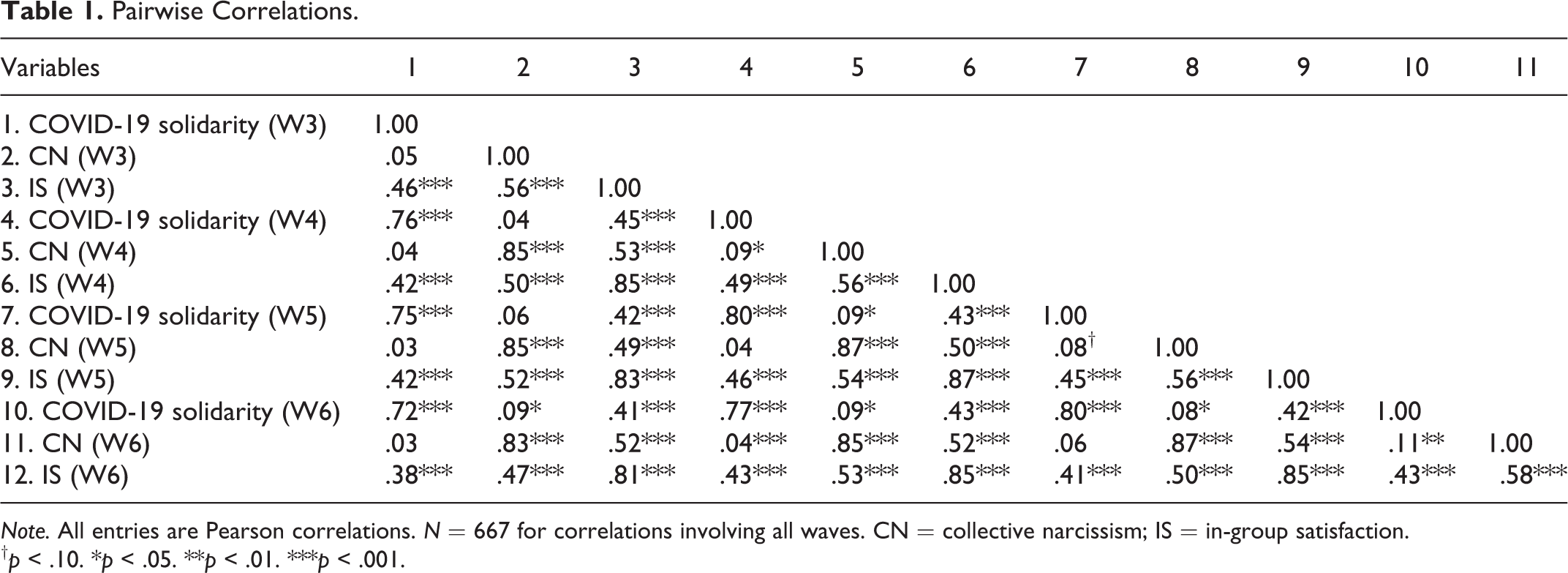
Note. All entries are Pearson correlations. N = 667 for correlations involving all waves. CN = collective narcissism; IS = in-group satisfaction.
† p < .10. *p < .05. **p < .01. ***p < .001.
Predictors of COVID-19 Solidarity: Cross-Sectional Analysis
We began by carrying out a cross-sectional examination of the relationships between CN and IS and solidarity with those afflicted by COVID-19. We regressed Wave 3 solidarity on Wave 3 CN and IS using ordinary least squares. The model also included male gender, education, and age as covariates to control for variation in solidarity due to standard demographic characteristics. 6 HC3 robust standard errors were used (Long & Ervin, 2000). These estimates are summarized in Table 2, and the relationships between CN and IS and solidarity in each wave are plotted in Figure 1. Consistent with our hypothesis, IS was positively related to COVID-19 solidarity, controlling for CN (Wave 3: b = .44, β = .53, p < .001). Given the 0–1 variable codings, the unstandardized coefficients indicate that going from the minimum to the maximum value of IS is associated with a 44% increase in solidarity in Wave 3 (Baguley, 2009). Also consistent with our hypothesis, CN was negatively associated with COVID-19 solidarity (b = −.15, β = −.19, p < .001), once variance shared with IS was accounted for. As such, moving from the minimum to the maximum value of CN is associated with a 15% decrease in solidarity.
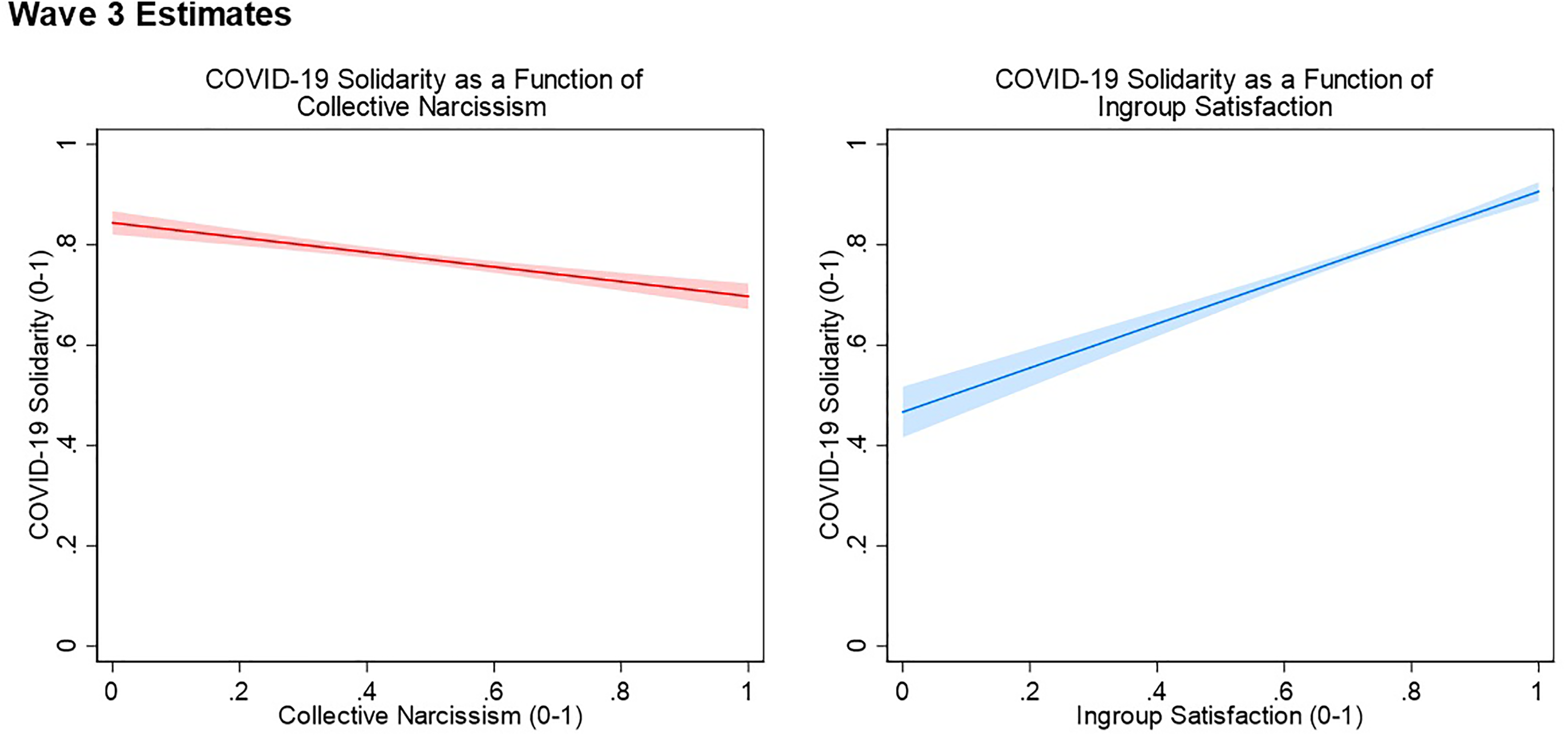
COVID-19 solidarity as a function of collective narcissism and in-group satisfaction: Cross-sectional estimates for Wave 3.
Thus, as predicted, only IS remains positively related to solidarity once the variance it shares with CN is accounted for. In contrast, CN becomes negatively related to solidarity once its overlap with IS is removed. We performed the same analysis in Waves 4–6 and obtained virtually identical results, suggesting a largely consistent pattern of cross-sectional relationships. We report these results in the Supplemental Materials.
Robustness checks
In the Supplemental Materials, we provide robustness checks on these cross-sectional results. First, we estimate cross-sectional models that include measures of Graham et al. (2009) moral foundations. The results of these models are substantively similar, though we find that the relationships between IS and solidarity are somewhat weaker once moral foundations are accounted for. Second, we estimate cross-sectional models with individual-level narcissism (Crocker & Park, 2004; Morf, & Rhodewalt, 2001; Rhodewalt & Sorrow, 2003) included as a covariate, given that individual narcissism correlates with CN and may predict selfish behavior and low solidarity apart from CN (Marchlewska et al., 2020). These models produced results substantively similar to those in Table 2. Third, to address endogeneity, we reestimated the main cross-sectional models using two-stage least squares, with measures of IS and CN from Waves 1 and 2 as instruments for IS and CN in Waves 3–6 (Wooldridge, 2013). These models produced results similar to the ordinary least squares estimates.
COVID-19 Solidarity as a Function of Collective Narcissism and In-Group Satisfaction in Wave 3 (Cross-Sectional Estimates).
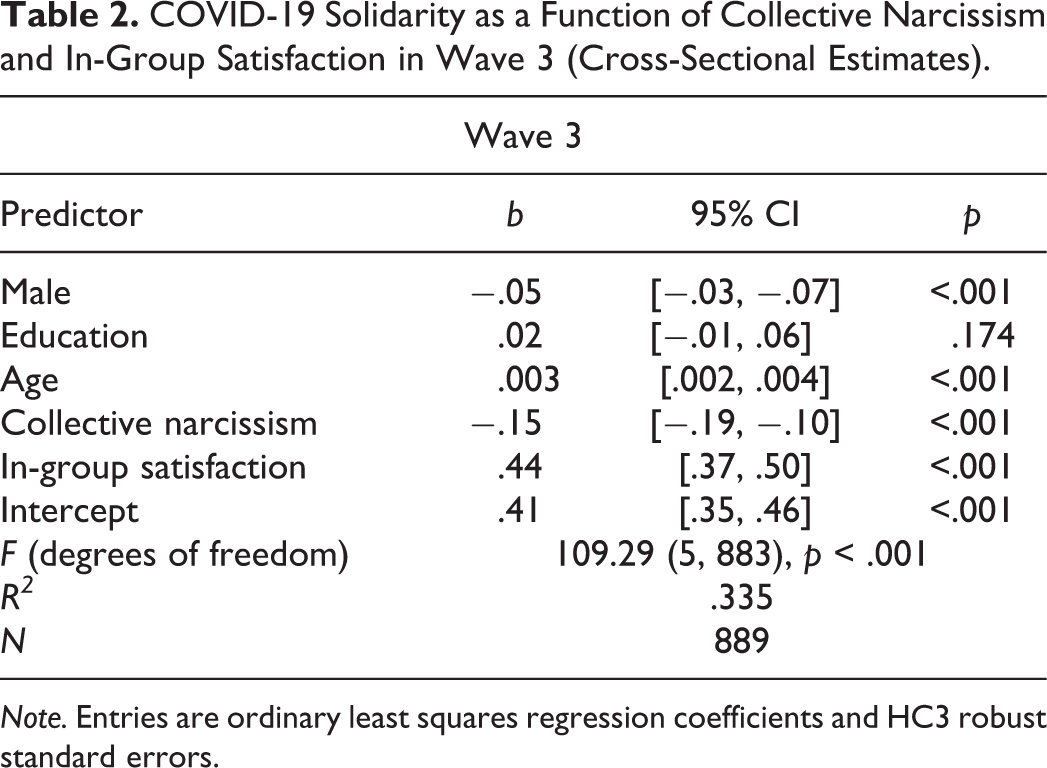
Note. Entries are ordinary least squares regression coefficients and HC3 robust standard errors.
Dynamic Models of IS, CN, and COVID-19 Solidarity
The above analyses examine the relationships between our study variables at single points in time. To expand on these findings, we examined our hypothesis from a dynamic perspective to see whether IS and CN predicted changes in solidarity over time. Using the measures of IS, CN, and COVID-19 solidarity from Waves 3 to 6, we estimated two dynamic models: a traditional cross-lagged panel model (CLPM) and a random-intercept CLPM (RI-CLPM; Hamaker et al., 2015). These models allow us to examine dynamic relations between variables in two ways. The CLPM tracks total change in the study variables, consisting of change between persons (relative to sample means) as a function of other variables and change within persons relative to their stable level of each construct. The RI-CLPM specifically isolates within-person change by adding random intercepts for each variable to the CLPM to account for stable individual differences.
A conceptual diagram of the CLPM and RI-CLPM is shown in Figure 2. 7 To estimate both models in the same framework, each variable in each time period was entered as a latent variable with its observed value as a single indicator with its loading fixed to 1 and its residual variance fixed to 0. Both models share the following: (1) in Waves 4–6, each construct in that wave was regressed on all three constructs in the prior wave; (2) the disturbances for the constructs in Waves 4–6 were all allowed to correlate within each wave; and (3) the Wave 3 measures of the constructs were also allowed to correlate. The RI-CLPM adds a random intercept for each construct in the form of a latent variable with the measures of the construct at the four waves serving as its indicators; the loadings are fixed to 1. The random intercepts were allowed to correlate, and each intercept is equivalent to a person’s average construct level over all waves. Importantly, the CLPM is nested within the RI-CLPM and can be obtained by fixing the variances and covariances of the random intercepts to 0. All models estimated in R (Version 3.6.3) with the lavaan package (Version 0.6-5) using maximum likelihood with the Satorra–Bentler correction for nonnormality (Rosseel, 2012; Satorra & Bentler, 1994). The models used only those respondents who provided complete data on all measures in all waves (N = 667).
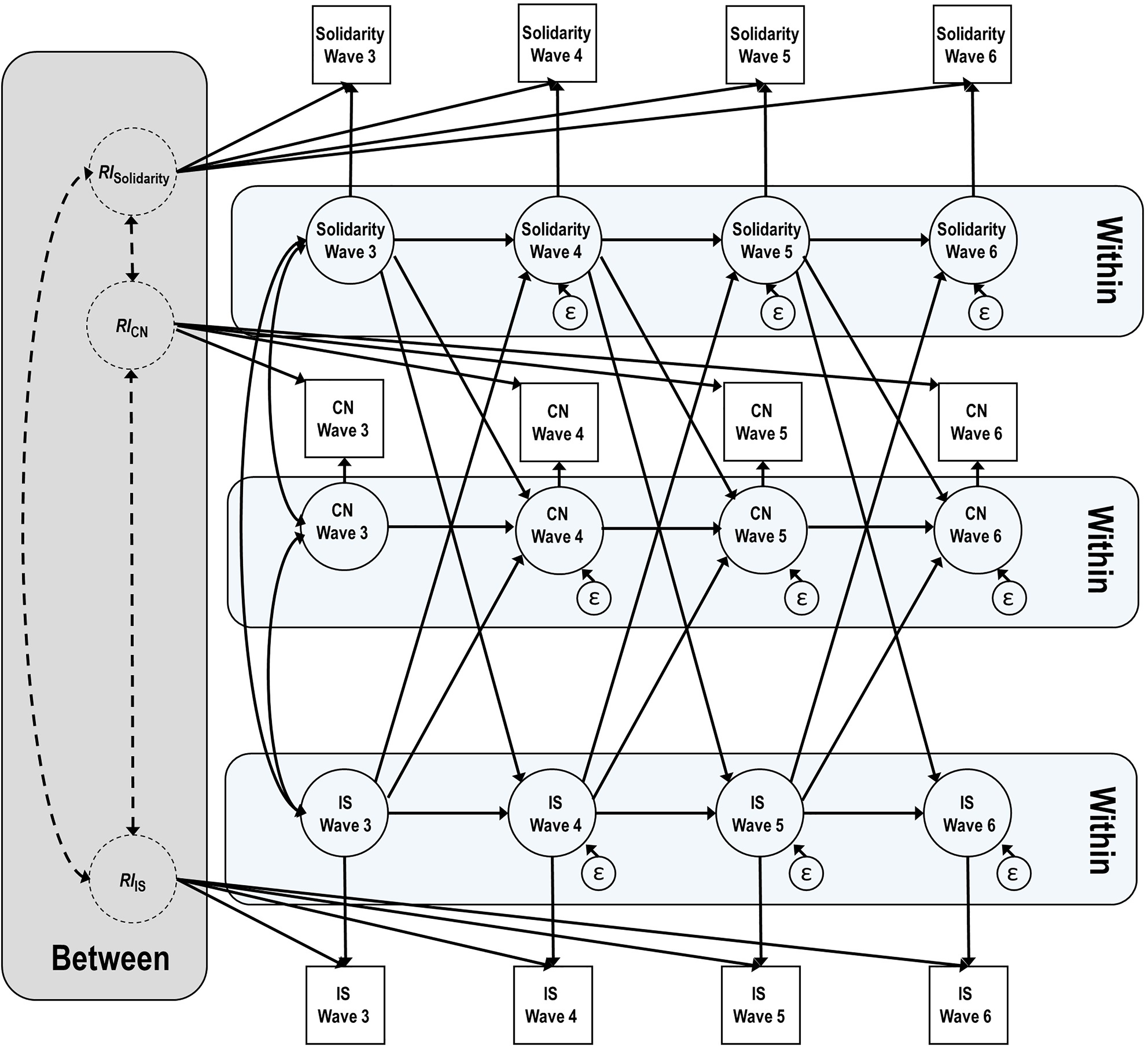
Conceptual diagram of cross-lagged panel model (CLPM) and random-intercept CLPM (RI-CLPM) models of the relationships between CN, IS, and COVID-19 solidarity. When the variances and covariances shown with dotted lines are fixed to 0, the diagram represents the CLPM; when they are freely estimated, the diagram represents the RI-CLPM. Disturbances within each of Waves 4–6 are allowed to correlate; paths are not shown for visual clarity.
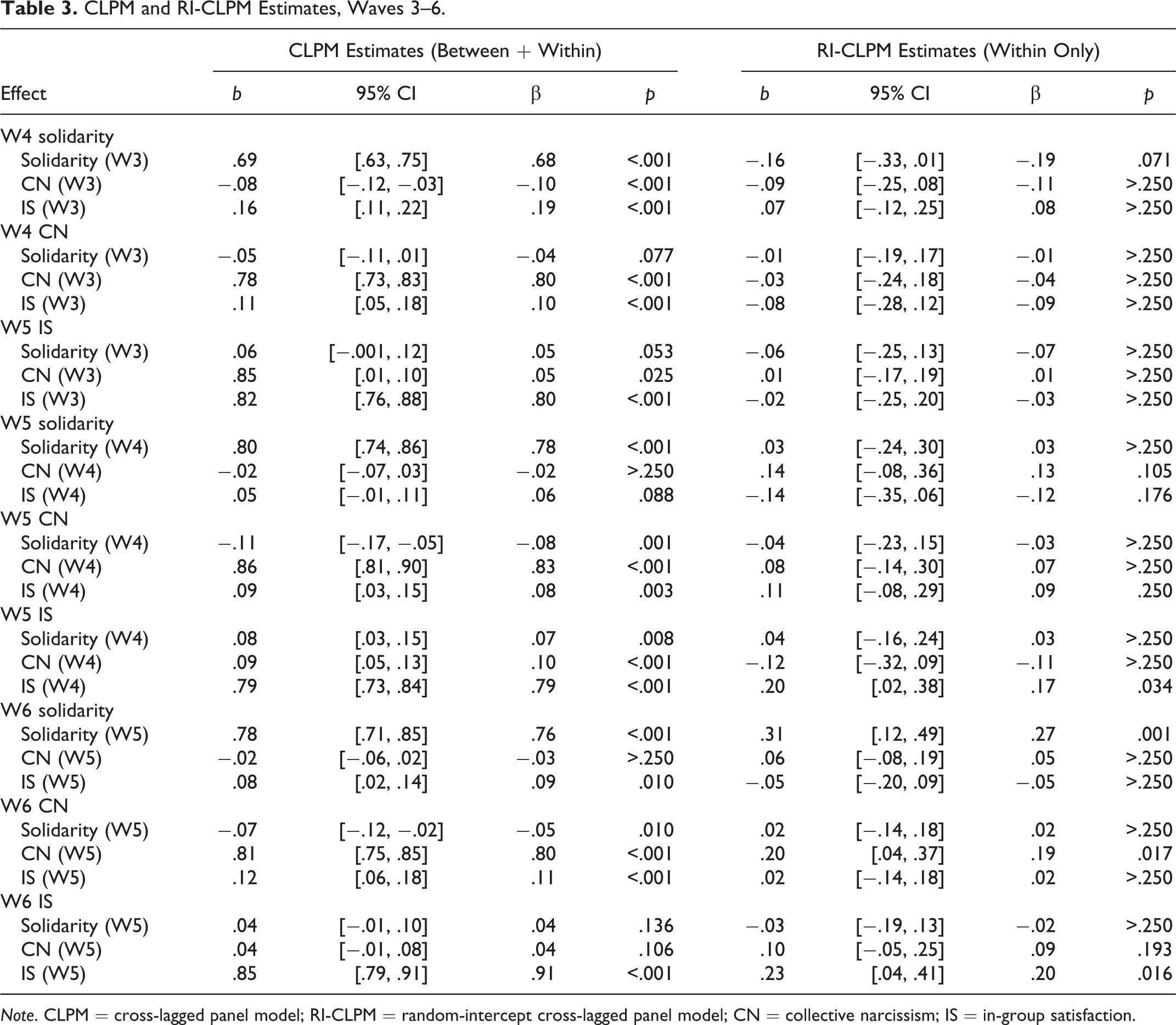
Estimates for both models are summarized in Table 3. The CLPM provided an adequate fit according to the CFI (comparative fit index; CFI = .93) and SRMR (standardized root mean square residual; SRMR = .05) but not the RMSEA (root mean square error of approximation; RMSEA = .16), with χ 2 (27) = 492.31, p < .001. The autoregressive parameters indicate that the three variables were stable over time between persons (all βs > .65, ps < .001). As expected, the predicted total dynamic effects of IS and CN on total variability in solidarity were strongest between Waves 3 and 4, when the coronavirus crisis was ramping up. Wave 3 IS was associated with higher levels of Wave 4 solidarity, adjusting for Wave 3 solidarity and CN (β = .19, p < .001). Wave 3 CN was associated with lower levels of Wave 4 solidarity, controlling for Wave 3 solidarity and IS (β = −.10, p = .002). In contrast, the reverse paths from Wave 3 solidarity to Wave 4 IS (β = .05, p = .053) and CN (β = −.04, p = .077) were smaller in magnitude. The dynamic effects of IS and CN on total variability in solidarity between Waves 4 and 5 (IS, β = .06; CN, β = −.02) and between Waves 5 and 6 (IS, β = .09; CN, β = −.03) were weaker, as expected, given the time line of events in Poland. 8 Nevertheless, the dynamic effects of IS were marginal or significant across both periods. Interestingly, though not predicted, we find reverse effects of solidarity on total variability in IS and CN across these periods that are consistent in sign with expectations. For example, Wave 4 solidarity predicted greater Wave 5 IS (β = .07, p = .008) and reduced Wave 5 CN (β = −.08, p = .001).
As noted above, the CLPM does not specifically capture changes over time within individuals since it does not account for trait-like stability in variables. Rather, it reveals changes in the rank ordering of individuals in solidarity within the sample as a function of how individuals score on IS and CN relative to the sample means of the latter (or vice versa) plus within-person change. To examine within-person dynamics, we turn to the RI-CLPM estimates in Table 3. The RI-CLPM provided a good fit (CFI = 1.00, RMSEA = .04, SRMR = .02), with χ 2 (21) = 40.13, p = .007. In contrast to the CLPM, the RI-CLPM reveals little evidence of within-person dynamic effects. IS and CN do not predict changes in solidarity within individuals across waves (ps > .250 from Wave 3 to 4 and Wave 5 to 6; ps > .10), and solidarity does not predict changes in IS and CN within individuals (ps > .250 across all wave transitions). However, the random intercepts—representing between-persons variation in each construct—were correlated in the expected fashion. Between-persons IS was highly correlated with between-persons solidarity (ϕ = .53, p < .001), whereas between-persons CN was not (ϕ = .07, p = .136). 9 Constraining these correlations to equality reduced model fit, suggesting a stronger relation between IS and solidarity than CN and solidarity, Δχ 2 (1) = 207.94, p < .001.
CLPM and RI-CLPM Estimates, Waves 3–6.
Note. CLPM = cross-lagged panel model; RI-CLPM = random-intercept cross-lagged panel model; CN = collective narcissism; IS = in-group satisfaction.
Thus, whereas the CLPM estimates provide support for the predicted overtime effects with respect to combined between-person and within-person changes, the RI-CLPM does not suggest statistically reliable within-person effects once trait-like stability variability is modeled.
Discussion
The goal of the present study was to explore how two positive beliefs about one’s nation relate to solidarity in the face of the COVID-19 pandemic: IS and CN. IS reflects a tendency to highly value the national in-group, but CN represents a belief that one’s nation is extraordinary but insufficiently appreciated by others—a belief motivated by desires for self-importance (Golec de Zavala & Lantos, 2020). With this in mind, we hypothesized that IS (controlling for CN) would be positively associated with solidarity in the face of COVID-19 and that CN (adjusting for IS) would be negatively associated with such solidarity.
Using a representative panel study of Polish adults, we found support for this hypothesis. First, in cross-sectional regressions, IS had the expected positive relationship with solidarity (controlling for CN) and CN had the expected negative relationship with solidarity (controlling for IS) in all waves. This result held up in a variety of robustness checks. Second, in dynamic analyses, we found evidence that IS and CN predicted parallel overall changes in solidarity. These effects were strongest during the late-March period when the pandemic intensified most in Poland. Data from later waves also suggested reverse effects consistent in sign with expectations such that solidarity was associated with increases in IS and decreases in CN. However, effects were not found specifically at the within-person level once trait-like stability in the study variables was accounted for using a RI-CLPM. Together, these results indirectly suggest that changes in solidarity as a function of IS and CN mainly reflect between-person dynamics—that is, shifts in the between-person rank ordering of individuals’ solidarity levels rather than within-person changes relative to individuals’ average levels of each construct.
Thus, the results broadly support our hypothesis that IS and CN have divergent relationships with solidarity in face of COVID-19. Those who felt happy to be Polish were more likely to show solidarity in response to the pandemic, whereas those who felt Poland was exceptional but insufficiently recognized by others demonstrated lower solidarity. Echoing previous work (Golec de Zavala, 2019), the negative association between CN and solidarity was only observed when the overlap between IS and CN was accounted for. In this respect, the present findings add to a growing body of research suggesting that IS and CN have distinct relationships with prosocial behavior once their overlap is statistically accounted for (Golec de Zavala & Bierwiaczonek, 2020; Golec de Zavala et al., 2013; Marchlewska et al., 2020; Mole et al., 2020).
As such, our results indicate that not all positive beliefs about the national in-group are equivalent to one another or have the same consequences. Most importantly, they suggest that not all positive in-group beliefs facilitate social solidarity. In this respect, our findings further develop the theory of CN. The negative association between CN and solidarity supports previous theorizing that collective narcissists objectify their in-groups. CN compensates for low self-esteem and reflects a desire for self-importance projected onto an in-group (Golec de Zavala et al., 2019; Golec de Zavala & Keenan, 2020). According to this account, CN is motivated by a shared perception of threat to self-importance rather than a sense of common fate conducive to social solidarity. This lack of concern for others is thus a defining feature of narcissism, whether it be at the individual or collective level.
Although not our main focus, the supplemental analyses were also instructive. First, analyses including the five moral foundations (Graham et al., 2009) indicated that the hypothesized relationships were not reducible to basic moral concerns. Although the moral foundations of care and fairness had strong relationships with solidarity, both IS and CN continued to have the predicted associations with solidarity after the former variables were accounted for. To be sure, the relationships between IS and CN and solidarity were smaller once moral foundations were added. This was especially the case for IS. Given the strong relationships between care and fairness and solidarity, this result suggests that the impact of IS might be accounted for in part by its relationship with moral concerns focused on the well-being and rights of other people (Haidt, 2012).
Second, analyses including individual narcissism indicated that the relationships between CN and IS and COVID-19 solidarity were unchanged once individual feelings of exaggerated excellence and entitlement were accounted for. It is especially noteworthy that negative relationship between CN and solidarity was robust to the inclusion of individual narcissism in the models, given that the latter is a negative predictor of prosocial behavior in interpersonal contexts (Konrath & Tian, 2018). This suggests that the negative implications of CN for solidarity cannot be explained by the correlation between collective and individual narcissism.
Our study does leave us with a few unresolved questions. One of these centers on the discrepancy between the overall dynamics in the CLPM and the within-person dynamics isolated by the RI-CLPM. Our results here may reflect a general absence of within-person dynamic effects once trait-like individual differences in IS, CN, and solidarity are accounted for (Hamaker et al., 2015). This interpretation is consistent with the strong stability estimates for our variables, which are often thought of as stable individual-difference constructs (Golec de Zavala et al., 2019). However, the discrepancy may also reflect the relatively small number of waves in our study and the short lags between them (1–2 weeks); our study may not have covered a sufficient period of time to detect within-person dynamics. A second question arises from the fact that our data are from a single national context: Poland. Although our sample benefits from its large size and panel design, its focus on a sole nation raises questions about how well our results are likely to generalize to other national contexts. Although findings suggesting that IS and CN have distinct effects replicate in multiple nations (Golec de Zavala et al., 2019), it is possible that the dynamics of the relationship between the two forms of group attachment and pandemic solidarity may differ outside Poland.
Despite these questions, our results shed important light on how national identity is linked with social solidarity in the face of a global pandemic. As our analysis suggests, different forms of positive in-group belief relate in distinct ways to solidarity in the face of the current crisis. Generalized feelings of national pride are associated with greater solidarity, but an exaggerated, fragile view of the national in-group’s worth appears to impede a willingness to unite and work together with others to face a global public health challenge.
Supplemental Material
Supplemental Material, cn_covid_5_(SM) - Collective Narcissism, In-Group Satisfaction, and Solidarity in the Face of COVID-19
Supplemental Material, cn_covid_5_(SM) for Collective Narcissism, In-Group Satisfaction, and Solidarity in the Face of COVID-19 by Christopher M. Federico, Agnieszka Golec de Zavala and Tomasz Baran in Social Psychological and Personality Science
Footnotes
Authors’ Note
The first two authors contributed equally to this work and should be considered co-first authors.
Acknowledgment
Thanks to Danny Osborne for his helpful comments and suggestions.
Declaration of Conflicting Interests
The author(s) declared no potential conflicts of interest with respect to the research, authorship, and/or publication of this article.
Funding
The author(s) disclosed receipt of the following financial support for the research, authorship, and/or publication of this article: Data collection was supported by Polish National Science Centre grant 2017/26/A/HS6/00647 awarded to Agnieszka Golec de Zavala.

Supplemental Material
The supplemental material is available in the online version of this article.
Notes
References
Supplementary Material
Please find the following supplemental material available below.
For Open Access articles published under a Creative Commons License, all supplemental material carries the same license as the article it is associated with.
For non-Open Access articles published, all supplemental material carries a non-exclusive license, and permission requests for re-use of supplemental material or any part of supplemental material shall be sent directly to the copyright owner as specified in the copyright notice associated with the article.
