







Abstract
Elections and pandemics highlight how much one’s safety depends on fellow community members, a realization that is especially threatening when this collective perceives political realities inconsistent with one’s own. Two longitudinal studies examined how people restored safety to social bonds when everyday experience suggested that fellow community members inhabited inconsistent realities. We operationalized consensus political realities through the negativity of daily nationwide social media posts mentioning President Trump (Studies 1 and 2), and the risks of depending on fellow community members through the pending transition to a divided Congress during the 2018 election season (Study 1), and escalating daily U.S. COVID-19 infections (Study 2). On days that revealed people could not count on fellow community members to perceive the same reality of President Trump’s stewardship they perceived, being at greater risk from the judgment and behavior of the collective community motivated people to find greater happiness in their family relationships.
As romantic partners, friends, parents, co-workers, constituents, and community members, people are inextricably dependent on the good judgment of others to keep them safe from harm (Holt-Lundstadt, 2018). While the risks posed by depending on spouses to be supportive, children to be loving, and friends to be magnanimous are often salient in daily life (Murray et al., 2006), the risks posed by depending on fellow community members are more often hidden. However, such dependence can become painfully salient in the immediate aftermath of elections where fellow citizens voted the “wrong” political parties into power or in the face of rising infection rates during a viral pandemic.
In national elections, the candidates who fellow citizens choose control whether one’s health care is guaranteed, unemployment benefits are secure, or taxes are increased (Calantone & Warshaw, 1985; Tov & Diener, 2008; Williams & Medlock, 2017). People even experience heightened physiological stress when fellow citizens put the “wrong” candidates into office, suggesting they understand the risks posed by depending on strangers to choose the same political governance they would choose themselves (Blanton et al., 2012; Stanton et al., 2010; Trawalter et al., 2012). In pandemics, the carelessness or conspiratorial thinking of community members can put one’s employment or physical health in even greater jeopardy. Indeed, community members who refused to socially distance or wear a mask during the COVID-19 pandemic heightened one’s personal risk of illness (Eikenberry et al., 2020; Lyu & Wehby, 2020).
Finding Safety in the Face of Risk
People generally feel safer depending on others when they believe that others possess good judgment, seeing the world just as they do (Griffin & Ross, 1991; Hardin & Higgins, 1996; Murray et al., 2002). Therefore, people should feel safer with their personal fates tied to their fellow community members when ongoing experiences suggest these strangers rationally, rightfully, perceive the same (positive or negative) reality of the country’s political stewardship they themselves perceive (Jost et al., 2018). However, people should feel threatened and less than safe with their fates tied to fellow community members when ongoing experience instead suggests these strangers inhabit a reality that is inconsistent with their own.
Because people have to depend on others to survive (Holt-Lundstadt, 2018), they are strongly motivated to believe they can find some safe targets for connection (Murray & Holmes, 2017). The acute realization that the community members people depend on to keep them safe from harm inhabit an inconsistent reality of the country’s political stewardship should put the good judgment of this collective in question, motivating people to seek an alternate means to feel safe depending on others. People often turn to intimates, such as spouses or children, for comfort from stress (Feeney & Collins, 2015; Murray et al., 2017; Plusnin et al., 2018). However, depending on intimates is risky; they can just as readily be hurtful as helpful in such circumstances (Murray et al., 2006). For example, just the thought of depending on romantic partners automatically activates ambivalent feelings (Koranyi & Meissner, 2015; Murray et al., 2008; Zayas & Shoda, 2015). Therefore, for family relationships to provide reassurance in the face of the risks posed by depending on fellow community members, people likely need to dispel doubts and overstate the case for their happiness (Lamarche & Murray, 2014).
Specifically, the acute realization that fellow community members inhabit an inconsistent reality of the country’s political stewardship, and thus, might not possess the good judgment needed to keep one safe from evident harm, should motivate people to see their family relationships in the most positive light possible, thereby disavowing any conflict or doubt. Consistent with this logic, people generally defend against uncertainty by imposing consistency and stability on experience (Jonas et al., 2014). For instance, when family members behave more unexpectedly, people who generally feel unsafe depending on their romantic partner profess greater faith in their government’s wisdom (Murray et al., 2021). Similarly, events that signal future uncertainty motivate people to believe they will thrive in the future (Dai et al., 2015; Peetz & Wilson, 2013, 2014).
Overview
The current longitudinal studies of the 2018 U.S. midterm election and 2020 COVID-19 pandemic are the first to examine whether threats to the safety of collective relationships can trigger motivated perceptual biases known to sustain personal relationship bonds over time (Murray et al., 2011). In each study, we tracked two independent variables—(1) the daily consistency between one’s own perception of the (positive or negative) reality of President Trump’s stewardship and the consensus of fellow community members and (2) the salience of the risks posed by depending on one’s fellow community members. We also tracked a daily dependent variable—happiness in family relationships, indexing positive feelings through the avowal of satisfaction and disavowal of conflict or doubt. When daily experience suggested that people could not count on fellow community members to perceive the same reality of President Trump’s stewardship they perceived, we expected people to find more reason for happiness in their family relationships on days when the risks posed by depending on the judgment and behavior of this collective were more (vs. less) salient. 1
Study 1: A Divided Congress
Participants provided once-weekly reports for an 8-week period spanning the 2018 U.S. midterm election. We indexed the consistency or inconsistency between one’s personal view of President Trump’s stewardship and popular consensus by tracking the percentage of social media posts mentioning the President that were negative on each assessment day. We indexed national sentiment through negative rather than positive posts because most people distrust politicians (Combs & Keller, 2010) and even Trump’s ardent supporters still perceived his behavior to be somewhat objectionable (Joseph et al., 2019). We then used political partisanship to define (1) days when U.S. citizens more often posted negative comments mentioning Donald Trump as inconsistent with the positive reality of his stewardship most conservatives perceived and (2) days when U.S. citizens less often posted negative comments mentioning Donald Trump as inconsistent with the negative reality of his stewardship most liberals perceived.
We indexed the salience of the risk posed by depending on one’s fellow community members on each assessment day temporally through the passing of the midterm election season. With each passing week during the 2018 midterm election season, the electoral result—Democrats gaining control of the House and Republicans retaining the Senate—became increasingly clear to the public. 2 Because neither party gained unilateral control of Congress, not knowing whether one’s preferred party would ultimately wield enough power over the country’s governance in the postelection future should make the risks of having one’s fate tied to the votes cast by fellow community members more salient to partisans of both stripes. We indexed the dependent variable—increased happiness in family relationships—through increased satisfaction and decreased ambivalence and conflict in romantic and parent–child relationships on high- versus low-risk days (Murray & Holmes, 2017).
We expected the greater temporal proximity of the uncertain postelection future under a divided Congress to make the risks posed by depending on fellow community members more salient, thereby making liberals and conservatives more invested in believing they could trust fellow community members to perceive the same reality of President Trump’s stewardship as they did. On days when nationwide social media posts about President Trump instead suggested that participants could not count on fellow community members to perceive the same reality of his stewardship they did, we expected participants to find greater happiness in their family relationships when the postelection future was closer (vs. farther away) in time, and thus, the risks of depending on fellow community members to make the right choices were more personally salient.
Method
Participants
We contracted Qualtrics to recruit 175 participants with seven assessments, which Qualtrics exceeded given oversampling to guarantee the targeted sample size. Eligible participants had to be U.S. citizens in monogamous, heterosexual live-in romantic relationships, native English speakers, have at least one child under 18 at home, and pass a research integrity check. Of 373 eligible participants, we dropped 76 who completed fewer than three assessments (51 dropped after 1 week), leaving 297 completing more than three (with 208 completing all eight). Participants (81 men) averaged 40.6 years old (SD = 7.7) and had 2.5 children (SD = 1.4). Relationships averaged 15.8 (SD = 7.3) years in length (three dating, one engaged, and 293 married). Participants were recruited into one cohort, with eight once-weekly assessments straddling the November 6, 2018, midterm. Murray et al. (2021) utilized study data to test different hypotheses (see Supplementary Online Material). We based the target sample size in Studies 1 and 2 on the results of Monte Carlo power simulations to detect two-way cross-level interactions (Mathieu et al., 2012), using input parameters obtained in tests of conceptually related questions in our prior diary research. Based on these simulations, the power to detect two-way cross-level interactions should approximate .90.
Procedure
Qualtrics issued the first weekly survey link to participants at 6 p.m. (EST) 6 weeks before the 2018 midterm election (September 27), with subsequent surveys issued once every week (October 3, 10, 17, 24, and 31), November 7 (the day after the midterm), and November 13. Participants who missed a survey were not sent subsequent ones. Participants were asked to complete the survey before bed the day they received it, but the link remained accessible for 3 more days to maximize retention given the fixed timing of the election; the majority of surveys (86%) were completed within a day. The first survey contained demographic/background measures assessed once, including political orientation (i.e., 1 = extremely liberal, 5 = neither liberal nor conservative, 9 = extremely conservative; Jost et al., 2007). The next seven surveys repeatedly assessed the focal dependent measures among other measures (see SOM-R).
Independent Variables
Popular sentiment toward President Trump
We used the social-media monitoring tool Digimind to retrieve and analyze social media posts mentioning “Trump” on each of the assessment days. Digimind uses machine learning to classify posts by valence (see SOM-R), allowing us to identify the percentage of U.S. social media posts about President Trump that were negative, neutral, or positive on a given day (summing to 100). The z-scored percentage of negative social media posts on the exact day (of the 4 possible days) each participant completed the weekly survey indexed popular sentiment.
Risks of depending on fellow community members
We indexed risk salience via time, centering assessment week (2 through 8) on the day after the midterm (scored 0), such that more positive scores captured greater proximity to the postelection future, and thus, greater risk salience.
Dependent Variables
Satisfaction
Three items (α = .93) capturing satisfaction in the romantic relationship were z-scored across the sample and averaged on each assessment day (e.g., “How satisfied are you in your romantic relationship with your partner right now”: 1 = not at all, 7 = extremely; “Overall, how would you describe your relationship with your romantic partner now”: –3 = terrible, 3 = terrific; “I am extremely satisfied with my current romantic relationship”: 1 = not at all true, 9 = completely true). The 2 parallel items (α = .83) capturing satisfaction in the parent–child relationship were also z-scored and averaged (i.e., “How satisfied are you in your relationship with your children right now?”; “Overall, how would you describe your relationship with your children now?”).
Ambivalence
Participants separately rated how “uncomfortable,” “uneasy,” “bothered,” “torn/conflicted,” “uncertain,” and “ambivalent” they felt thinking about their feelings about their (1) romantic (α = .78) and (2) parent–child (α = .96) relationships, 0 = not at all, 6 = very much, on each assessment day.
Conflict/tension
Participants separately rated how much conflict/tension they experienced in their interaction with their (1) romantic partner and (2) child(ren) in the past week (1 = none, 7 = a great deal) on each assessment day.
Results and Discussion
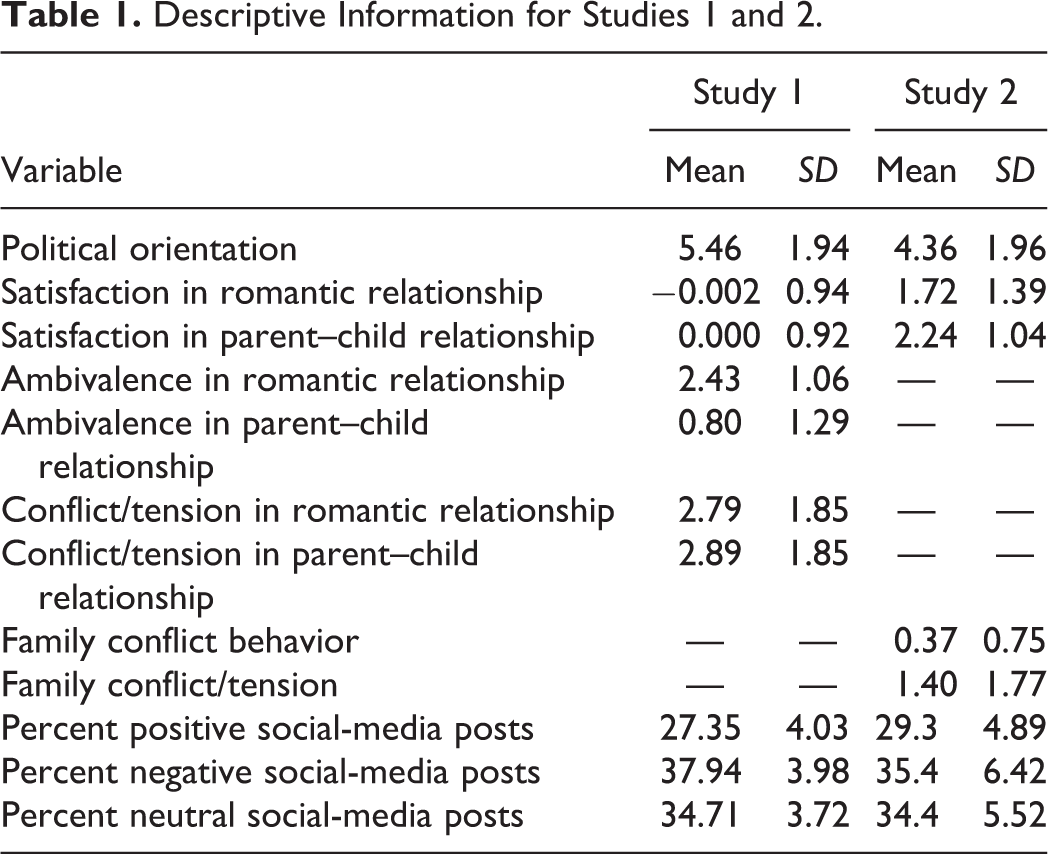
We created overall indices of romantic and parent–child relationship happiness each assessment day by averaging z-scored reports of satisfaction, ambivalence (reversed), and conflict (reversed). Then, we created an overall composite index of family relationship happiness by averaging romantic and parent–child happiness composites (α = .74). Higher scores captured greater daily family relationship happiness. Tables 1 and 2 contain the descriptive statistics intercorrelations among the analyzed variables.
Descriptive Information for Studies 1 and 2.
Intercorrelations Among the Primary Variables in Studies 1 and 2.
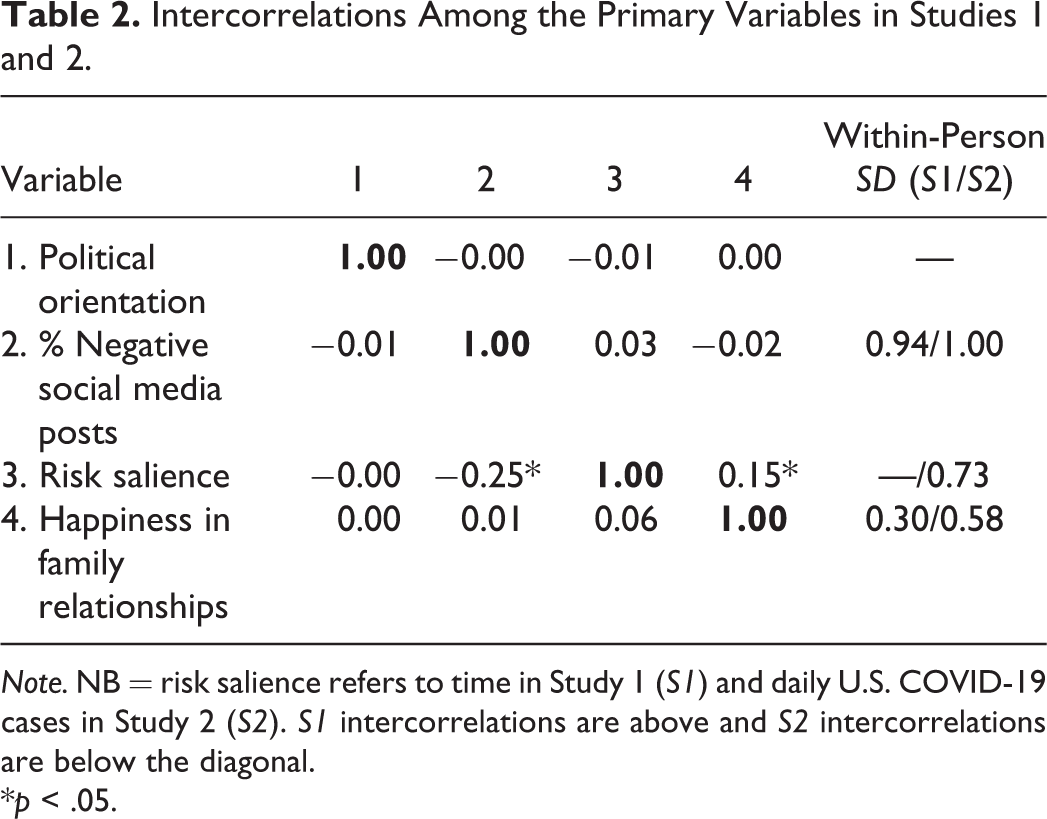
Note. NB = risk salience refers to time in Study 1 (S1) and daily U.S. COVID-19 cases in Study 2 (S2). S1 intercorrelations are above and S2 intercorrelations are below the diagonal.
*p < .05.
We modeled the data as a two-level nested structure using the multilevel modeling program MLwiN (Goldstein et al., 1998) with assessment week at Level 1 and participant at Level 2. We predicted the composite index of family relationship happiness from (1) the fixed effect of family happiness on the prior assessment day, centered on the participant’s own mean across assessments; (2) the random effect of time, centered such that 0 indicated the day after the midterm; (3) the random effect of the current assessment day’s popular sentiment toward President Trump, centered on the participant’s mean experience across weeks; (4) the fixed effect of between-person ratings on political orientation, mean-centered; (5) the two-way interactions among the current assessment day’s popular sentiment toward President Trump, time, and political orientation; (6) the three-way interaction between these variables; and (7) error terms.
Days when the U.S. populace made fewer negative social media posts about President Trump should be inconsistent with the negative reality of his stewardship that liberals perceive, putting the good judgment of fellow citizens acutely in question. Therefore, on days when popular sentiment was less negative than usual, we expected the greater proximity of the postelection future (and greater coincident risks of depending on their fellow citizens) to motivate liberals to find greater reason for happiness in their family relationships. In contrast, days when U.S. citizens more often made negative social media posts about President Trump should be inconsistent with the positive reality of Trump’s stewardship that conservatives perceive, putting the good judgment of fellow citizens acutely in question. Therefore, on days when popular sentiment was more negative than usual, we expected the greater proximity of the postelection future to motivate conservatives to find greater reason for happiness in their family relationships.
Table 3 contains terms and coefficients for the multilevel model predicting the composite of family happiness. The hypothesized three-way interaction was significant (and the results for the composite’s component measures of family satisfaction, ambivalence, and conflict were parallel, SOM-R). Table 4 reveals opposite and significant conditional two-way popular sentiment by time interactions predicting family relationship happiness for moderate liberals (i.e., 1 SD below the mean) and partisan liberals (i.e., those who identified as very or extremely liberal) on the political orientation scale and moderate conservatives (i.e., 1 SD above the mean) and partisan conservatives (i.e., those who identified as very or extremely conservative) on the political orientation scale. (Partisan liberals and conservatives fell in the bottom and top 15%, respectively, of the sample.)
Predicting Today’s Family Happiness From In/Consistency and Risk in Studies 1 and 2.
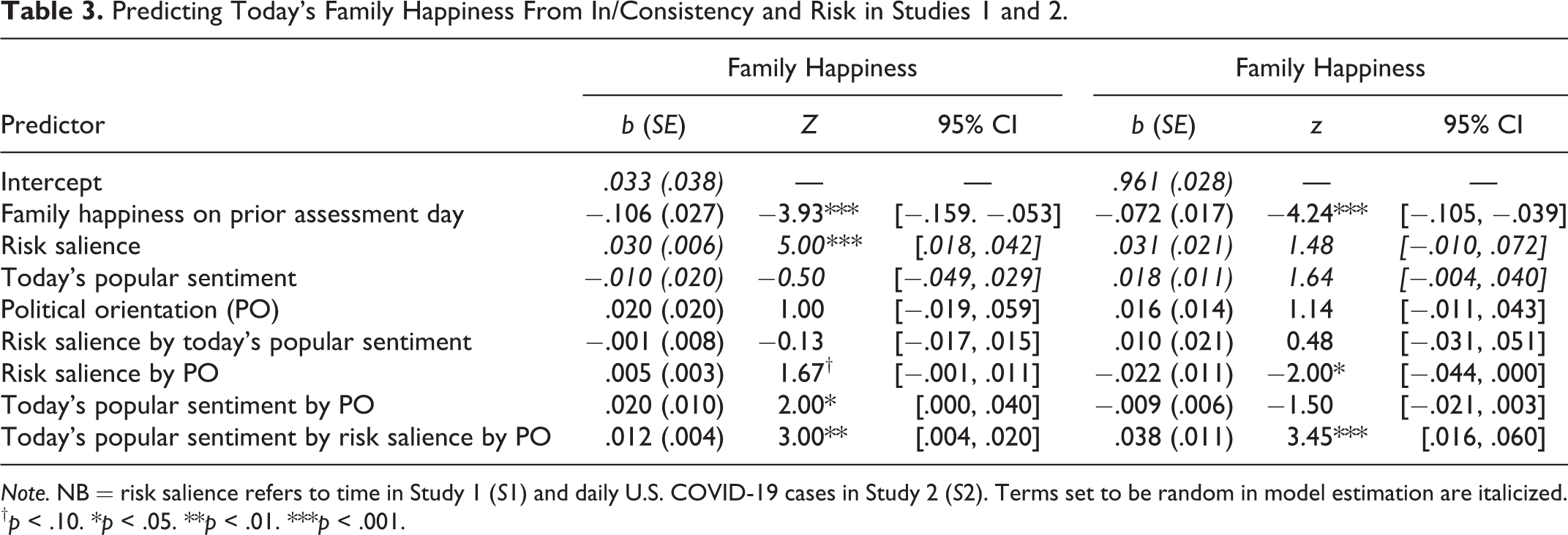
Note. NB = risk salience refers to time in Study 1 (S1) and daily U.S. COVID-19 cases in Study 2 (S2). Terms set to be random in model estimation are italicized.
† p < .10. *p < .05. **p < .01. ***p < .001.
Conditional Two-Way Time/Risk Salience Interactions in Studies 1 and 2.
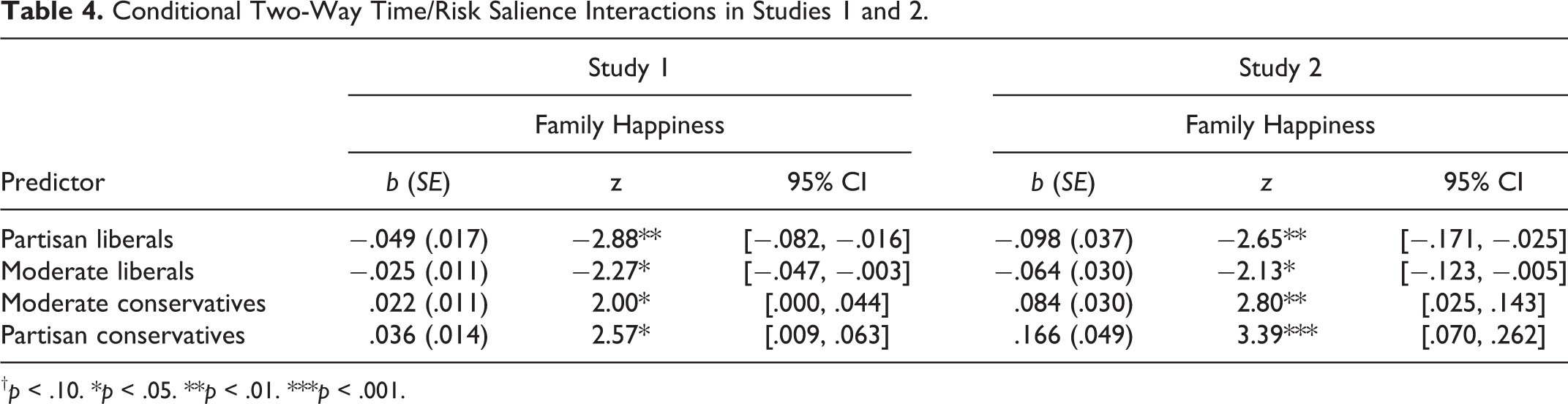
† p < .10. *p < .05. **p < .01. ***p < .001.
Figure 1 illustrates the predicted scores for the conditional two-way interactions between today’s popular sentiment and time for partisan liberals and partisan conservatives. Table 5 presents the simple effects of time on family relationship happiness for liberals and conservatives on days when popular sentiment toward President Trump was more versus less negative than usual (1 SD above/below the mean). As expected, on days when popular sentiment toward President Trump was less negative than average and personally inconsistent for liberals, moderate and partisans reported significantly greater family relationship happiness when the postelection future was temporally closer (vs. farther away). However, on days when popular sentiment toward President Trump was more negative than average and personally consistent for liberals, the simple effects of time were not significant. But, on days when popular sentiment toward President Trump was more negative than average and personally inconsistent for conservatives, moderate and partisans reported significantly greater family relationship happiness when the postelection future was temporally closer. However, on days when popular sentiment toward President Trump was less negative than average and personally consistent for conservatives, the simple effects of time were not significant.
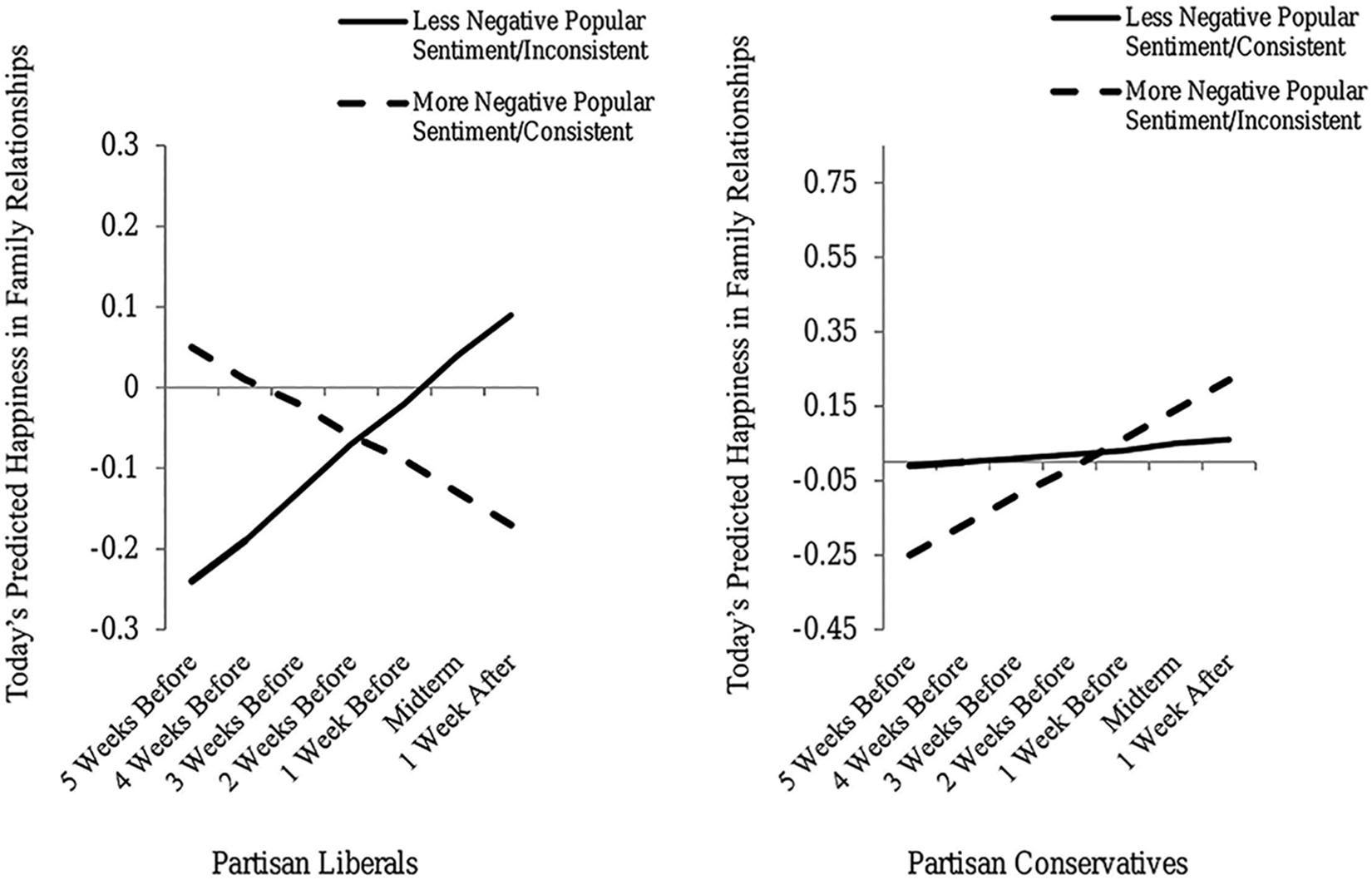
Today’s predicted happiness in family relationships from popular sentiment, time/risk salience, and political orientation.
Simple Effects of Risk Salience in Studies 1 and 2.
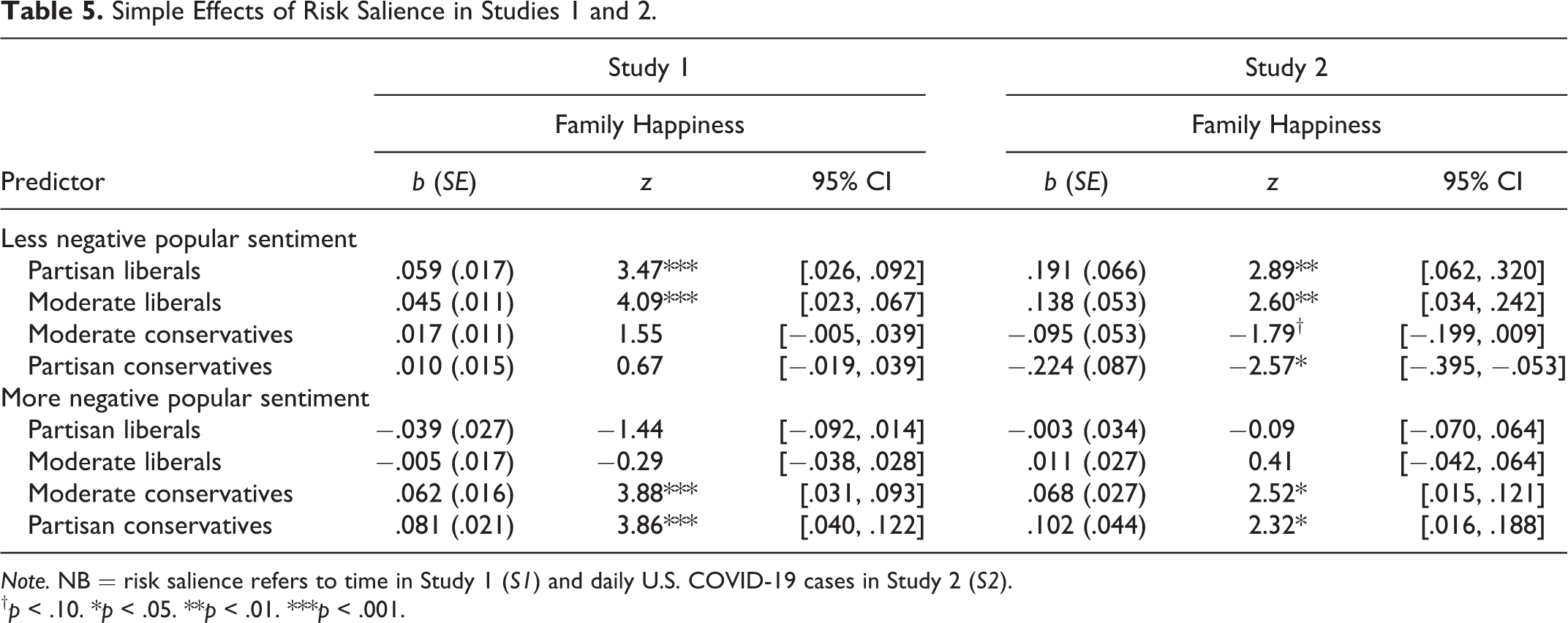
Note. NB = risk salience refers to time in Study 1 (S1) and daily U.S. COVID-19 cases in Study 2 (S2).
† p < .10. *p < .05. **p < .01. ***p < .001.
Summary
On days that revealed people could not count on fellow community members to perceive the same political reality they did, the greater risks of depending on this enigmatic collective (indexed by the temporal proximity of the postelection future and the reality of having to live with others’ wrongheaded choices) predicted liberals and conservatives finding greater daily reason for happiness in their families.
Study 2: An Ailing Nation
Participants provided reports every other day for a 3-week period, 3–4 months into the 2020 COVID-19 pandemic in the United States. We again used the partisan divide in support for Donald Trump’s Presidency to define (1) days when U.S. citizens more often posted negative comments mentioning Donald Trump as inconsistent with the positive reality of his Presidential stewardship most conservatives perceived and (2) days when U.S. citizens less often posted negative comments about the President as inconsistent with the negative reality of his Presidential stewardship most liberals perceived. We indexed the salience of the risk posed by depending on fellow community members on each assessment day through disease risk, indexed through the cumulative number of COVID-19 infections in the United States that day. We indexed the dependent variable—increased happiness in family relationships—through increased satisfaction and decreased conflict in romantic and parent–child relationships on high- as opposed to low-risk days.
We expected greater than usual daily increases in the total number of COVID-19 infections nationwide to make the risks posed by depending on fellow community members to keep one safe from illness more salient, making liberals and conservatives more invested in believing they could trust fellow citizens to perceive the same political reality of President Trump’s stewardship as they did. Therefore, on days when nationwide social media posts about President Trump instead suggested that participants could not count on fellow community members to perceive the same political reality they did, we expected participants to find greater reason for happiness in their family relationships when daily increases in the total number of U.S. COVID-19 infections were larger (vs. smaller), and thus, the risks of depending on fellow community members to make the right choices were more personally salient.
Method
Participants
We contracted Qualtrics to recruit 400 participants, which Qualtrics exceeded given oversampling to guarantee the targeted N. Eligible participants had to be U.S. citizens in monogamous, heterosexual live-in romantic relationships, native English speakers, and pass a research integrity check. Qualtrics did not recontact participants who only completed one assessment, leaving 555 participants (with 348 completing all 11). Participants (268 men) averaged 42.6 years old (SD = 11.7) and 363 had 2.1 children (SD = 1.1). Relationships averaged 13.3 (SD = 10.2) years in length (130 dating, 36 engaged, and 389 married). Participants were recruited in two cohorts in May and June 2020. Study 2 is the first to report findings from this sample.
Procedure
Qualtrics issued the first survey link to participants at 5 p.m. local time, with subsequent surveys issued every other day for 20 days (11 assessments). They were asked to complete the survey before bed, but the link remained accessible until 6 a.m. the next day to accommodate shift work. The first survey contained demographic/background measures assessed once, including the Study 1 political orientation measure. The next 10 surveys repeatedly assessed the focal dependent measures among unrelated measures. Participants were randomly assigned to one of the two automatic partner attitude conditioning protocols (which did not moderate the effects; see SOM-R).
Independent Variables
National sentiment toward President Trump
The z-scored percentage of negative social media posts mentioning President Trump again indexed daily popular sentiment.
Risks of depending on fellow community members
We indexed the risks of depending on fellow community members through the cumulative number of COVID-19 infections in the United States on each assessment day (www.coronavirus.jhu.edu/map).
Dependent Variables
Satisfaction
We averaged the items capturing daily satisfaction in romantic (i.e., “Overall, how would you describe your relationship with your romantic partner today”) and parent–child relationships (i.e., “Overall, how would you describe your relationship with your children today?”: −3 = terrible, 3 = terrific) to index daily family satisfaction.
Conflict/tension
Participants indicated (1 = yes, 0 = no) whether “my romantic partner did something that hurt, irritated, or angered me,” “my child(ren) did something that upset or hurt me,” “I did something that upset or hurt my romantic partner,” or “I did something that hurt or upset my children.”. Participants also rated how much conflict/tension they experienced in their interactions with people inside their home (1 = none, 7 = a great deal) on each assessment day. We created a daily index of family conflict by summing the rejecting behaviors (range = 0–4), z-scoring this sum, and then averaging it with the z-scored rating of conflict inside the home.
Results and Discussion
We created overall indices of family relationship happiness each assessment day by averaging z-scored reports of satisfaction and conflict (reversed). Higher scores captured greater daily happiness (α = .56). (The composite captured romantic relationship happiness for childless participants.) Tables 1 and 2 contain the descriptive statistics and intercorrelations among analyzed variables.
We modeled the data as a two-level nested structure. We predicted family relationship happiness from (1) the fixed effect of family happiness on the prior assessment day, centered on the participant’s own mean across days; (2) the random effect of today’s cumulative number of COVID-19 infections across the United States, centered on the participant’s mean experience across days; (3) the random effect of the current assessment day’s popular sentiment toward President Trump, centered on the participant’s mean experience; (4) the fixed effect of between-person ratings on political orientation, mean-centered; (5) the two-way interactions among today’s popular sentiment toward President Trump, today’s cumulative COVID-19 infections, and political orientation; (6) the three-way interaction; and (7) error terms.
As Table 3 illustrates, the three-way interaction predicting the composite index of today’s family happiness was significant (and the results for its component measures of family satisfaction and family conflict were parallel, see SOM-R). Table 4 reveals opposite and significant conditional two-way popular sentiment by today’s COVID-19 infections interactions predicting family relationship happiness for moderate and partisan liberals and moderate and partisan conservatives.
Figure 2 illustrates the predicted scores for the conditional two-way interactions between today’s popular sentiment and today’s cumulative COVID-19 infections for partisan liberals and partisan conservatives. Table 5 presents the simple effects of today’s cumulative U.S. COVID-19 infections on family relationship happiness for liberals and conservatives on days when popular sentiment toward President Trump was more versus less negative than usual (1 SD above/below the mean). As expected, on days when popular sentiment was less negative than average and personally inconsistent for liberals, moderate and partisans reported significantly greater happiness in their family relationships on days when the total number of U.S. COVID-19 infections increased more (vs. less) than usual. However, on days when popular sentiment was more negative and personally consistent for liberals, the simple effects of COVID-19 infections were not significant. But, on days when popular sentiment was more negative than average and personally inconsistent for conservatives, moderate and partisans reported significantly greater happiness in their family relationships on days when the cumulative number of U.S. COVID-19 infections increased more (vs. less) than usual. However, on days when popular sentiment was less negative and personally consistent for conservatives, moderate and partisans reported significantly less happiness on days when the cumulative number of COVID-19 infections increased more (vs. less) than usual.
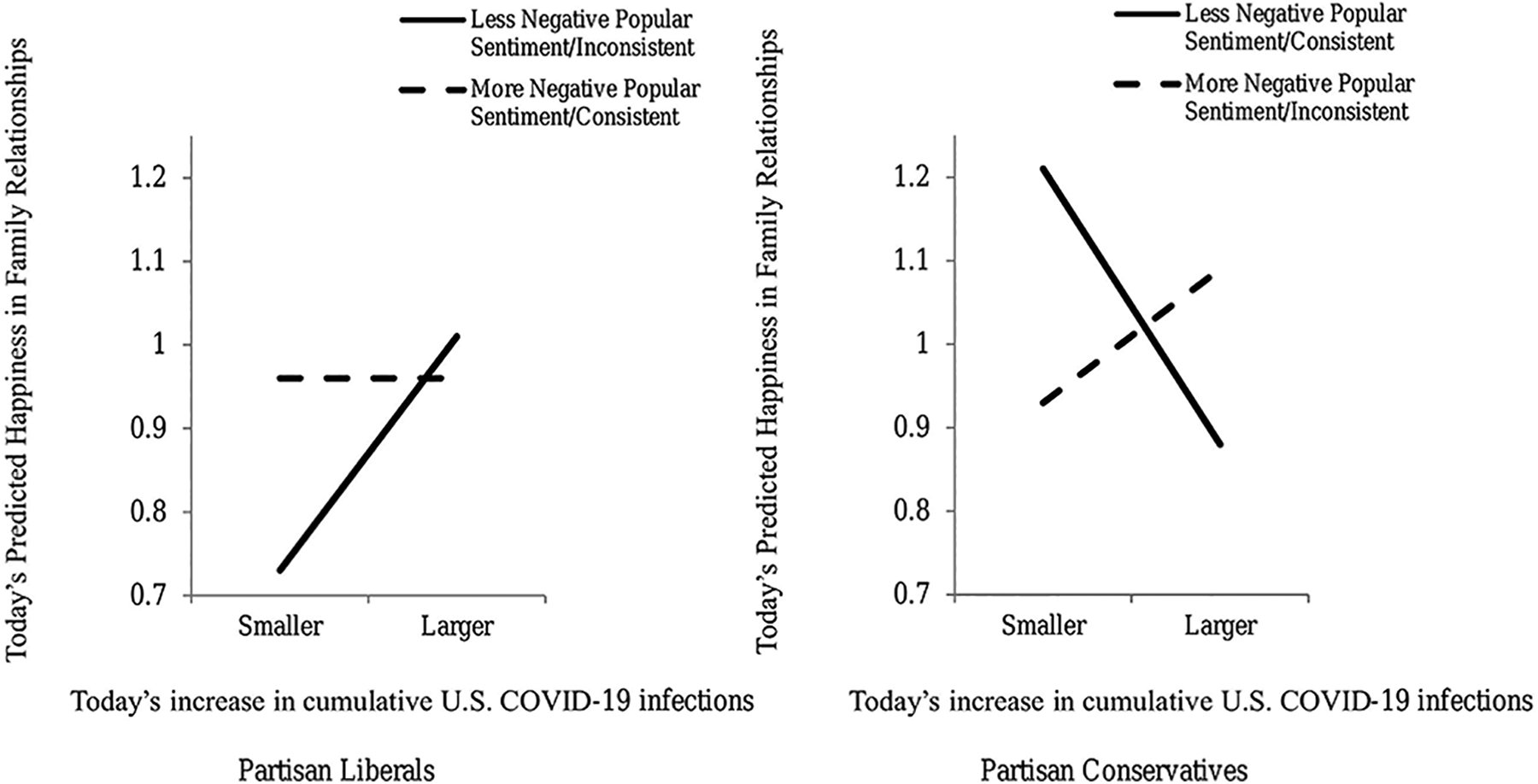
Today’s predicted happiness in family relationships from popular sentiment, COVID-19 infections/risk salience, and political orientation.
Summary
On days that people could not count on fellow community members to perceive the same political reality they did, the greater risks of depending on this enigmatic collective (indexed by greater daily increases in U.S. COVID-19 infections) predicted liberals and conservatives finding greater daily reason for happiness in their families.
General Discussion
The present studies suggest that political partisans find safety in their family relationships when everyday experiences heighten the risks of depending on a collective populace that cannot be counted on to perceive “obvious” political realities.
Alternate Explanations and Qualifications
There are qualifications to consider. First, the effects in Study 1 were specific to negative social media posts. However, a mirror image pattern of effects emerged in Study 2 utilizing both negative and positive posts about President Trump (see SOM-R).
Second, the logic of our hypotheses assumes that people are especially averse to inconsistency when they are highly dependent on the good judgment of others to keep them safe. If that is the case, fellow community members perceiving an inconsistent reality of President Trump’s stewardship should motivate daily affirmations of greater family happiness when the risks of depending on this collective for good judgment are obvious, but not when they are hidden. Meta-analyzing the simple effects of in/consistency across studies revealed inconsistency had exactly this property (see SOM-R). When the risks of depending on others were high, making inconsistency aversive, people reported greater family relationship happiness when others perceived an inconsistent rather than consistent reality of President Trump’s stewardship. However, when the risks of such dependence were low, people instead reported greater family happiness when others perceived a consistent reality. We also measured state feelings of dissonance (i.e., “uncomfortable, “uneasy,” and “bothered”) and personal needs for structure (e.g., “I wanted to have a place for everything and everything in its place”) to index tolerance of inconsistency over the election cycle in Study 1. The greater proximity of the postelection future (and the uncertainty of living with the electoral choices other people made) predicted decreased tolerance of inconsistency, as evidenced in increased personal desires for structure and increased reluctance to admit to feeling personally conflicted (see SOM-R).
Third, the reported analyses used the two-way interaction between political orientation and negative sentiment to index in/consistency. While providing a statistically powerful hypothesis test, this approach nonetheless conflates political orientation with in/consistency (because more negative collective sentiment index is consistent for liberals, but inconsistent for conservatives). Therefore, we rescaled the popular U.S. sentiment index in a further set of analyses, so that lower scores correspond to inconsistency for liberals and conservatives alike (see SOM-R). These analyses revealed that the predicted two-way interaction between the daily risks of depending on one’s fellow community members and daily inconsistency emerged regardless of partisanship.
Fourth, negative social media posts might capture angst about current events or popular mood rather than sentiment toward President Trump per se. To validate the role of sentiment, we collected the President’s Tweets on each assessment day in Study 1, coded these Tweets as more or less positive and uplifting (vs. negative and demeaning), and then predicted weekly changes in popular sentiment from the President’s prior Tweets. The President’s Tweets drove popular sentiment: The less positive and uplifting (more negative, demeaning) his Tweets in the prior week, the more often the U.S. populace posted negative social media comments about him the next week (see SOM-R).
Fifth, when fellow citizens voiced inconsistent sentiments about President Trump, the risks of depending on such an untrustworthy collective might have motivated people to find greater reason to be happy in their families because not being able to count on others to validate one’s own reality of the nation’s political stewardship motivates people to affirm any established meaning framework (Heine et al., 2006). If so, participants might have defended against the inconsistency simply by affirming their own political ideologies. However, when fellow community members collectively expressed inconsistent sentiments, the proximity of the postelection future did not motivate liberals to increase their disavowal, or conservatives to increase their avowal, of any of the right-wing beliefs we assessed weekly in Study 1 (see SOM-R).
Sixth, throughout the Trump administration, partisan liberals were living in a more undesirable political reality than conservatives. This might suggest that liberals should have been chronically happier with their family relationships than conservatives because liberals were living in a chronically discordant state. We did not necessarily expect this to be the case because chronic relationship evaluations are influenced by myriad factors such as support, conflict, and economic stress, any of which might dwarf political consistency per se. Nevertheless, to capture any potential effects of political climate, we averaged popular sentiment across weeks and added its effects to multilevel models predicting family happiness in Studies 1 and 2. No significant interactions involving general political climate emerged (see SOM-R) and the reported three ways involving the current day’s popular sentiment toward Trump remained significant. The reported effects thus capture state defenses that afford safety as needed.
The studies do have limitations. The effects are modest in size. The predicted cross-level interaction with Level 2 variable political orientation explained 17% (Study 1) and 26% (Study 2) of the random slope variance in the Level 1 two-way interaction between today’s popular sentiment and risk (Aguinis et al., 2013). However, this effect size should be interpreted in light of the subtlety of the social media measures of inconsistent popular sentiment. In addition, neither study included a direct measure of the presumed motivating threat—anxiety about depending on others. As is common in uncertainty reduction research (Heine et al., 2006), we inferred the presence of threat from the compensatory effects we observed on family relationship happiness. Indeed, “threat” checks are often ambiguous in situations where anxieties might be unconscious or people might use the measure of the presumed mediator as a means to compensate (Sigall & Mills, 1998). Future research should utilize indirect measures of anxiety about dependence to examine the mechanisms underlying the effects.
Conclusion
National elections and global health pandemics highlight how much one’s personal welfare depends on the actions of fellow citizens, political leaders, and the parties they represent. Threats to the safety of the collective relational world likely make fellow community members invalidating one’s own political reality especially unsettling, motivating people to find greater happiness in their family lives.
Supplemental Material
Supplemental Material, sj-docx-1-spp-10.1177_19485506211018351 - Looking for Safety in All the Right Places: When Threatening Political Reality Strengthens Family Relationship Bonds
Supplemental Material, sj-docx-1-spp-10.1177_19485506211018351 for Looking for Safety in All the Right Places: When Threatening Political Reality Strengthens Family Relationship Bonds by Sandra L. Murray, Mark D. Seery, Veronica M. Lamarche, Han Young Jung, Thomas L. Saltsman, Dale W. Griffin, David Dubois, Ji Xia, Deborah E. Ward and James McNulty in Social Psychological and Personality Science
Footnotes
Declaration of Conflicting Interests
The author(s) declared no potential conflicts of interest with respect to the research, authorship, and/or publication of this article.
Funding
The author(s) disclosed receipt of the following financial support for the research and/or authorship of this article: This work was supported by National Science Foundation (BCS-2028461).

Supplemental Material
The supplemental material is available in the online version of the article.
Notes
References
Supplementary Material
Please find the following supplemental material available below.
For Open Access articles published under a Creative Commons License, all supplemental material carries the same license as the article it is associated with.
For non-Open Access articles published, all supplemental material carries a non-exclusive license, and permission requests for re-use of supplemental material or any part of supplemental material shall be sent directly to the copyright owner as specified in the copyright notice associated with the article.
