







Abstract
Various domains of life are improving over time, meaning the future is filled with exciting advances that people can now look forward to (e.g., in technology). Three preregistered experiments (N = 1,602) suggest that mere awareness of better futures can risk spoiling otherwise enjoyable presents. Across experiments, participants interacted with novel technologies—but, via random assignment, some participants were informed beforehand that even better versions were in the works. Mere awareness of future improvement led participants to experience present versions as less enjoyable—despite being new to them, and despite being identical across conditions. They even bid more money to be able to end their participation early. Why? Such knowledge led these participants to perceive more flaws in present versions than they would have perceived without such knowledge—as if prompted to infer that there must have been something to improve upon (or else, why was a better one needed in the first place?)—thus creating a less enjoyable experience. Accordingly, these spoiling effects were specific to flaw-relevant stimuli and were attenuated by reminders of past progress already achieved. All told, the current research highlights important implications for how today’s ever better offerings may be undermining net happiness (despite marking absolute progress). As people continually await exciting things still to come, they may be continually dissatisfied by exciting things already here.
Most people presumably would choose to live in a world that improves over one that does not. After all, an ever better future means ever better goods and services to eventually enjoy, and even merely thinking about exciting experiences ahead has been found to prompt pleasurable savoring and anticipation in the meantime (Kumar et al., 2014; Kurtz, 2008; Loewenstein, 1987; O’Brien, 2013).
It should be a welcome news, then, that this is the world in which people really live. Many industries seek continual growth (Inglehart & Welzel, 2005; Veenhoven, 2010), and various domains of life are indeed improving over time (Pinker, 2018). People can simply search their pockets for proof. In the 1960s, Intel cofounder Gordon Moore (2006) predicted that advances in computer processing would double roughly every 18 months—known today as Moore’s law. Moore’s law highlights the rapid improvements in technology that now pervade everyday life, from ever-advancing smartphones, games, and other gadgets to broader progress in fields spanning medicine to space exploration.
And yet, with so much future progress to now savor and anticipate, growing evidence paints a less exciting picture of how people’s real-time feelings may be affected in the present. For example, experiential mood measures have largely shown flat lines in recent years, even among populations that have shown increases in evaluative measures like life satisfaction (Diener et al., 2013; Kahneman & Deaton, 2010). From 2000 to 2014, self-reported day-to-day happiness declined in American adults (Twenge et al., 2016). While such trends are surely complex, and include many reasonable causes (e.g., outside negative events), they nonetheless highlight an interesting juxtaposition: Today’s world promises many exciting advances to look forward to, yet its inhabitants are not exactly enjoying the wait.
The current research explores the possibility that, because of—and not despite—having more exciting times ahead, people might sometimes grow less enthused for today. That is, a better future might create a contrast effect (Biernat, 2005; Mussweiler, 2003) against the present. Most relevant to the current research, the inclusion–exclusion model of assimilation and contrast (Bless & Schwarz, 2010) posits that superior alternatives raise one’s reference for what counts as “good,” worsening-related options by comparison when the comparison standard and the target to which it is compared cannot be construed in the same superordinate category (e.g., Chopik, O’Brien, Konrath, & Schwarz, 2015). From this perspective, exceptionally positive comparison standards (which, in practice, often exist in the future; e.g., announcements of next year’s iPhone plus) can risk eliciting contrast effects, making relevant targets (which, in practice, often exist in the past and present; e.g., the current model in one’s pocket) to seem less desirable.
Our hypothesis is grounded in this model, while also building upon it: A more self-driven mechanism may be operating to produce such contrast in one’s real-time stimulus interactions. Consider, for example, what one might think upon learning that a better model of one’s current phone is in the works. Assuming a reliable source, norms of information exchange (Grice, 1975) might reasonably lead people to conclude that there must have been something to improve upon (or else, why was a better one needed in the first place?). Given the confirmatory nature of expectations on attention and search behavior (Klayman, 1995; Nickerson, 1998; O’Brien, Ellsworth, & Schwarz, 2012), such awareness may lead people to perceive the present in a different light: Thanks to a better tomorrow, people may now be more attentive to today’s flaws that must have needed fixing (“I always knew my phone was too slow!”). That is, despite being able to draw on one’s actual interaction with a present stimulus to inform one’s judgment, one’s actual interaction may be tainted: Better futures may lead people to perceive more flaws in the present than they would have perceived otherwise, creating contrast by changing how they then interact with the stimulus. Messages of a better tomorrow may indeed inspire people—to perceive today as worse.
The Present Research
Three experiments (N = 1,602) tested the hypothesis that mere awareness of future improvement may risk worsening people’s experience of what is presently available—by prompting people to perceive more present problems. We tested this hypothesis in the context of enjoying technology. Thus, we hypothesized that people’s experience of the same technology stimulus may be less enjoyable if they are under the impression that a better future version is in the works, and that this effect may be mediated by corresponding differences in the amount of “bugs” people perceive in the stimulus while experiencing it.
Technology is just one tested domain, but it is not a small one. Recent calls highlight the need for more research on the growing psychological effects of technology in everyday life (Dunn & Dwyer, 2018; Waytz & Gray, 2018). This domain also allows us to concretely operationalize the constructs of interest (e.g., “version 1 vs. 2”; “bugs”). For further generalizability, we tested a different technology stimulus in each experiment, across varying contexts and measures (see General Discussion for more about generalizability).
Moreover, our experiments are designed with various features that afford an especially informative test. First, we tested the effects of better futures on both relevant and irrelevant present stimuli, with our rationale predicting the effect should be stronger for relevant presents (e.g., vs. some generic demand of positive information). Second, all participants fully experienced the present stimulus and never experienced the future stimulus, and they formed judgment only after their full interaction (e.g., vs. being swayed by labels alone). Finally, all participants experienced the same enjoyable stimulus, identically dated (ruling out preferences for chronological newness: van Trijp & van Kleef, 2008)—and experienced it themselves for the first time.
To restate these features with a thought experiment: Suppose a person awakes from under a rock with no knowledge of smartphones. In principle, toying with a current iPhone should be an eye-opening experience, just as it was in reality upon the first iPhone release. Yet, as we will test, if first-time users are merely told that the iPhone plus is on its way, then they may experience today’s model as buggier and less enjoyable—despite being brand new to them, and despite nothing actually changing in today’s model as a function of this knowledge. This hypothetical captures a growing reality in everyday life: In today’s age of Moore’s law, many people are likely increasingly aware of better futures they might one day enjoy but presently cannot (e.g., seeing ads touting phone updates that are not yet released—and, once released, ever newer updates soon emerge that continually return phone users to square one). People often must enjoy something else as they await something better—and this interim state might sometimes undermine their presents.
Experiment 1
Art Time
In Experiment 1, we designed an art-creation computer game. We instructed the programmer to build “ambiguous bugs” into the game (e.g., a paintbrush tool producing flickering colors might seem like feature or bug). Before playing, some participants were merely informed that an even better version was in the works. We tested whether they enjoyed their experience less than others, driven by perceived buggyness while playing.
In addition, participants in a third condition were similarly informed of a better future version—except for an unrelated game. Whereas some generic demand of positive information suggests any reminder of a better future may undermine present experiences (if so, this third condition should similarly spoil the art game), our rationale suggests it depends on its link to the present (if so, this third condition may not spoil the art game).
In this and all experiments, we report all measures, manipulations, and exclusions. See http://osf.io/u2z7w/ for data, materials, and preregistrations.
Method
Participants
We requested 800 MTurkers, yielding 806 (M age = 36.16 and SD age = 11.25, 45.04% female, and 23.57% non-White) who participated for $0.75 USD. 1
Procedure
We conducted the experiment in September 2017. Participants were informed they would play “Art Time,” a game whereby players use tools to create colors and shapes on a blank canvas, that we had allegedly developed “about a year ago (October 2016).” For cover, the experiment was advertised as being about memory, so participants would first rate a flyer, then play Art Time, and then re-rate the flyer.
Participants were assigned to one of the three conditions that varied the flyer at Phase I. No future knowledge participants (n = 269) viewed a flyer for “Art Time: October 2016 Release.” This was our control condition: Participants viewed a flyer for the same game they would play at Phase II, with no information of future releases. Better future game participants (n = 273) viewed a flyer for “Art Time 2: October 2017 Release.” This was our key experimental condition: The flyer announced a “new and improved” update of the game at Phase II. Better unrelated future participants (n = 264) viewed a flyer for “Paint Wars 2: October 2017 Release,” announcing a “new-and-improved update” to “Paint Wars” (where we expected any undermining effect of better futures to be reduced).
For Phase I, all participants rated how colorful and memorable they found their flyer’s colors, as well as how much they liked them (1 = not at all; 7 = extremely), simply to match our cover story (all flyers are visually identical). Next, for Phase II, they played “Art Time: October 2016 Release.” Note that they all played the same game, identically dated. They played until a 2-min timer expired, then rated an enjoyment block and buggyness block, with blocks and block items randomized. For enjoyment, they rated how enjoyable, fun, and cool the game was; how happy they felt playing; and how much they liked it; for buggyness, they rated how buggy it was, how much it could be improved, how outdated it was, how high tech it was (to be reverse-coded in our analyses), and whether it was as good as it could be (to be reverse-coded in our analyses) (1 = not at all; 7 = extremely).
Finally, participants reported whether everything loaded (yes/no), whether they have taken similar studies (yes/no), how “big of a gamer” they are in general (big/moderate/infrequently play/never play), and completed attention checks (one regarding what flyer they saw at Phase I: Art Time/Art Time 2/Paint Wars 2; one regarding what game they played at Phase II: Art Time/Art Time 2/Paint Wars 2).
Results
In this and all experiments, enjoyment and buggyness items fell into two distinct factors (see Supplemental Materials) and so were collapsed to their intended scales (αs ≥ .69).
Enjoyment
A one-way analysis of variance (ANOVA) found an omnibus effect of condition, F(2, 803) = 7.69, p < .001, η2 = .02 (Figure 1A): The same game was less enjoyable merely when participants knew a better version loomed in the future (M = 5.08 and SD = 1.59) than without such knowledge (M = 5.42 and SD = 1.41), p = .007, d = 0.23. 2 However, not all improvement was created equal: Bringing to mind unrelated better futures did not undermine enjoyment (M = 5.56 and SD = 1.38) compared to control, p = .273, d = .10 (vs. experimental: p < .001, d = .32).
Buggyness
Buggyness showed converse effects, F(2, 803) = 19.07, p < .001, η2 = .05 (Figure 1B): The same game seemed buggier merely when participants knew about a better future version (M = 4.36 and SD = 1.20) than without such knowledge (M = 3.84 and SD = 1.23), p < .001, d = .43. Yet, bringing to mind unrelated improvement did not increase perceived buggyness (M = 3.78 and SD = 1.19) compared to control, p = .577, d = .05 (vs. experimental: p < .001, d = .49).
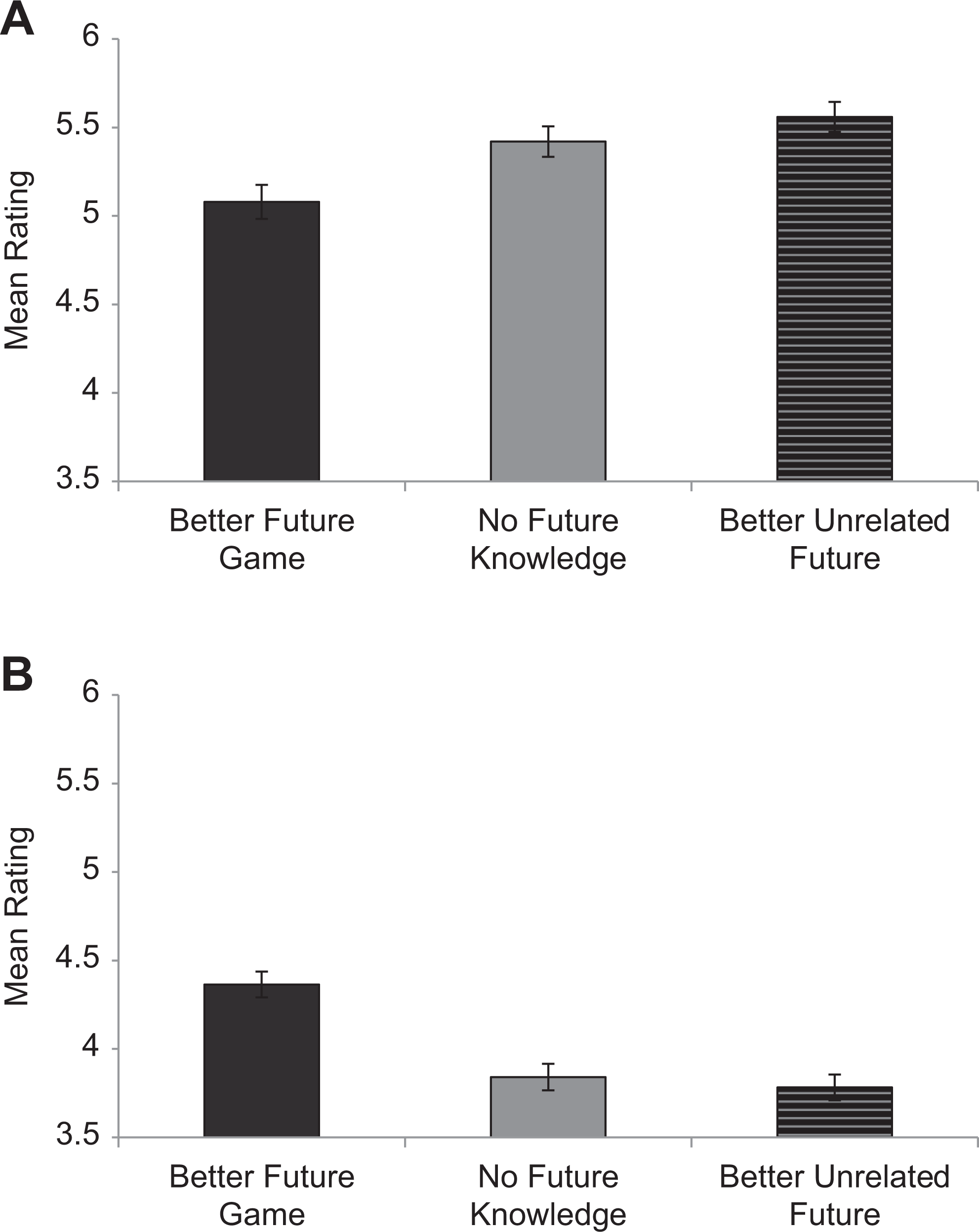
Experience of the same present game, by condition. Panel A: Enjoyment. Panel B: Buggyness. Note. Error bars ± 1 SE.
Mediation
Mediation analyses (SPSS PROCESS Model 4, 5,000 iterations: Hayes, 2013) imputing condition (x; 1 = no future knowledge/better unrelated future; 2 = better future), buggyness (m), and enjoyment (y) yielded a significant indirect effect of condition on enjoyment, via buggyness, b = −0.42, SE = 0.07, 95% CIboot [−0.56, −0.28]. When imputing enjoyment (m) and buggyness (y), this effect was weaker, b = 0.21, SE = 0.06, 95% CIboot [0.10, 0.33], suggesting the patterns are best explained by buggyness mediating enjoyment and not vice versa (see osf.io/u2z7w/ for full mediation output for this and all experiments 3 ).
Other Variables
There were no differences on flyer ratings (ps ≥ .225); 99.50% of participants (802/806) reported everything loaded, and 82.75% (667/806) reported never taking similar studies. There was a mix of general gamer fandom: 25.81% (208/806) big, 37.22% (300/806) moderate, 26.80% (216/806) infrequent, and 10.17% (82/806) never; 87.22% (703/806) passed the flyer check, and 93.05% (750/806) passed the game check. All patterns remain excluding participants based on these items and controlling individual differences (see Supplemental Materials). 4
Experiment 1 supports the hypothesis. The same first-time gaming experience was less enjoyable when participants were aware an updated version was coming, driven by increased perceptions of bugs while playing—but only for stimulus-relevant presents.
Experiment 2
Virtual Reality (VR)
Experiment 2 extended to a second context and stimulus: virtual reality (VR). Before experiencing the same VR technology, some participants were informed even better versions were in the works. We tested whether they enjoyed it less, and deemed it buggier, than others. We also tested a strategy for protecting first-time experiences, derived from our proposed mechanism. Other participants were informed of better versions and were reminded of older technology—to test whether focusing on flaws already fixed attenuates the effect. This condition further validates our theorizing: If the effect is moderated by recalibrating perceived bugs, this strengthens our causal inferences regarding buggyness as mediator (Preacher, 2015).
Method
Participants
We recruited 309 on-campus subject pool participants (M age = 23.38 and SD age = 7.67, 52.10% female, and 62.14% non-White) who participated for $6.00 USD.
Procedure
Participants completed the study in individual laboratory sessions. They experienced a VR technology involving wearing a headset and “blasting” creatures with a handheld device.
Participants were assigned to one of the three conditions. No future knowledge participants (n = 102) were informed they would play “a version of the technology from 2016,” and that this remained the market version (we conducted the experiment over the summer and fall quarters 2018). Better future participants (n = 101) were informed they would play “a version of the technology from 2016,” but that an even better version “will soon be released.” Better future + past reminder participants (n = 106) followed these same latter procedures except first saw a “Blast From The Past!” page with images of old blaster-game technology (e.g., Atari’s 1978 “Space Invaders”). They were encouraged to reflect on how far blaster-game technology has come, and to keep this in mind while playing.
Next, participants adjusted the headset to their comfort. We loaded a 5-min level, which included being able to move around the room in all directions while playing. Again, note that all participants experience the same stimulus, always dated from 2016.
Afterward, participants rated enjoyment and buggyness as in Experiment 1. Finally, participants reported whether everything loaded (yes/no), whether they had any past VR experience in general (yes/no/maybe), and completed attention checks (one regarding whether they were told that a new version was coming: yes/no; one regarding whether they saw the “Blast From The Past!” prompt: yes/no).
Results
Enjoyment
A one-way ANOVA found an omnibus effect of condition, F(2, 306) = 4.61, p = .011, η2 = .03 (Figure 2A): The same VR technology was experienced as less enjoyable merely when participants knew about a better future version (M = 4.61 and SD = 1.43) than without such knowledge (M = 4.96 and SD = 1.52), p = .082, d = .24. However, among participants who were additionally reminded of past progress, better futures no longer hurt: Their experience was no less enjoyable (M = 5.21 and SD = 1.32) compared to control, p = .206, d = .18 (vs. experimental: p = .003, d = .44).
Buggyness
Again, buggyness showed converse effects, F(2, 306) = 11.00, p < .001, η2 = .07 (Figure 2B): The same VR technology seemed buggier merely when participants knew about a better future version (M = 4.51 and SD = 1.04) than without such knowledge (M = 3.81 and SD = 1.07), p < .001, d = .66. Yet, adding a reminder of past progress yielded different patterns. Unexpectedly, these participants still found things buggier (M = 4.07 and SD = 1.08) than control, p = .079, d = .24, but indeed less buggy than the experimental condition, p = .004, d = .42.
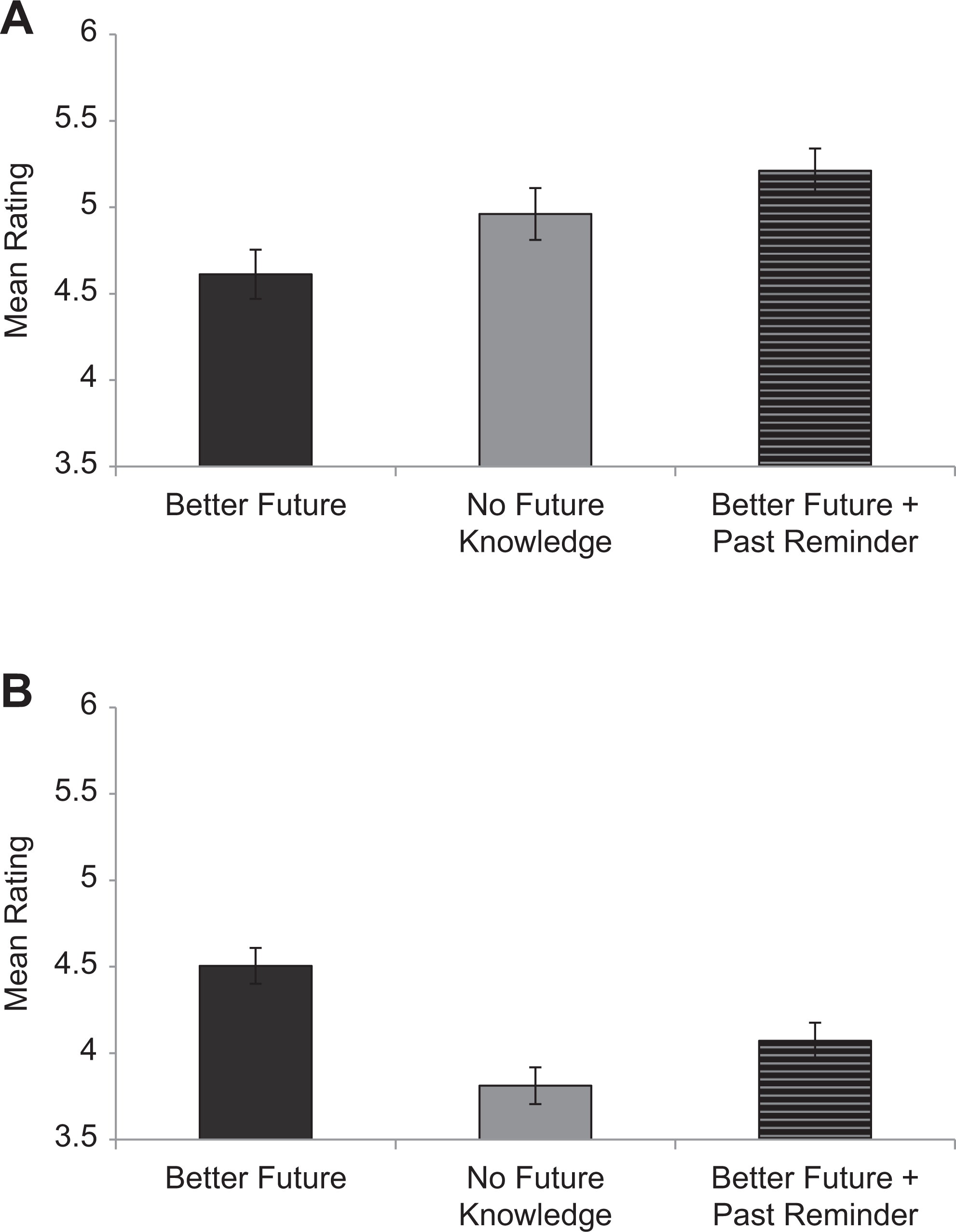
Experience of the same present virtual reality technology, by condition. Panel A: Enjoyment. Panel B: Buggyness. Note. Error bars ±1 SE.
Mediation
Again, mediation analyses (SPSS PROCESS Model 4, 5,000 iterations) yielded a significant indirect effect of condition (x; 1 = no future knowledge/with reminder; 2 = better future) on enjoyment (y), via buggyness (m), b = −0.32, SE = 0.09, 95% CIboot [−0.52, −0.18]; reversing m, y: b = 0.15, SE = 0.06, 95% CIboot [0.05, 0.30].
Other Variables
83.82% of participants (259/309) reported everything worked. There was a mix of general VR experience: 63.11% (195/309) no, 33.98% (105/309) yes, and 2.91% (9/309) maybe; 97.41% (301/309) passed the future check, and 96.44% (298/309) passed the “Blast” check. All patterns remain when excluding participants based on these items and controlling individual differences (see Supplemental Materials).
These results advance Experiment 1. The same VR experience was less enjoyable when participants were aware of a better future version, driven by perceived buggyness. Conversely, reminding participants of past progress attenuated these effects.
Experiment 3
Costs of “Next”
Experiment 3 further extended to a third context and stimulus, and also tested consequences. Participants watched a video utilizing 360-degree technology. Beforehand, some were informed even better versions were in the works. We tested whether they enjoyed it less, and deemed it buggier, than others. Further, all participants learned the experiment involved repeating this task—but could buy out if desired. We adapted this design from O’Brien’s (2019) Study 6, which found that many people bet some money to avoid repetition. We tested whether better future participants exhibit this behavior even more: They may (unnecessarily) pay to avoid Time 2 if they conclude from Time 1 that the technology is buggy and not worth repeating (while they would have happily reexperienced that same thing, without sacrificing any pay, had they simply been naive).
Method
Participants
We requested 500 MTurkers, yielding 487 (M age = 35.57 and SD age = 11.22, 46.61% female, and 24.44% non-White) who participated for $2.00 USD. (A programming error affected 13 participants, who saw no measures.)
Procedure
Participants played with 360-degree technology that we allegedly had been working to “implement into our surveys” since “summer 2018” (we conducted the experiment in June 2019)—involving watching an immersive city tour whereby a guide walks around sharing facts and figures. Viewers can rotate the camera at any angle while watching, thus mimicking how they could naturally look around during an in-person tour. Participants were informed they would complete 10 min of tasks, and that their first few minutes involved such a tour.
Participants were assigned to one of two conditions. No future knowledge participants (n = 239) were informed they would experience “a version of the technology from summer 2018,” and that this remained our current version. Better future participants (n = 248) were informed they would experience “a version of the technology from summer 2018,” but that an even better version “will soon be used in our surveys instead.” Then, all participants watched the same tour of Salvador, Brazil, playing with the technology until the video ended (∼4.5 min) and rated enjoyment and buggyness as in Experiments 1 and 2.
Next, participants were informed they would repeat this task with another video. We told participants “various checks” would ensure they completed everything as described. However, we offered them the chance to opt out if they so desired. They could bid from US$0.00 to US$2.00, in one-cent increments, to skip the task and end early. We informed them that whatever they bid would be compared against others’ bids at the time of participation, with the highest bid being accepted (and that amount being subtracted from their US$2.00 pay). Thus, we measured real behavior via amounts bet.
Then, all participants were debriefed, reported whether they had ever been to Salvador (yes/no) or seen a video like this (yes/no), whether everything loaded (yes/no); how much past 360-degree experience they had in general (not much/a bit/a lot), and completed an attention check (regarding whether they were told that a new version was coming: yes/no).
Results
Basic Effects
Independent samples t tests replicated Experiments 1 and 2: The same 360-degree technology was less enjoyable when participants knew of future improvement (M = 6.18 and SD = 0.89) than without such knowledge (M = 6.40 and SD = 0.85), t(485) = 2.82, p = .005, d = .26, and seemed buggier when participants knew of future improvement (M = 2.83 and SD = 1.11) than without such knowledge (M = 2.23 and SD = 1.09), t(485) = −6.02, p < .001, d = .55.
Betting Behavior
Better future participants even bet more money to avoid reexperiencing the technology (∼US$0.28, representing a 14.00% reduction; M = 28.41, SD = 55.24), relative to control (∼US$0.17, representing an 8.50% reduction; M = 17.54, SD = 40.01), t(485) = −2.48, p = .014, d = .23.
In our preregistration, we posited these data may be positively skewed since pay behavior often is (Kahneman & Ritov, 1994), and MTurkers presumably want to make money (so bet nothing). This was true—52.02% of better future participants (129/248) and 55.23% of control (132/239) bet nothing—but patterns hold via log-transformations, LG10(bet): M BetterFuture = 1.36, SD = 0.73; M NoFutureKnowledge = 1.18, SD = 0.68; t(224) = −1.92, p = .056, d = .26; LG10(bet + 1): M BetterFuture = 0.68, SD = 0.84; M NoFutureKnowledge = 0.56, SD = 0.74; t(485) = −1.71, p = .089, d = .16. Figure 3 shows violin plots.
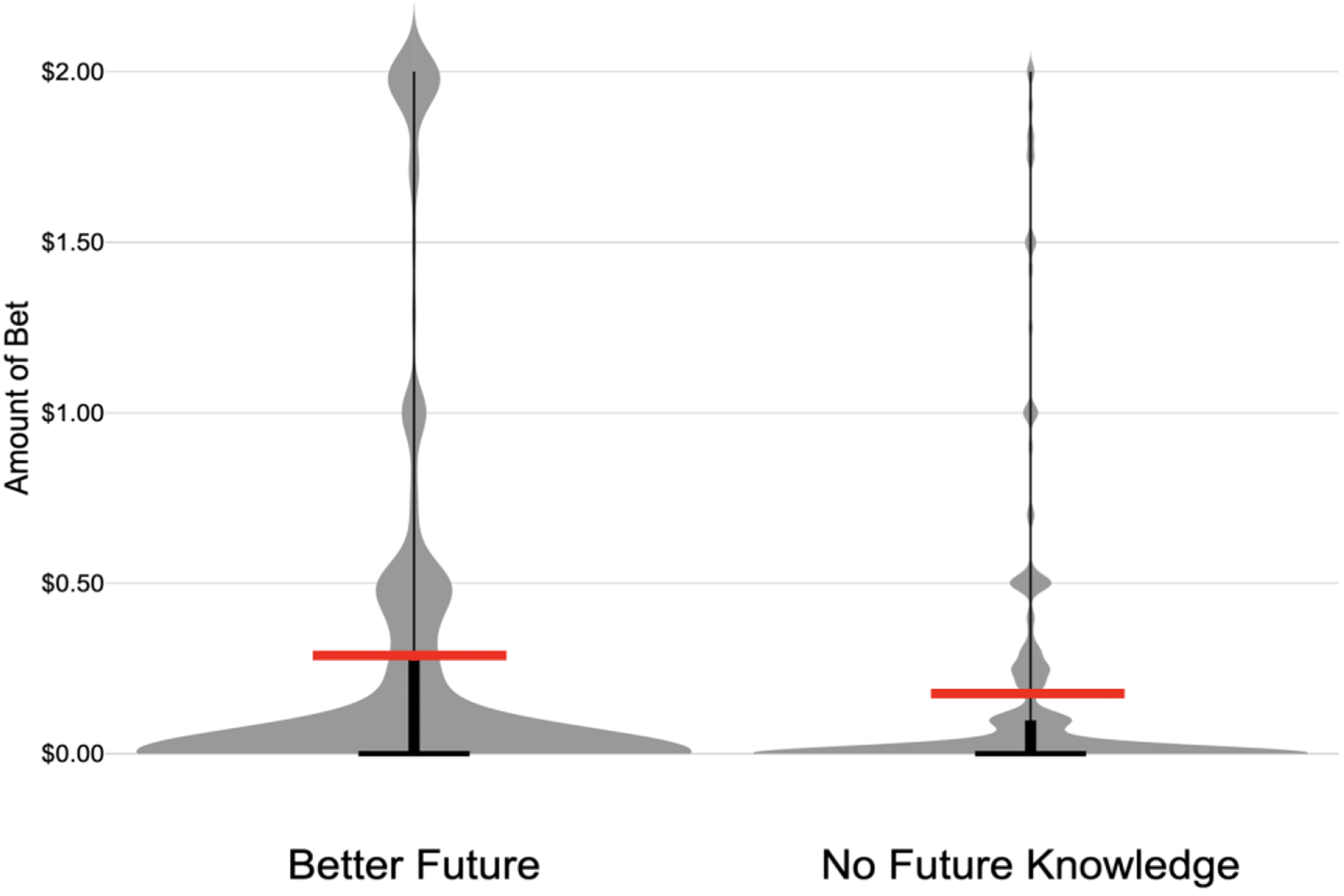
Bets (in USD) to avoid the same 360-degree technology. Note. Means marked with horizontal lines.
Mediation
Replicating Experiments 1 and 2, mediation analyses (SPSS PROCESS Model 4, 5,000 iterations) yielded a significant indirect effect of condition (x; = no future knowledge; 2 = better future) on enjoyment (y), via buggyness (m), b = −0.25, SE = 0.05, 95% CIboot [−0.35, −0.17]; reversing m, y: b = 0.15, SE = 0.05, 95% CIboot [0.05, 0.26].
For curiosity (not preregistered), we also explored serial mediation for predicting bets (SPSS PROCESS Model 6, 5,000 iterations), with condition (x; 1 = no future knowledge; 2 = better future)→buggyness(m)→enjoyment(m)→bets(y). This serial path was not significant, b = −0.45, SE = 0.80, 95% CIboot [−2.04, 1.17]—but buggyness again dominated: The indirect effect of condition was significant via buggyness, b = 4.98, SE = 1.81, 95% CIboot [1.96, 9.15], but not via enjoyment, b = 0.06, SE = 0.27, 95% CIboot [−0.29, 0.98].
Other Variables
99.18% of participants (483/487) confirmed everything loaded, 96.92% (472/487) had never visited Salvador, and 94.66% (461/487) had never seen similar videos. There was a mix of general 360-degree experience: 87.06% (424/487) not much, 10.27% (50/487) a bit, and 2.67% (13/487) a lot; 88.30% (430/487) passed the future check. All patterns remain when excluding participants based on these items and controlling individual differences (see Supplemental Materials).
Experiment 3 replicates Experiments 1 and 2 and highlights consequences. Mere awareness of better futures led participants to pay unsubstantiated costs in the present.
General Discussion
In a popular The New York Times op-ed, economist Sendhil Mullainathan (2014) put forth an “Apple conspiracy theory”: Whenever Apple is set to release a new iPhone, they slow down past models so to kindle desires to upgrade. Google data, for example, show that searches for “iPhone slow” spike during the weeks leading up to each annual release.
Beyond many reasons why companies may engage in nefarious tactics, one piece of the puzzle could be psychological: Mere awareness of future improvement may lead people to perceive the present as worse. Three experiments suggest such an effect and highlight some costs and boundaries: The same technology seemed buggier and was less enjoyable the first time participants experienced it, simply if they knew even better versions were in the works. As discussed, various study controls render these effects especially compelling, suggesting they are even stronger in (uncontrolled) everyday life.
Insights and Implications
Our findings build upon the inclusion–exclusion model of assimilation and contrast (Bless & Schwarz, 2010). This model would predict that better futures may undermine the present to the extent people construe the two as exclusive; next year’s iPhone may improve the Apple brand (inclusive comparison) yet make any one current model seem worse (exclusive comparison). Our findings are consistent with the notion of exclusive contrast while also suggesting an intriguing way in which it may be produced: A superior entity may drive people to focus more on the bad qualities of its comparison counterpart than on its own good qualities per se (thus perversely rendering it “superior”).
This distinction may prove critical for understanding how the future affects the present—highlighting a different perspective on traditional understandings. Indeed, far beyond anticipatory savoring, many literatures emphasize benefits of being surrounded by messages of change in general (Klein & O’Brien, 2017; O’Brien & Kardas, 2016) and especially by messages of future improvement (e.g., the power of growth mindsets and optimistic thinking: Dweck, 2008; Higgins, 1987; Markus & Ruvolo, 1989; Taylor & Brown, 1988; Wilson & Ross, 2001); if anything, positive future states have been theorized to helpfully contrast against present states so as to motivate goal pursuit (Carver & Scheier, 2002; Markman & McMullen, 2003). Of course, perhaps our findings capture a different kind of better future (e.g., we tested better futures that were out of participants’ control). Yet, our findings join others (including those involving self-important, controllable goals) that highlight downsides of positive future thinking (e.g., setting anxiety-filled expectations: Ford & Mauss, 2014; fostering overconfidence: Kardas & O’Brien, 2018; Klein & O’Brien, 2018) and warn of future–present contrast (e.g., Hanko et al., 2009; Kristal, O’Brien, & Caruso, 2019; Meyvis & Cooke, 2007; Meyvis & Nelson, 2007; O’Brien, 2015a; O’Brien, 2015b; O’Brien, Kristal, Ellsworth, & Schwarz, 2018; Oettingen et al., 2016; Strahan & Wilson, 2006; Wilson et al., 2012). As one point of contact: It seems reasonable to assume people who report positive future perceptions are those who are now thriving—yet, echoing our data, public health surveys find positive future perceptions negatively predict present well-being (Busseri, 2013; Busseri et al., 2012; Busseri & Merrick, 2016). In addition to their well-established benefits, proclamations of better futures may partly backfire by leading people to perceive new “flaws” in their presents.
This insight also sheds light on top-down perception effects—meaning, how preexisting knowledge can influence subsequent experiences (vs. simply responding to a stimulus “bottom-up” from its objective features: for a social–psychological review, see Lee et al., 2006). As those authors review, top-down expectations matter (e.g., merely labeling a beer as containing “vinegar” can make people avoid trying it)—however, this research often stops at choice. In discussing pressing outstanding questions, they write: “A third question concerns how specific perceptual, attentional, and cognitive mechanisms mediate the effect of expectations on experience (or reported experience)” (p. 1057) and that “In a review of the influence of sensory expectation on sensory perception, Deliza and MacFie (1996) concluded “it is an immensely complex topic which has had very little research attention” (p. 122). “We agree” (p. 1058). Helping fill these gaps, our buggyness results hint at how top-down effects influence choice: Mere awareness of a better future could risk shifting attention to present flaws, suggesting a self-fulfilling cycle: Awareness of a better future may make the present seem worse—and hence the future seem better—over and over.
Next Steps for “Next”
Beyond technology
Future research should extend beyond technology—not least in order to establish more direct connections between our findings and broader trends of unhappiness (see Introduction). Applied to self-evaluation, people who focus on future improvement could indeed feel motivated to work harder (Dweck, 2008), but they may also become more sensitive to present flaws and so feel continually unsatisfied. Applied to social evaluation, offenders may risk making their problematic current state seem worse by announcing plans to reform. Likewise, those looking to impress might advertise future potential to stimulate immediate interest in evaluators (Tormala et al., 2012), but left unfulfilled, this may simply draw attention to present lackluster accomplishments by comparison (raising ever higher expectations). More generally, our findings may help explain Frederick and Loewenstein’s (1999) puzzling notion of “feedforward” in hedonic adaptation (e.g., employees are most frustrated by their salary right before a known raise takes effect; prisoners are most frustrated in the last days of their sentence): As people come out of a problem, the last steps may be the hardest—with increased awareness of tomorrow’s greener pastures making today appear increasingly unbearable. This idea may also inform policy-related issues; in coming out of COVID-19 (and other shocks), for example, overadvertising how much better things could soon become may increase aggressive pushback until then, by making one’s current situation seem that much worse.
Boundary conditions
Future research should also seek to better understand exceptions to these effects. First, research should assess whether our effects emerge on more validated dependent measures and whether they indeed apply to better futures within one’s control. Second, research should assess whether people believe the purported improvement. Our designs led participants to assume better versions were better, but this is not always the case (e.g., as when consumers revolt against tweaks to a favorite recipe or cherished franchise, like infamous “New Coke”: Klein, 2015); presumably, our effects are moderated by trust, loyalty, expertise, and so forth. Third, research should further unpack the self-driven nature of our proposed mechanism; it is especially interesting if people explicitly infer “there must have been something to improve upon” and therefore search for (and alas, find) more problems, but our data cannot yet confirm such a process. Fourth, research should account for when these effects flip altogether; when do better futures lead people to savor the present? Our experiments assessed novel, designed-to-be enjoyable presents; tapping into other psychological processes, one possibility is that patently undesirable presents may suddenly seem “okay” under a better future light (e.g., as when looming graduations stir a longing for campus events that students previously avoided: Kurtz, 2008; see also Galak & Meyvis, 2011; O’Brien & Ellsworth, 2012).
Other directions
Surrounded by many advances in modern life (Pinker, 2018), various perspectives are needed to better calculate their net value. This is especially important because newer offerings are not always better (e.g., companies that engage in planned obsolescence: Garcia-Rada, John, O’Brien, & Norton, 2021; Gershoff et al., 2012). Our findings suggest people will struggle to discern true change from cosmetic change; better futures may accelerate adaptation to otherwise untarnished presents. In the same vein, future research should assess intuitions. People may opt into conditions of continual improvement without accounting for ill effects on present well-being. More debiasing tactics like Experiment 2 should be tested (e.g., instructing people to consider other attributions for announced change). Likewise, when people have genuinely improved content to share, our findings advise they advertise their improvements soon before they manifest so as to minimize the window in which their audiences’ anticipatory savoring transforms into discovered dissatisfaction—yet, they may intuitively (and mistakenly) share such developments as early as possible.
In sum, the current research highlights an undermining effect of better futures, tainting people’s first-time experiences of otherwise happy presents. In technology and elsewhere, people often know a better future is coming but must enjoy something else until then—an increasingly common, yet underresearched, state. Our findings suggest a closer look: If something breaks today, perhaps it is tomorrow that needs fixing.
Supplemental Material
Supplemental Material, sj-docx-1-spp-10.1177_19485506211034972 - The “Next” Effect: When a Better Future Worsens the Present
Supplemental Material, sj-docx-1-spp-10.1177_19485506211034972 for The “Next” Effect: When a Better Future Worsens the Present by Ed O’Brien in Social Psychological and Personality Science
Footnotes
Acknowledgments
Shun Wang provided helpful assistance with study design. Alex Kristal and the CDR lab at Chicago Booth collected data. In addition to the review team, Linda Hagen, Reid Hastie, Chris Hsee, Norbert Schwarz, Emma Levine, Anuj Shah, and On Amir provided especially helpful feedback.
Declaration of Conflicting Interests
The author(s) declared no potential conflicts of interest with respect to the research, authorship, and/or publication of this article.
Funding
The author(s) disclosed receipt of the following financial support for the research, authorship, and/or publication of this article: This research was supported by the Willard Graham Faculty Research Award and the Charles E. Merrill Faculty Research Award, both at Chicago Booth.

Supplemental Material
The supplemental material is available in the online version of the article.
Notes
References
Supplementary Material
Please find the following supplemental material available below.
For Open Access articles published under a Creative Commons License, all supplemental material carries the same license as the article it is associated with.
For non-Open Access articles published, all supplemental material carries a non-exclusive license, and permission requests for re-use of supplemental material or any part of supplemental material shall be sent directly to the copyright owner as specified in the copyright notice associated with the article.
