






Abstract
Mask wearing plays a vital role in the fight against the novel coronavirus (COVID-19). Despite its ubiquity in everyday social life, it is still unknown how masked faces are mentally represented. Drawing on construal-level theory, we test the hypothesis that masked faces and unmasked faces are implicitly associated with psychological distance and proximity in memory, respectively. Four preregistered, high-powered experiments (N = 354 adults) using the Implicit Association Test lend convergent support to this hypothesis across all four dimensions of psychological distance: social distance, spatial distance, temporal distance, and hypothetical distance. A mini meta-analysis validates the reliability of the findings (Hedge’s g = 0.46). The present work contributes to the growing literature on construal-level effects on implicit social cognition and enriches the current discussion on mask wearing in the pandemic and beyond.
Avoiding infection risk is one of the most critical public health issues we currently face in the coronavirus (COVID-19) pandemic. As of August 2021, for example, more than 208 million total confirmed COVID-19 cases worldwide have been reported, with more than 4.3 million global deaths in over 192 countries (JHU, 2021). To contain the spread of the virus, different public health measures have been implemented, including social distancing, hygiene, and respiratory etiquette (World Health Organization, 2021). In addition, over 100 countries worldwide have made mask wearing mandatory in many public spaces such as supermarkets, public transportation, or in the workplace (for an overview, see Greenhalgh et al., 2020).
Face masks help mitigating the transmission of COVID-19 (and other respiratory diseases) due to a reduction in potentially harmful aerosols and droplets (for a meta-analysis, see Chu et al., 2020). At the same time, there is also growing controversy over face masks, because wearing a mask appears to yield also detrimental effects (e.g., reductions in ventilation; Fikenzer et al., 2020). Thus, understanding how people perceive mask wearing is crucial for ongoing public health efforts regarding mask wearing and related policies. However, research on how mask wearing affects human social cognition is far from understood. Specifically, an important open question is how people mentally represent masked (vs. unmasked) faces.
In the present investigation, we address the question of whether masked faces are associated with psychological distance (i.e., the subjective experience that an object is close or far away from the self). Because one purpose of wearing face masks is to physically separate people from each other, it seems plausible that mask wearing might engender a sense of physical and psychological distance from mask wearers. However, to our knowledge, no research has empirically examined this notion. Our approach to this question builds on construal-level theory (CLT; Liberman & Trope, 2008; Trope & Liberman, 2010), which relates the abstractness (vs. concreteness) of mental representations of objects with their perceived distance (vs. proximity) from the self—socially, spatially, temporally, and in hypotheticality. We show that masks wearers are mentally represented as more psychologically distant on all of these distance dimensions and discuss the implications of this finding for understanding and promoting protective behaviors against the spread of the virus.
Face masks cover approximately 50%–60% of the face including the nose, mouth, and chin, thus rendering many facial features invisible (Freud et al., 2020; Hess, 2020). This poses a challenge for perceivers who need to navigate social situations that include mask wearers as the facial cues they need to gauge their emotions, intentions, and dispositions are occluded. A large body of face perception research suggests that perceivers respond to such challenges by forming abstract, schematic representations of the face on the basis of the available cues (e.g., Aviezer et al., 2012a, 2012b; Hassin & Trope, 2000; Krosch & Amodio, 2019; Ratner & Amodio, 2013; Stolier et al., 2020; Todorov, 2017; Trope, 1986). Forming abstract representations of a face may, in turn, have implications for the perceived distance from the face (even when the objective distance from the face does not differ). Specifically, research conducted in the framework of CLT has shown that perceivers experience objects they construe abstractly as being located relatively farther away from them (e.g., Amit et al., 2009; Amit et al., 2012; Rim et al., 2019; Snefjella & Kuperman, 2015; Stephan et al., 2010). Perceivers may therefore associate masked faces with being spatially distanced from themselves and unmasked faces with being spatially proximal.
Importantly, based on CLT research showing that the different psychological distance dimensions are subjectively interrelated (Bar-Anan et al., 2006; Fiedler et al., 2012; Fiedler et al., 2015; Maglio et al., 2013; Tavares et al., 2015), we predict that perceivers will associate masked faces not only with spatial distance but also with all other psychological distance dimensions—temporal distance (later vs. soon), social distance (stranger vs. close other), and hypothetical distance (unreal vs. real).
How can we capture the associations between wearing face masks and psychological distance? Here, we employ an implicit measure, allowing us to assess individual differences in implicit social cognition (for reviews, see Gawronski & Payne, 2011; Greenwald & Banaji, 1995; Nosek et al., 2011; Schröder-Abé & Fatfouta, 2018). One of the most widely known implicit measures is the Implicit Association Test (IAT; Greenwald et al., 1998). The IAT is a dual categorization task that assesses the relative association strength between a target concept (e.g., masked vs. unmasked faces) and an attribute dimension (e.g., psychological distance vs. psychological proximity). The logic is that individuals find the task easier (i.e., respond faster) when mentally associated categories share a response key (e.g., masked faces—distal entities) than when this is not the case (e.g., masked faces—proximal entities). The resulting “IAT effect” describes the reaction time (RT) difference between the two pairings and is assumed to reflect the strength of implicit associative links; in our case, between masked faces and psychological distance (for a description, please see the Method paragraph below).
The Present Research
In the present research, we aim to show that there is a basic association between the concepts of “masked faces” and “psychological distance” at an implicit level. To accomplish this, we performed four experiments using the IAT, each examining one distinct domain of psychological distance: social (Experiment 1), spatial (Experiment 2), temporal (Experiment 3), and hypothetical distance (Experiment 4). Across all four experiments, our focal prediction was that masked faces are associated with cues of psychological distance, whereas unmasked faces are associated with cues of psychological proximity. Accordingly, we expected participants to respond faster when they use the same response key for either masked faces or psychological distance than when they use the same response key for either masked faces or psychological proximity. Table 1 details the experimental manipulations and stimuli used in each of the four experiments.
Experimental Manipulations and Stimuli in Experiments 1–4.
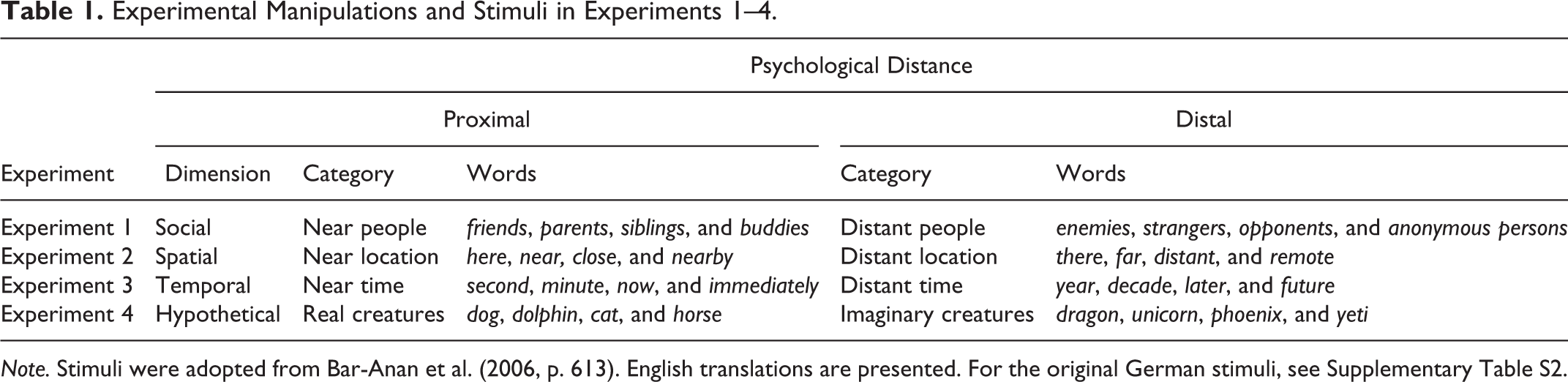
Note. Stimuli were adopted from Bar-Anan et al. (2006, p. 613). English translations are presented. For the original German stimuli, see Supplementary Table S2.
Method
The present research followed a preregistered plan, which is available at the Open Science Framework (OSF; https://osf.io/ryq2z). We report how we determined our sample size, all data exclusions (if any), all manipulations, and all measures in the study (Simmons et al., 2012). Supporting information that is not essential for understanding the conclusions of the manuscript but nevertheless might benefit the reader is available from the OSF (i.e., Supplementary Tables S1 and S2). We also provide complete data (i.e., Open Data), material (i.e., Open Material), and code (i.e., Open Code) used for the analyses reported below (https://osf.io/67b84).
Participants
We recruited a total of 354 German-speaking individuals for four independent experiments with identical procedures and materials (except for the IAT, which differed according to the psychological distance dimension in question). 1 Of these, five (0.01%) individuals were excluded based on our preregistered exclusion criterion (i.e., IAT response latencies of 10% of all trails <300 ms). The inclusion of these participants did not impact the results reported below. Participants were recruited online to participate in a brief (10 min) study on “Attitudes and Thoughts During the COVID-19 Pandemic.” To this end, we used 216 university email distribution lists and made sure that each experiment was advertised using a distinct, nonoverlapping set of email lists. As an incentive, participants could enter a draw for a gift card for an online retailer worth 25€ or obtain course credit. After consenting to participate, participants completed the IAT. JavaScript was used to achieve a millisecond-accurate recording of response latencies (for further details on response-timing accuracy in JavaScript online studies, see Reimers & Stewart, 2015). Table 2 details the final sample characteristics for each experiment.
Sample Characteristics in Experiments 1–4.
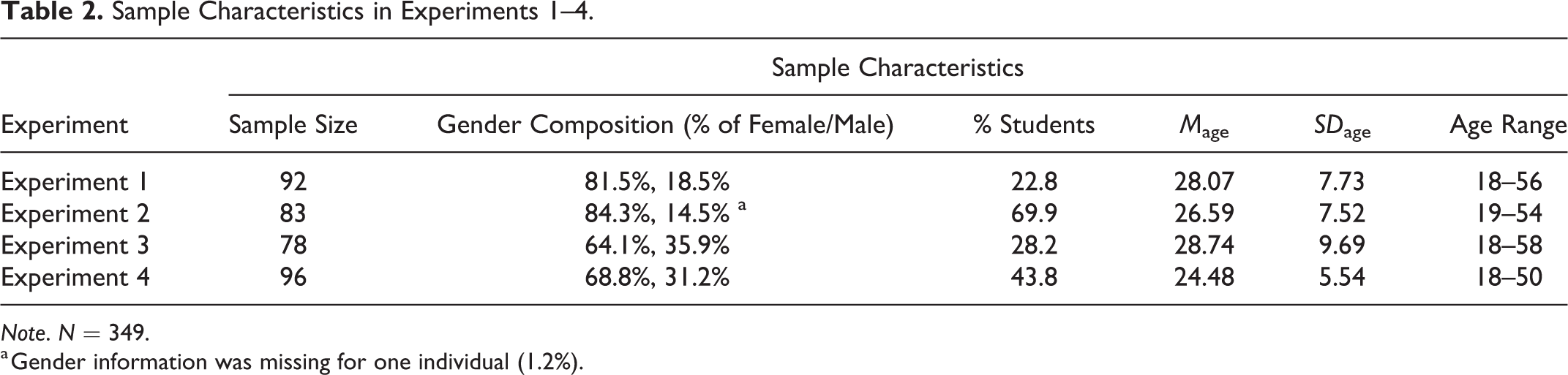
Note. N = 349.
a Gender information was missing for one individual (1.2%).
Power Considerations
The required minimum sample size per experiment was predetermined on the basis of an a priori power analysis using G*Power (Faul et al., 2009). On the basis of similar CLT-research using the IAT (Bar-Anan et al., 2006), we expected to find a medium effect of .41 (α = .05, power: .80) and calculated a sample size of at least N = 49 per experiment. Given the novelty of the studied effect, we deliberately oversampled to ensure high power (i.e., N range: 78–96, for Experiments 1–4).
Procedure
In all four experiments, participants completed an IAT. Given that the IATs were identically constructed, we only describe the IAT from Experiment 1 examining social distance. Figure 1 shows example stimuli used in the IAT.

Implicit Association Test sample screens and stimuli for Experiment 1 (social distance).
Pictures of masked or unmasked faces and words representing socially close or distant targets were presented in the center of the screen. Individuals were asked to classify these stimuli as fast as possible into four different categories using two different keys; two target categories (“masked faces” vs. “unmasked faces”; four pictures each) and two attribute categories (“near people” vs. ”distant people”; four words each). The speed to associate masked faces + distant people and unmasked faces + near people (Figure 1A and B) relative to the opposite pairing (Figure 1C and D) was taken to reflect an implicit mental association between masked faces and social distance. 2
Block 1 (20 trials) introduced the target category (masked faces vs. unmasked faces), and Block 2 (20 trials) introduced the attribute category (near people vs. distant people). Both were combined in critical Blocks 3 (20 trials) and 4 (40 trials). The target categories switched sides in Block 5 (20 trials), resulting in switched pairings in critical Blocks 6 (20 trials) and 7 (40 trials). As counterbalancing the order of compatible and incompatible blocks was found to distort effect sizes and, hence, bias effects-size estimates, the order of the combined blocks was held constant (for a discussion of this procedural detail, see Banse et al., 2001).
For each participant, IAT scores were calculated using the improved scoring algorithm (Greenwald et al., 2003). This score divides the difference between critical block means by the individual-respondent standard deviation of all the latencies in the two critical blocks. Higher scores reflect higher implicit associations between masked faces and psychological distance relative to psychological proximity. We applied the improved scoring algorithm separately to two mutually exclusive subsets of the critical trials of the IAT to estimate its reliability (Schmukle & Egloff, 2006). The reliability of the IAT was high (Spearman–Brown corrected split-half reliability based on parallel test halves: .87–.94, for Experiments 1–4).
Stimuli Used in the IATs
For the target categories (i.e., masked vs. unmasked faces), four male and four female pictures with a neutral facial expression were taken from the FACES database (Ebner et al., 2010). An independent pilot study (N = 200; M age = 23.77 years, SD = 3.69; 100 male, 100 female) confirmed that the four pictures were of equal attractiveness and trustworthiness. 3 A professional graphic designer modified the pictures by individually applying face masks to cover the same part of each face. All images were converted to gray scale and adjusted for size, luminance, and contrast. Altogether, there were eight pictures (i.e., two versions of a masked male, masked female, unmasked male, and unmasked female person). For the attribute categories (i.e., psychological distance vs. proximity), words were adopted from the study by Bar-Anan et al. (2006), which similarly examined all four psychological distance dimensions using IATs. Lexical analyses revealed that that the words belonging to either attribute category did not differ in terms of word length (ps ≥ .182) or word frequency (ps ≥ .302).
Data Analyses
To test our main hypothesis that masked faces are associated with psychological distance relative to psychological proximity, we analyzed mean RTs in milliseconds for congruent (masked faces/distance + unmasked faces/proximity) and incongruent (unmasked faces/distance + masked faces/proximity) conditions using paired samples t tests. Although not preregistered, we aimed to provide a methodological replication of our results by analyzing the IAT scores using one-sample t tests (test value = 0, as this would indicate a neutral association between the target and attribute categories). This analysis allowed us to take the individual standard deviation of response latencies into account (i.e., individual variability of the latencies), thereby providing a more stringent test of our hypothesis. This analysis yielded similar results to those obtained below (see Supplementary Table S1).
Results
Because the results were highly consistent across all four experiments, we report them jointly. As shown in Figure 2A–D and Table 3 and as hypothesized, performance was significantly faster in the congruent (masked faces/distance + unmasked faces/proximity) condition than in the incongruent (unmasked faces/distance + masked faces/proximity) condition. Importantly, the pattern of results replicated across all four dimensions of psychological distance: social distance, spatial distance, temporal distance, and hypothetical distance. Thus, as expected, the results conclusively suggest that masked faces are implicitly associated with attributes that relate to psychological distance relative to attributes that relate to psychological proximity.
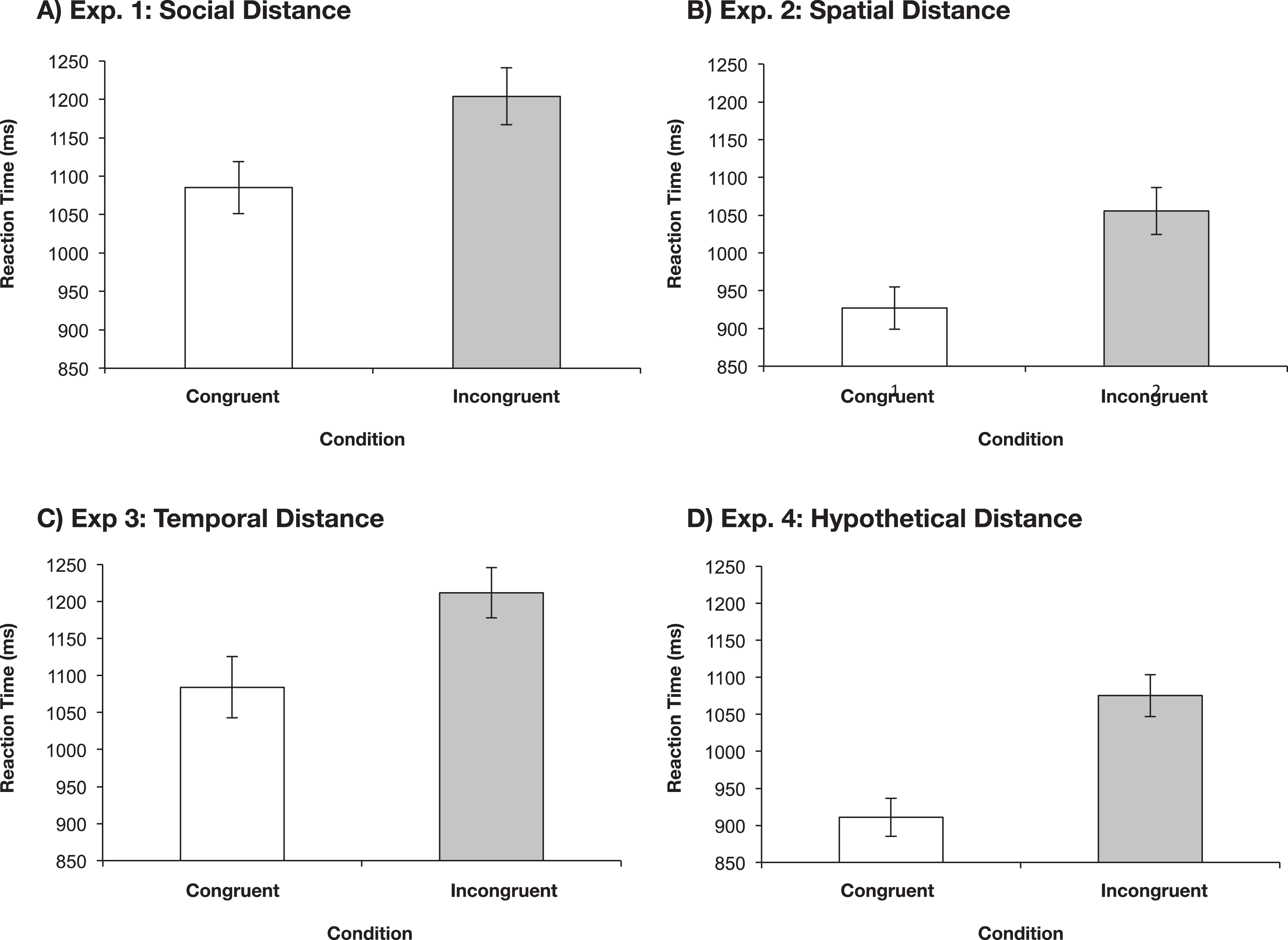
Reaction time for congruent and incongruent pairings for all four experiments. Note. The difference between conditions was significant in all four experiments (A–D). Error bars indicate ±1 standard error of the mean; congruent pairing = masked faces/distance + unmasked faces/proximity; and incongruent pairing = unmasked faces/distance + masked faces/proximity.
Paired-Samples t-Tests Comparing RT for Congruent and Incongruent Distance Construal-Level Pairings for All Experiments.
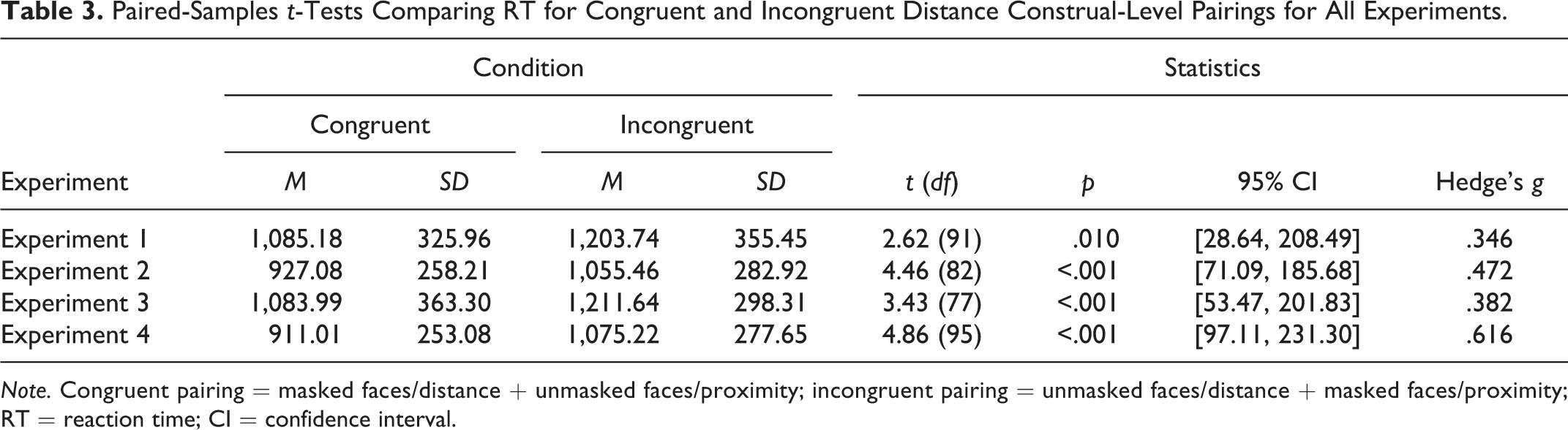
Note. Congruent pairing = masked faces/distance + unmasked faces/proximity; incongruent pairing = unmasked faces/distance + masked faces/proximity; RT = reaction time; CI = confidence interval.
Mini Meta-Analysis
Although our experiments were adequately powered, we nevertheless aimed to examine the reliability of the findings. To this end, we conducted a mini meta-analysis including all four experiments (Goh et al., 2016). We found that people tend to associate masked faces with psychological distance and unmasked faces with psychological proximity more than they associate unmasked faces with psychological distance and masked faces with psychological proximity, Hedge’s g = 0.46, 95%CI [0.307, 0.607], Z = 5.80, p < .001 (two-tailed). The results reflect a medium-sized effect, which is highly consistent with the meta-analytic average for psychological distance effects (0.475, k = 125 studies; Soderberg et al., 2015). In addition, results revealed no significant heterogeneity among the experiments, I2 = 0.0%, χ2(3) = 1.95, p = .583 (two-tailed). Hence, the meta-analysis provides strong support for the observed effects. Figure 3 details the forest plots.
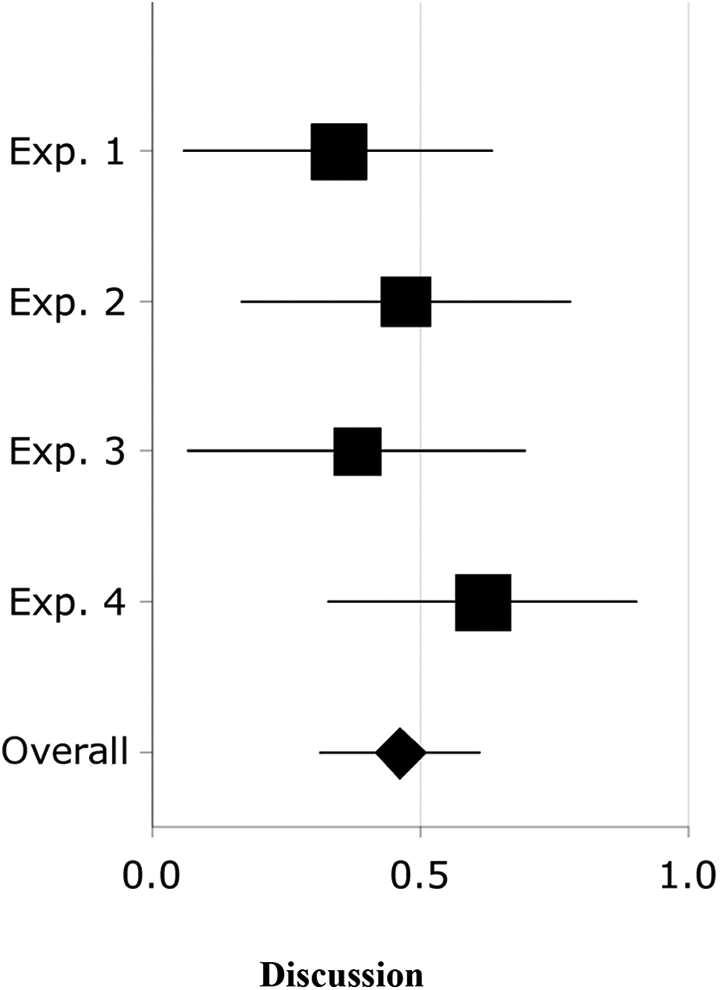
Forest plot of mini meta-analysis results (Hedge’s g [95% confidence interval]).
Discussion
Mask wearing can help mitigating the spread of respiratory diseases, such as COVID-19. Here, we examined the implicit association between mask wearing and psychological distance. A set of four preregistered, high-powered experiments provide convergent evidence for the idea that people tend to associate masked faces (vs. unmasked faces) with psychological distance (vs. proximity). Importantly, this pattern of results was fully replicated across all dimensions of psychological distance: social (Experiment 1), spatial (Experiment 2), temporal (Experiment 3), and hypothetical distance (Experiment 4). Specifically, the experiments showed that masked faces were associated with distal entities (i.e., distant people, distant events, distant locations, and imaginary creatures) more than proximal entities (i.e., near people, near events, near locations, and real creatures). More broadly, these results highlight the existence of an implicit associative link between masked faces and psychological distance.
Based on face perception research showing that ambiguous faces are represented schematically in a top-down manner (e.g., Aviezer et al., 2012a, 2012b), we suggest that when parts of a face become occluded, people form abstract representations of the face. Such a representation, as CLT research has shown (see meta-analysis by Soderberg et al., 2015), engenders the subjective experience that the face is distal rather than proximal. Conversely, an unoccluded face leads perceivers to form a concrete representation of the face, resulting in the subjective experience that the face is proximal rather than distal.
Although there is little research on mask wearing and distance, the existing studies support, at least indirectly, our claim that masked faces might be associated with different dimensions of psychological distance. First, people wearing face masks tend to exhibit more social distancing behaviors (Betsch et al., 2020). Second, observational data suggest that face masks may be a cue for other individuals to keep a greater spatial distance (Seres, Balleyer, Cerutti, Danilov, et al., 2020; Seres, Balleyer, Cerutti, & Friedrichsen, 2020). Third, no end to mask wearing is currently in sight. Instead, it is assumed to persist into the foreseeable future beyond the current COVID-19 pandemic (Scudellari, 2020), thus expanding the temporal scope of mask wearing. Finally, masking and mask wearing is often associated with unlikely or unreal worlds, such as “fantasy and fiction” (Teseëlon, 2001).
Although these previous studies are consistent with the present findings, each of them focused on a different distance dimension. The present research, by contrast, examined for the first time the association between mask wearing and all four psychological distance dimensions within a single experimental paradigm that, moreover, assessed the implicit association between mask wearing and the various psychological distance dimensions. In addition, whereas past research has offered a different account for the association of each distance dimension with mask wearing, the present research offers a unified account that integrates all the psychological distance dimensions. It should be noted, however, that although a large amount of past research has provided evidence for our postulated CLT mechanism, future research is needed to directly test it in the context of mask wearing.
Public Health and Social Implications
How might the effect we documented affect physical distancing, which represents another primary means of pandemic control? Past research has shown that health behaviors are often implicitly influenced by cues in the environment (Hollands et al., 2016; Sheeran et al., 2013). Face masks may similarly serve as a psychological distance cue and, hence, increase distancing behaviors without participants realizing the impact of the cue. Face masks may thus “nudge” individuals toward the social norm to keep more distance. Consistent with this, field experiments have shown that people keep a greater distance to masked versus unmasked individuals (Marchiori, 2020).
Alternatively, it is also possible that face masks may decrease, rather than increase, physical distancing. If people perceive masked individuals as more distant, as the present findings show, they may be inclined to keep a lesser distance to masked individuals because all else being equal a person would seem farther away if masked than not. This notion is consistent with the risk compensation hypothesis (e.g., Hedlund, 2000), according to which people may compensate for the risk reduction provided by masks by adjusting related behaviors (e.g., approaching others). Future research is needed to determine whether an implicit association between masked faces and psychological distance increases or decreases compliance with physical-distancing recommendations.
The effects of mask wearing may have other consequential social implications beyond health-protective behaviors. A recent behavioral economics study, for example, revealed that mask wearing alters people’s behavior in a decision-making task (Fatfouta & Oganian, 2020). Specifically, individuals accepted more monetary offers (including more unfair offers) from a masked than from an unmasked proposer. Mask wearing was interpreted as increasing social distance and, hence, prompting more rational bargaining behavior due to a focus on more abstract considerations. Our research adds credence to this notion and suggests that incidental cues can affect behavioral processes outside people’s awareness. On the other hand, mask wearing might have adverse social consequences. Indeed, prior research has shown that mask wearing may impair smooth social interactions (Carbon, 2020). One might even speculate that the abstract and distanced representation of mask wearers might deindividuate them and lead to treating them as an undifferentiated collective (LeBon, 1895/2002; Zimbardo, 1969)
Potential Limitations and Directions for Future Research
Despite their robustness, the generalizability of the current findings and their implications need to be considered with caution. First, the studies were conducted in Germany at a time when mask ordinances were in place and most people in this country have already grown accustomed to wearing and seeing others wearing. Compared to early in the pandemic, mandatory face mask use may have affected the implicit associations that have emerged. Indeed, implicit measures are known to be influenced by contextual factors including the time period in which the data are collected (Gawronski, 2019). Future research would benefit from examining the malleability of implicit associations across the different waves of the COVID-19 pandemic (and beyond). For example, as more people get vaccinated and mask ordinances are lifted, the implicit associations between masked faces and psychological distance may dissipate over time.
Second, an important open question pertains to the formation of implicit evaluations of masked (vs. unmasked) faces. At present, we do not know whether the results are reflecting newly formed associations during the pandemic or, alternatively, whether the same results would have been obtained prior to the pandemic and whether they may hold long after the pandemic ends. Assuming that implicit measures capture overlearned associations produced by long-term socialization (e.g., Wilson et al., 2000), one might speculate that the implicit associations we have documented would depend on the frequency of exposure to masked faces (e.g., as part of one’s profession). For example, mask wearing has been traditionally required by some professions (e.g., surgeons, dentists) and is common in some cultures (e.g., East Asian). Longitudinal research on such groups might shed light on the trajectory of the implicit associations we observed between masked faces and psychological distance.
Third, further research is needed to elucidate the mechanism that might underlie this association. We argued that masked faces are associated with psychological distance because they are represented more schematically. This needs to be tested more directly by examining potential mediating perceptions (e.g., perceived abstractness).
Conclusion
Widespread utilization of face masks across the world constitutes a cost-effective way to slow the spread of COVID-19, but psychological effects are often overlooked. The present findings contribute to and complement a growing body of research on the psychological effects of mask wearing. We show that people implicitly associate masked faces with psychological distance. Collectively, our results showcase that face masks may not only physically curb the spread of viral diseases but may also exert an influence on people’s perceptions of others, which in turn might affect people’s protective behavior against the spread of such diseases.
Footnotes
Author Contributions
Ramzi Fatfouta conceived and designed the study, collected and prepared the data, and analyzed the data. Both Ramzi Fatfouta and Yaacov Trope wrote the paper.
Declaration of Conflicting Interests
The author(s) declared no potential conflicts of interest with respect to the research, authorship, and/or publication of this article.
Funding
The author(s) received no financial support for the research, authorship, and/or publication of this article.
