







Abstract
Internet use is increasingly ubiquitous among older adults and may buffer against declines in cognitive engagement. We examined longitudinal associations between three types of internet use (media, social, and instrumental) and two indicators of cognitive engagement (Openness to Experience and Need for Cognition) in a nationally representative sample of Dutch older adults (N = 2,922 adults aged 65–99) assessed annually from 2008 to 2017. Preregistered analyses indicated that older adults who were more cognitively engaged used the internet more frequently, especially for instrumental purposes like search and email. Those who increased in their use of online media declined less in Need for Cognition than their peers. These associations remained constant over time even as internet use became more common. We benchmarked our findings against null associations between cognitive engagement and TV/radio use and tested associations in younger comparison samples. Findings bolster our understanding of the role that technology use plays in personality development and aging.
Individual differences in cognitive engagement reflect dispositional tendencies to seek intellectual stimulation, think in broad and deep ways, and approach novel concepts (Cacioppo & Petty, 1982; McCrae & Sutin, 2009). Older adults who are more cognitively engaged have higher levels of daily mental functioning (Hill et al., 2020), live longer (Graham et al., 2017), and find more meaning in life (Lilgendahl et al., 2013). Although most people experience declines in cognitive engagement in older adulthood, some do not (Baer et al., 2013; Roberts et al., 2006; Schwaba et al., 2018). What explains these differences in development?
One common behavior that may be associated with late-life development of cognitive engagement is use of Information and Communications Technology (ICT) like social media, email, and internet search. ICT use has become increasingly ubiquitous among older adults, rising from 40% to 73% in the United States over just the last decade ( Pew research internet/broadband fact sheet, 2019). Cross-sectional research has established that ICT use is associated with cognitive engagement among older adults (Chopik et al., 2017; Correa et al., 2010; Hope et al., 2014; Morris et al., 2007; Vroman et al., 2015). However, no longitudinal research to date has tested whether the two are developmentally linked. 1 To understand the role that ICT use plays in the development of cognitive engagement and the mechanisms underlying these associations, longitudinal studies are needed that track the real-world development of cognitive engagement alongside a wide variety of different ICT over years among large samples.
We hypothesize that high levels of cognitive engagement may drive older adults to learn and use ICT. People with higher levels of cognitive engagement are intellectually curious and tend to seek out mental stimulation (Schwaba, 2019; Ziegler et al., 2015) and knowledge (Ackerman, 1996) by investing themselves in enriching activities like school (von Stumm et al., 2011) and reading (Trapp & Ziegler, 2019). In this way, the information gathering and exploratory affordances of the internet (Nimrod, 2019) may attract curious older adults with high levels of cognitive engagement. Especially among current cohorts of older adults who grew up before the internet existed, the perceived novelty and intellectual challenge of ICT use (Morris et al., 2007) may draw in older adults with high levels of cognitive engagement and repel those who are less cognitively engaged.
Reciprocally, habitual ICT use may facilitate sustained high levels of cognitive engagement. Models of personality development suggest that repeated trait-relevant behavior may coalesce into personality trait change (Wrzus & Roberts, 2017). Older adults who learn and use ICT may frequently put themselves into highly cognitively engaged states (Vroman et al., 2015) and come to view themselves as more cognitively engaged. Over time, this investment into mentally enriching behavior may lead to higher trait levels of cognitive engagement (Ackerman, 1996; Ziegler et al., 2015). These processes may be especially relevant in older adulthood, as many older adults experience low levels of everyday mental enrichment (Rohrwedder & Willis, 2010; Stine-Morrow et al., 2014). ICT use may also buffer against decreases in cognitive engagement in older adulthood by serving as a compensatory technology. Many older adults report using ICT to communicate, shop, and gather information without assistance from others (Ihm & Hsieh, 2015; Nimrod, 2019). In this way, ICT use can promote healthy continuity in behavior and identity and thus continuity in cognitive engagement (Atchley, 1999; Carstensen, 2006).
These potential co-developmental associations can be further probed by comparing ICT use to TV and radio use, two similar behaviors that may be less relevant to cognitive engagement. Specifically, listening to the radio, watching TV, and ICT activities like browsing YouTube are each forms of media consumption. However, TV and radio are more familiar to current cohorts of older adults, require less specialized knowledge to operate (Hunsaker & Hargittai, 2018), and do not facilitate communication nor active information seeking. These differences may make TV and radio use less relevant to cognitive engagement. By comparing associations across these modalities, we can better understand how technology use is linked to cognitive engagement.
Studying the roles of time and age in these associations can provide further insights. As ICT use becomes more common among older adults, it may decline in novelty. Testing whether associations between ICT use and cognitive engagement have changed across the last decade provides information about the role of novelty in these associations and their likelihood to persist into the future. Furthermore, associations may differ across the life span, as younger adults use the internet much more frequently and are not yet grappling with age-based functional challenges.
The Present Study
In the present research, we examined the co-development between ICT and cognitive engagement using a nationally representative sample of 2,922 Dutch adults aged 65–99 who contributed up to 10 annual waves of data as part of the Longitudinal Internet Study for the Social Sciences (LISS; Scherpenzeel, 2011). We tested nine preregistered hypotheses. We predicted that older adults who were more cognitively engaged would be (Hypothesis 1) more likely to use ICT and (Hypothesis 2) more likely to increase in ICT use, that (Hypothesis 3) older adults who used ICT more frequently would be less likely to decrease in cognitive engagement, and (Hypothesis 4) decreases in cognitive engagement would be associated with decreases in ICT use (and vice versa). We predicted that (Hypothesis 5) these associations would hold after including covariates related to health and technology access and explored (Hypothesis 6) whether some clusters of ICT use (media, social, and instrumental) were more strongly associated with cognitive engagement than others. We compared these effects to those observed for TV and radio use, predicting that (Hypothesis 7) cognitive engagement would be less strongly associated with watching TV and listening to the radio than using ICT. We then compared associations across the study period and age groups. We predicted that (Hypothesis 8) associations between ICT use and cognitive engagement would decrease across the study period and that (Hypothesis 9) associations between ICT use and cognitive engagement would grow stronger with age.
Method
This study was preregistered at https://osf.io/xjehp/, and we document our prior knowledge of the LISS data set in the Supplemental Online Materials (SOM). There were four deviations from the preregistration. First, we planned to conduct simulation-based sensitivity analyses to supplement our root mean squared error approximation (RMSEA)-based power analyses. However, estimates from these sensitivity analyses were unreliable and did not provide clear information about power to detect effects, so we omitted them from the final article. Second, we planned to scale time by chronological year (i.e., 2008–2017). However, an error in LISS data collection created high levels of personality data missingness in 2012 and 2014, preventing model convergence. To correct this problem, we instead scaled time in terms of years after each participant contributed their first measurement. Third, we preregistered that we would compare co-development between initially offline older adults and initially online older adults (Hypothesis 7 in the preregistration). However, the model that we estimated to compare these two groups did not converge, due to restricted variance in internet use among initially offline older adults and because the measurement models for ICT use did not fit well to the data among initially offline. Fourth, to facilitate continuity in the article, we reordered Hypotheses 6–10 from the preregistration so that they are now referred to as Hypotheses 9, [deleted], 8, 7, and 6, respectively.
Sample
The LISS panel has followed a nationally representative sample of the Dutch population since 2008 (Scherpenzeel, 2011). Because the ICT use survey changed substantially in 2012, our analyses used annual data collected from 2012 to 2017 except when otherwise specified. LISS participants who did not have a computer or internet connection were provided with a PC to complete surveys, meaning that all participants had ICT access.
Our sample was composed of participants aged 65 years and older who provided data on ICT use and personality traits (total N = 2,922; n for 2012–2017 = 2,357; M age in 2012 = 70.41; SD age = 7.18, range = 65–99 ). Half of participants were female, and participants had completed the American equivalent of a high school education, on average. Data from participants who entered the study when they were younger than 65 were included after they turned 65. In analyses addressing Hypothesis 9, we included data from additional LISS participants aged 16 and older: younger adults (aged 16–44; N = 5,462; M age = 29.28; SD age = 7.15; 56% female) and middle-aged adults (aged 45–64; N = 2,798; M age = 51.02; SD age = 5.14; 54% female).
Measures
Cognitive engagement
We examined two measures of cognitive engagement: Openness to Experience and Need for Cognition (NFC), which were measured in Waves 1, 2, 3, and 5. Openness was measured using the 10-item Openness Scale from the International Personality Item Pool-50 Personality Inventory (Goldberg, 1999). NFC was measured using the 18-item NFC Scale (Cacioppo et al., 1984). These measures demonstrated acceptable internal consistency across waves (Openness α = .71–.79 and ωh = .47–.56; NFC α = .88–.89, ωh = .68–.73). Descriptive information for all measures is available in the SOM (Tables S1 and S2).
ICT use
Participants were asked annually across Waves 1–6 about their ICT use using a branched series of questions (see Figure S1 for a flowchart). Across the study period, 179 participants did not use the internet at any wave. Participants who indicated that they used the internet were asked about whether they used any of 14 online behaviors and the amount of time weekly they spend on those behaviors (e.g., “reading and/or writing blogs”; see Figure S2 for the complete list of response options). We coded answers that indicated over 16 h per day as missing and log-transformed answers to account for positive skew. A factor analysis of these items revealed that a three-factor solution fit the data well and was interpretable as clusters of instrumental (e.g., searching for information), media (e.g., reading news), and social (e.g., using social media) ICT use. We used these clusters as latent variables in our analyses (see Figure S2 and Schwaba & Bleidorn, 2020, for details). The internal consistency of these clusters was relatively low (instrumental ICT α = .44–.65 and ωh = .42–.53, media ICT α = .15–.62 and ωh = .17–.47, and social ICT α = .22–.37, ωh = .14–.47); however, each cluster showed substantial test–retest stability across years (rank-order r > .70), demonstrated measurement invariance (see SOM), and had incremental predictive validity over individual ICT items (Table S2), indicating that these clusters are useful higher order descriptors of ICT use.
Television and radio use
Television and radio use were measured annually across Waves 1–6 with two branched questions. Participants were first asked, “How many days do you watch television/listen to the radio? If you do not watch television/listen to the radio, enter a 0.” Participants who reported that they watched TV/listened to the radio more than 0 days were then asked “On the days that you watch television/listen to the radio, how much time do you spend watching television/listening to the radio, on average?” in hours and minutes. We coded answers over 16 h per day as missing and log-transformed the number of hours reported to adjust for positive skew in reporting.
Covariates
We examined the potential effects of four covariates: gender (coded as 0 = male and 1 = female), highest educational attainment achieved over the study period (coded as an ordinal variable from 1 = primary school to 6 = university), average subjective health issues (“How would you describe your health, generally speaking”: 1 = poor to 5 = excellent [reverse coded]; M = 3.10, SD = 0.64), and mobility issues (a 3-item composite score: “Can you indicate, for each activity, whether you can perform it from 1 = without any trouble to 5 = not at all?…walking 100 meters/walking up a staircase without resting/stopping”; M = 1.39; SD = 0.66; α = .80; ωt = .80).
Analyses
Analyses were conducted in R (R Core Team, 2020) using the packages psych (Revelle, 2017) and lavaan (Rosseel, 2012). Analysis scripts are available at https://osf.io/rxmpk/. We handled missing data using Full Information Maximum Likelihood estimation. We assessed model fit using confirmatory fit index (CFI) and RMSEA with CFI ≥ .90, and RMSEA ≤ .08 indicating generally acceptable fit (Lai & Green, 2016). To compare nested models, we used log-likelihood difference tests based on χ2 model fit. We interpreted p values of .01 or lower as significant to balance Type I and Type II error rates. Power analyses suggested that we had high power (99.8%) to detect bivariate cross-sectional correlations and medium power (61%) to detect bivariate longitudinal correlations at p < .01 (see SOM). Measurement invariance test results indicated that scale scores could be meaningfully interpreted across measurement waves (see SOM). We interpret effect sizes according to the recommendations by Funder and Ozer (2019) with correlations smaller than r = .20 indicating small effects, correlations r > .20 and < .30 indicating medium-sized effects, and correlations above r = .30 indicating large effects.
Results
Univariate Analyses
To describe development over the study period, we estimated second-order univariate latent growth curve models for each variable (see Figures 1 and 2 for path diagrams). These models fit acceptably to the data (CFIs ≥ .902, RMSEAs ≤ .065). On average, older adults did not change in either NFC (B = −.083 per year, p = .019, 95% CI [−.152, −.013]) or Openness (B = −.006 per year, p = .258, 95% CI [−.147, −.040]). Older adults increased in social ICT use (B = .914, p < .001, 95% CI [.767, 1.060]) but not in instrumental (B = .060, p = .057, 95% CI [−.002, .122]) or media ICT use (B = .086, p = .042, 95% CI [.004, .167]). We note that when considering change in raw (non-log-transformed) total hours per week of ICT use, older adults increased markedly in ICT use over the study period (see Table S1), from 8.5 h per week at Wave 1 to 12 h per week at Wave 6, consistent with time use trends of American older adults reported in Pew Research internet/broadband fact sheet (2019). For all variables, we found substantial individual differences in change over time (ps < .001)
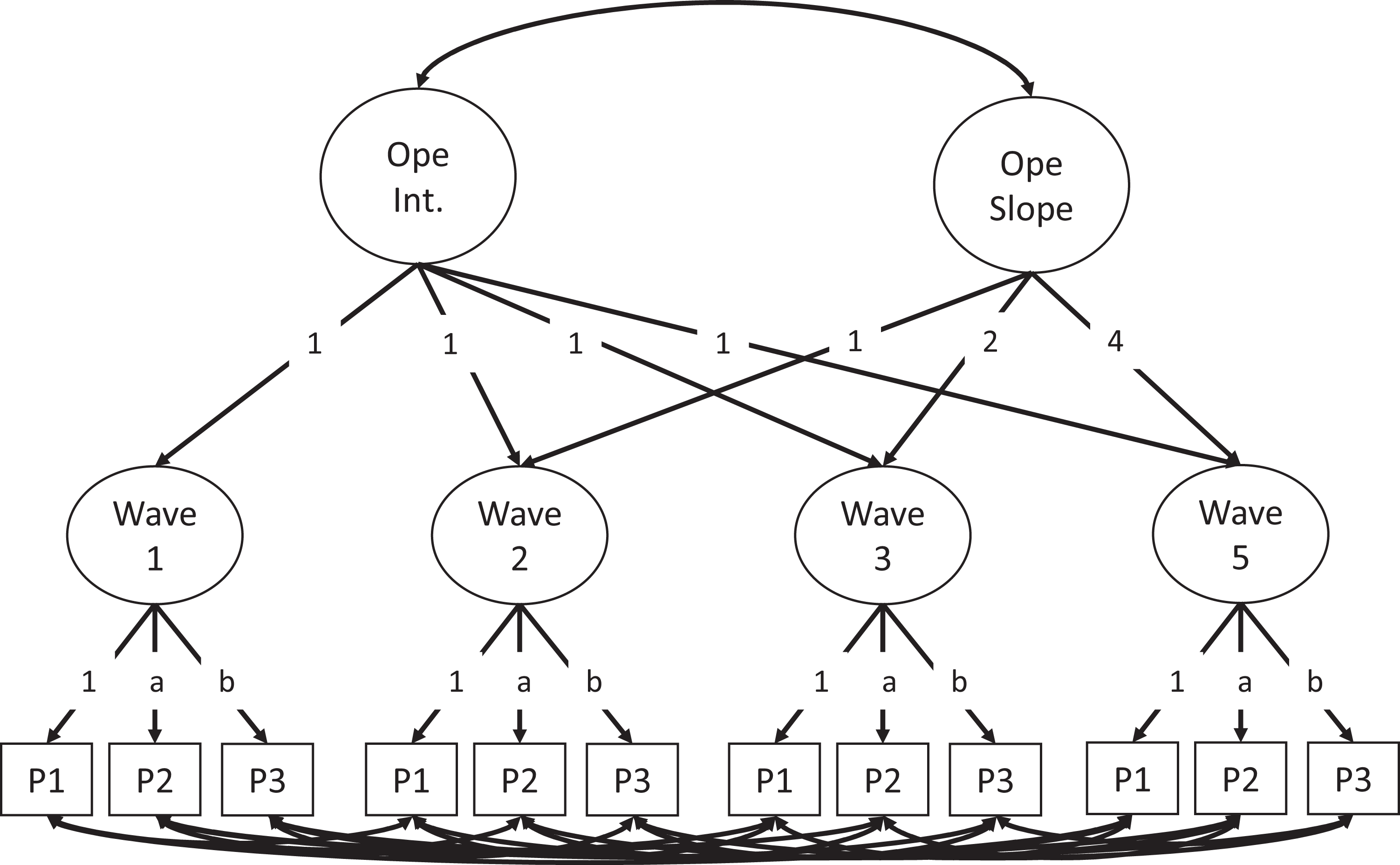
Path diagram for Openness latent growth curve model. Note. Ope = Openness; Int. = Intercept; P1–P3 = Parcel 1 to Parcel 3. Scores at each wave were measured as latent variables composed of three item parcels. Due to data missingness, cognitive engagement scores were not estimated at Wave 4 or Wave 6. Factor loadings were set equal across waves (1/a/b) in accordance with measurement invariance test results. Openness intercept estimates a participant’s score at baseline. Openness slope estimates a participant’s linear change in Openness across waves. An identical model was estimated for Need for Cognition.
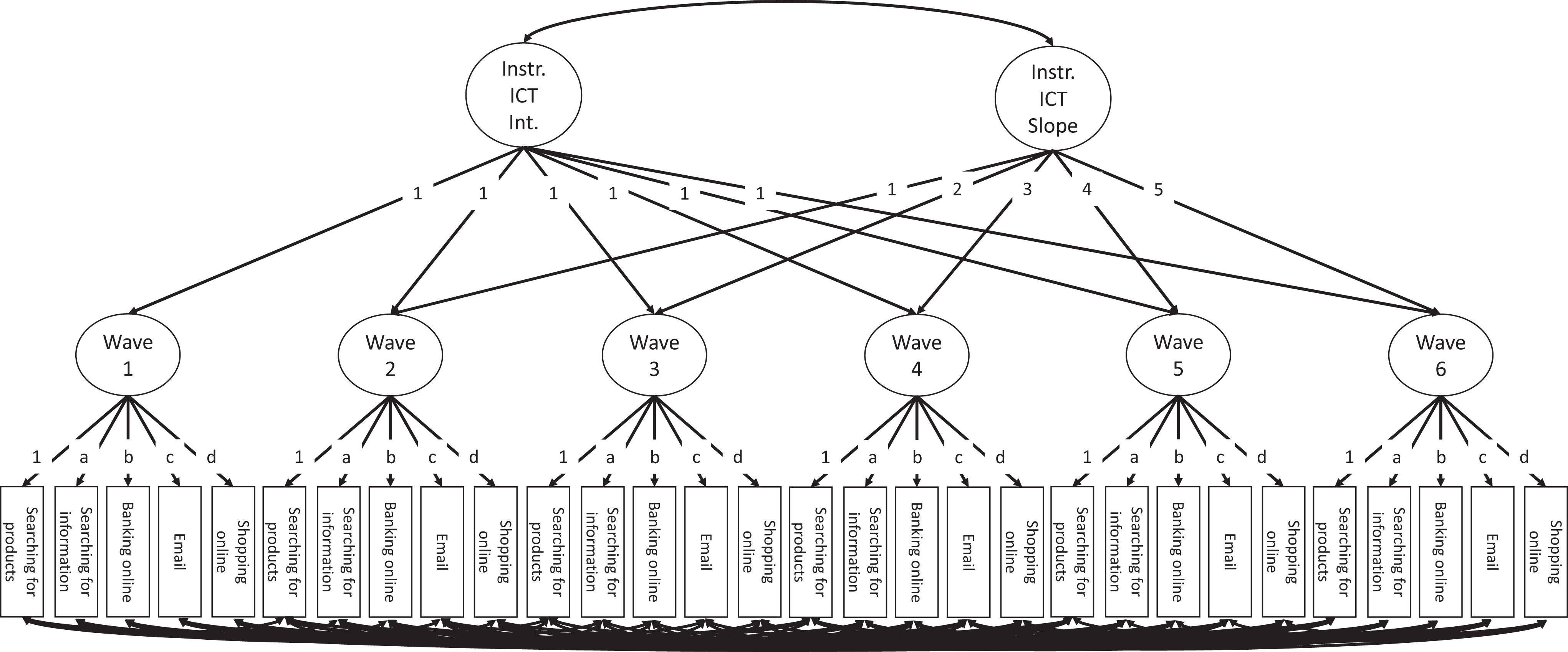
Path diagram for instrumental internet use latent growth curve model. Note. ICT = Information and Communications Technology; Instr. = Instrumental ICT. Factor loadings were set equal across waves (1/a/b/c/d) in accordance with measurement invariance test results. Instrumental ICT intercept estimates a participant’s frequency of use at baseline. Instrumental ICT slope estimates a participant’s linear change in frequency of use across waves. Identical models were estimated for Social ICT and Media ICT.
Hypothesis 1 to Hypothesis 6: Co-Development Between Internet Use and Cognitive Engagement
To investigate co-development between ICT use and cognitive engagement (Hypothesis 1 to Hypothesis 6), we combined the univariate latent growth curve models into two second-order multivariate latent growth curve models. Specifically, for each cognitive engagement variable (Openness and NFC), we estimated co-development with all three ICT use clusters by estimating covariance paths between all latent intercepts and slopes. These models fit well according to RMSEA (for Openness, RMSEA = .032, 95% CI [.031, .032]; for NFC, RMSEA .032, 95% CI [.032, .033]) but less well according to CFI (for Openness, CFI = .830; for NFC, CFI = .840). We note that these models combine six waves of ICT data with five waves of personality data. Because we structure data by waves (e.g., Wave 1 = Time Point 1), the sixth wave of ICT data provides 1 year of extra information about change in overall ICT use but does not directionally bias intercept or slope estimates.
Supporting Hypothesis 1 and replicating past research, older adults who were more cognitively engaged tended to use all forms of ICT more frequently at baseline, with effect sizes that were medium, on average (rs = .125–.336; Table 1). In contrast to our predictions in Hypotheses 2 and 3, baseline levels of Openness and NFC did not predict change in any ICT use cluster across the study period, and baseline levels of media, social, and instrumental ICT use did not predict change in either Openness or NFC across the study (all ps > .01). Supporting Hypothesis 4, older adults who reported steeper increases in their use of instrumental ICT tended to increase in both Openness and NFC relative to their peers, and older adults who increased in media ICT use tended to increase in NFC relative to their peers. These effects were small, ranging from r = .09 to .15 (see Figure S3 for scatterplot visualizations).
Results of Multivariate Latent Growth Curve Models.
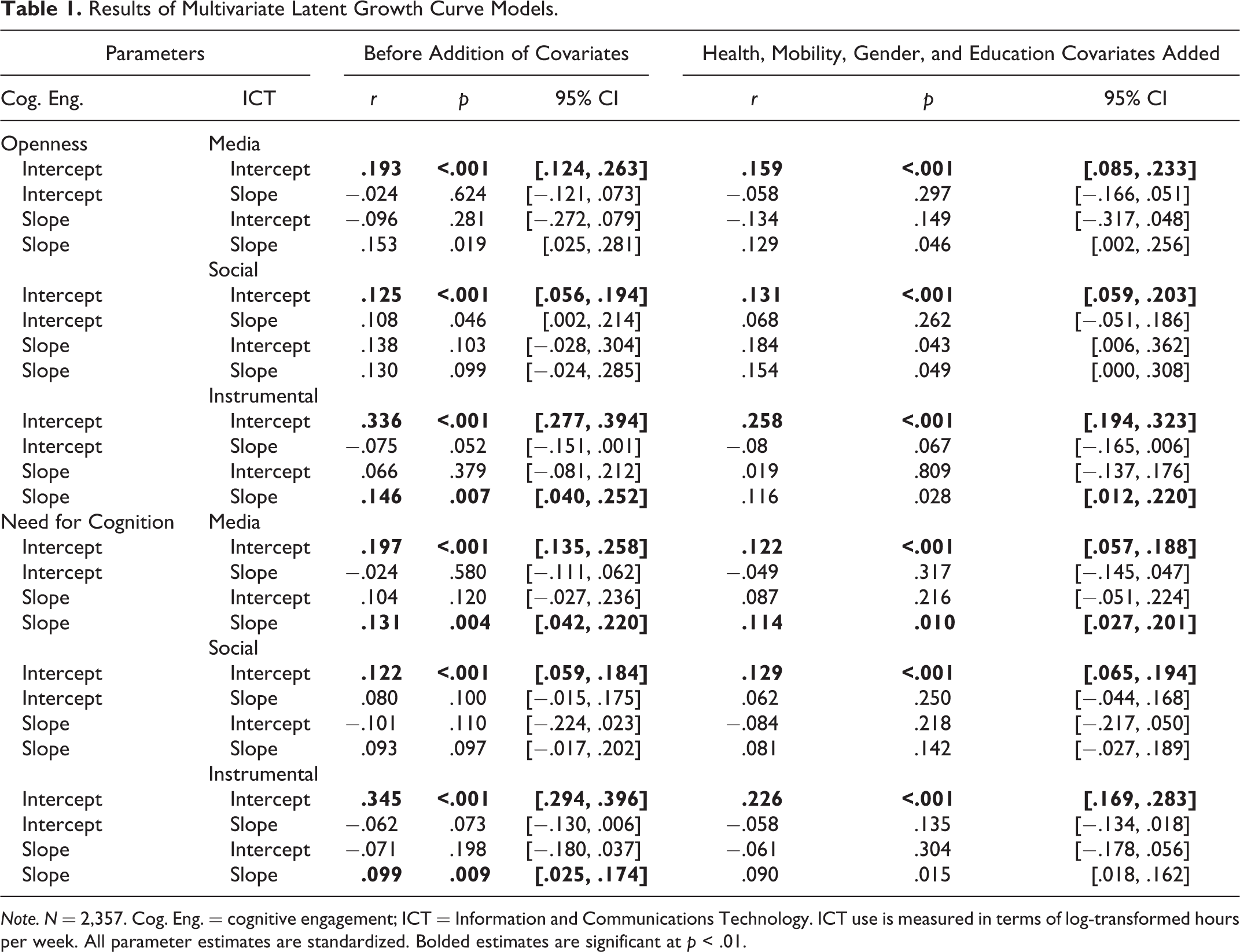
Note. N = 2,357. Cog. Eng. = cognitive engagement; ICT = Information and Communications Technology. ICT use is measured in terms of log-transformed hours per week. All parameter estimates are standardized. Bolded estimates are significant at p < .01.
To test Hypothesis 5, we regressed all latent intercepts and slopes simultaneously on four covariates (subjective health, mobility problems, gender, and education). These variables were unassociated with change in ICT use and cognitive engagement over the study period, with one exception: women increased in social ICT use more than men (r = .173, p < .001, 95% CI [.085, .261]). These nonsignificant longitudinal associations indicate that health, gender, and education played little role in the co-development of ICT use and cognitive engagement. After including these variables, however, correlated change between instrumental ICT and Openness/NFC was no longer significant at p < .01. Correlated change between media ICT and NFC was still significant. Overall, results provided some support for our hypothesis that associations would hold after including covariates, although associations with instrumental NFC were not robust to covariate inclusion.
To formally test whether associations with cognitive engagement differed across ICT use clusters (Hypothesis 6), we compared the fit of two nested growth curve models. In the first model, covariance paths between cognitive engagement and ICT use were constrained to be equal across ICT use clusters, and in the second, these covariance paths were estimated freely. Freeing these constraints significantly increased model fit, both for Openness (Δχ2 (6) = 111.28, p < .001) and NFC (Δχ2 (6) = 157.87, p < .001), indicating that associations differed across ICT use clusters. Associations with cognitive engagement were stronger for instrumental ICT than social or media ICT.
Hypothesis 7: Comparing Associations With TV and Radio Use
Next, we examined associations between cognitive engagement and TV/radio use using the multivariate growth curve framework described above. These models fit the data well (CFIs ≥ .965 and RMSEA ≤ .047). Older adults who scored higher on Openness and NFC watched TV slightly less frequently (Table 2). Neither Openness nor NFC was significantly associated with radio use. Furthermore, all co-developmental parameters were nonsignificant (ps > .01). These findings support our prediction (Hypothesis 7) that cognitive engagement would be more strongly correlated with ICT use than with TV and radio use.
Co-Development Between Cognitive Engagement and TV/Radio Use.
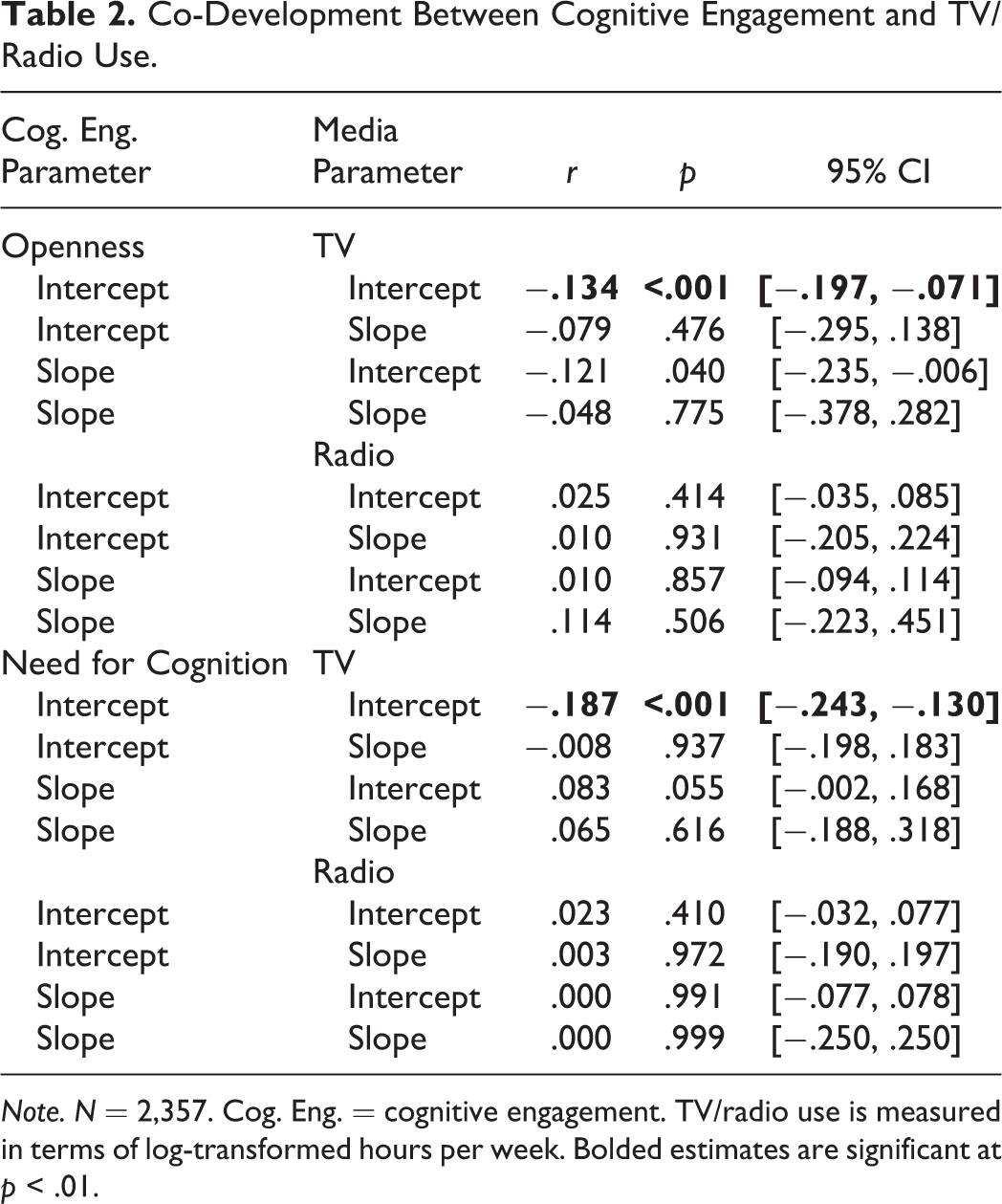
Note. N = 2,357. Cog. Eng. = cognitive engagement. TV/radio use is measured in terms of log-transformed hours per week. Bolded estimates are significant at p < .01.
Hypothesis 8: Comparing Associations Across Chronological Years
Next, we tested whether associations between ICT use and cognitive engagement waned over the study period using the eight ICT use variables that were measured across 2008–2017. To do this, we compared the fits of two nested structural equation models: one where correlations between ICT use and cognitive engagement were constrained to be equal across years, and another where the correlations were freely estimated in each year (see Figure S4 for a path diagram). Both models fit the data well (CFIs > .944, RMSEAs = .020). Allowing correlations to vary across years did not improve model fit for either Openness (Δχ2 (5) = 3.17, p = .674) or NFC (Δχ2 (5) = 3.65, p = .601), indicating that correlations between cognitive engagement and ICT use did not change in magnitude across the study period. These findings provide evidence against Hypothesis 8.
Hypothesis 9: Comparing Associations Across Age Groups
Finally, we tested whether co-developmental associations between ICT use and cognitive engagement were smaller in comparison groups of younger and middle-aged adults (Hypothesis 9). To do this, we estimated two sets of multiple-group multivariate latent growth curve models. In the first, we constrained co-developmental paths between cognitive engagement and ICT use to be equal across age groups. In the second, we estimated co-developmental paths separately for younger adults (aged 16–44), middle-aged adults (aged 45–64), and older adults (aged 65–99). We then conducted nested model comparison tests to examine whether correlations differed across these three age groups.
Results indicated that freeing age-group constraints led to an improvement in model fit for both Openness (Δχ2 (24) = 159.59, p < .001) and NFC (Δχ2 (24) = 190.98, p < .001). As shown in Table 3, associations between levels of ICT use and levels of cognitive engagement were similar across age groups, whereas correlated change was strongest among middle-aged adults (on average, r = .10 stronger than in older adults). As predicted, correlated change was weakest and nonsignificant in younger adults. These results provide mixed evidence for our prediction (Hypothesis 9) that associations between ICT use and cognitive engagement would be strongest in old age—Co-developmental associations were stronger in older adults than younger adults, but strongest in middle-age.
Co-Development in Comparison Samples of Younger and Middle-Aged Adults.
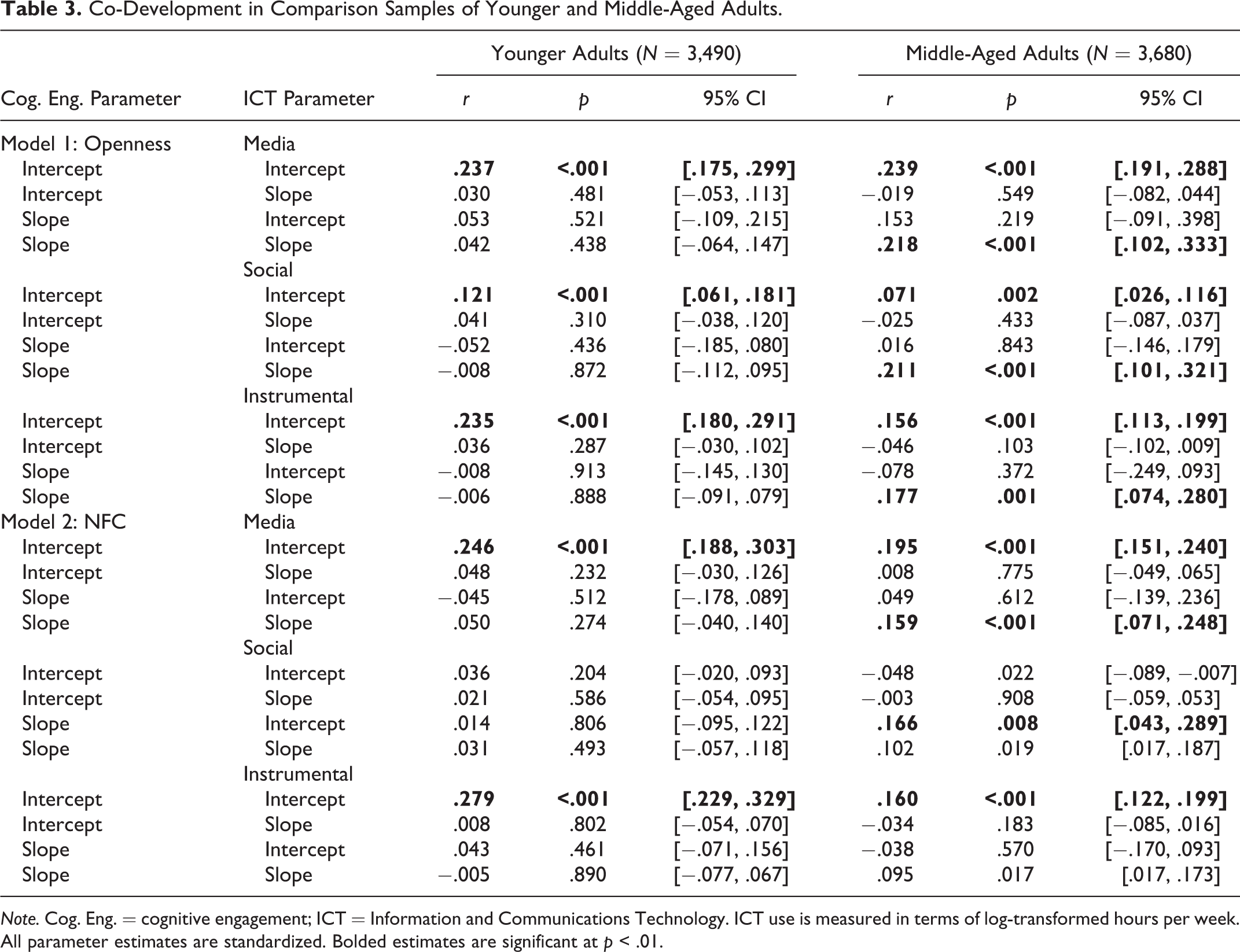
Note. Cog. Eng. = cognitive engagement; ICT = Information and Communications Technology. ICT use is measured in terms of log-transformed hours per week. All parameter estimates are standardized. Bolded estimates are significant at p < .01.
Discussion
We investigated the co-development between ICT use and cognitive engagement in a longitudinal sample of older adults. Results support several of our preregistered hypotheses. Older adults who were more cognitively engaged used ICT more frequently (Hypothesis 1), older adults who increased in media and instrumental ICT use relative to their peers declined less than their peers in cognitive engagement over the study period before the inclusion of covariates (Hypothesis 4), and co-developmental associations between NFC and media ICT persisted after the addition of covariates (Hypothesis 5). By comparing across types of ICT use, cognitive engagement was most strongly tied to instrumental ICT use, negatively associated with TV use, and not associated with radio use (Hypothesis 7).
These findings situate ICT use as a potentially relevant behavior to the late-life development of cognitive engagement. ICT may provide an enriching mental environment for older adults (von Stumm et al., 2011), which promotes cognitive engagement (Ziegler et al., 2015). To the extent that increases in ICT use are causally linked to healthy development in cognitive engagement, these findings could have important implications for individual and societal well-being. Substantial increases in technology use among this current cohort of older adults may have brought small but widespread benefits to the cognitive engagement of many older adults. We note that the results of this study suggest that co-development may be specific to particular elements of cognitive engagement (NFC) and particular kinds of ICT use (media ICT use), as other co-developmental associations were nonsignificant after the addition of covariates, even though covariates were generally unassociated with ICT use and cognitive engagement. More research is needed to clarify the specificity of co-developmental links between ICT use and cognitive engagement.
These findings also provide new information about how and why ICT use is relevant to cognitive engagement. First, stable levels of instrumental ICT were more strongly associated with stable levels of cognitive engagement than stable levels of social or media ICT use. Instrumental internet activities like searching the internet and using email tend to be especially intellectually stimulating and exploratory, and these characteristics may drive stronger associations with cognitive engagement. Second, associations between cognitive engagement and ICT use remained stable across 2008–2017, even as ICT use rose. This finding, which refutes our hypothesis (Hypothesis 8), indicates that correlations between ICT use and cognitive engagement are not merely a historical artifact driven by novelty. Finally, we can benchmark positive associations between cognitive engagement and all three ICT use clusters against nonsignificant associations between cognitive engagement and TV/radio use. These discrepancies suggest that general features of ICT use, such as navigating the internet and using a computer, may be relevant to cognitive engagement in and of themselves. Overall, patterns of evidence found in this study indicate that ICT use is relevant to cognitive engagement due to features common to all forms of ICT, instrumental information-gathering affordances of some ICT and not the novelty of ICT use among current cohorts of older adults.
Although we found support for most hypotheses, many were contradicted. First, although changes in media ICT use were associated with changes in NFC, stable levels of ICT use did not predict changes in cognitive engagement (refuting Hypothesis 3) and stable levels of cognitive engagement did not predict changes in ICT use (refuting Hypothesis 4). This may indicate that change in ICT use (e.g., learning how to use a new internet technology) is differentially relevant to the development of cognitive engagement than stable levels of ICT use (i.e., frequently using an already-known internet technology). Furthermore, although co-development between ICT use and cognitive engagement was stronger in older adulthood than among a comparison sample of younger adults (supporting Hypothesis 9), we found that co-development was strongest among middle-aged adults (refuting Hypothesis 9). We hypothesized that co-development would be strongest in older adulthood because older adults often face deficits in cognitive enrichment (Stine-Morrow et al., 2010) and declines in functioning that ICT use may ameliorate. Significant co-development in middle-aged adults, who are generally not facing these challenges, implies alternate mechanisms underlying co-development among this age group. Future research focused on ICT use in middle adulthood is needed to replicate and expand upon this finding, especially as there is relatively little research on the psychological effects of ICT use among middle aged adults (cf. Hartanto et al., 2020).
Limitations
We note some important limitations. First, it was impossible to us to establish causality because participants were not randomized to conditions. We believe this limitation is best addressed through future research that supplement the strengths of naturalistic research designs research like ours (large samples, ecologically valid measurement, and long-term tracking) with those of experimental interventions (causal inference and high-fidelity tests of mechanisms). Second, research has shown that self-report estimates of computer use and estimates derived from computer trackers often differ (Ellis et al., 2019). The self-report estimates from this study show expected patterns of convergent and discriminant correlations and temporal consistency, providing evidence for validity. However, results may differ from studies that track ICT use using methods other than self-report. Finally, the generalizability of this study is constrained by the time period and culture in which it was conducted, especially given the changing role of ICT use in everyday life. One advantage of measuring ICT use in terms of general clusters (e.g., social) instead of particular technologies (e.g., Facebook) is that general usage clusters may remain relevant even as particular ICT change.
Conclusion
With an aging global population, it is increasingly important to understand the factors associated with cognitive engagement development in older adulthood. In a preregistered investigation using a large population-representative sample, we found that older adults who were more cognitively engaged were more frequent users of the internet, but not TV or the radio. Over time, older adults who increased in media internet use declined less in NFC than their peers. Effects were small but may be especially widespread, given drastic recent increases in internet use among this cohort of older adults. Although we currently know little about the long-term consequences of technology use for personality development, we hope that this study encourages future research on this important topic.
Supplemental Material
Supplemental Material, sj-docx-1-spp-10.1177_19485506211049657 - Internet Use and Cognitive Engagement in Older Adulthood
Supplemental Material, sj-docx-1-spp-10.1177_19485506211049657 for Internet Use and Cognitive Engagement in Older Adulthood by Ted Schwaba and Wiebke Bleidorn in Social Psychological and Personality Science
Footnotes
Declaration of Conflicting Interests
The author(s) declared no potential conflicts of interest with respect to the research, authorship, and/or publication of this article.
Funding
The author(s) received no financial support for the research, authorship, and/or publication of this article.

Supplemental Material
The supplemental material is available in the online version of the article.
Note
References
Supplementary Material
Please find the following supplemental material available below.
For Open Access articles published under a Creative Commons License, all supplemental material carries the same license as the article it is associated with.
For non-Open Access articles published, all supplemental material carries a non-exclusive license, and permission requests for re-use of supplemental material or any part of supplemental material shall be sent directly to the copyright owner as specified in the copyright notice associated with the article.
