







Abstract
This study investigated whether misalignment between an individual and their community in partisan identity predicted psychological and behavioral distancing from local COVID-19 norms. A nationally representative sample of Republicans and Democrats provided longitudinal data in April (N = 3,492) and June 2020 (N = 2,649). Democrats in Republican communities reported especially heightened better-than-average estimates, perceiving themselves as more adherent to and approving of non-pharmaceutical interventions (NPI; e.g., mask wearing) than their community. Democrats’better-than-average estimates reflected high approval and behavior in Republican communities and substantial norm underestimation. Republicans in Democratic communities did not evidence worse-than-average estimates. In longitudinal models, injunctive norms only predicted NPI behavior when individual and community partisan identity were aligned. The strong personal approval-behavior association did not depend on misalignment; there were no effects of descriptive norms. Normative messages may have limited efficacy for a sizable subpopulation in politically polarized contexts, such as the COVID-19 pandemic.
Descriptive and injunctive norms, reflecting that most others engage in or approve of a behavior, are powerful drivers of personal behavior. Indeed, normative messages have been used to shape behaviors ranging from home energy use to decision making in health care settings (Cialdini & Jacobson, 2021; Tang et al., 2021). Throughout the COVID-19 pandemic and even following widespread vaccination, non-pharmaceutical interventions (NPIs; e.g., wearing masks, physical distancing) have played a critical role in reducing the spread of the virus (S. Moore et al., 2021). Given the broad efficacy of norm interventions, others have noted their potential for promoting engagement in NPIs (Van Bavel et al., 2020). However, an important question is whether certain subpopulations may be less responsive to COVID-19 norm-based messages.
We examined whether lack of person-environment fit—misalignment between an individual and their community in partisan identity—affected relative views of norms and the extent to which norms predicted behavior during COVID-19. This work has not only theoretical implications for understanding moderators of norms, but also practical implications. Correlations between psychosocial processes and behavior forebear which interventions are likely to be successful (Nolan et al., 2008; Sheeran et al., 2017) and therefore shed light on how best to develop interventions that maximize public health. Moreover, given partisan differences in views of climate change and gun control (Pew Research Center, 2020), the interplay between partisan misalignment and social norms has implications beyond the COVID-19 context.
Partisan identity during the COVID-19 pandemic provides a prime circumstance for considering issues of person-environment fit. Views of out-partisans have become increasingly polarized (Finkel et al., 2020), and Americans draw sharper in-group/out-group distinctions along party lines than they do by race, ethnicity, or religion (Westwood et al., 2018). Coinciding with these shifts, COVID-19 responses in the United States differed markedly across the political spectrum. Democratic leaders adopted more restrictive measures for controlling the virus, and Democrats were more likely to engage in NPIs and more willing to get the vaccine than Republicans (Adolph et al., 2021; Allcott et al., 2020; Bird & Ritter, 2020; Funk & Tyson, 2021). Research on person-environment fit has found that effects of psychosocial processes depend on by alignment between an individual and their community on a critical dimension. For example, religious people only live longer and those high on openness to experience only report better life satisfaction when their communities are also high in these characteristics (Ebert et al., 2020; Jokela et al., 2015). By extension, how individuals relate to their community’s social norms during the pandemic may depend on whether they “fit” politically with the broader community.
Although descriptive and injunctive norms reliably predict behavior, including NPI behavior during COVID-19 (Goldberg et al., 2020; Wu & Huber, 2021), both types of norms tend to be misperceived. Individuals typically put some psychological distance between themselves and most others by viewing themselves as having more favorable behaviors and attitudes than the average person, termed the better-than-average effect (Alicke & Govorun, 2005; Zell et al., 2020). Indeed, across 58 countries, 97% of respondents endorsed canceling social gatherings early in the pandemic, yet believed that only 67% of their country’s residents would agree (Fetzer et al., 2020). These misperceptions are problematic because individuals adjust their behavior in the less healthy, more unfavorable direction to be consistent with the misperceived norm (Cox et al., 2019). Although self-enhancement predominates in self-other comparisons, worse-than-average effects can also occur, wherein individuals view themselves as performing worse than most others (Kruger, 1999). Both better- and worse-than-average effects are exacerbated when individuals are aware that their own performance is particularly good or bad (D. A. Moore & Small, 2007). That is, when individuals perform well or consistently engage in a behavior, such as Democrats in the COVID context, they tend to produce better-than-average estimates of self-other differences. In contrast, when individuals perform especially poorly or seldom engage in a behavior, such as Republicans in the COVID context, worse-than-average estimates become more likely. These tendencies may be heightened during COVID-19 among individuals who are misaligned in partisan identity with their community and regularly observe that their NPI views and behaviors are especially better-than-average (Democrats) or especially worse-than-average (Republicans).
In addition to psychological distancing, misalignment may also affect behavioral distancing from social norms. Theories and empirical research have identified conditions under which social norms are less likely to serve as a basis for behavior. According to deviance regulation theory, individuals seek to stand out from the crowd when doing so confers positive public and private views of the self (Blanton et al., 2001). For example, when most people do not engage in a behavior, deviation from this norm is most likely when the positive attributes of those who engage in the behavior are highlighted (Blanton et al., 2001). In such circumstances, diverging from the norm allows for both achieving positive views of oneself and publicly signaling an important identity. Self-categorization theory and empirical research on social norms provide a complementary view, supporting that conformity is less likely when the norms emanate from a group with which an individual does not highly identify (Cialdini & Jacobson, 2021; Turner et al., 1987). Some work has found that low group identification not only reduces the effect of norms but also amplifies the role of personal cognitions, such as attitudes, in predicting behavior (Terry & Hogg, 1996). Thus, individual–community misalignment in partisan identity may produce a circumstance in which identification with the broader community is low and deviation from local norms confers positive self-views, thereby reducing the role of social norms and increasing the role of personal cognitions in predicting behavior.
To our knowledge, existing work has not examined the interplay between social norms and person-environment fit. We collected longitudinal data from a large, nationally representative sample in the United States in April and June of 2020, the first few months of the COVID-19 pandemic. We predicted that individual-community misalignment in partisanship would result in psychological and behavioral distancing from local social norms. First, we expected misalignment to exacerbate perceived self-other differences, such that Democrats in predominantly Republican communities, relative to those in majority Democratic communities, would produce heightened better-than-average estimates for behavior and approval. In contrast, we expected Republicans in predominantly Democratic communities, relative to those in Republican communities, to produce heightened worse-than-average estimates. Second, we hypothesized that descriptive and injunctive norms would more weakly predict change in NPI behavior over time when individual and community partisan identity were misaligned, relative to when aligned. We expected the reverse for personal approval, a stronger association with NPI behavior in the presence of individual-community misalignment, relative to alignment.
Method
Study Design, Participants, and Procedure
We fielded a nationally representative online survey of U.S. residents in mid-April and late June of 2020 via YouGov. To gather a representative sample of respondents from YouGov’s database, data were culled from the U.S. Census Bureau, voter registration databases, the Pew U.S. Religious Landscape Survey and the Current Population Survey. In all, 3,492 respondents who identified as a Republican or Democrat (82% of all participants, N = 4,271) completed the Time 1 survey; the Time 2 survey was completed by 2,649 of the Republicans and Democrats. Given the sample size, we were sufficiently powered to detect small increases in variance explained (e.g., 1%) due to the hypothesized interactions. Data and syntax used in the present analyses can be accessed by contacting the first author.
Measures
NPI-related descriptive norms, injunctive norms, behavior, and approval were assessed at both Times 1 and 2. Individual partisan identity was assessed at Time 1. Measures reflected U.S. government and Centers for Disease Control and Prevention (CDC) recommendations in March and April 2020 for reducing the spread of COVID-19 (CDC, 2020; The White House, 2020). Questions referenced (a) avoiding groups of 10 or more people, (b) washing hands with soap for at least 20 seconds, and when with individuals outside of one’s household, (c) maintaining at least 6 feet distance and (d) wearing a face mask. Exact wording of the measures that served as our primary predictors and outcomes is available in the Supplementary Online Material (SOM).
Descriptive and Injunctive Norms
Given the utility of community norms for developing interventions (Prestwich et al., 2016), norms items captured perceptions of community members (e.g., neighbors, co-workers, friends). Descriptive norms items captured whether community members engaged in the four NPI behaviors in the last week (e.g., “People in my local community [e.g., neighbors, co-workers, friends] are avoiding groups of 10 or more people”). Reflecting that conforming to injunctive norms is motivated by the desire to gain social approval (Jacobson et al., 2011) and consistent with prior work (Göckeritz et al., 2010), injunctive norms assessed community approval of individuals who engage in each behavior (e.g., “People in my local community [e.g., neighbors, co-workers, friends] approve of individuals who avoid groups of 10 or more people”). Descriptive norms items were rated from 1 (not at all) to 5 (always), and injunctive norms items were rated from 1 (not at all) to 5 (very much). Scale scores were formed by averaging the four items (Cronbach’s α descriptive norms = .86–.89; injunctive norms = .93).
NPI Behavior and Approval
NPI behavior and approval items directly mirrored those used to assess descriptive and injunctive norms. With respect to behavior, participants responded to four items assessing to what extent in the last week they had engaged in each of the four NPIs (e.g., “In the last week, how often have you avoided groups of 10 or more people”). Response options ranged from 1 (not at all) to 5 (always) and were averaged to form a scale score (Cronbach’s α = .69–82). The mask item contributes to slightly lower reliability at Time 1, likely because the CDC’s mask recommendation was issued at the start of data collection. NPI approval items captured the extent to which participants personally “approve of individuals who” engage in each of the four NPI behaviors (e.g., “I approve of individuals who avoid groups of 10 or more people”). Response options ranged from 1 (not at all) to 5 (very much) and were averaged to form a scale score (Cronbach’s α = .91–.93). Principal axis factoring with direct oblimin rotation supported the distinction between the injunctive norms and personal approval items (see SOM for factor loadings).
Individual Partisan Identity
Individual partisan identity was assessed with the standard 7-point item (Green et al., 2002). Response options of 1 to 3 were labeled strong Democrat to lean Democrat, 4 as Independent, and 5 to 7 as lean Republican to strong Republican. “Don’t know” responses were treated as missing.
Community Partisan Identity
Community partisan identity was operationalized in two ways. In our primary analyses, the proportion of county residents who voted for presidential candidate Donald Trump in 2016 served as the indicator of community partisan identity. Because Alaska does not report election results by county, Trump’s vote share at the state level was imputed for Alaska residents. Participants’ zip codes were used to link county vote share to their Time 1 county of residence. Only 64 (2.5%) participants moved to a new county between Times 1 and 2. As exclusion of these individuals had no effect on results, they were retained in all analyses.
A sensitivity analysis examined whether results replicated using county-level political ideology, drawn from the American Ideology project (Tausanovitch & Warshaw, 2016). Tausanovitch and Warshaw (2013) applied multilevel regression with poststratification to policy items assessed in nationally representative surveys conducted between 2000 and 2016 to estimate political ideology, given a county’s demography. County political ideology scores ranged from −1, highly liberal, to +1, highly conservative. These scores strongly correlate with voting in presidential elections (|rs| > .65) but are less susceptible to short-term forces that can affect voting (Tausanovitch & Warshaw, 2013).
Covariates
COVID Outbreak Severity
Analyses controlled for time-specific, county-level indicators of local outbreak severity. Cumulative cases and deaths in each county were drawn from the New York Times COVID-19 database (New York Times, 2020). New York City and Kansas City, MO data were reported by the Times at the city level and are reflected as such in our data. The average number of new cases per 100,000 in the 7 days prior to Times 1 and 2 participation was calculated using 2019 county population estimates (United States Census Bureau, 2020). The difference in COVID cases between Times 1 and 2 was also calculated. Cumulative cases and deaths and the difference in Times 1 and 2 cases were log transformed: ln (cases + 1) (Allcott et al., 2020). Analyses utilized average new cases in the 7 days prior to and cumulative cases and deaths on the day prior to each individual’s participation date at each time point. Time 2 analyses also included the difference in cases between Times 1 and 2.
Population Density
Data used to calculate population density (population/ land area) were drawn from the Missouri Census Data Center (2022), log transformed, and linked to participants’ zip codes (Wu & Huber, 2021). Data were not available for 18 zip codes. Twelve were attached to P.O. boxes and assigned population density for the larger town or city; the other six remained missing.
Individual Covariates
All analyses controlled for participants’ self-reported age (calculated from birth year), gender (male or female), ethnicity (dummy coded as White vs. Black, White vs. Latinx, and White vs. other), educational attainment (1 = less than high school diploma, 6 = post-graduate degree), and Time 1 employment status (recoded to employed [full/ part-time] vs. unemployed [all others]).
Overall Analytic Strategy
Participants were located in 1,236 and 952 U.S. counties at Times 1 and 2. Across both time points, 49% of counties contained just one respondent, with an average of 3.45 and 3.28 respondents per county at Times 1 and 2. We examined whether multilevel models were needed. For all outcomes, design effects were below 2 (range: 1.002–1.11) and the standard errors did not differ between multilevel and ordinary least squares regression approaches (Lai & Kwok, 2015). We therefore report regression results. YouGov generated weights for each wave. Application of the Time 1 versus 2 weights was matched to the timing of the dependent variable and was done both to make model estimates nationally representative and to address Time 2 attrition. Weighting was preferred to other missing data approaches because it adequately removes bias due to attrition but requires less information for proper specification in national surveys than multiple imputation (Kim et al., 2006; Raghunathan, 2004; Seaman & White, 2013). Participants lost to follow-up between Times 1 and 2 had higher educational attainment but were lower in approval of NPI (p < .001); attrition was also marginally higher among people of color (p = .06). Attrition was not associated with any other variables used in analyses (ps ≥ .11). Table 1 presents means for all study variables at Times 1 and 2.
Sample Descriptives.
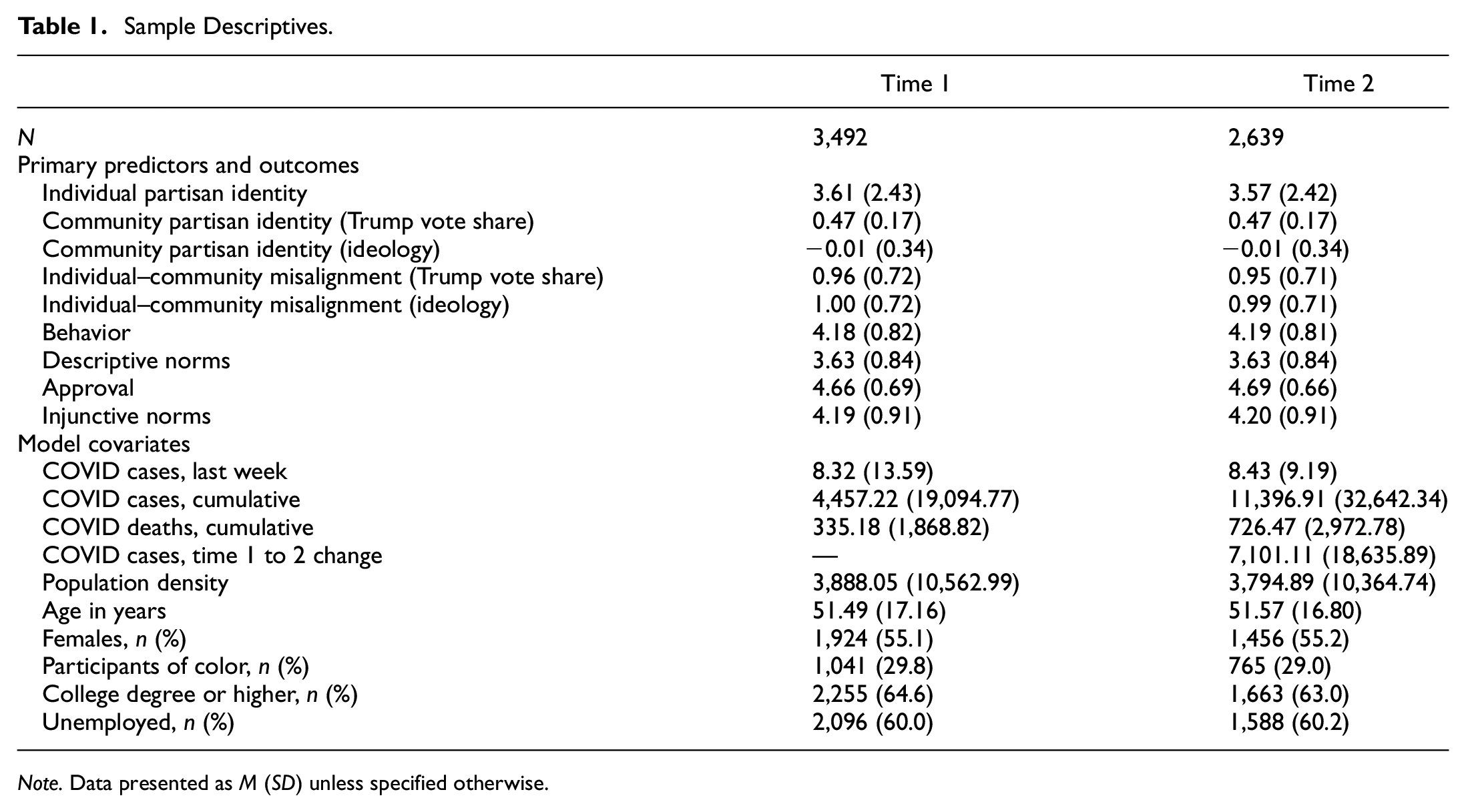
Note. Data presented as M (SD) unless specified otherwise.
All analyses were first examined with community partisan identity specified as Trump’s county-level vote share and then re-examined for county political ideology. Models controlled for population density, age, gender, ethnicity, education, and current employment status. Time 1 models also controlled for Time 1 outbreak severity indicators. Time 2 models controlled for the Time 1 score on the outcome of interest (i.e., self-other differences, behavior) and Time 2 outbreak severity indicators. All focal predictors were mean centered prior to forming interactions (Aiken & West, 1991).
Results
Partisan Misalignment and Self-Other Differences
To capture self-other differences, we calculated four difference scores—personal behavior minus descriptive norms (behavior self-other differences) and personal approval minus injunctive norms (approval self-other differences) at Times 1 and 2. Positive numbers reflected better-than-average estimates; negative numbers reflected worse-than-average estimates. Misalignment was captured in the interaction between individual and community partisan identity.
There were significant main effects of individual partisan identity on each of the self-other differences (see Table 2), such that Republicans consistently viewed themselves as less discrepant from their community in NPI approval and behavior than did Democrats. Main effects of community partisan identity on all but one self-other difference indicated that participants in Republican communities tended to report more discrepancy between themselves and their community. However, these main effects were qualified by the hypothesized individual by community partisan identity interactions. Interactions were probed at approximately one standard deviation above and below the mean of individual partisan identity, reflecting the mid-point of the Republican and Democrat identities (Aiken & West, 1991).
Individual and Community Partisan Identity and Their Interaction Predicting Self-Other Differences.
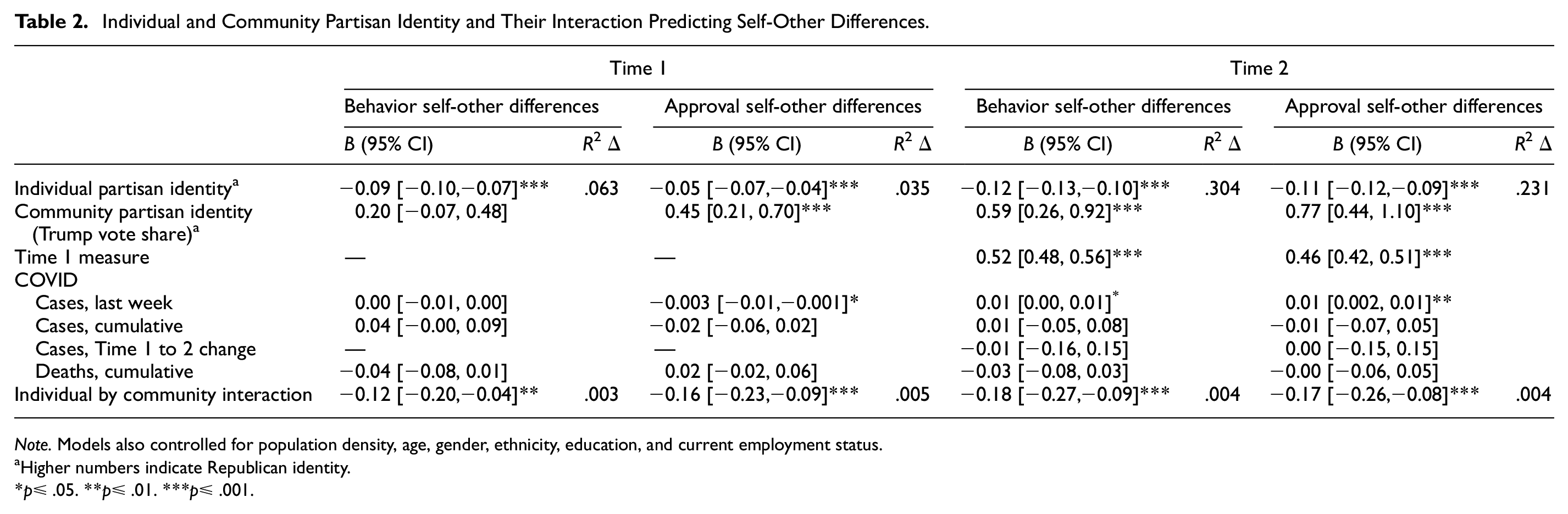
Note. Models also controlled for population density, age, gender, ethnicity, education, and current employment status.aHigher numbers indicate Republican identity.
p≤ .05. **p≤ .01. ***p≤ .001.
Simple slopes supported our hypothesis that Democrats would engage in more psychological distancing by generating heightened better-than-average estimates when in Republican communities. Community partisan identity positively predicted Democrats’ Time 1 self-other differences, indicating that Democrats reported greater discrepancy between themselves and their community in behavior (B = 0.52, SE = 0.16, t = 3.23, p = .001) and approval (B = 0.94, SE = 0.15, t = 6.44, p < .001) when living in Republican relative to Democratic communities. As self-other differences were above zero (see Figure 1), Democrats viewed themselves as especially better-than-average when living in Republican relative to Democratic communities. These effects replicated at Time 2. Democrats in Republican communities continued to generate heightened self-other differences (behavior: B = 1.02, SE = 0.19, t = 5.36, p < .001; approval: B = 1.19, SE = 0.19, t= 6.30, p < .001) and, specifically, heightened better-than-average estimates (see Figure 1).
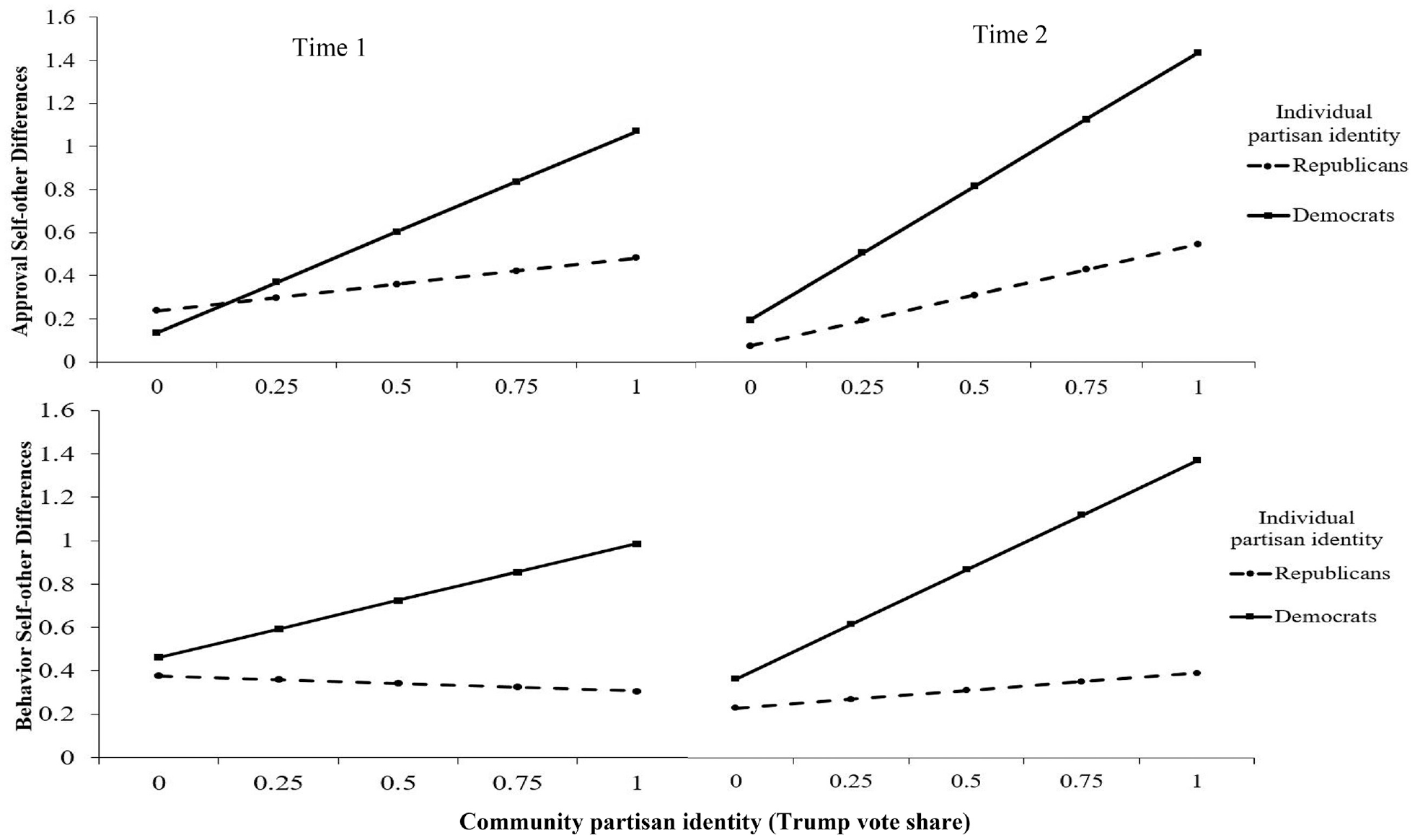
Self-Other Differences as a Function of Individual and Community Partisan Identity.
We hypothesized that Republicans in predominantly Democratic communities, relative to those in Republican communities, would produce heightened worse-than-average estimates. However, the magnitude of Republicans’ self-other differences did not vary as a function of community partisan identity at Time 1 (behavior: B = −0.07, SE = 0.18, t = −0.36, p = .72; approval:B = 0.25, SE = 0.16, t = 1.51, p = .13). Community partisan identity remained unassociated with Republicans’ self-other differences at Time 2 (behavior: B = 0.16, SE = 0.21, t = 0.76, p = .45; approval: B = 0.35,SE = 0.21, t = 1.64, p = .10). Moreover, as shown in Figure 1, Republicans did not generate worse-than-average estimates in Democratic communities. On the contrary, Republicans’ self-other differences were consistently above zero, indicating that they viewed themselves as better-than-average in both Democratic and Republican communities.
To clarify to what extent heightened self-other differences among Democrats in Republican communities were driven by self evaluations versus by normative estimates, a post hoc analysis examined the individual by community partisan identity interaction models (see Table 2) but with Times 1 and 2 behavior, approval, descriptive norms, and injunctive norms as outcomes (see SOM Tables 2 and 3 for results). The individual by community partisan identity interactions significantly predicted behavior and approval at Time 2 and injunctive norms at Times 1 and 2; the interaction was marginal for Time 1 descriptive norms. With respect to self-ratings, Democrats’ Time 2 behavior and approval did not vary as a function of community partisan identity (Bs = −0.13 to 0.16, ts ≤ |1.05|, ps ≥ .30). However, Republicans’ self-reported behavior and approval at Time 2 were significantly lower in Republican relative to Democratic communities (Bs = −0.58 to −0.47, ts ≥ 3.27, ps ≤ .001). With respect to norms, although both Democrats and Republicans perceived the norms as lower in Republican communities, Democrats’ perceptions of the Time 1 descriptive and Time 1 and 2 injunctive norms (Bs = −1.27 to −0.70, ts ≥−5.04, ps ≤ .001) were more strongly affected by community partisan identity than were Republicans’ (Bs = −0.78 to −0.38, ts ≥−2.44, ps ≤ .02). Accordingly, Democrats’ heightened self-other differences in Republican communities primarily reflected differences in norm perceptions rather than differences in their approval of or engagement in NPI.
Roles of Psychosocial Factors, Individual–Community Misalignment, and Their Interactions in Predicting Behavior Over Time.
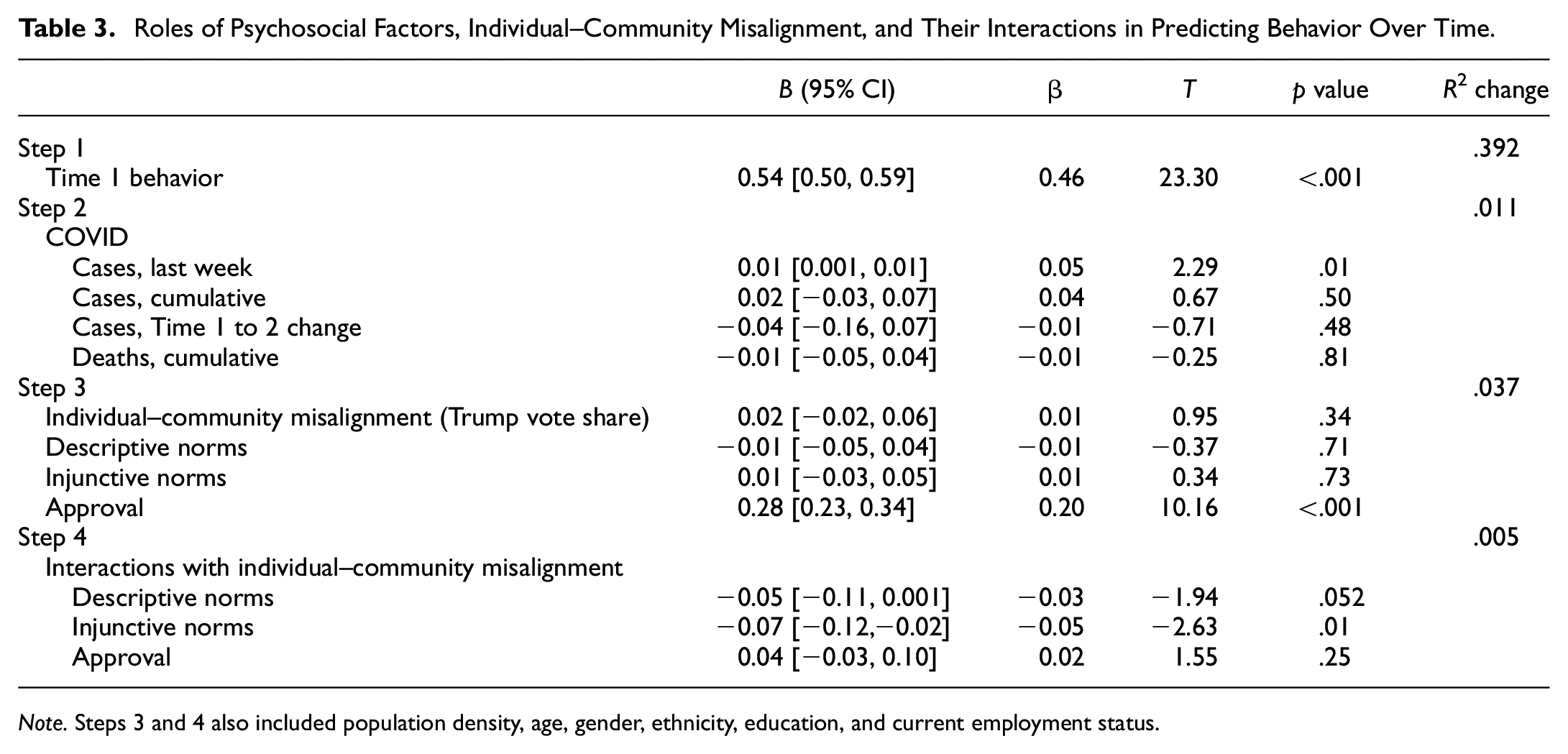
Note. Steps 3 and 4 also included population density, age, gender, ethnicity, education, and current employment status.
To better understand the pattern of these interactions and how the individual components produced self-other differences, we plotted Time 1 behavior against descriptive norms and Time 1 approval against injunctive norms for Republicans and Democrats (see Figure 2). Examination of Time 2 scores yielded the same results (figure in SOM). As shown in Figure 2, Democrats’ behavior and approval were high and stable across Democratic and Republican communities. However, Democrats’ (and Republicans’) perceptions of the descriptive and injunctive norms were substantially lower than Republican community members’ self-reported behavior and approval. A large literature on norm misperceptions rests on the view that self-reported behavior and approval are accurate whereas norms are misperceived (Lewis & Neighbors, 2006), and Republicans in Republican communities would have little reason to self-inflate, especially on a questionnaire administered in private (Del Boca & Darkes, 2003). These results therefore support that Democrats underestimated the norms in Republican communities. Thus, heightened self-other differences among Democrats in Republican communities reflected both a role of their Democratic identity in maintaining high NPI behavior and approval across contexts, and substantial underestimation of community norms.
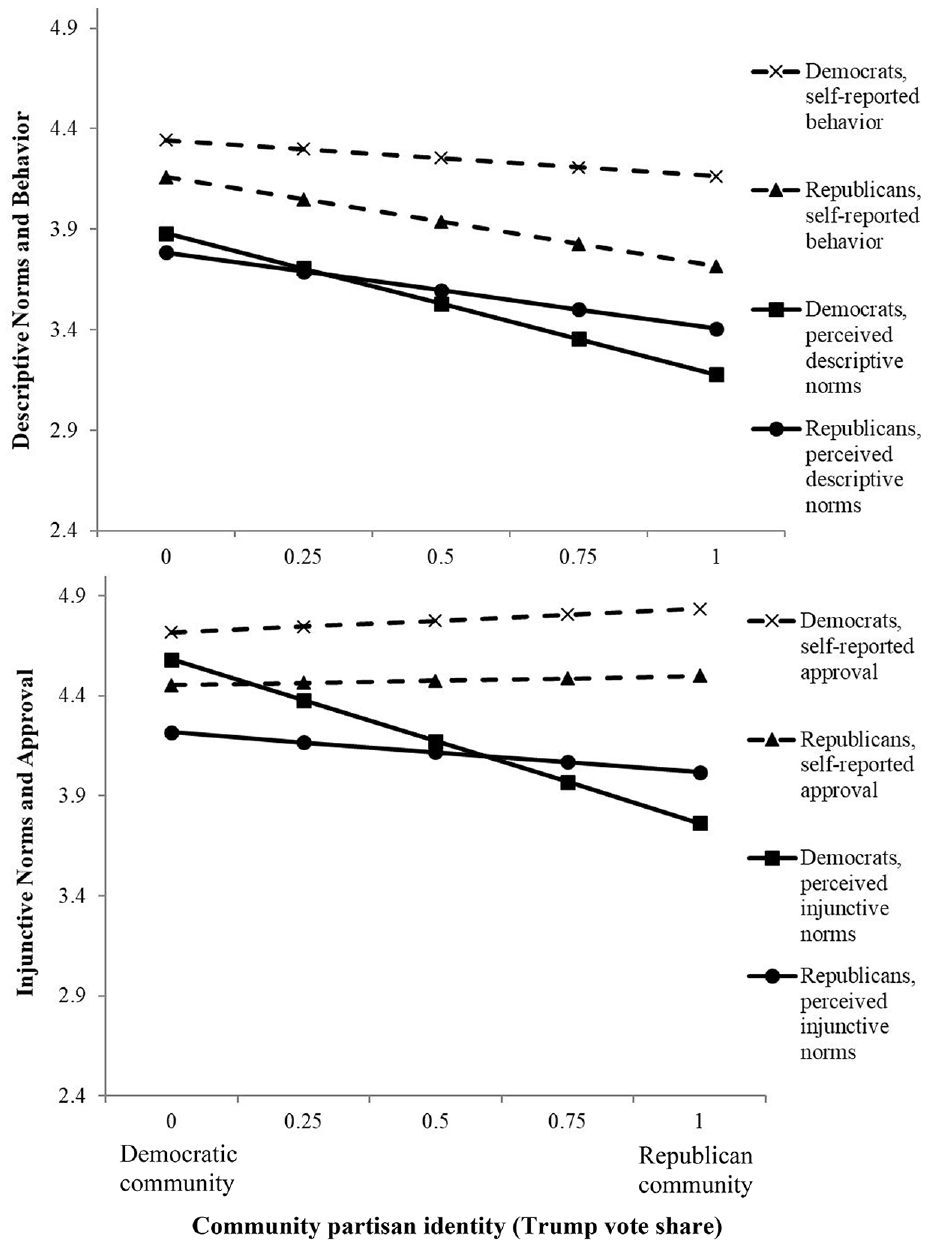
Time 1 Behavior and Descriptive Norms and Approval and Injunctive Norms as a Function of Individual and Community Partisan Identity.
Partisan Misalignment and Prediction of Behavior
To examine behavioral distancing from social norms, we examined whether misalignment, independent of individual partisan identity, moderated associations of norms and approval with behavior. We first standardized individual and community partisan identity by centering each at its mid-point (i.e., 4 for individual identity, .50 for Trump’s vote share) and dividing by the standard deviation. Because we were interested in the magnitude of misalignment but not the direction of it, misalignment reflected the absolute value of the difference between the standardized individual and community partisan identity scores.
Results indicated that approval, but neither descriptive nor injunctive norms, had a main effect on behavior (see Table 3). However, consistent with our hypotheses, the extent to which individual and community partisan identity were misaligned significantly moderated the effect of injunctive norms on change in NPI behavior and marginally moderated the effect of descriptive norms. Perceived injunctive norms predicted increased Time 2 NPI behavior when individual and community partisan identity were aligned (B = 0.12, SE = 0.05, t = 2.45, p = .01) but not when these were misaligned (B = 0.02, SE = 0.02, t = 1.07, p = .28; see Figure 3). Descriptive norms demonstrated a similar pattern but did not significantly predict behavior for either aligned (B = 0.08, SE = 0.05, t = 1.56, p = .12) or misaligned individuals (B = 0.01, SE = 0.004, t = 0.20, p = .84). The personal approval by misalignment interaction was non-significant. It is worth noting that, beyond past behavior, the psychosocial constructs, particularly personal approval, had the largest contribution to explaining variance in NPI behavior (see standardized coefficients in Table 3). Indicators of the local COVID context had a relatively small effect on behavior and were similar in magnitude to the observed interaction between individual-community misalignment and injunctive norms.
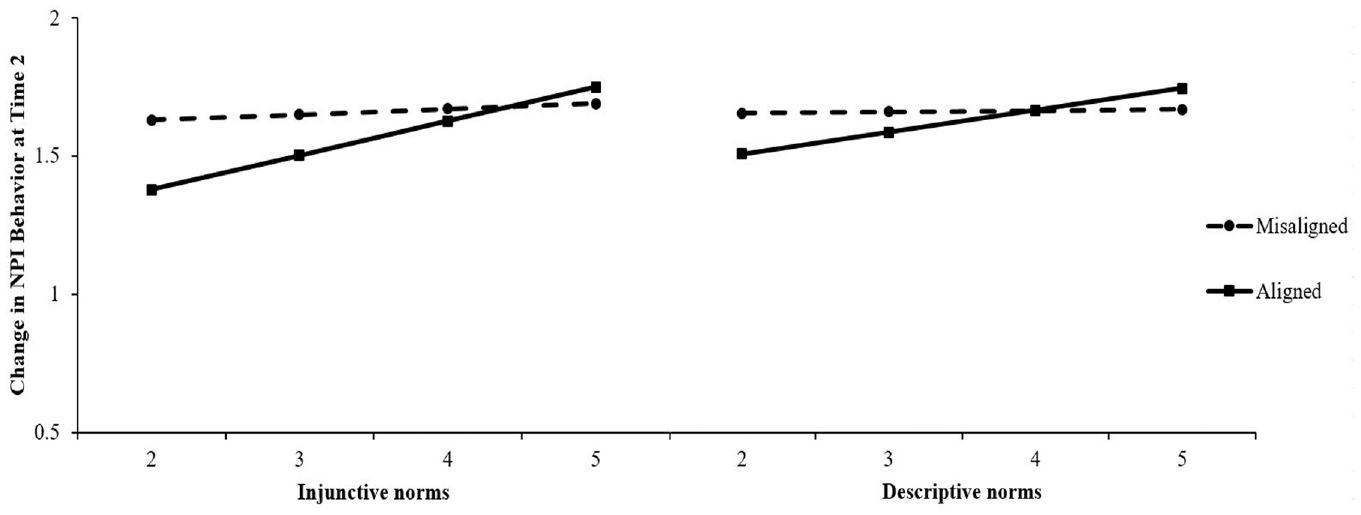
Individual-Community Misalignment by Norms Interactions Predicting Change From Time 1 to 2 in NPI Behavior.
Sensitivity Analysis
The sensitivity analysis examined whether the primary analyses replicated when county-level partisan ideology was used to characterize community partisanship. As expected, there were significant interactions between individual identity and community partisan ideology predicting each of the four Time 1 and 2 self-other differences (see SOM Table 5; ps < .05). As with the proportion of county residents who voted for Trump, Democrats consistently demonstrated heightened self-other differences when in conservative relative to liberal communities (Bs = 0.21–0.58, ts ≥ 2.64, ps ≤ .01). In contrast, the magnitude of Republicans’ self-other differences did not depend on community ideology (Bs= −0.5 to 0.15, ts ≤|1.38|, ps ≥ .17).
In models examining moderation of norms and approval by individual–community misalignment, approval was again the only psychosocial variable to evidence a significant main effect on Time 2 behavior. Mirroring the pattern of effects for Trump’s vote share, the interaction between individual–community misalignment and injunctive norms, but not descriptive norms or approval, was significant. The simple slopes indicated that injunctive norms were marginally associated higher Time 2 behavior when individual identity and community partisan ideology were aligned (B = 0.06, SE = 0.03, t = 1.84, p = .066) but not when these were misaligned (B = −0.04, SE = 0.03, t = −1.40, p = .16). In sum, results broadly replicated whether using Trump’s vote share or ideology to characterize community partisan identity.
Discussion
Given differences between Republicans and Democrats throughout the COVID-19 pandemic, we expected that individual-community misalignment in partisanship would affect relative views of and conformity to local social norms. Supporting this perspective, Democrats generated especially heightened better-than-average estimates when living in Republican communities, due to both underestimation of Republican community members’ NPI behavior and approval and maintaining high levels of personal behavior and approval in Republican communities. Contrary to hypotheses, Republicans did not view themselves as worse-than-average when in Democratic communities. However, injunctive norms predicted Time 2 NPI behavior only when individual and community partisan identity were aligned. Descriptive norms did not predict outcomes. The association of personal approval with NPI behavior was strong and independent of individual-community alignment, suggesting that issues of person-environment fit may primarily operate on social processes. Broadly, these results support that lack of person-environment fit on an important social identity is associated with psychological and behavioral distancing from local norms.
Normative interventions often reference a location-based group identity, such as others in one’s neighborhood. We found that these locations can contain meaningful subgroups that affect the extent to which local norms predict behavior. The magnitude of correlations between psychosocial factors and behavior serves as a marker for the likelihood that a corresponding intervention will be efficacious (Nolan et al., 2008; Sheeran et al., 2017). Our results therefore support that, in politically polarized contexts, normative messages may only improve behavior among those who share their community’s political identity. Underestimation of the norms was pronounced, even among those aligned with their community (see Figure 2), indicating the potential of messages that communicate the true norms for promoting NPI behavior (Lewis & Neighbors, 2006). An open question is what strategies might successfully change behavior among misaligned individuals. Here, location and party-specific norms may be useful (e.g., Ehret et al., 2018), as well as messages targeting personal approval, given the strong, unmoderated role of approval in predicting behavior.
Among Democrats, self-other differences were consistent with greater psychological distancing from the community in Republican contexts. Maintaining high levels of behavior and approval while community members were perceived as doing otherwise protected against disease, but also potentially allowed Democrats to deviate from local norms in a positive way (Blanton et al., 2001). Given high COVID cases and deaths in Republican communities (Pew Research Center, 2022), we suspect that Democrats’ heightened better-than-average estimates were sustained over time. Unexpectedly, Republicans’ self-other differences were not affected by community partisan identity, and notably, their Time 2 NPI behavior and approval varied with community partisan identity. This may reflect that Republicans, but not Democrats, are willing to conform to out-partisans (Kaikati et al., 2017), or alternatively, that Democratic communities’ COVID-19 policies largely curtailed individual decision making. Thus, examination of self-other differences among misaligned Republicans’ later in the pandemic and in other politically divided contexts is needed.
Throughout, the observed interactions were small in magnitude, though the misalignment by norms and approval interactions explained a similar amount of variance as the severity of the local COVID outbreak. However, small effects should be expected when predicting complex, multifaceted behavioral phenomena (Götz et al., 2022) and when scaled up, may nonetheless translate to substantial real-world effects if normative interventions fail among misaligned individuals. Indeed, small pockets of people who choose not to adhere to recommendations can have large consequences for public health (e.g., measles outbreaks fueled by the unvaccinated; Sugerman et al., 2010).
Limitations
The present results should be considered in light of the study’s limitations. First, we were unable to operationalize community partisan identity at the city or census tract level. As our county-level operationalization of individual-community misalignment biases against finding effects, we believe the results would replicate at more proximal levels of analysis. Second, we collected self-report rather than objective data on participants’ behavior and perceptions of local norms. However, individuals do not appear to over-report adherence to NPIs (Larsen et al., 2020), and to our knowledge, objective means of assessing each of the NPI behaviors were not available at the individual level. Third, it is possible that the observed relationships shifted after the first 4 months of the pandemic. As partisan differences remained throughout the winter wave of the pandemic and re-emerged in vaccination intentions (Funk & Tyson, 2021; Pew Research Center, 2021), we expect our results to replicate at later time points. Finally, it is unclear whether our results generalize to other politically charged but less public contexts, like climate change. Given that individuals believe that opposing partisans’ views are more polarized than they actually are (see Figure 2 and also Levendusky & Malhotra, 2015), we believe that individual–community misalignment in partisan identity is likely to affect distancing from local norms across a range of outcomes.
Conclusion
The present results highlight the importance of considering moderators of normative influence, and specifically, person–environment fit on an important, context-relevant social identity. Indeed, individual–community misalignment in political identity may limit the efficacy of norms-based messages across a range of politically charged contexts. Consideration of this important moderator will enable construction of messages that are broadly efficacious in motivating not only NPI behavior, but also uptake of vaccines and boosters, two behaviors that remain critical for containing and ultimately ending the pandemic.
Supplemental Material
sj-docx-1-spp-10.1177_19485506221121204 – Supplemental material for Individual–Community Misalignment in Partisan Identity Predicts Distancing From Norms During the COVID-19 Pandemic
Supplemental material, sj-docx-1-spp-10.1177_19485506221121204 for Individual–Community Misalignment in Partisan Identity Predicts Distancing From Norms During the COVID-19 Pandemic by Allecia E. Reid, Madison L. Eamiello, Andrea Mah, Katherine L. Dixon-Gordon, Brian Lickel, Ezra Markowitz, Tatishe M. Nteta, Joel Ginn and Se Min Suh in Social Psychological and Personality Science
Footnotes
Handling Editor: Danny Osborne
Declaration of Conflicting Interests
The author(s) declared no potential conflicts of interest with respect to the research, authorship, and/or publication of this article.
Funding
The author(s) disclosed receipt of the following financial support for the research, authorship, and/or publication of this article: Data collection was supported by National Science Foundation grant 2026922. Preparation of this article was supported by grant K01AA028530 to A.R.

Supplemental Material
Supplemental Material for this article is available online.
Author Biographies
References
Supplementary Material
Please find the following supplemental material available below.
For Open Access articles published under a Creative Commons License, all supplemental material carries the same license as the article it is associated with.
For non-Open Access articles published, all supplemental material carries a non-exclusive license, and permission requests for re-use of supplemental material or any part of supplemental material shall be sent directly to the copyright owner as specified in the copyright notice associated with the article.
