







Abstract
In a contemporary landscape fraught with unprecedented challenges, it is imperative to forge strategies that transcend present concerns and equally prioritize future generations. This research, anchored in the philosophy of longtermism, seeks to bridge this temporal divide. Across three pre-registered and highly-powered studies, we scrutinize the potential of philosophical arguments underpinning longtermism to foster alignment with its principles, thereby catalyzing attitudes and actions that resonate with a more future-oriented approach to global welfare. Leveraging scalable educational interventions through text and video media formats, we discern a noticeable resonance of these philosophical arguments among individuals, influencing their beliefs, policy support, donation behaviors, and cognitive investment directed toward the betterment of future generations. Our findings illuminate the critical mediating role of longtermism beliefs between the interventions and favorable future-focused outcomes, establishing the promising potential of philosophical discourse as a pragmatic tool in mobilizing collective efforts to safeguard our long-term future.
Learning Longtermism to Cultivate Pro-Future Attitudes and Action
How can we inspire present-day people to prioritize averting future threats of untimely human extinction? Throughout Earth’s history, roughly 99% of the species that have come into being have gone extinct (Aitken, 1998; Cody Fenwick, 2023). Cataclysmic natural phenomena, like oxygen depletion and global warming, have had their hand in five mass extinction events to date (Penn et al., 2018). But insights from the natural sciences have revealed that a sixth mass extinction event is currently unfolding, catalyzed by the impact of human civilization on the global ecosystem (Aitken, 1998; Dirzo et al., 2022). On one hand, the technological advancements of our species have the potential to achieve immense good, like curing disease (Grégoire et al., 2020), diverting near-Earth asteroids (Anthony & Emami, 2018), and helping to alleviate global hunger (Mwalupaso et al., 2019). But humanity’s global impact has a dark side as well, posing catastrophic risk to our future as a species which emanates from sources such as artificial intelligence (AI), climate change, and pandemic disease (Greaves & MacAskill, 2019; MacAskill, 2022; Ord, 2021).
While most people agree that future human extinction would be unfavorable (Schubert et al., 2019; Syropoulos, Law, Kraft-Todd, & Young, 2023), they also tend to discount the needs, moral rights, and welfare of future generations (Hauser et al., 2014; Law et al., 2023; Wade-Benzoni, 2008; Wade-Benzoni & Tost, 2009). Nonetheless, people who embrace the core principles of the emerging longtermism philosophy show a pronounced departure from this trend (Law et al., 2023; Syropoulos, Law, Kraft-Todd, & Young, 2023; Syropoulos, Law, & Young, 2023). Considering these findings, it is imperative to determine whether alignment with longtermism principles can be cultivated through intervention and ultimately impact attitudes and action toward safeguarding humanity’s long-term future.
Recent research and attention in the popular press suggests that many people acknowledge the existence of threats to the long-term well-being of our species (Hunter & Hewson, 2020; McLamb, 2022; Syropoulos, Law, Kraft-Todd, & Young, 2023). Furthermore, the majority of people are in agreement that the premature extinction of humanity would be unfavorable (Schubert et al., 2019; Syropoulos, Law, Kraft-Todd, & Young, 2023). Yet, to what extent will awareness and appraisals of existential threats translate into tangible individual and collective action to mitigate them? Well-established research in psychology (e.g., Hauser et al., 2014) and behavioral economics (e.g., intergenerational discounting; Wade-Benzoni, 2008, 2017; Wade-Benzoni & Tost, 2009) consistently reveals a human tendency to prioritize present over future generations, obfuscating a clear answer to this question. Recent studies reaffirm these findings, showing a similar trend in the way we subjectively assess the moral worth of future generations (Law et al., 2023). Essentially, this emerging research suggests that our moral circles, moral obligations, and prosocial intentions progressively contract as we extend our focus further into the future. Critically, these findings suggest that present-oriented biases in human morality and prosociality may constrain efforts to mitigate existential threats that will primarily impact future generations.
While it is true that many individuals tend to prioritize present over future generations, emerging evidence indicates significant variability in these preferences among people. Notably, the longtermism philosophy and social movement, an outgrowth of the effective altruism movement (Singer, 2015, 2016), is gaining traction and now boasts a growing following (Greaves & MacAskill, 2019; MacAskill, 2022; Ord, 2021). Longtermism can be distilled into three core principles: recognition that the welfare of future generations holds immense importance, acknowledgment of the potentially vast number of future human lives, and belief in the possibility of securing a prosperous future for humanity through present-day actions.
Originating in ethical philosophy, longtermism has rapidly spread its influence into psychology (Caviola et al., 2022; Syropoulos, Law, Kraft-Todd, & Young, 2023; Syropoulos & Markowitz, 2022; Wilks et al., 2023), the natural sciences (Blaser, 2018; Taylor et al., 2013) and popular culture (Hunter & Hewson, 2020). And, although its core following of individuals who actively engage in efforts (e.g., donations, volunteerism, and career change) to safeguard the long-term future remains small, a budding line of inquiry into lay endorsement of the philosophy’s principles suggests longtermism ideals have a foothold in the general population (Syropoulos, Law, Kraft-Todd, & Young, 2023; Syropoulos, Law, & Young, 2023). Pivotally, people who endorse longtermism principles on the Longtermism Beliefs Scale (LBS; Syropoulos, Law, Kraft-Todd, & Young, 2023) exhibit a multitude of attitudes and behaviors in line with safeguarding the long-term future of humanity. For instance, high scorers on the LBS display greater legacy motivation, future consequence awareness, effective altruism beliefs, climate change awareness, extinction threat awareness, and moral regard for and generosity toward people in future generations (Law et al., 2023; Syropoulos, Law, Kraft-Todd, & Young, 2023; Syropoulos, Law, & Young, 2023).
The above findings offer hope that a segment of the population acknowledges and values the welfare of future generations (Syropoulos, Law, Amormino, & Young, 2023). Yet, another crucial question emerges: What proportion of the population subscribes to these beliefs, and will it suffice to drive the necessary actions needed to confront the currently bleak prospects for humanity’s future? Based on evidence in the present literature, the percentage of people who score highly (i.e., 75 or higher out of a possible 100) on the LBS’s items with respect to near and distant future generations alike (people empirically identified as “longtermists” by the scale’s authors) sits at just under 25% of the population across samples and studies employing the scale (Law et al., 2023; Syropoulos, Law, Kraft-Todd, & Young, 2023; Syropoulos, Law, & Young, 2023). So, while endorsement of longtermism’s principles is not negligible, the vast majority of the population does not show alignment. Thus, in the present research we seek to address whether interventions targeting longtermism beliefs can cultivate and bolster endorsement of the philosophy’s principles in the general population and in turn influence pro-future attitudes and action.
Recent research indicates that exposure to philosophical arguments from effective altruism writings (Singer, 2016) can prompt attitudes and actions (e.g., donation behavior) aligned with effective altruism principles (Lindauer et al., 2020), offering promise that similar exposure to philosophical arguments associated with longtermism may hold the potential to foster longtermism beliefs and pro-future action. Effective altruism, the parent philosophy of longtermism, advocates allocating prosocial resources in a cost-effective manner to socially-distant targets in the most severe need (Singer, 2015). While obstacles to effective altruism often stem from hesitations to act prosocially beyond social boundaries (e.g., Berman et al., 2018; Everett, 2018; Kahane et al., 2018; Law et al., 2022; McManus et al.,2020, 2021), longtermism presents a parallel challenge, demanding prosociality across temporal boundaries to benefit individuals living in the distant future. A body of evidence indicating substantial overlap in the processing mechanisms for social and temporal distance (Gilead et al., 2020; Hill et al., 2017; Soutschek et al., 2016; Tuen et al., 2023) provide support for the possibility that philosophical arguments, which can garner action across social boundaries (Lindauer et al., 2020), may serve similar utility across temporal boundaries as well. Furthermore, there is substantial overlap in the effective altruist and longtermist populations (Caviola et al., 2022). Taken together, this convergence of underlying psychological processes for various elements of psychological distance and philosophical alignment between effective altruism and longtermism implies that interventions targeting longtermism beliefs could potentially find resonance among the general population, broadening the scope of pro-future actions within society.
The Present Studies
In the present studies, we explored whether exposure to longtermism arguments through different media can promote support for its ideals and pro-future actions (see Table 1 for information regarding the design and sample characteristics for all studies). Study 1 showed both text and video interventions raised Longtermism Beliefs Scale (LBS) scores and support for pro-future legal reform. The effect on support for pro-future legal reform was mediated by increased longtermism beliefs. Study 2 demonstrated that both interventions increased donations to a future-focused charity, with the video’s impact again being mediated by longtermism beliefs. Study 3 confirmed the video intervention’s effects on longtermism beliefs and also demonstrated that watching the video intervention had a significant indirect effect on a task demanding high cognitive effort from participants in exchange for donations toward the benefit of future generations. These results suggest philosophical arguments can boost longtermism alignment and action via a brief, scalable intervention offering practical utility for efforts to safeguard the future through public policy, philanthropy, and individual and collective effort.
All data files, materials and code for the studies is available on the Open Science Framework (OSF): https://osf.io/4hnwg/
Information for All Studies

Study 1
Our first study examined whether two different educational interventions would increase endorsement of longtermism beliefs and support for reform to benefit future people. We tested an intervention using philosophical arguments from the book “What We Owe The Future” (MacAskill, 2022; “Future People Count” subsection of Chapter 1) and an excerpt advancing these arguments from an online lecture delivered by Professor William MacAskill. The design, measures, sample size and analytical plan for the study were pre-registered, https://aspredicted.org/GYS_LBJ.
Methods
Participants
A total of 1,050 participants were recruited in line with our pre-registered power analysis. After applying exclusion criteria (see pre-registration), 1,033 participants remained.
Procedure
Participants were randomly assigned into one of the three conditions. In the control condition, participants had to complete the Big Five-2 Inventory (Soto & John, 2017). This measure was intended as a filler measure and was thus not analyzed in the study. In the book condition, participants were presented with four pages from the book “What We Owe The Future” (MacAskill, 2022). Each page from the book was shown as a separate page on Qualtrics, and participants could proceed to the next page after one minute had passed. Participants spent an average of 7.22 minutes (SD = 4.85 minutes) reading the four pages in the book condition. Participants in the lecture condition were presented with the first 10 minutes of the following recorded lecture by Professor William MacAskill, https://www.youtube.com/watch?v=vCpFsvYI-7Y. Participants spent an average of 11.75 minutes (SD = 3.78 minutes) in this condition.
Materials
Regardless of condition, after the condition-specific stimulus, participants first completed the Longtermism Belief Scale (LBS; Syropoulos, Law, & Young, 2023; e.g., “Positively influencing the long-term future is a key moral priority of our time.”). This seven-item measure displayed each item simultaneously for four different timeframes/timepoints (1,000, 10,000, 100,000, and 1,000,000 years in the future). Scores for the measures are captured on slider scales ranging from 0 = strongly disagree – 100 = strongly agree. The average for each item across all timeframes was first estimated, which was then averaged across all items (a = 0.97). After completing this measure, participants responded to 10 items that captured support for legal reform to protect the welfare of different entities. Five of these items were filler items (Humans living in the present, Non-humans animals, Environment [e.g., rivers, trees, or nature itself], Sentient artificial intelligence (assuming its existence)), and five were our target outcome (Humans living 100, 1,000, 10,000, 100,000, and 1,000,000 years in the future), averaged into a single construct (a = 0.95). These items were adapted from Martínez and Winter (2023).
Results
Analytical Plan
We pre-registered that we would compare both conditions independently to the control, as our goal was to determine whether reading a passage from a book on longtermism or watching a lecture on longtermism would increase endorsement of longtermism beliefs and support for reform to benefit future people compared with not receiving either form of the educational intervention. Results are depicted visually in Figure 1.
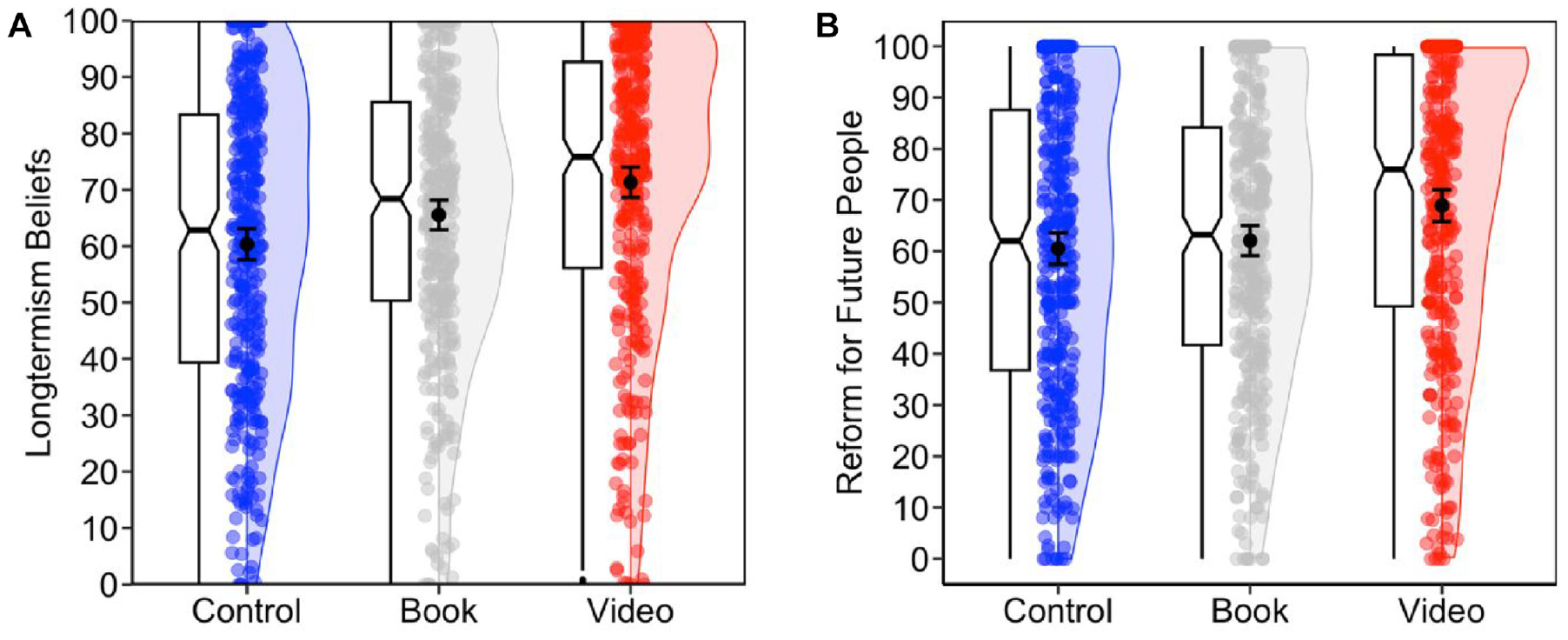
Plots Depicting Longtermism Beliefs (A) and Support for Reform to Benefit Future People (B) by Condition. Colored Dots Correspond to Individual Data Points and are Jittered for Readability, With Split Violin Plots Overlaid to Show the Relative Distribution of Scores Across Conditions. Error Bars Depict 95% CI Around the Mean. Notched Boxplots are Included, With Notches Depicting a Confidence Interval Around the Median
Books Versus Control
Participants in the book condition (N = 342) scored significantly higher in longtermism beliefs, t(693) = 2.70, p = .007, d = 0.21, but not reform for future generations, t(693) = 0.72, p = .470, d = 0.06, compared with the control condition (N = 353).
Lecture Versus Control
Participants who saw the lecture on longtermism (N = 338) scored significantly higher on longtermism beliefs, t(689) = 5.61, p < .001, d = 0.43, and support for reform to benefit future people, t(689) = 3.77, p < .001, d = 0.30, compared with the control (N = 353).
Exploratory Analyses
Exploratory, non-pre-registered analyses suggested this effect was driven by a significant difference of condition on support for reforms for people living 1,000, t(689) = 3.39, p < .001, d = 0.26, 10,000, t(689) = 4.03, p < .001, d = 0.31, 100,000, t(689) = 3.87, p < .001, d = 0.30, and 1,000,000, t(689) = 3.74, p < .001, d = 0.28, years in the future, but not for people living 100, t(689) = 1.66, p = .097, d = 0.13, years in the future (see Figure 2).
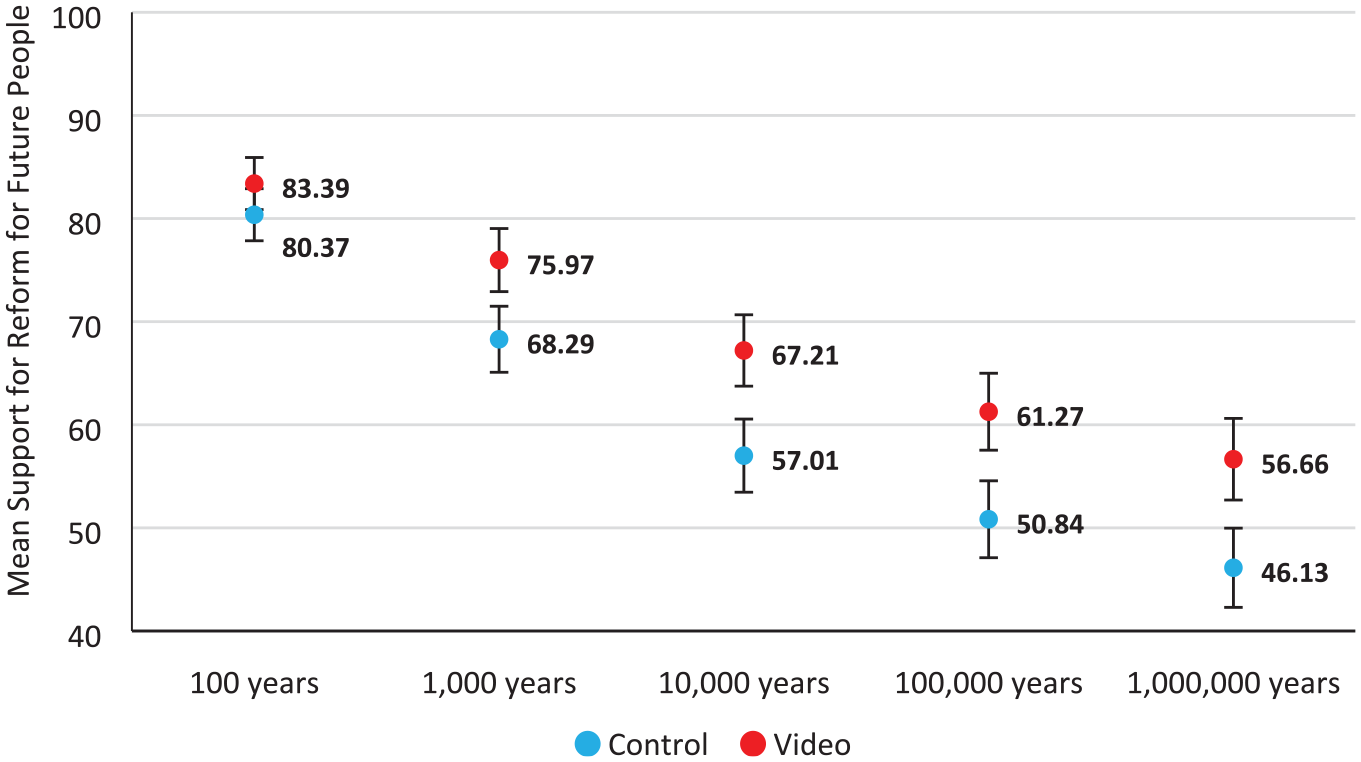
Comparisons for Each Specific Timeframe for Reform to Protect Future Generations With 95% CI
Indirect Effects
We pre-registered that should a significant effect be observed on longtermism beliefs, given that we expected a significant positive association between longtermism beliefs and support for reform (r = .79, p < .001) a significant indirect effect of condition on support for reform for future people via increased longtermism beliefs might be observed. We tested for this effect using the PROCESS Macro (Hayes, 2013) using Model 4, with 10,000 bootstrapped samples. Both for the book condition (b = 4.64, 95% CI [1.29, 8.03]) and the lecture condition (b = 9.88, 95% CI [6.44, 13.44]) significant indirect effects were observed.
Discussion
Results from our first study suggest that educational interventions that expose individuals to the longtermism philosophy appear effective at shifting longtermism beliefs and support for policy to protect future generations. These results constitute the first round of evidence suggesting that longtermism beliefs are malleable. The increased endorsement of longtermism beliefs also explained the effect of each condition on support for legal reform.
Study 2
In our second experiment we sought to determine whether these educational interventions could also shift financial support for a longtermist charity. In addition, we also adjusted the book reading intervention by adding a short task that asked participants to reflect on the text they read to boost engagement with the material. The design, measures, sample size, and analytical plan for the study were pre-registered, https://aspredicted.org/J34_N87.
Participants
A total of 1,000 participants were recruited in line with our pre-registered power analysis. After applying exclusion criteria (see pre-registration), 969 participants remained.
Procedure
Participants were randomly assigned to one of the three conditions. The control and video conditions were identical to Study 1. The book condition relied on the same excerpts as Study 1, but also included a short reflection. The following instructions were presented to participants “In a short paragraph, please reflect on the excerpt you just read. We request that you spend at least 3 minutes on this reflection. After 3 minutes have passed you will be able to proceed to the next part of the survey.”
Materials
Regardless of condition, after the condition-specific stimulus, participants first completed the Longtermism Belief Scale (a = 0.96). After completing this measure, participants responded completed the donation task, which was first used by Wade-Benzoni et al. (2012) and later adapted by Zaval et al. (2015). In this task participants were told that one participant, randomly selected, would receive an amount of US$10. They were then told that they could donate part of this sum to a longtermist charity (the Long-Term Future Fund—a charity that directs funding to highly effective organizations working to safeguard the long-term future of humanity) after being provided descriptive information regarding the organization (see SOM for task instructions). Thus, our outcome variable was how much of the amount participants opted to donate to the longtermist charity.
Results
We pre-registered the same analytical procedure as Study 1. Results are depicted visually in Figure 3.
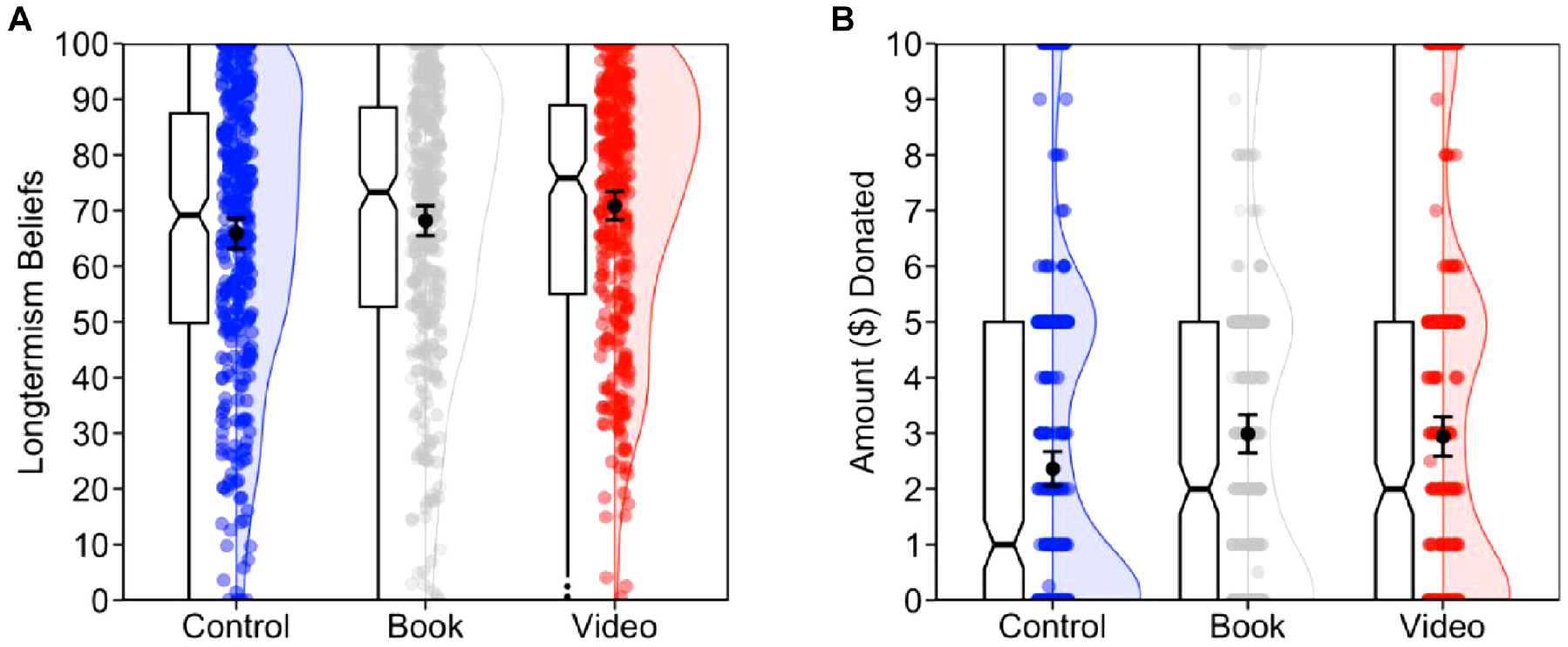
Split Violins With Overlaid Jitter Density and Notched Box-Plots Depicting Longtermism Beliefs (A) and Amount Donated to the Long-Term Future Fund (B) by Condition
Books Versus Control
Participants in the book condition (N = 322) did not significantly differ in longtermism beliefs, t(658) = 1.18, p = .239, d = 0.09, from the control condition (N = 338). However, participants who read an excerpt of What We Owe The Future, and wrote a short reflection donated significantly more to the Long-Term Future Fund, t(658) = 2.67, p = .008, d = 0.21, compared with the control.
Lecture Versus Control
Participants who saw the lecture on longtermism (N = 309) scored significantly higher on longtermism beliefs, t(645) = 2.60, p = .009, d = 0.21, and donated significantly more to the Long-Term Future Fund, t(645) = 2.42, p = .016, d = 0.19, compared with the control (N = 338).
Indirect Effects
We pre-registered that should a significant effect be observed on longtermism beliefs, given that we expected a significant positive association between longtermism beliefs and donations to the Long-Term Future Fund (r = .24, p < .001) a significant indirect effect of condition on donations via increased longtermism beliefs might be observed. We tested for this effect using the same analytical approach as Study 1. For the book condition (b = 0.06, 95% CI [−0.04, 0.16]), this indirect effect was not significant; however, for the lecture condition (b = 0.14, 95% CI [0.04, 0.26]), a significant indirect effect was observed.
Discussion
Our second study directly replicated the effects of the video exposure on longtermism beliefs. However, the book condition did not successfully shift longtermism beliefs. Nevertheless, both conditions did successfully increase donations to a longtermist charity, with this effect being fully mediated by increased longtermism beliefs for the video condition.
Study 3
In our third and final experiment, we sought to determine whether the lecture manipulation, which appeared to be more consistently effective across Studies 1 and 2, would also shift people’s willingness to engage in cognitively effortful action to benefit future people. To that end, we adapted the Work for Environmental Protection Task (WEPT; Lange & Dewitte, 2022) by switching the charity of interest from a pro-environmental organization to an organization that seek to protect future generations more directly. Below, we refer to the adapted task as the Work for Future Protection Task (WFPT) when discussing results. The design, measures, sample size, and analytical plan for the study were pre-registered, https://aspredicted.org/M6L_G9Q.
Participants
A total of 850 participants were recruited in line with our pre-registered power analysis. After applying exclusion criteria, 844 participants remained. 1
Procedure
Participants were randomly assigned to one of two conditions, the control and video conditions. The video (i.e., lecture) condition was identical to our previous studies. However, to address possible concerns stemming from inherent differences between the control and experimental tasks employed in Studies 1 to 2, we chose to include a better-matched control condition in Study 3. The new control condition was a 10-minute philosophy lecture given at Oxford University on another topic (https://www.youtube.com/watch?v=S7H8R1PBrQI). Given the longer duration of the study, we removed the book condition.
Materials
Regardless of condition, after the condition-specific stimulus, participants first completed the Longtermism Belief Scale (a = 0.95). After completing the LBS, participants completed an adapted version of the WEPT (Lange & Dewitte, 2022). For the WEPT, participants are presented with instructions that they will be asked to complete a series of trials. For each trial, a certain number of integers will be shown. Their task is to identify numbers with an odd first digit and an even second digit. They are told that only pages where 90% of answers are correct will count toward successfully completing the task. Successfully completing the task in turn would result in either $ 0.10, $ 0.20 or $ 0.30 being donated to a particular charity (participants are not provided the option to keep the money for themselves). Scores are captured as the total number of trials participants indicate they are willing to complete (i.e., Min = 1, Max = 15; a = 0.90). We did not inspect participant accuracy, as in the original study, the authors ascertained that results were highly similar with/without removing incorrect responses. The adapted WEPT was identical to the original WEPT, with the only difference being that we utilized a longtermist charity as the recipient of the bonus (the Long-Term Future Fund; see SOM for task instructions). As such, we refer to this adapted task below as the Work for Future Protection Task (WFPT).
Results
Participants who were randomly assigned to the longtermist video/lecture condition (N = 430, M = 71.38, SD = 23.10), scored significantly higher, t(842) = 3.33, p < .001, d = 0.23, on the LBS compared with those in the control video condition (N = 414, M = 66.09, SD = 23.04). However, no significant difference was observed for performance on the WFPT, t(842) = 0.10, p = .924, with average scores for both conditions being around 3.40 completed trials.
Importantly, higher scores on the longtermism beliefs scale predicted completing more trials on the WFPT (b = .04, SE = .01, 95% CI [0.03, 0.05], p < .001, β = 0.22, R 2 = .05; see Figure 4). In fact, this was the case for each specific possible trial of the WFPT (see Table 2). 2
Logistic Regression With Longtermism Scores Predicting Participation in Each Trial of the WFPT
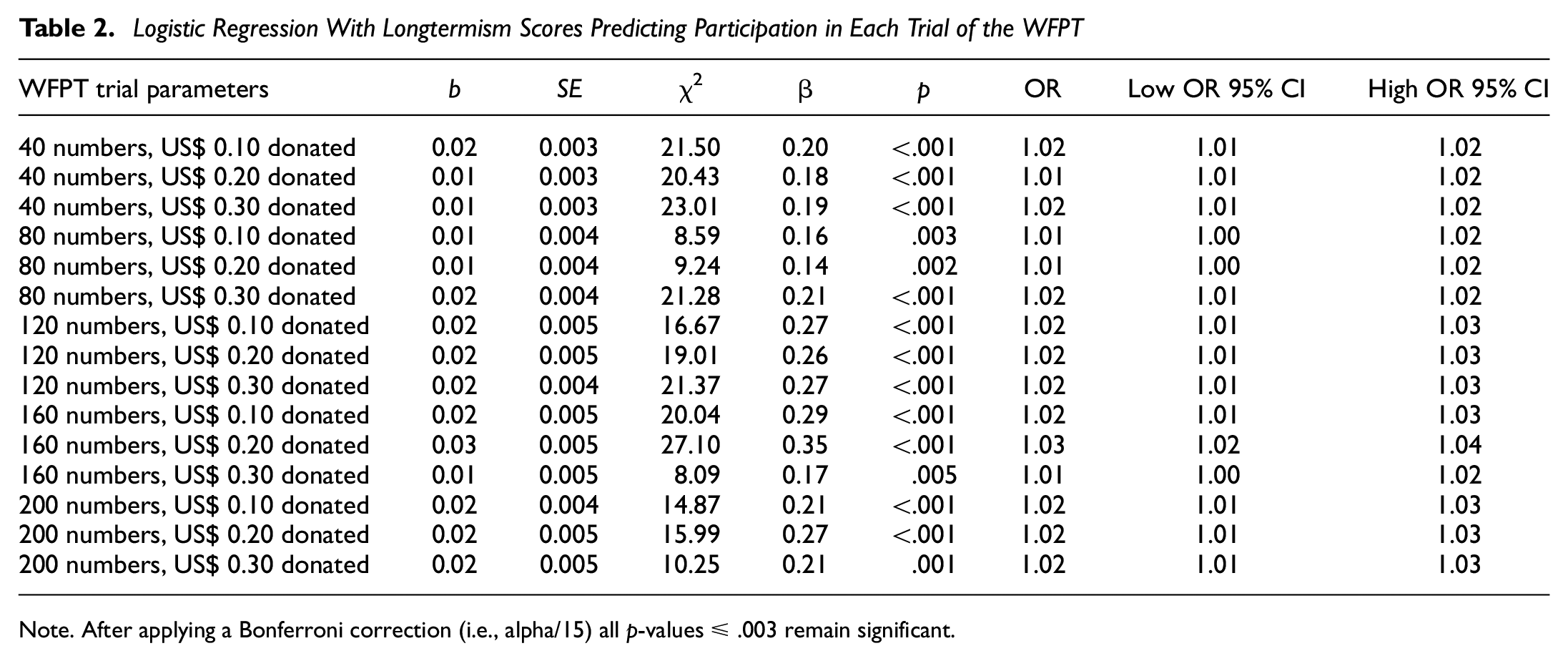
Note. After applying a Bonferroni correction (i.e., alpha/15) all p-values ≤ .003 remain significant.
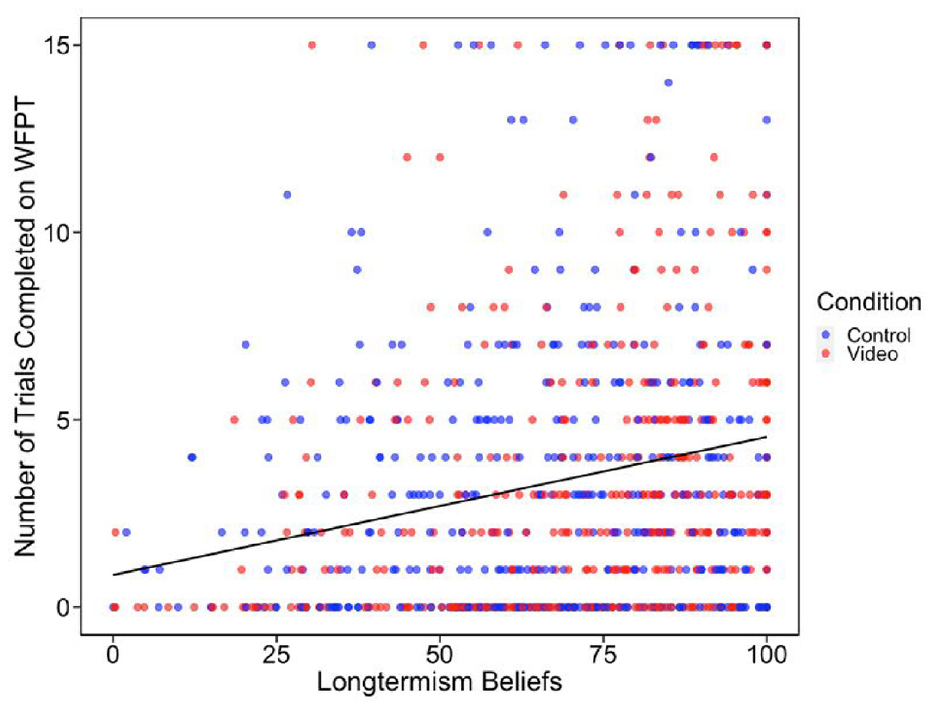
Relationship Between Longtermism Beliefs and the Number of Trials Completed on the WFPT. Each Point Represents an Individual Participant, With Blue Points Denoting Those in the Control Condition and Red Points Indicating Those in the Video Condition. The Black Line Illustrates the Overall Regression Relationship Between the Two Variables, Irrespective of the Condition
Indirect Effects
Considering that the manipulation influenced longtermism beliefs, longtermism beliefs influenced effort exerted on the WFPT, and our pre-registered analytical plan, we examined a potential indirect-only mediation relationship between the video intervention and effort exerted on the WFPT through LBS scores, using a similar approach to that employed in Studies 1 and 2. A significant indirect effect was observed (b = .20, SE = .06, 95% CI [0.08, 0.33]).
Mini Meta-Analysis of Effects on Longtermism Beliefs Across Studies 1-3
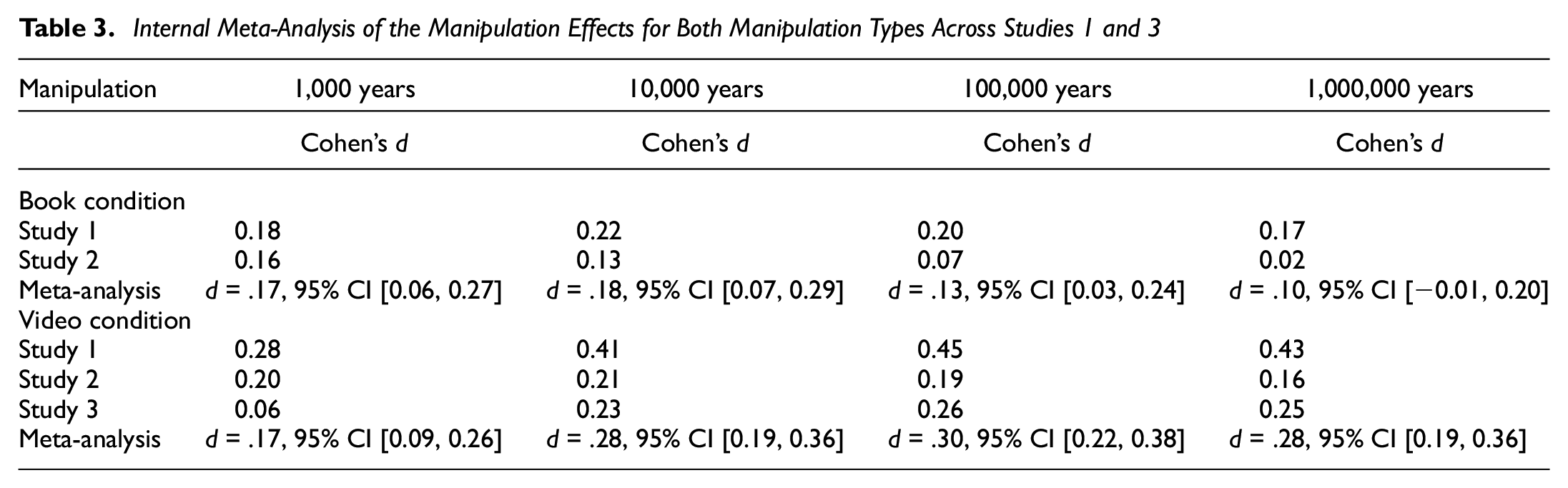
Utilizing the methodology developed by Goh and colleagues (2016), we conducted a “mini” meta-analysis of the present results. Doing so allowed us to better pinpoint whether longtermism beliefs that are temporally closer or further were influenced more by each manipulation. As seen in Table 3, the book manipulation had effect sizes ranging from .18 to .10, with larger effect sizes for shorter timeframes, while the video manipulation had effect sizes ranging from .17 to .30, with larger effect sizes for more distant timeframes.
Internal Meta-Analysis of the Manipulation Effects for Both Manipulation Types Across Studies 1 and 3
General Discussion
In contemplating the monumental challenges of our times, such as climate change, pandemics, and the complex dynamics of global welfare, it becomes evident that solutions must extend beyond the immediate temporal horizon (Greaves & MacAskill, 2019; MacAskill, 2022; Ord, 2021). The philosophy of longtermism advocates considering the welfare of future generations with equal weight to the present. Here, across three pre-registered and highly-powered studies, we delve into whether exposure to philosophical arguments via multiple media (e.g., video and text) for longtermism can ignite alignment with its principles, subsequently influencing attitudes and actions that advance the well-being of humanity across temporal boundaries. Through multiple educational interventions spanning text and video media formats, we investigate and find evidence that these arguments resonate with individuals and influence longtermism beliefs, support for relevant policies, and donation behavior. Furthermore, we provide evidence that longtermism beliefs play a critical mediating role between interventions and pro-future outcomes and consistently correlate positively with pro-future outcomes. The findings not only provide intriguing insights into the malleability of longtermism alignment but also underscore the practical utility of philosophical discourse in driving collective action to safeguard the future.
This research corroborates previous findings that philosophical discourse can assist individuals in transcending parochial biases in their altruistic choices. Ordinarily, people preferentially protect the welfare of socially close versus distant others (Berman et al., 2018; Caviola et al., 2022; Fowler et al., 2020; Kahane et al., 2018; Law et al., 2022; McManus et al.,2020, 2021). Nonetheless, exposing individuals to arguments rooted in the principles of effective altruism has shown a promising attenuation of this inclination (Lindauer et al., 2020). Further, seminal and burgeoning lines of inquiry have unveiled a comparable bias wherein individuals are more inclined to protect the welfare of current versus future generations (Law et al., 2023; Syropoulos, Law, Kraft-Todd, & Young, 2023; Syropoulos, Law, & Young, 2023; Wade-Benzoni, 2008, 2017; Wade-Benzoni & Tost, 2009). Our current investigation reveals that exposure to philosophical dialectics related to the longtermism philosophy (MacAskill, 2022) has the potential to dampen present-centric bias pervading attitudes and prosociality. In fact, emerging evidence suggests that those who deeply value protecting future generations also express greater prosociality in general, expressed as greater perspective taking, less dehumanization, more identification with other humans, and overall moral expansiveness (Syropoulos, Law, & Young, 2023; Syropoulos, Law, Amormino, & Young, 2023). Thus, it possible that increasing endorsement of longtermism beliefs could increase prosociality more broadly. The role of philosophical deliberations in nurturing more expansive altruistic viewpoints and actions, transcending both social and temporal barriers, might be attributed to congruencies in the processing paths that govern the perception of social and temporal distance considerations (Gilead et al., 2020; Hill et al., 2017; Soutschek et al., 2016; Tuen et al., 2023). However, a deeper exploration through forthcoming research is essential to substantiate this possibility.
The present research also potentially offers a viable strategy to foster increased interest in protecting the long-term future. Notably, the video-based intervention employed in the present research is short in duration, easy to implement, low cost, and potentially highly scalable. Similar educational interventions have been shown to be incredibly effective and easy to implement across vast populations to robustly influence outcomes such as mental health symptoms during the COVID-19 pandemic (Rizvi et al., 2022; Yeager et al., 2022), climate change attitudes and beliefs (Ranney & Clark, 2016), reduced infection rates for sexually transmitted diseases (Warner et al., 2008), and attitudes toward outgroup members (Krause et al., 2022; Theriault et al., 2017). However, it remains to be seen whether the interventions studied here can foster lasting pro-future attitudes and inspire action in vivo. Future research could examine the enduring nature of effects longitudinally and in a more immersive setting (i.e., in-person or virtual classroom). Moreover, significant boosts in pro-future outcomes from brief interventions in our studies underscore the power of these manipulations. We encourage further investigations into explore the depth of this phenomenon, examining whether extended interventions—such as a semester-long or open-source online course on, active engagement with, or social engagement (e.g., dialogue or discourse) pertaining to the longtermism philosophy—could amplify positive shifts in future-oriented attitudes and behaviors and shape more substantial investments in the future, such as career choices (80,000 Hours, 2023). In sum, understanding the potential scalability and long-term effects of such experimentally informed interventions is a crucial next step in advancing efforts to promote pro-future thinking and behavior.
Despite the numerous strengths of the present research, there are some limitations worthy of mention as well. For one, the video intervention elicited longtermism alignment and pro-future outcomes more consistently than the text-based intervention across studies, putting into question the utility of the latter. Because the content presented in both interventions was closely matched, it is likely that the video presentation simply garnered more interest and retention of the content. Indeed, existing research from the educational psychology literature suggests that garnering initial interest in novel concepts benefits from “dressing-up” content with peripheral interest triggers which tend to be more emotionally salient, a feat more easily achieved through mixed-media than text alone (Linnenbrink-Garcia et al., 2010). Future research might further explore the relative effectiveness of various formats for longtermism interventions at different stages of interest development.
Second, our findings from Study 3 illustrate that, while the video intervention did not directly impact cognitive effort expended in the Work for Future Protection Task (WFPT), it did significantly enhance longtermism alignment, which was subsequently a robust and consistent predictor of engagement with the WFPT (in general, and for each specific trial). Nonetheless, individual differences in longtermism alignment consistently correlated positively with all pro-future outcomes across studies. While we did observe a significant indirect effect in Study 3, it’s crucial to delineate that the observable enhancements in cognitive effort can be ascribed to the alterations in longtermism beliefs engendered by the intervention, rather than a direct influence of the intervention itself. This suggests an integral role of fostering pro-future attitudes as a pivotal step in eliciting more committed and concerted efforts toward safeguarding the future. Moreover, as behavioral outcomes were measured immediately following the interventions in Studies 2 and 3, the critical question of whether such interventions can cultivate lasting behavioral change remains open for future research to explore.
Finally, while the present research was pre-registered and well-powered, our samples comprised exclusively participants from the United States. Safeguarding humanity’s future represents a global challenge with global solutions. Thus, examining potential cultural and geographic variability in the effects of interventions on pro-future outcomes will be critical in navigating toward a brighter horizon. We invite and look forward for future research which examines cultural and geographic nuance in these effects to address issues of generalizability as well as elucidate the effectiveness of longtermism interventions on a global scale.
Conclusion
This research highlights the vital role of longtermism in addressing contemporary global challenges by fostering consideration of future needs and future people. Our comprehensive studies reveal that engagement with longtermism principles can significantly influence individuals toward adopting future-oriented policies and behaviors. These promising findings affirm the practical value of philosophical discourse in guiding collective actions toward securing a prosperous future for all.
Supplemental Material
sj-docx-1-spp-10.1177_19485506241228465 – Supplemental material for Longtermist Education Interventions Increase Concern for and Action to Protect Future Generations
Supplemental material, sj-docx-1-spp-10.1177_19485506241228465 for Longtermist Education Interventions Increase Concern for and Action to Protect Future Generations by Stylianos Syropoulos, Kyle Fiore Law and Liane Young in Social Psychological and Personality Science
Footnotes
Handling Editor: Danny Osborne
Declaration of Conflicting Interests
The author(s) declared no potential conflicts of interest with respect to the research, authorship, and/or publication of this article.
Funding
The author(s) disclosed receipt of the following financial support for the research, authorship, and/or publication of this article: This research was supported by a grant from the John Templeton Foundation (Grant #62221; “The Impact of Social Norms on Virtue”).

Supplemental Material
The supplemental material is available in the online version of the article.
Notes
Author Biographies
References
Supplementary Material
Please find the following supplemental material available below.
For Open Access articles published under a Creative Commons License, all supplemental material carries the same license as the article it is associated with.
For non-Open Access articles published, all supplemental material carries a non-exclusive license, and permission requests for re-use of supplemental material or any part of supplemental material shall be sent directly to the copyright owner as specified in the copyright notice associated with the article.
