







Abstract
The current research offers a cross-cultural examination of transgender prejudice, with a particular focus on the role of gender. Analyses of a survey conducted in 23 countries (with N’s ranging from 485 to 1,098) representing both Western and non-Western societies showed that there is greater bias toward transgender women (vs. men) overall, among both male and female participants. These differences were small and not reliable in most Western countries, whereas participants in China, Russia, South Korea, and Türkiye made greater distinctions. Men (vs. women) and conservatives reported higher prejudice, and this was more pronounced in Western (vs. non-Western) countries. Religiosity was associated with anti-transgender prejudice in Western (but not non-Western) countries, but this was completely accounted for by anti-gay attitudes. Finally, anti-gay and anti-transgender prejudice were strongly related to each other across samples, and the denial of gender identity predicted anti-transgender prejudice over and above anti-gay prejudice.
Across myriad group hierarchies, men are disproportionately more likely to be the perpetrators and targets of prejudice relative to women (e.g., Pratto et al., 2006; Veenstra, 2013). Work specifically investigating attitudes toward sexual minorities has found that attitudes toward gay men are markedly more negative than attitudes toward lesbian women, especially among men, across cultures (Bettinsoli et al., 2020; Norton & Herek, 2013). This is explained, at least in part, by asymmetrical reactions to gender nonconformity—i.e., both gay men and lesbian women are perceived to violate traditional gender norms (Kite & Deaux, 1986; Nagoshi et al., 2008), but men (vs. women) tend to experience more severe backlash for gender atypical behavior, particularly from other men (Feinman, 1981, 1984; Sirin et al., 2004; Vandello et al., 2008).
This gender difference has also emerged in research examining transgender attitudes, such that men (vs. women) report greater prejudice in virtually every sample that has assessed this, including studies conducted in North and South America, Europe, and Asia (e.g., Flores et al., 2016; Hatch et al., 2022; Worthen, 2016). Little research, however, has focused on the gender of the target—that is, whether or not people harbor more negative attitudes toward transgender women versus men. Insofar as people tend to categorize transgender women as male (Doan et al., 2019; Morgenroth et al., 2024), several theoretical frameworks would predict that they would be subject to worse prejudice and discrimination compared to transgender men, both because males (vs. female) are treated more harshly for perceived gender nonconformity (e.g., Feinman, 1984) and because male members of lower status groups tend to experience worse treatment more generally—a phenomenon labeled the “subordinate male target hypothesis” (Pratto et al., 2006; Veenstra, 2013). However, findings from the handful of studies that have separately assessed attitudes toward transgender women versus men have yielded mixed results. Some studies, conducted with college student samples in the United States (Totton & Rios, 2021) and China (Chen & Anderson, 2017), have found greater levels of prejudice toward transgender women (vs. men), whereas other studies have found no differences in attitudes as a function of target gender, in both U.S. student samples (Worthen, 2016) and online samples of adults in the United States and India (Elischberger et al., 2018).
Other evidence also suggests that gender may be a less important factor in evaluations of transgender people. For instance, in terms of stereotype content, cisgender women and gay men are rated as more communal and less agentic than cisgender men and lesbian women, respectively, whereas there are no differences in agency or communality ratings for transgender men versus women (Gallagher & Bodenhausen, 2021; Klysing et al., 2021). In addition, while transgender individuals are over four times more likely to be targets of violence compared to cisgender people, transgender men and women are equally likely to be victims of these crimes (e.g., Flores et al., 2021). This lack of gender difference stands in contrast to other intergroup domains, such that gay and Black men are more frequently the victims of violence and aggression compared to lesbian and Black women, respectively (e.g., Pratto et al., 2006; Stotzer, 2012).
Predictors of Anti-Transgender Prejudice
One aim of the current work is to systematically examine the role of gender in anti-transgender prejudice—that is, whether men and women are more prejudice toward transgender men versus women, and whether this varies cross-culturally. Because cross-national data on transgender attitudes are rare, a second aim of this research is to examine how other predictors, including age, education, conservatism, and religiosity, commonly highlighted in Western research (e.g., Campbell et al., 2019; Hatch et al., 2022), relate to anti-transgender attitudes more globally.
Similar to prejudice in other domains (e.g., Henry & Napier, 2017; von Hippel, 2007), survey data suggest that people with higher (vs. lower) education and younger (vs. older) people tend to be more supportive of transgender rights across countries (Flores et al., 2016). In addition, people who are politically conservative tend to be less tolerant toward transgender people in the United States (Atwood et al., 2024; Nagoshi et al., 2008). However, some findings indicate that this association might vary across contexts. For instance, one study using MTurk participants in the United States and India found that conservatism was strongly associated with anti-transgender attitudes in the United States but unrelated in India (Elischberger et al., 2018). In addition, a meta-analysis (based primarily on Western samples) found that the association between conservatism and anti-transgender attitudes was moderated by study year, such that the association was becoming stronger over time (Hatch et al., 2022). The authors speculated that this could be because of the increased prominence of transgender policy, suggesting that the association between conservatism and transgender attitudes might be exacerbated by the extent to which transgender issues have been politicized in any given context.
Extant research has also found that religiosity is positively related to anti-transgender attitudes, but the limited research that has examined this more globally suggests that this link may be stronger for people identified as Christian compared to other religions (Campbell et al., 2019; see also Elischberger et al., 2018). Anecdotally, in some non-Western contexts, there are cases where gender transitions are conceived of in spiritual terms (e.g., the hijra in India, Nanda, 1986; or burrneshat in the Balkans, Dickemann, 1997) or at least not prohibited by religious doctrine (e.g., fatwas in Egypt and Iran; Alipour, 2017), unlikely homosexuality. Thus, it is conceivable that the association between religiosity and anti-transgender prejudice might be weak or absent in some non-Western/non-Christian contexts.
Although anti-gay and anti-transgender attitudes are highly related to each other (e.g., Norton & Herek, 2013), studies conducted in the United States have found that, over and above anti-gay attitudes, transgender individuals face additional hostility stemming from the perception that are deceptive and untrustworthy, and this is because they are perceived as concealing their “real” identity (Totton & Rios, 2021; see also Doan et al., 2019). This suggests that the rejection of transgender people’s identities should explain additional variance in anti-transgender prejudice. Thus, the third aim of this research is to investigate whether the denial of transgender people’s gender identity predicts prejudice against them, even after adjusting for attitudes toward gay people, in both Western and non-Western contexts.
The “Western/Non-Western” Distinction
Psychologists have shown that cultures can be categorized on myriad dimensions, including collectivism/individualism (Hofstede, 2001; Triandis, 2001), cultural logics (e.g., cultures of honor or dignity; Leung & Cohen, 2011), tightness/looseness (Gelfand et al., 2011), and value dimensions (Schwartz, 2006), among others. In this research, I use a broad-stroke characterization of “Western” versus “non-Western,” which is based on theorizing about the structural and psychological effects prompted by exposure to the medieval Western Church (Henrich, 2021; Schulz et al., 2019). More specifically, as the medieval predecessor of the Roman Catholic Church, the Western Church promoted and enforced bans on marriages between close kin, which markedly impacted the culture of those influenced by this Church, transforming societies based on extended kin networks into ones composed of loosely connected, neolocal, nuclear families (Henrich, 2021; Schulz et al., 2019). Places influenced by the Eastern Church (i.e., the medieval predecessor to the Orthodox Christian Church), such as Eastern parts of Europe and Central Asia, and places not influenced by either medieval Christian Church (i.e., the rest of Asia and most of Africa), tended to maintain intensive kinship structures for much longer. This divergence in societal structures is postulated to be the basis for the particular (“weird”) psychological tendencies found in historically Western, Educated, Industrialized, Rich, and Democratic (WEIRD) countries of Western Europe and places occupied by its cultural descendants (i.e., North and South America, Australia, and New Zealand). Specifically, WEIRD (or Western) cultures tend to be more individualist and nonconformist (e.g., Gelfand et al., 2011; Hofstede, 2001; Schwartz, 2006), 1 and WEIRD people tend to display unique cognitive processing (e.g., in terms of self-concepts, visual perception, spatial and moral reasoning, categorization, etc.; see Henrich et al., 2010; Henrich, 2021), compared to the rest of the world.
A Survey of Transgender Attitudes
The current research investigates predictors of prejudice against transgender men and women in 23 countries examining (a) whether prejudice varies as a function of targets’ gender; (b) the associations between individual differences (including participant gender, age, education, conservatism, and religiosity) and anti-transgender prejudice; and (c) whether both anti-gay prejudice and transgender identity denial independently predict anti-transgender prejudice. I predict that, unlike attitudes toward other outgroups, anti-transgender prejudice will not vary as a function of target gender—that is, people will express similar attitudes toward transgender women and men. I also predict that prejudice will be higher among men (vs. women), older (vs. younger) people, and people with low (vs. high) education, across contexts, but that conservatism and religiosity will be more strongly associated with prejudice in Western (vs. non-Western) countries. Finally, I predict that the denial of transgender identities will predict anti-transgender prejudice, over and above anti-gay prejudice, across countries.
The study, including the survey company’s recruitment procedure, was approved by the Institutional Review Board at New York University Abu Dhabi. The full survey assessed attitudes toward gay people, transgender people, and traditional gender role endorsement (see Bettinsoli et al., 2020 for in-depth analyses of attitudes toward gay men and lesbian women). The questionnaire and data set are available at https://osf.io/xkqjm/.
For the analyses, I categorized countries into “Western” and “non-Western” (see Table 1) based on whether or not they were affected by the medieval Western Church’s changes to kinship structures (see Schulz et al., 2019). It should be noted that the “non-Western” countries are a much more diverse group, differing on a host of historical and contemporary attributes. In other words, there is a stronger theoretical basis for grouping the Western countries together (and expecting them to show roughly similar patterns) compared to the non-Western ones. Thus, in addition to multilevel models, I also analyzed each country separately (see Supplementary Materials for details).
Sample Details and Means (and Standard Deviations) for Focal Variables
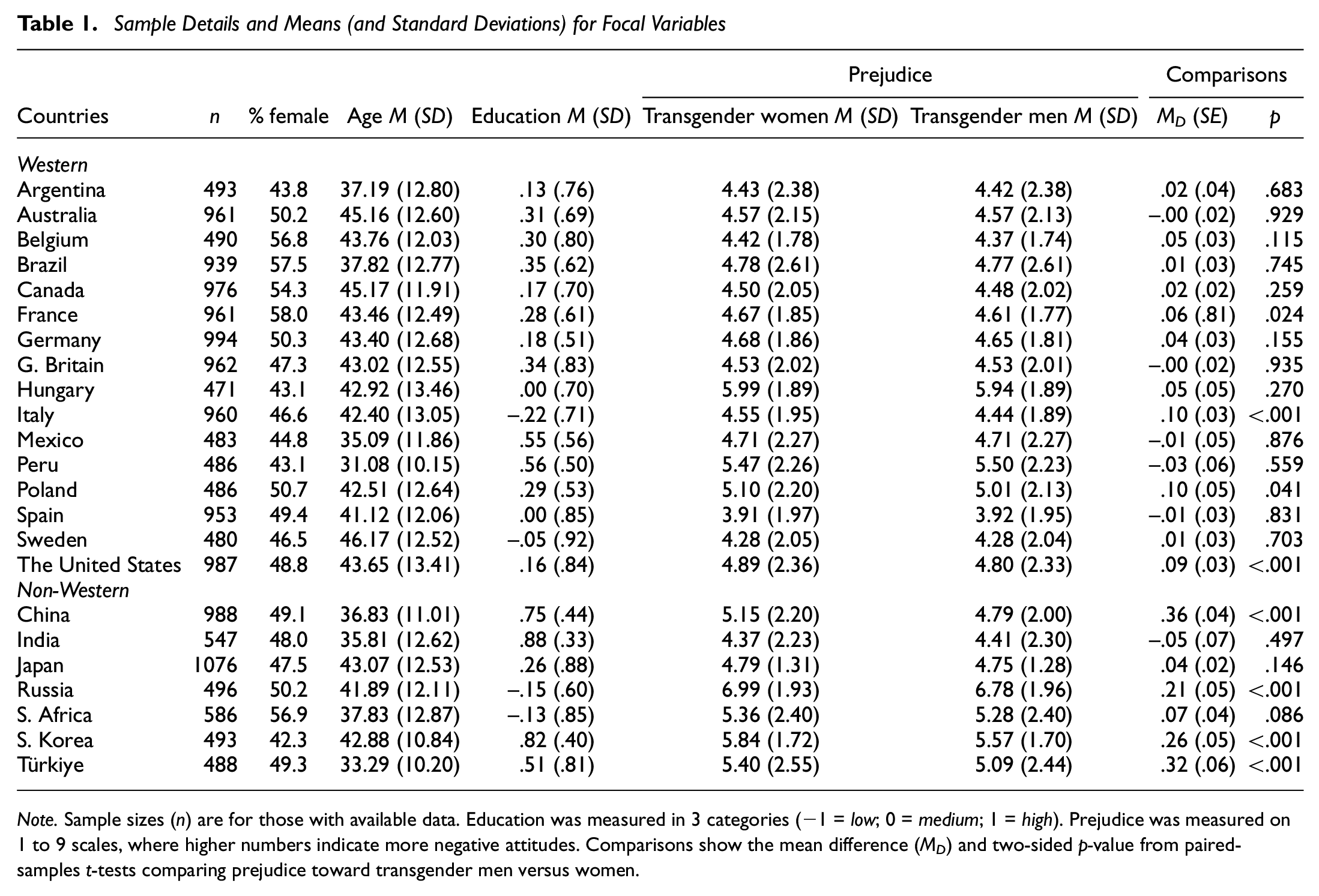
Note. Sample sizes (n) are for those with available data. Education was measured in 3 categories (−1 = low; 0 = medium; 1 = high). Prejudice was measured on 1 to 9 scales, where higher numbers indicate more negative attitudes. Comparisons show the mean difference (MD) and two-sided p-value from paired-samples t-tests comparing prejudice toward transgender men versus women.
Method
Participants
Data were collected between November 27 and December 7, 2018 through Ipsos (n.d.) Global Advisor monthly syndicate service, which fields survey questions to online participants in 23 countries, with sample sizes of 500 or 1,000 per country (total N = 16,756 with available data; see Table 1). Ipsos provides data on participants’ (binary) gender, age, and income and education, both assessed with three categories (−1 = low; 0 = medium; 1 = high). Because response rates for income were low and because income is rarely an important predictor of prejudice (e.g., Bettinsoli et al., 2020; Norton & Herek, 2013), it was omitted from the models. Ipsos does not provide data on participants’ race or ethnicity, sexual orientation, or gender identity other than categorization within the male/female binary.
According to Ipsos, samples are representative of the national population in Argentina, Australia, Belgium, Canada, France, Germany, Great Britain, Hungary, Italy, Japan, Poland, South Korea, Spain, Sweden, and the United States, whereas the samples from countries with lower internet penetration (Brazil, China, India, Mexico, Peru, Russia, South Africa, and Türkiye) are more urban, educated, and have higher income than the national population.
Materials
Participants were asked how they feel toward certain “types of people in your country,” on a scale from 1 (extremely positive) to 9 (extremely negative), which included ratings of transgender men, transgender women, gay men, and lesbian women. Because language and labels for social groups can vary across contexts, the words “gay” or “transgender” were not used in the survey. Instead, participants were given a description, such that transgender women were described as “someone was considered male at birth who feels they are actually female and so dresses and lives as a woman,” and transgender men were described as “someone who was considered female at birth who feels they are actually male and so dresses and lives as a man.” Responses to each of these items were used as a measure of prejudice toward transgender women and men, respectively. Similarly, gay men (and lesbian women) were described as “A man [woman] who is romantically or sexually attracted to other men [women].” I computed the mean of these two items (α’s > .70) as a measure of anti-gay prejudice.
Participants were also asked to indicate their agreement with the statement: “A person cannot really be a different gender than the one they were considered at birth,” on a scale from 1 (strongly disagree) to 9 (strongly agree), which was used as the measure of gender identity denial.
At the end of the survey, participants reported their degree of religiosity and social conservatism, on scales ranging from 1 (not at all) to 5 (extremely). The question about social conservatism was not fielded in China. All continuous variables were group-centered in the models; for China, conservatism was set to zero.
Results
Examining the Effects of Target Gender on Prejudice
I first conducted paired-samples t-tests comparing prejudice toward transgender women versus men within each country (see Table 1). As seen in the last set of columns in Table 1, the largest differences emerged among non-Western samples, such that transgender women (vs. men) were rated more negatively in China, Russia, South Korea, and Türkiye. Attitudes toward transgender women (vs. men) were also slightly (but significantly) more negative in France, Italy, Poland, and the United States. There were no differences in the remaining countries. Analyses including adjustments for gender, age, education, religiosity, and conservatism yielded similar results (see Supplementary Table S1). 2
To estimate the overall effects as a function of region, I conducted a multilevel model, with people nested in country, in two steps, predicting prejudice with target gender (male = 0; female = 1) as a within-subjects variable in Step 1, and participant gender (male = 0; female = 1) and region (Western = 0; Non-Western = 1) and all the two- and three-way interactions in Step 2 (see Table 2). Age, education, conservatism, and religiosity were included as covariates.
Estimated Fixed-Effects From a Multilevel Model (With Participants Nested in Country, and Target Gender Nested in Participants) Predicting Anti-Transgender Prejudice
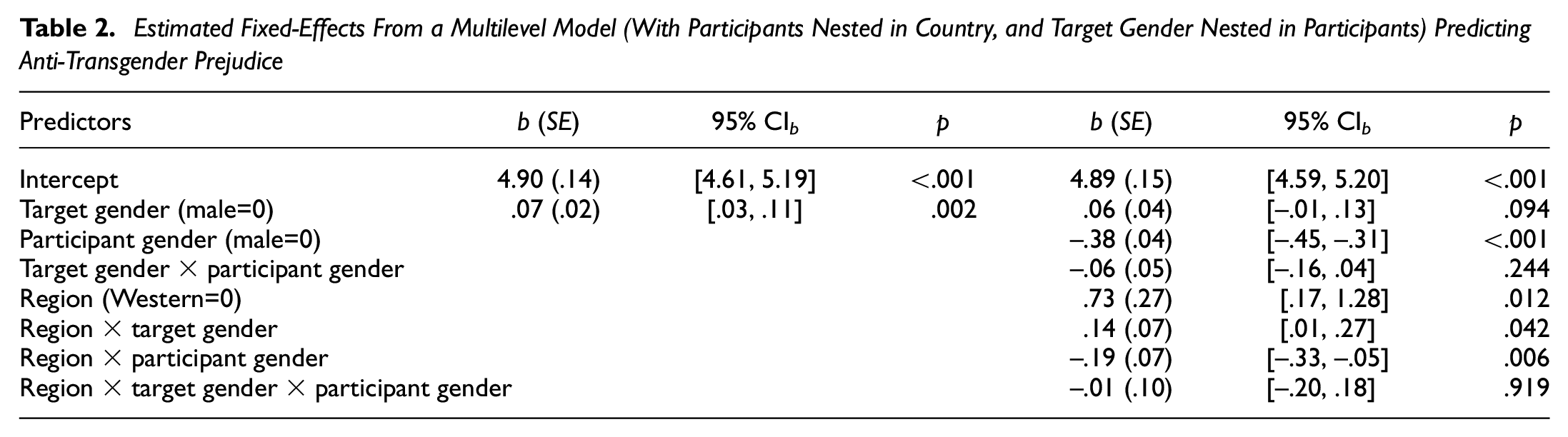
Results from Step 1 revealed a main effect of target gender: overall, participants reported greater prejudice toward transgender women (vs. men). Results from Step 2 showed an effect of region, which was qualified by interactions with target gender and participant gender. Simple slopes analyses showed that there was no reliable effect of target gender on prejudice in Western countries, b = .06, SE = .04, p = .094, whereas participants in non-Western countries reported greater prejudice toward transgender women (vs. men), b = .20, SE = .06, p < .001. In addition, men reported greater prejudice than women overall, but this gender gap was greater in non-Western countries, b = −.57, SE = .06, p < .001, compared to Western ones, b = −.38, SE = .04, p < .001.
Predictors of Transgender Prejudice by Region
Figure 1 shows the extent of agreement with the gender identity denial question. One-sample t-tests comparing agreement with this item to the scale midpoint (5) showed that participants in Russia, China, India, Peru, Hungary, South Africa, Poland, and the United States were significantly above the midpoint in agreement, whereas participants in Spain, Sweden, Belgium, France, Argentina, Germany, Canada, Italy, and Japan were significantly below the scale midpoint on average.
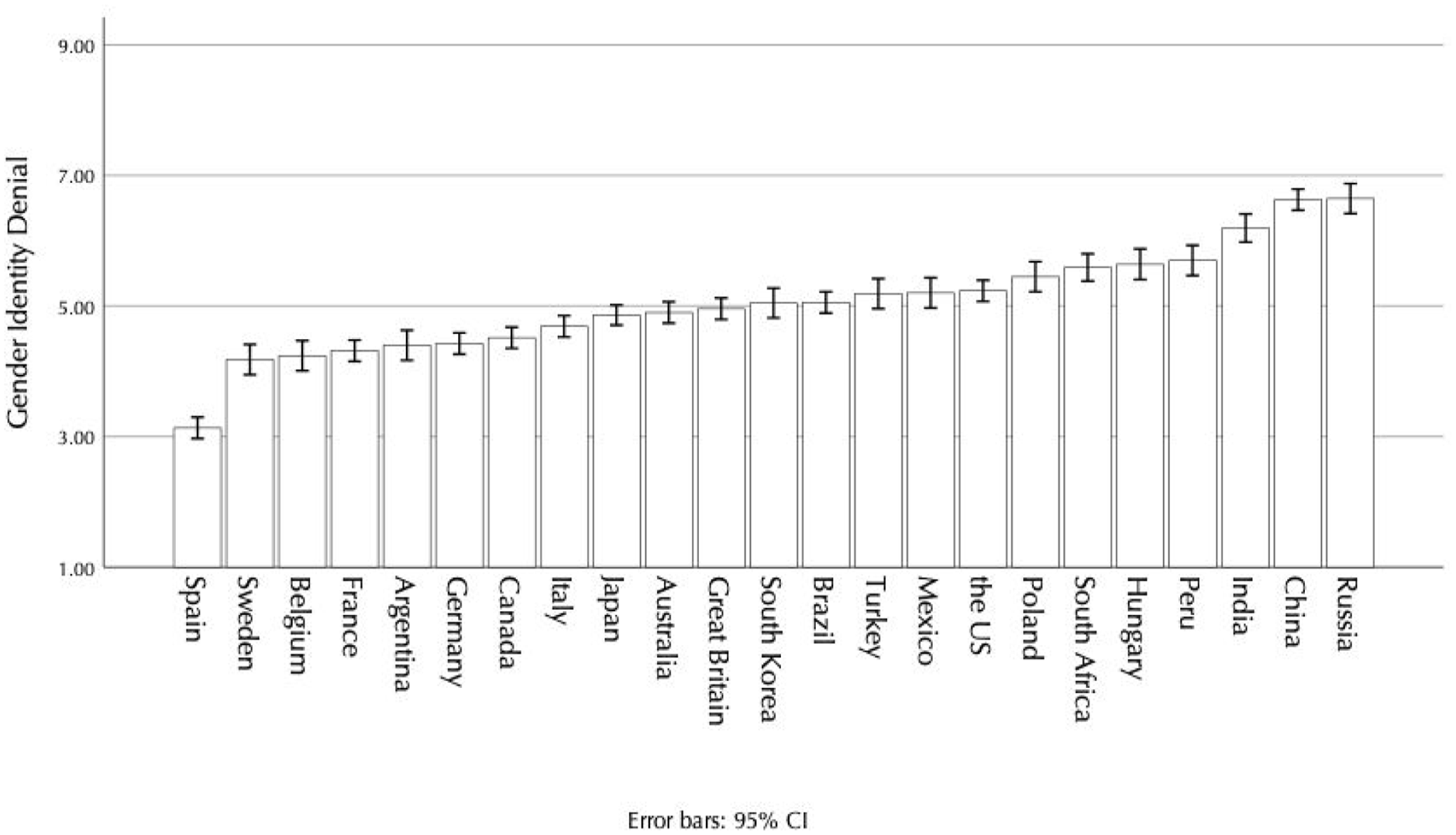
Mean Agreement With the Statement: “A Person Cannot Really be a Different Gender Than the One They Were Considered at Birth” (in Order From Lowest to Highest)
To examine the relations between demographic variables (i.e., gender, age, education, conservatism, religiosity), anti-gay prejudice, and transgender identity denial with anti-transgender prejudice, I computed the mean of negativity toward transgender male and female targets to use as a measure of transgender prejudice. 3 I conducted a multilevel model, with people nested in country, predicting transgender prejudice with demographic variables in Step 1, anti-gay prejudice in Step 2, and gender identity denial in Step 3, including interactions with region (Western = 0; Non-Western = 1) for each predictor variable (see Table 3).
Estimated Fixed-Effects From a Multilevel Model (With Participants Nested in Country) Predicting Anti-Transgender Prejudice
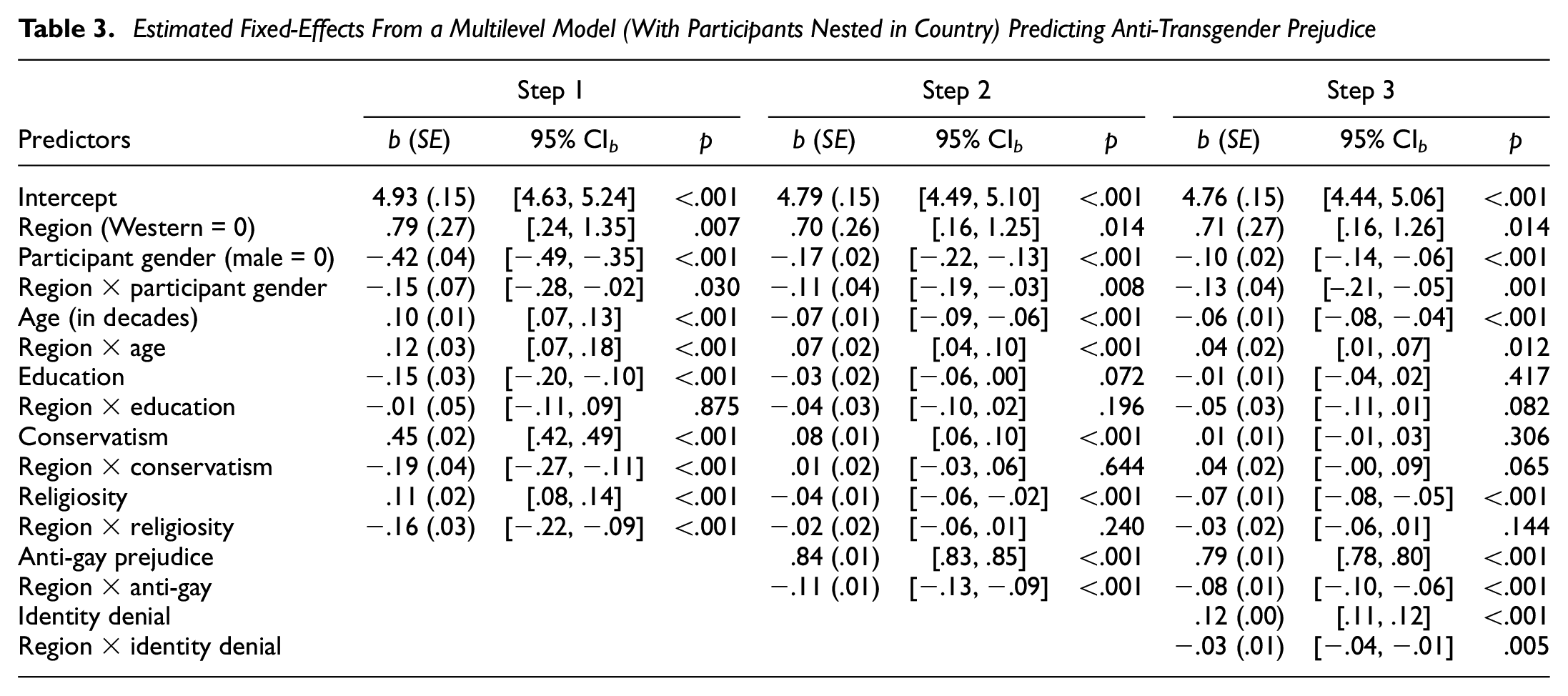
Results from Step 1 showed that men harbor more prejudice than women overall, with a larger gender difference in non-Western, b = −.57, SE = .06, p < .001, compared with Western, b = −.42, SE = .04, p < .001, contexts. Age was positively associated with prejudice, an effect that was larger in non-Western, b = .22, SE = .03, p < .001, versus Western, b = .10, SE = .01, p < .001, countries. Education was inversely associated with prejudice regardless of region, as evidenced by the non-significant interaction. Conservatism was associated with more prejudice, and this effect was bigger in Western contexts, b = .45, SE = .02, p < .001, compared to non-Western ones, b = .26, SE = .03, p < .001. Religiosity was associated with more prejudice in Western countries, b = .11, SE = .02, p < .001, but unrelated to attitudes in non-Western countries, b = −.05, SE = .03, p = .096.
In Step 2, I added anti-gay prejudice, which was strongly related to anti-transgender prejudice, but more so in Western countries, b = .84, SE = .01, p < .001, compared to non-Western ones, b = .74, SE = .01, p < .001. After including anti-gay prejudice in the model, the associations between other demographics and anti-transgender prejudice changed. For instance, over and above anti-gay prejudice, age was inversely related to anti-transgender prejudice in the West, b = −.07, SE = .01, p < .001, such that younger (vs. older) people reported slightly more prejudice, and there was no longer an association between age and prejudice in non-Western countries, b = −.00, SE = .01, p = .785. The association between education and prejudice was no longer reliable. The effect of conservatism was drastically reduced (albeit still significant) and no longer qualified by region. The effect of religion was reversed, such that more (vs. less) religious people reported slightly less prejudice, b = −.04, SE = .01, p < .001, and this was not qualified by region.
In Step 3, results showed that, above and beyond anti-gay prejudice, gender identity denial was positively associated with prejudice, with a slightly stronger association in the West, b = .12, SE = .001, p < .001, compared to the non-West, b =. 09, SE = .01, p < .001. Separate analyses for each country (see Table S3 in Supplementary Materials) showed that identity denial accounted for a small but significant amount of additional variance in transgender prejudice above and beyond anti-gay prejudice in every country except India (where it was not significant).
Discussion
An analysis of anti-transgender prejudice in 23 countries showed that, overall, (a) prejudice toward transgender women tends to be higher than prejudice toward transgender men, but this difference is smaller in Western (vs. non-Western) countries; (b) men and conservatives are especially likely to harbor anti-transgender prejudice, and this is especially pronounced in Western (vs. non-Western) countries; and (c) both anti-gay prejudice and denial of gender identity independently predict anti-transgender prejudice, suggesting that hostility toward transgender people stems from a combination of their perceived value violations (e.g., Callahan & Vescio, 2011) and the threat they pose to an unalterable, binary conception of gender (Morgenroth & Ryan, 2021). The analyses also illuminated other regional differences, such that the predictors highlighted in the psychological literature, like religiosity and conservatism, are better predictors of Western (vs. non-Western) attitudes.
Effects of Target Gender
Results showed that transgender women face more prejudice compared to transgender men, but this difference tended to be small and was not reliable in the majority of countries. This was especially true in the West, such that only four (France, Italy, Poland, and the United States) of the 16 Western countries showed a significant effect of target gender. Among the non-Western countries, participants in China, Russia, South Korea, and Türkiye (but not India, Japan, or South Africa) reported greater prejudice toward transgender women (vs. men). In models that included participants’ gender and other demographic variables (see Supplementary Materials), results showed greater prejudice toward transgender women (vs. men) in France, Italy, the United States, China, South Korea, and Türkiye, among men (but not women) in Russia and South Africa, and among women (but not men) in Sweden.
Overall, the effect of target gender was about .06 points in Western countries, and .20 points in non-Western ones. This differs from research on anti-gay attitudes, which tends to find rather large differences in prejudice toward gay men versus lesbian women. For instance, in the 23 countries studied here, prejudice toward gay men was, on average, about a half of a point (.50) higher than prejudice toward lesbian women using the same 1 to 9 scale (Bettinsoli et al., 2020). Thus, while transgender women appear to face more hostility compared to transgender men overall, especially in some of the non-Western countries studied here, gender seems to be a less important factor in prejudice toward transgender people compared to sexual minorities.
There are myriad reasons why transgender women might face more hostility relative to transgender men in any given context. For one thing, there is variance across cultures in the extent to which transgender identities are politicized, which could lead to more group-specific prejudice. For instance, one reason why there might be more bias toward transgender women (vs. men) in some Western countries, like the United States, could be at least partly due to political campaigns that have promoted anti-transgender legislation by portraying transgender women as a threat to vulnerable groups, like women and children (Atwood et al., 2024). This rhetoric has not just come from the political right but also from some feminists (Worthen, 2022). For instance, Kajsa Ekis Ekman, a Swedish Marxist feminist, has taken a strong public stance against gender identity recognition (Ekman, 2019), which could explain why Sweden—a country with a strong radical feminist political party—was the only sample in the current research where women (but not men) were more prejudice toward transgender women (vs. men).
Another factor could be the extent to which masculinity and maleness are valued in society. This idea is consistent with the “social value” explanation for asymmetries in reactions to gender non-conformity proposed by Feinman (1981; 1984)—namely that hostility to perceived femininity in men stems, in part, from the perception that femininity is a socially devalued trait. Consistent with this, he found that people were more accepting of lower status group members (i.e., women and younger people) acting in ways that emulate higher status group members (men or older people, respectively) compared to the reverse (e.g., older people acting young, or men acting feminine; Feinman, 1984). This could be why men, especially, were more biased toward transgender women (vs. men) in Russia, where the increasingly hostile anti-queer sentiments have come part and parcel with a hyper-emphasis on masculinity and glorification of “real men” (Ryabova & Ryabov, 2011; Wiedlack, 2020).
At the same time, the notion of social value could also play a role in people’s perceptions of transgender men—whereas transgender women may be perceived as natal males violating the social value of maleness by adopting feminine behaviors and a female gender identity, transgender men may be perceived as natal females violating the social order by aspiring to a higher status that is not “rightfully” theirs (see Worthen, 2016). Insofar as transgender men are perceived as claiming membership in a higher status group, they may be subject to the same biases that lead people to particularly dislike women (but not men) with power-seeking intentions (Okimoto & Brescoll, 2010), but such reactions could be society-specific. For instance, the burrneshat (or so-called “sworn virgins”) of Albania are natal females who swear to a life of chastity to live as men, and thus reap the same freedoms as men, including the ability to serve as head of a household. This was a relatively accepted practice through the 20th century, and even considered necessary when families were left with no male descendant (Dickemann, 1997; Higgins, 2021). Thus, it is conceivable that transgender men may solicit less hostility in places where the gender hierarchy is perceived to be especially stable, presumably because it is seen as less susceptible to threats.
Predictors of Anti-Transgender Prejudice
The current research also illuminated similarities and differences across cultures in predictors of anti-transgender prejudice. As predicted, results showed a robust gender difference, such that men reported greater prejudice than women did. Analyses of individual countries (see Supplementary Table S1) showed that this was true everywhere except in Brazil, Germany, and Mexico, where the gender difference in attitudes was not significantly different from zero. Thus, in no country were women more prejudiced than men. Overall, this gender difference persisted, even after adjusting for anti-gay prejudice and gender identity denial, suggesting that men harbor more negative attitudes over and above their relatively greater prejudice toward gay people.
Education was negatively associated with anti-transgender prejudice in both Western and non-Western countries, but this effect was no longer reliable after accounting for anti-gay attitudes. Age was positively associated with prejudice, but this association appears to have been completely driven by younger people’s greater acceptance of gay men and lesbian women. Once anti-gay attitudes were included in the model, the effect of age in non-Western countries was no longer reliable, and the effect in Western countries flipped, such that, over and above anti-gay attitudes, older people tended to report less anti-transgender prejudice than younger people. This may be indicative of a disturbing trend—i.e., a co-occurrence of rising hostility toward transgender people and increased acceptance of gay people, at least in the United States and the United Kingdom (e.g., Goodier, 2023; Jackson, 2022; Lewis et al., 2017; Smith, 2022).
Results also showed that the positive association between religiosity and anti-transgender attitudes—which was present in Western, but not non-Western, samples—was completely accounted for by anti-gay attitudes. In fact, once anti-gay attitudes were included in the model, religiosity was inversely associated with prejudice in both Western and non-Western contexts. This suggests that the religious opposition to transgender people stems from perceived violations of the heteronormative system, like threats to traditional marriage and family, more broadly (e.g., Campbell et al., 2019). Because transgender identities are not sexual in nature, it is conceivable that they would solicit less religious disapproval than same-gender relationships.
Conservatism was a consistent predictor of transgender prejudice. This association was positive and strong in all 16 Western countries, Russia, and Türkiye (see Supplementary Table S1)—thus, overall, it was a stronger predictor in Western (vs. non-Western) countries. There was no association between conservatism and anti-transgender prejudice in India (replicating previous findings; Elischberger et al., 2018) or South Korea, and it was only weakly related in Japan. The association between conservatism and anti-transgender prejudice was reduced, but remained significant, after accounting for anti-gay prejudice, but it was no longer reliable once gender identity denial was accounted for. This is consistent with other work showing that ambiguities arising from not-easily-quantifiable groups (like bisexual and non-binary people) can spark additional hostilities, especially among people with a high need for closure (Burke et al., 2017; Morgenroth et al., 2020), which is a psychological correlate of conservatism (e.g., Jost et al., 2009).
Both conservatism and religiosity accounted for relatively less variance in transgender attitudes in non-Western (vs. Western) countries. This dovetails with previous research showing that the endorsement of traditional gender roles is less reliably related to anti-gay attitudes in non-Western (vs. Western) countries (Bettinsoli et al., 2020). It is possible that this is at least partly explained by cultural differences, such as differences in cultural tightness/looseness (Gelfand et al., 2011)—where many non-Western cultures have stronger social norm enforcement (i.e., are tighter) compared to the looser cultures of the West, where tolerance for deviations from traditional social norms is relatively high (see also, Henrich, 2021). Thus, as individual differences, conservatism and religiosity may have more predictive power in loose (vs. tight) cultures.
One very consistent finding in the current analyses was the association between anti-gay and anti-transgender prejudice, which was strong and reliable across all countries (see Supplementary Table S3). The denial of gender identity also accounted for a small but significant amount of variance in anti-transgender prejudice, over and above anti-gay attitudes, in every country except for India, where there was no reliable association. The majority of participants in Russia, China, India, Peru, Hungary, South Africa, Poland, and the United States tended to agree that gender cannot be changed, whereas the majority of participants in the rest of Europe (i.e., Belgium, France, Germany, Italy, Spain, and Sweden) tended to disagree.
Limitations and Conclusions
One important limitation of this research is that the survey only assessed attitudes toward binary gender identities. Most South Asian countries (e.g., Pakistan, Nepal, India, Bangladesh) recognize social groups with gender identities that fall outside the male/female binary, and members of these groups are often seen as naturally occurring “third genders,” and not necessarily as people who have transitioned (e.g., Hossain, 2017). Data from the United States, by contrast, show that attitudes toward non-binary people are especially negative (e.g., Perez-Arche & Miller, 2021). It is thus possible that there is more regional division concerning attitudes toward non-binary gender identities, which is an important area for future research. Another limitation that is important to mention is that in the current survey, there was no information available for the participants’ gender identity. Given that transgender people account for less than 1% of the adult population (Herman et al., 2022), it seems unlikely that this could have made a marked impact on the results. Nevertheless, the prevalence of transgender people in any given place undoubtedly affects attitudes.
In summary, the current research highlights both similarities and differences across cultures in predictors of anti-transgender prejudice. One broader takeaway from this research is that it demonstrates some shortcomings in applying Western psychological theory to understand global notions of (and attitudes toward) sexual orientation and gender identity and highlights the need for more non-Western voices in the psychological literature.
Supplemental Material
sj-docx-1-spp-10.1177_19485506241289638 – Supplemental material for A Cross-Cultural Investigation of Prejudice Against Transgender People
Supplemental material, sj-docx-1-spp-10.1177_19485506241289638 for A Cross-Cultural Investigation of Prejudice Against Transgender People by Jaime L. Napier in Social Psychological and Personality Science
Footnotes
Handling Editor: Shenel, Husnu
Declaration of Conflicting Interests
The author(s) declared no potential conflicts of interest with respect to the research, authorship, and/or publication of this article.
Funding
This research was supported by startup and annual research funding awards from N.

Supplemental Material
The supplemental material is available in the online version of the article.
Notes
Author Biography
References
Supplementary Material
Please find the following supplemental material available below.
For Open Access articles published under a Creative Commons License, all supplemental material carries the same license as the article it is associated with.
For non-Open Access articles published, all supplemental material carries a non-exclusive license, and permission requests for re-use of supplemental material or any part of supplemental material shall be sent directly to the copyright owner as specified in the copyright notice associated with the article.
