







Abstract
According to attachment theory, attachment bonds are foundational for subjective well-being. But does that mean that having more attachment relationships is better than having fewer? The current research assessed this question in a cross-sectional study of 4,625 people. We found that the association between the number of targets used for attachment-related needs and well-being was essentially zero. However, exploratory analyses revealed that, among people who had anxious attachments with their attachment figures, having more figures for attachment-related needs was associated with lower subjective well-being. The reverse was found among more secure people (i.e., less anxious) in their attachments. These findings imply that there is not a straightforward relationship between the number of attachment figures people have and their well-being. It is possible that using multiple people for attachment functions may reflect a compensatory process for those who are anxious about their attachments.
Keywords
Attachment theorists have long held that the development of attachment bonds in adulthood is critical for subjective well-being (Bowlby, 1988; Gillath et al., 2016; Webster, 1997). An attachment bond is a relationship in which a person seeks proximity to another, uses that person as a safe haven in times of distress, and uses them as a secure base from which to explore the world (Ainsworth, 1991; Bowlby, 1988; Hazan & Zeifman, 1994). Although people may develop attachment relationships with multiple targets, it is unclear whether having multiple attachments facilitates or impairs well-being. According to one perspective, having additional targets available for attachment-related needs provides additional sources of security and social and emotional support (Meehan & Hawks, 2015; Umemura et al., 2018). If this is correct, psychological well-being should be highest among people who indicate that there are multiple targets they use for attachment-related functions. An alternative perspective is that using multiple people to meet attachment needs may indicate that one or more of those relationships is less capable, less likely, or less trusted to fulfill these needs (Del Valle et al., 2010; Gillath et al., 2017). Therefore, people may seek additional attachment targets to attain a more reliable support system fulfilling attachment needs (Friedlmeier & Granqvist, 2006; Keefer et al., 2012). As such, the well-being of people who report multiple targets for attachment-related needs may be lower than that of people who report fewer targets.
The primary goal of the present research is to evaluate these alternative perspectives by examining the association between the number of targets that people use for attachment-related functions and subjective well-being. To do so, we used a well-validated measure of who people use for various attachment-related functions (i.e., the WHOTO, Fraley & Davis, 1997) to assess the size of attachment networks in a sample of 4,625 people. In addition to examining whether the number of attachment targets people used was associated with well-being, we also examined the security of those bonds as a potential moderator. We hope that this research can clarify how attachment relationships contribute to psychological functioning while also resolving theoretical ambiguities in how and when the number of attachment targets matters.
Attachment Relationships and Attachment Targets
Attachment relationships are defined as relationships that serve the functions of proximity seeking and maintenance, safe haven, and secure base (Ainsworth, 1991; Bowlby, 1969/1982; Crowell & Waters, 1994). In an attachment relationship, one preferentially seeks out and maintains proximity with an individual and protests separation from that person. When feeling distressed or upset, they turn to that individual for support and comfort. They also use that specific person as support as they venture out into the world (Ainsworth, 1991; Gillath et al., 2016; Hazan & Zeifman, 1994). The prototypical attachment relationship is that which develops between children and their primary caregivers. Young children often refer to their primary caregivers to fulfill attachment-related functions and mostly direct their attachment behaviors toward their mothers (Colin, 1996).
Although the parent-child bond may be the first attachment that a child develops, people tend to develop new attachment relationships throughout their life spans (Ainsworth et al., 1978; Bowlby, 1969/1982, 1973). For example, people begin to transfer some attachment-related functions from parents to peers when they enter early adolescence (Kobak et al., 2007; Mayseless, 2004). According to Hazan and Zeifman (1994), the transference of these functions occurs in a sequential manner. Early adolescents first seek proximity to peers and spend more time with them compared with their parents. They may then transfer the safe haven functions to their peers. Finally, they begin using some of their friends for secure base purposes (Hazan & Zeifman, 1994). In early and young adulthood, people also mostly use peers, especially their romantic partners, for attachment-related needs (Fraley & Davis, 1997; Zhang et al., 2011). For instance, college-aged students showed a higher tendency to use their romantic partners (if they had one) as attachment figures (Trinke & Bartholomew, 1997). The same is true for people entering adulthood who mostly identify their romantic partners as those who fulfill their attachment-related functions (Doherty & Feeney, 2004).
Although people may begin to use new people as attachment figures at different stages of their lifespan, they do not necessarily relinquish other attachments. Instead, people may use multiple others to fulfill attachment needs. For example, Fraley and Davis (1997) demonstrated that college students mainly nominate their peers as those who fulfill the proximity-seeking and safe haven functions. However, parents were more likely to be identified as the main attachment figures serving secure base functions (Fraley & Davis, 1997). Zhang and colleagues (2011) also demonstrated that Chinese young adults preferred peers to fulfill their proximity-seeking needs and parents to support the secure base functions. They ranked parents and peers similarly regarding their role in the fulfillment of safe haven needs (Zhang et al., 2011).
Is it Beneficial to Have Multiple Attachment Figures?
Although it is generally assumed that having multiple sources of social support can be beneficial (Edwards et al., 2023; Freeman et al., 2023), theoretical models and empirical evidence make it less clear whether having more people to whom one seeks for attachment functions is positively associated with well-being. One reason having multiple targets could be beneficial is that a larger attachment network may provide a greater sense of security and social support and facilitate better development and adjustment. For instance, research shows that developing attachments with multiple caregivers may increase children’s sense of security and their levels of emotional, social, and physical investments (Meehan & Hawks, 2015), especially in societies with limited economic resources (Keller, 2016). Having multiple (vs. single) attachments is also associated with adolescents’ better emotional adjustments and protects them against internalizing problems such as emotional and peer problems (Umemura et al., 2018).
Furthermore, the process of developing a new bond is sometimes assumed to be facilitated by already having a secure base. That is, having a secure attachment to a parent allows a child to explore the environment with fewer inhibitions, facilitating interactions with others and allowing new relationships to be forged (Kestenbaum et al., 1989; McElwain et al., 2003). Research shows that having secure attachments is associated with developing social networks with kin and friends (Fiori et al., 2011). Similarly, people may be more likely to develop an attachment to a peer or romantic partner if they are already secure, suggesting that having a secure attachment facilitates the development of additional secure bonds (Fraley & Davis, 1997). Developing such attachments may be related to positive psychological outcomes such as reduced depression and anxiety (Tian, 2023). If this is true, we should expect to see that the more attachment figures one reports the higher their subjective well-being is.
On the contrary, some theorists have noted that people may be motivated to develop new attachments because their existing attachments are not fulfilling. If someone does not feel that they can use a parent as a safe haven and a secure base, for example, they may seek the fulfillment of these functions from other people (Cassidy, 1999; Del Valle et al., 2010). A person may expand their attachment networks and social ties to obtain more reliable resources for support, especially under stressful situations and distressing times (Allen, 2023; Henderson, 1977). In other words, people with insecure attachments (e.g., high avoidance) may perceive targets in their networks to fulfill fewer functions (Gillath et al., 2017) and may be seeking ways to satisfy attachment-related needs in other relationships (Friedlmeier & Granqvist, 2006; Keefer et al., 2012; Milyavskaya & Lydon, 2013; Nickerson & Nagle, 2005). This raises the possibility that people who have multiple attachment relationships may not necessarily have a rich social support system in place—one in which multiple people can serve attachment functions as needed. Instead, it could indicate that no one relationship ideally fulfills attachment functions and, as such, the person seeks those functions from an increasingly diverse set of targets. If this is true, we should expect to see that subjective well-being is lower among people who nominate multiple people for serving attachment-related functions.
The Current Study
Attachment theory suggests that attachment relationships are foundational to psychological well-being (Ainsworth, 1991; Bowlby, 1969/1982, 1988), but it remains unclear whether psychological benefits increase with the number of people one uses for attachment-related functions. The purpose of this research was to address this question by assessing the number of people who serve attachment-related functions, and examining how that factor is related to subjective well-being. In addition to addressing this issue, we also examined whether the overall security of people’s relationships with four targets (i.e., mother, father, partner, and best friend) moderates the association between the number of people used for attachment-related functions and their subjective well-being. Indeed, previous work suggests that attachment orientations are useful ways to understand both social networks and who people turn to for attachment-related functions (e.g., Julal et al., 2017; Milyavskaya & Lydon, 2013). 1 It is possible, for example, that people are more likely to seek attachment-related functions from a larger number of targets if the relationships they have tend to be insecure.
Method
Participants
Participants included 4,625 people with a mean age of 33.85 (SD = 10.65). The majority of the sample were women (N = 3,761) and Whites or Caucasians (N = 3,496). The demographic characteristics of the sample are reported in Table 1.
Demographic Characteristics of the Sample
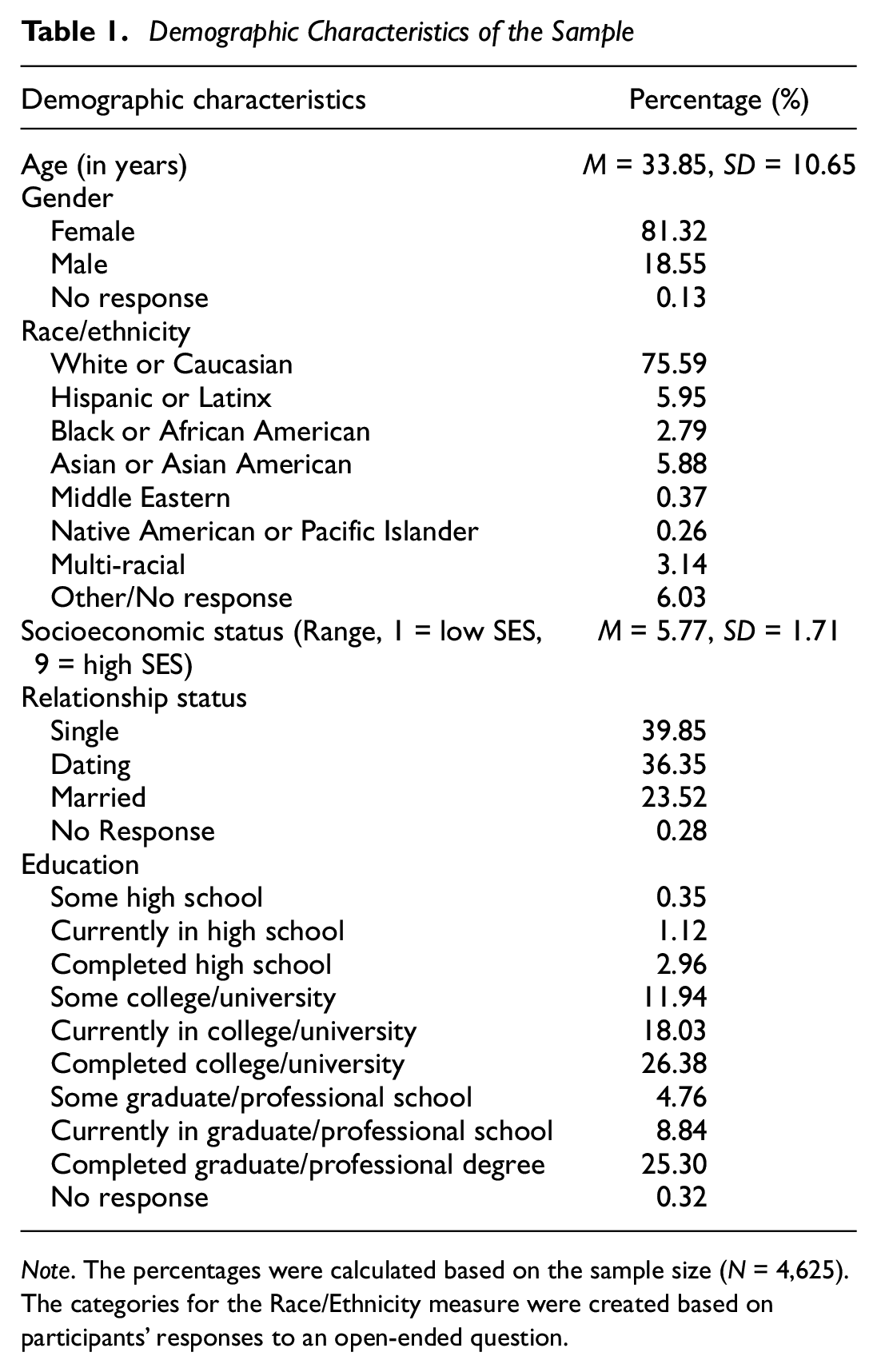
Note. The percentages were calculated based on the sample size (N = 4,625). The categories for the Race/Ethnicity measure were created based on participants’ responses to an open-ended question.
Procedure
The data used in this research came from a broader study on attachment, personality traits, and life experiences. People interested in learning about their attachment orientations or personality traits could access the survey by doing a web-based search using attachment and personality-related keywords (e.g., personality tests, attachment quizzes) or by referral from a friend, teacher, counselor, or others. Before completing the survey, they created a free account using an email address and indicated that they were 18 years old or older. After validating their email address by receiving an automated email from the survey website, they were able to complete the survey on their attachment styles, personality traits, and life experiences. Upon completion of the survey, they were also provided with text-based and graphical feedback about their attachment orientations and personality characteristics. Although participants had the opportunity to participate longitudinally, we only used data that people completed in the first wave at which they completed the WHOTO (see below).
The original dataset was divided into an exploratory sample (N = 300) and a confirmatory sample (N = 4,625). 2 The exploratory sample was used by the first author to develop the measurement system and to build the analytic code. The first author, who performed the analyses for this study, did not have access to the confirmatory dataset until the pre-registration was complete. The preregistered materials including the method, analysis plan, and analysis code are available on the Open Science Framework at: https://osf.io/ydm9t. We excluded cases in which a participant (a) reported a relationship length greater than their age, (b) reported being less than 18 or greater than 65 years of age, or (c) failed the attention check items. We did not impose any additional exclusion criteria on the dataset in the present research.
Measures
People Used for Attachment-Related Functions
To calculate the number of targets used for attachment-related functions for each person, we used the WHOTO measure (Fraley & Davis, 1997). In this version of the measure, people were asked six questions about attachment-related functions (e.g., “Who is the person you most like to spend time with?”; “Who is the person you want to be with when you are feeling upset or down?”). They nominated one target (i.e., mother, father, partner, friend, sibling, other) for each question (see Table 2). If a target was selected for one or more questions, we recoded that target as 1, and if the target was not selected for any of those six questions, we recoded it as 0. To calculate a score for each person representing the number of people used for attachment-related functions, we added the numbers we assigned to the targets (the recoded numbers). For instance, if someone selected partner for three attachment-related functions, mother for two, and father for one question, we recoded partner, mother, and father as 1, and other targets including friend, sibling, and other as 0. The total score for that person was the sum of those numbers, which means that the person used three targets (i.e., partner, mother, and father) to meet attachment-related needs. Thus, higher scores for this composite indicated using more people for attachment-related functions (see Table 3). Scores ranged from 1 to 6 (M = 2.37, SD = 0.88).
Participants’ Distribution Based on WHOTO Questions
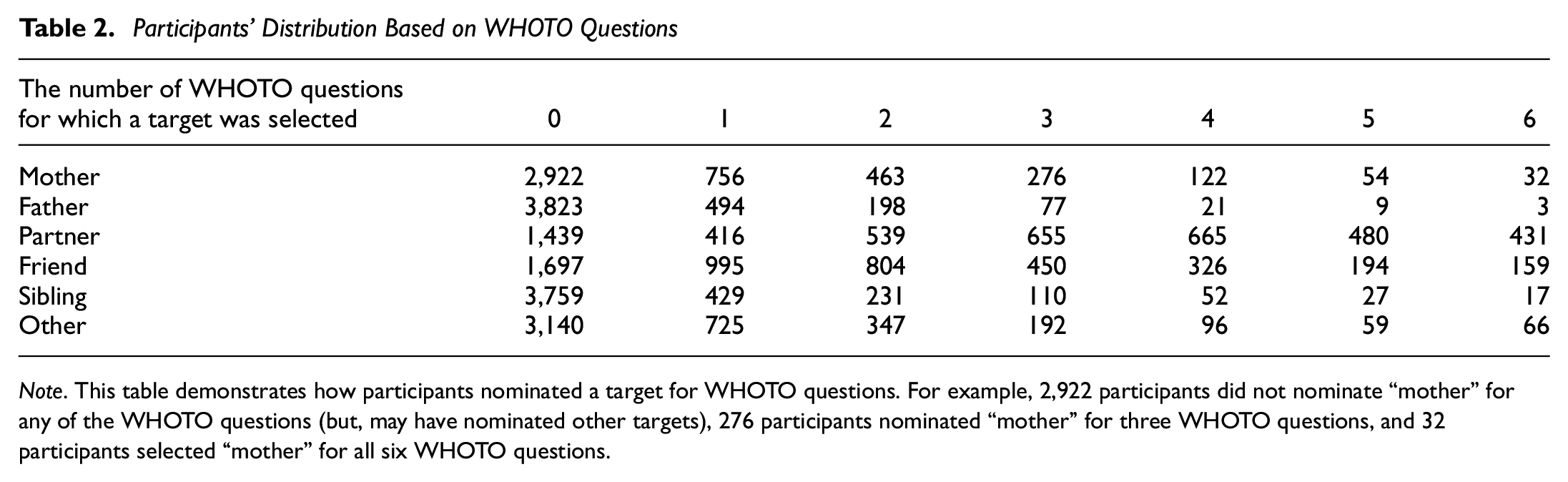
Note. This table demonstrates how participants nominated a target for WHOTO questions. For example, 2,922 participants did not nominate “mother” for any of the WHOTO questions (but, may have nominated other targets), 276 participants nominated “mother” for three WHOTO questions, and 32 participants selected “mother” for all six WHOTO questions.
Participants’ Distribution Based on the Number of Nominated Targets
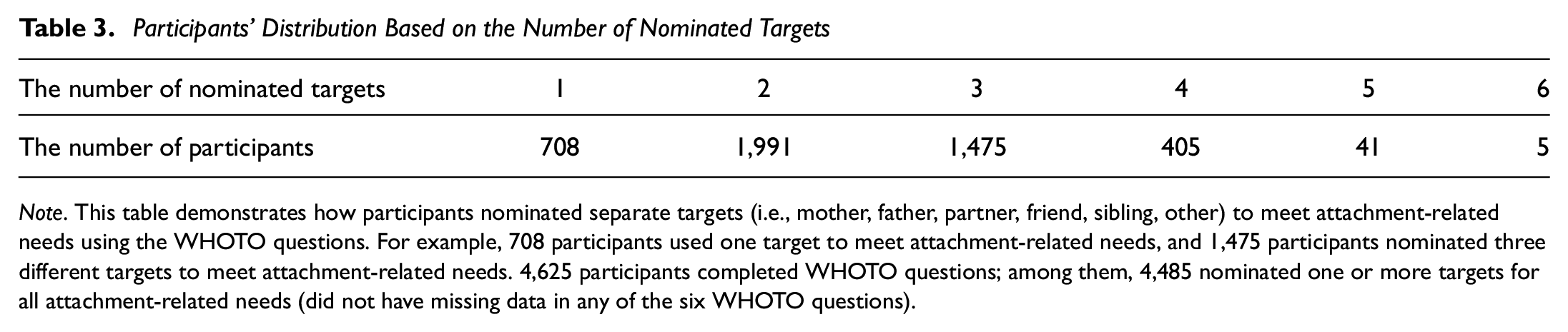
Note. This table demonstrates how participants nominated separate targets (i.e., mother, father, partner, friend, sibling, other) to meet attachment-related needs using the WHOTO questions. For example, 708 participants used one target to meet attachment-related needs, and 1,475 participants nominated three different targets to meet attachment-related needs. 4,625 participants completed WHOTO questions; among them, 4,485 nominated one or more targets for all attachment-related needs (did not have missing data in any of the six WHOTO questions).
Subjective Well-Being
We used the five-item Satisfaction with Life Scale (SWLS; Diener et al., 1985) to assess people’s subjective well-being. Participants responded to each item (e.g., “In most ways my life is close to my ideal”; “The conditions of my life are excellent”) on a scale from 1 (strongly disagree) to 5 (strongly agree). We averaged items to create each participant’s overall score on subjective well-being. Responses ranged from 1 to 5 with a higher score indicating higher subjective well-being (M = 2.88, SD = 0.88).
Attachment Orientations
To assess attachment orientations, we used the Experiences in Close Relationships-Relationship Structures (ECR-RS; Fraley et al., 2011) questionnaire. This measure included three items assessing attachment anxiety (e.g., “I’m afraid that this person may abandon me”), and six items assessing attachment avoidance (e.g., “I prefer not to show this person how I feel deep down”). Participants completed the measure separately for each attachment target (i.e., mother, father, romantic partner, and best friend) on a scale from 1 (strongly disagree) to 5 (strongly agree). We computed two kinds of attachment scores for each person. First, we calculated an anxiety and avoidance score for each of the following targets: mother, father, partner, and friend. Second, we created a “general” measure of anxiety and avoidance by averaging across these domains. However, we only did so if the target in question had been nominated as an attachment target in the WHOTO measure. For instance, if a person selected partner and mother in the WHOTO measure (as the only targets used for attachment-related functions), we calculated general avoidance and anxiety scores based on the partner and mother ratings (but not including the father and friend ratings). We used this method because we wanted a broad measure of how insecure the person was in their relationships with the people they nominated specifically as serving attachment-related functions. The average of attachment avoidance scores ranged from 1 to 5, with higher scores demonstrating higher avoidance toward attachment targets (M = 1.99, SD = 0.64). The average of attachment anxiety scores ranged from 1 to 5 with higher scores indicating higher anxiety toward attachment targets (M = 2.25, SD = 0.97).
Results
Primary Analyses
All data analyses were conducted in RStudio 2023.12.0+369. The main question focused on the association between using people for attachment-related needs and subjective well-being. To examine this association, we regressed subjective well-being on the number of people reported as serving attachment functions. The regression coefficient was not statistically significant (b = .02, SE = .01, β = .02, 95% CI [−0.01, 0.05], p = .242). 3 Therefore, using multiple people for attachment-related needs was not related to higher (or lower) subjective well-being (see Figure 1).
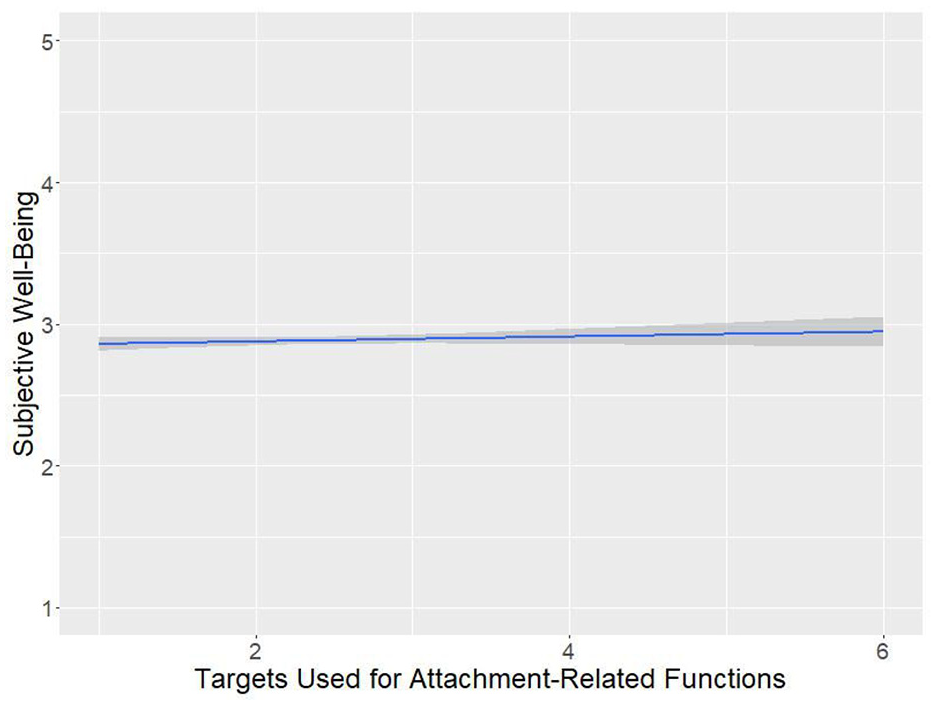
The Association Between Using Targets for Attachment-Related Functions and Subjective Well-Being
Exploratory Analyses
The association between the number of targets nominated for attachment-related functions and subjective well-being may also be related to the quality of the attachment with such targets. Accordingly, we examined the association between having multiple targets for attachment-related needs and the overall security of those attachments. To do so, we regressed the number of people who were nominated for attachment-related functions on peoples’ average avoidance and average anxiety toward nominated targets using a negative binomial model. People were more likely to use multiple people for attachment-related needs if their relationships with those people were higher in attachment avoidance and lower in attachment anxiety (see Table 4, Figures 2 and 3). Therefore, using multiple targets for attachment-related needs was associated with more avoidance and less anxiety in such relationships.
The Number of Targets Nominated as Attachment Figures as a Function of the Average Attachment Avoidance and Anxiety Toward Those Targets

Note. b = regression coefficient; SE = Standard Error; β = standardized regression coefficient; df = Degrees of freedom; 95% CI = 95% confidence interval.
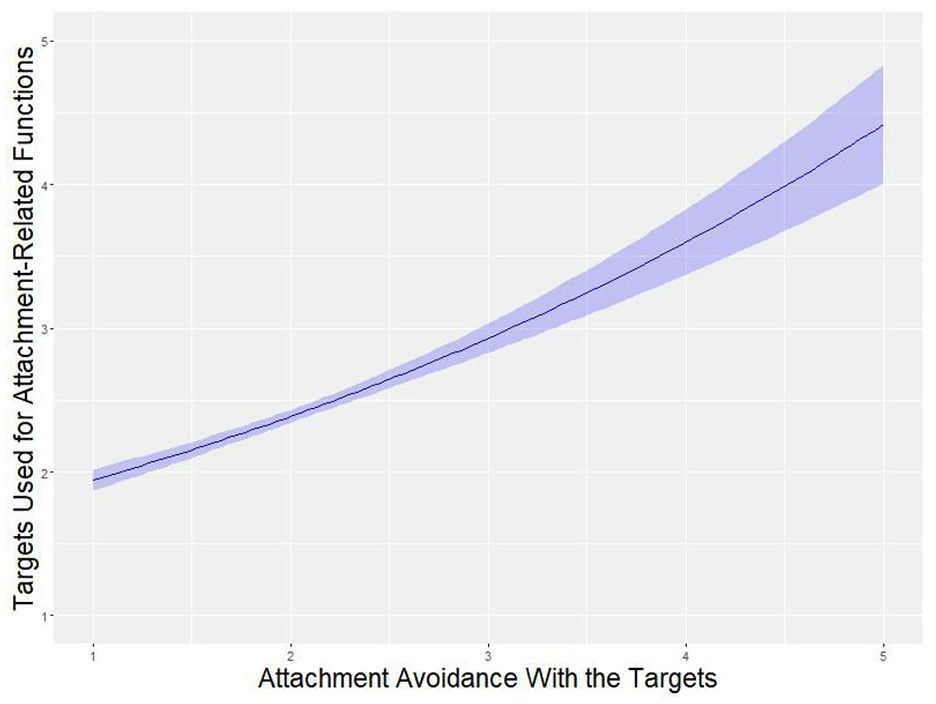
The Association Between Having Multiple Targets for Attachment-Related Functions and Attachment Avoidance
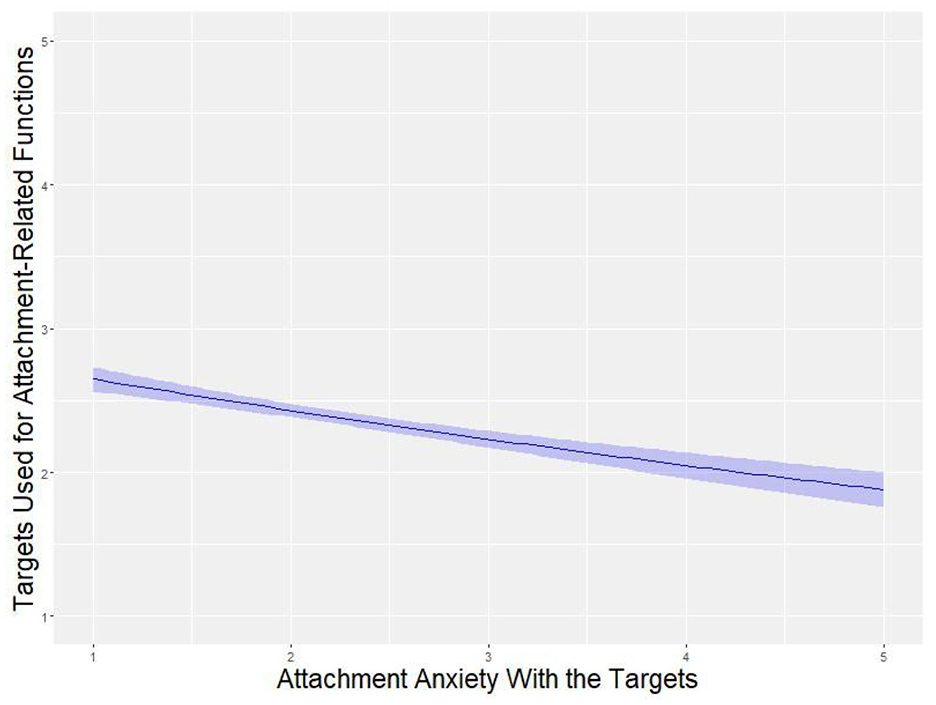
The Association Between Having Multiple Targets for Attachment-Related Functions and Attachment Anxiety
As exploratory analyses, we also examined whether attachment styles moderated the association between using multiple targets for attachment-related functions and subjective well-being. To address this question, we first examined the Nominated Targets × Attachment Avoidance interaction predicting subjective well-being. The interaction was not significant (see Table 5), suggesting that attachment avoidance did not moderate the association between having multiple targets for attachment-related needs and subjective well-being.
Subjective Well-Being as a Function of the Number of Targets People Nominated for Attachment Functions and Their Average Avoidance Toward Those Targets
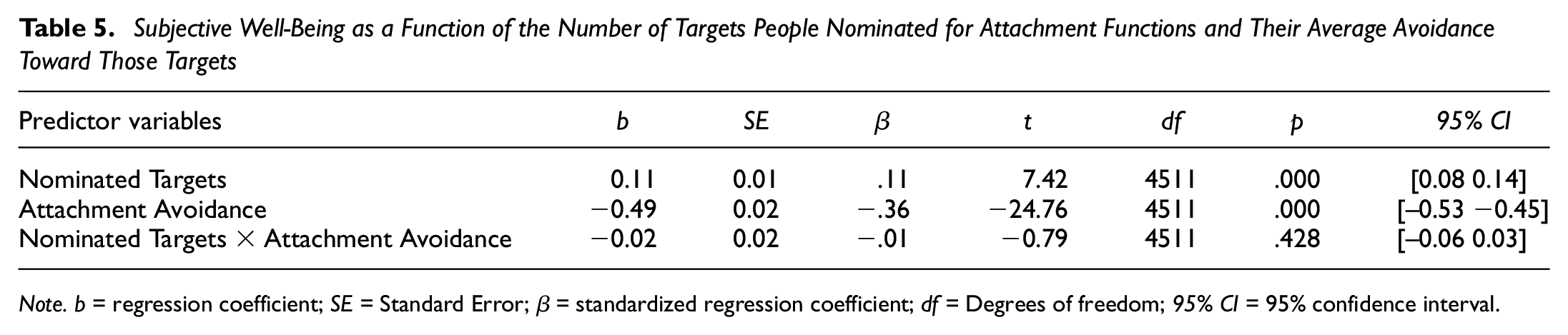
Note. b = regression coefficient; SE = Standard Error; β = standardized regression coefficient; df = Degrees of freedom; 95% CI = 95% confidence interval.
We then assessed whether attachment anxiety moderated the association between using multiple targets for attachment-related needs and subjective well-being. The interaction between nominated targets and attachment anxiety was statistically significant (see Table 6). Simple slopes tests indicated that, for people low in attachment anxiety (1 SD below the mean), the association between the number of targets they nominated and subjective well-being was positive (b = 0.07, SE = 0.02, β = .07, t[4511] = 3.56, 95% CI [0.03, 0.11], p < .001). However, for people high in attachment anxiety (1 SD above the mean), this association was negative (b = −0.12, SE = 0.02, β = −.12, t[4511] = −5.72, 95% CI [−0.16, −0.08], p < .001; see Figure 4). In short, using multiple people for attachment-related functions appeared to be beneficial for people who were lower in anxiety (i.e., more secure) across those relationships, but detrimental for people who were higher in anxiety.
Subjective Well-Being as a Function of the Number of Targets People Nominated for Attachment Functions and Their Average Anxiety Toward Those Targets

Note. b = regression coefficient; SE = Standard Error; β = standardized regression coefficient; df = Degrees of freedom; 95% CI = 95% confidence interval.
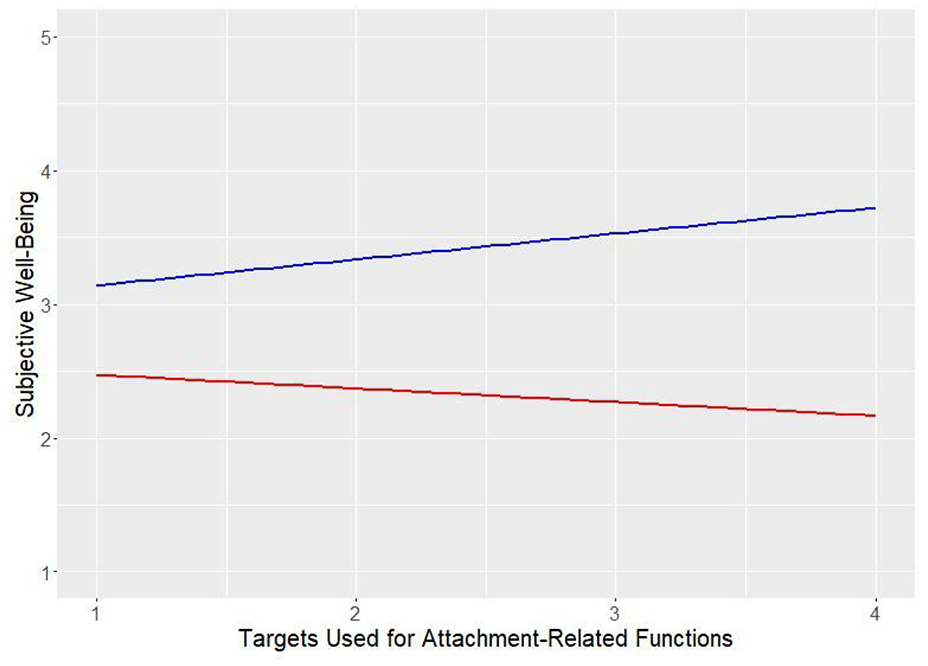
The Influence of Using Multiple Targets for Attachment-Related Needs on Subjective Well-Being at Different Levels of Attachment Anxiety
Discussion
The primary purpose of this research was to examine the association between the number of targets people use for attachment-related functions and subjective well-being. According to one conceptual perspective, having more attachment targets may provide additional sources of security and support and, as a result, lead to higher levels of subjective well-being. An alternative perspective is that people may seek additional attachment targets because their existing relationships do not reliably fulfill their attachment needs. According to this perspective, people who have multiple attachment targets may have lower well-being than those who have fewer. Our results, however, did not support either of these perspectives: Having multiple targets for attachment-related needs was unrelated to subjective well-being.
However, secondary analyses suggested that the lack of an association between the number of targets nominated for attachment-related needs and subjective well-being may be due to diverging ways in which attachment orientations relate to the use of attachment objects. Specifically, we found that people who reported using multiple targets for attachment functions had higher well-being if they reported low levels of attachment anxiety with those targets. In contrast, people who reported using multiple targets for attachment functions reported lower well-being if those relationships were characterized by attachment anxiety. Avoidance, in contrast, did not moderate the relationship between the number of attachment targets people had and their subjective well-being. Taken together, these findings suggest that, although there is not a simple association between the number of targets people use for attachment functions and well-being, people who seek attachment needs from multiple people with whom they have anxious/insecure relationships tend to have lower well-being than those who have less anxious relationships with the people they use for attachment functions.
Implications for Theory and Research
Previous research has examined how close others can fulfill attachment needs (Fraley & Davis, 1997; Hazan & Zeifman, 1994; Kobak et al., 2007). People may use different targets to meet specific types of attachment needs at different stages of their lives. For instance, adolescents and young adults use peers, such as friends and romantic partners, for proximity-seeking and safe haven purposes, and parents for secure base needs (Fraley & Davis, 1997; Mayseless, 2004). Therefore, developing attachment networks may have implications for supporting attachment needs. Having multiple support figures has also been associated with positive physical and mental health outcomes such as increased happiness, reduced depression, and decreased suicidal ideation (Chan & Lee, 2006; Tian, 2023).
Our research, however, suggests that there is not a straightforward relationship between the number of figures people use for attachment-related needs and subjective well-being: People who had multiple targets they used for attachment functions were just as satisfied with their lives as people who had fewer. However, we did find that the security of those relationships moderated the association between the number of people used for attachment functions and well-being. Specifically, people who tended to be anxious in their relationships with their attachment targets reported lower levels of subjective well-being if they also reported relying on multiple targets for attachment functions. In contrast, people who were more secure (i.e., lower in anxiety) reported higher levels of well-being if they also reported relying on multiple targets for attachment functions.
These findings raise the possibility that when people feel insecure in their relationships, they may seek to compensate for those deficits by seeking others for attachment-related functions. There are a few ways this could be addressed in future research. For example, one could identify subsamples of people who, at one point in time, have relatively insecure relationships with an attachment object and then study the ways in which attachment-related functions are directed toward other targets over time. It is possible that, for some people, such a process may prove beneficial, especially if those efforts allow one to develop a secure bond with another target. Indeed, based on basic theoretical principles, we might even expect that a person’s overall security may be boosted in the process if that “search” does lead to a target who can satisfy attachment-related needs effectively. But, if this happens, it, of course, raises questions about what happens to existing attachment targets. Does the development of a new relationship lead to a revision or reorganization of other bonds? It may be possible that if the new bond was forged as part of a compensatory process, people may eventually “let go” of other figures and more fully invest in the newer relationship.
This reasoning, however, also implies that “attachment” is a limited resource, such that investing in one attachment figure requires that one invest less in another. Although time is a limited resource (i.e., one cannot be seeking proximity to two or more people who are separated in space at the same time), affectionate bonds may not be (see Gillath et al., 2016). One of the important questions for future research is to learn more about the fate of previous (insecure) attachments when new bonds are formed.
Furthermore, although our approach provides a broadband way to study the questions at hand, there are ways to probe such questions deeper. For example, whether there is an association between specific kinds of targets nominated (parents, peers) and subjective well-being or whether such an association differs at different ages. These conceptual questions can also be addressed within this broader framework in future research.
Strengths and Limitations
One of the strengths of this research is that we used a large sample (N = 4,625) to address our research questions. The sample was also diverse in many respects, including people of different races/ethnicities, education levels, socioeconomic statuses, and relationship statuses. Using a large sample with differing characteristics increases statistical power and reduces the risk of Type II errors (Cohen, 1962; LeBel et al., 2017; Marszalek et al., 2011).
Despite these strengths, this study also had some limitations. Most importantly, we did not have more than six options in our WHOTO questions (i.e., mother, father, partner, friend, sibling, other), nor did we provide people with a way to nominate more than one person per question. Therefore, we could not distinguish whether people targeted one specific person or different ones when nominating friends, siblings, or others for WHOTO questions. It was possible that, for example, a participant wanted to nominate “brother” for one WHOTO question and “sister” for the other, but they had to select “sibling” for both questions. Similarly, they may have wanted to nominate more than one target for each question. Therefore, our WHOTO measure did not capture the precise number of attachment figures people had; it is not a measure of social network size per se. Future research on these issues may benefit by both allowing for a broader range (perhaps using free-response options) of nominations for each function and by allowing people to nominate more than one target for each function. Our intuition is that doing so will provide more precision in assessing some of the nuances in the way people organize their attachments, but that quantitative measures extracted from such a method would likely correlate strongly with the method we used here.
A second limitation is that we did not collect data on the quality of the attachment bonds participants may have had with targets other than parents, partners, and friends. As such, we could not examine the security of the relationships people had with others serving attachment-related functions, such as siblings, teachers, or grandparents. Furthermore, the current research was correlational and, as such, does not allow causal conclusions to be drawn. Thus, we do not know whether having multiple targets for attachment functions is negatively related to well-being among anxious people because using multiple targets for attachment functions causes decrements in well-being. There may be alternative causal models that could explain this association. For example, it is possible that people who are lower in well-being find themselves unable or unwilling to invest in their social relationships, creating a situation in which it is difficult to develop a secure bond with close others. Finally, the majority of our sample was from North America which may restrict the generalizability of findings to other cultures and geographical locations. For example, in societies with limited economic resources (which impose more workload on mothers and restrict their time assigned to kids), children may develop attachment with multiple caregivers, which may increase their sense of security, support, and well-being (Keller, 2016). Future research can examine this association in other societies with different household compositions and living arrangements.
Conclusion
Attachment relationships constitute a major category of one’s close relationships that support a variety of interpersonal functions. People choose different strategies for creating and developing their attachment relationships. Some may prefer to expand their attachment networks and use multiple targets to meet attachment needs. Others may prefer to limit their networks and invest in a few primary attachment figures. The present research demonstrates that the number of figures a person uses for attachment-related needs is largely unrelated to psychological well-being. However, it also shows that the quality of those attachments may matter: Having more anxious attachments was associated with lower well-being, whereas having more secure attachments was associated with higher well-being. Taken together, this work raises the possibility that having a larger network of secure relationships may be beneficial for psychological functioning.
Supplemental Material
sj-docx-1-spp-10.1177_19485506251323640 – Supplemental material for The Association Between Using People for Attachment-Related Functions and Subjective Well-Being
Supplemental material, sj-docx-1-spp-10.1177_19485506251323640 for The Association Between Using People for Attachment-Related Functions and Subjective Well-Being by Meisam Vahedi, Kristina L. Howell, Omri Gillath, Pascal R. Deboeck and R. Chris Fraley in Social Psychological and Personality Science
Footnotes
Handling Editor: Yuthika Girme
Declaration of Conflicting Interests
The author(s) declared no potential conflicts of interest with respect to the research, authorship, and/or publication of this article.
Funding
The author(s) disclosed receipt of the following financial support for the research, authorship, and/or publication of this article: This research was supported by the National Science Foundation (NSF BCS-1423874).

Supplemental Material
The supplemental material is available in the online version of the article.
Notes
Author Biographies
References
Supplementary Material
Please find the following supplemental material available below.
For Open Access articles published under a Creative Commons License, all supplemental material carries the same license as the article it is associated with.
For non-Open Access articles published, all supplemental material carries a non-exclusive license, and permission requests for re-use of supplemental material or any part of supplemental material shall be sent directly to the copyright owner as specified in the copyright notice associated with the article.
