







Abstract
Does it matter whether people believe in free will? Over recent decades, this question has sparked a debate across philosophy, sociology, psychology, and cognitive neuroscience. Previous research has largely overlooked how this belief relates to people’s everyday affect. To address this gap, we conducted two experience-sampling studies with participants from five European countries to examine the association between belief in free will and individuals’ daily affect (Ntotal = 1,381; ktotal = 12,856), and one experimental study (N = 1,053). In Studies 1 and 2, stronger belief in free will was positively associated with positive affect across the day. Importantly, all effects remained after controlling for constructs related to the belief and everyday affect. Study 3 showed that exposing participants to pro- (vs. anti-) free will viewpoints increased positive affect. Our findings highlight the unique role of belief in free will in shaping daily positive affect and its wider social implications.
Does belief in free will matter? Some scholars (e.g., Smilansky, 2000, 2001) argue that believing in free will is crucial for society and human behavior because it promotes social order and moral actions, while others (e.g., Caruso, 2014; Greene & Cohen, 2004; Nadelhoffer, 2010; Pereboom, 2006) contend that this belief can have adverse consequences. To contribute to this ongoing debate, our research examines whether, and to what extent, people’s belief in free will relates to their positive affective experiences in everyday life, which are known to play a key role in people’s success, health, and sense of meaning in life (Fredrickson & Joiner, 2002; King et al., 2006; Lyubomirsky et al., 2005; van Steenbergen et al., 2021).
Belief in Free Will
Philosophical concepts of free will have grown increasingly diverse and complex (Carey & Paulhus, 2013). Thus, researchers studying whether it matters if people believe in free will have mainly focused on laypeople’s understanding of free will. Such analyses revealed that laypeople’s belief in free will centers on the perception that individuals possess a fundamental capacity to make choices freely and therefore hold responsibility for their behaviors and decisions (Carey & Paulhus, 2013; Feldman, 2017; Genschow et al., 2023; Paulhus & Carey, 2011). Previous research has shown that this belief is distinct from other widely used constructs, including self-efficacy, implicit beliefs, self-control, locus of control, self-esteem, and autonomy (Davidov & Eisikovits, 2015; Feldman, 2017; Monroe et al., 2014). Whereas these constructs capture more specific abilities or characteristics that can vary across individuals and situations, belief in free will reflects a broader conviction that one possesses free choice.
In contrast to belief in free will, belief in determinism asserts that all events are fixed by prior causes and natural laws, leaving no room for alternative possibilities (e.g., Van Inwagen, 1983). Notably, many laypeople endorse compatibilistic views, believing in free will alongside determinism (Nadelhoffer et al., 2014). A related construct, belief in dualism—the idea that mind and body are separable—which, although conceptually distinct, is positively associated with free will beliefs, likely due to shared religious underpinnings (Wisniewski et al., 2019).
Understanding the concept of laypeople’s belief in free will prompts the crucial question about its relevance to everyday life. Previous research has shown that people’s belief in free will is associated with various social behaviors and attitudes (for a review, see St Quinton et al., 2023), such as perceiving behaviors as intentionally driven (Genschow et al., 2017, 2019; Genschow & Lange, 2022; for a review, see Genschow & Brass, 2022), making harsher punitive decisions (Clark et al., 2014; Genschow et al., 2017; Martin et al., 2017), engaging in victim blaming (Genschow & Vehlow, 2021), and exhibiting increased prosocial behavior when their actions are perceived as resulting from intentional choice (Genschow et al., 2023). 1 Despite these seminal findings, the literature on the debate has largely overlooked the question: Does believing in free will make people happier in their daily lives? This is rather surprising, as experiencing positive affect is an important factor that influences outcomes such as relationship quality (Waugh & Fredrickson, 2006), success (Lyubomirsky et al., 2005), purpose in life (King et al., 2006), and health (Cohn et al., 2009; Cohen & Pressman, 2006; Fredrickson & Joiner, 2002; Steptoe et al., 2008; van Steenbergen et al., 2021).
Affect, Well-Being, and Life Satisfaction
Positive affect is the experience of positive feelings like joy and happiness, while subjective well-being is a broader construct that includes both positive affect (feeling happy often) and life satisfaction (Diener, 1984; Diener et al., 1999). As a holistic evaluation of one’s life, well-being is strongly shaped by perceived autonomy (Deci & Ryan, 1985). Because free choice is central to belief in free will (e.g., Carey & Paulhus, 2013; Feldman, 2017; Genschow et al., 2023; Paulhus & Carey, 2011), it is reasonable to expect a positive association between free will beliefs and subjective well-being. Empirical research has largely focused on global indicators such as well-being and life satisfaction, consistently finding positive associations with belief in free will (Bergner & Ramon, 2013; Crescioni et al., 2016; Kondratowicz-Nowak & Zawadzka, 2018; Li et al., 2017; Spronken et al., 2019; Zhao & Huo, 2022). Based on these findings, it is tempting to propose that life satisfaction (as part of the construct of well-being) is the main driver of the relationship between belief in free will and well-being. However, this claim can only be made when life satisfaction is assessed separately from daily affect—an approach that has been neglected in previous research.
In this article, we propose that belief in free will is related to daily affective experiences because it shapes how individuals perceive their own agency. Free will has been conceptualized as an evolved functional system that enables people to detect dissatisfaction, reflect on their circumstances, and intentionally regulate their actions in pursuit of personally meaningful goals (Sheldon, 2024). Importantly, the belief that one can freely choose actions aligned with one’s own interests may itself be inherently rewarding, thereby fostering positive affect (Langer & Rodin, 1976). This sense of agency is closely tied to meta-cognitive representations of the self. Because perceived free will is linked to the symbolic self that guides alignment with one’s ideal self-concept (Sedikides & Skowronski, 1997), believing in one’s capacity for free choice may promote a sense of authenticity and ease in everyday life. Consistent with this view, prior research shows that belief in free will is associated with perceiving both one’s own (Genschow & Lange, 2022) and others’ behavior (Genschow & Brass, 2022; Genschow et al., 2017, 2019) as intentionally driven—an attribution style that is itself linked to positive affect (Forgas, 1998). Beyond individual perception, belief in free will may also facilitate social functioning. It enables individuals to coordinate effectively with others and to present themselves as reliable and respectable agents within their communities (Gillett, 2015). Moreover, believing that one can justifiably take credit for one’s good actions (Cruz & Mata, 2025) and hold others accountable for their bad actions (Clark et al., 2021) may further enhance positive emotional experiences in daily life. Taken together, these considerations suggest that stronger belief in free will should be positively associated with daily positive affect. In the present research, we tested this prediction in two experience-sampling and one experimental study.
Transparency and Openness
The main hypotheses and analysis plan of our studies were preregistered. In both experience-sampling studies (Studies 1 and 2), the data were already collected at the time of preregistration. In Study 1, to ensure transparency, responsibilities were split: some authors retained access to the dataset while others handled the preregistration and conducted the preregistered analyses; the dataset was only shared with the analysis team after preregistration. Similarly, in Study 2, the data existed prior to preregistration but were only provided to the research team after the preregistration had been completed. The preregistrations, the data sets, analysis scripts of all studies, as well as codebooks from the respective studies covering all relevant variables are publicly available on OSF (https://osf.io/p5agv).
Study 1
Methods
Participants
This research was part of a broader study on social comparison processes in everyday life (Diel et al., 2021), which included measures relevant to the current research question. The initial sample comprised 453 German participants, with 429 participants completing both the mobile and an intake questionnaire (Mage = 29.32, SD = 8.81, range = 18 to 66 years; Nfemale = 296, Nmale = 130, three participants did not indicate their gender). We only included those 429 who completed both the belief in free will measure (intake questionnaire) and responded to at least one signal during the mobile phase. No other participants were excluded from the study. We aimed to make the sample as diverse as possible within Germany in terms of age, occupation, and gender. Recruitment was conducted through panels, research databases, social media platforms, and flyers at the University of Cologne. To enhance statistical power, the initial study aimed to recruit at least 400 participants. A sensitivity analysis by Arend and Schäfer (2019) indicated that with NLevel1 = 12, NLevel2 = 429, we could detect effects of β≥ 0.09 with 80% power (α = 0.05, ICC = 0.30). Participants received €5 for the intake survey and €15 for completing at least 70% of daily signals. In addition, three €100 raffles were held, with each completed survey acting as a lottery ticket.
Materials and Procedure
Participants completed a three-stage study procedure: a screening questionnaire (assessing eligibility and providing study information, including duration, compensation, and requirements: ≥18 years, residence in Germany, Android smartphone), an intake questionnaire with dispositional measures using Qualtrics, and a six-day mobile phase (MovisensXS app; Movisens GmbH, 2016, Karlsruhe, Germany). Eligible participants completed the 15 min intake questionnaire, followed by the mobile phase starting the next day, during which they received five daily signals at random times between 10 a.m. and 10 p.m.
Intake Questionnaire
The intake questionnaire included dispositional measures and demographic data, including gender, age, and socioeconomic status (see OSF for a comprehensive list of materials). In the context of the present research, we assessed belief in free will using the German translation (Genschow et al., 2019) of the Free Will Inventory (FWI; Nadelhoffer et al., 2014), which comprises 15 items designed to gauge the intensity of belief in free will and associated concepts such as beliefs in dualism/nonreductionism and determinism. Sample items are “People always have free will” (free will), “Human action can only be understood in terms of our souls and minds and not just in terms of our brains” (dualism), and “People’s choices and actions must happen precisely the way they do because of the laws of nature and the way things were in the distant past” (determinism). These items were rated on a seven-point scale (1 = do not agree at all, 4 = neither, 7 = fully agree, α free will = 0.76, α dualism = 0.79, α determinism = 0.75). We also assessed trait self-control with the 13-item German short version of the Self-Control Scale (SCS-K; e.g., “I am good at resisting temptation,” 1 = does not apply at all, 7 = applies fully, α = 0.82; Bertrams & Dickhäuser, 2009; Tangney et al., 2004), moral identity with 10 items (symbolization, α = 0.75, internalization, α = 0.76; e.g., “Being someone who has these characteristics is an important part of who I am,” 1 = do not agree at all, 7= fully agree; Aquino & Reed, 2002), religious beliefs with three items (e.g., “My religious beliefs form the basis of my approach to life,” 1 = not at all, 4 = very much, α = 0.96; Koenig & Büssing, 2010), political orientation with one item (“In politics, people often talk about “left” and “right.” Where would you place yourself on this scale?,” 1 = left, 11 = right), and life satisfaction with five items (e.g., “I am satisfied with my life,” 1 = not at all, 7 = very much, α = 0.87; Diener et al., 1985; Glaesmer et al., 2011), as well as gender, age, education, and occupation.
Mobile Phase
With each mobile signal, participants were initially asked about their current affective state (“How are you feeling right now?,” 0 = good, 1 = bad). Subsequent questions assessed variables unrelated to the present article.
Analytic Procedure and Strategy
In our study, observations of reported affect (Level 1) were nested within individual participants (Level 2). With our binary outcome variable categorizing affect as either “bad” or “good,” we conducted multilevel logistic regression analyses using the lme4 package in R (Bates et al., 2014), specifying random-intercept models with participants as a random effect and belief in free will as a fixed effect. Although we had preregistered a multiple regression, this approach was inappropriate due to the nested structure of the data; therefore, we corrected our analysis plan to use multilevel modeling, which properly accounts for the dependency of observations within participants. Subsequent analyses and visualizations were conducted with the following R packages: dplyr: version 1.1.2 (Wickham, François, et al., 2023), lme4: version 1.1-27.1 (Bates et al., 2014), jtools: version 2.2.2 (Long, 2023), haven: version 2.4.3 (Wickham, Miller, et al., 2023), psych: version 2.4.1 (Revelle, 2024), sjPlot: version 2.8.15 (Lüdecke et al., 2023), ggplot2: version 3.4.4 (Wickham, Chang, et al., 2023), and ggpubr: version 0.6.0 (Kassambara, 2023). As preregistered, we tested four models controlling for specific variables (see the results section). For all models, we report effect sizes using odds ratios to quantify the strength and direction of the relationship between belief in free will and the binary outcome of affect.
Results and Discussion
A total of 9,229 observations were collected from 429 participants who documented their affective states in daily life and their belief in free will in the intake questionnaire. 7,256 states were categorized as “good” and 1,973 as “bad.”
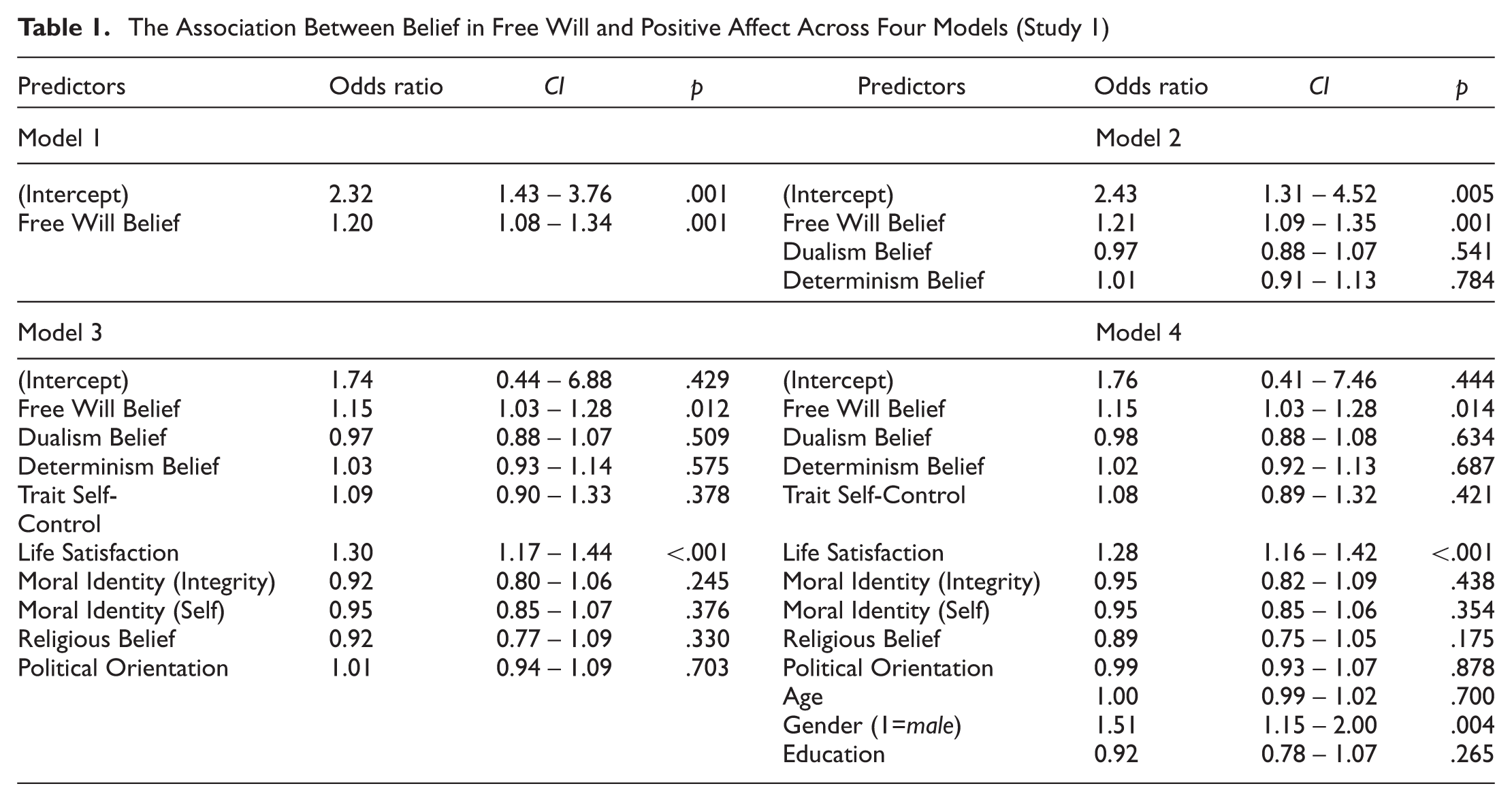
As preregistered, we examined whether belief in free will was significantly associated with affect by employing four models. The initial model tested whether belief in free will as a single predictor is significantly linked to affect. Subsequently, the second model assessed whether belief in free will is associated with affect above and beyond dualism and determinism beliefs. The third model examined the robustness of this effect when incorporating trait self-control, life satisfaction, moral identity, religious beliefs, and political orientation as predictors. In a final model, age, gender, and education were added to further refine the analysis.
In line with our predictions, Model 1 indicated a significant relationship between belief in free will and positive affect (see Figure 1). This association persisted even after incorporating beliefs in dualism and determinism in Model 2, and subsequent additions of trait self-control, life satisfaction, moral identity, religious beliefs, and political orientation in Model 3. Notably, in the comprehensive Model 4, which additionally included age, gender, and education, belief in free will continued to exert a significant influence on affect (see Table 1 for all model outcomes). 2 According to Model 4, the odds ratio for belief in free will is 1.15, indicating that for each one-unit increase in belief in free will, the odds of reporting positive affect in a given situation are 15% higher, holding other variables constant. This finding suggests a positive association between belief in free will and the likelihood of experiencing positive affect. Figure 2 displays the odds ratios for all variables included in Model 4.
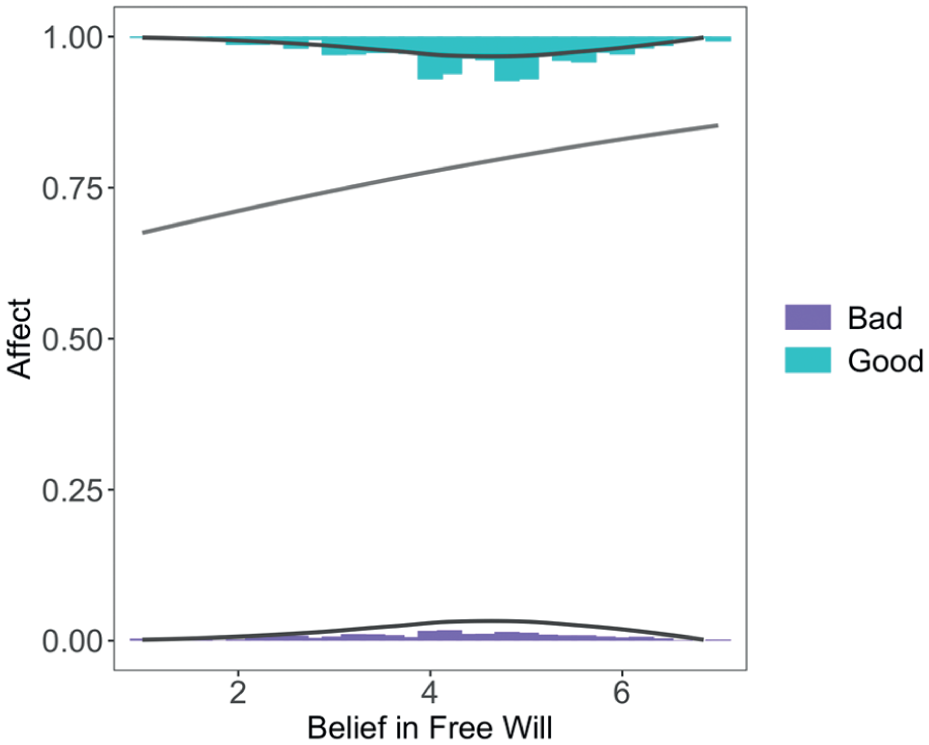
Logistic Regression of the Relationship Between Belief in Free Will and Positive (vs. Negative) Affect
The Association Between Belief in Free Will and Positive Affect Across Four Models (Study 1)
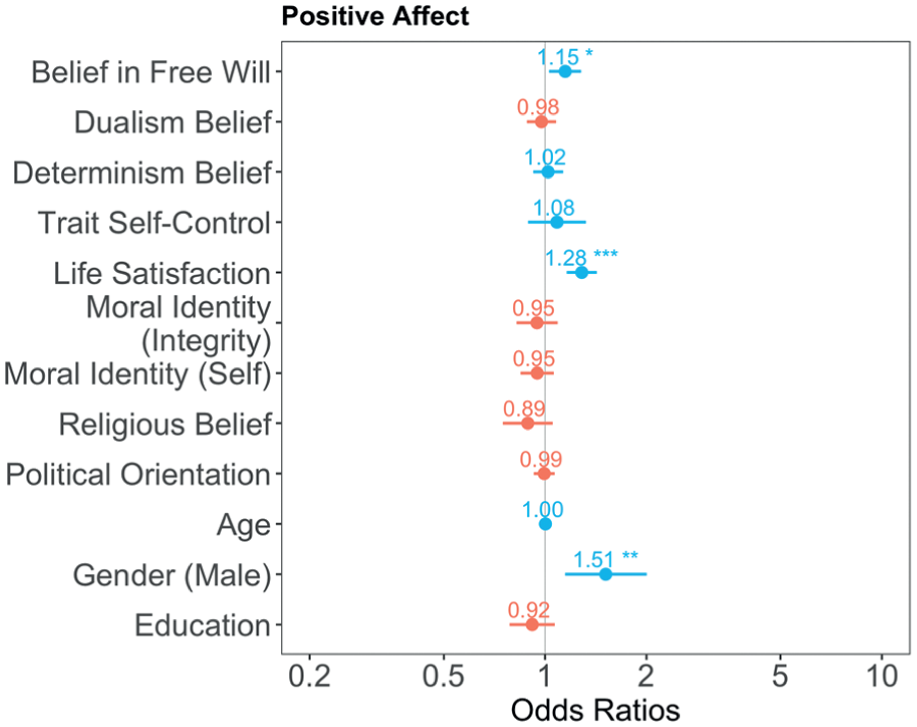
Forest plot of odds ratios for variables in Model 4 predicting affect
In exploratory analyses, we also tested whether the association between belief in free will and positive affect was non-linear. Adding a quadratic term suggested a potential inverted-U-shaped relationship, such that the association weakened at very high levels of belief in free will. Because these analyses were not preregistered, they should be interpreted cautiously (see Online Supplement, Section S4).
Study 1 demonstrated that belief in free will contributed to people’s day-to-day affect above and beyond other variables known to influence it. To test the robustness of this effect, we conducted Study 2.
Study 2
Study 2 aimed to replicate Study 1 in a more diverse sample drawn from five European countries, with all hypotheses preregistered. Mirroring Study 1, we controlled for covariates (age, gender, education, political orientation, and state life satisfaction); however, because this was a preexisting dataset, our choice of covariates was limited. Based on exploratory findings from Study 1, we preregistered an additional test of a non-linear (quadratic) association between belief in free will and positive affect (see Online Supplement, Section S5).
Method
Participants
The study was part of a larger project measuring daily well-being and related measures over a week during the UEFA EURO 2024 football tournament (Petrowsky et al., 2026). The sample consisted of 1,012 participants from five countries (England: 202, Germany: 204, Italy: 201, Netherlands: 204, Poland: 201), with an average age of 33.05 years (SD = 10.41, range: 18–74, 67.1% male, 32.5% female, and 0.4% identified as other). Participants who did not complete any of the daily measures (n = 60) were removed from the dataset. The final sample consisted of 952 individuals, who collectively contributed 3,627 daily measures. An effect-size sensitivity analysis (see Arend & Schäfer, 2019) revealed that detectable effects with NLevel1 = 4 and NLevel2 = 200 were around β = 0.12 (α = 0.05, power = 0.80). Given that our sample included more than 900 participants at Level 2, power was more than sufficient to detect such effects.
Materials and Procedure
Participants completed an intake survey assessing demographics and trait measures relevant to the present study, including age, gender, education, political orientation, and belief in free will (“I believe in free will,” 1 = no belief in free will, 7 = absolute belief in free will). The day after each match played by their national team in the tournament (a maximum of seven matches), participants received a brief daily questionnaire at 12:00 p.m. These surveys assessed daily affect (“Do you feel happy today?”; 1 = not at all, 7 = completely) and state life satisfaction, which was measured once in the intake survey and in the daily surveys with the item “I am satisfied with my life today” (1 = very dissatisfied, 7 = very satisfied). The remaining variables from the daily questionnaires were not relevant to the current article.
Results and Discussion
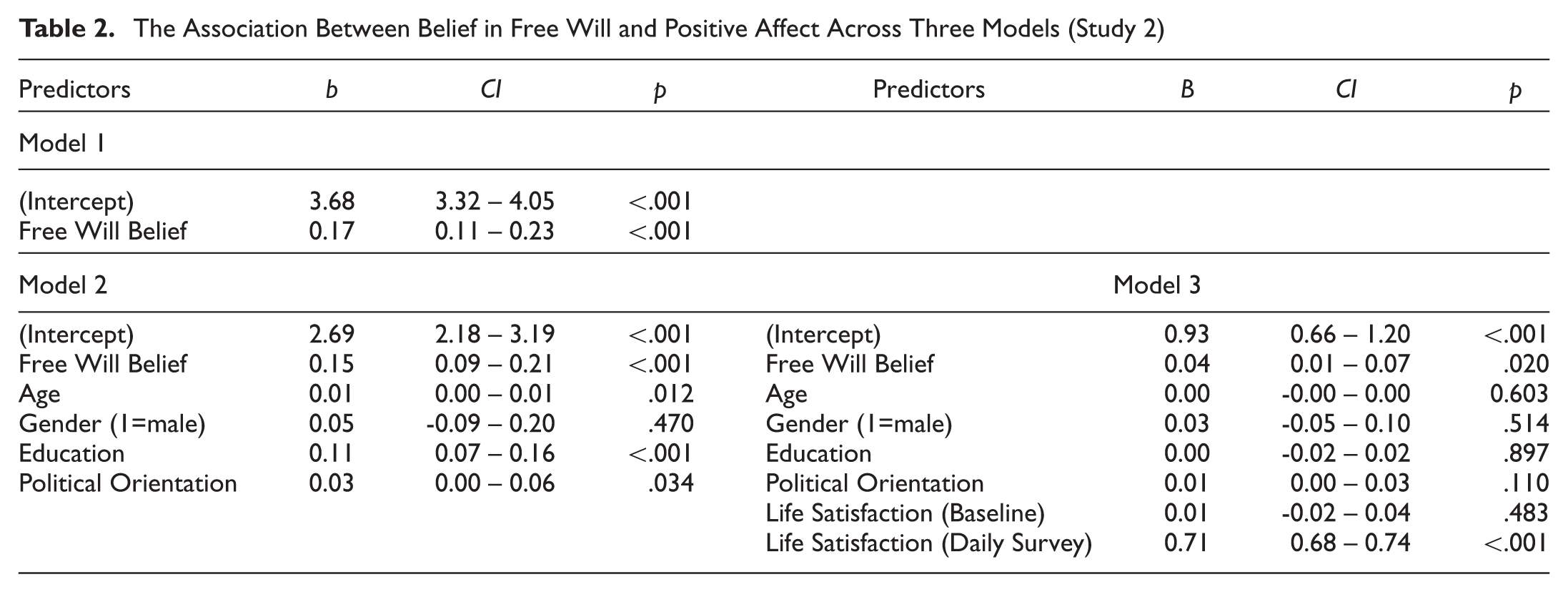
As preregistered, we examined whether belief in free will was significantly associated with daily positive affect by employing three models. We estimated multilevel random-intercept models with belief in free will as a fixed effect, daily affect as the outcome, and participants as a random effect. The initial model tested whether belief in free will as a single predictor was significantly linked to daily positive affect. Subsequently, the second model assessed whether belief in free will was associated with positive affect above and beyond demographic factors, such as age, gender, education, and political orientation. The third model additionally incorporated both the baseline and daily life satisfaction measures.
In line with our predictions, Model 1 indicated a significant predictive relationship between belief in free will and daily positive affect. This association persisted even after incorporating demographic variables in Model 2 and the subsequent addition of state life satisfaction in Model 3 (see Table 2 for all model outcomes).
The Association Between Belief in Free Will and Positive Affect Across Three Models (Study 2)
By contrast, the preregistered quadratic term did not reach significance, providing no evidence for a non-linear relationship in this sample (S5).
In sum, Study 2 successfully replicated the central finding of Study 1: individuals with a stronger belief in free will are more likely to experience positive daily affect even when controlling for demographic variables and life satisfaction.
Study 3
Although Studies 1 and 2 demonstrate that belief in free will is associated with positive daily affect, the causal relationship between these constructs remains unclear. Thus, we conducted a preregistered experiment to examine the causal effect of belief in free will on positive affect. We predicted that participants in the pro-belief in free will condition would show higher positive affect than those in the anti-belief in free will condition.
Method
Participants
We recruited 1,053 English-speaking participants from the Prolific platform (Mage = 46.07 years, SD = 14.21, 54.0% female, 45.4% male, 0.5% preferred to self-describe (e.g., as non-binary), 0.1% preferred not to disclose their gender).
We first conducted a power analysis to assess the number of participants needed to detect the predicted effect. We based our sample size calculation on a recent article (Holzmeister et al., 2025) that detected significant downstream consequences of free will belief manipulations with an effect size of d = 0.138. With α = 0.05% and 90% power, 2,200 participants were needed to detect this effect. We recruited participants following a preregistered sequential Bayesian sampling procedure. We preregistered to continue data collection in increments of 200 unless the Bayes factor (BF10) for the t-tests, computed in JASP using the default Cauchy prior (r = 0.707), exceeded 3 or fell below 1/3. This criterion was met at the first scheduled stop, so we ceased data collection (i.e., N = 1,053).
Materials and Procedure
To manipulate belief in free will, we followed the procedure that has been meta-analytically shown to produce the strongest effects (cf. Genschow et al., 2023)—namely, a combination of reading either a pro- or anti-free will text and engaging with either pro- or anti-free will statements (Katzir & Genschow, 2022; Seto & Hicks, 2016; Vohs & Schooler, 2008). We slightly adapted this paradigm to strengthen the manipulation and enhance ecological validity by asking participants not only to select statements, but also to select those that applied to their everyday life and to describe related personal experiences.
First, participants were randomly assigned to either the pro- or anti-belief in free will (BFW) condition. In the pro (vs. anti) BFW condition, participants first read a short text that supported (vs. challenged) the existence of free will and were instructed to imagine the scenario as if its content were true (“Imagine that the latest scientific findings showed. . .”; see the full text in the Study 3 Materials on OSF). On the next page, participants had to select three out of six statements on free will beliefs that they should imagine applying to their own lives. Example statements included in the pro BFW (and anti BFW) condition were: “I am (un)able to override the genetic and environmental factors that sometimes influence my behavior.” (see Study 3 Materials on OSF for a full list). On the following three pages, participants were shown their selected statements one at a time and asked to describe a personal experience or an example from their everyday life that related to each statement in an open text box. After completing each description, they were immediately asked, “How did you feel after this experience?” (1 = extremely bad, 7 = extremely good) before proceeding to the next statement.
Afterwards, as a manipulation check, we measured participants’ agreement with the statements “Based on the first text you read, free will is an illusion” (reverse-coded) and “Based on the first text you read, humans have free will,” using a seven-point scale (1 = strongly disagree, 7 = strongly agree, α = 0.95). At the end, participants indicated basic demographic variables and were debriefed about the study purpose.
Results and Discussion
As preregistered, participants in the pro (vs. anti) BFW condition perceived the story as expressing a stronger belief in free will (Mpro = 6.49, SD = 0.85 vs. Manti = 2.81, SD = 1.58, t[1051] = 47.91, p < .001, d = 2.96).
In line with our preregistration, we first aggregated all three affect items per participant (α = 0.83). In line with our prediction, participants in the pro BFW condition reported higher positive affect than participants in the anti BFW condition (Mpro = 5.20, SD = 1.11 vs. Manti = 3.25, SD = 1.09, t[1051] = 28.71, p < .001, d = 1.77).
In addition to this analysis, we conducted a preregistered multilevel analysis to account for the nested structure of affect within participants. The results mirrored our aggregated analysis, showing that participants in the pro (vs. anti) BFW condition reported significantly higher positive affect (b = 1.95, SE = .07, t[1053] = 28.73, p < .001). Hence, Study 3 provides evidence for a causal effect of belief in free will on positive affect.
General Discussion
This article investigated the relationship between belief in free will and daily positive affect. Across two experience-sampling studies and one experimental study, people with stronger beliefs in free will reported higher positive affect throughout the day. These effects remained when controlling for preregistered covariates in Studies 1 and 2 and were replicated across five European countries (Study 2), supporting the generalizability of the findings. Taken together, these results provide robust evidence for a link between belief in free will and daily affect.
Our findings also clarify how belief in free will relates to subjective well-being. Positive affect is a core component of well-being, alongside life satisfaction, yet previous work on free will beliefs has focused mainly on global well-being or life satisfaction. By assessing daily affect separately from life satisfaction and by showing that belief in free will predicts it beyond life satisfaction, our studies close this gap and suggest that the relationship between belief in free will and well-being may largely emerge from the affective component of well-being.
Our research also provides a more nuanced view of the debate of whether belief in free will matters. While some scholars (e.g., Smilansky, 2000, 2001) argue that believing in free will is crucial for society and human behavior, others (e.g., Caruso, 2014; Greene & Cohen, 2004; Nadelhoffer, 2010; Pereboom, 2006) argue that this belief can have adverse consequences. Our findings support the first argument, as holding free will beliefs is associated with positive daily affect. This finding is particularly important, as frequent experiences of positive affect are related to a more purposeful life, greater success, and stronger relationships (Cohn et al., 2009; King et al., 2006; Lyubomirsky et al., 2005; Waugh & Fredrickson, 2006).
In Study 1, we found evidence for a potential non-linear trend: the positive association between belief in free will and daily positive affect increased up to a certain point (approximately the 76th percentile of the distribution) and then declined at more extreme levels of belief. It is important to note that we were unable to replicate the non-linear pattern in Study 2. Several factors may account for this discrepancy, including differences in measurement (a single-item belief measure in Study 2), limited statistical power to detect effects at the end of the belief distribution, and the exploratory (non-preregistered) nature of the initial finding. We therefore treat the non-linear pattern as tentative and view it as an open question for future research, ideally using larger experience-sampling samples and targeted designs to test when, if at all, extreme free will beliefs cease to confer affective benefits.
Despite these contributions, the present research has several limitations. First, Studies 1 and 2 relied on correlational data, limiting causal inference about whether stronger belief in free will enhances daily affect. Study 3, however, demonstrated a causal influence of free will beliefs on affect, suggesting that belief in free will can shape daily experience. Second, affect in Study 1 was assessed with a dichotomous measure, reducing precision and obscuring more nuanced relationships. Studies 2 and 3 used more fine-grained measures and replicated the main effect, making it unlikely that this measurement choice drives our findings. Third, although we controlled for several variables related to free will beliefs and affect, unmeasured factors may better account for daily affect. Future work should therefore include additional predictors, such as daily stressors, life events, and interpretations of daily choices. Fourth, although we repeatedly showed the positive association between belief in free will and positive daily affect, our investigation remains silent about the exact underlying processes. In principle, different potential mechanisms could account for the effects we found. Belief in free will may relate to positive daily affect because it enhances feelings of agency, which is inherently rewarding and supports intentional action toward personally meaningful goals (Langer & Rodin, 1976). It may also strengthen alignment with one’s self-concept, fostering the feeling of acting in line with one’s “true self,” promoting psychological ease (Sedikides & Skowronski, 1997), and encouraging the interpretation of one’s own and others’ behavior as intentional—an attribution style associated with more positive emotional experiences (Genschow & Lange, 2022). In addition, free will belief may facilitate social coordination by enabling individuals to present themselves as reliable and respectable agents while allowing them to take credit for positive actions and hold others accountable for negative ones (Clark et al., 2021; Cruz & Mata, 2025), which may further enhance everyday positive affect. Future research should more systematically examine these psychological mechanisms. Finally, although our samples offer reasonable generalizability within European and other Western populations, broader cultural diversity is needed to determine whether these effects extend to societies with different norms around agency and responsibility.
Conclusion
Across three studies, we provide converging evidence that believing in free will is positively associated with how people feel in their everyday lives and can causally influence their momentary affective experiences. These findings suggest that seeing oneself as a free and responsible agent may be an important psychological resource for subjective happiness, over and above life satisfaction.
Supplemental Material
sj-docx-1-spp-10.1177_19485506261450242 – Supplemental material for Are Free Will Believers Happier? Converging Evidence From Daily Life and Experimental Research
Supplemental material, sj-docx-1-spp-10.1177_19485506261450242 for Are Free Will Believers Happier? Converging Evidence From Daily Life and Experimental Research by Kathi Diel, Giel van der Spiegel, Wilhelm Hofmann, David Wisniewski, Sonja Grelle, Yannik A. Escher, Hannes M. Petrowsky and Oliver Genschow in Social Psychological and Personality Science
Footnotes
Handling Editor: André Mata

Funding
The authors disclosed receipt of the following financial support for the research, authorship, and/or publication of this article: This work was supported by a grant from the German Science Foundation (DFG; HO 4175/5-1) awarded to the third author and a grant from the German Science Foundation (DFG; 497678237) awarded to the last author.
Declaration of Conflicting Interests
The authors declared no potential conflicts of interest with respect to the research, authorship, and/or publication of this article.
Data Availability Statement
Data collection adhered to the current APA Ethical Principles of Psychologists and Code of Conduct, and informed consent was obtained from all participants prior to data collection.
Supplemental Material
The supplemental material is available in the online version of the article.
Notes
Author Biographies
References
Supplementary Material
Please find the following supplemental material available below.
For Open Access articles published under a Creative Commons License, all supplemental material carries the same license as the article it is associated with.
For non-Open Access articles published, all supplemental material carries a non-exclusive license, and permission requests for re-use of supplemental material or any part of supplemental material shall be sent directly to the copyright owner as specified in the copyright notice associated with the article.
