







Abstract
Popular advice in media and self-help literature encourages people to trust their intuition when forming impressions of strangers. We tested this widespread lay belief by examining whether intuitive judgments are preferred over deliberate ones and whether such preferences are justified by differences in accuracy. In Study 1 (n = 401), participants from the general population reported using intuition more frequently, preferring it, and expressing greater confidence in it compared to deliberate reasoning when judging strangers. In Study 2, we analyzed 21,739 judgments from 380 users of the quiz app “Who Knows,” who inferred personality-related characteristics from short video introductions. Judgment mode was experimentally manipulated within persons across multiple game rounds. While intuitive judgments were again preferred, accuracy did not differ between conditions. Thus, although intuition is favored when judging strangers, it does not yield higher accuracy but may still be adaptive by achieving comparable accuracy with less time.
Introduction
Forming impressions of unfamiliar others is a central feature of everyday social life. People routinely judge strangers’ personalities, intentions, and preferences in situations ranging from brief encounters to consequential decisions, such as hiring, cooperation, or trust. Because such judgments are often formed rapidly and based on limited and ambiguous information (Willis & Todorov, 2006), intuitive judgment processes appear to be a natural and appealing strategy in social perception (Todorov & Oh, 2021). Intuitive judgments are typically experienced as fast, effortless, and fluent and are well suited for detecting patterns in sparse information (Gigerenzer & Gaissmaier, 2011; Kahneman & Klein, 2009; Topolinski & Strack, 2009). Thus, from an everyday perspective, it seems plausible that people would favor intuition when evaluating strangers over deliberation.
The distinction between intuitive and deliberate judgment is commonly discussed within dual-process frameworks, which differentiate between intuitive and more reflective modes of processing (Epstein, 2010; Evans & Stanovich, 2013; Kahneman, 2011). Empirical findings on the relative merits of intuitive and deliberate judgments in person perception are far from uniform. Research on thin-slice judgments shows that intuitive impressions based on brief behavioral excerpts can be moderately accurate for certain attributes and in some contexts (Ambady, 2010). In contrast, research in applied domains such as personnel selection demonstrates that more structured and deliberative approaches outperform intuitive judgments, particularly when reliability and consistency are prioritized (e.g., Highhouse, 2008). At the same time, decision makers in such contexts frequently continue to rely on intuitive strategies despite evidence favoring structured procedures (Miles & Sadler-Smith, 2014). Integrative reviews suggest that these findings are not contradictory but systematically context-dependent because the relative performance of intuitive and deliberate judgment depends on the type of task, the diagnosticity and structure of available information, and the criteria used to define accuracy (Begrich et al., 2021; Murphy & Hall, 2021; Ouellet & Tremblay-Antoine, 2024).
In daily life, people form impressions across situations that differ in goals, stakes, available cues, and evaluative standards. Because multiple potentially relevant moderators are active at once, existing research does not provide a clear basis for predicting a general superiority of intuitive judgment under ecologically valid conditions. At the same time, a widespread lay belief suggests precisely such an advantage. Popular advice in media and self-help literature frequently encourages people to “trust their gut” when forming impressions of others (e.g., de Becker, 1997; Gladwell, 2005; Raghunathan, 2015). The present research examines the psychologically influential assumption that intuitive impressions of strangers are not only preferred but also more accurate than deliberate ones. Rather than deriving strong directional predictions from a specific theoretical model, we test this widely held belief under ecologically valid conditions. We assess both whether people subjectively prefer intuitive over deliberate judgment and whether such preferences are reflected in objective differences in inferential accuracy. By directly contrasting subjective belief and objective performance, our contribution lies in empirically examining a theoretically underdetermined but practically consequential assumption about social judgment.
In Study 1, we examined how people describe their judgment strategies in everyday life. Specifically, we tested the hypotheses that participants report relying on intuition more frequently than deliberation when judging strangers (H1), that they express a stronger preference for intuitive over deliberate judgments (H2), and that they report greater confidence in the correctness of intuitive judgments compared to deliberate ones (H3). These hypotheses capture the subjective side of the lay belief that intuition is the dominant and trusted mode of social judgment. In addition to our confirmatory hypotheses, we preregistered exploratory research questions concerning how people evaluate the accuracy and error-proneness of intuitive versus deliberate judgments made by others. These exploratory analyses extend our focus on lay beliefs by examining whether people apply different standards when evaluating their own judgments compared to those of others.
In Study 2, we examined whether subjective preferences are mirrored in a realistic judgment task. Using a gamified smartphone-based paradigm in which participants infer concrete personality-related characteristics of unfamiliar targets based on short video introductions, we tested two additional preregistered hypotheses. First, we expected that participants would again report a preference for intuitive over deliberate judgments in this context (H4). Consistent with this widespread assumption, we preregistered the prediction that judgments made under an intuitive prompt would yield higher objective accuracy than those made under a deliberate prompt (H5). We examined this question using a within-person design in an ecologically grounded judgment context and operationalized judgment modes through instructional prompts that explicitly encouraged reliance on intuition or on deliberate reasoning (e.g., Remmers et al., 2024).
Transparency and Openness
The hypotheses, study designs, and analysis plans of Study 1 and Study 2 were preregistered on the Open Science Framework (OSF) and are publicly accessible at https://osf.io/nqy7r/overview. Power analyses were conducted for both studies prior to data collection and are reported in the Supplemental Material and on the OSF. Study materials, anonymized primary data, and analytic code are available at the project folder on the OSF: https://osf.io/ztcuw/files/osfstorage. Additional statistical analyses are available in the online Supplemental file on the OSF.
Study 1
The aim of Study 1 was to examine people’s judgmental preferences when forming impressions of strangers in daily life. To test H1–H3, we described intuitive judgments to participants colloquially as convictions and feelings arising from the “gut” without being able to pinpoint exact reasons. Deliberate judgments were described as assessments “made with the head” after thinking carefully and recalling reasons (see Methods section for detailed instructions). After reading the judgment-mode descriptions, participants were asked about their personal approaches to judging strangers in daily life.
Methods
Participants
Participants were recruited in an online panel (www.prolific.com), provided informed consent, and completed the study in English or German based on their country of residence. Eligibility criteria were fluency in the survey language and age ≥ 18 years. Two participants failed an attention-check item and were excluded. Within the final sample (N = 401, English: n = 200, German: n = 201), 208 participants identified as male, 191 as female, and 2 as other gender. Age ranged between 18 and 79 years (median = 33), and education levels were relatively high (59% with university degree, 17% with high school degree, 23% with secondary school degree, 1% without secondary school degree).
Procedure and Materials
Participants reported demographic data and received written descriptions of intuitive (referred to as “gut”-based) and deliberate (referred to as “head”-based) judgment modes. They were informed that the study explores preferences and attitudes regarding these approaches in the context of judging strangers, with no right or wrong answers. The instructions distinguished intuitive and deliberate reasoning in colloquial terms, reflecting how people commonly talk about intuition in everyday language:
“Gut” (intuition): Judgments and decisions that are made from the gut arise without us having to think about them for long. When we rely on our gut—our intuition—we have a hunch, a conviction or a feeling without being able to pinpoint the exact reasons for it.
“Head” (deliberate reasoning): Judgments and decisions made with the head are made after thorough deliberation. When we rely on the head, we consciously recall the reasons for our own assessment and think carefully.
Measures
Participants then completed self-report measures assessing (a) the frequency of using each judgment mode (“Imagine you meet a person for the first time and want to make a judgment about their character or preferences. How do you usually go about this in everyday life?”, 7-point scale: −3 = always head, 3 = always gut), (b) preference for a particular mode (“Which approach do you usually prefer when you form a judgment after an initial encounter with a person?”; 7-point scale, −3 = exclusively head, 3 = exclusively gut), and (c) certainty about accuracy in each mode (“When you judge a stranger in everyday life: How certain are you that your gut feeling/your head-based judgment is right?”; 2 items on a 10-point scale: 1 = absolutely uncertain, 10 = absolutely certain). In addition, they rated error-proneness of others’ judgments (“What do you think: How prone to error are other people’s gut feelings/head-based judgments when they judge strangers?”; two items on a 10-point scale: 1 = not at all prone to error, 10 = absolutely prone to error) and accuracy of others’ judgments (“What do you think: How accurate are other people’s gut feelings/head-based judgments when they judge strangers?”; two items on a 10-point scale, 1 = absolutely inaccurate, 10 = absolutely accurate).
Results
Subjective Preferences for Intuition vs. Deliberation When Judging Strangers
As Figure 1 shows, all three hypotheses were supported (all ps < .001). Participants reported using their intuition more frequently than deliberate thought when forming judgments about a stranger’s personality characteristics in daily life (H1), t(400) = 5.25, p < .001, d = 0.26. They reported more preference for using their intuition than for using deliberation (H2), t(400) = 7.57, p < .001, d = 0.38, and were also more certain about the rightness of their intuition as compared to their deliberate reasoning when judging a stranger in daily life (H3), t(400) = 3.12, p < .001, d = 0.16. 1
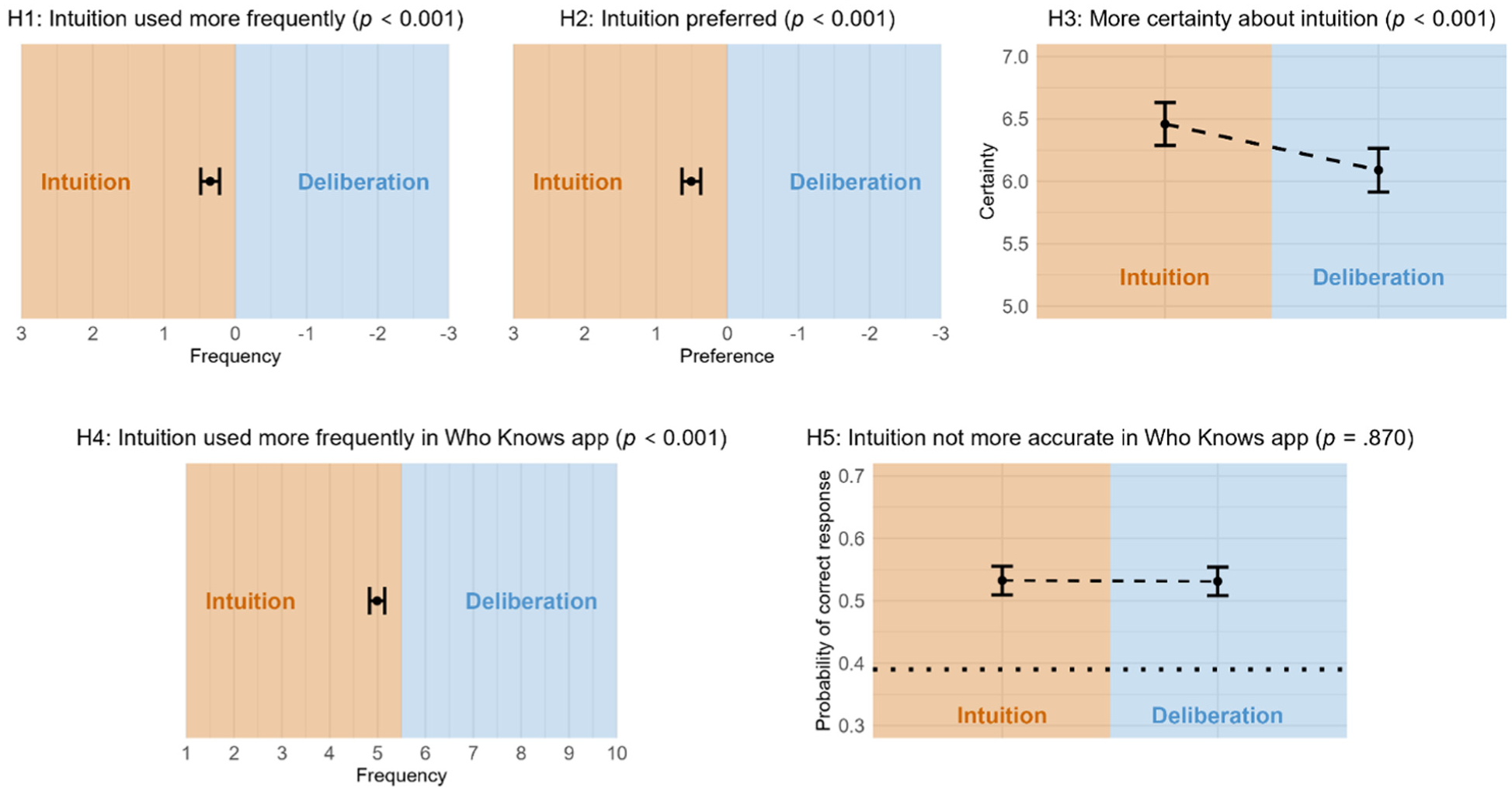
Results of Study 1 (H1–H3) and of Study 2 (H4 and H5)
We also explored whether participants think that other people’s intuitive judgments differ from deliberate judgments in terms of accuracy (RQ1) and proneness to errors (RQ2) using two-tailed paired samples t-tests. While participants expressed greater confidence in their own intuition, they did not assume a comparable accuracy advantage for others’ intuition (RQ1), MΔ = 0.17, t(400) = 1.62, p = .106, d = 0.08. In fact, they rated others’ intuitive judgments as more error-prone than others’ deliberate judgments (RQ2), MΔ = −0.32, t(400) = −2.84, p = .005, d = −0.14.
Study 2
Study 1 shows that people tend to believe good social judgment is linked to intuition. In Study 2, our aim was to examine whether the subjective preference for intuition—and the belief in its accuracy—would be reflected objectively in the accuracy of intuitive (vs. deliberate) judgments of strangers. For this purpose, we implemented an online experiment within Who Knows, a quiz app developed by personality researchers which offers lay people an opportunity to test their ability to infer personality aspects of strangers from short videos (Rau et al., 2025).
In each game round, the Who Knows app presents a short self-introduction video of an actual person (target) and tasks the user to answer five forced-choice questions about the person (see Figure 2 for an example). At the end of each round, the user receives feedback as to whether their answers were accurate (i.e., aligned with the target’s self-report). The targets are drawn randomly from a socio-demographically heterogenous pool of individuals (n = 53), and the questions are drawn from a large pool of highly concrete items (n = 776) with varying response formats featuring content from multiple life domains (values and attitudes, lifestyle and leisure, knowledge and skills, emotions and relationships).
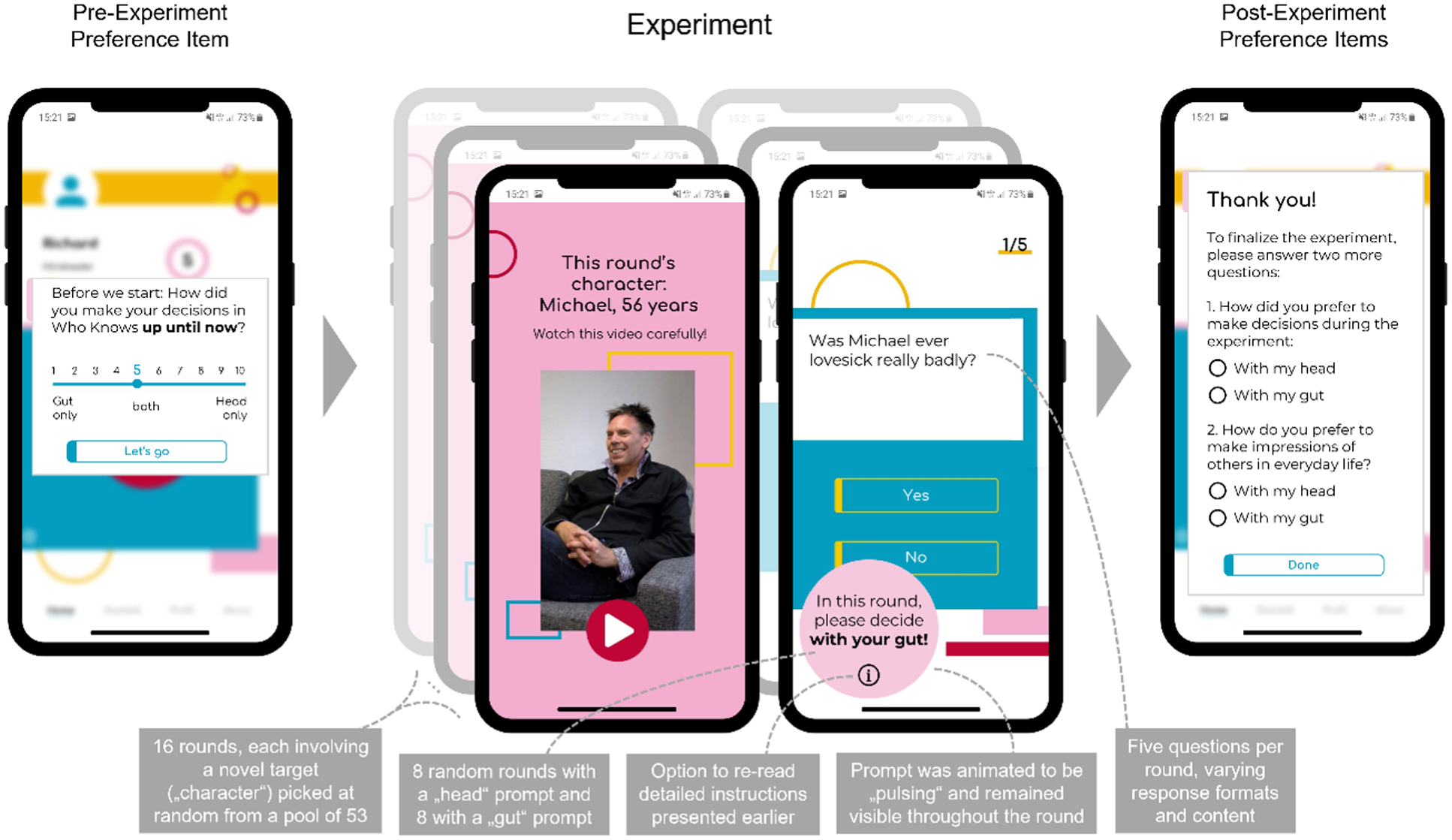
Procedure of Study 2.
Participants for Study 2 were recruited from the user pool of Who Knows. When asked about their preferred way of making judgments within Who Knows, we again expected a greater preference for intuition over deliberation (H4). Furthermore, we hypothesized that intuitive judgments would yield greater accuracy than deliberate reasoning (H5). To examine H5, we designed a within-person experiment in which we randomly assigned participants to one of two judgmental modes (intuitive vs. deliberate) in each of several game rounds.
Methods
Participants and Design
Participants were recruited from the existing user base of the Who Knows app. The app is publicly available and advertised via social media, public outreach, and academic channels. Users typically encounter the app outside of laboratory or classroom settings and participate voluntarily. They are German-speaking and primarily based in Germany, reflecting the app’s initial dissemination context.
From the Who Knows user base, everyone who had provided demographic information in their profile (i.e., age and gender) and who was sufficiently familiar with the app’s basic functionalities (i.e., at least 16 completed regular game rounds) was invited to take part in the experiment via a window popping up on their screen as they accessed the app. They could close the window either by pressing a button to provide informed consent and sign up for the experiment or by declining participation and return to using the app in its default mode. The majority of users who accepted the invitation to participate had not exceeded the minimum required level of prior experience when they started the experiment (i.e., 80% had completed exactly 16 pre-experimental rounds).
Once they had signed up, the 16 following game rounds deviated from the default mode in that participants were prompted to decide either intuitively or deliberately in each round (within-person experimental design; for comparison, see the central part of Figure 2). Judgment-mode prompts (“gut” vs. “head”) were assigned randomly at the level of each game round within participants. Across the experimental rounds, the number of prompts was balanced within person.
Sign-ups were allowed until n = 200 users had completed all 16 experimental game rounds. After this, the experimental prompts continued to be displayed to participants who were already enrolled in the experiment but had not yet finished all game rounds for 2 weeks. After this, the relevant data were exported, and no more prompts were displayed. Overall, this yielded an effective sample of N = 380 (280 female, 97 male, 3 other; age: 18–75 years, median = 43) where, on average, participants completed 11.57 experimental rounds (SD = 5.53).
Procedure and Materials
At the onset of the experiment, participants were provided definitions of “gut” and “head” judgments. The definitions were the same as in Study 1. Participants then reported how much they had relied on intuition versus deliberation within Who Knows thus far (for comparison, see the left part of Figure 2). They then completed the experimental game rounds, each following the standard gameplay of Who Knows as described in Rau et al. (2025) but with the modification that they were explicitly prompted in each game round to decide either “from their gut” or “with their head.” They could display the full definitions of “head” or “gut” by tapping the prompt.
Response times were recorded as a manipulation check. After completing the experiment, two dichotomous items assessed the preferred judgment mode during the experiment and in real life, respectively (“Which type of judgment did you prefer during the experiment?” 0 = head judgments vs. 1 = gut judgments and “Which way of forming impressions do you prefer in real life?” 0 = with the head vs. 1 = from the gut; cf. right part of Figure 2).
Operationalizing Accuracy
The accuracy of judgments was operationalized in terms of the correspondence of participants’ judgments with the targets’ self-reports. The experiment employed four item types (binary, open-ended, scale, and trivia; cf. Rau et al., 2025). Participants’ responses to binary and open-ended items were scored as correct (= 1) when they aligned with the targets’ responses. Otherwise, they were scored as incorrect (= 0). Responses to scale items (e.g., “From 1 to 10: How much does X like children?”) were scored as correct if they fell within ±1 point of the value reported by the target and as incorrect otherwise. Items of the type “trivia” tasked participants to predict whether the target knew the correct answer to a knowledge question (e.g., “Does X know the capital of Estonia?”). For these items, participants’ responses were scored as correct if they aligned with the targets’ actual performance in answering the question and as incorrect otherwise.
Statistical Analysis
Using logistic mixed-effects models with crossed random coefficients, we examined the effect of judgment mode (0.5 = intuition, −0.5 = deliberation) on the accuracy of responses. Random intercepts were included to account for accuracy differences between participants, targets, items, and combinations of targets and items. The fixed regression coefficient of judgment mode was tested for significance using its z-value in a two-sided test. Pre-registered robustness checks assessed whether adding random slopes for the effect of judgment mode would improve model fit, and whether excluding items of the type scale, trivia, or both affected the results. The latter was checked because the classification of scale items as correct/incorrect is somewhat arbitrary, and trivia items may require other judgment approaches compared to items about habits and attitudes. These analyses confirmed the stability of our findings and did not alter any conclusions. They can be reproduced using the data and analysis script provided on the OSF project folder. 2
Results
Subjective Preference for Intuitive vs. Deliberate Judgments of Strangers
In line with our expectation to find a subjective preference for using intuitive over deliberate judgments (H4), the average response to the pre-experiment preference item deviated significantly from the scale midpoint of 5.5 toward the “gut” pole, M = 4.99, t(378) = −6.32, p < .001, d = −0.32 (see Figure 1). 3 In addition, we examined whether this preference for intuitive judgments also emerged after the experiment using the dichotomous item asking which judgment mode participants had preferred during the experimental task. Consistently, a one-sided binomial test showed that a greater proportion of participants (n = 201) preferred judging with their “gut” (66.17%) than with their “head” during the experiment, p < .001, odds ratio (OR) = 1.96.
Objective Accuracy of Intuitive vs. Deliberate Judgments of Strangers
Our focal hypothesis (H5) predicted that judgments made under a “gut” prompt (intuitive condition) would more often be accurate than those made under a “head” prompt (deliberate condition). Thus, of note, other than in most psychological research, the unit of analysis was not that of participants but rather that of single judgments made by a certain participant, about a certain target, on a certain item, and under a certain condition.
Using n = 21,739 judgments, we regressed the accuracy of a judgment (incorrect vs. correct) on the experimental condition (intuition vs. deliberation). Accuracy in both conditions was above chance level. Contrary to our prediction in H5 and as shown in Figure 1, no significant difference in accuracy between conditions emerged, B(logit) = 0.005, SE = 0.033, p = .87, OR = 1. To verify that this absence of an effect was not due to a failed experimental manipulation, we checked whether “gut” and “head” trials differed in terms of response times. As expected, response times in trials with a “gut” prompt were on average 2.29 seconds faster than those in trials with a “head” prompt, SE = 0.076, d = −0.42, p < .001, indicating that judgments were indeed made more intuitively versus deliberately depending on the condition (see Supplemental Material on OSF for a visualization of the reaction times distributions in both conditions). Furthermore, we also observed a negative effect of response times on accuracy (i.e., the probability for a response being correct was higher, the quicker it was given). This effect occurred across conditions (for details, see Supplemental Material on OSF) and is consistent with trial-by-trial differences in difficulty leading to both variation in accuracy and response times.
We also considered that the experimental manipulation might have had a varying effect on accuracy depending on users’ pre-experimental preference for intuition relative to deliberation, but we did not find any indication for this type of interaction (p = .20). Similarly, no interaction effect emerged when entering the post-experimental item that assessed preference in daily life into the model (n = 201, p = .21). Contrastingly, a significant interaction effect emerged when entering the post-experimental item that assessed preference for judgment mode during the experiment as a moderator (cf. Figure 2). Accuracy was significantly higher in game rounds that corresponded with the judgment mode the participant reported to have preferred during the experiment (see Supplemental Material on OSF). However, this interaction should be interpreted with caution because the preference measure was collected only after participants had already received the experimental treatment and feedback (see General Discussion).
General Discussion
The present research investigated whether people prefer intuitive or deliberate judgments when evaluating strangers and whether these judgment modes differ in objective accuracy. Across two studies, the results revealed a widespread preference for intuitive (vs. deliberate) judgments when evaluating strangers, both in a general population survey (Study 1) and in an ecologically embedded judgment task within the Who Knows app (Study 2). At the same time, results of the experimental manipulation in Study 2 showed that intuitive judgments were not more accurate than deliberate ones. Across more than 21,000 judgments, accuracy did not systematically differ between conditions. Exploratory analyses further suggested that participants evaluated their own intuition more favorably than the intuition of others, and that accuracy appeared higher in trials that matched participants’ retrospectively reported judgment preferences.
Taken together, these findings highlight a dissociation between subjective preference and objective accuracy in social judgment modes. The absence of accuracy differences between intuitive and deliberate trials suggests that, at least in the present task, judgment mode itself does not substantially influence performance. Instead, accuracy in judgments of strangers may be primarily constrained by the diagnosticity of available cues rather than by whether judgments are formed intuitively or deliberately (Begrich et al., 2021; Murphy & Hall, 2021). In this sense, the present findings add nuance to the mixed literature on intuition and deliberation in person perception (Ambady, 2010; Highhouse, 2008). Importantly, even after completing the task and receiving feedback about their performance, most participants continued to prefer intuitive judgments. This persistence of intuitive preference despite the absence of an accuracy advantage is consistent with prior work showing that people often trust intuition even when it does not improve performance (Frederick, 2005; Pennycook et al., 2017).
Why, then, does intuition remain the preferred judgment mode? One explanation for the preference for intuitive judgments lies in the experiential qualities associated with intuitive processing. In everyday social perception, intuitive judgments are often accompanied by a processing fluency, felt ease, and affective coherence (Remmers et al., 2024; Topolinski & Strack, 2009). These experiential characteristics may make intuitive judgments feel compelling and trustworthy, even when they are not objectively more accurate. Importantly, these experiential qualities are closely tied to the efficiency of intuitive processing. In the present data, intuitive trials were completed substantially faster than deliberate ones. Thus, intuitive judgments allowed participants to reach comparable levels of accuracy with less time and cognitive investment. From this perspective, the appeal of intuition may stem from the combination of subjective ease and processing efficiency it provides in everyday social perception, where judgments often need to be formed quickly and based on limited information. Consistent with this view, prior work has shown that relying on intuition can also enhance subjective satisfaction and positive mood in everyday decision contexts (Remmers et al., 2024; Zander-Schellenberg et al., 2019). Although the present data do not allow causal identification of these mechanisms, they provide a meaningful interpretative context for understanding why intuitive judgments are favored. To identify when experiential qualities translate into stable preferences, future research should separate initial intuitive responses from later deliberate revisions while tracking experiential processes. Furthermore, individual differences that might influence people’s preference for intuition (vs. deliberation) should be tested in ecologically valid conditions.
In addition, preferences for intuition may partly reflect the social meaning attached to different judgment modes. Prior work suggests that endorsing intuitive or biased judgments can signal socially desirable qualities such as trust or openness, whereas emphasizing deliberation may imply caution or suspicion (Cruz & Mata, 2025; Mata & Amaral, 2022). From this perspective, reported preferences for intuition may reflect not only beliefs about epistemic quality but also the interpersonal signals conveyed by how judgments are formed.
The exploratory findings provide further insights into how intuitive judgments are evaluated. Participants expressed relatively strong confidence in the reliability of their own intuitive judgments but evaluated the intuition of others as more error-prone. This self–other asymmetry is consistent with research on the bias blind spot, which shows that individuals are more likely to detect biases in others than in themselves (Pronin et al., 2002), as well as with work demonstrating that certain judgment tendencies are evaluated more favorably for the self than for others (Cruz & Mata, 2025; Mata & Amaral, 2022).
A second exploratory finding suggested that subjective preferences might appear meaningfully linked to performance under certain conditions. When self-reported preference assessed after the experiment was entered as a moderator, accuracy was higher in rounds that matched the preferred judgment mode. At face value, this pattern could be interpreted as evidence for a preference–task congruence effect (i.e., people perform better when they can use the mode they prefer). However, this interpretation is limited because participants received trial-by-trial feedback throughout the task, and the preference measure was assessed only after the experimental treatment and feedback. Research also shows that experienced success can systematically bias retrospective evaluations of one’s judgments and decisions (Aiyer et al., 2023; Roese & Vohs, 2012), and preferences can shift to align with prior choices and outcomes (Enisman et al., 2021; Sharot et al., 2010). Accordingly, the present interaction is more plausibly interpreted as reflecting retrospective preference alignment rather than a stable factor that influences accuracy. Consistent with this interpretation, we did not observe moderation effects for judgment-mode preferences reported before the experiment or for self-reported preferences in daily life.
Limitations
A key strength of the present study lies in the experimental manipulation of judgment mode in an ecologically embedded setting. Nevertheless, several limitations should be considered. First, the manipulation relied on an operational contrast between intuitive and deliberate responding. However, social judgments may emerge from a dynamic interaction of both intuitive and analytical processes operating in parallel (Kruglanski & Gigerenzer, 2011; Smith & DeCoster, 2000). From a default-interventionist perspective (Evans & Stanovich, 2013), intuitive responses may serve as a default that can later be monitored or modified by more reflective processing. Such reflective engagement may, in some cases, involve post hoc rationalization of an initially intuitive response. As such, artificially separating these modes may reduce ecological validity, shifts the relative emphasis between faster and more reflective processing, and cannot fully disentangle these dynamics. At the same time, the distinction between intuitive and deliberate judgment modes is widely used in everyday thinking about how people form impressions of others. In this sense, the present manipulation was used not to perfectly isolate underlying cognitive systems but to experimentally operationalize this widely shared lay distinction. By prompting participants to respond either “from the gut” or “with the head,” we examined how people enact and evaluate these modes within a naturalistic judgment context. In the future, it would be informative to investigate whether naturally occurring judgments of strangers follow this default-interventionist pattern and under what conditions deliberative processes are triggered. For the latter, employing ecological momentary assessment methods in future work could offer valuable insights into the relative contributions and interplay of intuitive and deliberative processes in real-life social cognition.
Second, the assessment of judgment mode relied partly on self-reports and instructions, which reflect subjective experiences and may be influenced by post hoc rationalization or self-presentation (Mata & Amaral, 2022; Pennycook et al., 2017). Moreover, even judgments in the deliberate condition were based on brief behavioral excerpts and may have involved reasoning. The thin-slice nature of the task might have introduced substantial trial-by-trial variability in cue diagnosticity. Some judgments may have been based on clear cues and were therefore both fast and accurate, whereas others were more ambiguous, leading to slower and less-accurate responses, potentially overshadowing any effects of judgment mode. This again highlights the challenges of isolating judgment modes in ecologically valid social perception paradigms. Future research could address these challenges by relying more on process-proximal indicators, systematically varying the stakes of impression-formation tasks, or implementing default–interventionist designs that track initial responses and subsequent revisions.
Finally, extending the generalizability of the present findings to other social and cultural contexts and populations will be an important next step. Investigating how intuitive and deliberate judgment processes operate in diverse real-world social environments may provide further insight into when and how different judgment modes shape interpersonal perception.
Conclusion
A recurring piece of advice in public media and folk psychology is to rely on one’s “gut” when it comes to assessing strangers. While the present research suggests that most people tend to follow this advice, we could not detect any accuracy benefits of an intuitive compared to a deliberative judgment approach in a highly powered and ecologically valid experiment. Thus, at least when it comes to inferring personality characteristics of strangers from short video presentations, relying on one’s gut versus one’s head neither seems to hurt nor harm.
Supplemental Material
sj-docx-1-spp-10.1177_19485506261452705 – Supplemental material for Intuitive Judgments of Strangers Are More Popular but Not More Accurate Than Deliberate Ones
Supplemental material, sj-docx-1-spp-10.1177_19485506261452705 for Intuitive Judgments of Strangers Are More Popular but Not More Accurate Than Deliberate Ones by Carina Remmers, Albert Anoschin, Johannes Zimmermann, Michael P. Grosz, Mitja D. Back and Richard Rau in Social Psychological and Personality Science
Footnotes
Handling Editor: André Mata

Author Contributions
CR: Theoretical Framework, Conceptualization, Methodology, Supervision, Writing – Original draft, Writing – Review and Editing, Project Administration
JZ: Conceptualization, Methodology, Writing – Review and Editing, Formal Analysis
AA: Methodology, Formal Analysis, Investigation/Data Collection, Data Curation, Writing – Original draft (supporting), Visualization
MG: Methodology, Writing – Review and Editing
MB: Writing – Review and Editing
RR. Conceptualization, Methodology, Data Collection, Supervision, Writing – Review and Editing, Project Administration, Resources
Funding
The authors received no financial support for the research, authorship, and/or publication of this article.
Declaration of Conflicting Interests
The authors declared no potential conflicts of interest with respect to the research, authorship, and/or publication of this article.
Supplemental Material
The supplemental material is available in the online version of the article.
Notes
Author Biographies
References
Supplementary Material
Please find the following supplemental material available below.
For Open Access articles published under a Creative Commons License, all supplemental material carries the same license as the article it is associated with.
For non-Open Access articles published, all supplemental material carries a non-exclusive license, and permission requests for re-use of supplemental material or any part of supplemental material shall be sent directly to the copyright owner as specified in the copyright notice associated with the article.
