







Abstract
Background
Transradial access for neurointerventional procedures was adopted and modified from cardiovascular intervention and is increasingly established as a safe and effective alternative to transfemoral catheterization. As social media influences public opinion on medical treatment, this study analyzes Twitter conversations to elucidate social media’s depiction of transradial access as a neurointerventional tool.
Materials and methods
Twitter hashtags #RadialFirst and #RadialForNeuro were evaluated using a mixed-method analysis of quantitative social media metrics and qualitative thematic analysis.
Results
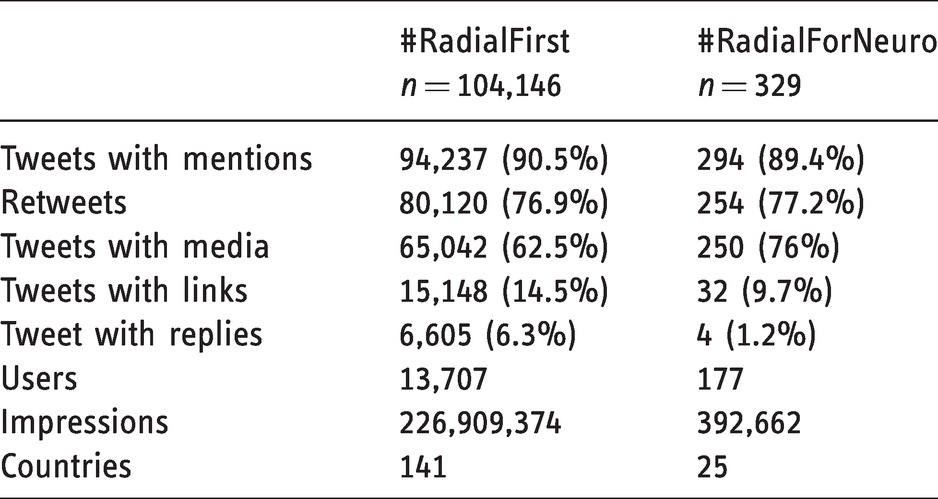
Between January 2015 and April 2020, 104,146 tweets from 141 countries employed the hashtag #RadialFirst (2015 (1); 2016 (0); 2017 (22,804); 2018 (33,074); 2019 (38,352); 2020 (9,915 January-April)). These generated 226,909,374 impressions and were retweeted 80,120 times by 13,707 users. Media was present in 62.5% of tweets (e.g. wrist image, angiographic runs) but only 14.5% had a reference article. Physicians authored 70.8% of tweets; interventional cardiologists accounted for 83% of top 100 influencers. #RadialForNeuro is more nascent (6 posts in 2019; 323 posts January–April 2020), with 392,662 impressions, and 254 retweets by 177 users; physicians authored 35.6%. Compared to #RadialFirst, #RadialforNeuro tweets were more likely to include media (76%), less likely to include citations (9.7%), and more likely to discuss complications and troubleshooting techniques.
Conclusion
Twitter activity regarding transradial access permits information dissemination and discussion on approach benefits and challenges. However, many posts arise from non-physician sources and lack links to peer-reviewed publication. The public should be mindful that tweets may reflect opinions, rather than experience or scientific evidence.
Introduction
Radial access is rapidly emerging as a safe and effective alternative to the transfemoral approach within neurointerventional surgery.1–4 This method was pioneered within cardiovascular intervention, as it provided comparable diagnostic and therapeutic technical success, and was associated with fewer access-site related complications than femoral access. 5 A 2018 Cochrane review of 31 interventional cardiology randomized controlled trials concluded that transradial access reduced death from cardiac causes, 30 day all-cause mortality, bleeding, local access-site complications, and hospital length of stay. 6 In neurointerventional surgery, various institutional and multicenter studies have recently corroborated similar safety, feasibility, and clinical benefits of radial catheterization for cerebral and spinal angiography, stroke rescue, tumor embolization, and treatment of aneurysms, arterio-venous fistulas, and vascular malformations.1–4,7–12 The ability to perform transradial catheterization is an important tool to have in a neurointerventional armamentarium. The speed of technique adoption within the field will in part be dependent upon the growing pool of evidence for transradial access efficacy, and the rate of information dissemination.
Historically, the diffusion of innovative technology and techniques across the medical field has relied heavily on peer-reviewed publication and presentations at scientific meetings. While important, these usually impose a cost barrier and less-rapid dissemination, as do traditional instructive textbooks. However, the past decade has demonstrated the importance of social media as a catalyst for literature dissemination, enhanced discussion, and adoption of technology, especially within surgical and interventional specialties.13,14 Today, 72% of the public uses some type of social media, and for many users, social media is part of a daily routine. 15 The use of hashtags (#) permit unified discussion of a topic and permit analysis of public engagement surrounding the idea. The hashtag #RadialFirst emerged within the cardiac community and has expanded to social media conversations within neurointerventional surgery, along with the creation of #RadialForNeuro. While this hashtag is added to features of peer-reviewed publication, it is also used by individuals documenting personal experience and patient-specific cases, generally tilted toward cases with favorable results. A recent systematic review of mechanical thrombectomy results among neurointerventionalists on Twitter heeds warning that the publicized tweets may be biased toward sharing higher thrombectomy success scores. 16 Thus, given the influence of social media on medical practice, it is important to better understand the sources, references, and conversations being propagated around the radial access discussion.
Twitter is a social networking service based in the United States that allows users to communicate through brief messages up to 280 characters. Globally, over 300 million people use the service. 17 This study analyzes Twitter conversations regarding this topic using the popular hashtags #RadialFirst and #RadialForNeuro to provide a quantitative and qualitative evaluation of tweets for thematic analysis and highlight the impact of Twitter in disseminating information regarding the technique, and the role of social media in education and refinement of technical approaches.
Methods
Search strategy and data collection
The Hashtag Finder database (Symplur, Upland, CA, USA) was used to determine the extent of Twitter usage pertaining to transradial approaches. Both #RadialFirst and #RadialForNeuro hashtags were queried for the period between January 2015 and April 2020, since #RadialFirst was initially used in 2015. Data pertaining to the following parameters were compiled from each hashtag search: number of followers for Twitter accounts, timing of tweets, country and state of origin, and type of post (media versus text only) if publicly available. Additional data included the number of impressions (number of times a post is viewed by a user, whether or not the post is clicked), engagements (number of times a post is clicked on to magnify the image or text or view a video), retweets, likes, and URL clicks each post received. Regarding the type categorization of the account owner and his or her profession, Symplur uses machine learning algorithms applied to public data from Twitter account bios and combines that data with human evaluation and quality control to automatically categorize the top influencers of any given healthcare topic into subcategories such as physician or patient. To further evaluate if Twitter account owners were in interventional cardiology, interventional radiology, or neurointerventionalists, our authors reviewed the public biographies of the top 100 influencers. Influencers in this case are defined by two proprietary, recursive algorithms: SymplurRank and Healthcare Social Graph Score, which include a neural network of billions of data points on unique user activity that incorporates but is not limited to followers, retweets, impressions, breadth of influence, and more.
Statistical analysis and ethical considerations
Summary statistics including mean, median, standard deviation, and interquartile range (IQR) for Twitter metrics were calculated. Frequency of term use was displayed in a bubble chart, with bubble size corresponding to term frequency (by Symplur). Analyses were performed with Microsoft Excel. All data were gathered from publicly accessible resources and were strictly archival and cross-section observational, without interaction with users or collection of their usernames.
Results
#RadialFirst
Between January 2015 and April 2020, there were 104,146 tweets from 141 countries using the hashtag #RadialFirst
Statistics for #RadialFirst and #RadialForNeuro Hashtags.
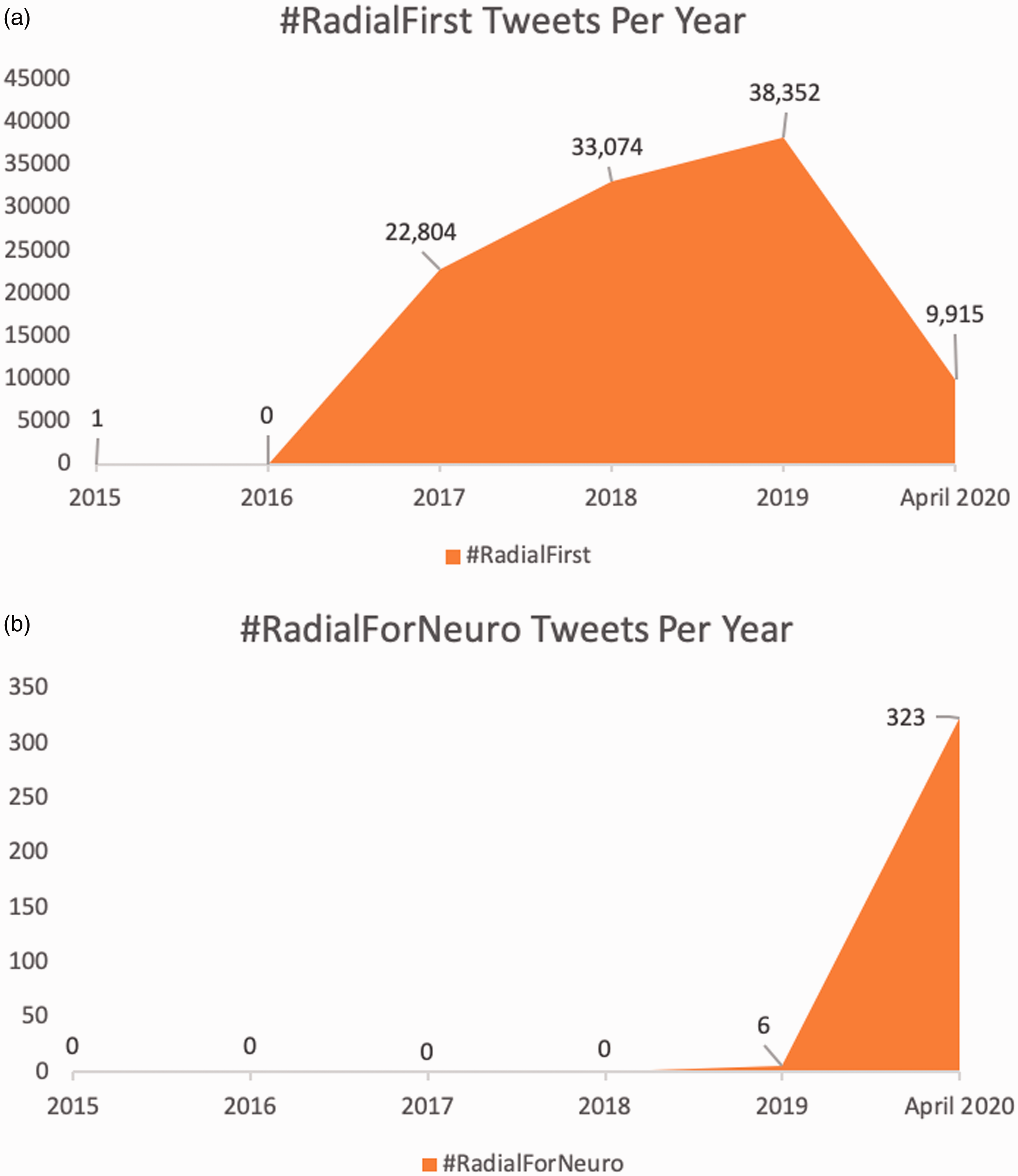
Tweets per year utilizing (a) #RadialFirst and (b) #RadialForNeuro
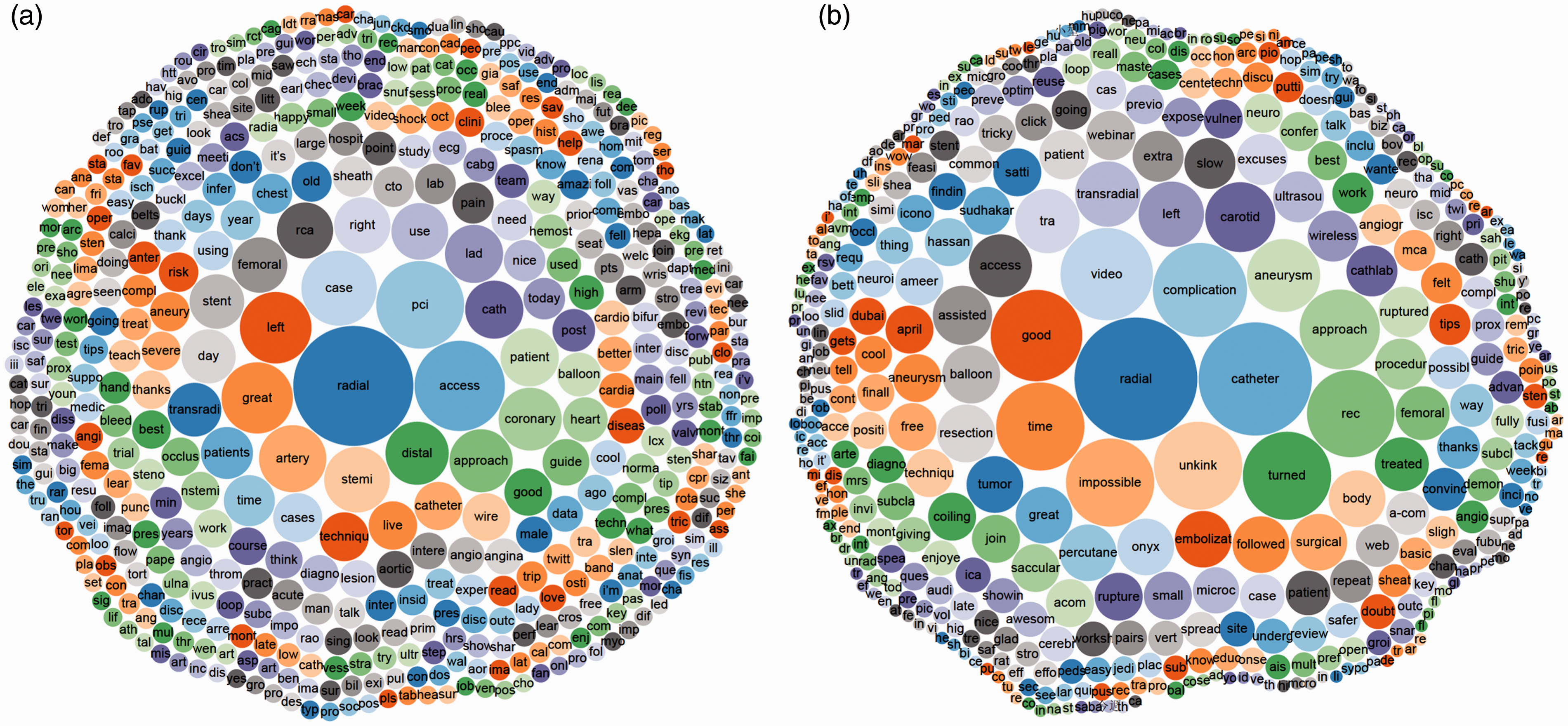
Bubble chart of most common words used in conjuncture with (a) #RadialFirst and (b) #RadialForNeuro. Image created on Symplur.com.
#RadialForNeuro
As a spin-off from #RadialFirst, #RadialForNeuro is a more nascent term. Between January 2015 and April 2020, there were 329 tweets from 25 countries using the hashtag #RadialForNeuro
Discussion
This analysis of #RadialFirst and #RadialForNeuro hashtag use on Twitter elucidates how the public is utilizing social media in disseminating innovative technology and techniques across medical systems. The presence of #RadialFirst use in 141 countries reflects global awareness of the technique within cardiology, and progressively within the neurointerventional community. The majority of tweets incorporated media, a known strategy to increase post interaction (number of times a post is clicked on to magnify the image or text or view a video), and propagation (retweeting, sharing), 13 and likely contributed to over 200 million interactions. While #RadialForNeuro as a separate entity has only emerged since 2019, it is already being used in 25 countries and has left over 300,000 impressions (number of times a post is viewed by a user, whether or not the post is clicked). This may underrepresent awareness in the neurointerventional surgery community, as many Twitter users will continue to use the more popular #RadialFirst hashtag, even for cerebral and spinal applications.
Demographically, the primary influencers for #RadialFirst were physicians (70.8%) and researchers (12.4%), whereas #RadialForNeuro had only 35.6% physicians. Over half of the #RadialForNeuro accounts belonged to individuals who did not have their profession clearly identified on their profile or in their Twitter biography. The unknown population may reflect neurointerventional surgeons with ambiguous social media accounts, or could reflect occult advocate organizations, patients, and non-healthcare individuals. This population breakdown differs greatly from hashtags that have become more mainstream within the public. For instance, only 8.4% of tweets that utilize #stroke are authored by physicians, while 6.7% are authored by patients, and the majority are generated by advocacy groups and non-healthcare persons. These topics center around stroke prevention, symptoms, associated medical conditions, and treatment options. 23 As #RadialFirst and #RadialForNeuro are more technique-centered rather than disease centered, the core of discussion will likely remain with physician influencers. Additionally, nearly all tweets for both hashtags were in English. Both movements may benefit from broadcasting translations of tweets into other languages to reach more demographics. Free diffusion of early transradial experience has the potential to empower safer and earlier adoption of such access for neurovascular procedures and language is an important aspect of accessibility. For example, users have free access to operator experience in navigating radial loops and avoiding vasospasm or digital ischemia.
The risk of misinformation propagating on Twitter warrants further discussion. It is possible that social media may limit the exposure to diverse perspectives and favor the formation of groups of like-minded users who cultivate a shared narrative. 24 Recent measures by the service include labeling of tweets as potentially misleading when indicated. 25 This caution applies to medical information as well as world affairs, however, measuring how representative and scientifically accurate the information presented in Twitter is poses challenges. For #RadialFirst, approximately 15% of tweets included a reference link to an article, compared to nearly 10% for #RadialForNeuro. The highest impact tweets that contained resource links for #RadialFirst were clinical images, case reports, viewpoints, and correspondence letters from notable journals such as NEJM and Journal of the American College of Cardiology. Such articles do not include robust evidence on the efficacy or effectiveness of approach. In contrast, the highest impact links affiliated with #RadialForNeuro posts were systematic reviews and original research studies. Overall, Twitter posts with reference article links may guide audiences toward evidence-based literature and should be both continued and encouraged.
Regarding the remaining 85–90% of radial access tweets that lack a resource link, there is potential for spreading biased information. In a recent review of Twitter posts for mechanical thrombectomy for stroke, authors noted that individuals documenting personal experience and patient-specific cases disproportionally shared favorable results, which may create an overly positive perception bias for outcomes. 16 Furthermore, author disclosures and financial incentives are seldom apparent, and posts may be used as advertising for specific products or interventions. However, the third most common word used in the #RadialForNeuro discussion was “complication.” Other frequently used terms included “unkinked” and “ruptured,” among multiple positive descriptive terms such as “good” and “rec.” In comparison, the term “complication” was ranked 86th in word frequency for #RadialFirst. This may reflect differences between cardiology and neurointervention in community perspective, openness to discuss obstacles, prevalence of complication, or status of the field on the learning curve of the approach. The prevalence of these terms suggests that the social media discussion is not entirely one-sided, and online exchanges may be facilitating education and refinement of technical approaches through shared experiences of both successes and challenges.
While this study clarifies the landscape of Twitter conversations on transradial access, it has important limitations. First, it only includes tweets containing the #RadialFirst or #RadialForNeuro hashtag and with a potential of an unknown amount of additional radial access related content not included in this analysis. Additionally, the lack of baseline understanding of how many neurointerventionalists or neurosurgeons utilize Twitter as a professional tool limits our understanding of the proportion of engagement with #RadialFirst or #RadialForNeuro tweets, or comparison of social media activity between cardiac and neurological discussions. Regarding demographics, user age and gender are not included in the database, and for #RadialForNeuro, the profession or background of the user was unknown in over 50%. “Tweetstorms” can ignite an opinion stage and could influence many others who have limited hands-on experience in the procedure under evaluation. In addition, an author’s popularity on Twitter and likelihood of successful audience engagement does not necessarily correspond with clinical experience or validity. This is supported by a recent publication that compared a social metric known as the Kardashian index (k-index) with citation index (h-index) scores of interventional neuroradiologists. 26 A lack of association between the k- and h- indices suggests that a robust Twitter presence does not necessarily imply scientific rigor or impactful work. In addition, the demographics and comorbidities of patient cases are also seldom available in order to protect patients according to Health Insurance Portability and Accountability Act (HIPAA) regulations, which introduces unknown bias for case complexity. Finally, the prevalence of hashtag use does not necessarily correspond to increased clinical use. Despite broad use of #RadialFirst within cardiology and extensive literature supporting transradial access over transfemoral for percutaneous coronary intervention, the vast majority (>80%) of proceduralists in the United States remain low radial adopters, and many recent studies continue to be exclusively femoral access.27,28 Nonetheless, this analysis provides useful information about topic trends and discussion within neurointerventional surgery and demonstrates a rise in conversation about the transradial approach.
Conclusion
Twitter communications regarding transradial access for cardiac and neurointerventional care delivery are global, with over 200 million impressions since the origin of the #RadialFirst hashtag. As #RadialForNeuro has differentiated into a new subspecialty discussion, there is evidence of online communication about both the successes and challenges of the approach, as well as sharing of recent original peer-reviewed research. This underscores the impact of Twitter on information dissemination, and the role of social media in education and refinement of technical approaches. The public should be mindful that tweets may reflect opinions, rather than experience or scientific evidence generating mechanisms, and as clinicians engaging in social media conversations, we should strive to propagate unbiased, evidence-based information.
Footnotes
Author note
Naif M Alotaibi is also affiliated to Department of Neurosurgery, National Neuroscience Institute, King Fahad Medical City, Riyadh, Saudi Arabia.
Conflict of interest
The authors declare that they have no competing interests.
Author contributions
Conception and design: Alotaibi; acquisition of data: Alotaibi; analysis and interpretation of data: all authors; drafting the article: Robertson, Alotaibi; critically revising the article: all authors; reviewed submitted version of manuscript: all authors; approved the final version of the manuscript on behalf of all authors: Alotaibi; statistical analysis: Alotaibi; and study supervision: Alotaibi, Patel.
Funding
This research received no specific grant from any funding agency in the public, commercial or not-for-profit sectors.
