







Abstract
Against the backdrop of an ‘intelligent lockdown’ the Dutch government has launched a threefold emergency package to support businesses and safeguard employment as much as possible. This ‘Emergency Jobs and Economy Package’ contains, amongst others, measures that aim to ensure the safeguarding of income and salaries for employees as well as self-employed workers. It concerns mainly subsidy law and the extension of social security legislation, not employment law. However, the safeguarding of income for employees (NOW) entails a fine on redundancies during the period of support. Not only employees, but also self-employed workers can apply for income support. From a health and safety perspective (during lockdown as well as going forward to relaxation), no specific national measures have been taken. The general rules on social distancing and hygiene have to be implemented as part of the general obligation to provide a safe working place. No specific care arrangements for working parents that have to work from home have been put in place.
1. Introduction
Against the backdrop of an ‘intelligent lockdown’ as the general measures to contain Covid-19 are characterised by the government, the Dutch government has launched a threefold emergency package to support businesses and safeguard employment as much as possible. This ‘Emergency Jobs and Economy Package’ announced on 17 March 2020 and established in the weeks thereafter, contains measures that include: (i) the safeguarding of income and salaries, (ii) the postponement of taxpaying, and (iii) the relaxation of credit provisions. Very few of these measures are labour law related; most of them concern tax law, subsidy law and the extension of social security legislation. Furthermore, there is an ongoing debate on state support for large companies that are deemed vital for the economy, such as the national airline, KLM-Air France.
The general measures to protect public health include the prohibition of events such as sporting events, concerts or festivals, and the closure of public places such as museums, theatres, sports clubs, bars, cafés and restaurants. Shops, market places and public transport can only continue to provide services if the relevant hygiene measures can be sufficiently complied with (mainly the rule that a 1.5-metre distance has to be observed) and there is a ban on gathering in groups in public spaces. Furthermore, people are urged to work from home and schools are closed. On 6 May 2020 the government announced a step-by-step plan to relax the measures. The main steps include that from 11 May 2020, primary schools can reopen and certain professions can take up work again (hairdressers, beauty salons, physiotherapy, etc.). From 1 June 2020 secondary schools reopen, and bars, restaurants, cinemas and theatres may open again with a maximum number of guests and all based on reservations being made. The wearing of facemasks will be compulsory on public transport. At the time, further relaxation had been foreseen for 1 July and 1 September 2020, all under the condition that the infection numbers remain stable. General rules (staying home as much as possible, maintaining a 1.5-metre distance and not shaking hands) will remain in place.
As in every country, these measures have a tremendous impact on the economy and employment. With the ‘Emergency Jobs and Economy Package’, the government envisages supporting businesses and workers in order to keep bankruptcies to a minimum and to avoid mass unemployment. This article will only focus on the measures that safeguard income and salaries, since these measures are primarily aiming to avoid dismissals and also apply to the self-employed. Measures with respect to health and safety are very limited and will be touched upon briefly. With the relaxation of the measures, employers face the challenge of redesigning processes and workplaces in order to ensure that the 1.5-metre distance rule can be kept and that maximum hygiene is safeguarded.
2. Income support
The income support pillar of the ‘Emergency Jobs and Economy Package’ contains three major measures and one smaller one, set out in the table below. There have been no measures or amendments with respect to the unemployment benefits or rules with respect to sick pay. Under Dutch law, the employer has a statutory obligation to pay employees that are on sick leave for a period of 2 years, during which time the employee is entitled to 70% of his salary with a maximum of 70% of the maximum day wage (currently: EUR 219.28 gross per day).
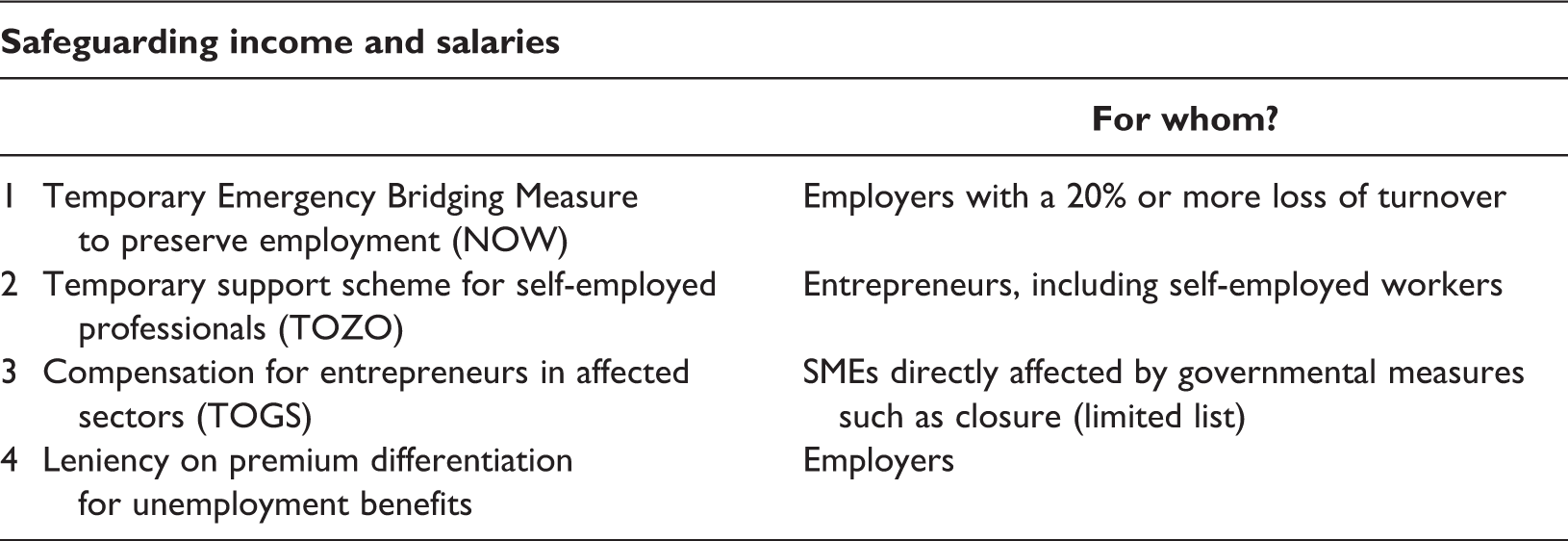
2.1. Temporary Emergency Bridging Measure to preserve employment (NOW) 1
The NOW offers employers the possibility to obtain compensation for wage costs. It is a subsidy, not a loan. The scheme is administered by the UWV (Employee Insurance Agency). On 1 April 2020, the scheme was officially published and was made available from 6 April 2020. On 6 May 2020, 118,000 requests had been processed and EUR 2 billion had been transferred by means of an advance to 110,000 employers that together employ 1.8 million employees. 2
Eligibility criteria
All employers that suffer a decrease of at least 20% of their turnover can apply for the NOW subsidy. The decrease in turnover will be established by comparing the turnover in 2019 (divided by 4) with the turnover in any 3-calender month period between 1 March 2020 and 31 July 2020. In the original legislation, the decrease in turnover was to be calculated on an aggregated level in the case of a group of companies. However, after pressure from the social partners and the parliament, the Minister of Social Affairs and Employment agreed to amend this and allow group companies to file for the subsidy based on their own turnover under certain conditions. 3
Level of subsidy
In the case of a 100% decrease in turnover, the employer is entitled to a subsidy of 90% of the wage sum over the period between 1 March 2020 and 31 May 2020 (the decrease in turnover can take place in a different period; see eligibility). If the decrease in turnover is lower, the subsidy will be reduced accordingly (so in case of a 50% reduction in turnover, the subsidy will amount to up to 90% of 45% of the wage sum). The wage sum is the wage for social insurance purposes that is known by the UWV and amounts up to a maximum of EUR 9,538 per employee per month are taken into account. To this wage sum 30% is added for pension premiums, holiday allowances and other costs/benefits.
Advance payment
Based on the expected decrease in turnover and on the wage sum over January 2020, the employer can receive an advance payment of up to 80% of the expected final subvention, to be paid within two or three weeks after receiving the application.
Conditions
To obtain the final subsidy, next to more general conditions aimed at the control and prevention of fraud, the following conditions apply to eligible companies. The company:
has not filed any request for dismissal on economic grounds as of 18 March 2020 (the day after the announcement that NOW would be put in place) until the end of the period of subsidy (31 May 2020);
is obliged to keep the total wage sum at the same level as far as possible in order to stimulate employers to continue using flexible forms of employment and to continue paying on-call employees;
uses the subsidy only for the payment of wages;
informs the works council, or if there is no works council, the employees, on the subsidy received; and
provides an audit certificate regarding the decrease in turnover.
NOW explicitly also covers the wage costs of flexible contracts. In the case of temporary agency work, it is the temporary work agency that is the employer and it can apply for the subsidy. Employers are called to continue employment as much as possible and to keep on-call workers on the payroll.
Analysis
The scheme was designed and implemented in an extremely short period. This was only possible because it is a relatively simple arrangement without many details or the possibility to deliver tailor-made solutions for specific sectors or companies. This means on the one hand, that companies that made huge profit in recent years or that profit from very favourable tax regimes can (successfully) apply for the subsidy whilst, for instance, companies highly dependent on certain seasons for their turnover, cannot. This has led to some public indignation and to lobbying from the relevant employers’ organisations. Furthermore, despite the explicit and repetitive call from the government not to let go of temporary staff and to continue to pay on-call workers, a lot of flexible contracts were terminated during the months of March and April. Although unemployment benefits are, in theory, available, it happens regularly that these employees have not built up enough rights to actually qualify for such benefits. This is detrimental to the likes of students, artists or those who combine flexible work with being self-employed. Social partners via the STAR (i.e. the Joint Industrial Labour Council) have asked the Minister of Social Affairs and Employment to amend the NOW in order to provide a safety net for this group. At the moment of writing, this is under consideration.
Of particular interest is the sanction that is provided in case of a lower wage sum or dismissals during the period of subsidy. The primary sanction is a rebate on the final subsidy. However, if the company requests a permit for dismissal on business economic grounds, 4 in assessing the request the UWV will take into account if using the NOW would have been a suitable alternative to the redundancy.
The NOW is implemented to provide a wage subsidy for the months of March, April and May. It is possible to renew the NOW and add conditions to it. It is to be expected that if the NOW is extended, the regulation shall be less simple, and more conditions added to obtain a better targeted scheme. Although there are no official documents available yet, it is expected that in the extended scheme the employer will have the possibility to restructure and dismiss staff. It is also expected that there will be conditions that stimulate the retraining of staff and prohibit dividend distributions on shares.
2.2. Temporary benefits for self-employed professionals (TOZO)
The second pillar of the ‘Emergency Jobs and Economy Package’ entails measures to safeguard the income of self-employed workers. Moreover, the regular rules that apply to social assistance for self-employed are relaxed. The Social Assistance for Self-Employed Decree 2004 5 already provides the possibility for the self-employed to apply for social assistance, but under the TOZO, the usual asset test, partner income test or the condition that the business must be viable, do not apply. Although not confirmed, it is expected that the TOZO will be renewed and that the new scheme might include the partner income test.
The TOZO is, like all other social assistance regulations, administered by the municipalities. The TOZO was officially established with the Decree of 17 April 2020, 6 but municipalities started administering the scheme from the end of March when they received the advance payments from the national government.
Conditions
The TOZO applies to already established self-employed professionals, aged between 18 and the statutory retirement age who are legitimately living and residing in the Netherlands and have the Dutch nationality or a nationality that is considered to be equal. Further requirements are as follows:
The income has fallen below the social minimum and/or there are liquidity issues;
the business is still active (unless activity has been ceased due to the COVID-19 crisis);
the business or profession is practised in the Netherlands;
all legal requirements for being a business owner are met;
the company was established before 17 March 2020 at 18:45 (the date and time of the announcement of this regulation);
a minimum of 1,225 hours per year are put into the company or the professional activities; and
the applicant lives in the municipality where he applies.
The scheme does not apply to those self-employed that have their business in another EU Member State. According to a letter of the Secretary of State of Social Affairs and Employment of 24 April 2020, 7 the scope of the scheme was be extended to the self-employed that live in the Netherlands and have a business in another Member State as far as income support is concerned. Those that have their business in the Netherlands but live in another Member State can apply for an equity loan that is provided under the scheme. It is not clear when this will enter into force. The scope will also be extended to those self-employed that have reached the statutory retirement age.
Entitlement
The TOZO consists of income support, depending on the income and the household situation, up to a maximum of EUR 1,500 (net) per month for a period of three months between March and August. Furthermore, a loan for business capital up to a maximum amount of EUR 10,157 is possible. It is possible to request a delay for repayment and the interest rate shall be lower than under the regular 2004 Decree.
Analysis
The scheme has been received relatively positively, although organisations that represent the self-employed consider it only a first step. Furthermore, the government and the organisations for the self-employed have urged the self-employed to only make use of the scheme if it really is necessary. This type of support for the self-employed is along the same lines as the advice of the Committee Regulation of Work. 8 The Committee advised, amongst other things, the extension of social protection of self-employed workers.
2.3. Compensation for entrepreneurs in affected sectors (TOGS)
The government awards entrepreneurs in a number of specific sectors who have been affected by the COVID-19 measures a one-time compensation of EUR 4,000. The compensation is for those SMEs, with or without staff, that suffer loss because of the necessary closing of their enterprise, restriction of meetings and/or curtailment of travel. 9
Eligible sectors are, for instance, food and beverage, cinemas, hair, nail and beauty care, travel agents or tour operators, driving schools, saunas, solariums, swimming pools, fitness centres, sports clubs and sporting events, certain private cultural organisations such as museums, circuses, theatres and music schools, event locations and organisers, and casinos. All sectors were enumerated comprehensively on 27 March 2020, and several extensions have since taken place.
Conditions
In order to obtain the compensation, the company has to fulfil the following conditions:
the activities of the company must be one of the activities in the aforementioned enumeration;
the company cannot be established at the home address of the owner;
there should be an expectation of loss of turnover of at least EUR 4,000 between 16 March 2020 and 15 June 2020;
the company should have overhead costs of at least EUR 4,000 between 16 March and 15 June 2020;
the company must employ no more than 250 employees;
the company must be established and registered at the Chamber of Commerce on or before 15 March 2020 (the day before the regulation was announced);
the company cannot be a public company; and
the company cannot be in bankruptcy.
2.4. Leniency on premium differentiation for unemployment benefits
As of 1 January 2020, there is a premium differentiation to stimulate the use of fixed-term contracts. The administrative demands for employers to deal with this are postponed until 1 July 2020. Furthermore, a solution is to be found for the expected overtime in certain sectors in this period (e.g., health care) that could lead to an increase of premiums based on the new rules.
3. Health and safety measures and teleworking or remote working
To secure the supply of essential goods, such as food and medication, driving time and rest period regulations have been relaxed. On the basis of Art 14 Regulation 561/2006 the following changes have been established:
daily maximum driving time: 11 hours instead of 9;
weekly maximum driving time: 60 hours instead of 56
two-weekly maximum driving time: 96 hours instead of 90; and
weekly rest period: can start 7 days after the last weekly rest instead of 6 days after the last weekly rest.
Furthermore, at the request of certain sectors, the Secretary of State of Social Affairs and Employment has exempted some demands within the Health and Safety Act regarding certificates that are necessary to perform some tasks. The exemptions are valid until 31 August 2020. 10
There have been no specific measures at national level regarding teleworking or remote working or health and safety with respect to COVID-19. However, at sectoral level, protocols have been designed on how to work safely during the pandemic. These protocols are mostly drafted in close collaboration between trade unions, employers’ organisations and the relevant Ministries. 11 Furthermore, no specific measures have been put in place to facilitate parents that have to work from home. Schools and childcare facilities have remained available for those parents that have key professions (such as those working in care, policing, food chain distribution, and public transport). It is considered the responsibility of employers and employees to find solutions, possibly using existing leave arrangements in creative ways.
When it comes to return to work in the reopening phase, the general health and safety rules imply that employers have to provide a workspace that can meet the guidelines of the National Institute for Public Health and the Environment (e.g. observing the1.5-metre distance rule, implementing hygiene measures etc.). At sector level, plans are being developed to deal with this. There is no specific regulation on a national level foreseen at the moment. The main concern is the debate on employers making inquiries on the employees‘ health, such as compulsory recording of body temperature to establish whether someone has a fever. It is questionable to what extent privacy rules preclude this practice.
4. Final remarks
Compared to the financial crisis in 2008, the package that the government has launched is huge. In 2008 there were no actual measures, except for a National Agreement between social partners that laid the foundation of the major reform of dismissal law as per 1 July 2015. 12 The package that had been recently adopted was established fast and is very generic. It is remarkable that there are no hardcore labour law measures. Dismissal law and unemployment benefits are not touched upon. It all comes down to supporting businesses to maintain employment.
The precarious position of flexible workers is highlighted. They are likely to fall between two stools: they cannot profit from any of the schemes and might not yet be eligible f or unemployment benefits. It is tempting to use this observation as an argument for the reinstatement of the contract for an indefinite period of time as the answer to all precariousness. However, I would prefer to focus on the idea that decent social protection should be available for every worker, regardless of their contract or statute. The approach of the Dutch government is an (imperfect) attempt to do so. It has to be seen whether these imperfections will be addressed if and when the package is renewed. It is likely that the focus will more on the division of risks between labour and capital than on the distinction between the different types of workers.
Footnotes
Declaration of conflicting interests
The author(s) declared no potential conflicts of interest with respect to the research, authorship, and/or publication of this article.
Funding
The author(s) received no financial support for the research, authorship, and/or publication of this article.