







Abstract
The regulation of the recognition of professional qualifications is an oft-overlooked and generally under-explored area of EU law. However, it is a vital facilitator of access to employment, particularly in respect of vulnerable groups such as third-country nationals. Since the 2015 European Migration Crisis, the recognition of professional qualifications of third-country nationals in the EU has attracted some significant political attention. This has recently culminated in two recommendations from the European Commission on people fleeing Russia's invasion of Ukraine and third-country nationals more generally, as well as the Commission's proposal for a regulation establishing an EU Talent Pool. This note describes and analyses the current legal position in EU law, the specific rules applicable to third-country nationals and these recent developments.
Keywords
Introduction and background
The recognition of professional qualifications in EU law has not attracted much attention by legal academics and there has been even less commentary on this issue in respect of third-country nationals, although interest has grown rapidly in the past decade. This should come as no surprise; the integration of Syrian refugees into the economies and societies of the EU's Member States in the aftermath of the 2015 European Migration Crisis was to a large extent facilitated by the recognition and improvement of their academic and professional qualifications. Fast-forward to 2022 when the mass influx of persons fleeing Russia's invasion of Ukraine started and the EU has since absorbed over 4 million Ukrainian nationals. In the light of these developments, the European Commission issued a recommendation on the recognition of qualifications for people fleeing Russia's invasion of Ukraine in April 2022 1 and in November 2023 adopted a recommendation on the recognition of qualifications of third-country nationals generally. 2 In the same month, the Commission also proposed a regulation establishing an EU Talent Pool, 3 which has implications for the recognition of professional qualifications of third-country nationals coming to the EU. This note describes and critically reviews the existing legal position as well as these recent developments.
Recognition of professional qualifications of third-country nationals in EU law: a critical review
There are three scenarios in which third-country nationals may seek to have their qualifications recognised: (a) before arriving in the EU; (b) on arrival and during their stay in the EU; and/or (c) when moving within the EU.
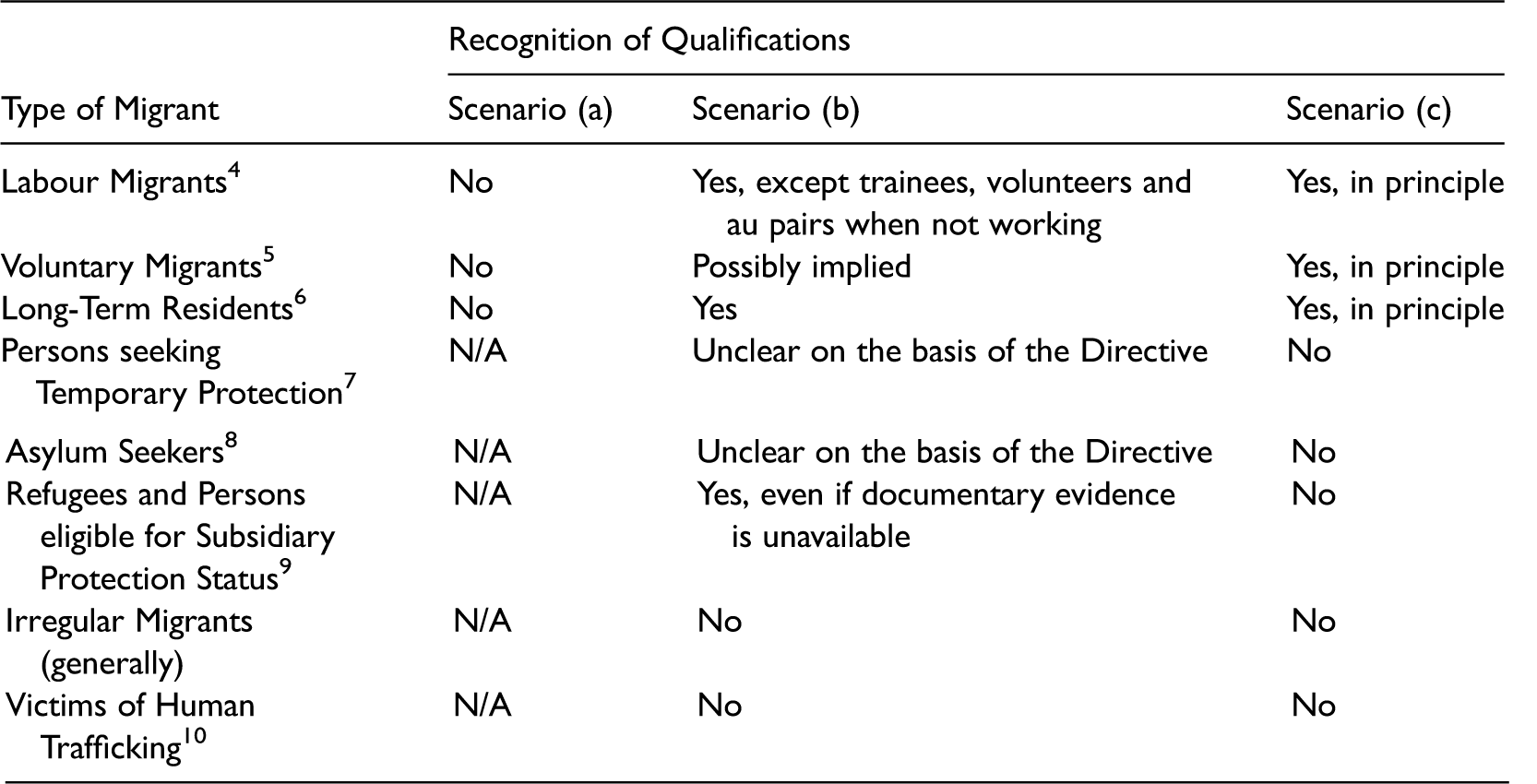
In respect of scenario (a), as the Commission quite damningly admitted in its Fitness Check on EU Legislation on legal migration, ‘[d]epending on the laws of the country of destination, TCNs may (…) face more onerous requirements for recognition of their qualifications than EU citizens holding a similar EU or non-EU qualification’.
11
This seems like an obvious instance of unfairness. Further, the Commission observed, ‘Recognition of diplomas is a widely posed requirement, especially for work-related permits, but its existence and the related guidance are relatively difficult to find. This, together with the complex process of recognition itself and the multitude of requirements especially concerning regulated professions make recognition one of the more burdensome requirements for TCNs. It has been documented that when there are requirements in terms of qualification level in order to be eligible to a work-related residence permit, some potential highly skilled migrant workers are sometimes excluded because of the excessive requirements or procedures, the impossibility to have access to recognition procedures from outside the country or the lack of knowledge in the destination country (by the administration or by the employer) about the value of the non-EU qualification.’
12
Turning thence to scenario (b), a number of questions arise. First, the guarantee of equal treatment ‘in accordance with the relevant national procedures’ is in relation to Member State nationals. However, for the most part, particularly where Member State nationals hold qualifications obtained in the relevant Member State, no question of recognition arises. Rather, their qualifications are automatically recognised by the relevant authority. This does not mean, however, that third-country nationals are not entitled to equal treatment. Indeed, if they hold qualifications obtained within the Member State, then they are equally entitled to such automatic recognition. In general, though, most third-country nationals do not hold qualifications obtained from within the EU. Accordingly, for those third-country nationals who hold qualifications obtained from outside the EU, they will be entitled to the same procedural treatment granted to Member State nationals who obtain qualifications from outside the EU.
It is now that the amorphous phrase ‘in accordance with the relevant national procedures’ comes to the fore. This can only mean one thing: permitted discrimination. Allow me to explain. Suppose a Member State national obtains a qualification outside the EU and seeks to have it recognised by an authority within the EU. That authority is obligated to compare it with equivalent qualifications obtained within the EU. If that authority concludes that the qualification obtained outside the EU is equivalent to that obtained within the EU, then it is obliged to recognise it. If, by contrast, the authority concludes that the non-EU qualification is not equivalent to the EU qualification, then it is not required to recognise it. Returning, then, to those third-country nationals who hold non-EU qualifications: like Member State nationals holding non-EU qualifications, they are simply entitled to have their qualifications compared with relevant Member State qualifications. This is a limited guarantee of procedural equality in respect of the recognition test applicable to non-EU qualifications. But, crucially, it does not determine the grounds upon which comparison is to be made. Suppose, for example, that a Member State authority is comparing a non-EU qualification with an EU qualification. There is nothing stopping that authority developing criteria which discriminate against non-EU qualifications provided that the recognition procedure is applied to EU and non-EU nationals alike. To put the point another way, while third-country nationals are entitled to procedural equality with Member State nationals in respect of qualification recognition, that procedural equality may be substantively unequal.
All of this, of course, is only of relevance to third-country nationals who are clearly granted equal treatment in respect of qualification recognition procedures in accordance with Member State procedures. But not all third-country nationals are so entitled. For voluntary migrants, for example, no such express guarantee of equal treatment is provided; and for persons seeking temporary protection and asylum seekers, there is no such guarantee of equal treatment. Even though asylum seekers are entitled to labour market access within nine months of the date of their application for asylum, it cannot be said that, on the basis of the text of the relevant Directive, they are entitled to equal treatment with Member State nationals in respect of access to qualification recognition procedures. Similarly, victims of human trafficking, who must be given access to the labour market, are not expressly entitled to equal treatment in respect of qualification recognition procedures. These differences in treatment are difficult to rationalise. They range from being entitled to equal treatment in respect of qualification recognition even in the absence of proof of qualifications in the case of refugees and persons seeking subsidiary protection—who might be considered to benefit from the ‘gold standard’ of protection, to no equal treatment whatsoever, as in the case of irregular migrants generally and victims of human trafficking, in particular. Even in the recitals to the relevant Directives, there is little reasoning provided as to why, if at all, such differences of treatment exist. Indeed, it is possible that the status quo is in breach of the general principle of legal certainty in EU law according to which ‘[i]ndividuals must be able to ascertain unequivocally what their rights and obligations are and take steps accordingly’. 13
There is a particular moral ideal which can enlighten and respond to the uncertainty created for third-country nationals seeking to have their qualifications recognised, one which has attracted the attention of labour and migration scholars in recent years.
14
It is the ideal of freedom as non-domination. In the context of migration specifically, the ideal of freedom as non-domination can identify the intensity and extent of domination in the lives of migrants. As Iseult Honohan puts it, ‘The intensity of domination…will depend on the degree of arbitrariness; the ease of exclusion; and the severity of the measures excluding foreigners…The arbitrariness of migration controls appears in the way in which the exact requirements for migration are liable to change according to the will of the admitting state…The intensity is increased by the arbitrariness that arises from the greater prevalence of discretionary powers in the area of migration than in most areas of domestic policy: here agencies and officials are given wide powers, often laid down without legislative provision or oversight; their decisions are often not subject to review, judicial or otherwise; the framework within which they make decisions is often neither clearly laid out nor well known to citizens as well as non-citizens. The extent of domination will depend, first, on the range of areas of their lives affected, and the degree to which their options are limited for those who are excluded. On this basis, evidence suggests that the extent of domination by migration controls is significant. The whole lives of potential migrants who lack the basics of a reasonable level of subsistence may be determined by the difficulty of migration, which leaves them unable to access the preconditions for a flourishing life—even if they are not continuously subject to interference in each aspect of their lives.’
15
How, then, can such domination be reduced? The simple answer is to reduce arbitrariness, an absence of controls and discretionary powers. One way in which this can be achieved is simply by clearly stating the rights and entitlements of third-country nationals coming to the EU. Notice that the ideal of freedom as non-domination does not demand that all migrants be afforded the same rights: indeed, it is likely consistent with a tiered system of rights afforded depending on the degree of integration and participation of the migrant in their host society. 16 However, it does require, at a minimum, clarity and fairness in the rights and entitlements afforded to migrants. By clearly stating the reasons for differential treatment as well as the actual differences in treatment, the domination migrants habitually experience would be significantly reduced.
Turning finally to scenario (c), there is one major point to make in respect of the circumstances in which third-country nationals can benefit from Directive 2005/36/EC. 17 It concerns the general exclusion of qualifications obtained from third-countries from Directive 2005/36/EC. This means that many if not most third-country nationals will not be able to rely on Directive 2005/36/EC when moving within the Single Market and permits that Member States maintain independent criteria for third-country nationals when moving within the EU. On the one hand, the rationale for this exclusion is clear: unlike the Member States, third-countries are not bound by the principle of mutual recognition which underlies Directive 2005/36/EC and are therefore not required to coordinate their qualification recognition systems with those of the EU's Member States. Indeed, permitting the mutual recognition of professional qualifications obtained outside the EU with the Single Market may effectively allow third-countries to control, albeit very much indirectly, the quality of professional qualifications in the EU. On the other hand, the general exclusion of third-country qualifications from the terms of Directive 2005/36/EC appears to leave Member States with a degree of discretion in relation to the procedures governing the recognition of qualifications obtained in third countries. On its own, such discretion may be a significant source of domination for third-country nationals and persons holding professional qualifications obtained in a third country insofar as they may not be entitled to procedural equality with Member State nationals or persons holding professional qualifications obtained in the EU.
Recognition of professional qualifications of third-country nationals: recent developments
As noted earlier, the first Commission recommendation concerned the recognition of professional qualifications of people fleeing Russia's invasion of Ukraine. This recommendation followed the activation of the Temporary Protection Directive by the Council of the European Union in 2022, 18 which designated certain persons fleeing Russia's invasion of Ukraine as benefitting from temporary protection. The Temporary Protection Directive provides such persons with a clear legal status under EU law and grants them access to ‘employed or self-employed activities, subject to rules applicable to the profession’ as well as in activities such as educational opportunities for adults, vocational training and practical workplace experience. While, as noted earlier, it is unclear on the basis of the wording of the Temporary Protection Directive whether its subjects are entitled to equal treatment with Member State nationals in respect of the procedures governing the recognition of their professional qualifications, as suggested below, the tenor of the Commission's recommendation indicates that persons benefitting from temporary protection should be treated the same as refugees and persons eligible for subsidiary protection status.
The recitals to the recommendation are insightful. First, they note that, empirically-speaking, third-country nationals and refugees in particular often have to take jobs below their qualification level. Facilitating the effective recognition of their qualifications may better enable them to use and develop their skills in a manner commensurate with the qualifications they already have. Second, it notes that the Commission's Action Plan on Integration and Inclusion for 2021–2027 recognises that facilitating the recognition of qualifications acquired in third countries and increasing their comparability with EU qualifications is essential to faster and fairer inclusion of refugees in the labour market. However, third, the Commission acknowledges the Member States have exclusive competence to regulate the recognition of professional qualifications of third-country nationals, unless an international agreement applies. This means that the recognition procedures may differ greatly across the Member States. In this vein, the Commission expressly recognises that Directive 2005/36/EC does not generally apply to third-country nationals.
Nonetheless, the Commission endeavoured to provide some concrete, practical guidelines to the Member States when assessing the professional qualifications of people fleeing Russia's invasion of Ukraine. These guidelines concern the organisation of the recognition of professional qualifications for people enjoying temporary protection, facilitating academic recognition for such persons, the provision of information to the Member States on the use of electronic tools for enabling qualification recognition, practical tips on dealing with incomplete evidence of qualifications, specific requirements for certain professions, as well as facilitating the exercise of regulated professions. While the recommendation is strictly non-binding and hortative in nature, its undertones are imperative. The Commission recommended that Member States issue their recognition decisions ‘swiftly’, ensuring that ‘only essential documents are required’, to ‘accept other forms of proof than original documents’, dispense with certified translations and to reduce or eliminate the fees associated with the recognition process. Overall, the Commission recommended that Member States adopt ‘a flexible approach’ to recognition and to ‘consider checking qualifications of professionals only if it is essential’. Ukrainian higher education qualifications should be automatically recognised and such recognition in one Member State should be accepted in other Member States. Member State authorities should liaise with the Ukrainian authorities to obtain confirmation of the qualification achieved where possible.
The specific guidelines for certain professions and for the exercise of regulated professions are perhaps the most significant part of this recommendation. The Commission encouraged Member States to consider how persons enjoying temporary protection could be employed in healthcare services, such as by developing short-term up-skilling programmes to meet the minimum training standards for certain healthcare professions, or to allow such persons to perform certain activities with a different status than that of a full member of a profession. In addition, the Commission recommended that Ukrainian-qualified teachers and other educational professionals should be employed in schools that Ukrainian-educated children now attend, and that language training be provided to such education professionals. In terms of facilitating the exercise of regulated professions, the Commission recommended that the Member States ‘do not introduce or maintain any requirement for companies to prove that they could not hire an EU citizen before recruiting a person enjoying temporary protection’.
It is important to remember that Commission recommendations are strictly non-binding on Member States. However, they are persuasive. The recommendations in respect of people fleeing the Russian invasion of Ukraine are powerful and wide-ranging. In large part, they are very practical, pointed and impactful in effect; designed to facilitate the better integration of such persons into Europe's economy and society; and focused on tangible impacts on such persons’ welfare. Indeed, the Commission's own assessment of the recommendation indicated that the recognition of professional qualifications of such persons was as successful as that of EU nationals. 19 However, they also amount, in substance, to an elision of the distinction in EU law between persons benefitting from temporary protection and refugees and persons eligible for subsidiary protection status, at least in respect of the right to the recognition of professional qualifications. While some forced migration activists may welcome this development, from the perspective of EU law it is difficult to justify. Moreover, the entire recommendation stands in stark contrast to the manner in which Syrian and other refugees were treated in the aftermath of the European migration crisis of 2015. There was, in fact, no such Commission recommendation in respect of such forced migrants nor such generous preferential treatment. Persons fleeing Ukraine are being treated far better than those migrants ever were. In addition, from the perspective of the Single Market, at least some of these recommendations are difficult to swallow. The suggestion, for example, that professional qualifications should only be assessed ‘if it is essential’ rides roughshod over the entire EU qualification recognition acquis and consequently diminishes the quality and integrity of the Single Market.
The background to the Commission's recommendation in 2023 on the recognition of professional qualifications of third-country nationals is somewhat different. In her 2022 State of the Union 2022 Address, Commission President Ursula von der Leyen specifically noted that, given the record-high job vacancies and skills shortages in the EU, ‘we need to speed up and facilitate the recognition of qualifications…of third country nationals’.
20
Accordingly, in the Commission's workplan for 2023 which was published shortly thereafter, a new ‘initiative’ to facilitate the recognition of qualifications of third-country nationals was envisaged to ‘attract the right skills’ to the EU.
21
In its communication on Skills and Talent Mobility, the Commission announced, over a year after the publication of its workplan for 2023, its adoption of its recommendation on the recognition of professional qualifications of third-country nationals. As the Commission put it, ‘Simpler, better procedures in this area will help employers to know what a qualification gained outside the EU means in practice, ensuring third-country nationals are able to perform the jobs they are recruited for and have comparable qualifications to their EU counterparts.’
22
‘…the recognition of qualifications and validation of skills of registered jobseekers from third countries should be conducted in the participating Member States upon request of the jobseeker or the employer in accordance with the national law and practices…’
While this does not go so far as to require Member States to set up a qualification recognition procedure for third-country nationals outside the EU (as it expressly defers to national law and practices in this respect), nonetheless it is a welcome development. It remains to be seen how this bold statement will be received by the other EU institutions. The Commission recommendation on the recognition of qualifications of third-country nationals is, however, expressly designed to apply to third-country nationals who are in the process of obtaining a visa or work and residence permit in a Member State or are already legally resident in the EU. Other, practical initiatives are also envisaged as part of the Commission's Skills and Talent Mobility package, such as improving the transparency of and access to recognition processes across the EU, using EU tools to help understand the value of qualifications and skills gained in third countries relevant for meeting EU labour market shortages, exploring the possibility of a broader reform of the EU system on the recognition of qualifications and validation of skills and cooperating with third countries to establish ‘Talent Partnerships’ – partnerships with certain third-countries to facilitate managed labour migration with mutually beneficial, tailor-made priorities. At a high level it can be observed that they are welcome in principle, although they appear to be highly controversial.
Returning to the detail of the Commission's recommendation on the recognition of qualifications of third-country nationals, the recommendation is expressly designed to apply to third-country nationals who are in the process of obtaining a visa or work and residence permit in a Member State or are already legally resident in the EU. Specifically, it applies to skills and qualification recognition requirements in the context of access to a regulated profession, access to a learning programme or where required as part of a labour migration process. The reference to ‘skills’ in this context is important: the recommendation seeks to target not only formal qualifications, but any skill which a third-country national may be able to evidence. The Commission elucidates five general ‘principles’ which should guide the recognition of skills and qualifications of third-country nationals. These concern the reduction of barriers to skills and qualification recognition, the need for Member States to adopt a ‘skills first’ approach, the reduction of use of labour market tests, the mitigation of the ‘brain drain’ from third countries and not extending the requirement for the recognition of skills and qualifications of third-country nationals to circumstances other than those to which the recommendation applies, such as in respect of professions that are not regulated. They should guide Member States’ overall approach to skills and qualification recognition.
The recommendation then goes on to identify a series of recommendations in respect of the organisation of the recognition of the skills and qualifications of third-country nationals concerning capacity building of Member State qualification recognition authorities, cooperation with third countries to facilitate easier qualification recognition, even pre-arrival to the EU, the provision of easily accessible and digestible information and support to third-country nationals on national qualification procedures and processes improved national procedures, such as by providing third-country nationals with instant acknowledgement receipts after submitting online applications for recognition. These recommendations are quite granular and amount, in substance, to a work programme for Member State qualification recognition authorities. For example, the Commission goes so far as to recommend that staff of such authorities develop their foreign language skills to enable them to better provide services to third-country nationals. On the issue of costs of recognition applications, however, the Commission's position is somewhat less ambitious; it simply recommends that national authorities should publish transparent information about the costs associated with recognition procedures and that the costs should not exceed the actual cost of the procedure and are comparable with those costs applied to EU citizens in similar circumstances.
In the final parts of this recommendation, the Commission makes a series of detailed recommendations in respect of the recognition professional qualifications specifically and the recognition of skills and qualifications for labour migration. The former consist of three overarching recommendations in respect of documents and formalities, recognition decisions and priority regulated professions. Perhaps the most controversial of these is that Member States should issue recognition decisions within two months at most, and within four weeks in general. This is likely to place great resource pressures on national authorities. The Commission also recommends that in respect of priority regulated professions, third-country nationals should be able to practise their profession after submitting their application for recognition but while the examination of their application is pending. This suggestion implies that the demands of economic efficiency in Member State labour and service markets should override the clear procedures which have been set down in Member State law and trample over the clear procedural limits set by Directive 2005/36/EC. This may be a hard pill for many national authorities to swallow. The recommendations in respect of the recognition of skills and qualifications for labour migration are more limited, emphasising cooperation between Member State authorities, clarity of communication of information to third-country nationals about qualification recognition procedures and enabling third-country nationals to have their qualifications recognised before arriving in the EU.
In sum, while the Commission's recommendations are not strictly binding on the Member States, they are nonetheless evidence of a minor revolution occurring in respect of the treatment of third-country nationals in EU and Member State law. It will be interesting to see how the other EU institutions and the Member States respond to these recommendations, whether they will be incorporated into Member State law or practice and whether they will positively impact the experience of third-country nationals working in the EU. Given their granularity and controversial nature, the fact that they were not incorporated into a Directive, as the European Parliament had expected, 23 is perhaps not surprising. Given the current political climate at EU and Member State level, openly treating third-country nationals the same as EU citizens in some circumstances – and preferentially in other circumstances – is unlikely to fly.
Footnotes
Declaration of conflicting interests
The author declared no potential conflicts of interest with respect to the research, authorship, and/or publication of this article.
Funding
The author received no financial support for the research, authorship, and/or publication of this article.
