







Abstract
The present article aims to discuss the protection of the right to silence in the Italian criminal justice system for an international audience. In Italy, the right to silence is a right that stems directly from the protection offered by the Constitution to the right of defence. Much debate revolves around the extent to which the right deserves to be safeguarded. Although the majority of scholarship favours the broadest extension of the right possible, this view is not endorsed unanimously. The legislature has introduced some limits, the most important being that which confines the right to silence to the facts concerning one’s own responsibility, save for exceptions. The courts, in turn, have taken a softer approach in the protection of the right to silence, which may allow the possibility of using the suspect’s silence to draw adverse consequences. Although the Italian system offers comparatively strong protection to the right to silence, it nonetheless leaves some openings that undermine the effectiveness of the right. This article therefore argues that compensating for the possible side effects of the rules on cooperation, removing some negative consequences of silence and the strengthening of remedies are the main fronts where the Italian system can still improve the protection of the right to silence.
Keywords
Introduction: the Italian criminal justice system
Italy belongs to the group of civil law countries. Historically, the Italian criminal proceedings resembled the traditional French mixed system with an inquisitorial investigation led by the investigating judge and a trial with adversarial characteristics. The 1988 Code of Criminal Procedure (CCP) 1 enacted a paradigm change which turned Italy towards an adversarial system. 2
The CCP, still in force, regulates the criminal proceedings in detail. The Code must not contradict the fundamental principles set out in the Constitution, 3 the latter being the preeminent source of national law. Among these principles, there is the right to a fair trial conducted with adversarial proceedings in front of an independent and impartial judge. 4 The Constitutional Court reviews the compatibility of the legislation with the Constitution.
The right to silence in Italy: a brief history
In Italy, recognition of the suspect/defendant’s right to silence has been gradual. 5 In the inquisitorial system which was in effect for centuries, the suspect/defendant was required to speak the truth upon oath; torture and violence were routinely employed to overcome silence. 6 A first departure from this tradition can be witnessed with the 1807 Code of Criminal Procedure of the Italian Reign – entered into force during the Napoleonic domination – which prohibited both asking a suspect/defendant to take an oath and using forms of compulsion. 7 Nevertheless, suspects/defendants were still not informed of their right to remain silent and no information was given on the allegations against them. 8 If the suspects/defendants remained silent, the judge was required to warn them that the investigations would still go on. 9 The situation improved slightly with the enactment of the 1913 Code, which required that suspects/defendants be informed of the allegations against them; this moved the warning against the silent suspect/defendant to the start of the questioning. 10 The Code did not, however, provide for suspects/defendants to be expressly informed of their right to silence.
This more liberal regime was once again tightened by the 1930 Code, drafted during the fascist period. 11 This provided that, if the suspect/defendant refused to speak, mention be made of this in the minutes, with the investigations nevertheless continuing. 12 Any prior warning or information which could even indirectly hint at the right to remain silent was written off as a dangerous concession. The legislature considered it more than generous that the suspect/defendant who remained silent would not be subsequently punished for that choice.
The right to silence received its formal recognition in 1969, in a law amending the 1930 Code. 13 An explicit obligation to inform suspects/defendants in every stage of the proceedings of their right to silence was introduced. 14 The literature saluted the introduction as a crucial change. 15 However, ways to circumvent the provision were soon devised, for example, interviewing suspects as if they were witnesses (with no right to silence). Eventually, the legislature addressed the shortcomings. The outcomes of these developments can be found in the 1988 CCP. 16
The enhancement in the protection of the right to silence that characterised the second half of the last century derived also from the greater importance attached to the provisions of the Constitution. The right to silence started to be seen as a component of the right to defence, 17 which is defined by the Constitution as inviolable in every stage of the proceedings. 18
Scope of the right to silence
In Italy, the exercise of the right to silence is considered a way to exercise the right of passive self-defence, which entails the free choice of the suspect/defendant not to cooperate with the authorities. 19 It is linked with the respect for the suspect/defendant’s moral freedom and self-determination – that is, to make defensive choices according to one’s own motivations and free from any coercion by the authority 20 – which is grounded in the values of liberty and dignity safeguarded by the Constitution. 21 Another underpinning of the right to silence and the idea that the suspect/defendant is free from any duty to cooperate is found in the presumption of innocence, also enshrined in the Constitution 22 – an innocent suspect/defendant is often someone with no knowledge of the alleged offences. 23
The right to silence is considered to be the real bulwark against any compulsion of the suspect/defendant to provide information contra se. It is a fundamental expression of the nemo tenetur se detegere principle (privilege against self-incrimination), according to which no one can be compelled to take responsibility for a criminal action. 24 Although both the right to remain silent and the privilege against self-incrimination include the right not to answer questions, they are not synonymous. The right to remain silent is held specifically by suspects/defendants. In contrast, every person enjoys the right not to incriminate themselves, including witnesses and persons informed about the facts (possible future witnesses at trial), although they also have a duty to speak the truth. 25 The privilege against self-incrimination is applicable until the right to silence is triggered, that is, until the person becomes a suspect. 26 The right to silence is stronger than the privilege against self-incrimination in that it allows a suspect to remain silent to all questions.
Both the privilege against self-incrimination and the right to silence do not extend beyond the making of statements. Suspects/defendants do not have a right to withhold evidence in their possession, except for information covered by state secret and professional privilege. 27 The suspect/defendant cannot be compelled to produce documents or other real evidence, but the authorities always have the right to acquire it, even coercively if needed: they can search and seize all relevant documents, obtain a bodily sample for a DNA test, seize digital devices. Coercing a suspect/defendant into revealing the password of an encrypted device is believed to be a breach of the right to silence, 28 although the case law has not yet recorded similar occurrences. Other means have been used to pierce the veil of digital protection, for example, directly breaking into the system or through the use of trojan horses, a possibility which is to some extent given by the CCP. 29
The right to silence entails the right to refuse to answer questions posed by a public authority (the public prosecutor, the judiciary police and the judge) in the context of the criminal proceedings. It covers both full and partial silence. 30 Suspects/defendants can choose whether to remain completely silent or to answer only some questions. However, suspects are invited to declare their own personal information and are warned that failure to reveal their identity is a criminal offence punished by the Criminal Code. 31
Unlike witnesses, 32 suspects/defendants do not have an obligation to tell the truth to any interviewing authorities. Some older case law (and scholarship) 33 considered the right to silence as including a right to lie. 34 The majority of scholarship today argues that lying is not a form by which the right to silence can be exercised – in that is qualitatively different from remaining silent – but it considers lying as a form of active self-defence, constitutionally protected. 35 Today, courts take a similar but slightly narrower view. Lying is legitimate as long as it is instrumental in defending oneself. 36 For example, falsely denying the allegations against oneself is constitutionally protected under the right of defence. 37 However, the false implication of others in the commission of the crime when it was not strictly necessary to dispel allegations against oneself goes beyond the right of defence 38 and it is punishable under the offence of falsely accusing others. 39
The right to silence can be exercised during the pre-trial stage (investigations), the preliminary hearing and at trial. The Italian system differentiates between types of interviews depending on the stage of the proceedings (trial, investigation) and on the role of the interviewer (judge, prosecutor, police, defence lawyer). Police interviews are looked at with greater suspicion. The prohibition against the police questioning arrested suspects 40 and the obligation for the lawyer to be present when the police question of their own initiative 41 exist precisely to protect the right to silence. The scope of the right to silence is broader in the context of private defence investigations (intervista difensiva), 42 in that nobody is required to reply to a defence counsel. 43
The scope of application of the right to silence in administrative proceedings of a ‘punitive’ nature (for example, before the authorities tasked to supervise financial markets) is object of heated discussion. Following a reference for preliminary ruling by the Italian Constitutional Court, 44 the Court of Justice of the European Union (CJEU) established for the first time that EU provisions on market abuse, read in the light of arts 47 and 48 of the Charter of Fundamental Rights of the EU, must be interpreted as preventing Member States from penalising natural persons who, in an investigation carried out in respect of them by the competent authority under the market abuse provisions, refuse to provide that authority with answers that are capable of establishing their liability for an offence that is punishable by administrative sanctions of a criminal nature or their criminal liability. The CJEU recognised the right to silence to natural persons who are subject to an administrative investigation for insider dealing. However, it underlined that the right cannot justify every failure to cooperate with the competent authorities, such as refusing to appear at a hearing or using delaying tactics. 45 The Italian Constitutional Court, as a consequence, declared unconstitutional the punishment of natural persons who refuse to provide the Consob (the authority supervising financial markets) or the Banca d’Italia (the national bank) answers that are capable of establishing their liability for an offence that is punishable by administrative sanctions of a criminal nature or their criminal liability. 46
The protection of the right to silence
The CCP strengthens the protection of the right to silence through different provisions. Some general ones govern the different types of interviews (interrogatorio) (with some exceptions) 47 and they offer generalised protection to the right to silence. They are arts 64 and 65 CCP, placed as they are in the section that sets out the general rules concerning defendants and their rights.
The protection offered by Articles 64 and 65: physical and moral freedom
The Constitution states that every physical or moral violence on persons subject to restrictions of their freedom is punished. 48 The scholarship has underlined that this provision is an expression of a more general principle that expands its scope beyond the situations in which the person is restricted in their freedom. 49
Suspects can be coerced into attending the questioning. If the (non-arrested) suspect is invited by the prosecutor and does not show up without adducing a legitimate reason, the prosecutor can order the police to bring the suspect (if necessary, with the use of coercion) for questioning. To do so, the prosecutor needs the authorisation of the judge for the preliminary investigations. 50 This has long been considered by scholars as undermining suspects’ moral freedom and as placing them under undesirable pressure. 51
Physical liberty is nevertheless guaranteed as a premise of moral freedom. 52 Suspects thus attend the questioning unrestrained (without the use of handcuffs), except for the safeguards that are necessary to prevent risk of absconding or violence. This is true also of suspects in pre-trial detention or who are otherwise detained. 53
The CCP forbids the use of methods or techniques that could influence the freedom of self-determination of the person and alter the ability to remember and assess facts. 54 The prohibition covers both those that directly aim to obtain an answer (e.g. torture, narcoanalysis, and hypnosis) 55 and those aimed at assessing whether the statements of the declarant are true (e.g. the polygraph 56 ). 57 Any form of threat, violence, intimidation, deceit, trickery, or promises of impunity is impermissible. 58 Prolonged questionings are also considered to be prohibited. 59 Even the suspect’s consent is expressly made irrelevant. 60 Every declaration (or choice not to declare) should be the result of free self-determination. 61
The prohibition of methods and techniques that could undermine moral freedom is applicable throughout all stages of the proceedings. 62 The CCP permits recourse to non-codified evidence-gathering activities only insofar they do not undermine moral freedom. 63
If the provisions safeguarding the requirement of voluntariness of the given statements and the prohibition of unlawful pressure are violated, the statements given by the suspect cannot be used in the proceedings and they must be immediately removed from the file at any stage. 64 The declarations and information obtained through the use of torture can be used only against people accused of the offence of torture to prove their criminal responsibility. 65
The protection offered by Articles 64 and 65: the cautioning and information on rights
Article 64(3) regulates the cautioning, namely the obligation to inform the suspects of their rights in advance. It aims to safeguard the suspects by enabling them to make informed procedural decisions in the best psychological conditions. 66
According to the provision, before the start of every interrogatorio, 67 the suspect needs to be warned by the questioning authority that: (a) their statements can be used in the proceedings, 68 both within the investigations and at trial; (b) they have the right not to answer any questions (except those regarding their identity), 69 although the proceedings will continue anyway; 70 (c) if they will make declarations on facts that concern the responsibility of other persons, they will become, concerning those facts, witnesses. 71
The authority is not required to caution the suspect using specific wordings: what matters is that the suspect is adequately informed. 72
Scholars have criticised art 64 in that it does not detail the consequences of remaining silent and it might even put pressure on the suspect by stating that the proceedings will in any case continue. 73 The provision also received criticism for not making explicit the absence of an obligation to utter the truth. 74
The implementation of the EU Directive 2012/13/EU on the information in criminal proceedings 75 has introduced new rules concerning a requirement that police officers executing a pre-trial detention order, arresting and/or stopping a suspect to hand that person a letter of rights, which includes the right to silence. 76
After the caution, the interviewing authority notifies the suspect – in a clear and precise manner – of the provisional charges, 77 the evidence against them and, where possible, their sources. 78 The information on the allegations should be sufficiently detailed to allow the suspects to defend themselves. The case law seems to adopt a less emphatic approach having stated that the notification of provisional charge can also be done during the questioning. 79 As for the evidence, there is no discovery at this stage (only at the end of the investigations can the defence have access to the entire file), merely a concise oral information on the incriminating evidence and – where this does not undermine the investigations (which are secret) – the sources of evidence. 80
If this information is omitted or insufficient, the interrogatorio is invalid, 81 but the rule does not apply in the case of the statements collected by the police upon their own initiative. 82 The scholarship has underlined that it should also prohibit disclosure of information little by little, as the questioning continues, so as to catch the suspect off-guard. 83
After the mentioned notification, the suspect is invited to present what they consider useful for their defence. Questions, directly posed by the questioning authority, follow. 84
The scope of application of Articles 64 and 65
Articles 64 and 65 are applicable, in principle, to all types of interviews within the criminal proceedings. They are also applicable to the questioning of legal entities, although legal entities are not criminally liable under the ordinary regime and there is some debate as to who exactly is entitled to exercise the right to silence. 85
It is debated whether art 64 (most notably, the cautioning and information on rights) applies in cases where the police, at their initiative, collect statements from suspects without a lawyer present. 86 This can happen only at the crime scene, immediately after the commission of the offence, in order to obtain information useful for the immediate continuation of the investigations. 87 The statements collected without the lawyer present cannot be used within the proceedings at any stage, and they cannot be documented at all. 88 It is not clear whether the reference to art 64, provided at the beginning of the provision concerning the collection of brief statements by the police (assunzione di sommarie informazioni), generally makes art 64 applicable also to this ‘special’ case. Some of the rules of art 64 could well be applicable as a result of an extensive interpretation. 89 Some scholars have stressed the importance of such an extensive interpretation as the statements made in these circumstances cannot be considered ‘harmless’ – they can be used during the investigations or serve as a basis for the application of a pre-trial order or for requesting, for example, wiretappings. 90
Article 64 does not apply when the suspect is voluntarily giving statements to the prosecutor 91 or the police 92 (spontanee dichiarazioni). The rules of the interrogatorio become applicable only if the authority starts to question the suspect. 93
Protection through interview’s documentation and recording
The interrogatorio needs to be documented through minutes. 94 When necessary, any physical traits and particular signs of the questioned person are to be mentioned. 95 If the suspect exercises the right to silence and refuses to answer any question, this is mentioned as well. 96 This comes from the need to document all the circumstances of the interrogation; it is not intended to allow the drawing of inferences from silence. 97 Trial judges do not typically have access to those minutes: as a general rule, they are not included within the dossier of the trial judge at the beginning of the trial.
The questioning is audio-visually or audio recorded when the suspect/defendant is in detention and questioned out of hearing. Violation of this rule makes the interrogatorio illegal evidence. 98 The questioning is also documented through summary minutes. In all the other cases, the questioning can be audio-visually recorded when absolutely necessary. 99
Protection through the defence lawyer’s presence
As a general rule, the defence lawyer has the right (not the duty) to be present during the questioning of the suspect. 100
The presence of the defence lawyer is, however, compulsory in most of the interviews performed by the judge, insofar as they take place immediately after the restriction of liberty. 101 Failure to ensure the counsel’s assistance voids the interview. 102 The presence of the lawyer is also required when the police take the initiative to question the suspect. 103 An exception is the questioning performed at the crime scene and immediately after the commission of the offence as the statements given by the suspect on this occasion cannot be documented. 104 The presence of the lawyer is required also during the intervista difensiva of the suspect in cases of connections and/or links between proceedings. 105
The counsel needs to be informed at least 24 hours before the interrogatorio. 106 This interval can be shortened if the delay may undermine the collection of evidence, but always giving the defence lawyer prompt notice. 107 In practice, prosecutors frequently send the invite at the same time to the suspect and the lawyer (or the potential court-appointed lawyer).
Other forms of protection
Rules safeguarding the right to silence can be circumvented when interviewing the suspect as a witness. The CCP sets out specific rules to avoid that: if during a witness interview elements indicating guilt emerge, the interviewing authority must (i) immediately stop the interview, (ii) inform the person that an investigation can be started against them and (iii) invite the person to appoint a defence lawyer. The statements made before cannot be used against the person who made them (but they may be used against others). 108
The rule is stricter if the person was heard as a witness while there were already elements pointing to their responsibility. As the person should have been heard as a suspect from the beginning, the statements given are unlawful and they cannot be used at all. 109 The case law has clarified that the prohibition against using statements given without the necessary guarantees does not extend to the following questioning in which – in full respect of all procedural guarantees – the person confirmed the earlier statements because the two interviews are autonomous. 110 The scholarship argues that the privilege against self-incrimination should be extended to the formal suspect who is questioned on facts other than those formally communicated. The lack of notification of the charges would make the situation comparable to the one above. 111
The CCP prohibits testifying on the statements given by the suspect/defendant during the proceedings. 112 The hearsay prohibition protects the free choice of the suspect/defendant to speak and guarantees the reliability of their utterances, which could be altered, misinterpreted or twisted by a third person reporting on them. The provision also ensures that the rules on the interview (particularly those safeguarding the right to silence) are not circumvented. 113
Protection through remedies for breaches of the provisions protecting the right to silence
When provisions concerning the right to silence are violated, the law provides for different remedies. Normally, the statements made by the suspect/defendant are excluded.
When the caution is completely omitted or does not reflect the content provided for by the law – that is, failing to inform adequately – art 64 is violated. 114 The scholarship has underlined the importance of the minutes documenting how the caution has been given to guarantee proper control. 115 When the suspect is not adequately informed of the right to silence (letter (a) and (b) of art 64 on the caution), the declarations made cannot be used at trial. 116 When the defect of the caution concerns letter (c) of art 64 – on statements involving others – the declarations made by the suspect on facts concerning the responsibility of others cannot be used against them and the suspect will not become a witness concerning those facts. 117 It is controversial whether these declarations can be used against the suspect. 118 The case law has clarified that they can be used to convict in the giudizio abbreviato – a type of summary judgement where the defendant renounces trial in exchange for a discount on sentence. 119 The case law has underlined that, when the suspect has been given only the caution (b) and (c), the statements can be used in evidence against third parties but not against the suspect. 120 The scholarship is divided on whether the statements without caution can be used in favour of the suspect (e.g. for acquitting). 121
When the questioning authority does not notify the suspect in a clear and precise manner of the provisional charges, the evidentiary elements against them and, where this does not undermine the investigations, the sources of evidence, 122 the interrogatorio is invalid. 123 The Cassation clarified that the failure to inform the suspect of some of the incriminating evidence and allegations does not represent a violation that inevitably taints the entire interview so as to cause its exclusion from the file (inutilizzabilità). Rather it constitutes a form of irregularity that can be cured if the suspect or the defence lawyer does not raise the issue in time (nullità intermedia). 124
When the provisions on silence are violated, suspects can be questioned again respecting all procedural rules. The case law insists that the new interrogation is valid because it is disconnected from the first interrogation.
The right to silence at trial
The 1988 Code introduced a strict separation of phases between the investigations and the trial. Such separation entails that investigative evidence can reach the trial stage (and consequently be used there) only in exceptional cases. The suspect’s interview is normally one such exception. However, it is not initially placed in the dossier of the court at the start of the trial. It can nonetheless be added to the file later, when the defendant either accepts or refuses to be interviewed at trial.
The defendant can be questioned during the trial phase. The trial questioning (esame) is led by the parties following the rules of the cross-examination. It is conditional on the defendant’s consent to be interviewed.
If the defendant consents to the interview, the general rules on cautioning and silence apply. 125 The law provides that the refusal to answer a question must be recorded in the minutes. 126 This triggered debate on whether this means that the court might attach negative consequences to silence. 127
The statements given by the defendant at trial have full probative value. If the defendant accepts the trial interview, the court might never be made aware that the defendant remained silent during the pre-trial interview. If the defendant did not remain silent during the pre-trial stage, their prior statements can be used to challenge them. This can happen if there is a discrepancy between the statements given at trial and those made before. There remains debate as to whether the same can happen if the defendant fails to speak at trial on an issue about which they had spoken at the pre-trial stage (‘intermittent’ silence). 128 Once used for impeaching purposes, the prior statements given to the prosecutor, to the police (only when delegated by the prosecutor), or to the judge can be used by the court to decide on the merits. 129 The statements collected by the police of their own motion cannot be used for impeaching purposes. The spontaneous declarations collected by the police can be used for impeachment purposes but they cannot be used to convict.
If the defendant does not consent to the trial interview or remains absent after having consented to it, their prior statements can be read in court and added to the file of the trial judge (save for statements collected by the police of their own motion). This requires the request of one of the parties; the judge cannot take the initiative. Once read in court (and added to the file), the statements given during the pre-trial phase can be used for the decision and also against the accused. 130
The defendants’ position at trial is thus largely affected by their conduct at the pre-trial stage. 131 Once the suspect gives statements at the pre-trial stage, their right to silence is not fully protected anymore. It is as if the suspect has waived the right. This makes the decision to speak at the pre-trial stage even more sensitive, in that it can impact the rest of the proceedings.
The case of statements against others’ responsibility
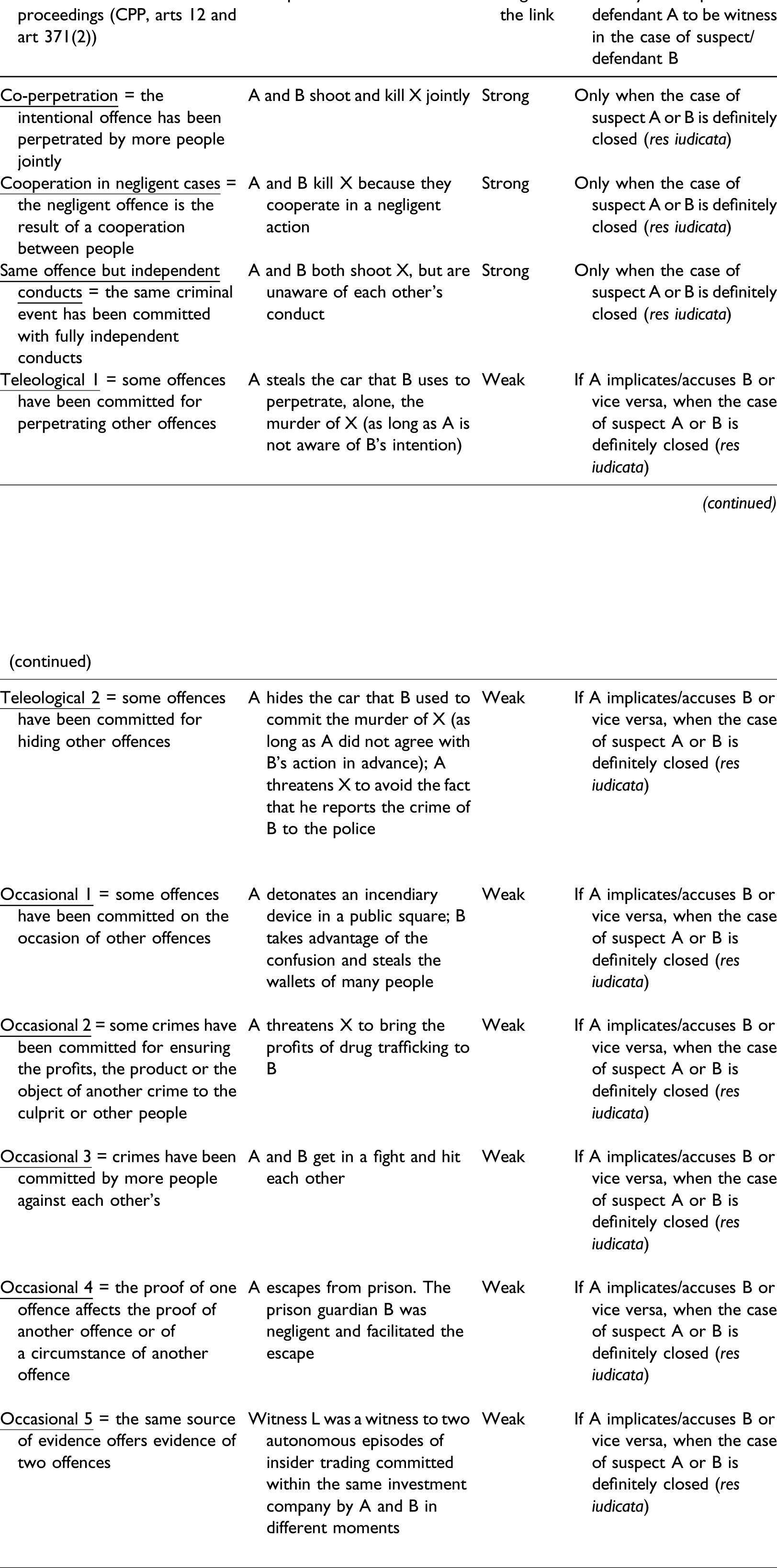
The right to silence in Italy finds a specific limitation concerning statements against the responsibility of others (declarations contra/erga alios). Until 2001, suspects/defendants always had the right to remain silent when questioned on the responsibility of others. This caused public outcry when, in several high-profile cases against organised crimes, suspects who had given statements implicating others during the investigations later remained silent at trial. The situation was worsened by the principle – still in force – that precludes the trial judge from having access to and making use of the pre-trial statements of defendants in connected proceedings who refuse to testify at trial. 132
To counter this situation, in 2001 the legislature passed a reform to reduce the scope of the right to silence for statements concerning the criminal liability of others. 133 The logic is that suspects/defendants who accuse others should take responsibility for their statements and should not be permitted to later ‘hide’ behind the right to silence. The new rules require that suspects/defendants be informed from the outset that they have the right to remain silent but that, if they choose to speak and implicate others, they will then become witnesses in the case against those they have implicated. 134
There is an exception to the rule: a suspect/defendant cannot – until their case is closed – be a witness in the case of a person who is charged with the same offence (a co-perpetrator, or someone who was jointly involved in the same negligent crime) or who is accused of conduct which caused the same criminal event. 135 The rationale is based on the idea that, in these cases, the allegations against the two suspects/defendants are so inextricably linked that it is impossible for one to speak of the conducts of the other without affecting his/her own position. The legislature believes that in all other cases it is possible to draw a line of demarcation between the allegations against the suspect/defendant and against others.
An example can assist in better explaining the provisions. If the suspect/defendant is accused of a bank robbery and, during the questioning, they claim that the robbery was perpetrated by X, they cannot be a witness against X, unless their case is closed. Likewise, if the suspect/defendant admits to the bank robbery but implicates X as a co-perpetrator, they cannot be a witness against their accomplice so long as their case is open. Imagine now the different scenario of a suspect/defendant accused of a bank robbery who, during the interview, reveals that the car used for the bank robbery was stolen by X. Because the theft of the car is a different offence from the bank robbery, the suspect/defendant becomes a witness in the case of X concerning the theft of the car. In short, suspects/defendants are entitled to an unconditional right to silence concerning the facts alleged against them, but they are entitled to a conditional right to silence concerning allegations against others for connected facts.
When suspects/defendants of offences connected to those of others take the role of witnesses, they are heard with special safeguards: they are assisted by a lawyer (which is normally not the case for witnesses) and they have a right not to answer questions concerning the facts alleged against them (unless they have been finally acquitted in their case or they have been finally convicted and have admitted to the charged offences). 136 For the rest, the provisions concerning witness testimony apply – there is an obligation to tell the truth and refusing to answer or declaring false information amounts to an offence (false testimony or false declarations to the public prosecutor). 137
The 2001 reform has been much criticised. The strongest objection is based on the nullification of the right to silence, in that these rules would limit the suspect’s freedom in their choice of a defensive strategy. Many lament that this sacrifice is done exclusively to further prosecutorial interests. 138 Furthermore, the criticism was raised that the difference between a strong and a weak connection is purely theoretical and practically untenable and that the entire regime depends on the charging decisions of the prosecutor. There may well be cases where the positions of two suspects/defendants are fully intertwined despite there being a weaker connection between the offences charged. Moreover, it is observed that those who become witnesses in the case of others are forced to confirm their original account more than they speak the truth, hence defying the purpose of ensuring that the witness gives a truthful and reliable account of facts. It could even be argued that the current regime incentivises defendants to remain silent to avoid ever being compelled to speak the truth.
The negative legal consequences of the exercise of the right to silence
The scholarship is unanimous in stating that any form of negative assessment of or adverse inference stemming from the suspect/defendant’s silence is impermissible in that it nullifies a constitutional right. 139 This – according to the majority of the scholarship – holds true not only with reference to the trial judgement, but also with regard to any other decision during the proceedings (for instance, on pre-trial custody or on intrusive investigative acts). 140
The case law recognises that the exercise of procedural rights by the defendant cannot be viewed negatively. 141 A careful analysis of the case law offers, however, a varied picture: judges do not always remain indifferent to silence.
Silence as evidence of guilt at the trial stage 142
The Grand Chamber (Sezioni Unite) of the Court of Cassation held that trial judges are allowed to draw inferences from the behaviour of the defendant during the proceedings. 143 The drawing of such inferences, however, should never undermine the right to defence in its substance or reverse the burden on proof that lies on the prosecutor. 144 Moreover, the defendant’s behaviour (including silence) must always be assessed together with other evidence or relevant elements. 145 Assessment of silence is thus allowed by the case law, albeit to different extents.
Courts have distinguished between different uses of silence. Taking the defendant’s silence during questioning (or the defendant’s refusal to be questioned at trial) as evidence of guilt is prohibited as it would violate the onus probandi rules. 146 Silence can never be used to fill the gaps of an insufficiently substantiated accusation. 147 However, already some decades ago the Court of Cassation took the position that a judgement of guilt could be based on evidence which was ‘objectively corroborated’ by the defendant’s silence. 148 It was not clear what the Court meant here. 149 In later cases, the Court tried to clarify the issue by stating that the defendant’s silence is not evidence (prova) but it can be a means to interpret other evidence (argomento di prova). 150 This has led the courts to hold that silence can be assessed in a residual and complementary manner, always together with probative accusatory elements that have an unequivocal meaning and would be sufficient in themselves to ground a conviction. 151 In these cases, silence does not have an autonomous probative meaning. The Supreme Court has quashed judgements that had gone beyond this approach in assessing the weight of silence. 152
The weight of inferences seems to be more substantial when the defendant fails to provide alternative exculpatory explanations in the face of potentially inculpatory evidence. In this line of case law, it is said that silence is not incriminating evidence as such, but courts can draw inferences from the defendant’s silence, particularly on potentially exonerating issues. 153 Failure to offer an alternative explanation of the events can represent an implicit validation of the existing evidence. 154 A perfect example is a case concerning the offence of aiding a dangerous individual to escape justice. The individual-at-large was found hiding in an empty building with a plastic bag full of supplies. Sometime before, the suspects had been seen entering the building with a large plastic bag, with their telephones switched off for the period in which they remained in the building. The defendants did not clarify the reason for their behaviour. The Court of Cassation upheld the conviction of the lower courts. Although silence is to be generally considered as ‘neutral’, it can gain importance in the context of other accusatory elements in the case. 155 The Court also clarified in another judgement that in such cases judges are not required to verify possible alternative hypotheses to the one advanced by the prosecutor. 156 In this last strand of cases, the weight of the adverse inference drawn from silence is heavier, resembling more a sort of ‘punitive’ approach toward the defendant’s silence.
It is difficult to establish to what extent this line of interpretation infringes upon the right to silence. When the fact-finding leading to a conviction is based on evidence and the reference to silence is of little value, being only a mere additional argument to further substantiate the conclusion, it could be argued that the right to silence does not suffer harm. 157 If this is the case, the question arises as to why the courts feel the need to mention the defendant’s silence as an argument in their reasoning, when it would seem to be redundant. It could be said that the courts mention it only for reasons of thoroughness. Nonetheless, it is a very fine line which separates such cases from situations where silence has been used to corroborate a finding of guilt where the main evidence was not entirely sufficient to prove guilt beyond reasonable doubt. Unsurprisingly, the principle of free interpretation of evidence is a leitmotiv in the case law concerning inferences from silence. 158 However, putting too much emphasis on the principle of free interpretation of evidence gives rise to the suspicion that the courts might sometimes be undermining the right to silence. 159
When drawing inferences from silence, the courts sometimes argued their conclusion by referring to the case law of the European Court of Human Rights, particularly Murray v United Kingdom. 160 This reference to justify inferences from silence is, however, misplaced. The Murray case concerns a jurisdiction where negative inferences from silence are provided for by the law, while in Italy this is not the case. The European Convention on Human Rights itself states that the less favourable guarantees provided by an international source cannot be invoked to limit the rights recognised at the national level. 161
Silence and sentencing
Courts have different views on the weight that the defendant’s silence can have on sentencing. Part of the case law has recognised that the exercise of the right to silence can be taken into account at the moment of sentencing as a negative element. 162 The legal basis for this would be the provision of the Criminal Code that empowers the judge to assess the dangerousness of the culprits – to be deduced, among others, from their behaviour after the commission of the crime. 163 Another strand of case law, however, refuses to draw such negative consequences, arguing that they would undermine the exercise of a constitutional right. 164
Equally debated is whether silence can play a role in precluding the mitigation of the penalty. The Criminal Code empowers the judge to discretionally reduce the penalty on the basis of non-codified (‘generic’) mitigating circumstances. 165 Can courts consider the defendant’s cooperative behaviour during the proceedings as a mitigating factor? Does silence preclude such mitigation of penalty? In 2012, the Court of Cassation (Grand Chamber) held that the right to remain silent and the possibility of lying do not allow the defendant to maintain ambiguous and misleading conduct during the proceedings. All parties must respect a principle of procedural integrity and the violation of this principle by defendants can be taken into account by the judge. 166 Other judgements have plainly held that the court can refuse to recognise the existence of generic mitigating circumstances due to the defendant’s silence, 167 in that it shows the persistent intent of the accused to offend. 168 More recently, the Court of Cassation has nevertheless stated that this is impermissible since the exercise of a procedural right cannot entail negative consequences. 169 In other cases, the courts draw a difference between the confession, which could be taken into account as a mitigating circumstance, 170 and silence, which does not per se preclude any mitigation. 171
In the past, silence has also been considered as a reason for rejecting the conditional suspension of the punishment. 172 The Court of Cassation has recently changed its approach by stating that the lack of confession cannot justify such denial. 173
Silence in the proceedings of application of pre-trial custody and other pre-trial measures
For several years after the introduction of the new code, silence was often one of the reasons to justify an order of pre-trial custody. Suspects/defendants were sometimes put and kept in pre-trial detention until they had confessed to the crime or at least offered some reconstruction of the alleged offence. 174 The uncooperative behaviour of suspects/defendants who remained silent was considered an element pointing to their dangerousness, which justified continued detention. In other cases, judges considered the suspect/defendant’s refusal to give evidence as an interference with the investigation which hampered the gathering of truthful and reliable evidence. The case law had de facto introduced an obligation for the suspect to cooperate in the investigations to avoid detention. 175 The parliament reacted by passing a law with the explicit goal of putting an end to such (ab)uses which forced the suspect to speak. 176 The new act in the CCP clarified that in no case could the refusal of the suspect to speak be considered as a threat to the collection of (reliable) evidence. 177
Scholars have criticised the reform for its narrow scope, 178 in that the 1995 law does not explicitly state that the suspect’s silence can never be taken into account to justify detention. They consider it dangerous that the prohibition against using silence only refers to justifying the risk to the collection of sufficiently reliable evidence. 179 Silence could in fact still be used to find that there is serious evidence of guilt against the suspect – a precondition for detention – or it could be used to assess the risk of fleeing and recidivism. For this reason, they argue that silence should hold no relevance in the whole proceedings concerning the application or maintenance of pre-trial custody or other precautionary measures restricting personal liberty. 180
After the reform the case law has endorsed views of greater protection of the right in the imposition of pre-trial custody. The courts have clarified that the suspect/defendant’s exercise of the right to silence – as well as their non-cooperation and refusal to be questioned – should not be used as an element to establish the existence of serious elements of guilt. 181 The courts have also held that silence does not allow the inference that there is a risk the suspect may, inter alia, commit other crimes. 182
Silence in proceedings for the compensation of unjust pre-trial detention
One important negative consequence attached to the exercise of the right to silence in questionings is that it can preclude compensation for the unjust pre-trial detention suffered. Compensation is given when suspects/defendants are placed in pre-trial detention and later acquitted, or when the courts later find that there was a violation of the law when issuing (or maintaining) the custodial order. 183 The law provides that suspects/defendants have no right to compensation if they contributed, with intentional or grossly negligent behaviour, to the issuing or maintaining of the custody. This can happen, for instance, when the suspects/defendants falsely accuse themselves. Likewise, the fact that the suspect/defendant made a false declaration – which was used against them to apply pre-trial detention – precludes access to compensation. 184 The courts have held that also remaining silent during the proceedings could contribute to one’s own detention by precluding the discovery of information that would have justified immediate release – or the non-application of pre-trial custody – or that would have led to a different interpretation of the existing evidence. 185 For instance, if the suspects remain silent during all the investigative questionings even when confronted with incriminating evidence, and if it is only later at trial that they raise an alibi, they will not be awarded compensation for the pre-trial detention endured. 186
The case law has clarified that, in principle, silence alone cannot preclude compensation, unless the suspect was silent on specific information that – unknown to the authorities – was suitable to provide a logical explanation to undermine the probative value of the evidence on which the pre-trial detention was based. The case law has come to state that there is an onus on the suspect/defendant to share this type of information which may have made the authorities reconsider the elements on which the pre-trial custody order was based. 187
The scholarship has underlined that it is essential to use caution when assessing serious negligence. It is in fact necessary to consider the motivations behind the silence and whether the exercise of such silence could be ‘reprehensible’: for example, when silence was exercised to avoid implicating a family member or when the accused was coerced into remaining silent. 188
The positive consequences attached to cooperation
The Italian system does not refrain from seeking the cooperation of the suspect/defendant. 189 The law has established a number of incentives, rewards, and benefits to encourage suspects/defendants to offer their contribution of knowledge.
One way to incentivise cooperation is by offering benefits to the suspects/defendants who confess. Judges tend to value confession as a mitigating factor. 190 A point of contention is whether the rules on negotiated pleas (patteggiamento) can constitute a way by which to induce a waiver of the right to silence. The defence can strike a deal with the prosecution on the outcome of the case, which is later submitted to the control and validation of a judge. The conclusion of such an agreement does not constitute, from a formal point of view, an admission to the crime, although several authors do not hesitate to call it a form of implicit confession. 191 The possibility is not remote that such negotiations are used by prosecutors for obtaining the cooperation of suspects. 192
The legislature has also recently introduced the possibility for perpetrators to obtain an acquittal by restoring all damages and adverse consequences caused by the crime. 193 While this possibility seems to be less prone to abuses which aim at forcing the suspect to speak, it further denotes that the legislature seeks the suspect/defendant’s cooperation.
Some provisions explicitly pursue the cooperation of the suspect/defendant. The legislature provides for mitigating circumstances that substantially diminish the sentence in cases where the suspect/defendant offers active and fruitful cooperation in stopping the commission of the crimes, provides help in the collection of evidence or the identification of the perpetrators, or similar acts of cooperation, depending on the case. The most renowned examples are those concerning terrorism 194 and mafia crimes. 195 This is also the case with regard to the crimes of facilitating illegal immigration, 196 drug-related crimes, 197 corruption, and other crimes committed by public officials against the public administration. 198
Some of these reductions are tied to the specific rules concerning the conditions of cooperation, the so-called legislation on ‘pentiti’. 199 These rules set out the conditions for the protection of individuals who offer to cooperate with judicial authorities in the context of crimes such as those committed for terrorist purposes or to subvert the constitutional order, and other very serious offences such as mafia crimes and the crimes relating to the exploitation of minors for prostitution and pedo-pornography. 200 The most important form of cooperation is the giving of statements that are reliable and relevant for the unfolding of the investigation or the decision on criminal responsibility.
A reward for cooperation is the other side of punishing non-cooperation. For this reason, many scholars argue that these incentives to speak infringe upon the right to silence and the freedom of self-determination. 201 However, others take a different view, emphasising that recognising a right to silence does not entail that cooperation cannot have positive consequences. On the one hand, they observe that promoting collaboration has proved useful in the fight against terrorism and mafia. On the other, they argue that reward and punishment cannot be equated, because if one is rewarded for a behaviour, this does not take away the freedom to act, which is instead curtailed by punishment. 202
The Directive 2016/342 on the presumption of innocence and the right to be present at trial
Although the deadline for the transposition of Directive 2016/342 on the presumption of innocence and the right to be present at trial 203 expired in April 2018, the Directive has not yet prompted any changes in Italy. This is not to suggest that the government and the parliament believe national law to be already compliant with the European rules – on two different occasions the parliament has taken steps towards the Directive’s implementation.
The Directive was first included in the Legge di delegazione Europea (the law that empowers the government to transpose EU directives) for the years 2016–2017. 204 However, with no governmental measure following suit the delegation of powers eventually expired. Towards the end of 2020 the implementation of the Directive resurfaced in the political debate, with many criticising the political standstill on such a crucial element of the criminal justice system. 205 The new Legge di delegazione Europea for the years 2019–2020, approved this year, delegates the government, for a second time, to transpose the Directive and draft the implementation provisions. 206 This time it is most likely that the government will adopt implementing rules, particularly with regard to arts 4, 5 and 10 of the Directive.
Dramatic changes are not to be expected concerning the regulation on the right to silence. The political debate is focused more on those provisions of the Directive that deal with public references to guilt. However, when transposing Directive 2016/342, the Italian government will also need to carefully assess the possible tensions between the Italian legal framework concerning the right to silence and art 7 of the Directive. If art 7(5) is interpreted so as to afford the maximum scope of protection of the right to silence, 207 some areas might deserve attention: for instance, the case law that seems to possibly allow the use of a suspect/defendant’s silence to draw some types of adverse inferences (especially when the defendant does not provide alternative explanations to inculpatory evidence) and the proceedings for the compensation of unjust pre-trial detention. 208
Conclusion
The right to silence is a right that stems directly from the protection offered by the Constitution to the right of defence. Much debate revolves around the extent to which the right deserves to be safeguarded. Although the majority of scholarship favours the broadest extension of the right possible, this view is not endorsed unanimously. The legislature has introduced some limits, the most important being that which confines the right to silence to the facts concerning one’s own responsibility, save for exceptions. 209 The courts, in turn, have taken a softer approach in the protection of the right to silence, which may allow the possibility of using the suspect/defendant’s silence to draw adverse consequences. Such inferences may acquire a worrying weight when the defendant does not provide alternative explanations to inculpatory evidence.
Another risk for the protection of the right to silence derives from the rules that encourage the cooperation of suspects. Such an approach is a more subtle form to counter the choice of suspects to remain silent. The offer of benefits and rewards for cooperation could discourage the exercise of a constitutional right. The scholarship sees here the classic ‘wolf in sheep’s clothing’, with the traditional inquisitorial approach (aimed at the confession of the suspect) taking the guise of a friendly (‘sweet’) inquisition that sides with the suspect. 210
Although the Italian system offers comparatively strong protection to the right to silence, it nonetheless leaves some openings that undermine the effectiveness of the right: it can be exposed to attacks from inside the procedural system itself. This opens up the possibility of an erosion of the right, which could not always be adequately countered. The uncertainty with the possible negative consequences also may represent a problem and it can alter the effective freedom of self-determination in the choice between remaining silent or speaking. It would first be necessary to remove all remaining ambiguities as to whether and to what extent the exercise of silence can have negative consequences. The situation is paradoxical: on the one hand, the cautioning seems to suggest that silence does not bring about any negative consequences (beside the possibility to become a witness concerning statements against others); on the other, such consequences do exist.
Finally, it is of note that in Italy there is a lack of a system of redress for blatant violations of the right to silence. When provisions concerning the right to silence are violated, the law provides for the exclusion of the relevant statements made by the suspect (or their invalidity in cases of coercion or other violations of the rights of defence). However, this remedy alone can be insufficient in many ways. Suspects can be questioned a second time with the respect of all procedural rules. The case law insists that, here, the new interrogation is perfectly valid because it is disconnected from the first interrogation where the suspect’s rights were infringed. This approach is clearly unsatisfactory and runs the risk of undermining the position of the suspect for the entire proceedings. More generally, the courts object to the adoption of the fruits of the poisonous tree doctrine, which in some cases could offer more adequate redress. 211 For egregious violations, even the possibility of halting the proceedings should be considered.
Compensating for the possible side effects of the rules on cooperation, removing some negative consequences of silence (particularly in proceedings for unjust detention) and the strengthening of remedies are the main fronts where the Italian system can still improve its otherwise fairly exhaustive regime on the protection of the right to silence.
Footnotes
Declaration of conflicting interests
The author(s) declared no potential conflicts of interest with respect to the research, authorship, and/or publication of this article.
Funding
The author(s) disclosed receipt of the following financial support for the research, authorship, and/or publication of this article: European Commission Justice Programme (grant no: 802102).
1.
Codice di Procedura Penale, DPR 22 Settembre 1988, n 447 (CCP).
2.
On the topic, see, e.g., Giulio Illuminati, ‘The Frustrated Turn to Adversarial Procedure in Italy (Italian Criminal Procedure Code of 1988)’ (2005) 4 Washington University Global Studies Law Review 567; Michele Panzavolta, ‘Reforms and Counter-Reforms in the Italian Struggle for an Accusatorial Criminal Law’ (2004) 3 North Carolina Journal of International Law 577.
3.
Costituzione della Repubblica Italiana (1947) (Costituzione).
4.
Ibid, art 111.
5.
For more details on this history, see Vittorio Grevi, ‘Nemo tenetur se detergere’: Interrogatorio dell’imputato e diritto al silenzio nel processo penale italiano (Giuffrè, 1972) 5–59.
6.
Ibid 6–7.
7.
Codice di Procedura Penale pel Regno d’Italia, 8 Settembre 1807, art 204.
8.
Grevi (n 5) 24–25.
9.
Codice di Procedura Penale pel Regno d’Italia, art 208. As noted by ibid 26ff, similar provisions were then introduced in other following Italian codes (Italy was still divided in several states with different codes until 1865).
10.
Codice di Procedura Penale Italiano, RD 27 Febbraio 1913, n 127, art 261(2); Grevi (n 5) 30–36.
11.
Codice di Procedura Penale, RD 19 Ottobre 1930, n 1399 (Codice Rocco).
12.
Ibid, art 367(2).
13.
Legge 5 Dicembre 1969, n 932.
14.
Codice Rocco, art 78(3).
15.
Grevi (n 5) 1–3.
16.
The CCP makes a distinction between the suspect (indagato) and the accused/defendant (imputato). A person becomes an indagato as soon as suspected of being involved in a crime. The indagato becomes imputato when formal charges are raised by the public prosecutor at the end of the investigations, when the trial phase starts (CPP, art 60).
17.
This has been confirmed by established case law of the Constitutional Court (e.g., Corte cost., sentenza 4 Aprile 1973, n 34 and Corte cost., ordinanza 6 Marzo 2019, n 117) and by the scholarship (e.g., Grevi (n 5) 49–50).
18.
Costituzione, art 24(2).
19.
E.g., Oliviero Mazza, L’interrogatorio e l’esame dell’imputato nel suo procedimento (Giuffrè, 2004) 42ff.
20.
Vania Patanè, Il diritto al silenzio dell’imputato (Giappichelli, 2006) 102, 104.
21.
Costituzione, art 2. See, e.g., Mazza (n 19) 28 and Paolo Moscarini, ‘Silenzio dell’imputato (diritto al)’, in Enciclopedia del diritto. Annali, vol 3 (Giuffrè, 2010) 1082.
22.
Ibid, art 27(2). On this, see, e.g., Patanè (n 20) 104–105 and Moscarini (n 21) 1083.
23.
E.g., Mazza (n 19), 47–48.
24.
E.g., Patanè (n 20) 3.
25.
CCP, art 198(2).
26.
E.g., Mazza (n 19) 50 fn 148.
27.
CCP, art 256.
28.
For example, Silvia Signorato, Le indagini digitali. Profili strutturali di una metamorfosi investigativa (Giappichelli, 2018) 238.
29.
CCP, art 266(2) and (2 bis) allows the interception of communications between those present by means of malware installed on a mobile electronic device. While the Code allows the use of malware to overhear conversations through the microphone of the device, the case law also allows the use of the keylogging function (on this, see, e.g., Corte di Cassazione (Cass), sez IV, sentenza 28 Giugno 2016, n 40903, Grassi e altri, CED Cassazione, Rv 268228). All judgements identified hereafter with a ‘Rv’ number can be found on CED Cassazione at  .
.
30.
E.g., Patanè (n 20) 88; Moscarini (n 21) 1083.
31.
CCP, art 64(3)(b); Codice Penale, RD 19 Ottobre 1930, n 1398, art 66(1) (CC).
32.
Witnesses commit a crime if they fail to speak the truth when questioned by the prosecutor (CC, art 371bis) or when testifying in court (CC, art 372).
33.
On the debate, see Grevi (n 5) 48ff.
34.
Cass, sez I, sentenza 9 Novembre1982, n 11956, De Lucia, Rv 156677; Cass, sez V, sentenza 3 luglio 1986, n 11369, Scaravella, Rv 174037.
35.
Mazza (n 19) 69–70 and Oliviero Mazza, ‘Interrogatorio dell’imputato’ in Enciclopedia del diritto. Annali, vol 3 (Giuffrè, 2010) 727–728. Sergio Sottani, ‘Silenzio (diritto al)’, in Alfredo Gaito and others (eds), Digesto delle Discipline Penalistiche (UTET 2013, 7th ed) 557 considers this active self-defence as a scriminante, a ground for excluding criminal responsibility based on the lawfulness of the behaviour.
36.
E.g., Mazza (n 19) 65ff; Patanè (n 20) 91ff.
37.
Moscarini (n 21) 1086.
38.
Inter alia, Cass, sez VI, sentenza 5 Novembre 2002, n 9929, Tummarello, Rv 223946.
39.
CC, art 368 (reato di calunnia).
40.
CCP, arts 350 and 370.
41.
CCP, art 350(1)–(4).
42.
A 2000 law (legge 7 Dicembre 2000, n 397) introduced in the Italian system the possibility for defence lawyers to conduct investigations in the interest of their clients.
43.
CCP, art 391 bis(3). For witnesses, such silence can be overcome by the defence lawyers asking the public prosecutor or the judge to question the person: ibid, art 391 bis(10) and (11)). In such cases, only the nemo tenetur principle will apply. The separate regime for these interviews is criticised by Patanè (n 20) 199–200, as creating an unequal treatment between public and private investigations.
44.
Corte cost., ordinanza 10 Maggio 2019, n 117.
45.
CJEU, Judgement of 2 February 2021, DB v Commissione Nazionale per le Società e la Borsa (Consob), Case C-481/19, ECLI:EU:C:2021:84.
46.
Corte cost., sentenza 13 Aprile 2021, n 84.
47.
See infraThe scope of application of Articles 64 and 65.
48.
Costituzione, art 13(4).
49.
Moscarini (n 21) 1082.
50.
CPP, arts 375–76.
51.
Alberto Camon, ‘Le prove’, in Alberto Camon and others (eds), Fondamenti di procedura penale (CEDAM, 2020) 292. Mazza (n 40) 719, 724–25 considers it also in contradiction with the right to silence itself: the suspect cannot avoid the commencement of the questioning.
52.
E.g., Oreste Dominioni, ‘Commento agli art. 64 e 65 c.p.p.’, in Ennio Amodio and Oreste Dominioni (eds), Commentario del nuovo codice di procedura penale, vol I (Giuffrè, 1989) 402.
53.
CPP, art 64(1). The term 'pre-trial detention' will be used in this article to identify all forms of restrictions of liberty before a final conviction.
54.
Ibid, art 64(2).
55.
E.g., Corte d’Assise di Caltanissetta, sentenza 28 Aprile 1999, Cosca, Foro italiano, 2000, II, c 248 s.
56.
E.g., Corte d’Assise d’Appello di Salerno, sentenza 16 Dicembre 2016, n 5275, Cassazione Penale (2018), 944; Corte d’Assise d’Appello di Roma, sentenza 27 Aprile 1956, Sciortino ed altri.
57.
Camon (n 51) 291–92.
58.
Mazza (n 35) 723.
59.
Camon (n 51) 292.
60.
CCP, art 64(2).
61.
Similarly, Patanè (n 20) 32–33. See also, e.g., Mazza (n 35) 722 and (n 19) 33–34; Paolo Marchetti, ‘L’uso processuale dei test di memoria autobiografica tra nuove tecnologie e antiche aspirazioni. A proposito di una recente sentenza della Corte di appello di Salerno’ (2018) 58(3) Cassazione Penale 948.
62.
With regard to the trial stage, see CCP, art 188.
63.
Ibid, art 189.
64.
E.g., Mazza (n 19) 36–7. CCP, art 191(1) states that the evidence collected in violation of the prohibitions provided by law cannot be used in the proceedings.
65.
CCP, art 191(2-bis).
66.
E.g., Patanè (n 20) 185–186; Mazza (n 19) 123; Giovanni Conso and Giulio Illuminati, Commentario breve al codice di procedura penale (CEDAM, 2015), arts 63 e 64.
67.
The fact that the suspect has already received the caution in another previous interrogatorio does not entail that the authority does not have to repeat it: e.g., Mazza (n 35) 733.
68.
CCP, art 64(3)(a).
69.
Ibid, art 66(1).
70.
Ibid, art 64(3)(b).
71.
Ibid, art 64(3)(c), except for the incompatibilities to testify and taking into account the guarantees provided by the law.
72.
Cass, sez II, sentenza 19 Giugno 1992, n 2980, Capasso, Rv 193122–01. In the scholarship, see, e.g., Mazza (n 35) 733–734.
73.
Mazza (n 35) 733; Carlo Bonzano, L’interrogatorio investigativo (CEDAM, 2012) 85.
74.
E.g., Mazza (n 19) 126; Patanè (n 20) 185, fn 90.
75.
Directive 2012/13/EU of the European Parliament and of the Council of 22 May 2012 on the right to information in criminal proceedings, OJ L 142, 1.6.2012, which has been transposed by Dlgs 1 Luglio 2014, n 101.
76.
CPP, arts 293(1)(d) and art 386(1)(d) and (1bis), as amended by the Dlgs 1 Luglio 2014, n 101.
77.
They will become definitive only at the end of the investigations, that close the pre-trial stage.
78.
CPP, art 65(1). See Cass, sez 1, sentenza 6 Aprile 1993, n 1489, Cafari e altri, Rv 193980–01. Since no motivation is required to omit the sources of evidence, the scholarship has underlined that to check on the compliance to this provision of prosecutorial discretion is difficult: Mazza (n 35) 744.
79.
Cass, sez IV, sentenza 23 Novembre 2000, n 13273, Magaddino, (2001) Archivio della nuova procedura penale, 344. See the section Protection Through Remedies for Breaches of the Provisions Protecting the Right to Silence.
80.
See, e.g., Cass, sez III, sentenza 19 Novembre 2014, n 5738, Pompei e altro, Rv 262415–01.
81.
CPP, art 178(1)(c) (nullità intermedia). Cass, sez I, sentenza 14 Ottobre 2015, n 5758, Binni, Rv 265995–01. For a more tolerant approach, see: Cass, sez III, sentenza 19 Novembre 2014, n 5738, Pompei, Rv 26241. See infra Protection through remedies for breaches of the provisions protecting the right to silence.
82.
CPP, art 350(1) refers only to art 64.
83.
Mazza (n 35) 746–47.
84.
CCP, art 65(2).
85.
See, e.g., Massimo Ceresa-Gastaldo, Il ‘processo alle società’ nel d.lgs. 8 giugno 2001, n. 231 (Giappichelli, 2002) 29; Massimo Ceresa-Gastaldo, ‘Processo penale e accertamento della responsabilità amministrative degli enti: una innaturale ibridazione’ (2009) 49(5) Cassazione Penale 2232.
86.
See infra, Protection through the defence lawyer’s presence, fn 107.
87.
CPP, art 350(5).
88.
Ibid, art 350(6).
89.
E.g., Moscarini (n 21) 1088–89.
90.
Ibid,1089.
91.
CCP, art 374.
92.
Ibid, art 350(7).
93.
Ibid, art 374.
94.
Ibid, art 134.
95.
Ibid, art 65(3).
96.
Ibid, art 65(3).
97.
Mazza (n 35) 747.
98.
CCP, art 141 bis(1).
99.
Ibid, art 134(4).
100.
E.g., Cass, sez II, sentenza 3 Luglio, n 39474, Rv 260785–01, Acquavite e altri.
101.
CPP, arts 294(4) and 391(1).
102.
Ibid, art 179(1) (nullità assoluta).
103.
Ibid, art 350(3).
104.
Ibid, art 350(5).
105.
Ibid, art 391bis (5).
106.
Ibid, art 364(3)–(4).
107.
Ibid, art 364(5).
108.
Ibid, art 63(1).
109.
Ibid, art 63(2). According to the Sezioni Unite (Grand Chamber, sez. un.) of the Court of Cassation, the ban on the use of these statements does not apply to those declarations that involve those accused of crimes that have no procedural link with the crime object of the proceedings, being in a position of total extraneity and indifference. With respect of these crimes, the declarant would anyway have become a witness so there has been no deprivation of guarantees: Cass, sez. un., sentenza 9 Ottobre 1996, n 1282, Carpanelli ed altri, Rv 206846–01.
110.
Cass, sez I, sentenza 21 Febbraio 2017, n 46566, 21 February 2017, M ed altri, Rv 271230–01.
111.
Mazza (n 35) 725.
112.
CPP, art 62.
113.
Corte cost., sentenza 23 Marzo 1993, n 237. See, e.g., Luca Marafioti, Scelte autodifensive dell’indagato e alternative al silenzio (Giappichelli, 2000) 121.
114.
Mazza (n 19) 124; Mazza (n 35) 734.
115.
Vittorio Grevi, ‘Prove’ in Giovanni Conso, Vittorio Grevi and Marta Bargis (eds), Compendio di procedura penale, CEDAM 2014, 331ff.
116.
CCP, art 64(3 bis).
117.
Ibid. If the caution has not be given to the suspect/defendant in a connected or linked proceedings, the statements are not to be used unless the situation of incompatibility to testify, where this has not emerged from the file, was deducted before the esame (Cass, sez 5, sentenza 23 Gennaio 2019, n 13391, Bazzurri, Rv 275624–01).
118.
On the debate, see, inter alia, Patanè (n 20) 205.
119.
Cass, sez III, sentenza 20 Dicembre 2018, n 1914, T, Rv 274343–01.
120.
Cass, sez I, sentenza 17 Marzo 2016, n 25613, Almagasbi, Rv 267121–01.
121.
On the debate, see, e.g., Patanè (n 20) 204 and Mazza (n 19) 133–35.
122.
CCP, art 65(1).
123.
Ibid, art 178(1)(c) (nullità intermedia).
124.
Cass, sez I, sentenza 14 Ottobre 2015, n 5758, Binni, Rv 265995–01. There are also cases where courts adopt a very tolerant approach, whereby the lack of information on the evidence is not considered problematic: Cass, sez III, sentenza 19 Novembre 2014, n 5738, Pompei, Rv 262415.
125.
CCP, arts 64 and 64, see supra The protection offered by Article 64 and 65: physical and moral freedom and The protection offered by Article 64 and 65: the cautioning and information on rights.
126.
Ibid, art 209(2).
127.
E.g., Sottani (n 35) 558–59; Moscarini (n 21) 1095. See the latter 1096–97 for a summary of the debate.
128.
For examples of the different views: Sottani ibid and Mazza (n 19) 306.
129.
CCP, art 503(5). Only the statements used for challenging can be used, not the entire pre-trial interview.
130.
Ibid, art 513(1).
131.
Sottani (n 35) 555.
132.
CCP, art 513(2).
133.
Legge 1 Marzo 2001, n 63, which amended the CCP, arts 63, 197 and 210.
134.
CPP, art 64(3)(c).
135.
Ibid, art 197(1)(a), which refers to art 12.
136.
CPP, art 197 bis (4), (5).
137.
See, e.g., Cass, sez VI, sentenza 13 Maggio 2008, n 33836, Pandico, Rv 240790–01.
138.
See, e.g., Giulio Illuminati, ‘L’imputato che diventa testimone’ (2002) Indice penale 387, 394.
139.
The following scholarship, e.g., agrees with this view: Patanè (n 20), 214, 217–218; Moscarini (n 21), 1093; Franco Cordero, Procedura Penale (Giuffrè, 2006) 254.
140.
E.g., Patanè (n 20) 34, 214–215, 217, 219.
141.
E.g., Cass, sez III, sentenza 26 Ottobre 1995, n 3654, Flamini, Rv 203941.
142.
143.
Cass, sez. un., 21 Ottobre 1992, n 1653, Marino ed altri, Rv 192469–01.
144.
Ibid. This has also been recently stressed in Cass, sez IV, sentenza 6 Novembre 2019, n 19216, Ascone, Rv 279246.
145.
Cass, sez II, sentenza 1 Marzo 2017, n 16563, Cazanave e altri, Rv 269507.
146.
Cass, sez III, sentenza 19 Settembre 2019, n 43254, C, Rv 2777259; Cass, sez VI, sentenza 27 Gennaio 2015, n 8958, Scarpa, Rv 262499; Cass, sez III, sentenza 19 Gennaio 2010, n 9239, B, Rv 246233; Cass, sez VI, sentenza 9 Febbraio 1996, n 3241, Federici ed altro, Rv 204546; Cass, Sez II, sentenza 28 Gennaio 2015, n 6348, Drago, Rv 262617.
147.
Sottani (n 35) 558.
148.
Cass, sez III, sentenza 1 Marzo 1982, n 5863, Di Bitetto, Rv 154201; Cass, sez VI, sentenza 5 Dicembre 1984, n 2283, Torreggiani, Rv 168222; Federici ed altro (n 146).
149.
On this ‘enigmatic’ formula, see Marafioti (n 113) 320.
150.
Drago (n 146); C (n 146).
151.
Marino ed altri (n 143); Ascone (n 144).
152.
Cass, sez I, sentenza 26 Ottobre 2011, n 2653, M, Rv 251828.
153.
Cass, sez I, sentenza 21 Aprile 2010, n 22651, Di Perna, Rv 247426; Cass, sez V, sentenza 14 Febbraio 2006, n 12182, Ferrara, Rv 233903.
154.
Drago (n 146).
155.
Cass, sez VI, sentenza 19 Giugno 2019, n 28008, Arena Giuseppe, Rv 276381. See also Cass, sez VI, sentenza 2 Luglio 2018, n 40347, Berlusconi e altri, (2019) Cassazione Penale 159. Similarly, also Cass, sez VI, sentenza 12 Novembre 2019, n 50542, Erario Gregorio Damiano, Rv 277682–01.
156.
Cass, sez III, sentenza 15 Luglio 2011, n 30251, Allegra, Rv 251313.
157.
This is, e.g., what happened in Ascone (n 151).
158.
Most recently, see Arena Giuseppe (n 155).
159.
Massimo Nobili, Il Principio del Libero Convincimento del Giudice (Giuffrè, 1974) 345.
160.
Murray v The United Kingdom, App n 14310/88 (ECtHR, 27 August 1991). Murray is also cited in Berlusconi e altri (n 155).
161.
Council of Europe, European Convention for the Protection of Human Rights and Fundamental Freedoms, 4 November 1950, ETS 5, art 53. See Mazza (n 35) 752.
162.
CC, art 133(2), nn 1 and 3. In the case law, see, e.g., Cass, sez I, sentenza 3 Marzo 1994, n 3819, Mannarino, Rv 196986; Cass, sez II, sentenza 27 Febbraio 1997, n 2889, Zampella, Rv 207560; Cass, sez VI, sentenza 16 Ottobre 1989, n 2218, Battaggia, Rv 183377.
163.
CC, art 133(2), n 3.
164.
See, e.g., Cass, sez V, sentenza 17 Gennaio 2020, n 17232, Boglione, Rv 279169–01; Cass, sez V, sentenza 14 Settembre 2017, n 57703, G, Rv 271894–01; Cass, sez III, sentenza 15 Marzo 1995, n 9781, Petrosino, Rv 202859–01.
165.
CC, art 62 bis.
166.
Cass, sez. un., sentenza 20 Settembre 2012, n 36258, Pg e Biondi, Rv 253152–01.
167.
CP, art 62 bis. See, e.g., Zampella (n 162).
168.
Cass, sez II, sentenza 10 Maggio 2019, n 27547, Barometro, Rv 276108.
169.
Flamini (n 141).
170.
This will not be the case, e.g., when confession is justified by utilitarian purposes such as mitigation of sentence rather than repentance (e.g., Cass, sez I, sentenza 5 Aprile, 2017, n 35703, Rv 271454–01, Lucaioli e altro) and when the cooperation has not facilitated the judgement on co-accused persons (Cass, sez I, sentenza 21 Marzo 2017, n 42208, Fondino, Rv 271224–01).
171.
Cass, sez III, sentenza 28 Dicembre 2015, n 50565, Rossi, Rv 265592–01.
172.
Cass, sez VI, sentenza 16 Febbraio 1984, n 4933, Rampuglia, Rv 164489–01.
173.
Cass, sez II, sentenza 25 Novembre 2015, n 4090, Tonti Donaggio, Rv 265713–01.
174.
Marafioti (n 113) 15ff.
175.
E.g., Patanè (n 20) 219–220.
176.
Legge 7 Agosto 1991, n 331.
177.
CCP, art 274(1)(a). The scholarship is divided on the consequences stemming from the violation of the rule: some argue that this would make the motivation of the custodial order deficient (see Patanè (n 20) 219ff).
178.
See, e.g., Alberto Camon, ‘Le Prove’, in Alberto Camon and others (eds), Fondamenti di procedura penale (CEDAM, 2020) 291.
179.
CCP, art 274 (1)(a).
180.
Patanè (n 20) 222–223.
181.
Scarpa (n 146) Rv 262499–01; B (n 146).
182.
Cass, sez V, sentenza 6 Luglio 2018, n 39523, Belfanti, Rv 273887.
183.
CCP, art 314.
184.
Cass, sez IV, sentenza 2 Dicembre 2020, n 36478, Gallo, Rv 280082.
185.
Among the most recent ones, Cass, sez IV, sentenza 27 Aprile 2018, n 24439, Stamatopoulou, Rv 273744–01. See also Cass, sez III, sentenza 2 Aprile 2014, n 29967, Bertuccini, Rv 259941–01.
186.
Cass, sez III, sentenza 11 Luglio 2017, n 51084, Pedetta, Rv 271419–01.
187.
Ibid; Cass, sez IV, 20 Maggio 2016, n 25252, Rv 267393–01, Ministero Economia Finanze ed altro. See also Cass, sez IV, sentenza 17 Novembre 2011, n 7296, Berdicchia, Rv 251928; Cass, sez III, sentenza 9 Novembre 2011, n 44090, Messina e altro, Rv 251325. More recently, Stamatopolou (n 185), which held that it is the burden of the suspect to adduce evidence to put forward arguments that could lead the competent judge to reach a different decision.
188.
Moscarini (n 21) 1101.
189.
Patanè (n 20) 144.
190.
See supra Silence and sentencing.
191.
Mitja Gialuz, ‘Applicazione della pena’, in Enciclopedia del diritto. Annali, vol 2 (Giuffrè, 2008) 24.
192.
Domenico Pulitanò, ‘Nemo tenetur se detegere: Quali profili di diritto sostanziale?’ (1999) Rivista Italiana Diritto e Procedura Penale, 1271; Federica Iovene, ‘La giustizia negoziata al confine tra modello inquisitorio e accusatorio: patteggiamento e verständigung a confronto’ (2013) Cassazione penale, 3282.
193.
CCP, art 162 ter, as amended by dlgs 28 Agosto 2000, n 274.
194.
CC, art 270 bis.1(3).
195.
Ibid, art 416 bis.1(3).
196.
Dlgs 25 Luglio 1998, n 286 (Testo Unico sull’Immigrazione), art 12(3quinquies).
197.
DPR 9 Ottobre 1990 n 309 (Testo Unico Stupefacenti), art 73(7).
198.
CC, art 323 bis.
199.
DL 15 Gennaio 1991 n 8 (Nuove norme in materia di sequestri di persona a scopo di estorsione e per la protezione dei testimoni di giustizia, nonché per la protezione e il trattamento sanzionatorio di coloro che collaborano con la giustizia), converted into law by Legge 15 Marzo 1991, n 82, modified by Legge 13 Febbraio 2001, n 45.
200.
Ibid, art 2(2).
201.
E.g., Patanè (n 20) 144.
202.
Bonzano (n 73) 31.
203.
Directive (EU) 2016/343 of the European Parliament and of the Council of 9 March 2016 on the strengthening of certain aspects of the presumption of innocence and of the right to be present at the trial in criminal proceedings, OJ L 65, 11 March 2016.
204.
Legge 25 Ottobre 2017, n 163.
205.
See, e.g., ‘Le parole di Gratteri dividono Parlamento e magistratura’, La Repubblica, 23 January 2021, 8.
206.
Legge 22 Aprile 2021, n 53.
207.
See Anna Pivaty, Ashlee Beazley, Yvonne Daly, Laura Beckers, Dorris de Vocht, Peggy ter Vrugt, ‘Opening Pandora’s box: The right to silence in police interrogations and the Directive 2016/343/EU’ in this Issue for the different possible ways in which art 7(5) may be interpreted.
208.
On this, see the analysis of Anna Pivaty, Ashlee Beazley, Yvonne Daly, Dorris de Vocht and Peggy ter Vrugt, ‘Strengthening the protection of the right to remain silent at the investigative stage: what role for the EU legislator?’ in this Issue.
209.
See supra The case of statements against others’ responsibility.
210.
Tullio Padovani, ‘La soave inquisizione. Osservazioni e rilievi a proposito delle nuove ipotesi di “ravvedimento”’, (1981) Rivista Italiana di Diritto e Procedura Penale 541.
211.
Michele Panzavolta, Contributo allo Studio dell’Invalidità Derivata nel Processo Penale (Aras, 2012) 309ff.