







Abstract
Rice is the staple diet of over half the population of the world at an estimated production volume of well over 800 million metric tonnes per month, the second largest produced cereal in the world. Rice grows from tropics to subtropical to warm temperature countries up to 400 S and 500 N of the equator. Four major environments are associated with rice growing as follows: irrigated, rain-fed lowlands, upland and flood prone. Fifty per cent of rice grown are consumed by China and India, and until a few years ago, the rice hulls (husks) resulting from hulling have been considered as agricultural waste and only used in a few small end applications. However, due to diligent research, the full potential of this valuable commodity is being realized and three significant products are being manufactured using this biomass – polymeric composite resins, polymeric lumber as an ideal substitute for natural wood, and more recently, rice hulls solid pellets as an alternative for diesel oil and coal as fuel for energy generation. While the first two are made from combinations of rice hulls flour and polymer resins, the last one is made by compression with suitable small quantities of additives primarily for adhesion. The dimensions and densities of these solid pellets can be varied to suit end applications and also to assist fuel feeding systems. When rice hulls solid pellets are used as fuel, they will generate ash in the combustion chamber and also flue ash which can be easily collected and both items can be successfully recycled. They can be used as filler for bricks, for roofing tiles, extraction of silica (>70%), fertilizer, chemical spill absorbents, filtration mediums and some others. The high content of silica in the ash will provide an enhanced moisture barrier for bricks and roofing tiles. A major end application is its usage as a component for the production of Portland cement. Rice hulls are also an ideal feedstock for producing bio-diesel, and for this purpose, thermochemical processes like pyrolysis and gasification can be used. This research study shows that rice hulls basically consisting of lignin polymer and 20% silica can be made into solid pellets and effectively used as an alternate fuel for petro-based diesel oil and coal for generation of energy. This emerging fuel from renewable sources can even replace the current usage of wooden pellets. Moreover, the resulting ash and flue ash from the combustion of rice hulls will have many viable end uses in industrial, commercial and chemical industries.
Introduction
In the context of generation of greenhouses gases, most of which is carbon dioxide (CO2) being released into the atmosphere causing global environmental issues, it is encouraging that many countries have been seeking alternate fuel sources for the generation of energy, other than the traditionally used diesel and coal, which produces high percentages of CO2. The use of biomass fuels to replace traditional petroleum-based feedstocks will result in the energy sector being one of the biggest beneficiaries.
Coal has been a reliable source of energy, but it comes with some inborn negatives. Mining coal is hazardous, and it is dirty to handle. The same chemistry that enables coal to produce energy – the breaking down of carbon molecules – also produces a number of harmful environment pollutants that even harm public health. When coal burns, the chemical bonds holding its carbon atoms in place are broken, releasing energy. However, other chemical reactions also occur, many of which carry toxic airborne pollutants into the environment.
Diesel engines like other internal combustion engines convert chemical energy contained in the fuel into mechanical energy. Diesel fuel is a mixture of hydrocarbons (HCs), which during an ideal combustion process would produce CO2 and water (H2O). Diesel exhaust gases are primarily composed of CO2 and H2O and the unused portion of engine charge air. The volumetric concentrations of these gases will vary. These concentrations will depend on the engine load, with the CO2 and H2O increasing and that of oxygen decreasing. Common pollutants include unused HCs, carbon monoxide (CO), nitrogen oxide (NOx) or particulate matter. Both fuels, coal and diesel, when used releases large amounts of CO2 into the atmosphere which is harmful.
Energy in many forms is one of the commodities most needed by humans, and the practice of using traditional materials, such as coal and diesel, has depleted the earth’s protective layer of ozone and scientific research studies have established this as one of the main causes for environmental concerns. Industrial use of these fuels is also a major contributing factor for climate changes due to air pollution. Constant research and development programmes have revealed that various forms of biomass can be used as alternate fuels for the generation of energy. Of emerging biomass fuels, wood pellets have become very popular, especially in North America and Europe, but at the expense of deforestation, which is again a factor with land erosion.
Rice hulls, on the other hand, are equally, if not, a better material to be used for fuel for generation of energy. They are available abundantly in many countries, and it is a gift of Mother Nature, and their ash residues after combustion with a high content of silica have many end applications as stated earlier. Rice hulls have been used as steam boiler fuel, for cooking, heating and so on in many Asian countries, but now they are emerging as solid fuels in many industrial applications, even very large energy-generating applications. This practice has advanced to a great extent in eastern countries such as China, Vietnam, Malaysia and others.
However, a huge expanding market exists for wood pellets. As an example, in Canada, Pinnacle Renewable Energy Company (Edmonton), with an annual production volume of over 1.5 million metric tonnes is now planning an additional annual production of 475,000 metric tonnes of wood pellets. This is in anticipation of expanding market demand covering North America and Europe, as more and more countries are taking advantage of the carbon neutrality of wood pellets. With many companies producing and exporting wood pellets, it is estimated that Canada’s revenue is around 300 billion dollars per annum. Japan and South Korea are the largest importers of wood pellets in Asia with around 650,000 metric tonnes per annum, while next in line are United Kingdom, Denmark and European countries. Vietnam was the biggest exporter of wood pellets to Asian countries, but with countries like Canada and Unites States of America coming in, their export volumes are a little lower now. Thus, the market for wood pellets is well-established as of now and growing rapidly, with the only drawback being deforestation, which is again an environmental hazard.
On the other hand, Asian countries having abundant resources of rice hulls from agricultural activity realizing the high potential of this valuable commodity from renewable resources have for some time now commenced on the production of solid rice hulls pellets which they successfully use for various industrial and commercial activities, including energy generation. China leading the way, many companies are offering small to heavy duty production machines for making rice hulls pellets, while some companies are manufacturers of complete pellet manufacturing plants and have installed them in African and Asian countries.
Rice hulls pellets will have a higher calorific value than wood pellets, although the carbon imprint will be slightly higher than wood but still under the threshold. Rice hulls and resulting ash have many end applications as already mentioned and can be used as an ideal reinforcing agent in the manufacture of fibre-cement corrugated or flat roofing sheets to replace asbestos-cement roofing sheets which most countries have banned. They can be used to produce polymeric lumber as an ideal substitute for natural wood. In the world, this composite lumber is gradually replacing the use of natural wood. This is a well-established trend especially in Asia and the far-eastern countries. The author has experimented with rice hulls in Sri Lanka and designed a feed-system for rice hulls as steam boiler fuel for projects setup by him.
What are rice hulls?
Rice hulls, also called husks or chaff, are the outermost hard layers (shells), convex in shape, protecting the rice grains inside. A process called milling will separate the grains and the husks and further processing will produce two types: rough and fine powder. As a major by-product of the rice milling industry, rice husks are one of the most commonly available lignocellulosic materials that can be made into solid pellets for use as an efficient alternate fuel source for traditional fuels used as diesel oil and coal. Rice hulls can also be used as feedstocks for chemical processes such as pyrolysis and gasification to produce bio-oil as a substitute for diesel oil. If desired, other biomass materials can also be mixed with rice hulls, either to achieve particular properties or for more economic reasons.
Rice husks characteristics
Table 1 provides rice husk characteristics in general, which may vary in some varieties.
Rice husk characteristics.
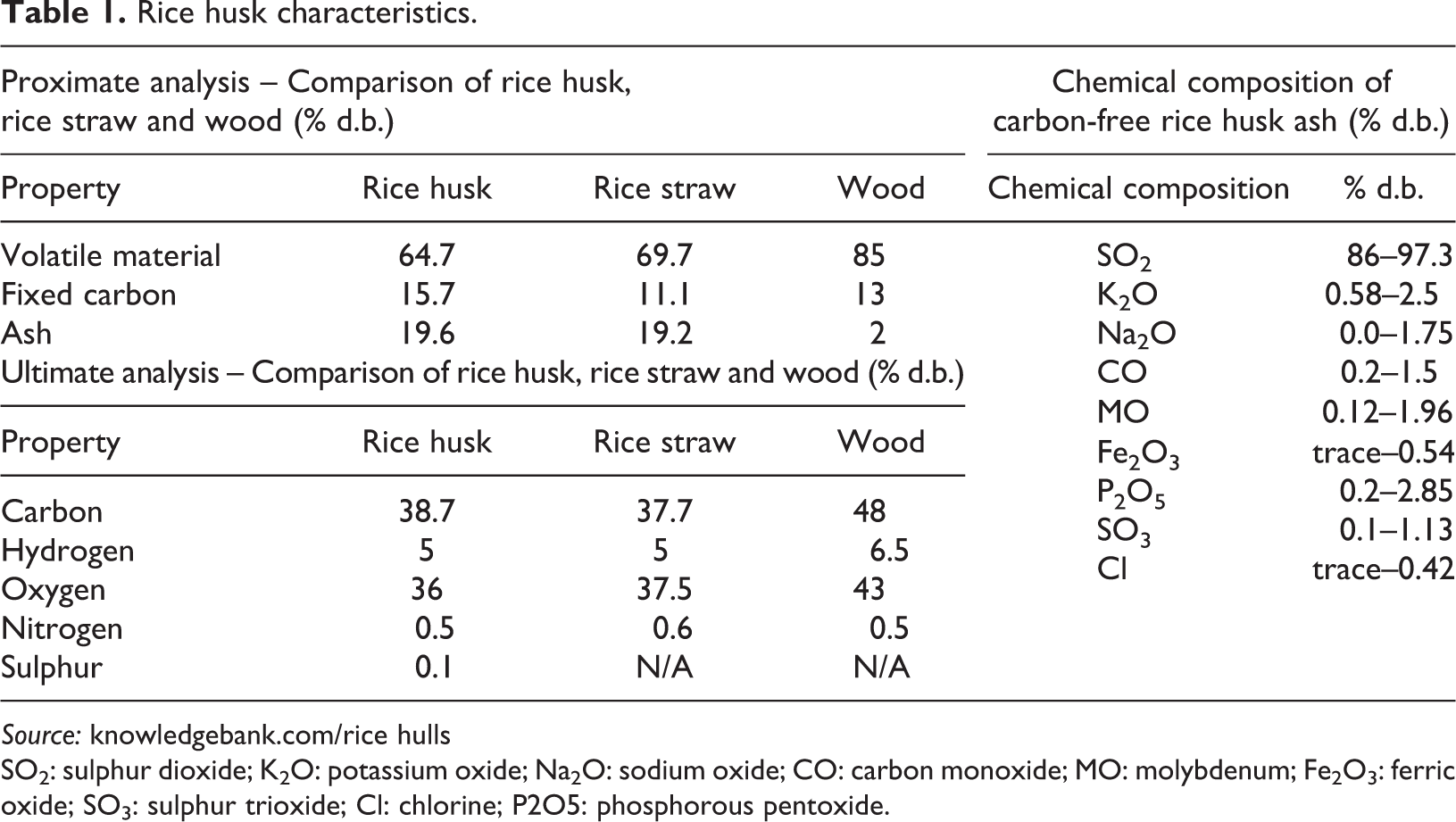
Source: knowledgebank.com/rice hulls
SO2: sulphur dioxide; K2O: potassium oxide; Na2O: sodium oxide; CO: carbon monoxide; MO: molybdenum; Fe2O3: ferric oxide; SO3: sulphur trioxide; Cl: chlorine; P2O5: phosphorous pentoxide.
Rice hulls properties
Rice hulls are generally yellow in colour and convex in shape. Typical dimensions are 4 × 6 mm2, but variations are possible from different types of rice grains. It is lightweight having a ground bulk density of around 300–400 kg/m3, and it is estimated that about 20% of the paddy weight is husk. These husks contain 75% organic matter such as lignin (polymer), cellulose and the rest is made up of minerals like silica and trace elements. The chemical composition of rice hulls will vary according to each rice grain variety, soil chemistry, climatic conditions and even on geographic locations. A typical analysis of rice hulls is given in Table 2:
Properties of rice hulls.a

Source: Researcher Centre.
a Most of the ash generated as residue will be in the combustion chamber and even the flue ash in the form of very fine particles will be directed down and collected, only a small percentage of ash will escape into the air.
Rice hulls when combusted is usually high in ash as compared to other biomass fuels and will be in the range of 10–20%. This ash will contain around 70% or more of silica, highly porous and lightweight, with a very high surface area. The presence of a high content of silica makes this a valuable material. Those materials in the raw form from the fields will have high moisture contents from exposure to the elements and will need intense drying before use. However, rice hulls stored in shelter will naturally contain less moisture and the degree of drying needed will be much less. Storage and transport challenges are due to its low density and unusual shape. For large volume storage in Silos, it is an alternative but lumping could result due to vertical weight pressure.
Rice hulls, which have been traditionally considered as an agricultural waste, are used in a few applications with the bulk being burnt or dumped in landfills, are now considered as a valuable commodity with great potential for industrial, consumer, building construction and other applications, and now, the manufacture of rice hulls solid pellets, as an alternate fuel for energy generation, may be one of the most important.
Advantages of using rice hulls pellets
Abundance of raw material High calorific value Cheap material costs Much lower sulphur and nitrogen contents Reduction in use of wood pellets Reduction in de-forestation Economically cheaper than using diesel or coal Does not deplete earth’s resources Eliminates many risks in coal mining Can be used efficiently as fuel even for steam generation for nuclear plants Compatible with other suitable biomass as fuel for energy generation Ideal for heating and cooking, even for small applications.
Disadvantages
Needs degree of drying to remove moisture before use Needs to remove foreign matter from raw material Raw material storage will pose challenges, needs large area Pellets difficult to ignite initially Needs efficient design to direct flue ash down to earth for collection May experience difficulties in transporting bulk raw material to factory.
Manufacturing rice hull pellets
The manufacture of rice hull solid pellets has been in practice for some time now, especially in Asian countries, although in the west, the current practice is about wood pellets. In countries like China, Vietnam and some others, complete manufacturing technology production machinery is available with some companies even offering turnkey projects. In the West, while especially Canada have advanced their technologies for making wood pellets, in Asian countries, rapid developments are taking place in the manufacture of rice hull pellets and production machinery design. It is possible to mix about 20% of other suitable biomass as shown in Figure 1, which also shows moulded pellets. According to trials carried out by technologists, it is also feasible to make fuel pellets from mixtures of rice husks and wood particles. Analysis of fuel pellets had showed that volatile matter, fixed carbon and heating values were high and within acceptable standards. Sizes can vary from 6 mm to 12 mm or more depending on the needs of customers. However, this presentation is about conversion of 100% rice hulls into solid pellets.

Different sizes of moulded rice hull pellets.
Particle data
When the feedstock is compacted, the distance between the particles is reduced, and the plays of intermolecular attractive forces are increased as the particle size is decreased. During pellet production, what will influence the bonding effect and eventually the durability of the pellets are feedstock composition with high lignin content biomass more easily moulded into pellets than those with low lignin contents. Lignin is a natural binder, and the latter may require good binders for effective bonding.
The moisture content must be reduced, preferably <2.0%, especially for export quality. This will help to increase the bonding within the pellets by spreading the inborn lignin evenly within the pellets and increasing the compression in the die holes of the pellet die. Excess moisture will lower the bonding strength and even block the pellet die holes.
Common binders in rice hulls pellet production
A binder can be a liquid or a solid forming a bridge, film or matrix or to cause a chemical reaction to impart enhanced inter-particle bonding. Examples of possible bonding agents for wood and rice hulls include starch, molasses, natural paraffin, plant oil, lignin sulphate and synthetic agents. Here, it should be mentioned that the bonding agent/agents used should be compatible with whatever standards they are made and also the local country laws, where exports are concerned.
Additives in rice hulls pellet making
Additives or binders for biomass pellet production are materials added during pellet production to improve adhesion, compatibility and bonding characteristics of the biomass to produce durable high-quality pellets. They also help lubrication of the pellet die for longer use. When strength, durability or heating values of pellets do not meet quality standards or marketing requirements, additional additives may have to be used or use a completely new additive system.
Pellet making process in brief
For export-oriented rice hull pellets to Europe and the West, the required international standards are ASTM (American), BSS (British) or DIN (German) with strict minimum requirements of moisture content <2.0% and emission tolerances. Some of the essential basic machinery will comprise of a rotary dryer, hammer mill, pulverizers, vibrating shifters, pellet mills with pellet dies, pellet coolers, packaging machines and so on. Special attention is needed in planning storage for both raw materials and finished products. This will apply especially for large volume production plants. Figure 2 shows small volume production units for rice hull pellets.

Photographs courtesy of GEMCO Rice Hull Mills – China.
Full-scale projects from manual operation, semi-auto and fully automatic production lines are available from sources in China, Vietnam, Canada and some other countries. Most will offer complete turnkey projects including technology, machinery and equipment and also project setup. There are also many suppliers of rice hulls and other biomass materials in any form you need. For example, rice hulls as loose leaf, powder, flour or ash. Some pellet producers may opt to combine two or three biomass materials to improve combustion or for cost-effectiveness. An important area needing attention when setting up a production plant is the use of good quality dies and the proper lubricator in the mix to minimize wear of the dies, which will be under high compression forces.
Biomass electricity generators
This is an interesting and exciting concept, especially when they are available as self-contained operating units capable of generating sufficient power to be of practical use. Although wood wastes in the form of chips or pellets are probably the more popular biomass material in the west, other biomasses like rice hulls, wheat hulls wastes (about 8% silica) and some others will also be practical feedstocks with one big advantage being available in huge quantities in most countries. Also the concept of mixtures of different biomasses contributing different properties should be interesting as pellets for solid fuel utilization. Figure 3 shows a self-contained electrical power generator using biomass fuel.

A self-contained biomass generator (20 kW). Photograph courtesy of All Power Laboratories, California and USA.
This revolutionary design by an engineer from California called the – Power Pallet – is a portable, self-contained small plant, essentially a biomass refinery and generator which can easily produce 20 kW of electricity.
Basically, the Power Pallet works by burning biomass but before the fuel is fully combusted, the resulting flammable gases like hydrogen and CO are spirited away to be used instead as fuel in a General Motors engine that works as an electricity generator. The addition of a small amount of Walnut shell powder/flour to the biomass would enhance efficiency but it is optional. According to the technical data available, 10 kg of biomass as fuel converted to electricity could cost as little as one-third the cost of diesel per kilowatt hour generated. The provision of an automatic ash collection chamber, which can be emptied periodically, makes this design truly remarkable.
Froling (a family-owned company in Austria, a pioneer in wood/biomass fired heating systems manufacturer). Their P4 boilers provide a convenient, cost-effective and easy to operate and environmentally responsible way to heat homes and provide hot water with biomass pellets as fuel. Home owners are assured of unusually efficient, low heating costs and ability to use abundantly available renewable fuel. With its fully automatic operation, these are easy to use. When installed, this unit or similar models will have additional equipment in order to support a complete heating system.
Special features
Pneumatic pellet feed system is ideally suited for bulk fuel applications. Variable speed–induced draft fan ensures optimal fuel-to-air ratio. Incoming combustion air temperature is raised with an integral preheating system. Cascade control system for multiple boiler systems. Multiple-pass heat exchanger and automatic cleaning provide maximum efficiency and exceptional fly-ash separation. Integrated storage tank control. Rated outputs from 36 k BTU/h to 200 k BTU/h. Systems go up to 800 k BTU/h. Exhaust temperature under 250°F. Must be installed with a moderately sized buffer tank to reduce on/off cycling for optimal efficiency. Ash separation to two drawers. Virtually silent operation.
Table 3 provides the basic technical data of some of the popular models.
Technical data: models 8, 15, 20, 25, 32, 38, 48 and 60.

In the west, biomass electrical power generators started with standard 20 kW up to 200 kW but now even larger ones are available as pellet technology has advanced and can be used as an efficient alternate fuel. These machines are self-contained and work on the principle of biomass pellets being converted to bio-diesel, which powers an inbuilt turbine generating electrical power. Where fuel energy is required for steam boilers, these solid pellets can be directly fed into combustion chambers, and the resulting solid ash and the flue ash can be collected via an efficient downward chute system, as this ash will have many applications.
Additional information
Since the machines presented earlier mostly works on the principles of pyrolysis and gasification, additional information is given which is sufficient to understand the process operation.

Biomass pellet boiler for thermal heat generation for residential purposes.
Pyrolysis
Pyrolysis is the chemical decomposition of organic (carbon-based) materials through the application of heat. Pyrolysis is considered as the first step in combustion and gasification which occurs in the absence or near absence of oxygen and is thus distinct from combustion (burning), which takes place only in the presence of oxygen. The rate of pyrolysis increases with temperature and in industrial applications; the temperatures used are often about 430°C (about 800°F) or higher. In small-scale operations, the temperatures may be much lower.
Pyrolysis transforms organic materials into their gaseous components, a solid residue of carbon, ash and a liquid called pyrolytic oil or bio-oil. Pyrolysis has two primary methods for removing contaminants from a substance with destruction and removal. In destruction, the contaminants are broken down into compounds with lower molecular weights, whereas in the removal process, they are not destroyed but separated from the contaminated material.
Pyrolysis is a useful process for treating organic materials that ‘crack’ or decompose under the presence of heat. Although pyrolysis is a useful process for removing or destroying inorganic materials such as metals, it can be used in techniques that render those metals inert. A pyrolysis process has numerous applications of interest with regard to green technology. One of the most important is the production of biofuel from agricultural crop wastes, such as rice hulls.
Gasification
Gasification is a flexible, reliable technology that can turn a variety of low-value feedstocks like rice hulls biomass into high-value products like biofuel and electricity. This will help to reduce a country’s imported oil and natural gas and can effectively provide clean alternative sources for baseload electricity, fertilizer, fuels and chemicals.
It is a manufacturing process that converts any material-containing carbon, such as coal, petroleum coke, biomass or wastes into syngas. This syngas can be burned to produce electricity or processed further to manufacture chemicals or other products of value. Gasification has been successfully used on a recently in the electrical power generation industry.
The type of feedstock more or less determines the design of the gasifier. In biomass gasification, there are three basic designs – updraft, downdraft and cross-draft. In an updraft gasifier, the biomass enters the gasification chamber from above, falls into a grate and forms a fuel pile. Air enters from the bottom through the grate and flows through the pile. The syngas, also known as producer gas in biomass industry, exits through the top of the chamber. In the other two systems, the air and syngas may enter and exit at different locations.
Conclusions
As a positive step toward reducing the carbon imprint, the use of biomass fuels as an alternative to diesel and coal for generation of energy has established a huge expanding market worldwide among which wood pellets lead the way. Even though the use of wood pellets is a great success for heating, steam boiler fuel even for nuclear electrical power generation, deforestation is not a feasible idea in the long run. The use of rice hull solid pellets as an alternate fuel, even along wood pellets, should be given serious thought, especially since rice hulls are abundantly available as a gift from Mother Nature, does not harm the earth and its by-products of ash have many viable uses in industrial applications. The value of this raw material from renewable biomass sources is enhanced as it can also be mixed with other compatible biomass for efficient generation of much needed energy.
Footnotes
Declaration of conflicting interests
The author(s) declared no potential conflicts of interest with respect to the research, authorship, and/or publication of this article.
Funding
The author(s) received no financial support for the research, authorship, and/or publication of this article.